
Stormwater management requirements for new developments in Victoria were updated under Amendment VC154. This guide explains what developments and subdivisions may need to provide for on-site stormwater and drainage. For more detail, see our guide on stormwater drainage regulations in Victoria.
For property developers active across the City of Whitehorse, City of Boroondara, Manningham City Council, City of Monash, Knox City Council, and Maroondah City Council, understanding these obligations is now a practical necessity. Failing to address stormwater management requirements at the design stage may result in delays to your planning permit application, requests for further information from the Responsible Authority, or conditions that require costly redesign. For context on how permit timelines can be managed, see our overview of deemed refusal provisions for planning permits. This article outlines what changed, who is affected, and what steps you may need to take to keep your development on track.
With extensive experience across Melbourne delivering projects across a wide range of development types, SQM Architects has worked through the implications of Amendment VC154 across residential, commercial, and industrial projects. The information below draws on that experience to help you understand the key compliance considerations for your project.
What Changed Under Amendment VC154
Prior to Amendment VC154, stormwater management requirements under the Victoria Planning Provisions applied primarily to residential subdivisions (under Clause 56.07) and apartment developments (under Clauses 55.07 and 58.03). The amendment addressed a recognised gap in the planning framework by extending consistent stormwater obligations to a much wider range of development types.
The core change was the introduction of Clause 53.18 – Stormwater Management in Urban Development, a new general provision that applies to non-residential development across Commercial 1, 2 and 3 Zones, Industrial 1, 2 and 3 Zones, the Public Use Zone, the Public Park and Recreation Zone, and a range of other zones including the Mixed Use Zone, Residential Growth Zone, General Residential Zone, and Neighbourhood Residential Zone.
Alongside Clause 53.18, the amendment also introduced a new integrated water management policy at Clause 19.03-3S in the Planning Policy Framework (PPF). This policy embeds integrated water management (IWM) objectives and strategies into urban land-use planning, requiring that new developments bring together all elements of the water cycle — including sewage management, water supply, stormwater management, and water treatment — to maximise community and environmental benefits.
The amendment also amended Clause 55.03-4 – Permeability to extend stormwater management requirements to all multi-dwelling residential development, including townhouses. Under this standard, the site area covered by pervious surfaces should generally be at least 20% of the site (unless a schedule to the zone specifies otherwise), and the stormwater management system should be designed to meet current best practice performance objectives.
Who Is Affected
The expanded scope of Amendment VC154 means that a significantly larger proportion of development applications now carry stormwater management obligations. The following development types may be subject to the new requirements:
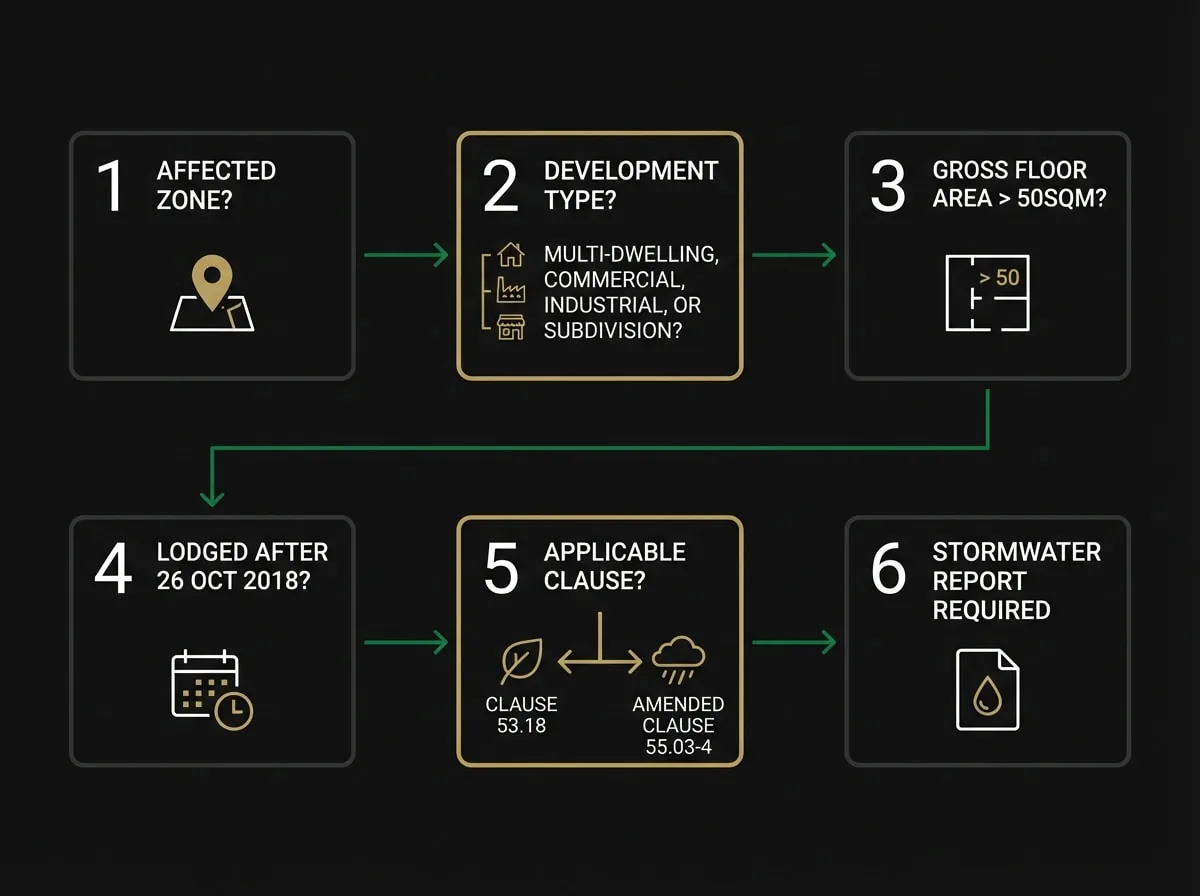
- All commercial and industrial subdivisions and developments
- All public use developments
- All residential multi-dwelling developments, including townhouse projects
- Subdivisions in urban areas across the affected zones
For developers in Melbourne, this is particularly relevant to medium-density residential projects — including dual occupancies, townhouse developments, and small apartment buildings — which are common across the General Residential Zone and Neighbourhood Residential Zone in councils such as the City of Whitehorse, City of Boroondara, and Manningham City Council.
Commercial and industrial developers are equally affected. If you are proposing a new office, retail, or warehouse development in a Commercial or Industrial zone, Clause 53.18 may now require you to submit a Stormwater Management Report as part of your planning permit application.
It is worth noting that certain applications are exempt from the new provisions, including:
- Applications to construct a building with a gross floor area not exceeding 50 square metres
- Applications to construct or carry out works with an area not exceeding 50 square metres
- Applications to subdivide land into lots each containing an existing building or car parking space
- Applications lodged before the approval date of Amendment VC154 (26 October 2018)
- Applications to construct a building or carry out works on a lot in a subdivision that was already assessed against the new stormwater provision
- Applications for an amendment of a permit under section 72 of the Act where the original permit application was lodged before the approval date
Understanding the Key Standards: W1, W2, and Site Management
Clause 53.18 sets out three categories of objectives and standards that applications may need to address: stormwater management for subdivision (Standard W1), stormwater management for buildings and works (Standard W2), and site management during construction.
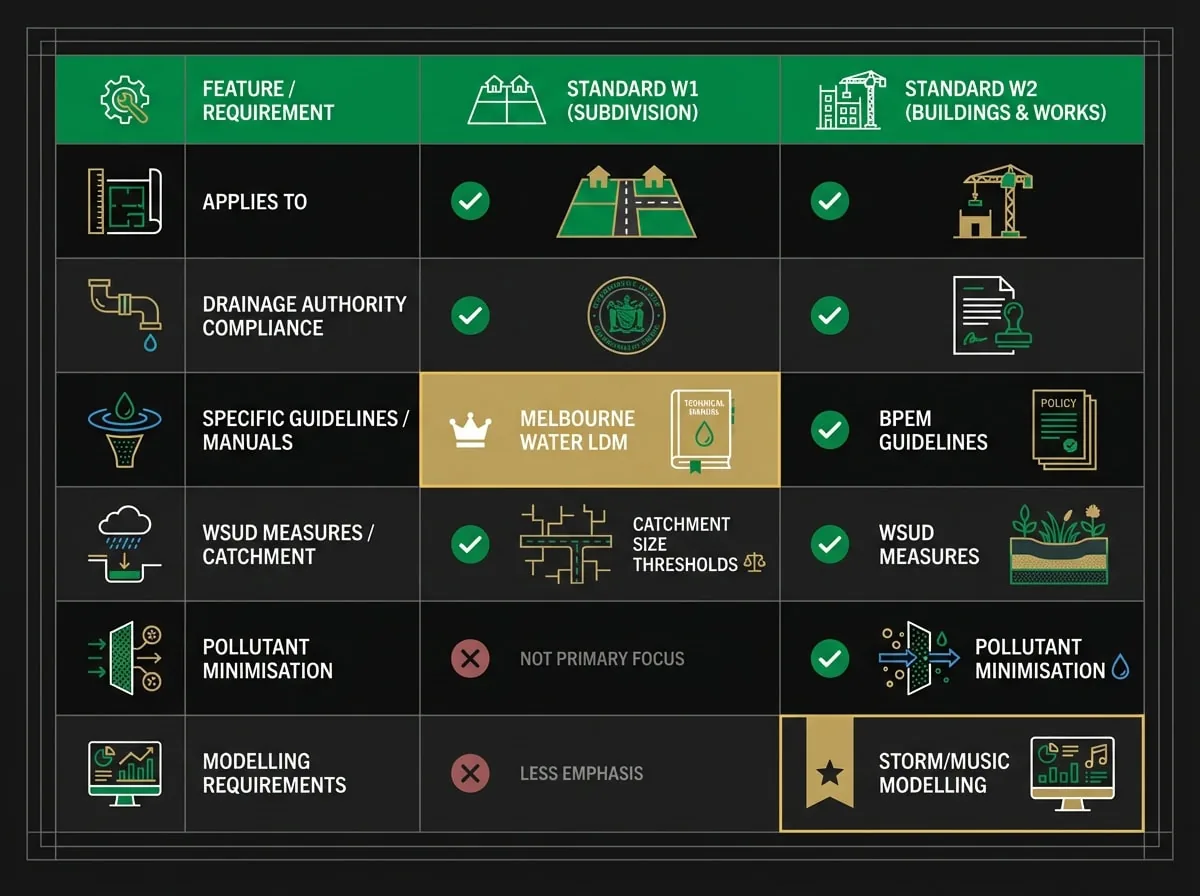
Standard W1 requires that stormwater management systems for subdivisions be designed and managed in accordance with the requirements of the relevant drainage authority. In metropolitan Melbourne, this is generally Melbourne Water for catchments greater than 60 hectares, or the local council for smaller catchments. Melbourne Water’s Land Development Manual (LDM) provides detailed guidelines for safety criteria and is a key reference for subdivision stormwater design.
Standard W2 applies to buildings and works and requires the stormwater management system to meet the Best Practice Environmental Management (BPEM) Guidelines. This standard also requires the development to be designed to minimise the impact of chemical pollutants and other toxicants entering the stormwater system. Compliance is typically demonstrated through Water Sensitive Urban Design (WSUD) measures such as raingardens, infiltration systems, permeable paving, or rainwater harvesting.
The site management component addresses erosion and sediment control during the construction period. Some councils across Melbourne may require a Site Management Plan (SMP) as a permit condition, and including one proactively in your planning permit application may assist in streamlining the assessment process.
Under Clause 53.18, an application must meet all of the relevant objectives and should meet all of the relevant standards. Where a standard cannot be met, the decision guidelines at Clause 53.18-7 guide the Responsible Authority’s assessment of the application against the objectives.
Get the 7-point site check to run before committing to a permit application — zoning, overlays, setbacks and council red flags, in plain English. Free PDF, instant download.
- Zone, overlay & setback checks
- What council assesses first
- Permit-readiness red flags
Something went wrong. Please try again.
No spam. Unsubscribe anytime.
Check your inbox — your checklist is on its way.
Practical Implications for Townhouse and Apartment Developments
For townhouse and medium-density apartment developments — the most common development type across Melbourne — the amended Clause 55.03-4 introduces specific permeability and stormwater management obligations that apply at the planning permit stage. Developers and their design teams may need to demonstrate that at least 20% of the site area is covered by pervious surfaces, and that the stormwater management system is designed to meet BPEM performance objectives.
In practical terms, this may influence site layout decisions, landscaping design, and the selection of materials for driveways, paths, and communal areas. Permeable paving, for example, may contribute to meeting the pervious surface requirement, but its design may need to account for major rainfall events to ensure that water is safely directed away from buildings and neighbouring properties.
Stormwater quality modelling tools such as STORM (for smaller developments) and MUSIC (for larger or more complex projects) are commonly used to demonstrate compliance with BPEM targets. A Stormwater Report prepared by a qualified hydraulic engineer or stormwater consultant is typically required as part of the planning permit application documentation. Engaging this specialist early in the design process — ideally during concept design — may help avoid costly changes later in the programme.
Council-Specific Considerations Across Melbourne
While Amendment VC154 introduced state-wide provisions, individual councils across Melbourne may have additional local requirements for stormwater management that apply over and above the state provisions. These may include on-site detention (OSD) requirements, specific WSUD guidelines, or council-specific permit conditions.
Pre-application discussions with the relevant council are strongly recommended for any development that triggers stormwater management obligations. Councils such as the City of Whitehorse, City of Boroondara, and Manningham City Council each have their own planning departments and may have local policies or guidelines that inform how stormwater requirements are assessed in their municipality.
For sites located within a Melbourne Water Development Services Scheme (DSS), the relevant planning policies still apply, but the DSS will generally address most stormwater management planning requirements through the proposed scheme works. This should be confirmed with the relevant council as part of pre-application discussions.
What Developers Should Do Now
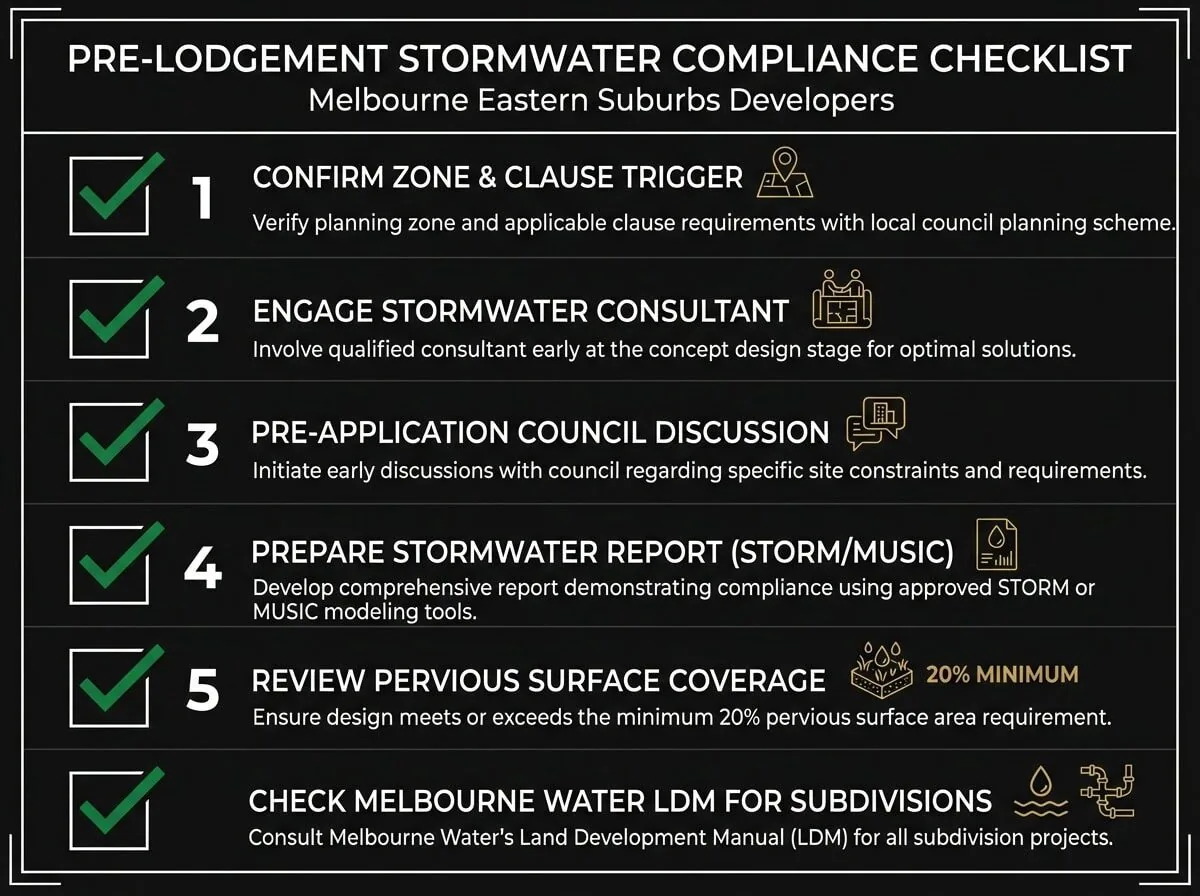
- Confirm whether your development triggers Clause 53.18 or the amended Clause 55.03-4 by checking the zone and development type against the provisions. The Clearwater Online Navigator Tool may assist with this assessment.
- Engage a stormwater consultant early — ideally at concept design stage — to assess the site’s stormwater management requirements and identify suitable WSUD measures.
- Conduct pre-application discussions with the relevant council to confirm any local stormwater requirements that may apply in addition to the state provisions.
- Prepare a Stormwater Report for inclusion with your planning permit application, demonstrating compliance with the relevant objectives and standards under Clause 53.18 or Clause 55.03-4.
- Review site layout and landscaping design to ensure that pervious surface requirements can be met without compromising yield or built form outcomes.
- Check Melbourne Water’s Land Development Manual if your project involves subdivision, to confirm drainage authority requirements for your catchment.
Frequently Asked Questions
Does Amendment VC154 apply to a small townhouse development of two or three dwellings?
Yes, the amended Clause 55.03-4 extends stormwater management requirements to all multi-dwelling residential developments, including small townhouse projects. This means that even a two-dwelling development may need to demonstrate compliance with permeability and stormwater quality objectives as part of a planning permit application. The 50 square metre exemption applies to buildings and works, not to multi-dwelling developments assessed under Clause 55.
What is a Stormwater Report and when is it required?
A Stormwater Report is a technical document prepared by a qualified stormwater consultant that demonstrates how a proposed development meets the stormwater management objectives and standards under the relevant planning provisions. It is generally required as part of a planning permit application where Clause 53.18 or the amended Clause 55.03-4 applies. The report typically includes stormwater quality modelling using tools such as STORM or MUSIC.
Are there exemptions from the new stormwater requirements?
Yes, certain applications are exempt, including applications to construct a building or carry out works with an area not exceeding 50 square metres, applications lodged before 26 October 2018, and applications to subdivide land into lots each containing an existing building or car parking space. A full list of exemptions is set out in Clause 53.18 and Planning Advisory Note 75.
Do the new stormwater rules apply to commercial developments in the City of Boroondara or City of Whitehorse?
Yes. Clause 53.18 applies to commercial development in Commercial 1, 2 and 3 Zones across all Victorian planning schemes, including those administered by the City of Boroondara and City of Whitehorse. In addition to the state provisions, each council may have local stormwater requirements, so pre-application discussions are advisable.
What does "best practice stormwater management" mean in practice?
Best practice stormwater management refers to meeting the performance objectives set out in the Urban Stormwater – Best Practice Environmental Management Guidelines (BPEM), published by the Victorian Stormwater Committee. These objectives relate to stormwater quality targets for pollutants such as total suspended solids, total phosphorus, and total nitrogen. Compliance is typically demonstrated through the design and modelling of WSUD measures such as raingardens, bioretention systems, or rainwater harvesting.
Can a planning permit application be refused on stormwater grounds?
Under Clause 53.18, an application must meet all of the relevant objectives. Where the decision guidelines indicate that the objectives have not been adequately addressed, the Responsible Authority may refuse the application or issue a notice requesting further information. Addressing stormwater requirements thoroughly at the application stage may reduce the risk of delays or refusal.
How does Amendment VC154 interact with Melbourne Water’s requirements?
Melbourne Water is the relevant drainage authority for most catchments greater than 60 hectares in metropolitan Melbourne. Standard W1 under Clause 53.18 requires that stormwater management systems for subdivisions be designed in accordance with Melbourne Water’s requirements, as set out in its Land Development Manual. For sites within a Melbourne Water Development Services Scheme, the DSS will generally address most stormwater planning requirements, but this should be confirmed with the relevant council.
Conclusion
Amendment VC154 represents a significant broadening of stormwater management obligations under the Victoria Planning Provisions. For property developers in Melbourne, the practical effect is that townhouse developments, commercial projects, industrial developments, and subdivisions now carry stormwater compliance requirements that may need to be addressed at the planning permit application stage. Understanding these obligations early — and engaging the right consultants at the right time — may help avoid delays and additional costs during the planning process.
SQM Architects has supported developers across the City of Whitehorse, City of Boroondara, Manningham City Council, City of Monash, Knox City Council, and Maroondah City Council through the planning permit process for many years across a broad range of residential and commercial development types. If you would like to understand how Amendment VC154 may affect your development site, contact our team for a complimentary site assessment or call us on (03) 9005 6588.
This article provides general information about Victorian planning for property developers. It does not constitute professional advice. For specific guidance on your project, contact SQM Architects for a complimentary site assessment.