Are you planning a building project in Victoria and confused about whether you need an architect or building designer? This critical decision could save or cost you thousands of dollars while determining your project’s success under Victorian building regulations.
According to the Building and Plumbing Commission (BPC), choosing between an architect vs building designer Victoria homeowners face is crucial for project success. While both professionals can create building plans, their qualifications, costs, and project scope differ significantly under Victorian building regulations.
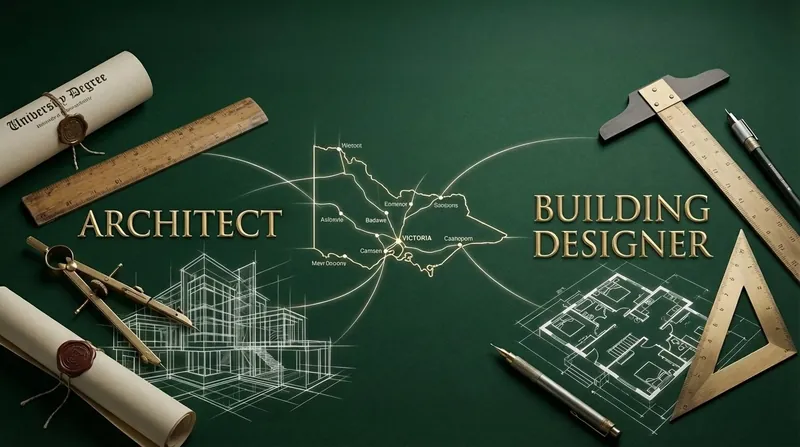
The main difference is that architects in Victoria must register with the Architects Registration Board of Victoria (ARBV), while building designers register with the BPC in classes set by design discipline — building design (architectural), building design (interior) or building design (services) — under Schedule 9 of the Building Regulations 2018. Neither registration carries a height or complexity limit on the buildings that may be designed. Both can create detailed plans and blueprints for your home, but their legal authority, design approach, and fee structures vary significantly.
Your choice between an architect and a building designer depends on several factors including your project type, complexity, budget, and Victorian council requirements. Some projects legally require an architect’s involvement, while others can be successfully completed with a building designer at a lower cost.
What’s the Difference Between Architects and Building Designers?
According to the Architects Registration Board of Victoria (ARBV), architects must complete a minimum 5-year university degree plus 2 years practical experience, while building designers can register with varying qualification levels through the BPC.
Architect Qualifications and Scope
Definitive Statement: under the Architects Act 1991, architects in Victoria are the only building professionals legally permitted to use the title ‘architect’, and the only ones who may describe their work as ‘architectural services’ or ‘architectural design’ in relation to building design. The Act protects those terms; it does not reserve the design work itself.
An architect is a licensed professional who designs buildings and oversees their construction, ensuring structures meet safety codes, zoning laws, and functional requirements. They complete extensive education and registration processes that grant them legal authority to sign off on building plans and take responsibility for structural integrity.
Specific Requirements:
- Bachelor’s degree in Architecture (3-4 years)
- Master’s degree in Architecture (2 years)
- Minimum 3,300 hours practical experience
- Professional examination through ARBV
- Continuing professional development (20 hours annually)
Architects can legally design and certify any type of building project, from residential homes to large commercial developments and public infrastructure. Their registration permits them to submit development applications and building permits to Victorian councils.
Building Designer Categories and Limitations
A building designer creates architectural drawings and plans for residential and commercial projects, typically focusing on less complex structures than those requiring a full architect. According to BPC data, building designers are registered in three distinct categories with specific limitations:
Category 1 (Low Rise):
- Buildings up to 3 storeys
- Class 1 and 10 buildings (houses and sheds)
- Maximum building area restrictions apply
Category 2 (Medium Rise):
- Buildings up to 3 storeys
- All building classes except Class 9 (hospitals, schools)
- Commercial and residential projects
Category 3 (Open):
- Unlimited building types and heights
- Requires degree-level qualification
- Similar scope to architects but different registration pathway
Victorian Registration Requirements: ARBV vs BPC
Understanding these registration requirements helps explain the practical differences between these professionals.
Architect Registration with ARBV
Authoritative Fact: “All practicing architects in Victoria must maintain current registration with ARBV, with penalties up to $24,000 for unregistered practice,” according to the Architects Act 1991.
To work as an architect in Victoria, you must complete a university degree in architecture and register with the Architects Registration Board of Victoria (ARBV). The registration process requires practical experience beyond your degree, and you must demonstrate ongoing professional competency.
Registration Process:
- Complete accredited architecture degree
- Log 3,300 hours practical experience
- Pass architectural practice examination
- Submit registration application with fees
- Maintain annual registration ($485 in 2025)
Only registered architects can legally use the title “architect” or offer architectural services under this designation.
Building Designer Registration Categories
According to BPC statistics, over 3,200 building designers are currently registered across Victoria’s three categories. In Victoria, building designers must obtain registration through the Building and Plumbing Commission (BPC), which is the government body that licenses building designers in Victoria.
Registration Requirements by Category:
- Category 1: Certificate IV or Diploma in Building Design
- Category 2: Advanced Diploma or equivalent experience
- Category 3: Bachelor’s degree in relevant field
All building designers need professional indemnity insurance and appropriate licensing before undertaking design work. The qualification pathway for building designers typically involves vocational education rather than university degrees.
Cost Comparison: Architect vs Building Designer Fees in Victoria
These qualification differences directly impact what you’ll pay for design services. Architects typically charge higher fees than building designers for residential projects, with the pricing difference reflecting variations in qualifications, scope of services, and project complexity each professional handles.
Typical Project Costs in Melbourne
According to industry data from the Australian Institute of Architects (AIA), fee structures vary significantly:
Architect Fees (2025 Victorian Market Rates):
- Residential projects: 8-15% of construction cost
- Commercial projects: 6-12% of construction cost
- Hourly rates: $150-$400 per hour
- Fixed fee projects: $3,000-$15,000 for house plans
Building Designer Fees Victoria:
- Residential projects: 1-3% of construction cost
- Hourly rates: $80-$200 per hour
- Fixed fee house plans: $1,500-$8,000
- Extension plans: $800-$4,000
Cost-Benefit Analysis
Data Point: According to a 2023 Victorian construction industry survey, projects designed by architects averaged 15% higher construction costs but 23% higher resale values compared to building designer projects.
For a $500,000 home build, you might pay $40,000 to $75,000 for an architect versus $5,000 to $15,000 for a building designer. Building designers provide excellent value for straightforward residential projects, while architects justify higher costs through comprehensive services and expertise.
Get the 7-point site check to run before committing to a permit application — zoning, overlays, setbacks and council red flags, in plain English. Free PDF, instant download.
- Zone, overlay & setback checks
- What council assesses first
- Permit-readiness red flags
Something went wrong. Please try again.
No spam. Unsubscribe anytime.
Check your inbox — your checklist is on its way.
When to Choose an Architect in Victoria
Project complexity directly determines which professional suits your needs. Architects are necessary for complex projects involving unusual structural requirements, creative design approaches, or challenging sites.
Complex Commercial Projects
Expert Recommendation: “For any building over 3 storeys or complex commercial developments, Victorian building regulations effectively require an architect or Category 3 building designer,” according to BPC guidance notes.
Architect-Required Scenarios:
- Heritage building modifications
- Buildings over $5 million construction value
- Complex structural engineering requirements
- Council planning applications requiring design excellence
- Projects requiring Building Information Modeling (BIM)
High-End Residential Projects
According to ARBV data, architects are typically chosen for:
- Custom homes over $800,000 construction cost
- Architecturally significant renovations
- Properties in heritage overlays
- Sustainable design certifications (Green Star, NABERS)
When to Choose a Building Designer in Victoria
Building designers handle straightforward residential projects like home extensions, renovations, and new houses with standard construction methods. They work efficiently on single and double-storey homes, granny flats, and minor commercial buildings.
Residential Extensions and Renovations
Industry Insight: “Building designers handle approximately 70% of Victorian residential extension projects under $200,000,” according to BPC registration data.
Ideal Building Designer Projects:
- Standard home extensions
- Granny flats and secondary dwellings
- Garage conversions
- Simple commercial fit-outs
- Warehouse and industrial buildings (Category 2/3)
Budget-Conscious Projects
Cost-Saving Fact: Victorian homeowners can save 60-80% on design fees by choosing building designers for straightforward residential projects, according to industry comparisons.
Building designers typically charge 1-3% of construction costs or offer fixed fees for straightforward projects. Their lower overheads and focused service scope allow for more competitive pricing on standard residential work.
How to Find Qualified Professionals in Victoria
Checking BPC and ARBV Registration
Verification Process: Always verify registration through official channels:
- ARBV Register: Check architect registration status at www.arbv.vic.gov.au
- BPC Register: Verify building designer credentials at www.bpc.vic.gov.au
Red Flags to Avoid:
- Unregistered practitioners
- Promises of guaranteed permit approval
- Significantly below-market pricing
- Lack of professional indemnity insurance
Questions to Ask Potential Professionals
According to consumer protection guidelines:
- “What is your BPC/ARBV registration number?”
- “Can you provide references from similar Victorian projects?”
- “Do you carry professional indemnity insurance?”
- “What is your experience with local council requirements?”
- “Will you manage the building permit application process?”
Design Process Comparison
The design process differs significantly between architects and building designers in terms of complexity, regulatory requirements, and the depth of technical documentation they produce. Both professionals follow similar phases, but architects typically engage in more comprehensive analysis and detailed documentation.
Initial Consultation
When you meet with an architect, they typically conduct an extensive site analysis, discuss regulatory requirements, and assess zoning restrictions. Architects often spend more time examining structural complexities and heritage considerations during this phase.
Building designers focus on practical aspects of your project, including budget constraints and construction feasibility. They gather information about your spatial needs and aesthetic preferences whilst evaluating site conditions that directly impact the build.
Construction Documentation
Architects produce detailed construction documentation that includes comprehensive specifications, structural engineering coordination, and extensive technical drawings. They prepare documents for complex approval processes and ensure compliance with stringent building codes.
Building designers create construction documentation focused on practical building requirements. Their plans include necessary structural details, material specifications, and code compliance information suitable for most residential projects.
Collaboration With Other Professionals
Both architects and building designers work closely with various specialists to bring projects to life, though the scope and complexity of these collaborations often differ. The relationships with engineers, building surveyors, and builders form the foundation of successful project delivery.
Engineers and Building Surveyors
Architects and building designers rely on engineers to ensure structural integrity and system functionality. In Victoria, building surveyors play a crucial role in the building permit process and construction inspections, working with both architects and building designers to ensure compliance with Victorian Building Regulations.
For architects working on complex or commercial projects, engineering collaboration begins early in the design phase to avoid costly redesigns. Building designers typically engage engineers for simpler consultations, particularly for residential projects.
Builders
Builders transform drawings into physical structures, making their input valuable throughout the design process. Regular communication between designers and builders during the documentation phase prevents conflicts during construction and leads to smoother construction processes.
Frequently Asked Questions
What’s the difference between an architect and building designer in Victoria?
Architects in Victoria must register with ARBV and can design unlimited building types. Building designers register with BPC in categories based on building height and complexity. Architects handle complex projects requiring extensive technical knowledge, while building designers typically focus on residential projects and smaller commercial work.
Do I need an architect for a building permit in Victoria?
Not necessarily. Both architects and appropriately registered building designers can prepare plans for building permits, depending on the project scope and building designer category. However, complex projects, heritage buildings, or structures requiring specialised engineering often require an architect’s involvement by law.
What’s the average cost difference between architects and building designers in Victoria?
According to industry data, building designers typically charge 50-70% less than architects for similar residential projects, with architects averaging 8-15% of construction cost versus 1-3% for building designers.
How do I verify if someone is a registered architect in Victoria?
Check the ARBV public register at www.arbv.vic.gov.au. All practicing architects must be listed with current registration status.
Can building designers handle planning permits in Victoria?
Yes, both building designers and architects can prepare planning permit applications, though complex heritage or design review applications often benefit from architect expertise.
Key Takeaways for Victorian Property Owners
Bottom Line: According to Victorian building industry analysis, the choice between architect vs building designer depends primarily on project complexity, budget, and regulatory requirements. For standard residential work under 3 storeys, building designers offer cost-effective solutions. For complex, high-value, or heritage projects, architects provide necessary expertise and unlimited design scope.
Action Steps:
- Determine your project’s building classification and complexity
- Check BPC/ARBV registration requirements for your project type
- Obtain quotes from both architects and building designers
- Verify all professional registrations and insurance coverage
- Review portfolios of similar Victorian projects
Ready to start your Victorian building project? Contact our registered professionals today for a free consultation and discover the right approach for your vision. Don’t navigate Victorian building regulations alone – book your free project assessment and ensure compliance from day one.