
A building notice and a building order are different instruments, and knowing which one you are holding changes what you do next. A notice asks you to show cause — it opens a conversation with a deadline. An order directs you to do something, and it is enforceable.
Both arrive in two situations: a project underway where work has departed from the approved documentation, and — commonly for owners of established homes and units — work carried out without a permit at some point in the past, sometimes by a previous owner. The instruments are the same in both cases; what differs is what the response has to establish.
Under Part 8 of the Building Act 1993 (Vic), building surveyors have broad enforcement powers to issue notices and orders when building work fails to comply with the Act or the Building Regulations 2018. The enforcement landscape has also shifted significantly in 2025, with the Victorian Building Authority (VBA) transitioning into the Building and Plumbing Commission (BPC) as of 1 July 2025 — a more powerful regulator with expanded rectification powers extending up to 10 years post-occupancy. For developers active across Melbourne, understanding this framework is no longer optional; it is fundamental to protecting project viability.
This guide explains the difference between a building notice and a building order, outlines the types of orders that may be issued, details the show cause process, and covers appeal rights through the Building Appeals Board (BAB). It applies equally whether you are managing a dual occupancy under construction or you have just been served over a garage conversion the previous owner never got a permit for. If the latter is your situation, see also work carried out by a previous owner, which covers what the response generally requires.
The Core Difference: Warning vs Legal Direction
The simplest way to understand the distinction is this: a building notice is a warning; a building order is a legally binding direction. Confusing the two — or treating a building notice with the same urgency as a building order — is a mistake that can have serious consequences in either direction.
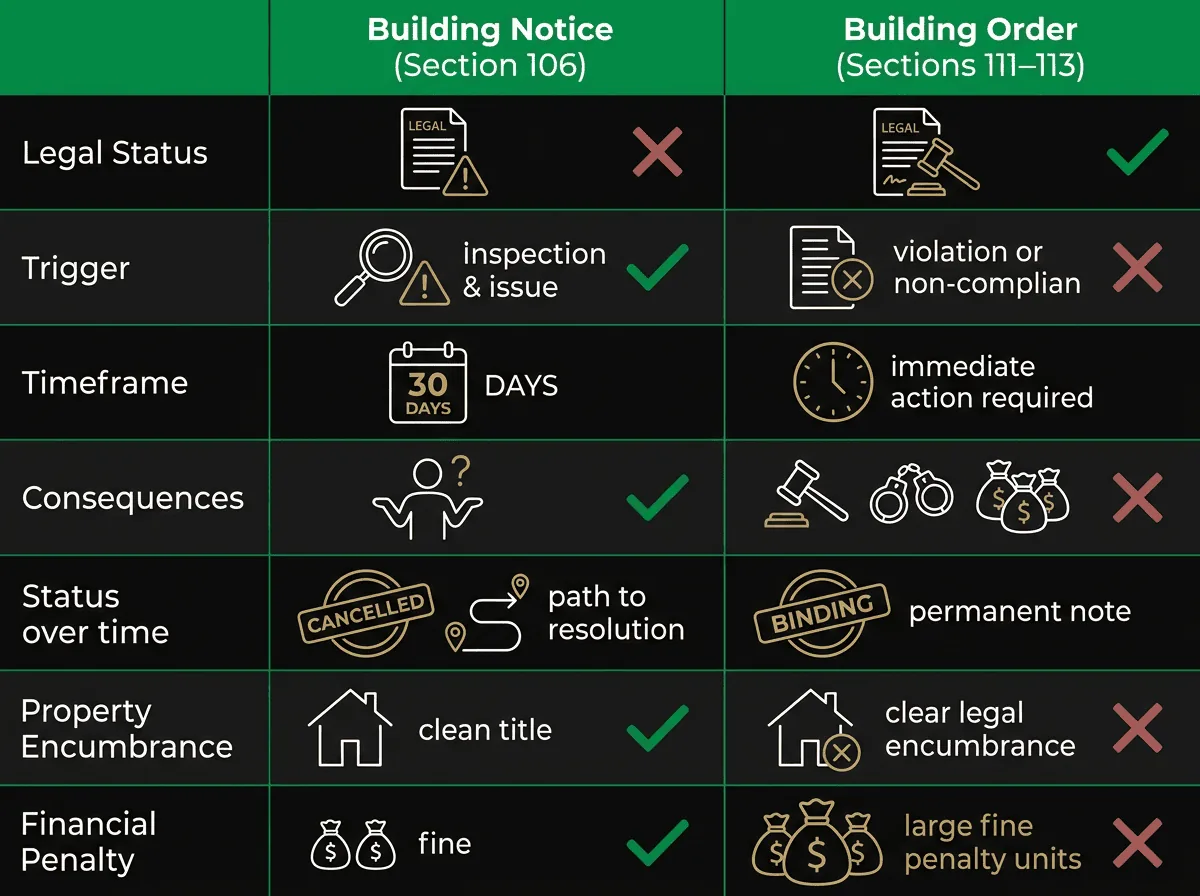
A building notice (issued under Section 106 of the Building Act 1993) is a formal "show cause" document. It notifies the registered property owner that a Relevant Building Surveyor (RBS) — either a Municipal Building Surveyor (MBS) employed by the council or a Private Building Surveyor (PBS) appointed to the project — has identified circumstances that may warrant further enforcement action. The notice gives the owner an opportunity to respond in writing, typically within 30 days, explaining why a building order should not be issued. This is the show cause period.
A building order, by contrast, is issued under Sections 111–113 of the Act and commands the owner to take specific action — or stop specific action — within a stated timeframe. Non-compliance with a building order is a serious statutory offence. Penalties for natural persons may reach 500 penalty units (approximately $101,755 at the 2025–26 penalty unit value of $203.51), while corporations may face fines of up to 2,500 penalty units (approximately $508,775). Note that the penalty unit is a different figure from the fee unit — the fee unit was $16.81 in 2025–26 — so exposure here is an order of magnitude higher than a fee-unit calculation suggests.
A building order is also a disclosable encumbrance that may appear on property records, affecting future sales, refinancing, and the ability to obtain an occupancy permit. This alone makes avoiding escalation from notice to order a high priority for any developer.
When Are Building Notices Issued?
Under Section 106 of the Building Act 1993, a building notice may be issued when any one of the following circumstances exists:
- Building work requiring a building permit has been carried out without a permit or in contravention of an existing permit
- The use of the building contravenes the Act or the Building Regulations 2018
- Safety or emergency services installations or equipment have not been maintained in accordance with the occupancy permit and regulations
- The building or place is unfit for occupation or use as a place of public entertainment
- The building work, land or place is a danger to life, safety or health of any member of the public or any person using the building or land
In practice, building notices issued to Melbourne developers most commonly arise from work carried out without a building permit, work that deviates materially from approved permit drawings, or failure to notify the RBS at mandatory inspection stages. From 2025, two new mandatory inspection stages — pre-lining and waterproofing — have been introduced. Failure to notify the RBS at either of these stages is now a primary trigger for a building notice, particularly on multi-unit residential projects.
It is important to note that a building notice must be issued in the prescribed form (Form 11 under Schedule 4 of the Building Regulations 2018) and must include the information required under Regulation 179. A notice that does not comply with these formal requirements may be challengeable at the Building Appeals Board.
Types of Building Orders and When Each Applies
Not all building orders are the same. There are four distinct types under the Building Act 1993, each with different triggers, timeframes, and implications for developers.
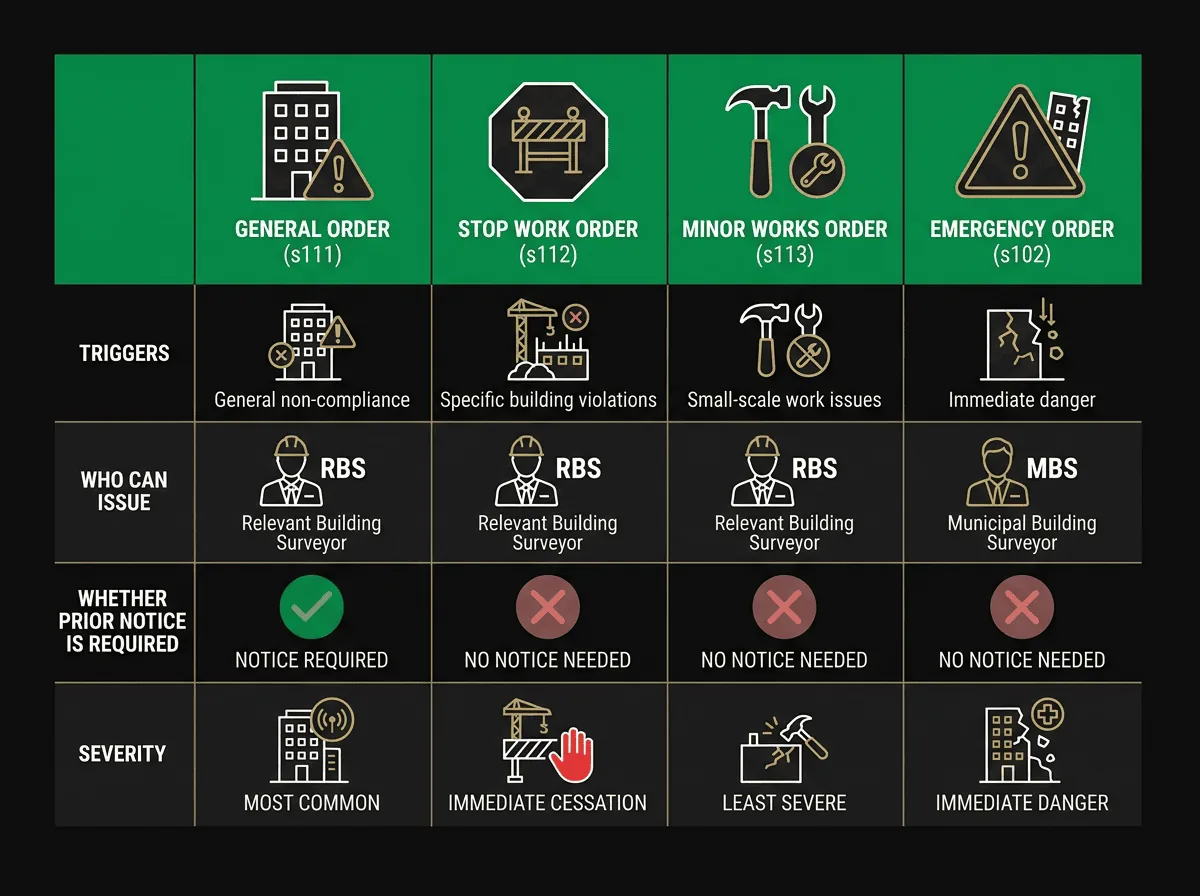
General Building Order (Section 111)
This is the most common type issued to developers. A general building order is typically issued after a building notice has expired and the owner’s response has been unsatisfactory — or no response has been made at all. It mandates specific rectification works within a stated timeframe. The order must be in the form of Form 12 under Schedule 4 of the Regulations and must address only the matters raised in the original building notice. If an order introduces new matters not covered by the notice, its validity may be challenged.
Stop Work Order (Section 112)
A stop work order can be issued without a prior building notice. It requires the immediate cessation of all building activity on the identified work. This type of order is typically issued where the building surveyor believes the work being carried out poses an immediate risk to safety or health, or where continuing the work would make rectification significantly more difficult or costly. For developers on tight construction programmes, a stop work order can be particularly damaging. Under the 2025 reforms, projects following the new "Type 1" and "Type 2" planning permit pathways may face increased exposure to stop work orders if deemed-to-comply standards under ResCode Clauses 54 and 55 are not met at the design stage.
Building Order for Minor Works (Section 113)
This order can also be issued without a prior building notice, but only where the building surveyor is of the opinion that the work required is of a minor nature. It is the least severe of the order types and is commonly used for straightforward rectification items such as installing fire-rated doors, upgrading smoke alarms, or addressing minor structural defects. Developers should not, however, treat this order lightly — non-compliance still constitutes a statutory offence.
Emergency Order (Section 102)
An emergency order is the most serious enforcement instrument and can only be issued by a Municipal Building Surveyor — not a private building surveyor. No building notice is required. Emergency orders are reserved for situations where there is an immediate danger to life or property, such as a structurally compromised building or an unsafe excavation adjacent to a public area. An emergency order takes effect immediately and remains in force until it is complied with or cancelled by the MBS. Developers should be aware that some councils in Melbourne have demonstrated a willingness to escalate to emergency orders where site safety hoarding or excavation support is considered inadequate.
Whether the work was done by you or by a previous owner, a building surveyor generally needs drawings of what is actually there before anything can be assessed. We measure the existing work, document it, and prepare the package a permit application requires.
- As-built drawings of the existing work
- What complies, what may need changing
- Documentation for your building surveyor
Or talk it through first — (03) 9005 6588. Melbourne-wide, all 31 metro councils.
The Show Cause Process: Your Most Important Window
When a building notice is served, the clock starts immediately. The show cause period — commonly 30 days, though Section 108 requires only that the notice specify a period rather than setting one — is the developer’s single most important opportunity to prevent escalation to a building order. A well-prepared, evidence-based response submitted within this window may result in the notice being cancelled under Section 110 of the Act, with no further enforcement action required.
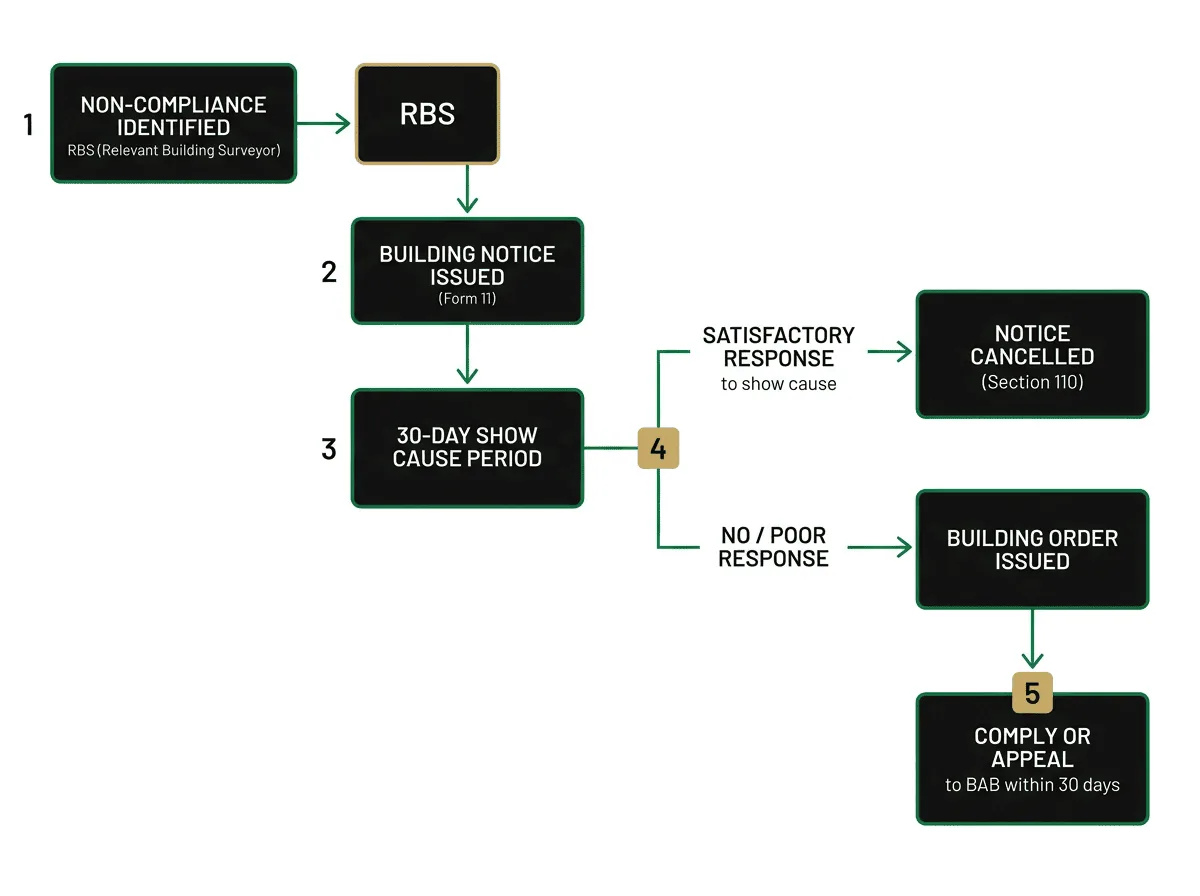
A show cause response should be in writing and should address each specific ground raised in the building notice. Depending on the circumstances, a response may argue one or more of the following:
- The building work does comply with the Act and Regulations, supported by technical evidence from a qualified building surveyor or structural engineer
- The work falls within a building permit exemption under Schedule 3 of the Building Regulations 2018
- The identified non-compliance is minor in nature and the owner proposes a specific rectification programme with a committed timeframe
- The building notice was issued in relation to matters that were not within the RBS’s jurisdiction or that do not satisfy the circumstances under Section 106
- The owner is in the process of obtaining the relevant planning permit or building permit to regularise the works
It is strongly advisable to engage a private building surveyor and, where the matter is complex or contested, a construction lawyer experienced in the Building Act 1993. The RBS has discretion to consider all written representations received within the show cause period. A poorly drafted or incomplete response — or no response at all — will almost certainly result in a building order being issued.
One practical note for developers: Victoria does not have a retrospective building permit pathway. If work has been carried out without a permit, the only mechanism to regularise it is through the building notice and order process, where the MBS may ultimately issue a Certificate of Compliance following a rigorous audit. This process is time-consuming and costly, reinforcing the importance of obtaining all required permits before commencing work.
Council Variations Across Melbourne
While the Building Act 1993 applies uniformly across Victoria, councils may vary in their enforcement approach, audit frequency, and the types of non-compliance they prioritise. Developers active across Melbourne should be aware of the following general tendencies.
Some councils, including the City of Whitehorse, may focus enforcement activity on residential alterations and additions where work has proceeded without a building permit, particularly in established streetscapes. Developers undertaking multi-unit projects in this area may encounter scrutiny on ResCode Standard B2-3 (side and rear setbacks, formerly B17) compliance, where any deviation from deemed-to-comply standards could prompt a building notice if the MBS considers the objective not met.
Councils with heritage overlays, such as the City of Boroondara, may place significant emphasis on heritage overlay compliance and protection works. Developers working near heritage-listed properties may need to demonstrate compliance with protection works notices under Section 93 of the Act. Failure to properly notify adjoining owners of potential structural impacts during excavation or demolition can be a common trigger for building notices in such areas.
Some councils, including Manningham City Council, may conduct audit activity on ESD (Environmentally Sustainable Design) permit conditions, using building notices to enforce conditions related to stormwater management and landscaping where these form part of an approved building permit. Developers should ensure ESD conditions are documented and tracked throughout the construction programme.
Councils such as the City of Monash and Knox City Council may conduct active enforcement on multi-unit residential developments where mandatory inspection stages are missed. Proposed pre-lining and waterproofing inspection stages were removed from the regulations made in 2026 and are not in force, but reviewing inspection notification protocols against the existing mandatory stages remains the reliable way to avoid building notices on these grounds.
Maroondah City Council and similar councils may enforce compliance with approved permit drawings, particularly where site coverage or building height deviates from approved plans. Developers should ensure that any design changes during construction are assessed against the approved building permit before proceeding.
Appeals: The Building Appeals Board
If a developer disagrees with a building notice or building order, the appropriate avenue for appeal in Victoria is the Building Appeals Board (BAB) — not VCAT. Under Regulation 271 of the Building Regulations 2018, appeals to the BAB must be lodged within 30 days of the notice or order being served.
Grounds for appeal may include that the notice or order was not issued in the correct form, that the circumstances under Section 106 were not satisfied, that the work falls within a permit exemption, or that the order requires action beyond what is reasonably necessary to address the identified non-compliance. The BAB has the power to set aside, vary, or confirm the notice or order.
Importantly, lodging an appeal does not automatically stay the effect of a building order. Developers should seek legal advice promptly if they intend to appeal, as the BAB may need to be asked to grant a stay of the order pending the hearing.
Practical Steps to Reduce Enforcement Risk
The following general measures are commonly considered by developers to reduce the risk of receiving a building notice or order, based on SQM Architects’ experience across Melbourne.
- Consider obtaining all required permits before commencing work. This includes both planning permits and building permits. A planning permit exemption does not necessarily exempt work from a building permit requirement — the two are separate regulatory instruments.
- Developers commonly consider appointing a qualified RBS early and maintaining regular communication throughout the construction programme, which may help identify potential compliance issues before they escalate to enforcement action.
- Notifying the RBS at all mandatory inspection stages, and documenting all notifications in writing, is generally considered good practice. (Proposed pre-lining and waterproofing stages were removed from the 2026 regulations before they were made and are not mandatory — though inspecting waterproofing before concealment remains prudent.)
- Assessing any design changes against the approved building permit before proceeding is advisable. Material changes may require a permit amendment or a new permit.
- Responding to every building notice within the show cause period is important. Even if you believe the notice has been issued in error, a written response is generally necessary. Silence will almost certainly result in a building order.
- Keeping comprehensive records of all permits, approved drawings, inspection notifications, and correspondence with building surveyors and councils may be critical in any show cause response or BAB appeal.
- For apartment developments of 3 or more storeys, note that from 1 July 2025, developers may be required to lodge a 2% bond of the total build cost with the BPC to cover potential defect rectifications. This may need to be factored into project financing.
Frequently Asked Questions
What is the difference between a building notice and a building order in Victoria?
A building notice is a show cause document issued under Section 106 of the Building Act 1993, giving the property owner an opportunity to respond before further enforcement action is taken. A building order is a legally binding direction issued under Sections 111–113 of the Act, requiring the owner to take specific action within a stated timeframe. Non-compliance with a building order is a statutory offence and may result in significant fines or prosecution.
Can a building order be issued without a building notice first?
Yes, in certain circumstances. A stop work order under Section 112 and a building order for minor works under Section 113 may both be issued without a prior building notice. An emergency order under Section 102 — which can only be issued by a Municipal Building Surveyor — also requires no prior notice and takes effect immediately.
How long do I have to respond to a building notice?
The show cause period is commonly 30 days from the date the building notice is served, though Section 108 of the Building Act 1993 requires only that the notice specify a period — it does not set one. You should respond in writing within whatever period the notice specifies, addressing each ground raised in the notice. Failing to respond within the show cause period will almost certainly result in a building order being issued.
Does a building order affect my property title?
A building order is a disclosable encumbrance that may appear on property records and affect future sales, refinancing, and the ability to obtain an occupancy permit. This is one of the key reasons why responding effectively to a building notice — before it escalates to an order — is so important for developers.
Can I appeal a building notice or building order?
Yes. Appeals against building notices and building orders in Victoria are heard by the Building Appeals Board (BAB), not VCAT. Appeals must be lodged within 30 days of the notice or order being served under Regulation 271 of the Building Regulations 2018. Lodging an appeal does not automatically stay the effect of an order, so legal advice should be sought promptly.
What happens if I carry out work without a building permit and receive a building notice?
Victoria does not have a retrospective building permit pathway. If work has been carried out without a permit, the only mechanism to regularise it is through the building notice and order process, where the Municipal Building Surveyor may ultimately issue a Certificate of Compliance following a rigorous audit of the works. This process is time-consuming and costly, and the outcome is not guaranteed.
Who can issue a building notice — the council or a private building surveyor?
Both a Municipal Building Surveyor (MBS) employed by the council and a Private Building Surveyor (PBS) appointed as the Relevant Building Surveyor for a project may issue building notices and general building orders. However, only an MBS can issue an emergency order, and only within their municipality. If a PBS issues a building order and the owner fails to comply, the PBS must refer the matter to the Building and Plumbing Commission (BPC), which then assumes compliance jurisdiction.
Conclusion: Act Early, Respond Thoroughly, Protect Your Project
Building notices and building orders are among the most consequential enforcement instruments a Melbourne property developer may encounter. The difference between the two is not merely technical — it is the difference between a manageable compliance issue and a legally binding direction that may delay your project, encumber your title, and expose you to significant financial penalties. Understanding the show cause process, knowing your appeal rights at the Building Appeals Board, and responding promptly and thoroughly to any building notice you receive are among the most effective general measures available to help protect your development outcome.
With the Building and Plumbing Commission now operating with expanded powers, new mandatory inspection stages in effect, and increased penalties under the 2025 legislative reforms, the compliance environment for Melbourne developers has never been more demanding. SQM Architects has worked across Melbourne on a range of residential and mixed-use developments and may be able to provide general guidance on compliance-related matters. If you have received a building notice, are concerned about compliance on a current project, or want to understand how to structure your next development to minimise enforcement risk, we are available to discuss your situation.
Book a Strategy Call — call SQM Architects on (03) 9005 6588 or submit an enquiry online to discuss general compliance questions with our team.
This article provides general information about Victorian building compliance for property developers. It does not constitute professional advice. For specific guidance on your project, contact SQM Architects for a complimentary site assessment.