

Building work in Melbourne requires navigating Victoria’s building permit system, where developers must obtain formal approval before construction can commence. The building permit process typically involves engaging a building surveyor, submitting detailed documentation including plans and specifications, undergoing multiple mandatory inspections, and obtaining final certification before occupancy. Understanding this process can help developers avoid delays that may extend project timelines by weeks or months.
Recent regulatory changes are reshaping how Melbourne developers approach building permit applications. Draft Building Amendment Regulations introduced in 2025 prescribe additional mandatory notification stages, including inspections before covering framework and after completing waterproofing work. These changes affect construction scheduling and coordination with building surveyors across all residential and commercial projects in Victoria.
This guide walks through the complete building permit process from pre-application preparation through to final occupancy certification. Developers will find practical information about engaging building surveyors, preparing compliant documentation, managing the assessment timeline, and coordinating required inspections at each construction stage. The guide also addresses how planning and building permits interact within Victoria’s regulatory framework, helping developers understand when both approvals may be required for a single project.
Understanding Building Permits and the Permit Process
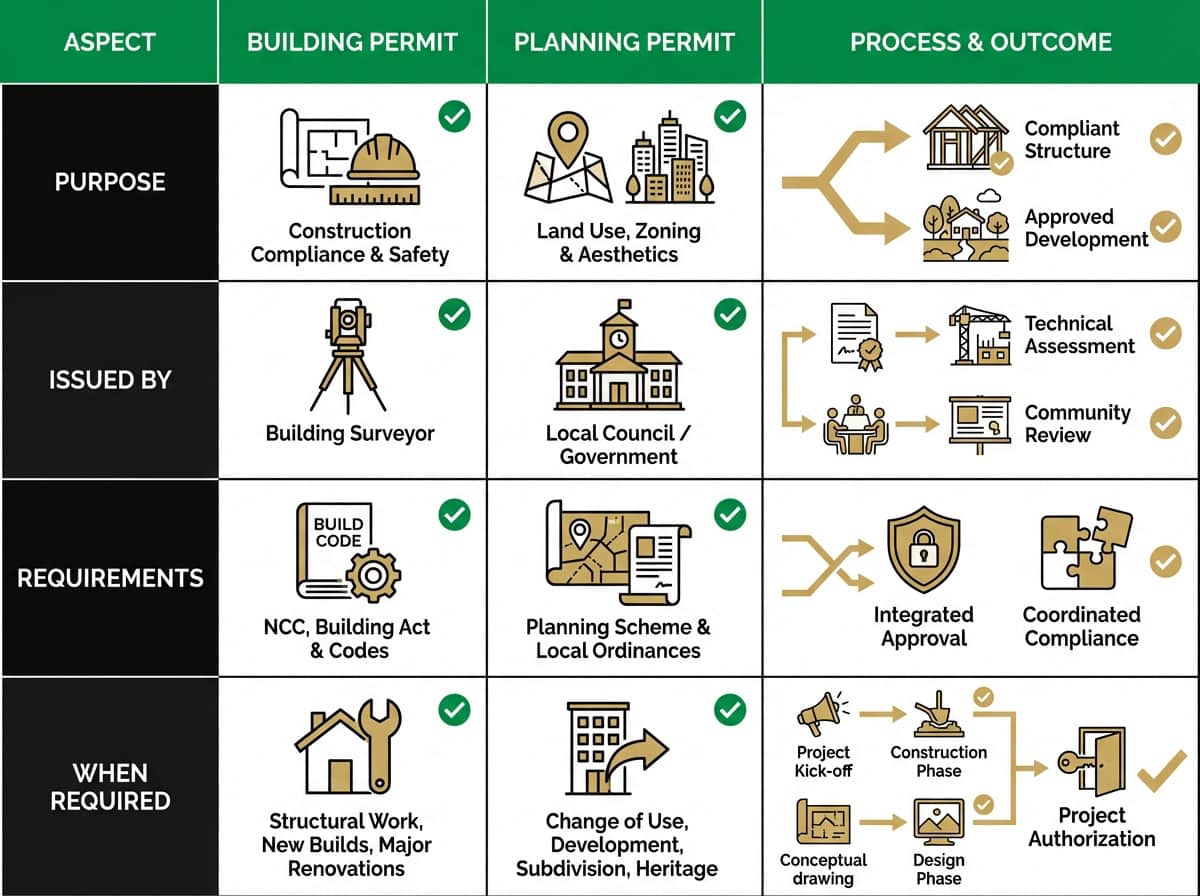
A building permit provides written approval to proceed with construction work, while planning permits grant permission to develop or use land in specific ways. These separate approvals each serve distinct regulatory functions within Victoria’s development framework.
What Is a Building Permit?
A building permit is official approval from a local council or private building surveyor that authorises construction work to commence. The permit confirms that proposed building work complies with the Building Act 1993, Victoria’s Building Regulations 2018, and the National Construction Code.
Private building surveyors or municipal building surveyors issue building permits after assessing technical compliance with structural, fire safety, accessibility, and energy efficiency standards. The building permit application requires detailed documentation including architectural plans, engineering specifications, and energy reports.
Recent amendments to Victoria’s Building Regulations 2018 have introduced additional mandatory notification stages. Construction projects must now notify the relevant building surveyor before covering framework and before covering waterproofing membranes, ensuring critical construction phases receive proper inspection.
Types of Building Permits and Approvals
Victoria’s regulatory framework includes several permit types that may apply to different development scenarios. A building permit addresses technical construction standards, while a planning permit deals with land use and development impacts under Victoria’s planning scheme.
Common permit and approval types include:
- Building permit – authorises construction, alteration, or demolition of buildings
- Planning permit – permits specific land use or development activities
- Demolition permit – separate approval required for demolishing structures
- Occupancy permit (OP) – certifies a building is suitable for occupation
- Certificate of final inspection – confirms completed work complies with permit conditions
Some projects require both planning and building permits, obtained through separate application processes. Planning permit applications are assessed by councils or Victoria’s planning authority, while building permit applications are processed by building surveyors.
VicSmart provisions introduced through Amendment VC114 provide streamlined planning assessment for straightforward proposals that meet specified requirements.
When Is a Building Permit Required?
Building permits are typically required for new buildings, structural alterations, extensions, or changes to a building’s classification. Most construction work affecting a building’s structure, weatherproofing, or fire safety systems requires a building permit before work commences.
Projects requiring building approval include new dwellings, multi-unit developments, commercial fitouts involving structural changes, and additions that increase building footprint or height. Alterations to load-bearing walls, roof structures, or significant renovations also trigger building permit requirements.
A building order may be issued by a municipal building surveyor where building work has been undertaken without the required building permit or where work fails to comply with approved documentation. Property developers must ensure permits are obtained before commencement to avoid enforcement action.
Exemptions from Building Permit Requirements
Minor building work may be exempt from building permit requirements under Schedule 7 of Victoria’s Building Regulations 2018. These exemptions apply to low-risk construction activities that pose minimal safety or compliance concerns.
Typical exemptions include:
- Pergolas and verandahs under 20 square metres with specific height limitations
- Decks less than one metre above ground level
- Retaining walls under one metre in height
- Minor repairs using comparable materials
- Non-structural internal alterations such as painting or floor coverings
Exemptions do not apply where work affects fire safety systems, structural elements, or heritage-listed properties. Planning permits may still be required for exempt building work if the development affects land use, heritage overlays, or neighbourhood character provisions under ResCode.
Developers should verify exemption status before commencing work, as incorrect assumptions about exemptions could result in building orders or compliance enforcement.
Key Legislative and Regulatory Framework
Building permit processes in Victoria operate under a multi-layered regulatory system that combines state legislation, national construction standards, and local planning controls. Understanding these frameworks helps property developers navigate compliance requirements and streamline project approvals.
Relevant Building Acts and Regulations
The Building Act 1993 establishes the primary legislative framework for building control in Victoria. This Act governs building permits, building surveyors, and enforcement mechanisms across the state.
The Building Regulations 2018 provide detailed technical requirements that support the Building Act 1993. These regulations prescribe mandatory notification stages, inspection requirements, and administrative procedures for building permits. Recent amendments introduce additional mandatory notification stages, including inspections before covering framework components.
The Victorian Building Authority administers and enforces building regulations throughout Victoria. This body oversees building surveyor registration, handles compliance matters, and provides guidance on regulatory interpretation for developers and practitioners.
State-based regulations work alongside national standards to create a comprehensive compliance framework. Developers must ensure their projects satisfy both Victorian-specific requirements and broader national construction standards.
National Construction Code and Building Codes
The National Construction Code provides technical standards for building work across Australia. Previously known as the Building Code of Australia, the NCC sets performance requirements for structural integrity, fire safety, health and amenity, and energy efficiency.
The NCC operates as a performance-based code that allows multiple compliance pathways. Developers may demonstrate compliance through deemed-to-satisfy provisions, performance solutions, or a combination of both approaches.
Victoria adopts the NCC through its building regulations, though the state may apply variations or additional requirements. These variations typically address Victoria-specific concerns such as bushfire protection, energy efficiency targets, or heritage considerations.
The code undergoes regular updates to reflect technological advances, safety improvements, and sustainability objectives. Property developers need to confirm which NCC version applies to their project based on permit application dates.
Zoning Regulations and Council Requirements
Local councils administer planning schemes that establish zoning controls and development standards for their municipalities. These schemes determine permitted land uses, building heights, setbacks, and site coverage requirements.
Planning permits may be required before a building permit can be issued, depending on the proposed development type and zoning classification. The Victorian Planning Authority coordinates strategic planning initiatives and develops planning scheme amendments that affect development requirements.
Councils also enforce local building codes and conditions that supplement state regulations. These local provisions may address neighbourhood character, heritage overlays, or environmental sensitivity zones specific to the municipality.
VicSmart provisions streamline assessment for certain straightforward proposals, reducing approval timeframes for eligible developments. Developers should confirm whether their project qualifies for this expedited process during initial planning stages.
Pre-Application Preparation
Proper groundwork before submitting a building permit application can prevent delays, reduce costs, and streamline the approval process. Engaging qualified professionals early, compiling comprehensive documentation, and conducting thorough site assessments form the foundation of a successful application.
Engaging Professionals and Appointing a Building Surveyor
Property developers must appoint either a private building surveyor or use a municipal building surveyor to assess and approve building permit applications. A registered building surveyor evaluates whether proposed construction complies with the Building Code of Australia and relevant Victorian building regulations.
Private building surveyors typically offer faster processing times and more flexible service arrangements compared to council-appointed options. The choice between private and municipal surveyors may depend on project complexity, timeline requirements, and council relationships.
Developers should also engage a registered building practitioner such as a building designer or architect to prepare compliant documentation. These professionals understand Victorian building standards and can coordinate with structural engineers to ensure technical compliance. Early engagement allows time to address design issues before formal submission, reducing the likelihood of requests for information or permit refusals.
Required Documentation and Reports
Building permit applications require detailed technical documentation that demonstrates compliance with building regulations and planning and building requirements. Core documents include architectural drawings, construction plans, and structural engineering drawings that specify all building elements, materials, and construction methods.
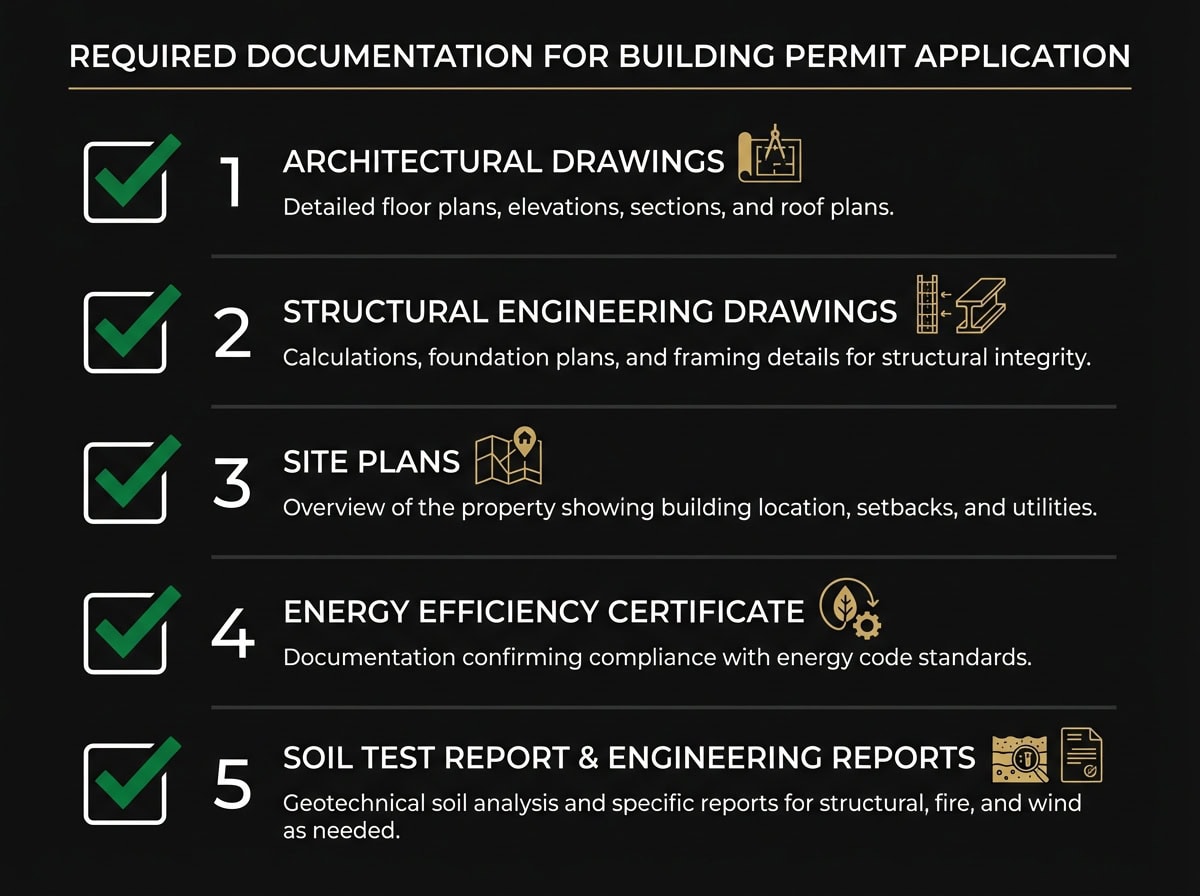
Engineering reports provide essential technical evidence for permit assessment. Structural engineering analysis confirms that the proposed design can withstand relevant loads and environmental conditions. A soil test determines ground bearing capacity and informs foundation design, particularly for sites with challenging soil conditions or slope.
Energy efficiency assessments have become increasingly important under Victorian building regulations. An energy rating certificate demonstrates that the proposed building meets minimum thermal performance standards. Developers should commission these assessments early, as results may necessitate design modifications.
Additional documentation may include:
- Site plans showing building setbacks, boundaries, and services
- Stormwater management plans
- Waste management strategies
- Wind engineering reports for taller structures
- Fire engineering reports for complex buildings
Site Analysis, Surveys, and Assessments
Comprehensive site analysis identifies constraints and opportunities that influence design and construction methodology. A detailed site survey establishes accurate boundary dimensions, levels, existing structures, and services locations. This information ensures architectural drawings reflect actual site conditions.
Geotechnical investigations beyond basic soil tests may be necessary for sites with suspected contamination, high water tables, or unstable ground. These assessments inform foundation design and may reveal remediation requirements that affect project feasibility.
Environmental assessments examine vegetation, habitat values, and potential heritage considerations. Sites within bushfire-prone areas require specific assessments under updated provisions including VC140, which introduced more directive bushfire risk management strategies. Developers should identify these requirements early to avoid costly design changes during assessment.
Step-By-Step Guide to the Building Permit Application Process
The building permit application process in Victoria involves selecting the appropriate application pathway, preparing comprehensive documentation, and paying required fees to the relevant building surveyor. Each step requires specific documentation and compliance with Victorian Building Authority regulations.
Determining Application Type: Certified vs Uncertified
Victoria operates two distinct pathways for building permit applications. A certified application involves a building surveyor who issues compliance certificates throughout the construction process, providing certificates of design compliance before work commences. An uncertified application typically applies to smaller, lower-risk projects where the permit authority may not require the same level of ongoing certification.
The certified pathway requires appointment of a registered building surveyor who becomes the permit authority. This surveyor assesses plans against the Building Code of Australia and relevant Victorian standards. They issue a building permit number once satisfied that designs comply with applicable regulations.
Most residential developments in Melbourne require certified applications. The building surveyor conducts mandatory inspections at prescribed stages and issues compliance certificates confirming work meets approved plans. Projects involving structural changes, new dwellings, or significant alterations typically follow this pathway.
Preparing and Lodging the Application
A building permit application requires detailed architectural drawings, engineering specifications, and supporting documentation. Applicants must provide site plans, floor plans, elevations, and structural details prepared by qualified professionals. Energy efficiency reports, bushfire attack level assessments, and soil reports may be necessary depending on location and project type.
The application package should include a certificate of design compliance from relevant practitioners. This demonstrates that designs meet Building Code requirements before construction begins. Surveyors assess whether documentation addresses all regulatory requirements including fire safety, accessibility, and structural adequacy.
Lodgement occurs directly with the chosen building surveyor who acts as the permit authority. Processing timeframes vary based on application complexity, though straightforward projects typically receive assessment within 10-15 business days. The surveyor may request additional information or modifications before issuing the building permit number.
Paying Levies and Fees
Building permit applications in Victoria attract multiple fees. The building surveyor charges for assessment services, inspection attendance, and ongoing project administration. These fees vary between practitioners and reflect project complexity and size.
Statutory charges include the building permit levy and building services levy. The Victorian Building Authority collects these levies to fund regulatory activities and building dispute resolution services. Levy amounts are calculated based on the cost of building work, with rates set in Victoria’s Building Regulations 2018.
Payment typically occurs before permit issue, though arrangements differ between surveyors. Some require upfront payment for assessment, with additional fees due at permit stage. Others invoice for the complete service including future inspections. Developers should clarify fee structures and payment schedules when appointing a building surveyor to avoid unexpected costs during construction.
Assessment, Issuance, and Required Inspections
Once a building permit application is submitted, the building surveyor conducts a thorough compliance assessment before the permit can be issued. Throughout construction, mandatory inspections ensure work meets regulatory standards at critical stages.
Assessment by Building Surveyor and Authorities
A building surveyor reviews submitted plans and documentation to ensure compliance with the Building Code of Australia, relevant Australian Standards, and Victoria’s building regulations. This assessment typically examines structural adequacy, fire safety measures, accessibility requirements, and energy efficiency standards.
The assessment by building surveyors and authorities may identify areas requiring modification or additional information. Building surveyors often issue requests for information when documentation is incomplete or requires clarification. Property developers should anticipate this stage taking several weeks, depending on project complexity and the completeness of initial submissions.
For projects requiring planning permits, coordination between planning and building approval processes is essential. The building surveyor may need to verify that proposed construction aligns with planning permit conditions before proceeding with the building permit assessment.
Permit Issuance and Conditions
Permit issuance occurs after the building surveyor confirms all requirements are satisfied. Building permits provide written approval to proceed with construction work and must be obtained before any building activity commences.
The issued permit typically includes:
- Approval conditions that must be met during construction
- Inspection stage requirements specifying when notifications are required
- Validity period within which construction must commence
- Approved plans stamped by the building surveyor
Permit conditions may specify materials, construction methods, or additional requirements specific to the project. Developers should review these conditions carefully, as non-compliance could result in stop-work orders or difficulties obtaining occupancy certification.
Mandatory Inspections During Construction
Mandatory inspections occur at prescribed stages throughout the construction process to verify compliance with approved plans and building standards. The building surveyor must be notified at each mandatory stage before work proceeds to the next phase.
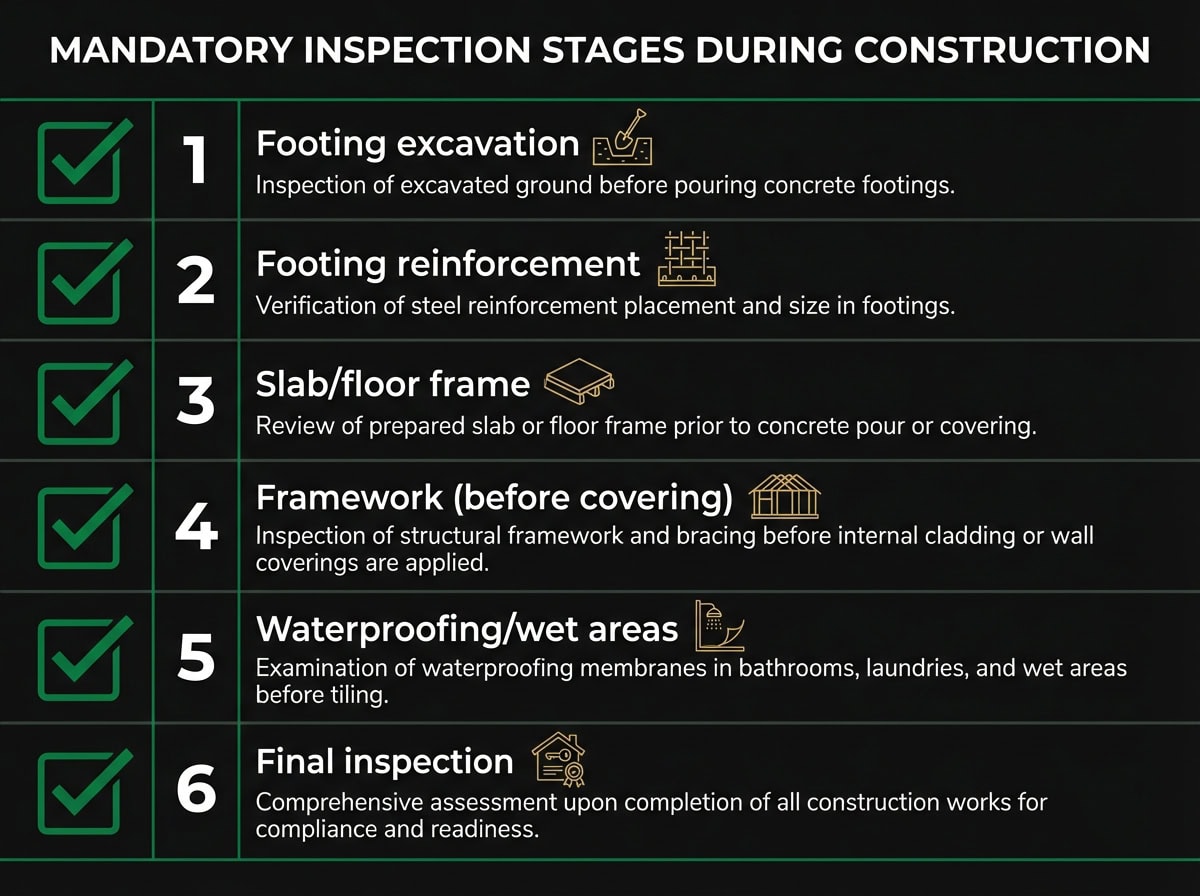
Under Victoria’s building regulations, mandatory notification stages typically include:
- Footing excavation stage
- Footing reinforcement stage
- Slab or floor frame stage
- Framework stage (before covering)
- Waterproofing and wet area compliance
- Final inspection
Draft regulations proposed for mid-2025 may introduce additional mandatory notification stages, including before covering framework components and before installing building services. The statutory building surveyor must issue an inspection report confirming whether each inspection passed or requires rectification work.
Property developers must provide adequate notice before each inspection stage. Missing or skipping mandatory inspections could delay the final inspection and prevent issuance of occupancy permits. A notice of completion is submitted after construction finishes, triggering the final inspection process where the building surveyor verifies all work complies with approved plans and mandatory inspection requirements have been satisfied.
Completion, Final Certification, and Occupancy
Once construction reaches its final stages, property developers must navigate mandatory certification and occupancy approval requirements before buildings can be legally occupied. The process involves lodging a certificate of final inspection or applying for an occupancy permit, depending on the classification and scope of the project.
Certificate of Final Inspection and Occupancy Permit
A certificate of final inspection typically applies to smaller structures, whilst more complex buildings require an application for occupancy permit through the relevant building surveyor. The surveyor conducts a final inspection to verify that construction complies with the approved building permit, relevant building codes, and the Building Act 1993.
Before issuing an occupancy permit, the building surveyor must ensure the building is safe for occupation. This involves verifying fire safety systems, structural integrity, access provisions, and environmental compliance. The building permit will state whether an occupancy permit or certificate of final inspection is required for the specific project type.
Developers should note that practical completion and certificate of occupancy are separate milestones—the former being a contractual matter between builder and client, whilst the latter represents regulatory approval for occupancy.
Compliance, Handover, and Notice Requirements
The application for occupancy permit must include evidence that all mandatory notification stages have been completed and inspections passed. Draft Building Amendment Regulations may introduce additional mandatory notification stages, including inspection requirements before covering framework elements, which could affect final certification timelines.
Developers must lodge a notice of completion with the Victorian Building Authority, updating the final cost of works where applicable. This requirement ensures accurate records are maintained for insurance and regulatory purposes. All relevant documentation, including building manuals for certain classes of buildings, must be prepared for handover.
Key compliance documents may include:
- As-built drawings and specifications
- Fire safety system certificates
- Warranty and maintenance documentation
- Building manual (where required under section 41A)
The occupancy permit cannot be issued until the building surveyor confirms all building work complies with the approved plans and applicable standards.
Additional Considerations and Best Practices
Securing building approval involves more than submitting documentation and waiting for certification. Proactive management of potential delays, ongoing compliance monitoring, and engaging qualified professionals may significantly reduce risks throughout the building permit process.
Common Delays and How to Avoid Them
Incomplete documentation remains the primary cause of building approval delays in Victoria. Missing structural calculations, inadequate site analysis, or outdated planning permit details may extend review periods by weeks or months. Developers should verify that all drawings reference the correct planning scheme controls and include required engineering certifications before submission.
Common causes of delay include:
- Conflicts between planning permit conditions and building documentation
- Insufficient detail in accessibility compliance drawings
- Missing calculations for structural loads or energy efficiency ratings
- Incorrect or outdated building services levy payments
The VicSmart provisions introduced under Amendment VC114 offer streamlined permit assessment for straightforward proposals, typically reducing assessment timeframes. However, these provisions apply only to specific development types meeting defined criteria.
Early engagement with building surveyors may identify potential conflicts before formal submission. Pre-application consultations allow surveyors to review preliminary documentation and flag missing information or non-compliant elements that could trigger delays.
Compliance During and After Construction
Mandatory notification stages require builders to notify surveyors at specific construction phases before proceeding. Victoria prescribes notification before covering framework, waterproofing, or commencing structural work. The Building Amendment (Building Manuals and Mandatory Inspections) Regulations 2025 introduced additional notification stages to strengthen compliance oversight during construction.
Building surveyors conduct inspections at these stages to verify work matches approved documentation. Non-compliant work discovered during inspections may require rectification before construction continues, potentially affecting project timelines and budgets.
Key compliance requirements include:
- Notification at prescribed construction stages
- Maintaining approved plans on-site for inspector reference
- Recording variations from approved documentation
- Submitting building manuals before occupancy (for applicable building classes)
Compliance certificates confirm that completed work meets the National Construction Code and approved building standards. Obtaining these certificates remains essential before property occupation or sale. The building services levy, calculated as a percentage of building cost, must be paid before surveyors issue building permits.
Role of Professional Guidance
Engaging qualified building surveyors, architects, and engineers early in the development process typically reduces approval complications. Building surveyors assess whether planning permits align with proposed building work and certify design compliance with applicable standards under the Building Act 1993.
Architects coordinate documentation across disciplines, ensuring structural, hydraulic, and electrical drawings integrate correctly with architectural plans. This coordination reduces conflicts that surveyors may identify during assessment. Engineers provide essential calculations and certifications that support building approval applications, particularly for complex structures or sites with challenging conditions.
Professional consultants navigate the building approvals process by managing documentation requirements, responding to surveyor requests, and addressing compliance issues during construction. Their expertise may accelerate approvals and reduce the risk of costly variations or delays. Developers should verify that consultants hold current registrations and maintain professional indemnity insurance appropriate to the project scope.
Frequently Asked Questions
Building permit applications in Victoria involve specific documentation requirements, assessment timeframes, and procedural steps that property developers need to understand. Costs vary based on project scope, and regulatory requirements differ between residential and commercial developments.
What are the required documents to submit for a building permit application?
A building permit application in Victoria typically requires detailed architectural plans, engineering specifications, and structural calculations prepared by registered professionals. The Victorian Building Authority manages building permit requirements that applicants must satisfy before approval.
Applications must include site plans showing the building location, boundaries, and setbacks from property lines. Floor plans, elevations, and cross-sections need to demonstrate compliance with the Building Code of Australia and relevant Australian Standards.
Energy efficiency documentation, including NatHERS ratings for residential projects, forms part of the standard submission. Developers may also need to provide drainage plans, fire safety reports, and access compliance statements depending on the building classification.
Under recent amendments including VC114, certain straightforward proposals may qualify for streamlined VicSmart assessment, which requires a simplified documentation set. A draft building manual is now required under new regulations for applicable building classes, containing prescribed information about the building’s design and construction.
How long does the assessment phase for a building permit typically take?
The assessment timeframe for a building permit in Victoria depends on the complexity of the project and the completeness of the application. Standard residential projects may take between 10 to 20 business days for initial assessment by a building surveyor.
Commercial and multi-residential developments typically require longer assessment periods, potentially extending to 30 or 40 business days. Projects requiring additional technical reports or referrals to authorities such as the Metropolitan Fire Brigade may experience extended timeframes.
VicSmart-eligible applications introduced under Amendment VC114 benefit from a 10-day statutory timeframe for straightforward proposals. Incomplete applications or those requiring additional information can add several weeks to the overall process.
The building surveyor may issue a Request for Information during assessment, pausing the statutory clock until the applicant provides satisfactory responses. Developers should factor in potential delays when planning project timelines and ensure all documentation is complete before lodgement.
Can you outline the steps involved in obtaining a building permit?
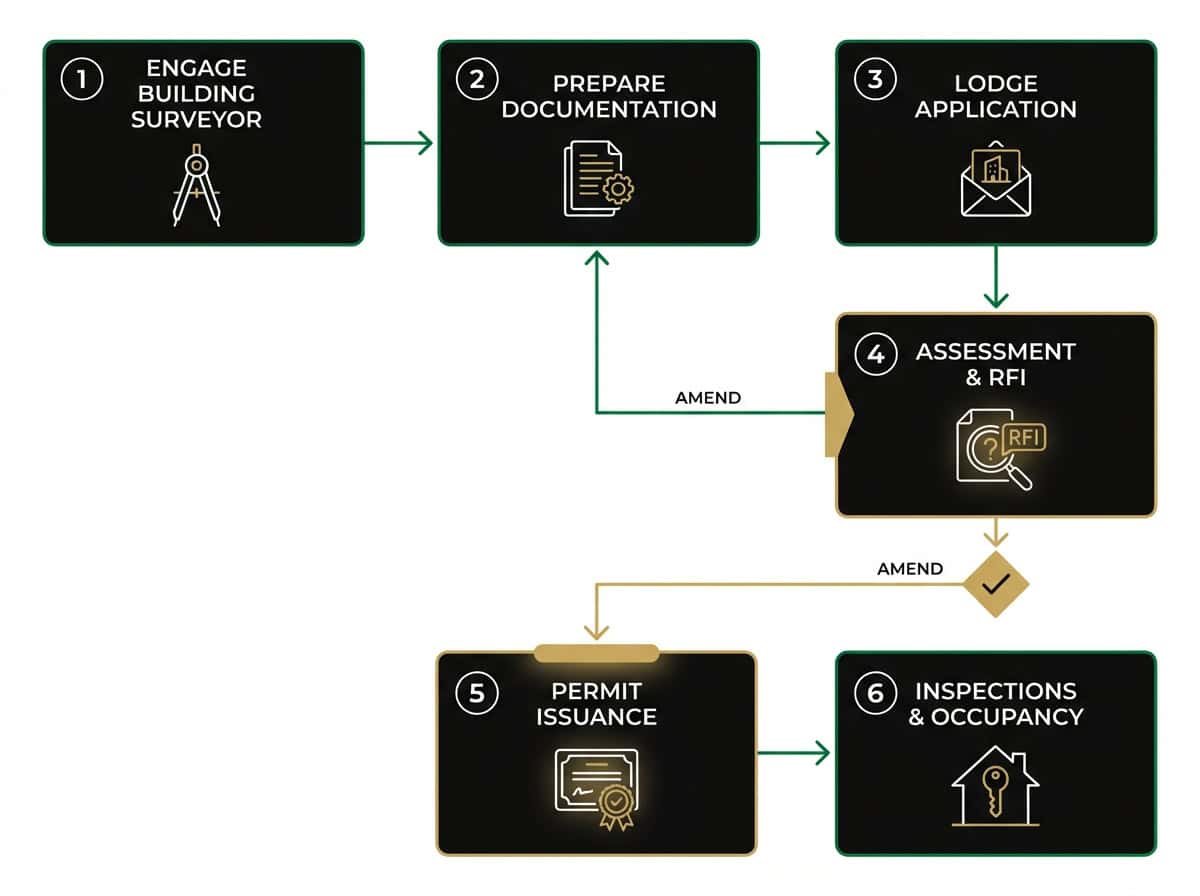
The building permit process in Victoria follows a structured sequence starting with engaging a registered building surveyor. Developers can choose either a municipal building surveyor or a private building surveyor to assess and issue the permit.
Preparation of compliant documentation by qualified designers and consultants forms the second step. Plans must demonstrate compliance with the National Construction Code and all relevant Victorian building regulations before lodgement.
The building surveyor conducts a thorough assessment of the submitted documentation against applicable codes and standards. This assessment may involve technical reviews, site inspections, and coordination with relevant referral authorities.
Once satisfied with compliance, the building surveyor issues the building permit along with mandatory notification stages. These stages, which now include additional inspection points under new regulations, must be satisfied during construction before proceeding with subsequent work.
After construction completion, the building surveyor conducts final inspections and issues an occupancy permit or certificate of final inspection. A building manual must now be provided for prescribed building classes, documenting essential information for future maintenance and alterations.
What are the costs associated with applying for a building permit?
Building permit costs in Victoria comprise several components including the building surveyor’s assessment fees and statutory charges. Private building surveyor fees vary based on project value, complexity, and the scope of services required throughout construction.
The Victorian Building Authority levy applies to all building permits based on the cost of building work. This levy contributes to industry regulation and consumer protection mechanisms administered by the VBA.
Additional costs may include fees for specialist consultants such as structural engineers, energy assessors, and fire safety engineers. Developers should budget for potential re-assessment fees if the application requires amendments or additional information during the review process.
For large-scale developments, ongoing inspection fees throughout the construction phase add to the overall permit costs. These inspection fees cover the building surveyor’s attendance at mandatory notification stages and other site visits required to verify compliance.
Are there any particular regulations I should be aware of when applying for a building permit in a residential area?
Residential developments in Victoria must comply with ResCode provisions within the planning scheme, which govern matters such as setbacks, site coverage, and overlooking. These requirements apply even after obtaining a planning permit, as building permit documentation must demonstrate consistency with any planning approval conditions.
Amendment VC140 introduced updated bushfire planning policies affecting developments in bushfire-prone areas. Properties in designated Bushfire Management Overlay areas require specific construction standards and defendable space provisions.
The reformed zones introduced under Amendment VC100 affect how planning schemes and permit applications are processed across Victoria. Developers need to verify current zone provisions as they may impact building envelope requirements and construction standards.
New mandatory notification stages prescribed under recent building regulations require additional inspections during construction. These include notifications before covering framework and at other critical construction stages, affecting project scheduling and surveyor coordination.
Energy efficiency requirements under the National Construction Code continue to evolve, with residential buildings needing to meet minimum NatHERS ratings. Developers should confirm current thermal performance standards applicable to their project classification.
How can I track the status of my building permit application once submitted?
Most building surveyors provide applicants with a reference number upon lodgement that enables status tracking. Private building surveyors typically communicate directly with applicants via email or phone regarding assessment progress and any outstanding matters.
Municipal building surveyors may offer online portals where developers can check application status and view correspondence. These systems typically show key milestones such as lodgement date, requests for information, and target decision dates.
Developers should maintain regular contact with their appointed building surveyor throughout the assessment period. Proactive communication helps identify potential issues early and facilitates timely resolution of any compliance matters.
The statutory timeframes for permit assessment begin once a complete application is received. If the building surveyor issues a Request for Information, developers should respond promptly to avoid extended delays in the approval process. Where disputes arise regarding permit conditions or refusals, developers may have recourse to VCAT for review of certain decisions.
Disclaimer: This guide provides general information about Victoria’s building permit process. Building regulations and requirements may change. Property developers should consult with registered building surveyors and qualified professionals for advice specific to their project circumstances.


