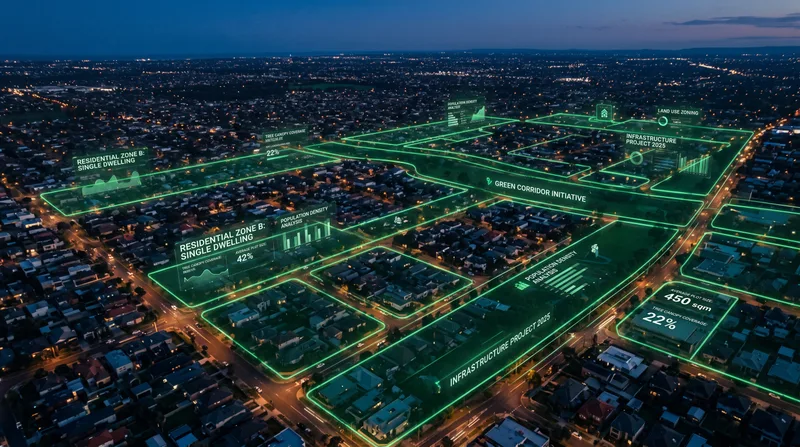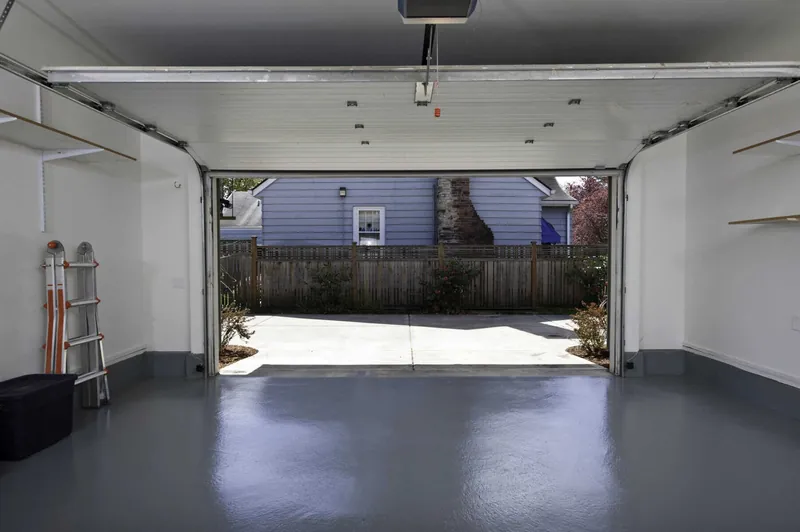
For property developers operating across Melbourne, an underutilised garage represents one of the most accessible and cost-effective opportunities to add habitable floor area, generate rental income, or increase a property’s overall market value. With Victoria’s planning system undergoing its most significant legislative overhaul in decades, understanding the current regulatory landscape is essential before committing to any conversion project.
Already had the work done, or bought a property where a previous owner converted the garage without a building permit? That is a different situation with a different process — see can you get a retrospective building permit in Victoria.
This guide outlines what developers need to know about garage conversions in 2025-26, covering planning permit requirements, building approvals, structural considerations, cost benchmarks, and the impact of recent Victorian planning reforms. Whether you are converting a single garage into a studio, a self-contained dwelling, or a secondary living space for a multi-generational household, the information below may help you navigate the process more efficiently across councils including the City of Whitehorse, City of Boroondara, Manningham City Council, City of Monash, Knox City Council, and Maroondah City Council.
SQM Architects has delivered a substantial portfolio of projects across Melbourne, with broad experience across these six council areas providing practical insight into what may be expected at each stage of a garage conversion project.
Do You Need a Planning Permit for a Garage Conversion?
This is the first question most developers ask, and the answer depends on several factors specific to your site, zone, and intended use. In Victoria, a garage conversion typically involves a change of use — from a non-habitable Class 10a structure to a habitable Class 1a space — which in most circumstances triggers the need for both a building permit and, depending on the scope of works, a planning permit from the Responsible Authority.
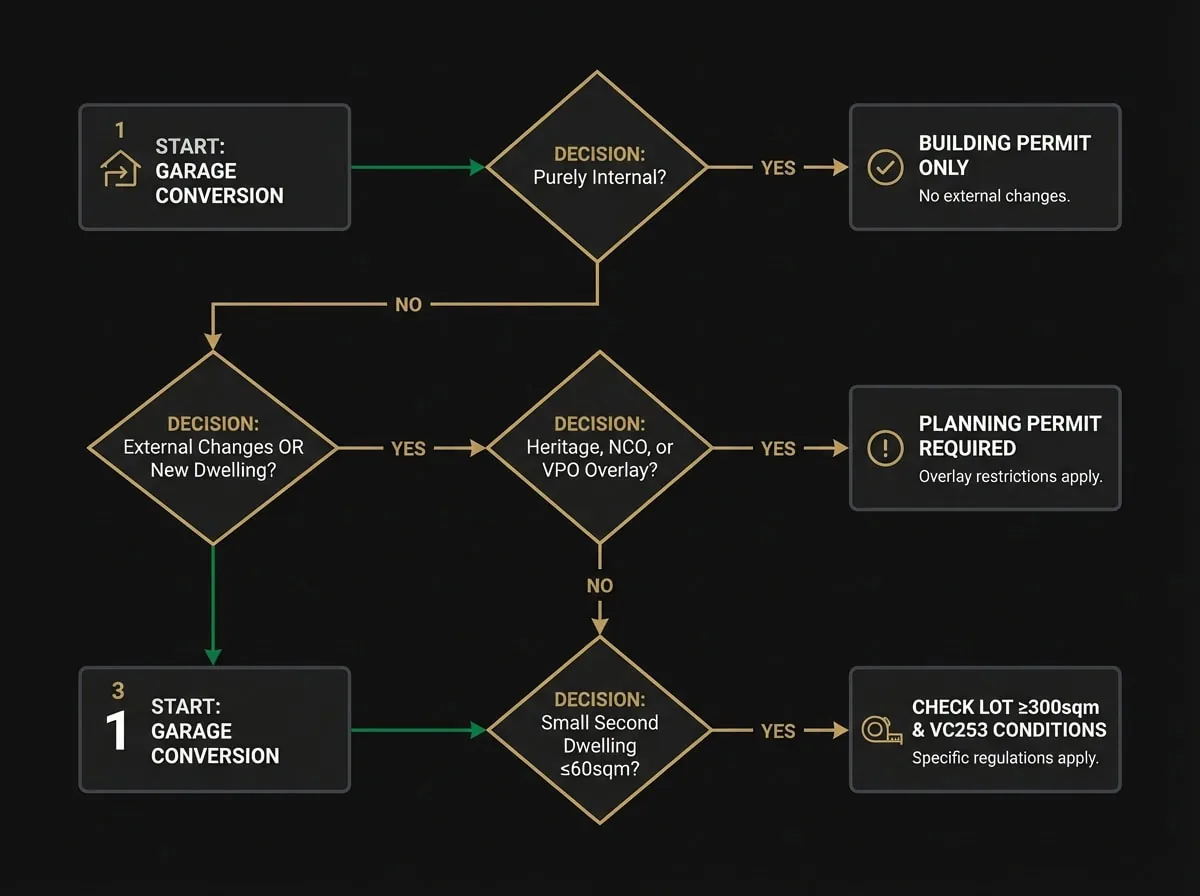
A planning permit may be required where the conversion involves changes to the external appearance of the building, affects the streetscape, introduces a new dwelling or secondary dwelling on the lot, or where the site is affected by an overlay such as a Heritage Overlay, Neighbourhood Character Overlay, or Vegetation Protection Overlay. Each of these overlays is common across Melbourne councils and may add assessment time and documentation requirements to your application.
Where the conversion is purely internal and does not alter the external envelope, a planning permit may not be required — however, a building permit will almost certainly still be needed. Developers should confirm requirements with the relevant Responsible Authority before commencing any works. Proceeding without the correct approvals may result in enforcement action, costly rectification, and complications at the point of sale or lease.
Small Second Dwellings: A Key Reform to Understand
Victoria’s planning schemes were amended in late 2023 via Amendment VC253 to introduce the concept of a small second dwelling — a self-contained residence of up to 60 square metres on a lot that already contains a primary dwelling. In most residential zones, a small second dwelling does not require a planning permit, provided certain conditions are met. This reform has direct implications for garage conversions where the intent is to create a self-contained secondary residence.
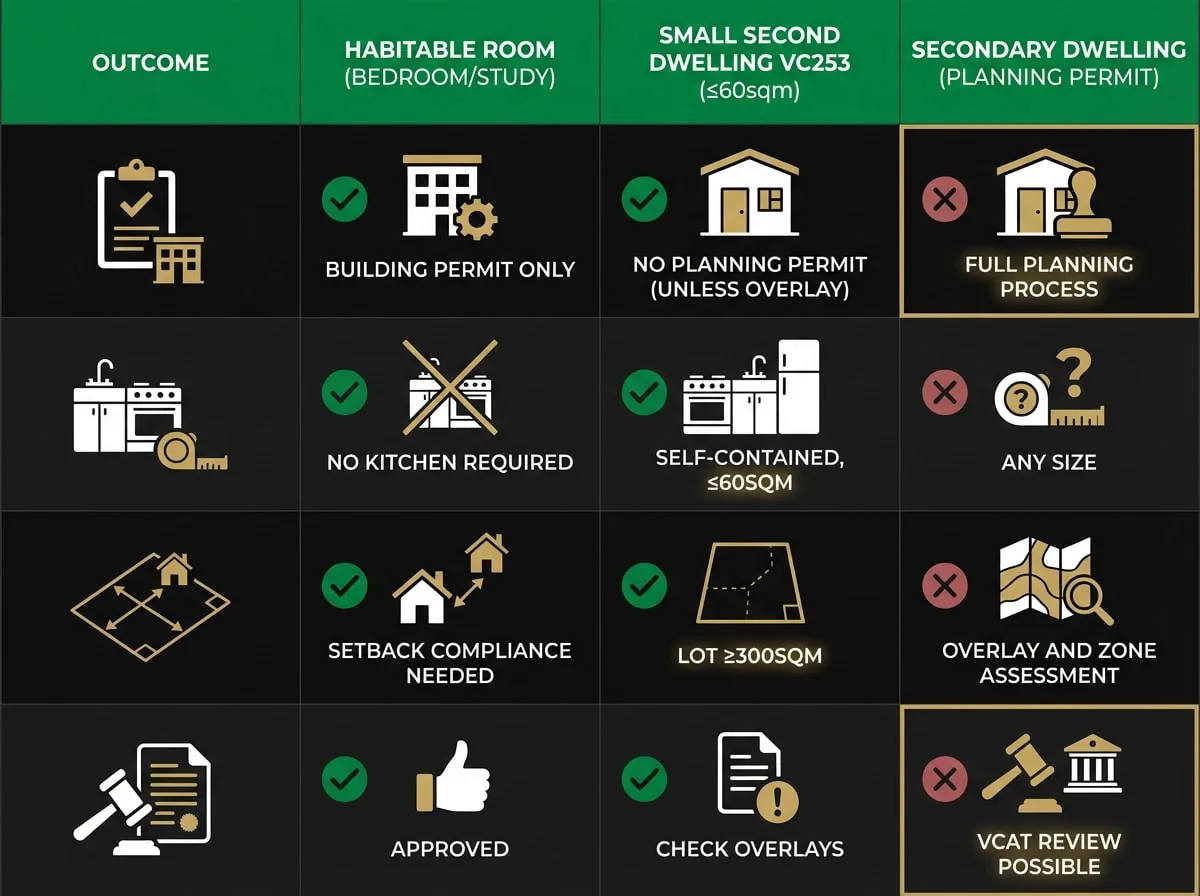
To qualify as a small second dwelling without a planning permit, the converted space may need to include a kitchen sink, food preparation facilities, a bath or shower, and a toilet and wash basin. The dwelling must be the only small second dwelling on the lot, and subdivision to create a separate title is not permitted under this pathway. A minimum of 8 square metres of private open space must also be provided, along with a clear and unobstructed path from the front street. Importantly, a planning permit is still required on lots smaller than 300 square metres, and overlay controls continue to apply regardless of the small second dwelling provisions.
Own a block in Melbourne?
Your land may be worth more than the house on it — see what your block could fit.
Many established Melbourne blocks may support a second dwelling, dual occupancy or subdivision under current planning rules. SQM’s free screener checks your address against zoning and lot-size rules in about 60 seconds.
Check my block — freeFree indicative screening based on public planning data. Results are general information, not planning or financial advice.
Building Permits and the National Construction Code
Regardless of whether a planning permit is required, a building permit is mandatory for any garage conversion that changes the use of the space to habitable. The conversion must comply with the National Construction Code (NCC), which sets minimum standards for structural integrity, fire safety, insulation, ventilation, natural light, and energy efficiency.
From 1 July 2025, the Victorian Building Authority (VBA) was replaced by the Building and Plumbing Commission (BPC), established under the Building Legislation Amendment (Buyer Protections) Act 2025. The BPC now serves as the integrated regulator for Victoria’s building system, bringing together the functions previously held by the VBA, DBDRV, and the domestic building insurance arm of the VMIA. Developers should direct building compliance enquiries and practitioner registration checks to the BPC going forward.
Under the new framework, building surveyors are now required to provide an information statement to the owner within 10 working days of issuing a building permit, improving transparency around the surveyor’s role in the approval process. This is a practical change that may assist developers in tracking permit timelines and understanding their obligations at each inspection stage.
Structural Requirements for a Compliant Conversion
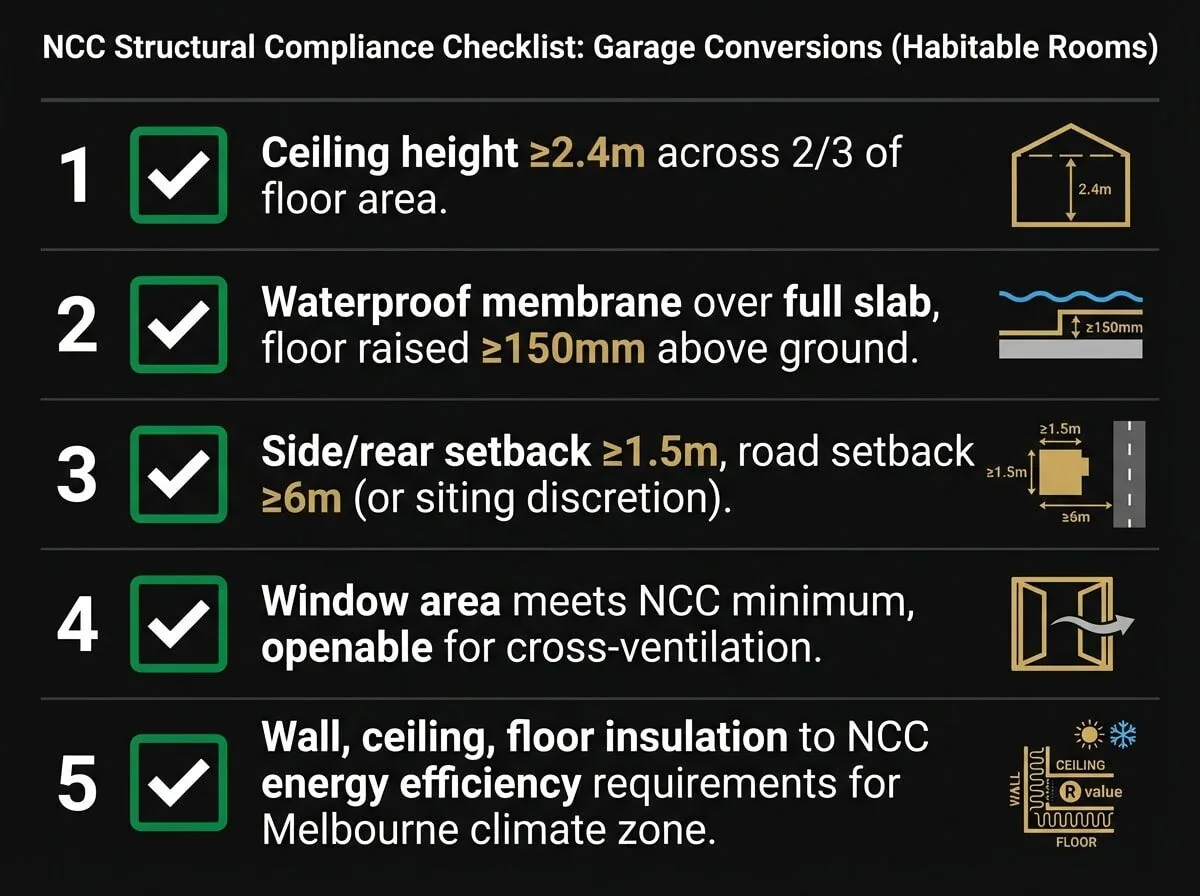
Meeting the NCC’s habitable room standards requires attention to several structural elements that are typically absent in a standard garage. Developers and their design teams should assess each of the following before finalising a conversion scope.
Ceiling Height
The NCC requires a minimum ceiling height of 2.4 metres for habitable rooms, maintained across at least two-thirds of the floor area. Many standard residential garages fall below this threshold, particularly where roof trusses or beams reduce the usable height. Where the existing ceiling is insufficient, structural modifications — including raising the roof or lowering the floor slab — may be required, adding cost and complexity to the project.
Floor Waterproofing and Level
Garage floor slabs are not constructed to habitable room standards. Rising damp is one of the most common and costly problems in converted garages. A compliant waterproof membrane must be applied over the entire concrete slab before any floor finishes are installed. The floor level should also be raised to align with the main dwelling and sit at least 150mm above ground level, or 50mm above any adjacent paved surface, to prevent water ingress.
Boundary Setbacks
Once a garage is reclassified as a habitable room, it must comply with the siting requirements applicable to habitable spaces under the relevant planning scheme and ResCode provisions. This typically means the converted space should not be within 1.5 metres of side or rear boundaries, and should maintain a minimum setback of 6 metres from any road boundary. Where existing garages do not meet these setbacks, a siting discretion application may be required prior to approval.
Natural Light and Ventilation
Habitable rooms must receive adequate natural light and ventilation. For most garage conversions, this means replacing the garage door opening with a new external wall incorporating a compliant window. The window must meet minimum area requirements relative to the floor area of the room, and must be openable to provide cross-ventilation. Skylights may also be considered where side or front windows are constrained by setback or streetscape requirements.
Insulation and Energy Efficiency
Under the NCC’s energy efficiency provisions, the converted space must meet minimum insulation requirements for walls, ceiling, and floor. In Melbourne’s climate zone, this is particularly important for thermal comfort and ongoing energy costs. Amendment VC282, effective September 2025, also introduced new ESD standards for residential development, including requirements for rooftop solar-ready areas and protection of north-facing windows from overshadowing — considerations that may be relevant where a garage conversion forms part of a broader site development.
A granny flat for family, an extension, or two homes where one stands — the seven rules that decide it, in plain English, verified against the current planning provisions. Free PDF, instant download.
- Your zone, overlays & the 60m² granny flat rule
- When you need a permit — and when you don’t
- The free two-minute check for your address
Something went wrong. Please try again.
No spam. Unsubscribe anytime. Or skip ahead: see what your block allows →
Check your inbox — your checklist is on its way.
2025-26 Planning Reforms: What Developers Need to Know
Victoria’s planning system is undergoing substantial reform, and developers active in Melbourne should be aware of the key legislative changes now in effect or approaching commencement.
Planning Amendment (Better Decisions Made Faster) Act 2026
The Planning Amendment (Better Decisions Made Faster) Act 2026 received Royal Assent on 17 February 2026 and represents the most significant update to Victoria’s planning legislation in decades. The Act establishes three planning permit assessment streams aligned with the risk, complexity, and potential impacts of each application — meaning lower-impact projects such as straightforward garage conversions may be processed more quickly under a simplified pathway. The default commencement date is 29 October 2027, allowing time for supporting changes to the Planning and Environment Regulations, Victoria Planning Provisions, and Ministerial guidelines to be prepared in consultation with industry.
Housing Statement Reform Act 2025
The Consumer and Planning Legislation Amendment (Housing Statement Reform) Act 2025, which received Royal Assent on 18 March 2025, extended the default planning permit expiry times for the use and development of land. The time permitted to commence a use or development has been extended from two years to three years, and the time to complete a development has been extended from four years to five years. This provides developers with greater flexibility in staging projects and managing construction timelines.
VicSmart Pathway for Single Dwellings and Two-Lot Subdivisions
Amendment VC282, effective 8 September 2025, introduced a streamlined VicSmart permit process for single dwellings and small second dwellings on lots under 300 square metres, with a 10-business-day turnaround and no third-party notice or review. From 16 October 2025, Amendment VC288 extended the VicSmart pathway to two-lot subdivisions in eligible zones. While these reforms are primarily directed at new dwelling construction, they may be relevant where a garage conversion forms part of a broader development or subdivision strategy on a smaller lot.
Cost Benchmarks for Garage Conversions in Melbourne
Conversion costs vary considerably depending on the scope of works, the condition of the existing structure, and the intended use of the converted space. The following figures are indicative estimates based on current market conditions in Melbourne and should be treated as a starting point for budgeting purposes rather than fixed pricing.
- Basic room conversion (bedroom or study): $25,000 – $45,000
- Conversion with ensuite bathroom: $45,000 – $65,000
- Conversion with kitchenette and bathroom: $60,000 – $90,000
- Full self-contained studio or secondary dwelling: $80,000 – $120,000+
- Building permit and council fees: $1,500 – $3,500 (indicative)
- Architectural and design fees: $3,000 – $12,000 depending on scope
Structural modifications — including raising the ceiling, replacing the garage door with a framed wall and window, waterproofing the slab, and upgrading insulation — are the primary cost drivers in most conversions. Plumbing and electrical works add further cost where a bathroom, kitchenette, or laundry is included. Developers should obtain detailed quotes from licensed contractors before committing to a project budget.
Typical Project Timeline
A garage conversion in Melbourne may follow a timeline broadly similar to the following, though actual durations will vary depending on council responsiveness, the complexity of the application, and contractor availability.
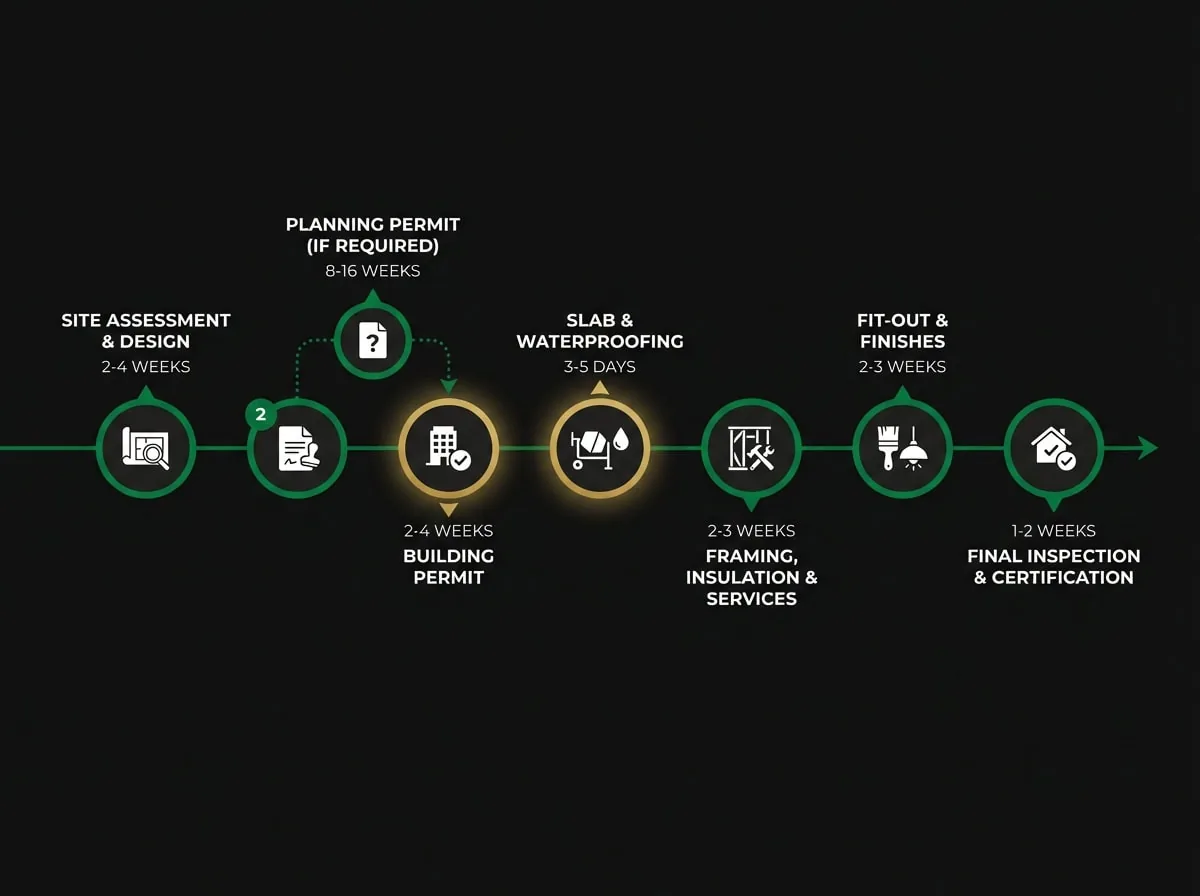
- Site assessment and design development: 2 – 4 weeks
- Planning permit application (if required): 8 – 16 weeks depending on council and complexity
- Building permit application: 2 – 4 weeks
- Construction — slab preparation and waterproofing: 3 – 5 days
- Framing, insulation, and services (electrical and plumbing): 2 – 3 weeks
- Plastering, flooring, painting, and fit-off: 2 – 3 weeks
- Final inspection and occupancy certification: 1 – 2 weeks
Where a planning permit is not required and the project proceeds directly to a building permit, the overall timeline may be considerably shorter. Engaging an architect or building designer early in the process — before lodging any applications — may help reduce delays and avoid the need for amended plans mid-assessment.
Insurance and Compliance Considerations
Developers and property owners should notify their insurance provider before commencing a garage conversion. Changing the use of a structure from non-habitable to habitable materially affects the risk profile of the property and may require adjustments to building insurance coverage. Failure to disclose the conversion could affect the validity of any future claim.
Where the converted space is intended for rental — including short-term accommodation — additional compliance obligations may apply, including minimum dwelling standards for light, ventilation, and ceiling height, and registration requirements under applicable short-term accommodation frameworks. Developers should seek independent legal and insurance guidance specific to their intended use.
Do You Need a Permit for a Garage Conversion in Melbourne?
In most cases, converting a garage into a habitable room in Melbourne needs a building permit, because the work changes the building’s use and must meet the National Construction Code for a habitable space (insulation, ventilation, natural light, egress and often waterproofing). A planning permit may also be required depending on your zone and any overlay — for example where the conversion reduces on-site car parking below what the planning scheme requires, or where a heritage or neighbourhood character overlay applies. Whether a permit is needed is site-specific, so it is worth confirming the requirements for your address before starting work.
Related: occupancy permits in Victoria and building permit requirements.
Frequently Asked Questions
Do I always need a planning permit to convert a garage in Melbourne?
Not always, but a building permit is required in almost all cases. A planning permit may be needed where the conversion changes the external appearance of the building, introduces a new dwelling on the lot, or where the site is affected by an overlay such as a Heritage Overlay or Neighbourhood Character Overlay. The Responsible Authority for your council area can confirm what approvals apply to your specific site.
Can a garage conversion qualify as a small second dwelling under Victoria’s planning reforms?
It may, provided the converted space meets the requirements introduced under Amendment VC253 — including a gross floor area of 60 square metres or less, self-contained facilities, and minimum private open space. A planning permit is still required on lots smaller than 300 square metres, and overlay controls continue to apply. Subdivision to create a separate title is not permitted under this pathway.
What is the minimum ceiling height required for a habitable room in Victoria?
The NCC requires a minimum ceiling height of 2.4 metres for habitable rooms, maintained across at least two-thirds of the floor area. Where an existing garage ceiling falls below this threshold, structural modifications may be required before the conversion can proceed.
Who regulates building permits in Victoria following the 2025 reforms?
From 1 July 2025, the Building and Plumbing Commission (BPC) replaced the Victorian Building Authority (VBA) as the integrated regulator for Victoria’s building system. Building permit applications and practitioner registration queries should now be directed to the BPC.
How long does a planning permit remain valid for a garage conversion in Victoria?
Under the Housing Statement Reform Act 2025, the default planning permit expiry time to commence a use or development has been extended to three years, and five years to complete a development. These extended timeframes apply to permits granted from 18 March 2025 onwards, providing developers with greater flexibility in managing project timelines.
What are the most common mistakes developers make with garage conversions?
The three most frequently encountered issues are: commencing works without the correct planning or building approvals; failing to adequately waterproof the concrete slab, leading to rising damp and mould; and installing insufficient insulation, resulting in a space that is uncomfortable and energy-inefficient. Engaging a registered architect or building designer before works commence may help avoid these outcomes.
Can I convert a carport rather than an enclosed garage?
A carport conversion is possible but typically involves more significant structural works, as a carport lacks enclosed walls and may not have a weatherproof roof suitable for habitable use. A building permit will be required, and a planning permit may also be needed depending on the extent of the works and the site’s planning controls. The converted space must meet the same NCC habitable room standards as any other garage conversion.
Conclusion
Garage conversions represent a practical and relatively cost-effective pathway for property developers in Melbourne to add habitable floor area, generate rental income, or create flexible secondary living spaces. However, the regulatory requirements — spanning planning permits, building permits, NCC compliance, and council-specific controls — are more involved than many developers initially anticipate. Victoria’s 2025-26 planning reforms, including the small second dwelling provisions, the extended VicSmart pathways, and the transition to the BPC, have introduced meaningful changes that may streamline certain projects while adding new considerations for others.
With extensive experience across the City of Whitehorse, City of Boroondara, Manningham City Council, City of Monash, Knox City Council, and Maroondah City Council, SQM Architects is well-positioned to help developers assess garage conversion opportunities, navigate current planning requirements, and prepare compliant applications. SQM Architects prioritises clear, practical guidance at every stage of a project, from initial site assessment through to occupancy certification.
Book a Strategy Call — or call SQM Architects on (03) 9005 6588 to discuss your garage conversion project.
This article provides general information about Victorian planning for property developers. It does not constitute professional advice. For specific guidance on your project, contact SQM Architects for a complimentary site assessment.