Why These Provisions Matter for Melbourne Developers
If you’re a property developer working across Melbourne, the updated small second dwelling provisions represent one of the most significant shifts in Victorian residential planning policy in recent years. For developers holding sites in established suburbs — particularly those zoned General Residential or Neighbourhood Residential — understanding these changes could meaningfully alter your preliminary considerations, your planning permit strategy, and your overall development outcome.
The Victorian Government’s amendments to the planning scheme provisions governing small second dwellings (sometimes referred to as secondary dwellings or granny flats in common usage) have introduced clearer pathways, updated size thresholds, and revised transitional rules that affect projects currently in the pipeline. Whether you’re assessing a new site in the City of Whitehorse, progressing a dual occupancy application in Manningham City Council, or reviewing an existing permit in Knox City Council, these changes may affect your project timeline and yield.
This guide outlines the core provisions, explains how transitional rules apply to projects at various stages, and provides practical guidance on navigating council-specific variations across Melbourne.
See How We Achieved Approval for This Complex Site
Understanding the Updated Small Second Dwelling Framework
Under the updated Victorian planning scheme provisions, a small second dwelling is generally defined as a self-contained dwelling located on the same lot as an existing dwelling, with a gross floor area not exceeding 60 square metres. This size threshold is a key planning trigger — dwellings at or below this threshold may qualify for a streamlined assessment pathway, while those exceeding it revert to standard ResCode assessment as a conventional dual occupancy or multi-dwelling development.
The 60m² threshold applies to the gross floor area of the second dwelling only and does not include the primary dwelling on the lot. It is worth noting that this figure generally encompasses all habitable and non-habitable floor space within the second dwelling, including any internal garage or carport that forms part of the structure. Developers should confirm with their architect how this is calculated for their specific design, as minor variations in floor plan layout can push a dwelling over or under the threshold.
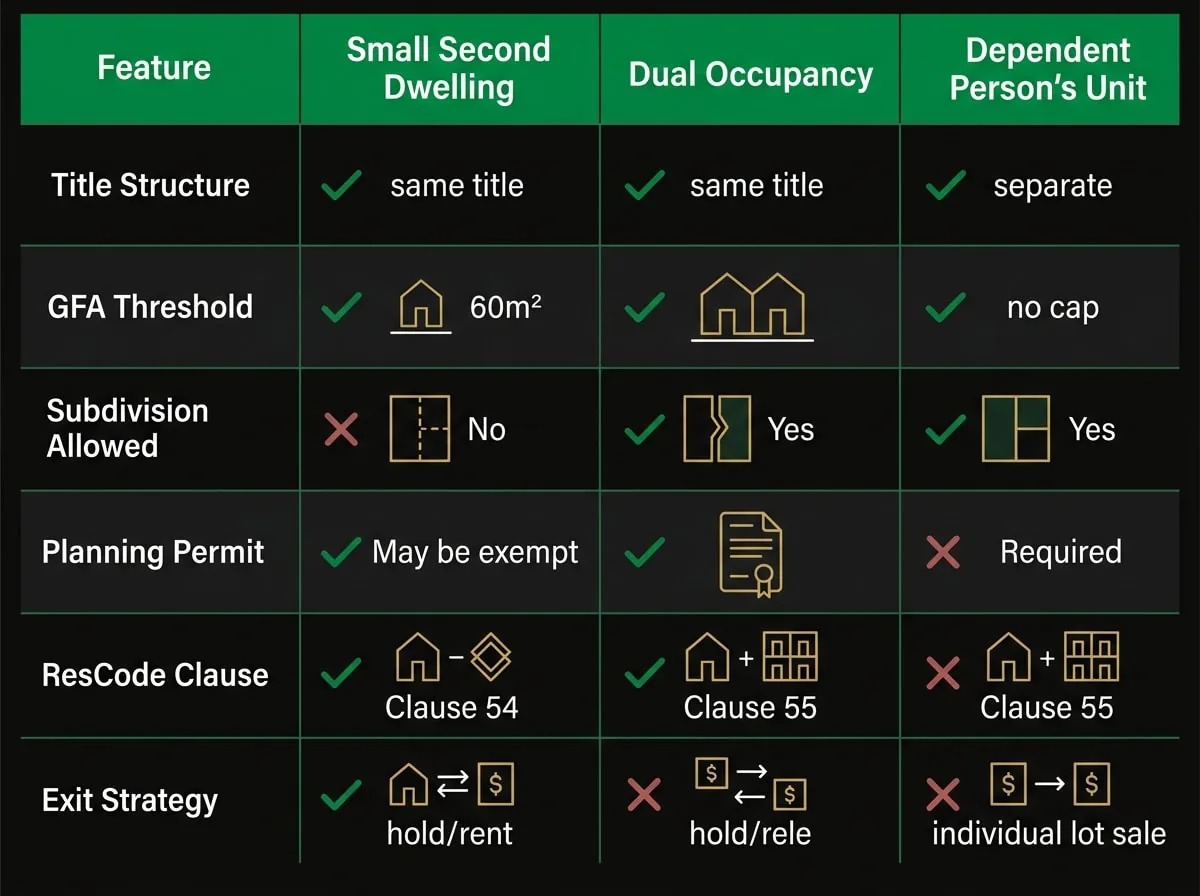
Critically, the updated provisions have introduced a clearer distinction between a small second dwelling and a conventional dual occupancy. A small second dwelling is intended to remain on the same title as the primary dwelling — it cannot be subdivided into a separate lot under the updated framework without a separate planning permit and subdivision process. This distinction has significant implications for developers whose exit strategy relies on individual lot sales rather than a single-title investment hold or rental yield model.
Planning Permit Requirements: When You Need One and When You Don’t
One of the most practically significant aspects of the updated provisions is the question of whether a planning permit is required at all. Under certain zone and overlay combinations, a small second dwelling meeting the 60m² threshold may be exempt from the requirement to obtain a planning permit, subject to compliance with the relevant ResCode standards and any applicable overlay controls.
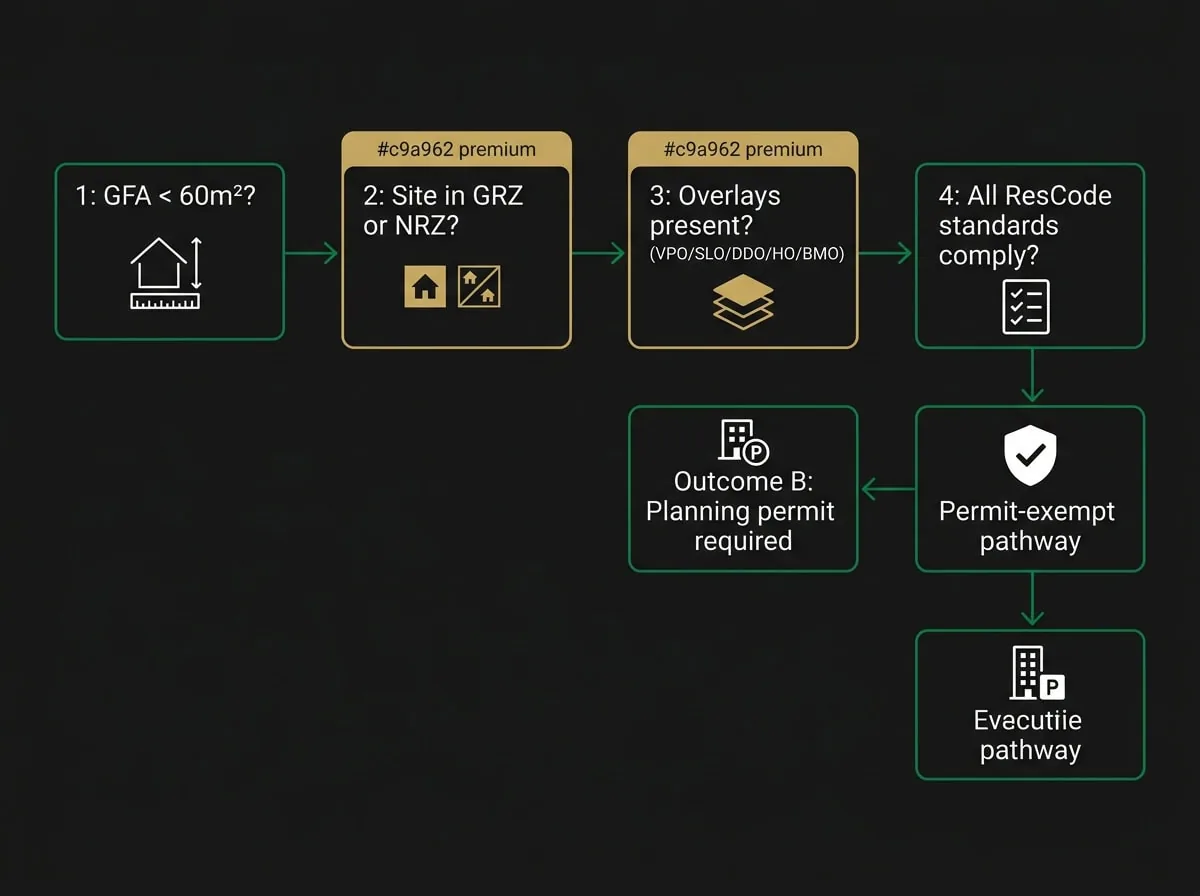
In the General Residential Zone (GRZ), which covers a substantial proportion of Melbourne, a small second dwelling may be constructed without a planning permit where it meets all of the following conditions: the gross floor area does not exceed 60m²; the lot has an existing dwelling; the proposal complies with all applicable ResCode standards (including setbacks, site coverage, and overlooking); and no overlay triggers a permit requirement. The most common overlays that may still require a permit include the Vegetation Protection Overlay (VPO), Significant Landscape Overlay (SLO), and Design and Development Overlay (DDO).
In the Neighbourhood Residential Zone (NRZ), the position is more restrictive. Many councils across Melbourne have applied the NRZ to their lower-density residential precincts, and in this zone, a planning permit may still be required even for a small second dwelling meeting the 60m² threshold. Developers should not assume that the permit exemption applies uniformly — a zone and overlay check is an essential first step for any site assessment.
- General Residential Zone (GRZ): Permit exemption may apply for compliant small second dwellings under 60m²
- Neighbourhood Residential Zone (NRZ): Planning permit likely required regardless of size threshold
- Mixed Use Zone (MUZ): Separate assessment pathway applies — seek specific guidance
- Overlay controls: VPO, SLO, DDO, and Heritage Overlay may each independently trigger a permit requirement
- Bushfire Management Overlay (BMO): Relevant in parts of Knox and Maroondah — additional requirements apply
Get the 7-point site check to run before committing to a permit application — zoning, overlays, setbacks and council red flags, in plain English. Free PDF, instant download.
- Zone, overlay & setback checks
- What council assesses first
- Permit-readiness red flags
Something went wrong. Please try again.
No spam. Unsubscribe anytime.
Check your inbox — your checklist is on its way.
Transitional Rules: What They Mean for Projects Already in the Pipeline
The transitional provisions are arguably the most complex aspect of the updated framework for developers with projects already underway. Victorian planning scheme amendments typically include transitional rules that determine which version of the provisions applies to a given application, depending on when it was lodged and what stage it has reached.
As a general principle, applications lodged before the commencement date of the relevant amendment are assessed under the provisions in force at the time of lodgement. This means that if you lodged a planning permit application for a secondary dwelling under the previous provisions, the Responsible Authority is generally required to assess that application under the old rules, even if the new provisions would produce a different outcome. However, applicants may in some circumstances elect to have their application assessed under the new provisions if this is more favourable — this is a decision that warrants careful consideration with your architect and planning consultant. For context on how accelerated pathways may interact with transitional rules, see our guide to the Fast-Track Planning Bill.
For developers who have received a planning permit under the previous provisions but have not yet commenced construction, the transitional rules may affect whether that permit remains operative and whether any conditions need to be revisited. If your permit was granted with conditions referencing superseded ResCode standards, you may need to seek an amendment to the permit under Section 72 of the Planning and Environment Act 1987 to align with updated requirements — particularly if your building permit application triggers a review of compliance.
It is also worth noting that the transitional provisions interact with the two-year commencement requirement for planning permits. If your permit is approaching its expiry date and you have not yet commenced development, you may need to apply for an extension of time while also considering whether the updated provisions affect the viability of your approved design. Early engagement with your architect is strongly advisable to avoid permit lapse.
Council-Specific Variations Across Melbourne
While the updated provisions establish a state-wide framework, individual councils retain the ability to apply local variations through their planning scheme schedules. Developers working across multiple councils in Melbourne will encounter meaningful differences in how the small second dwelling provisions are implemented in practice.
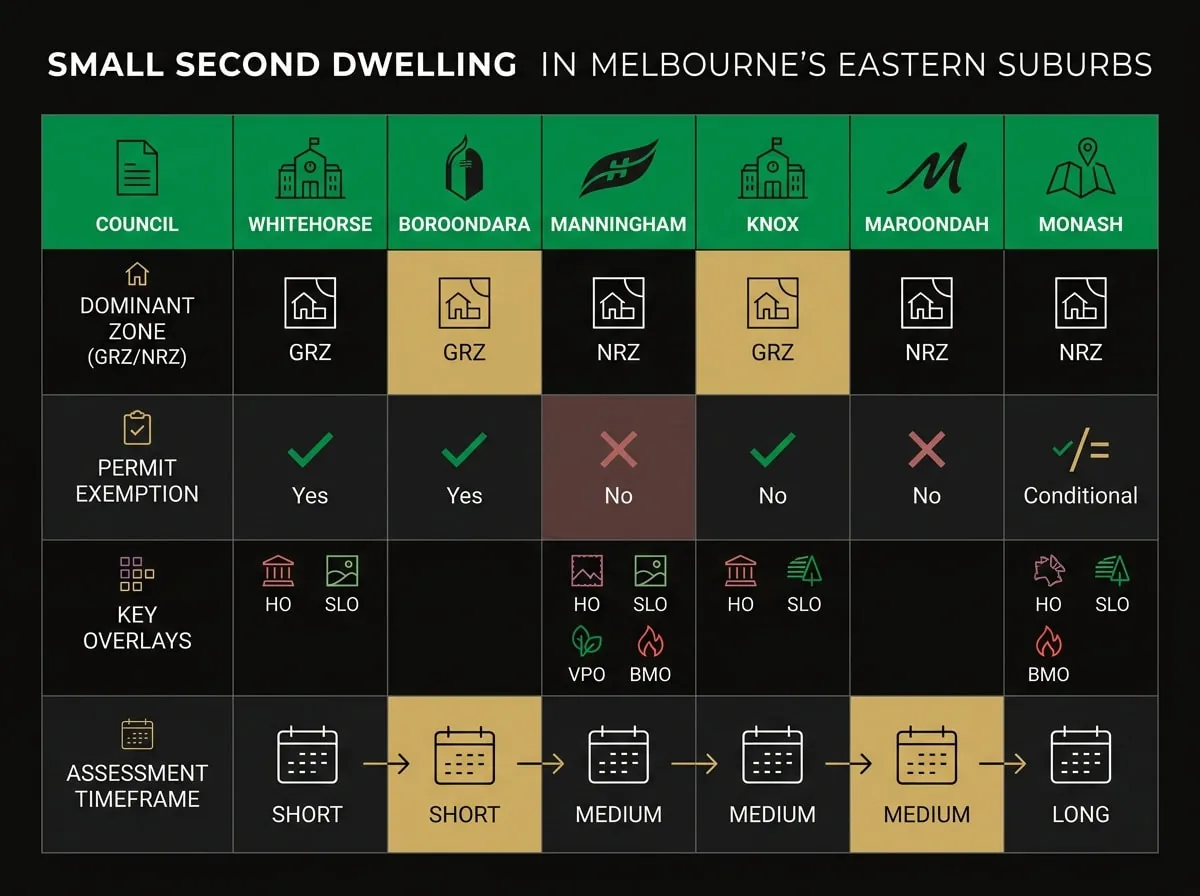
City of Whitehorse
The City of Whitehorse has applied the NRZ across a significant portion of its residential land, particularly in established precincts such as Box Hill South, Nunawading, and Mitcham. In these areas, a planning permit is likely required for a small second dwelling even where the 60m² threshold is met. The City of Whitehorse planning scheme schedule to the NRZ may also specify minimum lot sizes for secondary dwellings in some precincts, which may affect viability on smaller infill sites — always check the current zone schedule for your specific site. Developers should review the specific schedule provisions for their site rather than relying on general zone rules.
City of Boroondara
The City of Boroondara is one of the more restrictive councils in Melbourne for residential development. Much of its residential land is zoned NRZ, and the council has historically applied a conservative approach to secondary dwellings. Heritage overlays are also prevalent across Hawthorn, Kew, and Camberwell, which may trigger additional permit requirements and design constraints. Developers should factor in longer assessment timeframes and a higher likelihood of requests for further information when planning their programme in Boroondara.
Manningham City Council
Manningham City Council covers a mix of GRZ and NRZ land, with significant areas of Doncaster and Templestowe in the GRZ where the permit exemption pathway may be available for compliant small second dwellings. However, the Significant Landscape Overlay applies to substantial areas of Manningham, particularly in hillside and ridgeline locations, and this overlay will typically trigger a planning permit requirement regardless of the dwelling size. Tree protection requirements are also a notable consideration in Manningham, with the council’s local law and the VPO both potentially affecting site layout.
Knox City Council and Maroondah City Council
Knox City Council and Maroondah City Council both include areas subject to the Bushfire Management Overlay, which introduces additional requirements for any new dwelling — including a small second dwelling — in affected areas. Developers should obtain a BAL (Bushfire Attack Level) assessment early in the design process, as this can affect construction costs and development viability. Outside of BMO areas, both councils have a reasonable proportion of GRZ land where the updated provisions may offer a more streamlined pathway for small second dwellings.
City of Monash
The City of Monash has been an active participant in Melbourne’s middle-ring densification, and its planning scheme reflects a generally more permissive approach to residential development in GRZ areas. Developers working in suburbs such as Glen Waverley, Mount Waverley, and Oakleigh East may find that the updated small second dwelling provisions offer genuine opportunities for permit-exempt secondary dwellings on appropriately sized lots. However, the council’s local policies on neighbourhood character and the application of the DDO in some activity centre precincts should be reviewed on a site-by-site basis.
ResCode Compliance: Key Standards for Small Second Dwellings
Whether or not a planning permit is required, a small second dwelling must comply with the relevant ResCode standards set out in the Victorian planning scheme — typically under Clause 54 or Clause 55 depending on how the proposal is formally characterised. Developers should confirm with their architect which clause applies to their specific proposal, as this affects which standards govern the assessment.
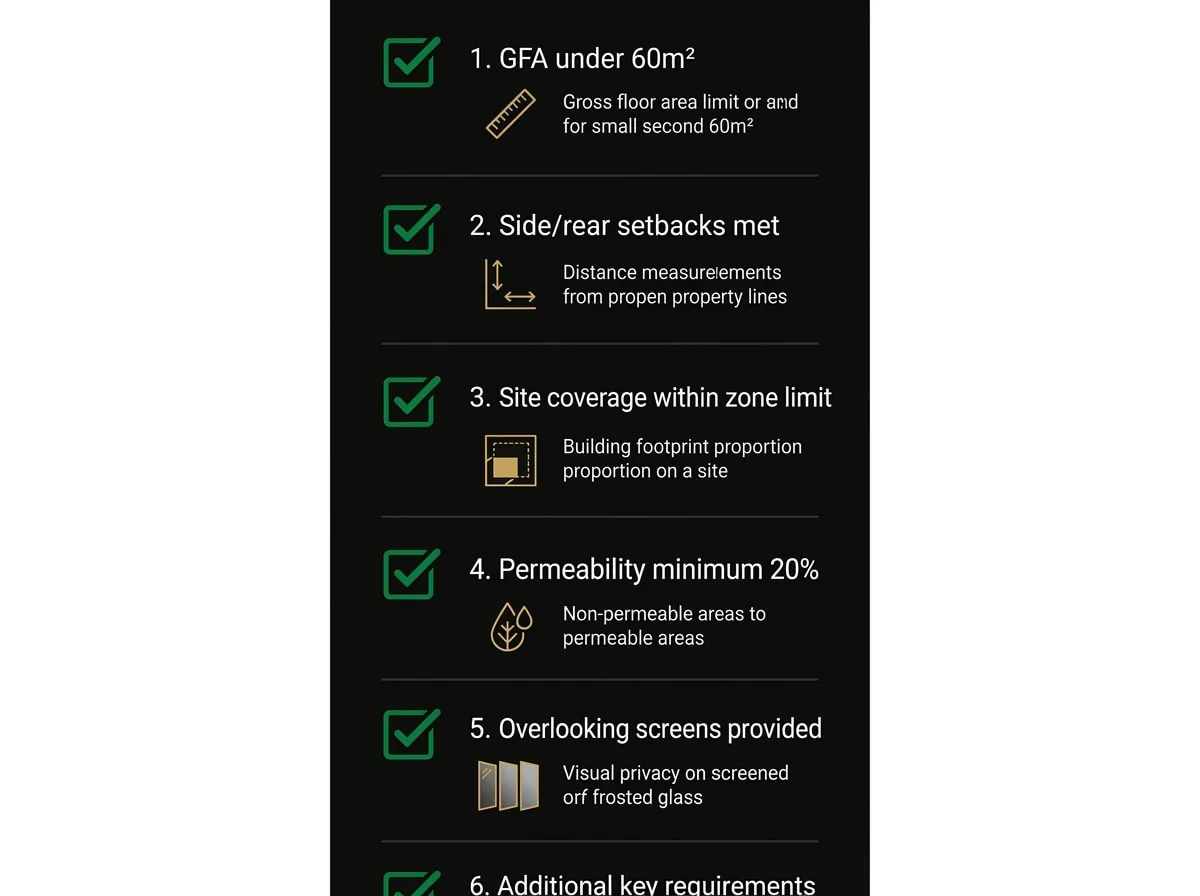
The following ResCode standards are particularly relevant for small second dwellings and warrant careful attention during the design phase:
- Side and rear setbacks: The required setback varies with wall height, zone, and distance from the relevant boundary. Refer to the applicable ResCode standard and zone schedule for your site.
- Site coverage: The combined site coverage of all buildings on the lot — including the primary dwelling — must not exceed the applicable maximum set out in the relevant zone schedule. Often up to 60% in GRZ areas, but always verify against the current schedule.
- Permeability: A minimum proportion of the site must remain permeable — generally at least 20%, though this may vary by zone schedule. This can be a constraint on smaller lots with existing hard surfaces. See also our guide to minimum garden area requirements in Victoria for related site coverage considerations.
- Overlooking: Windows and balconies must be screened or offset to avoid direct overlooking of habitable rooms and private open space in adjoining properties. Refer to the relevant overlooking standard for your zone.
- Overshadowing: The proposal must not cause unreasonable overshadowing of the secluded private open space of adjoining properties — refer to the applicable ResCode standard.
- Private open space: Each dwelling must have access to a minimum area of private open space — requirements vary by zone and dwelling type; confirm the applicable standard with your architect.
- Car parking: Car parking requirements vary by zone and council schedule — generally one space per dwelling is a common starting point, but confirm the applicable requirement for your site.
Achieving compliance with all applicable ResCode standards on a constrained lot — particularly where an existing dwelling already occupies a significant portion of the site — requires careful design coordination. SQM Architects routinely undertakes ResCode compliance assessments as part of our concept design process, helping developers identify potential issues before committing to a site or a design direction.
Practical Tips for Developers Assessing Small Second Dwelling Opportunities
Based on SQM Architects’ experience across Melbourne, the following practical guidance may assist developers in assessing and progressing small second dwelling opportunities under the updated provisions.
- Conduct a zone and overlay check first: Before any design work, confirm the zone, all applicable overlays, and the relevant schedule provisions for your site. This will determine whether a planning permit is required and what assessment pathway applies.
- Assess lot size and existing dwelling footprint early: The viability of a small second dwelling is heavily influenced by the size of the lot and the footprint of the existing dwelling. Smaller lots may face significant constraints in meeting ResCode standards for both dwellings simultaneously.
- Consider the 60m² threshold strategically: A dwelling designed just under the threshold may qualify for a permit-exempt pathway, while a dwelling marginally over it may require a full planning permit. The time and cost difference between these pathways may be significant — factor this into your design brief.
- Review transitional provisions if you have an existing permit: If you hold a permit granted under the previous provisions, seek advice on whether the updated rules affect your permit conditions or your building permit application.
- Engage your architect before purchasing the site: A pre-purchase assessment from SQM Architects may help identify potential planning risks, ResCode constraints, and indicative development considerations before you commit capital — our Book a Strategy Call is available for this purpose.
- Factor in council-specific timeframes: Assessment timeframes vary significantly across Melbourne — build realistic programme contingencies into your development model. See our planning permit timeline guide for council-by-council context.
- Do not conflate small second dwellings with dual occupancy subdivision: If your exit strategy requires separate titles, a small second dwelling under the updated provisions is not the right vehicle. You will need a dual occupancy planning permit and a separate subdivision application — a different process with different requirements.
Frequently Asked Questions
Can I subdivide a small second dwelling into a separate lot?
No — under the updated provisions, a small second dwelling is intended to remain on the same title as the primary dwelling. If you wish to create a separately titled lot, you will need to pursue a dual occupancy planning permit and a subdivision application, which involves a different assessment pathway and additional requirements. Developers whose development model depends on individual lot sales should seek specific guidance on the dual occupancy pathway before committing to a small second dwelling design.
Does the 60m² threshold include a garage or carport?
Where a garage or carport forms an integral part of the small second dwelling structure, it is generally included in the gross floor area calculation. A detached garage or carport that is structurally separate from the dwelling may be treated differently, but this is a design and interpretation question that should be confirmed with your architect and, where necessary, with the Responsible Authority before finalising your design.
My planning permit was lodged before the amendments commenced. Which provisions apply?
Applications lodged before the commencement date of the relevant amendment are generally assessed under the provisions in force at the time of lodgement. However, in some circumstances, applicants may elect to have their application assessed under the new provisions if this produces a more favourable outcome. This is a decision that warrants careful consideration — seek guidance from your architect or planning consultant before making an election.
Are there minimum lot size requirements for a small second dwelling?
Minimum lot size requirements are not set at the state level for small second dwellings, but individual council planning scheme schedules may specify minimum lot sizes for secondary dwellings in particular zones. Always check the relevant zone schedule for your specific site rather than relying on general guidance.
Can I build a small second dwelling in a Heritage Overlay area?
A Heritage Overlay will typically trigger a planning permit requirement for any new building or works, including a small second dwelling. The permit application will need to demonstrate that the proposal is sympathetic to the heritage significance of the place and the surrounding precinct. In practice, this means that the design of the second dwelling — including its siting, form, materials, and relationship to the primary dwelling — will be subject to heritage assessment. This is a common scenario in the City of Boroondara and parts of the City of Whitehorse.
How long does a planning permit application for a small second dwelling typically take?
Assessment timeframes vary by council and by the complexity of the application. In councils where the permit-exempt pathway is available and the proposal is straightforward, no planning permit is required at all, and the process moves directly to building permit. Where a planning permit is required, timeframes vary by council and application complexity — straightforward applications may be assessed within a few months, while complex sites with heritage, landscape, or neighbourhood character overlays typically take longer. Manningham City Council and City of Boroondara have historically had longer assessment timeframes than City of Monash or Knox City Council.
What is the difference between a small second dwelling and a dependent person’s unit?
A dependent person’s unit is a separate planning use category under the Victorian planning scheme, typically defined as a moveable building on the same lot as an existing dwelling, used to house a dependent person. A small second dwelling, by contrast, is a permanent structure. The two categories have different planning requirements and different implications for future use and resale. Developers should confirm which category applies to their proposed development before proceeding with design or permit applications.
Conclusion: Positioning Your Development Programme for the Updated Framework
The updated small second dwelling provisions may offer meaningful opportunities for Melbourne developers — particularly those working in GRZ areas across Melbourne — to deliver secondary dwellings more efficiently and with greater planning predictability. However, the framework is not uniform: council-specific variations, overlay controls, and transitional rules mean that the pathway for any given site requires careful, site-specific assessment. Developers who invest in thorough upfront due diligence — including zone and overlay checks, ResCode compliance assessments, and preliminary indicative assessments — are best positioned to capture the opportunities these provisions may create.
SQM Architects has supported property developers across Melbourne for many years. Our team understands the nuances of each council’s planning scheme and can provide practical, grounded guidance on how the updated provisions may apply to your specific site and development strategy. To find out how the updated small second dwelling provisions may affect your next project, get your Book a Strategy Call from SQM Architects today — call us on (03) 9005 6588 or submit your site details online.
This article provides general information only. For project-specific guidance, consult with a qualified architect or planning professional.