Why Approval Times Now Define Your Townhouse Development Outcome
For Melbourne property developers, holding costs are the silent killer of townhouse project returns. Every additional month a planning permit sits in assessment adds finance charges, delays presales, and erodes the development outcome you modelled at acquisition. Until recently, the average planning permit assessment time across Victoria sat at 145 days — well beyond the statutory 60-day deadline — with VCAT appeals adding a further average of 175 days from lodgement to hearing. For a four-townhouse project in Melbourne, that timeline may represent significant additional holding costs in finance charges alone, depending on finance structure and project scale.
The landscape changed materially on 31 March 2025, when the Victorian Government gazetted Amendment VC267, introducing the Townhouse and Low-Rise Code — a deemed-to-comply assessment pathway under Clause 55 of all planning schemes. For developers who understand how to use it, this reform may represent the most significant reduction in planning risk for townhouse projects in a generation. For those who don’t, the old delays remain very much alive.
This guide provides comparative approval time data across Melbourne councils, explains how the new Townhouse and Low-Rise Code interacts with local overlays, and outlines the practical steps that may help your next townhouse application move through assessment as efficiently as possible. SQM Architects has delivered 210+ projects across Melbourne over 12+ years, with a track record of approximately 98% planning approval across completed projects — and the insights below reflect what that experience has taught us about navigating council-by-council variations.
Read our Complete Guide to Dual Occupancy
The Baseline: What Approval Times Looked Like Before March 2025
To understand the value of the new framework, it helps to understand what developers were working against. Prior to Amendment VC267, a standard townhouse planning permit application in Melbourne typically moved through the following stages: lodgement, request for further information (RFI), advertising, assessment, and decision. Each stage carried its own delay risk, and councils varied considerably in how efficiently they managed their statutory obligations.
Based on Planning Permit Activity Reporting System (PPARS) data and industry experience, the pre-2025 picture for Melbourne councils looked broadly like this:
- City of Boroondara: 160–220 days average for townhouse permits, with Heritage Overlay (HO) sites frequently exceeding 300 days
- City of Whitehorse: 130–170 days for standard residential applications, with Design and Development Overlay (DDO) sites adding complexity
- Manningham City Council: 120–160 days, with Significant Landscape Overlay (SLO) sites in Templestowe and Doncaster East pushing timelines out considerably
- City of Monash: 110–150 days, generally more consistent processing in General Residential Zone (GRZ) areas
- Knox City Council: 100–140 days, with relatively lower overlay complexity in many residential precincts
- Maroondah City Council: 100–145 days, with Residential Growth Zone (RGZ) sites around Ringwood generally processing more efficiently
These figures represent calendar days from lodgement to decision, excluding VCAT appeal time. Applications that attracted objections — common in established suburbs like Camberwell, Balwyn, and Doncaster — routinely extended beyond these ranges, as the responsible authority could not issue a permit until the 28-day VCAT appeal window closed following a Notice of Decision. If an objector lodged a VCAT application for review, developers faced an additional 175-day average wait before a hearing.
The New Framework: Three Approval Pathways in 2025–2026
The 2025–2026 planning reform environment has introduced a tiered structure for residential approvals that developers need to understand clearly. The pathway your project follows will determine not just how long approval takes, but whether third-party objectors can appeal to VCAT at all.
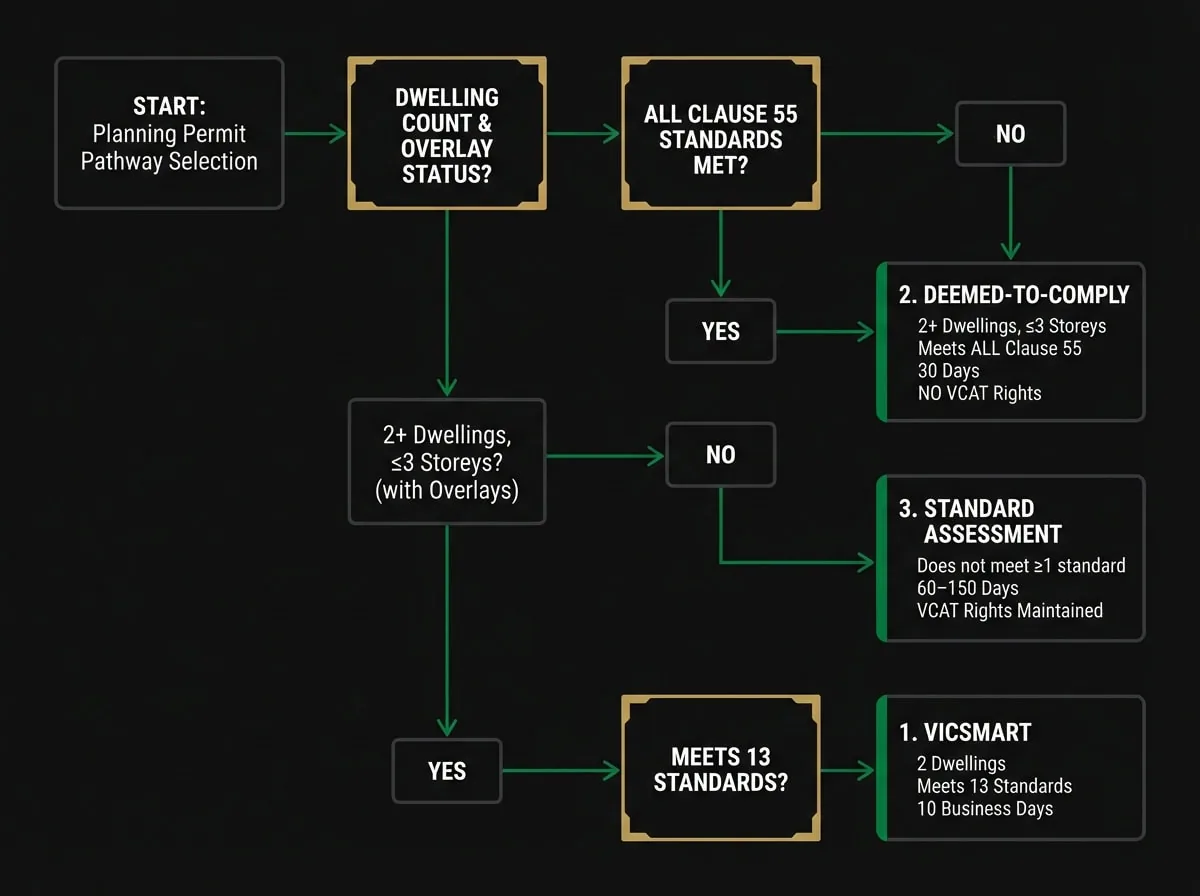
Pathway 1: Deemed-to-Comply Under the Townhouse and Low-Rise Code (Target: 30 Days)
If your townhouse development of two or more dwellings up to three storeys meets all applicable standards under the revised Clause 55, the application is deemed to comply. The responsible authority is not required to consider additional qualitative policy interpretations or decision guidelines for those standards. Critically, third-party appeal rights to VCAT are removed for compliant applications — the single most significant time-saving mechanism for developers in established suburbs where objections were previously routine.
The key Clause 55 standards that trigger deemed-to-comply status include neighbourhood character standards (Clause 55.02), daylight to existing windows (Clause 55.04-1), north-facing windows (Clause 55.04-2), overshadowing of secluded open space (Clause 55.04-3), overlooking (Clause 55.04-4), and overshadowing of domestic solar energy systems (Clause 55.05-2). Applications must include a formal written statement detailing which standards are met. Where a standard is not met, a detailed justification against the relevant objective and decision guidelines is required.
Pathway 2: Standard Assessment with Clause 55 Discretion (Target: 60 Days)
Where a development does not meet one or more Clause 55 standards, the standard planning permit process applies. The responsible authority assesses the application against the relevant objectives and decision guidelines. Third-party appeal rights are maintained. This pathway may still result in permit approval, but without the speed or certainty of the deemed-to-comply track. In practice, applications on this pathway in Melbourne councils may still take 90–150 days, particularly where advertising generates objections.
Pathway 3: VicSmart for Two-Dwelling Developments (Target: 10 Business Days)
Under Amendment VC288 (October 2025), most two-dwelling developments and two-lot subdivisions now qualify for the VicSmart pathway, provided they meet 13 specific character standards. VicSmart applications are assessed without advertising and without third-party rights. The 10-business-day target represents a dramatic acceleration for duplex-scale projects. Prior to this change, VicSmart was averaging around 29 days even for eligible applications — itself a significant improvement over standard assessment. For duplex-scale projects, see our Dual Occupancy Melbourne Guide for site-specific eligibility considerations.
Get the 7-point site check to run before committing to a permit application — zoning, overlays, setbacks and council red flags, in plain English. Free PDF, instant download.
- Zone, overlay & setback checks
- What council assesses first
- Permit-readiness red flags
Something went wrong. Please try again.
No spam. Unsubscribe anytime.
Check your inbox — your checklist is on its way.
How Melbourne Overlays Still Affect Your Timeline
The Townhouse and Low-Rise Code is a state-wide instrument, but local overlays remain the primary variable that determines whether your project accesses the fast-track pathway or reverts to standard assessment. This is where Melbourne developers need to exercise particular care at the site acquisition stage.
Heritage Overlay (HO) — City of Boroondara and Manningham City Council
The City of Boroondara has one of the highest concentrations of Heritage Overlay-affected residential land in metropolitan Melbourne. Suburbs including Camberwell, Hawthorn East, Kew, and Balwyn contain extensive HO precincts where a planning permit is required regardless of whether Clause 55 deemed-to-comply standards are met. Heritage assessment involves additional referral to the council’s heritage advisor, extended advertising periods, and — critically — maintained third-party VCAT appeal rights even for otherwise compliant applications. Developers acquiring sites in Boroondara should budget for 180–240 days on HO-affected land under current conditions.
Manningham City Council’s heritage precincts are more localised but include parts of Doncaster and Templestowe Lower. The Significant Landscape Overlay (SLO) is a more pervasive concern in Manningham, affecting sites with significant vegetation and triggering arborist report requirements at lodgement. New Clause 55.03-6 rules strictly limit crossover encroachment to less than 10% of a street tree’s Tree Protection Zone (TPZ), making arborist input essential before design is finalised.
Design and Development Overlay (DDO) — City of Whitehorse
The City of Whitehorse applies Design and Development Overlays across several activity centre precincts, including Box Hill and Nunawading. DDO-affected sites may have specific height, setback, or built form requirements that interact with Clause 55 standards. Where DDO requirements conflict with or supplement Clause 55 standards, the deemed-to-comply pathway may be partially or fully unavailable. Pre-application engagement with City of Whitehorse planning officers is strongly advisable before finalising design on DDO-affected sites.
Neighbourhood Residential Zone (NRZ) — Across Melbourne
The NRZ applies across significant portions of Melbourne and carries a site coverage limit of 60% under the revised Clause 55.03-3. Developers accustomed to working in General Residential Zone (GRZ) areas — where 65% coverage is permitted — may find NRZ sites require more conservative footprint planning. The NRZ also commonly includes a mandatory two-dwelling maximum in its schedule, which effectively limits townhouse development to duplex scale in those precincts. Confirming the zone schedule before acquisition is essential.
Comparative Approval Time Data: Melbourne Council Summary (2025–2026)
The following indicative timeframes reflect the post-Amendment VC267 environment for townhouse planning permit applications in Melbourne. These figures are indicative based on available data and SQM Architects’ project experience — individual applications may vary based on site-specific factors, application quality, and council workload.
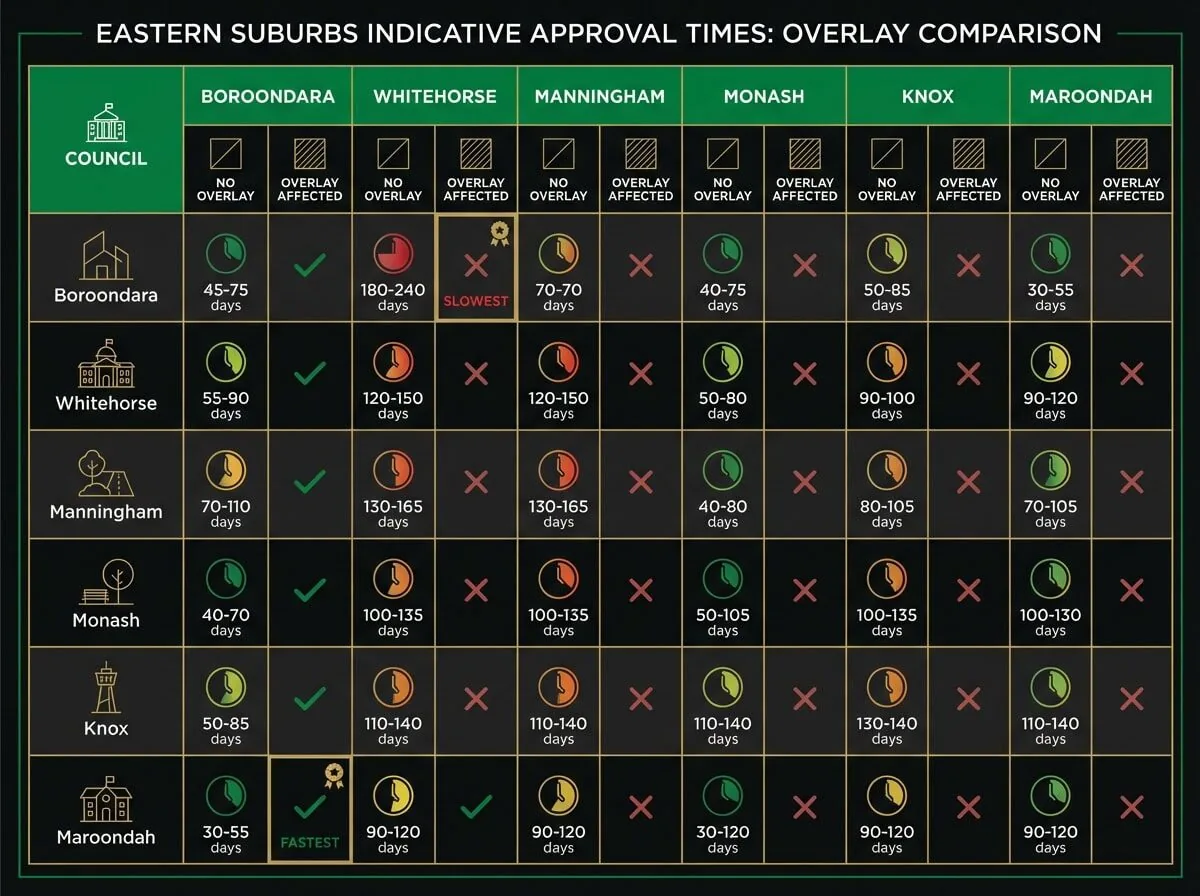
- City of Boroondara — No Overlay: 45–75 days (deemed-to-comply pathway); 150–200 days (standard assessment with objections)
- City of Boroondara — Heritage Overlay: 180–240 days; VCAT appeal rights maintained
- City of Whitehorse — GRZ, No Overlay: 40–70 days (deemed-to-comply); 110–160 days (standard)
- City of Whitehorse — DDO Affected: 90–150 days depending on DDO schedule requirements
- Manningham City Council — GRZ, No Overlay: 40–65 days (deemed-to-comply); 100–150 days (standard)
- Manningham City Council — SLO Affected: 90–160 days; arborist referral adds 3–6 weeks
- City of Monash — GRZ: 35–60 days (deemed-to-comply); 90–140 days (standard)
- Knox City Council — GRZ/NRZ: 35–60 days (deemed-to-comply); 85–130 days (standard)
- Maroondah City Council — RGZ (Ringwood): 30–55 days (deemed-to-comply); 80–125 days (standard)
The data illustrates a clear pattern: councils with lower overlay complexity — particularly City of Monash, Knox City Council, and Maroondah City Council — offer the most accessible deemed-to-comply pathway and the fastest indicative approval times. City of Boroondara remains the most challenging environment for townhouse approvals due to heritage overlay prevalence and historically conservative assessment culture, though the removal of third-party VCAT rights for compliant applications represents a meaningful improvement even in that context.
Key ResCode Standards That Determine Your Pathway
Understanding which Clause 55 standards are most commonly the source of non-compliance — and therefore most likely to push your application off the deemed-to-comply pathway — is essential for design efficiency. Based on SQM Architects’ experience across 210+ Melbourne projects, the following standards warrant particular attention during design development.
Tree Canopy (Clause 55.03-8)
The new mandatory tree canopy requirement — 10% of site area for lots up to 1,000m² and 20% for larger lots — is a genuinely new obligation introduced with Amendment VC267. Many townhouse designs that would otherwise comply with all other standards may fall short on canopy coverage if landscaping is treated as an afterthought. Engaging a landscape architect at schematic design stage, rather than at documentation stage, may help avoid costly redesign. Canopy coverage must be achievable at maturity, so species selection and planting locations need to be credible and supported by a landscape plan at lodgement.
Private Open Space (Clause 55.03-5)
The revised standard reduces the minimum private open space requirement from 40m² to 25m², provided minimum dimensions are met. This change meaningfully improves site efficiency for smaller lots, particularly in the NRZ where site coverage is already constrained at 60%. However, the quality and usability of open space — including solar access and dimensions — remains subject to assessment, and designs that technically meet the 25m² threshold but provide poorly oriented or dimensionally awkward spaces may still attract discretionary assessment.
Overlooking (Clause 55.04-6)
The revised overlooking standard no longer applies to bedroom windows, focusing controls only on primary living areas and secluded private open space. This relaxation provides meaningful design flexibility for upper-level layouts in townhouse developments, particularly on narrower lots where side setbacks are tight. Developers should note that this change applies to applications lodged after 31 March 2025 — applications lodged before that date continue to be assessed under the previous provisions.
Street Setback (Clause 55.03-1)
The standard front setback has been reduced to 6 metres (from 9 metres in many zones), or the lesser setback of an abutting dwelling. The removal of the “average of two adjoining dwellings” rule simplifies compliance considerably and reduces the risk of non-compliance on streets with inconsistent existing setbacks. This change alone may unlock deemed-to-comply status for projects that would previously have required a variation.
Practical Tips to Accelerate Your Planning Permit Application
The deemed-to-comply pathway is not automatic — it requires a well-prepared application that clearly demonstrates compliance with every applicable standard. Based on SQM Architects’ 12+ years of experience in Melbourne, the following steps may help position your application for the fastest possible outcome.

- Conduct a pre-application meeting: Most Melbourne councils offer pre-application meetings with planning officers. These sessions may help confirm overlay triggers, identify potential non-compliance issues before lodgement, and reduce the likelihood of RFI delays. Pre-application engagement is generally associated with fewer objections and a smoother assessment process in comparable projects.
- Prepare a comprehensive written statement: Applications for two or more dwellings must include a formal written statement addressing each applicable Clause 55 standard. A thorough, well-structured statement that clearly maps each design element to the relevant standard reduces the risk of RFI requests and demonstrates to the responsible authority that the application is ready for assessment.
- Commission an arborist report early: On any site with street trees or significant on-site vegetation, an arborist report should be commissioned before design is finalised. New Clause 55.03-6 rules on TPZ encroachment can affect driveway and crossover placement in ways that require design adjustment — discovering this at lodgement stage adds weeks to your timeline.
- Confirm your zone and overlay status via VicPlan: Before acquiring a site or finalising a design brief, use the state government’s VicPlan tool to confirm the zone, any applicable overlays, and the zone schedule. NRZ schedules with two-dwelling maximums, DDO height limits, and HO triggers are all site-specific and can fundamentally alter your development yield and approval pathway.
- Lodge a complete application: Incomplete applications are the primary cause of RFI delays, which stop the statutory clock and can add 4–8 weeks to your timeline. Ensure all required documents — site plans, elevations, shadow diagrams, landscape plans, written statement, and fee payment — are included at lodgement.
- Consider the Metropolitan Planning Levy: For projects with a development value above $1,344,000 (threshold from 1 July 2026), the Metropolitan Planning Levy (MPL) of 0.13% of development value must be paid to the State Revenue Office before lodging your planning permit application. Failure to obtain the MPL certificate will result in your application being rejected at lodgement.
Frequently Asked Questions
What is the deemed-to-comply pathway and how does it affect my townhouse approval time?
The deemed-to-comply pathway, introduced under Amendment VC267 on 31 March 2025, allows townhouse applications that meet all applicable Clause 55 standards to be fast-tracked without further discretionary assessment. The target assessment time for compliant applications is approximately 30 days, compared to the pre-2025 average of 145 days. Critically, third-party VCAT appeal rights are removed for deemed-to-comply applications, eliminating a major source of delay in established suburbs.
Does the Townhouse and Low-Rise Code apply in all Melbourne councils?
Yes — the Townhouse and Low-Rise Code operates through an amendment to all Victorian planning schemes, so it applies across City of Boroondara, City of Whitehorse, Manningham City Council, City of Monash, Knox City Council, and Maroondah City Council. However, local overlays such as Heritage Overlays, Design and Development Overlays, and Significant Landscape Overlays can still trigger additional permit requirements and may prevent full access to the deemed-to-comply pathway.
Can objectors still appeal to VCAT if my townhouse application is deemed to comply?
No — one of the most significant features of the new framework is that third-party objector appeal rights to VCAT are removed for applications that are fully compliant with the Townhouse and Low-Rise Code. Neighbours may still be notified and may make submissions, but they cannot lodge a VCAT application for review of a deemed-to-comply decision. This change may substantially reduce approval risk in suburbs where objections were previously common.
What happens if my site has a Heritage Overlay — can I still use the deemed-to-comply pathway?
A Heritage Overlay triggers a separate planning permit requirement that operates alongside Clause 55. Even if your development meets all Clause 55 deemed-to-comply standards, the Heritage Overlay assessment remains a separate process with its own requirements, advertising obligations, and third-party VCAT appeal rights. In practice, HO-affected sites in areas like Boroondara and parts of Whitehorse may still face approval timelines of 180–240 days. Early engagement with a heritage consultant and the responsible authority’s heritage advisor is advisable.
What is the VicSmart pathway and is my duplex project eligible?
VicSmart is a streamlined planning permit assessment process for straightforward applications, targeting a 10-business-day determination. Under Amendment VC288 (October 2025), most two-dwelling developments and two-lot subdivisions now qualify for VicSmart, provided they meet 13 specific character standards. VicSmart applications are assessed without advertising and without third-party rights. If your project is a duplex on a site without complex overlays, VicSmart eligibility is worth confirming with the responsible authority before lodgement.
How does car parking assessment work for townhouses under the 2025–2026 rules?
Amendment VC277, effective 18 December 2025, updated Clause 52.06 to use the Public Transport Accessibility Level (PTAL) methodology. Sites in high-access areas (Category 4) may have no minimum parking requirement, with maximum caps of two spaces per dwelling introduced. Sites in low-access areas (Category 1) continue to apply traditional minimum parking rates. Melbourne locations vary considerably in their PTAL category — confirming your site’s classification early may affect both design efficiency and development yield.
What is the Metropolitan Planning Levy and when does it apply to townhouse projects?
The Metropolitan Planning Levy (MPL) applies to planning permit applications where the estimated development cost exceeds $1,344,000 (threshold from 1 July 2026). The levy rate is 0.13% of the development value, payable to the State Revenue Office before lodging your application. An MPL certificate must accompany your planning permit application — without it, the responsible authority cannot accept your lodgement. For most multi-townhouse projects in Melbourne, the MPL threshold is likely to be exceeded, so this step should be built into your pre-lodgement checklist.
What This Means for Your Next Melbourne Townhouse Project
The 2025–2026 planning reform environment has created a genuine opportunity for well-prepared developers to compress townhouse approval timelines from 145+ days to 30–60 days — but only for applications that are designed for compliance from the outset. The deemed-to-comply pathway rewards thorough pre-application work, complete lodgement documentation, and design that genuinely meets Clause 55 standards rather than relying on discretionary assessment to bridge gaps. The removal of third-party VCAT appeal rights for compliant applications is a structural change that may materially reduce approval risk in established Melbourne suburbs where objections were previously a routine source of delay and cost.
Council-by-council variation remains significant. City of Monash, Knox City Council, and Maroondah City Council offer the most accessible deemed-to-comply environment for standard GRZ and RGZ sites. City of Boroondara and Manningham City Council present greater overlay complexity, particularly for Heritage Overlay and Significant Landscape Overlay-affected sites. Understanding these differences at the site acquisition stage — before design investment is made — is where experienced architectural guidance may deliver the most measurable value to your development outcome.
SQM Architects has guided 210+ projects through Melbourne planning system over 12+ years, with deep experience across council-by-council variations in Melbourne planning system. If you are assessing a townhouse development site or preparing a planning permit application, our team can provide a site-specific assessment of your approval pathway options.
Book a Strategy Call — call us on (03) 9005 6588 or submit your site details online.
This article provides general information about Victorian planning for property developers. It does not constitute professional advice. For specific guidance on your project, contact SQM Architects for a complimentary site assessment.