

If you are developing residential apartments or mixed-use buildings in Melbourne’s Eastern Suburbs, understanding Victoria’s cladding regulatory framework is no longer optional — it is a fundamental part of your project planning. Since the Grenfell Tower fire in 2017 and subsequent Australian incidents, the Victorian Government has progressively tightened cladding requirements, established dedicated rectification agencies, and introduced new compliance pathways that directly affect how you design, specify, and deliver external wall systems.
This guide provides property developers with a practical overview of the current cladding landscape in Victoria, including the role of Cladding Safety Victoria (CSV), the Cladding Risk Mitigation Framework (CRMF), Minister’s Guideline 15 (MG-15), and the National Construction Code (NCC) 2022 requirements that now govern new construction. Whether you are planning a new Class 2 apartment development in the City of Whitehorse or managing an existing building with legacy cladding issues in Manningham City Council, this information will help you navigate your obligations and protect your development outcome.
SQM Architects regularly assists developers in understanding how cladding compliance intersects with planning permit applications, building permits, and overall project feasibility. This article outlines the key frameworks, current reform context, and practical considerations every developer should be across in 2025–26.
What Is Cladding and Why Does It Matter for Developers?
Cladding refers to the external wall covering applied to a building’s facade. It serves multiple functions — weatherproofing, thermal performance, acoustic insulation, and aesthetic finish. However, not all cladding materials are created equal when it comes to fire safety. The materials that have attracted the most regulatory scrutiny in Victoria are aluminium composite panels (ACP) with a polyethylene core and expanded polystyrene (EPS) systems, both of which have been identified as posing elevated fire spread risk.
For developers, cladding decisions carry significant financial and legal weight. Specifying non-compliant materials on a new development may result in building permit refusal, enforcement action, or costly rectification after construction. For existing buildings, combustible cladding may trigger mandatory remediation requirements, affect the building’s insurability, and create liability exposure for owners corporations. Understanding the current regulatory environment is therefore essential to protecting your investment and managing project risk.
The Victorian Government’s response to the cladding issue has been one of the most comprehensive in Australia, involving a substantial rectification programme, a dedicated statutory agency, and a suite of new legislative instruments that continue to evolve. Developers working on new projects must also contend with updated NCC 2022 requirements, which introduced clarifications to fire safety provisions for external walls and restrictions on certain bonded laminated cladding panels.
The Victorian Cladding Regulatory Framework: Key Instruments
Victoria’s cladding regulatory framework is built on several interlocking instruments. Understanding how these interact is critical for developers and their design teams.
The Building Act 1993 and Building Regulations 2018
The foundational legislation governing building construction in Victoria is the Building Act 1993, supported by the Building Regulations 2018. These instruments give legal effect to the National Construction Code (NCC) requirements in Victoria. The Building and Plumbing Commission (BPC) — formerly the Building and Plumbing Commission (BPC) — manages compliance through registered building surveyors, who are responsible for issuing building permits and ensuring designs meet applicable standards.
For cladding specifically, the Building Act 1993 also provides the legislative basis for Minister’s Guidelines, including MG-15, which now plays a central role in how cladding risk is assessed and managed across Victoria. Developers should be aware that the BPC’s role as Municipal Building Surveyor (MBS) for cladding matters has been revoked, with responsibility transitioning to local councils and CSV.
National Construction Code 2022 and Cladding Requirements
The NCC 2022 (now incorporating Amendment 2) introduced several important changes relevant to external wall cladding on new buildings. Key provisions include clarifications to concessions from non-combustibility requirements and new provisions that prevent the fixing of certain bonded laminated cladding panels by adhesive only. These changes directly affect how architects and building surveyors specify and detail external wall systems on Class 2 apartment buildings and mixed-use developments.
The main provisions of NCC 2022 commenced in Victoria on 1 May 2023, with mandatory commencement of updated energy efficiency and condensation management requirements following on 1 May 2024. Developers planning new projects must ensure their design teams are working to the current NCC 2022 requirements, including the fire safety provisions for external walls. Buildings designed to earlier code versions may face compliance issues if building permit applications are lodged under the current regulatory framework.
Prohibition of Combustible External Wall Cladding
In 2021, the Minister for Planning declared the Prohibition of Combustible Materials Rulings under the Building Act 1993. These rulings prohibit the use of certain combustible cladding products on new buildings, providing clear guidance on which materials cannot be specified. For developers and their architects, this means that product selection for external wall systems must be carefully verified against the prohibited products list before any building permit application is lodged.
Cladding Safety Victoria: Role and 2025–26 Programme
Cladding Safety Victoria (CSV) was established in 2019 under the Cladding Safety Victoria Act 2020 to administer Victoria’s cladding rectification programme. Its core function is to collaborate with owners and owners corporations to help rectify non-compliant or non-conforming external wall cladding on existing residential and government-owned buildings. CSV provides support, guidance, and connections to appropriately registered practitioners.
The Victorian Government committed significant funding to the residential cladding rectification programme and a further allocation to address combustible cladding on government-owned buildings. As of 2025, works have been completed on a substantial number of privately owned and government-owned buildings, with CSV’s programme now entering its final stages.
CSV’s 2025–26 Annual Work Programme
CSV’s Annual Work Programme for 2025–26 details the activities intended to support the successful completion of the agency’s core remit. By mid-2026, every privately owned residential apartment building referred to CSV or discovered by it — as well as a range of government-owned buildings — is expected to have either had cladding removed or been risk-assessed and provided with appropriate advice and assistance. This includes all unacceptable-risk, elevated-risk, and low-risk buildings.
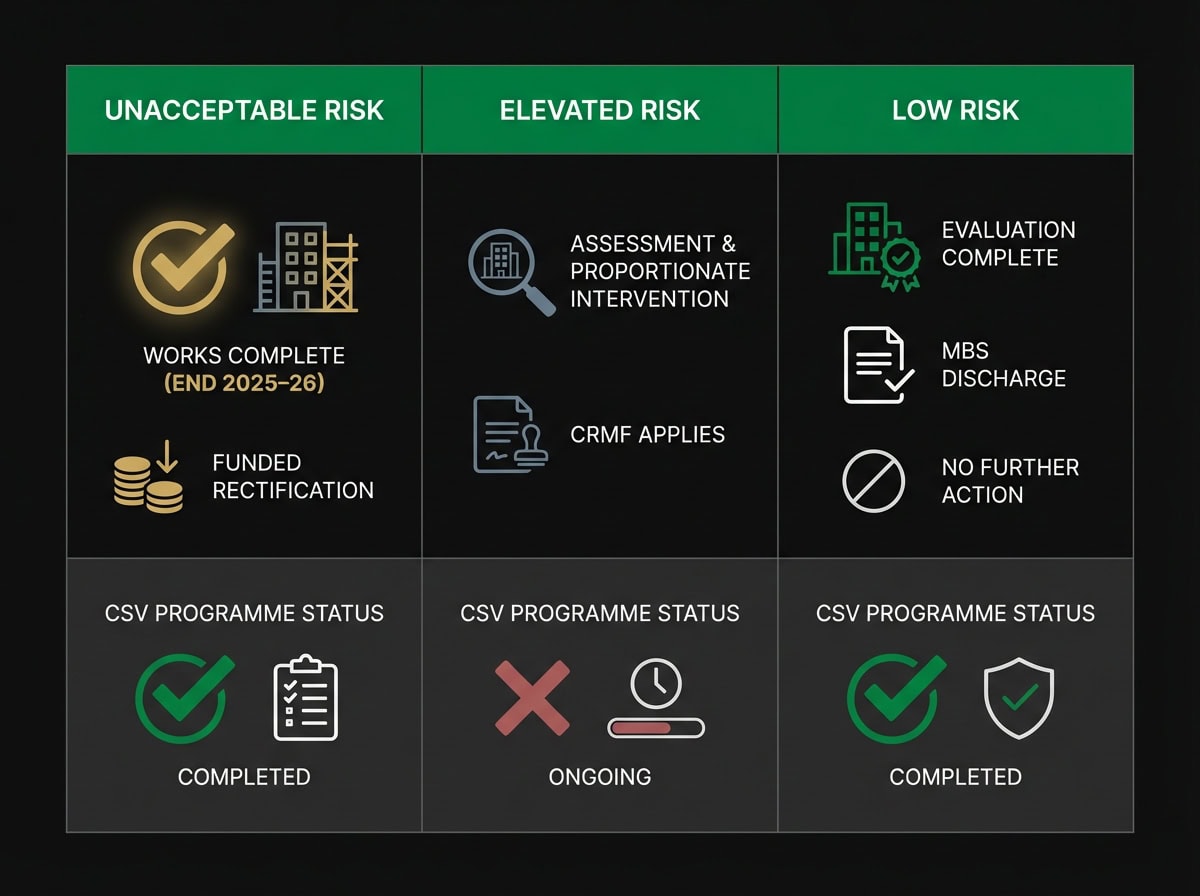
The programme is structured around three building risk categories:
- Unacceptable-risk buildings: By the end of 2025–26, works are expected to be complete on all unacceptable-risk Class 2 buildings in the CSV programme. CSV’s quality assurance processes and clerk of works programme support delivery of this final cohort.
- Elevated-risk buildings: CSV aims to complete assessments for all elevated-risk buildings and identify interventions that could reduce cladding risk to an acceptable level. Extensive cladding removal may not be required in all circumstances — CSV’s risk-reduction framework, publicly released in 2023–24, enables proportionate responses based on fire spread risk rather than a comprehensive list of building elements.
- Low-risk buildings: CSV aims to finalise its evaluation of all low-risk buildings and, where agreement is reached with Municipal Building Surveyors (MBSs), notify owners corporations that no further action is required. All low-risk buildings and those identified as out-of-scope are expected to be formally discharged to support close-out of the overall programme.
A significant outcome of CSV’s work to date is that a large number of apartment buildings have been identified for which no further action is necessary. This reflects the proportionate, evidence-based approach that has been central to the programme.
Minister’s Guideline 15 and the Cladding Risk Mitigation Framework
Two of the most important instruments for developers and building owners to understand are Minister’s Guideline 15 (MG-15) and the Cladding Risk Mitigation Framework (CRMF). These were developed under section 188(1)(c) of the Building Act 1993 and published in the Victoria Government Gazette on 21 September 2023.
MG-15 requires all building surveyors to have regard to CSV’s advice for each building and on cladding risk more generally. This means that when a Municipal Building Surveyor is considering enforcement action in relation to combustible cladding, they must take CSV’s risk assessment into account. The practical effect of this is that building owners and developers may not be automatically required to remove all combustible cladding — a proportionate, risk-based approach may be applied instead.
The CRMF is consistent with the Victorian Government’s established approach to risk and is based on technical tools developed by CSV. It determines risk by fire spread rather than by assessing a comprehensive list of building elements. In many cases, this could result in a significant reduction in the costs borne by affected owners to address cladding risk. The framework has enabled CSV to provide alternative approaches to full cladding removal in a substantial number of cases.
The Cladding Remediation Partnership Programme
For buildings where combustible cladding is present but presents a lower risk, the Victorian Government has established the Cladding Remediation Partnership Programme. This programme involves the Department of Transport and Planning (DTP), local councils, CSV, and building owners working together to manage the remediation process with clear policy and procedure.
The programme covers all in-scope buildings, including:
- Class 2 and Class 3 buildings three storeys and above
- Class 9 buildings two storeys or higher
The objective is to provide owners with a pathway to mitigate cladding risk at the lowest cost, while also satisfying any enforcement issued by a Municipal Building Surveyor. Because remediation proposals are developed collaboratively between CSV and MBSs, building owners and owners corporations may have greater clarity about what they need to do. For developers managing existing assets in Melbourne’s Eastern Suburbs, this programme may provide a more cost-effective pathway than full cladding replacement.
The Cladding Rectification Levy: What Developers Need to Know
Since 1 January 2020, a cladding rectification levy (CRL) has applied to certain building permit applications in Victoria. This levy was introduced under the Building Amendment (Cladding Rectification) Act 2019 as part of the funding mechanism for the rectification programme.
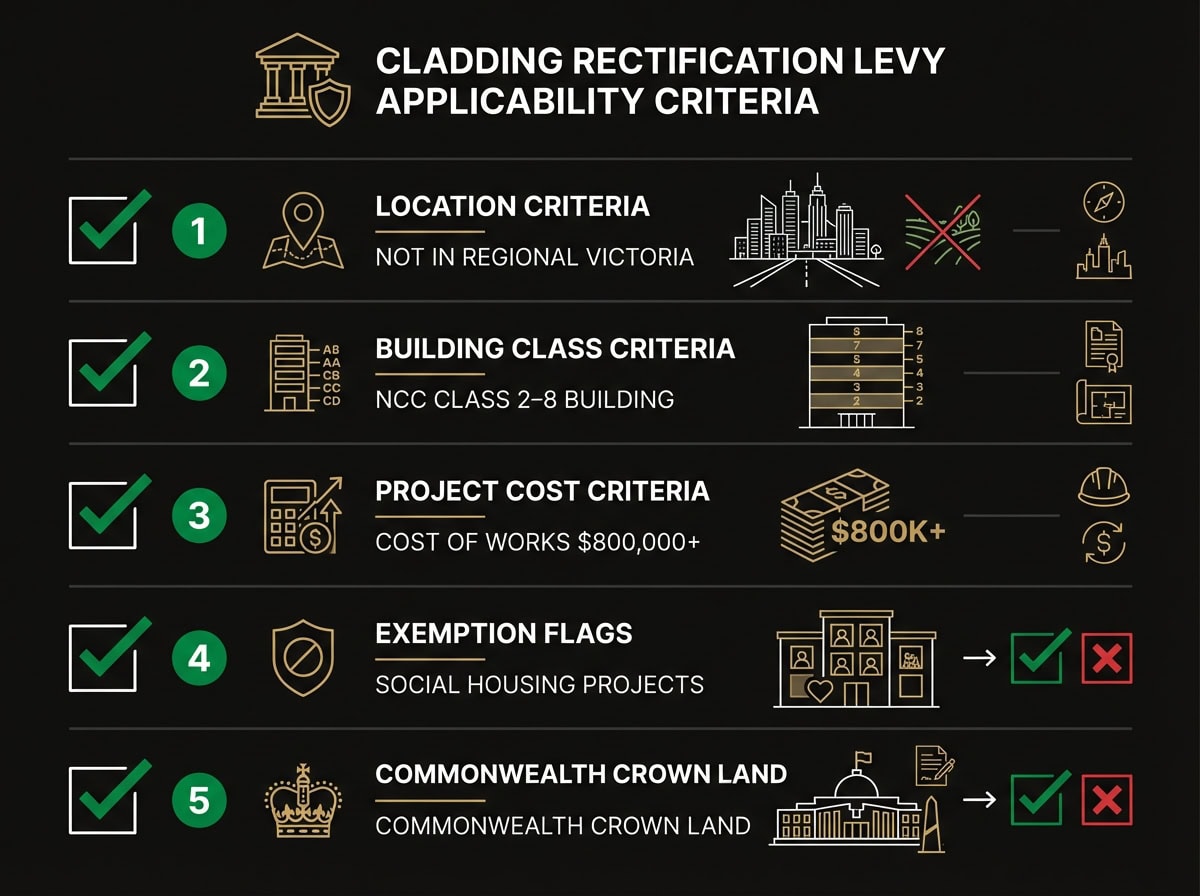
The CRL applies to building permits where:
- The building is not located in regional Victoria (as defined under the First Home Owner Grant Act 2000)
- The building is, or will be, of any NCC Class 2 to 8
- The cost of building works relating to Class 2 to 8 is $800,000 or more
For developers in Melbourne’s Eastern Suburbs — including the City of Boroondara, City of Monash, and Knox City Council — virtually all medium and large-scale apartment or mixed-use developments are likely to be subject to the CRL. This levy is payable in addition to the standard building permit levy and should be factored into project feasibility modelling from the outset. Exemptions may apply to certain social housing projects and buildings on Commonwealth Crown land.
Implications for New Developments in Melbourne’s Eastern Suburbs
For developers planning new Class 2 apartment buildings or mixed-use developments across Melbourne’s Eastern Suburbs, the current cladding regulatory environment has several practical implications that should be addressed early in the design process.
Material Selection and Specification
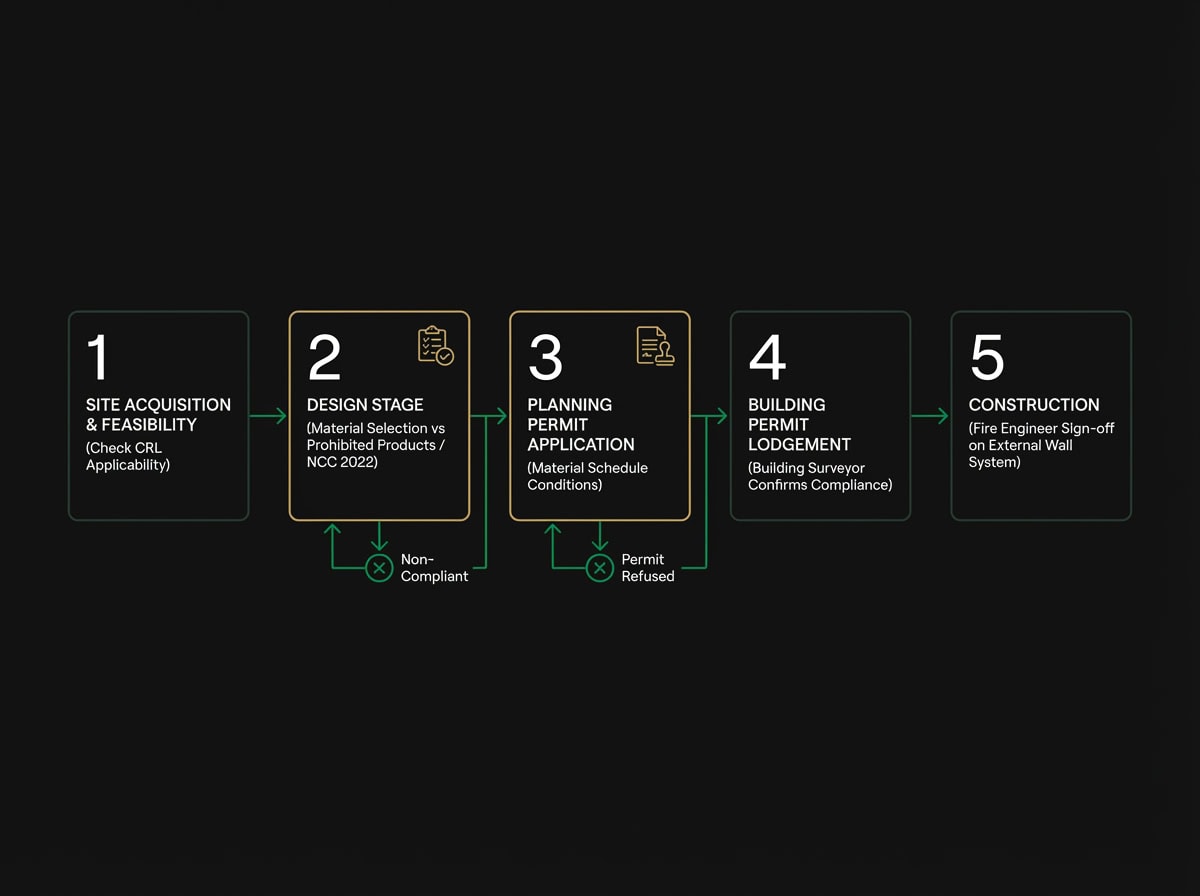
Cladding material selection must be verified against the NCC 2022 requirements and the prohibited products list before building permit lodgement. Your architect and building surveyor should confirm that all proposed external wall cladding products are compliant with current fire safety provisions, including the restrictions on bonded laminated cladding panels. SQM Architects works closely with building surveyors and fire engineers on all projects to ensure external wall specifications meet current requirements across councils including the City of Whitehorse, City of Boroondara, and Maroondah City Council.
Due Diligence on Existing Buildings
If you are acquiring an existing apartment building as part of a development or investment strategy, cladding due diligence is essential. You may need to determine whether the building has been assessed by CSV, what risk rating has been assigned, and whether any enforcement notices or orders are in place. Buildings with unresolved cladding issues may affect your ability to obtain finance, insurance, or planning permits for further development works.
Planning Permit Considerations
While cladding compliance is primarily a building permit matter rather than a planning permit matter, the two processes intersect in important ways. Responsible Authorities across Melbourne’s Eastern Suburbs may impose conditions on planning permits relating to external materials and finishes, and non-compliant cladding specifications could create issues at the building permit stage that delay your overall programme. Addressing cladding compliance as part of the planning permit design process — rather than leaving it to the building permit stage — is a more efficient approach.
Frequently Asked Questions
What types of cladding are prohibited on new buildings in Victoria?
The Minister for Planning’s Prohibition of Combustible Materials Rulings, made under the Building Act 1993, prohibit certain combustible cladding products on new buildings. The materials of primary concern are aluminium composite panels (ACP) with a polyethylene core and expanded polystyrene (EPS) systems. Developers and their design teams should verify all proposed external wall cladding products against the current prohibited products list before lodging a building permit application.
Does my new apartment development need to comply with NCC 2022 cladding requirements?
Yes. The main provisions of NCC 2022 commenced in Victoria on 1 May 2023, and all new building permit applications must comply with current requirements. NCC 2022 introduced clarifications to fire safety provisions for external walls and restrictions on certain bonded laminated cladding panels. Your appointed building surveyor is responsible for confirming compliance as part of the building permit process.
What is the Cladding Risk Mitigation Framework and how does it affect existing buildings?
The CRMF is a policy framework developed by CSV and backed by Minister’s Guideline 15 (MG-15), published in September 2023. It enables a proportionate, risk-based approach to cladding remediation on existing buildings, meaning that full cladding removal may not always be required. The framework determines risk by fire spread modelling rather than a prescriptive list of building elements, which in many cases could result in significantly lower remediation costs for owners corporations.
Will the cladding rectification levy apply to my development?
The cladding rectification levy (CRL) may apply if your building permit is for a Class 2 to 8 building in metropolitan Melbourne with a cost of works of $800,000 or more. For most medium and large-scale apartment or mixed-use developments in Melbourne’s Eastern Suburbs, the CRL is likely to apply and should be included in your project feasibility modelling. Exemptions may be available for certain social housing projects.
What happens if my building is referred to Cladding Safety Victoria?
If your building is referred to CSV, it will be assessed and assigned a risk rating — unacceptable, elevated, or low risk. CSV will then work with you, your owners corporation, and the relevant Municipal Building Surveyor to develop a remediation pathway appropriate to the risk level. Under CSV’s 2025–26 Annual Work Programme, all referred buildings are expected to receive a clear pathway by mid-2026, whether they are eligible for funded rectification or not.
Can I still receive funding from CSV for cladding rectification?
CSV’s funded rectification programme is focused on unacceptable-risk Class 2 residential buildings. By the end of 2025–26, works are expected to be complete on all unacceptable-risk buildings in the programme. For elevated-risk and low-risk buildings, CSV may provide remediation work proposals and guidance, but direct funding may not be available. Other options may include Cladding Rectification Agreements (CRAs), self-funding, strata loans, or refinancing. Speaking with CSV directly or engaging a registered building surveyor may help clarify your building’s position. SQM Architects can assist with design and compliance aspects of any remediation pathway.
How do cladding requirements affect planning permit applications in Melbourne’s Eastern Suburbs?
Cladding compliance is primarily assessed at the building permit stage, but it can intersect with planning permit processes where Responsible Authorities impose conditions relating to external materials and finishes. Councils including the City of Whitehorse, City of Boroondara, and Manningham City Council may request material schedules as part of planning permit applications. Addressing cladding compliance early in the design process helps avoid delays at both the planning permit and building permit stages.
Conclusion: Staying Ahead of Victoria’s Cladding Requirements
Victoria’s cladding regulatory framework has matured significantly since the initial statewide audit commenced in 2019. With CSV’s programme approaching completion in 2025–26, the focus is shifting from emergency rectification to a sustainable, risk-proportionate system underpinned by MG-15, the CRMF, and updated NCC 2022 requirements. For property developers in Melbourne’s Eastern Suburbs, this means that cladding compliance — on both new projects and existing assets — requires careful attention at every stage of the development process, from site acquisition and feasibility through to design, building permit lodgement, and construction.
SQM Architects regularly assists developers with planning permit applications and cladding compliance across Melbourne’s Eastern Suburbs, working across the City of Whitehorse, City of Boroondara, Manningham City Council, City of Monash, Knox City Council, and Maroondah City Council. To discuss your project’s cladding and compliance requirements, contact us for a complimentary site assessment or call (03) 9005 6588.
This article provides general information about Victorian building and planning regulations for property developers. It does not constitute professional advice. For specific guidance on your project, contact SQM Architects for a complimentary site assessment.


