
A building notice in Victoria arrives in two very different situations, and the difference matters for what you do next.
The first is a developer or owner mid-project, where work has deviated from the approved documentation. The second is a notice about work that was completed by somebody else, often years before you bought the property — a garage converted into a living room, an enclosed carport, a deck or a bathroom added without a building permit. The current owner is the one served, regardless of who carried out the work or when.
If that second case is yours, the useful thing to know at the outset is what the notice is asking for. Under Section 106 of the Building Act 1993 a building notice is a formal "show cause" instrument: not a conviction, not a fine, and not an order to demolish. It is a request — with a deadline — to demonstrate that the building work either complies with the relevant legislation or can be rectified so that it does. Handled promptly, building notices may often be resolved without progressing to a building order.
What that demonstration generally requires is documentation of what is actually there. That is the part most owners have never had to arrange, because the work predates them and no drawings exist. It is covered in detail below under work you did not carry out.
This guide covers the full process: what a building notice is, why it may have been issued, how to respond strategically, what escalation looks like under the 2025 regulatory reforms, and how developers across councils including the City of Whitehorse, City of Boroondara, Manningham City Council, and others in Melbourne may encounter council-specific variations. Having delivered projects across Melbourne, SQM Architects has supported developers through compliance challenges at every stage of the development process.
What Is a Building Notice and Who Issues It?
A building notice is a statutory enforcement instrument issued under Division 2 of Part 8 of the Building Act 1993. It is served on the owner of the building or land — not necessarily the builder or contractor — and identifies specific concerns about building work or the use of a building. The notice sets out the alleged non-compliance, the relevant legislative provisions that may have been breached, and a timeframe within which the owner must "show cause" why they should not be required to comply with a direction (which may include rectification or demolition).
Two types of building surveyors may issue a building notice:
- A Private Building Surveyor (PBS) — engaged directly by the developer or owner, with authority to issue building notices and building orders under the Act.
- A Municipal Building Surveyor (MBS) — employed by the relevant council (for example, the City of Whitehorse or Knox City Council), who may act on complaints from neighbours, observations during site inspections, or referrals from other council departments.
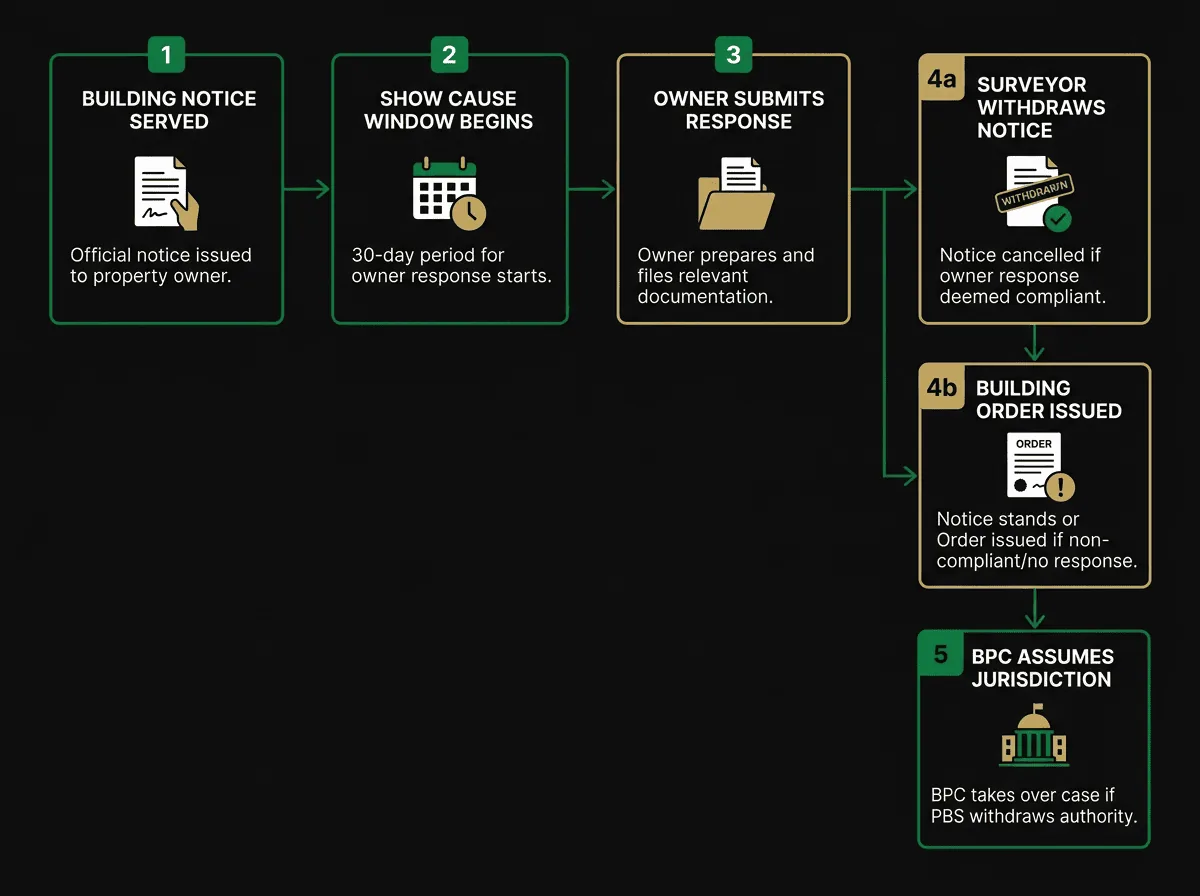
It is important to note that only a Municipal Building Surveyor may issue an Emergency Order under Section 102 of the Act — a more severe instrument used when there is an immediate threat to life or property. Private Building Surveyors do not hold this power. If your PBS issues a building notice and you fail to respond adequately, they are required by law to refer the matter to the Building and Plumbing Commission (BPC) — the body that replaced the Victorian Building Authority (VBA) on 1 July 2025 — and cease further involvement. At that point, the BPC assumes compliance jurisdiction, and the process generally becomes less flexible.
Building notices are served on the property owner, so even if a builder or subcontractor carried out the non-compliant work, the legal obligation to respond rests with you as the developer or landowner. This is a critical distinction that catches many developers off guard.
Common Reasons a Building Notice May Be Issued
Understanding why a building notice has been issued is the first step toward formulating an effective response. The most common triggers for developers in Melbourne include:
- Building work carried out without a building permit — perhaps the most frequent cause, including structures such as retaining walls, decks, carports, or extensions added during a project without the required permit documentation.
- Work carried out in contravention of an approved building permit — where construction deviates from the endorsed plans, such as altered setbacks, changed floor levels, or modified structural elements.
- Breaches of the Building Regulations 2018 or the National Construction Code (NCC) — including non-compliant waterproofing, inadequate fire separation in multi-dwelling developments, or structural deficiencies.
- ResCode non-compliance — particularly relevant for residential developments, where Clause 54 (one dwelling on a lot) or Clause 55 (two or more dwellings) of the Victoria Planning Provisions may be implicated. Common ResCode triggers include overlooking, overshadowing, and side and rear setback breaches.
- Unsafe or dangerous building work — where the surveyor considers the structure poses a risk to occupants or the public.
- Use of a building in contravention of the Act — for example, occupying a building before an occupancy permit has been issued.
For developers working across multiple sites in councils such as Manningham City Council or Maroondah City Council, it is worth noting that neighbour complaints are a frequent catalyst for MBS investigations. A complaint about overlooking or boundary setbacks on a townhouse development, for instance, may prompt a site inspection that uncovers a broader range of compliance issues than the original complaint identified.
When the Work Was Carried Out by a Previous Owner
This is a common situation and it has its own shape. A property changes hands, and some time later the current owner is served with a building notice about work nobody living there has ever seen documented — a garage or carport converted to a habitable room, a rear extension, a deck, a bathroom or laundry added inside an existing footprint.
Three things generally follow from it.
The obligation sits with you, not the previous owner. A building notice is served on the current owner of the building or land. That is the case regardless of who carried out the work or how many years ago. Whether you have any recourse against the vendor depends on what was disclosed in the section 32 vendor statement, and that is a question for your conveyancer or solicitor — it runs in parallel with the notice rather than instead of it.
There are usually no drawings, and that is the practical obstacle. Work done without a building permit leaves no approved documentation behind. A building surveyor therefore has nothing to assess the work against. Before anyone can form a view on whether the work complies, or what would make it comply, somebody has to measure and document what is physically there. That set of drawings is what the industry calls as-built documentation, and regulation 25(1)(g) of the Building Regulations 2018 is why it is required. The provision says an application for a building permit to alter an existing building must be accompanied by "copies of drawings and allotment plans that clearly differentiate between the existing building and the proposed building work for which the permit is sought".
The outcome is often less drastic than owners expect. Not every unpermitted conversion has to be removed. Where the work can be shown to meet the relevant standards, or can be brought up to them with defined rectification, the usual path is a building permit covering the completion or rectification of the works, with the existing condition documented in support. Where it cannot, the surveyor may require changes or removal. Which of those applies is a matter for the relevant building surveyor, assessed on the specifics — it is not something that can be determined from the notice alone.
Practically, for a unit or apartment there is one extra step: if the work touches common property, the owners corporation is likely to have an interest in it, and its consent may be needed before rectification works proceed.
Whether the work was done by you or by a previous owner, a building surveyor generally needs drawings of what is actually there before anything can be assessed. We measure the existing work, document it, and prepare the package a permit application requires.
- As-built drawings of the existing work
- What complies, what may need changing
- Documentation for your building surveyor
Or talk it through first — (03) 9005 6588. Melbourne-wide, all 31 metro councils.
Your Response Window: Timeframes and What They Mean
The standard show cause period under Section 108 of the Building Act 1993 is 30 days from the date of service of the notice. Some notices — particularly those issued by municipal building surveyors — may add five additional days to account for postage time, giving an effective response window of approximately 35 days. However, you should treat the 30-day period as your operative deadline and begin preparing your response immediately.
This timeframe is not generous when you consider what a thorough response may require: engaging a Private Building Surveyor to assess the non-compliance, commissioning structural engineering reports, obtaining any certificates of compliance required under section 238, coordinating with your architect or building designer to prepare as-built and amended documentation, and potentially engaging a building lawyer if the matter is complex. In practice, the preparation of a credible show cause response for a multi-dwelling development can take two to three weeks of concentrated effort.
If you genuinely need more time, it may be possible to request an extension from the issuing surveyor. However, this is at their discretion and is not guaranteed. A better approach is to contact the issuing surveyor promptly after receiving the notice, acknowledge receipt, indicate that you are taking the matter seriously, and provide a realistic timeline for your response. This demonstrates good faith — a factor that can influence how the surveyor exercises their discretion when assessing your submission.
Under the current penalty unit value, the financial consequences of non-compliance can escalate quickly. Corporate entities may face penalties of up to 6,000 penalty units — a significant financial exposure under the civil penalty framework introduced by the Building Legislation Amendment (Buyer Protections) Act 2025. These figures underscore why prompt, professional engagement is essential.
How to Prepare a Strong Show Cause Response
A show cause response is a written submission to the issuing building surveyor that either demonstrates compliance, proposes a rectification pathway, or — in limited circumstances — argues that the notice should be withdrawn. The quality of this submission directly influences whether the matter is resolved at the notice stage or escalates to a building order.
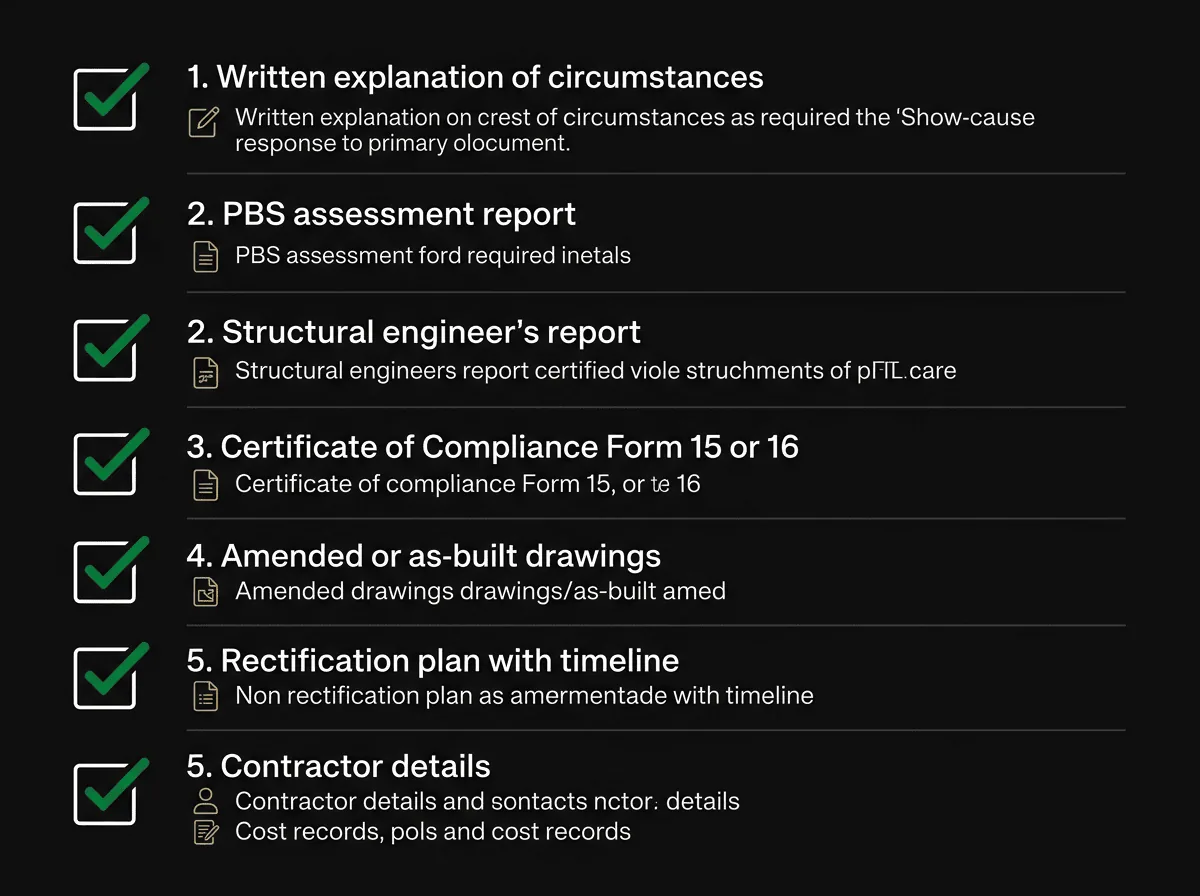
Your response may need to include some or all of the following, depending on the nature of the alleged non-compliance:
- A written explanation of the circumstances that gave rise to the non-compliance, including when the work was carried out and by whom.
- An assessment report from a registered Private Building Surveyor confirming whether the work complies (or can be made to comply) with the Building Regulations 2018 and the NCC.
- A structural engineer’s report — particularly important for work carried out without a permit, where the structural integrity of the construction must be independently verified.
- A certificate of compliance — issued under section 238 of the Building Act 1993 and regulation 126 of the Building Regulations 2018, in the approved form, by a prescribed engineer or registered building surveyor. It certifies that a design, or as-constructed work, complies with specified provisions. A certificate is one of the means by which a relevant building surveyor may be satisfied under section 24 before issuing a building permit — it is a supporting document, not a substitute for the permit itself.
- Amended or as-built drawings prepared by a registered architect or building designer, demonstrating the current state of the work and any proposed rectification.
- A rectification plan with a realistic timeline, if the work does not currently comply but can be brought into compliance through additional works.
- Contractor details and cost records, which some municipal building surveyors (including those at the City of Whitehorse and Knox City Council) may request as part of their assessment.
The issuing surveyor has three options after reviewing your response: withdraw the notice (if satisfied that the work complies or that the notice was issued in error), take no further action pending rectification works, or issue a building order. A well-prepared, evidence-based submission may support a more favourable outcome at this stage.
Escalation: Building Orders, Emergency Orders, and the BPC
If your show cause response is unsatisfactory — or if you do not respond at all — the issuing surveyor may proceed to issue a Building Order under Section 111 of the Building Act 1993. Unlike a building notice, a building order is mandatory and enforceable in the Magistrates Court. There are several types:
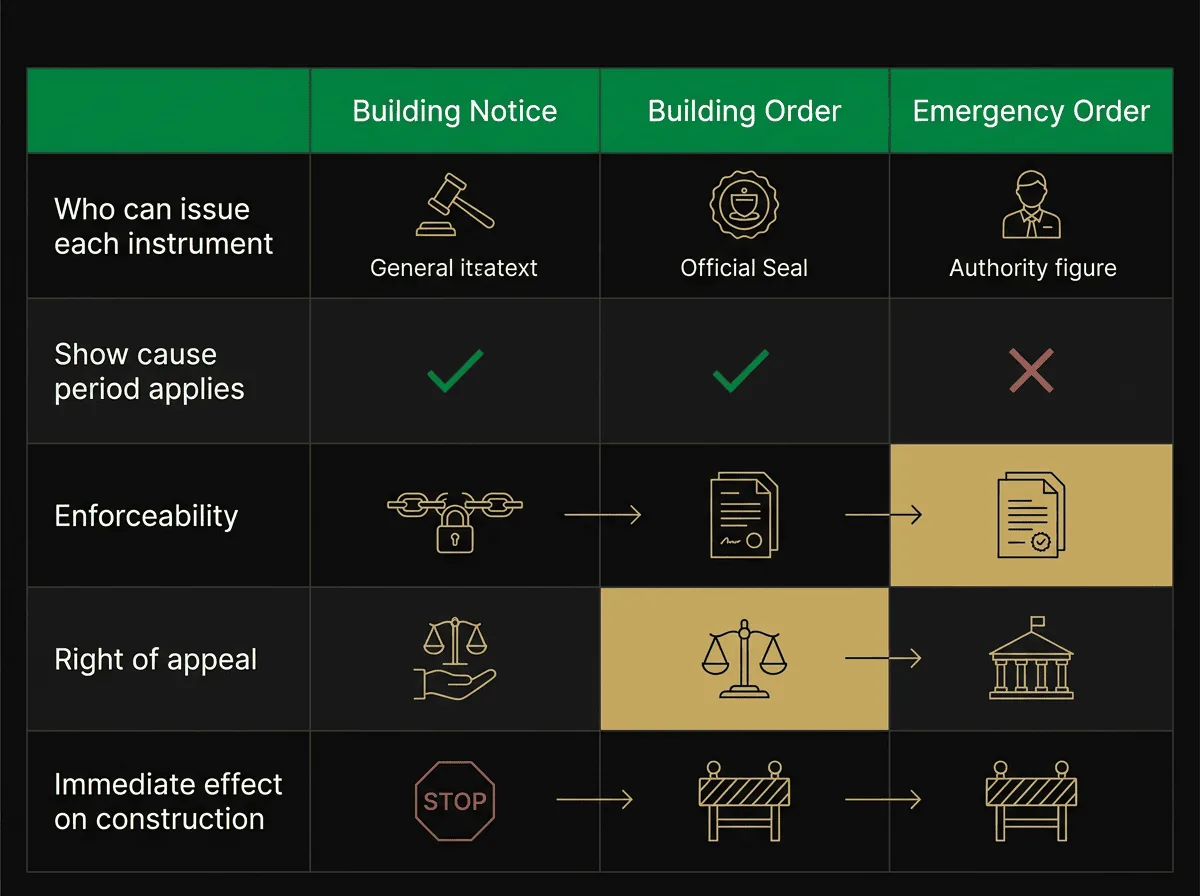
- Building Order (General) — requires specific actions to remedy non-compliance within a set timeframe.
- Building Order (Minor Works) — for less significant rectification; notably, this type can be issued without a prior building notice.
- Stop Work Order — halts all building activity on the relevant work immediately. This is a serious escalation that can bring a development to a standstill.
- Emergency Order — issued only by a Municipal Building Surveyor where there is an immediate risk to life or property. No show cause period is required, and the order takes effect immediately.
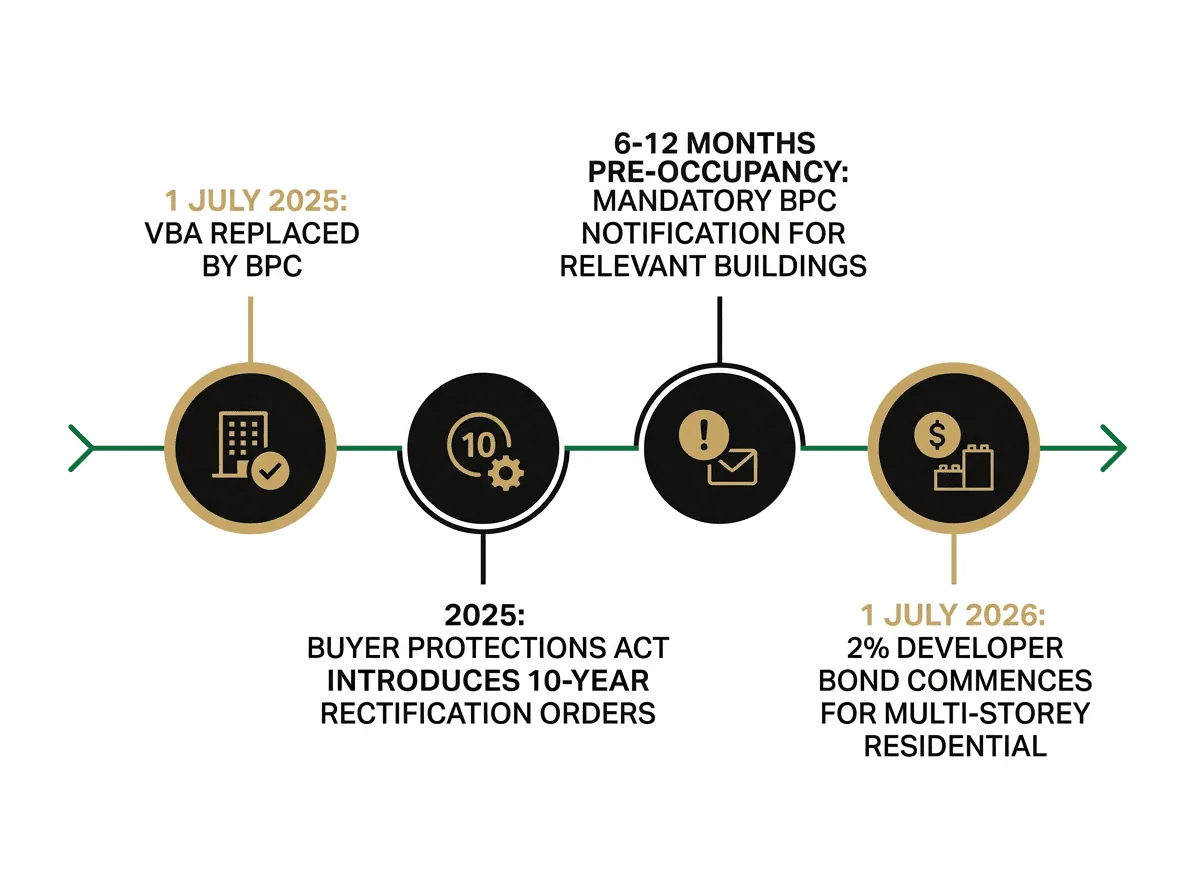
If a building order is issued by your PBS and you fail to comply, the PBS must refer the matter to the BPC and withdraw from the engagement. The BPC will then assume jurisdiction. Developers should be aware that the BPC — as the successor to the VBA — has significantly expanded enforcement powers under the 2025 reforms, including the ability to issue rectification orders for up to 10 years post-occupancy under current provisions. For multi-storey residential developments commencing from 1 July 2026, a 2% developer bond of the total build cost may be required under current provisions before an occupancy permit is issued, providing the BPC with additional leverage in compliance matters.
If you disagree with a building notice or building order, you may appeal to the Building Appeals Board (BAB) under Section 142(1) of the Act. The prescribed appeal period is 30 days from the date the notice is served. Lodging an appeal does not automatically stay the notice or order, so legal advice may be needed to manage the process concurrently with any rectification works.
Council Variations Across Melbourne
While the Building Act 1993 provides a consistent statutory framework across Victoria, the practical experience of receiving and responding to a building notice can vary meaningfully between councils. Developers active across Melbourne should be aware of the following tendencies:
City of Whitehorse — The MBS team at the City of Whitehorse has a documented process for responding to building notices relating to unauthorised works. Their guidance indicates that evidence submissions may need to include contractor details and cost records, and they encourage engagement of a registered PBS to coordinate the compliance assessment. Response documentation is submitted directly to the building and planning department for assessment.
City of Boroondara — Given the high proportion of heritage overlay properties and established residential streetscapes in Boroondara, building notices in this area frequently intersect with planning permit conditions. Developers may find that a building compliance issue also triggers a planning enforcement referral, requiring coordinated responses to both the MBS and the Responsible Authority.
Manningham City Council — Manningham has been active in enforcing ResCode compliance on medium-density developments, particularly regarding overlooking (Standard B4-4 at Clause 55.04-4, formerly B22) and side setbacks. Building notices in Manningham often arise from neighbour complaints on townhouse and unit developments, and the council’s enforcement team may conduct site inspections with relatively short notice.
Knox City Council and Maroondah City Council — Both councils cover areas with significant greenfield and infill development activity. Building notices in these areas frequently relate to retaining walls, earthworks, and stormwater management — elements that are sometimes overlooked in the permitting process for multi-lot subdivisions.
City of Monash — Monash has seen increased enforcement activity around apartment and townhouse developments, particularly where construction deviates from endorsed plans. Developers should ensure that any design changes during construction are formally documented and, where required, that amended building permits are obtained before proceeding.
Practical Tips for Developers: Avoiding and Managing Building Notices
Prevention remains the most cost-effective strategy. The following measures may help reduce the risk of receiving a building notice on your development projects:
- Engage your building surveyor early — before construction commences, not after issues arise. A proactive relationship with your PBS means compliance concerns can be identified and addressed before they become enforcement matters.
- Ensure all design changes are documented and approved — variations from endorsed plans are a leading cause of building notices. Any change to setbacks, floor levels, openings, or structural elements during construction may need to be reflected in an amended building permit.
- Conduct regular compliance audits during construction — particularly at key stages such as slab, frame, and lock-up. Identifying non-compliance early, when rectification is still straightforward, is far preferable to discovering it at practical completion.
- Maintain clear records of all permits, endorsed plans, and inspection certificates — these documents are essential if a building notice is issued and you need to demonstrate compliance.
- Respond to any building notice within 48 hours of receipt — not necessarily with your full submission, but with an acknowledgement to the issuing surveyor and an indication that you are engaging professional assistance. This establishes good faith from the outset.
- Under the 2025 reforms, notify the BPC 6–12 months before seeking an occupancy permit on relevant residential buildings — this mandatory notification requirement allows for proactive inspections and may reduce the risk of last-minute compliance issues blocking your occupancy permit.
Frequently Asked Questions
Can I continue building work after receiving a building notice?
Generally, yes — a building notice does not automatically halt construction. However, if the notice relates to work that is currently underway, it is prudent to pause that specific work until you have sought advice from your PBS. If the surveyor subsequently issues a Stop Work Order, all relevant building activity must cease immediately. Continuing work in defiance of a Stop Work Order is a serious offence under the Building Act 1993.
I received a building notice for work a previous owner did. Am I responsible?
Yes. A building notice is served on the current owner of the building or land, regardless of who carried out the work or how long ago. Buying a property transfers that exposure to you. You may have separate recourse against the vendor depending on what was disclosed in the section 32 vendor statement, but that is a conveyancing question and it does not change your obligation to respond to the notice.
What is as-built documentation and why is it needed?
As-built documentation is a set of measured drawings recording what physically exists on the site, as distinct from what was approved or intended. Where work was carried out without a building permit there are usually no drawings at all, so a surveyor has nothing to assess against. The as-built set establishes the existing condition, which then allows the compliance assessment and any proposed rectification to be documented and lodged. See as-built documentation for what the package generally contains.
Does Victoria allow retrospective building permits?
No. A building surveyor may only issue a building permit for work that has not yet been carried out, so there is no such thing as a retrospective building permit in Victoria.
The route generally used instead is a building permit for the completion or rectification of the works — the remaining work is what the permit authorises, and the existing work is documented as part of the application. Regulation 25(1)(g) of the Building Regulations 2018 requires an application to alter an existing building to include drawings that clearly differentiate between the existing building and the proposed building work, which is why as-built documentation is normally the first thing required. Depending on what the work involves, the application may also be supported by structural engineering computations, a soil report, and certificates of compliance under section 238. In some cases completed work may need to be opened up for inspection.
The exact pathway is a matter for the relevant building surveyor, and it varies with what was built. This is general information rather than advice on your particular notice.
What happens if I simply ignore a building notice?
Ignoring a building notice will almost certainly result in the issuing surveyor escalating to a Building Order. A building order is enforceable in the Magistrates Court, and non-compliance may result in prosecution, significant fines, and in serious cases, a court-ordered demolition of the non-compliant work. The BPC may also flag the matter on the property title, which could affect your ability to obtain an occupancy permit or register a plan of subdivision.
Can I appeal a building notice I believe has been issued incorrectly?
Yes. Under Section 142(1) of the Building Act 1993, you may appeal to the Building Appeals Board (BAB) within 30 days of the notice being served. You can appeal against the decision to serve the notice, or against a failure or refusal to cancel it. It is advisable to seek legal advice before lodging an appeal, and to continue preparing your show cause response concurrently, as lodging an appeal does not automatically stay the notice.
Who is responsible for responding to a building notice — the developer or the builder?
Building notices are served on the owner of the building or land, which in most development scenarios means the developer or landowner. Even if the non-compliant work was carried out by a builder or subcontractor, the legal obligation to respond rests with the owner. You may have contractual recourse against your builder, but this does not affect your statutory obligations under the Act. In some cases, a notice may be served on both the owner and the person in charge of the site.
How does the new Building and Plumbing Commission (BPC) affect the process?
The BPC replaced the VBA on 1 July 2025 and has broader enforcement powers than its predecessor. Under the Building Legislation Amendment (Buyer Protections) Act 2025, the BPC can issue rectification orders for up to 10 years post-occupancy under current provisions, and can effectively block the issuance of an occupancy permit where serious defects are identified during mandatory pre-occupancy inspections. Developers of residential buildings over three storeys may also need to lodge a 2% developer bond before an occupancy permit is issued under current provisions, commencing 1 July 2026.
What role can an architect play in responding to a building notice?
A registered architect can play a significant role in preparing the technical documentation required for a show cause response — including as-built drawings, amended plans, and written assessments of ResCode compliance under Clause 54 or Clause 55. Where the notice relates to a deviation from endorsed plans, an architect can prepare revised documentation demonstrating how the work can be brought into compliance, which forms a critical part of the rectification strategy presented to the issuing surveyor.
Conclusion: The Response Is a Documentation Exercise
A building notice is a formal instrument with a date on it, but the show cause process exists precisely so that owners can demonstrate compliance or propose a credible rectification pathway. Handled promptly, notices may often be resolved without progressing to a building order.
For work carried out without a permit — whether by you or by a previous owner — the response is largely a documentation exercise. Somebody has to measure and draw what exists, assess it against the relevant standards, and set out what, if anything, needs to change. Once that package is in front of the building surveyor, the matter usually has a defined path. The two things worth doing early are telling the issuing surveyor you are acting on it, and asking for an extension of time before the stated date passes rather than after.
SQM Architects prepares as-built and rectification documentation for building notices across Melbourne, in all 31 metropolitan councils, and has taken this pathway through from notice to permitted resolution.
As-built documentation and building notice response — or call (03) 9005 6588 to talk through what your notice is asking for.
This article provides general information about Victorian building compliance. It is not advice on your particular notice, and the pathway available in any given case is a matter for the relevant building surveyor. SQM Architects, ABN 32 600 928 390, ARBV Reg. No. 51498.