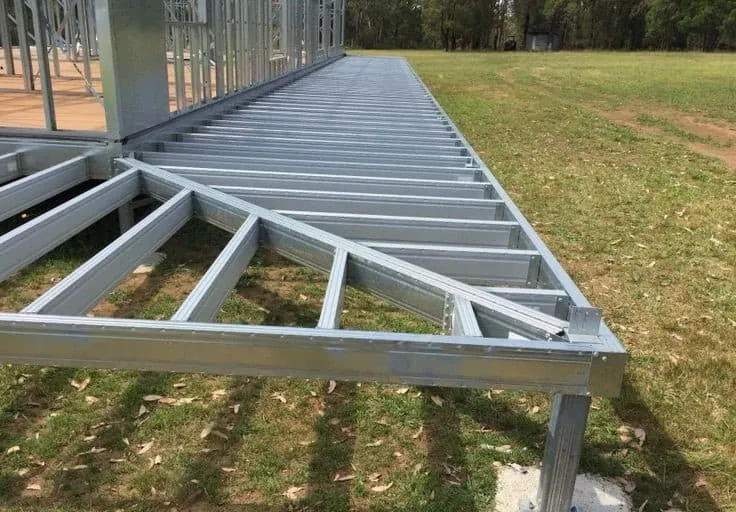
If you’re a property developer in Melbourne managing construction activity across sites in the City of Whitehorse, City of Boroondara, Manningham City Council, or beyond, understanding the White Card requirement is a non-negotiable part of running compliant, safe projects. Whether you’re overseeing a dual-occupancy development in Doncaster, a townhouse project in Glen Waverley, or a multi-unit build in Ringwood, anyone accessing your construction site — including you — may need to hold a valid White Card.
The White Card (formally known as the General Construction Induction Card) is the baseline safety certification required under Victorian law for anyone entering or working on an operational construction site. It is not a trade licence, nor a substitute for site-specific induction — it is the foundational credential that demonstrates a person has completed nationally recognised training in construction health and safety. For developers, understanding who needs one, how to obtain it, and how it interacts with broader building and planning compliance obligations is essential to keeping your projects on track and your sites legally compliant.
This guide covers everything you need to know about the White Card in Victoria as of 2025, including recent regulatory context, the shift from the Building and Plumbing Commission (BPC) to the Building and Plumbing Commission (BPC), and how broader building system reforms may affect your development programme.
What Is a White Card and Why Does It Matter for Developers?
A White Card is evidence that the holder has successfully completed the nationally recognised unit of competency CPCCWHS1001 – Prepare to Work Safely in the Construction Industry. It is issued by a Registered Training Organisation (RTO) upon successful completion of the course and serves as legal proof that the cardholder is authorised to enter and work on Australian construction sites.
For property developers, the White Card matters on two levels. First, if you personally visit your construction site — even briefly, even just to inspect progress — you are legally required to hold a valid White Card. Second, as the person conducting the business or undertaking (PCBU) responsible for the site, you have an obligation under the Occupational Health and Safety Act 2004 (Vic) to ensure that every person on your site holds appropriate certification. That includes your builder, subcontractors, delivery drivers dropping materials inside the construction zone, and any consultants or architects conducting site visits.
WorkSafe Victoria enforces this requirement, and non-compliance can result in fines for both the individual and the responsible party. More practically, an uncertified person found on site can be removed immediately, causing delays that ripple through your programme and affect your development outcome. With project experience across Melbourne, SQM Architects has seen first-hand how compliance gaps at the site access level can create unnecessary friction during construction phases.
Who Needs a White Card in Victoria?
The requirement is broader than many developers initially assume. Under Victorian law, a White Card is required for anyone who needs to enter an operational construction site, regardless of whether they are performing hands-on construction work. The following roles typically require a White Card:
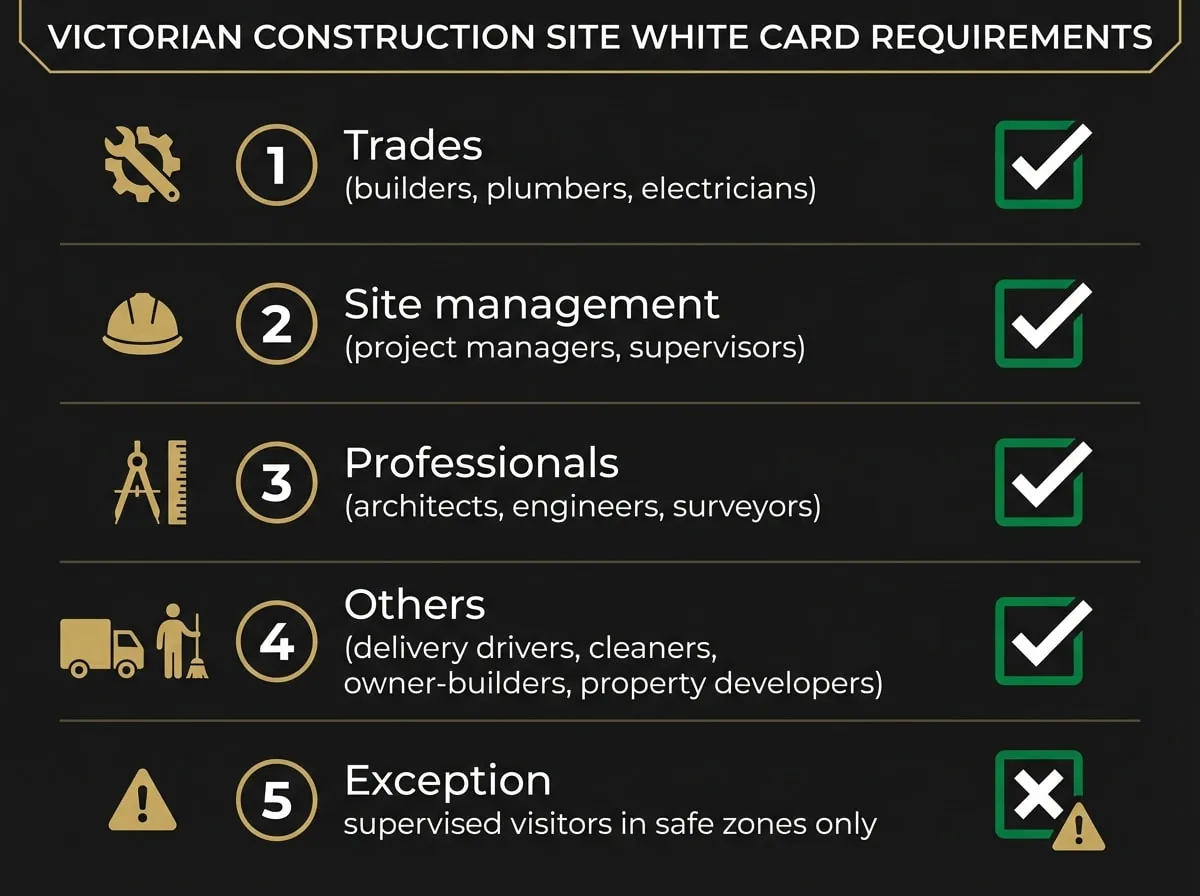
- Builders, labourers, carpenters, bricklayers, plumbers, and electricians
- Scaffolders, painters, tilers, and floor finishers
- Demolition workers and excavation crews
- Project managers and site supervisors
- Architects and designers attending site for inspections or consultations
- Engineers and surveyors undertaking preparatory or inspection work
- Building inspectors and building surveyors
- Delivery drivers entering the construction zone
- Cleaners and maintenance workers on structures under construction
- Work experience students undertaking construction work
- Owner-builders carrying out structural work
- Property developers who access their own sites
There is a narrow exception for visitors on a guided tour who remain under direct supervision of a site supervisor and stay within designated safe zones at all times. However, for any developer who regularly accesses their sites — which is virtually all of them — obtaining a White Card is the straightforward and correct approach.
How to Obtain a White Card in Victoria
Obtaining a White Card in Victoria involves completing the CPCCWHS1001 course through an accredited RTO. The process is relatively straightforward, but there are important Victorian-specific requirements that differ from some other states.
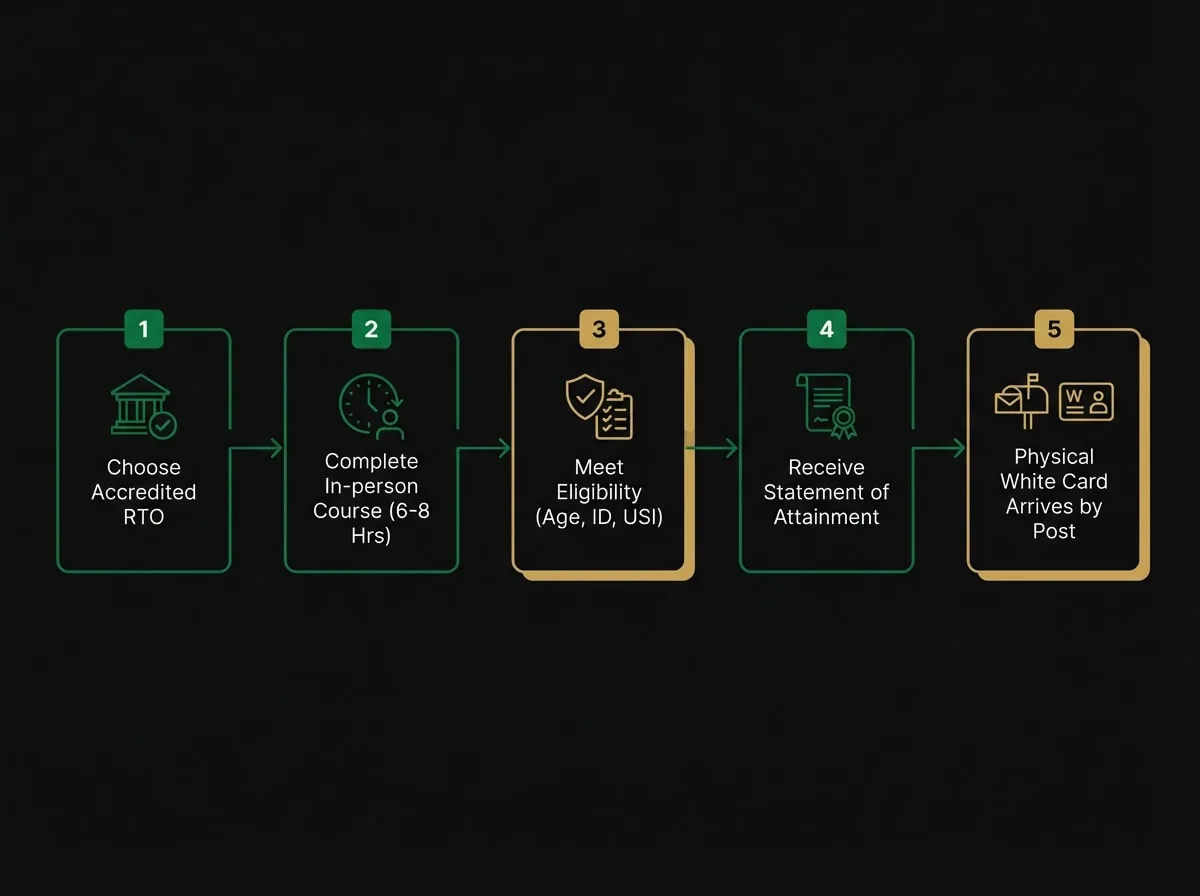
Step 1: Choose an Accredited RTO
You must complete your White Card training through an RTO that is officially listed under WorkSafe Victoria’s licensing requirements. A list of approved RTOs can be found on the Australian Government’s training.gov.au website. When selecting an RTO, it is worth comparing course price, location, scheduling flexibility, and customer reviews. Not all RTOs deliver training to the same standard, and the quality of instruction can affect how well participants retain safety knowledge relevant to your sites.
Step 2: Complete the Course In-Person
This is a critical point for Victorian developers and their teams: the White Card course cannot be completed online in Victoria. WorkSafe Victoria requires face-to-face delivery in a classroom setting. This requirement has been in place since 2019, when Queensland — the last state that had allowed online completion — also moved to mandatory in-person training, closing the loophole that some Victorian workers had previously used.
As of 2025, only Western Australia and Tasmania permit online White Card completion, and only for residents of those states. Any website offering an online White Card course to Victorian residents should be treated with significant caution. The course typically runs for a minimum of 6 hours, with most RTOs delivering sessions of 6 to 8 hours. It can generally be completed in a single day.
Step 3: Meet Eligibility Requirements
To enrol in a White Card course in Victoria, participants must:
- Be at least 14 years of age
- Have a basic understanding of English
- Provide valid photo identification (driver’s licence, passport, or equivalent)
- Have or create a Unique Student Identifier (USI), which can be obtained free of charge via the government USI portal in approximately 5 to 10 minutes
Step 4: Receive Your Statement of Attainment and White Card
Upon successful completion of the course, the RTO will issue a Statement of Attainment for CPCCWHS1001. This document can be used immediately as evidence of training to access construction sites while you wait for the physical White Card to arrive by post. It is advisable to save a digital copy of the Statement of Attainment as a backup.
Get the 7-point site check to run before committing to a permit application — zoning, overlays, setbacks and council red flags, in plain English. Free PDF, instant download.
- Zone, overlay & setback checks
- What council assesses first
- Permit-readiness red flags
Something went wrong. Please try again.
No spam. Unsubscribe anytime.
Check your inbox — your checklist is on its way.
White Card Validity and Renewal
The Victorian White Card does not have a formal expiry date — once issued, it remains valid indefinitely under normal circumstances. However, there is an important practical caveat: if a cardholder has been absent from the construction industry for more than two consecutive years, they may be required to complete the course again before returning to site. This is to ensure that safety knowledge remains current and relevant.
The White Card issued in Victoria is nationally recognised and valid across all Australian states and territories. If your development activities take you interstate, or if you engage subcontractors from other states, their White Cards — regardless of which state issued them — are valid on your Victorian sites, provided they were obtained through an accredited RTO and meet the national standard.
If a White Card is lost, stolen, or damaged, the cardholder should contact the RTO that originally issued it to request a replacement. A small fee and proof of identity may be required. If the original RTO no longer operates, the relevant state authority overseeing construction training can assist.
What the White Card Course Covers
The CPCCWHS1001 course is designed to provide a solid foundation in construction site safety. For developers, understanding what the course covers helps you appreciate why it is a baseline requirement rather than a tick-box exercise. The key topics include:
- Occupational health and safety responsibilities for workers, employers, and PCBUs
- Identifying and managing construction hazards and risks using the hierarchy of controls
- Responding to accidents and incidents, including emergency procedures
- Safe work practices for common construction activities
- Personal protective equipment (PPE) — when and how to use it
- Construction site signage and its meanings
- High-risk work and when a separate High Risk Work (HRW) licence is required
- Traffic management and mobile plant safety
- Access to site amenities including drinking water and sanitation
- Hazards specific to construction environments: unplanned collapse, working at heights, electrical risks, and more
It is important to note that the White Card provides general construction induction training only. It must be complemented by site-specific induction training before any person commences work on a particular site. This site-specific induction is the responsibility of the PCBU — typically the principal contractor or developer — and covers procedures, hazards, and PPE requirements unique to that site.
The Shift from BPC to BPC: What Developers Need to Know
A significant structural change in Victoria’s building regulatory landscape is the transition from the Building and Plumbing Commission (BPC) to the Building and Plumbing Commission (BPC). This reform, part of the Victorian Government’s broader building system reform programme outlined in the Building Statement: Strengthening Victoria’s Building System, represents a fundamental shift in how building practitioners are regulated and how consumers are protected.
The BPC is being granted new powers that are directly relevant to property developers, including:
- Rectification orders — directing builders and developers to fix poor work, including after occupancy
- New first resort warranty scheme for projects up to three storeys, improving access to insurance if things go wrong
- A new developer bond for apartment buildings above three storeys, as a first step towards a 10-year insurance product for apartment buildings
The building reform programme also introduces a requirement for building surveyors to provide an information statement to the owner of the building or land within 10 working days of issuing a building permit. This aims to address longstanding concerns about the lack of consumer understanding regarding the role of building surveyors in the building permit process — a gap that has sometimes created confusion for developers, particularly those newer to the Victorian system.
Expanded building industry registration is also on the horizon, with new categories including building consultants and site supervisors to be brought under the registration framework. This will increase regulatory oversight and accountability across the construction supply chain that developers rely upon. SQM Architects has navigated multiple regulatory transitions across an Melbourne project portfolio by staying across exactly these kinds of regulatory shifts.
White Card Requirements for Owner-Builders
Owner-builders occupy a specific position in Victoria’s building regulatory framework, and the White Card requirement applies to them in particular circumstances. If you are undertaking domestic building work as an owner-builder and the project involves structural building work — such as constructing a new dwelling or carrying out significant structural alterations — obtaining a White Card is mandatory.
For minor, non-structural renovations, the White Card may not be strictly required, though it is advisable to verify the specific requirements for your project with the relevant authority. Owner-builders should also be aware of several additional obligations that sit alongside the White Card requirement:
- Building permit: A building permit is required before commencing construction. This involves submitting detailed plans and specifications to a registered building surveyor for assessment against the Building Act 1993 and Building Regulations 2018.
- Home Warranty insurance: Mandatory for eligible domestic building work valued over $20,000 under contracts signed on or after 1 July 2026 (administered by the BPC). Its predecessor, Domestic Building Insurance, applies to earlier contracts over $16,000, with cover of six years for structural and two years for non-structural defects.
- Public liability insurance: Covers legal liability if someone is injured or property is damaged due to construction activities.
- Workers’ compensation insurance: Compulsory if workers are employed on site.
- Planning permit: Depending on the nature and location of the project, a planning permit may also be required from the Responsible Authority prior to commencing work.
2025 Planning and Building Reforms: Context for Developers
The White Card requirement sits within a rapidly evolving regulatory environment. Victoria’s building and planning systems are undergoing the most significant reforms in decades, and developers active in Melbourne need to understand how these changes may interact with their project pipelines.
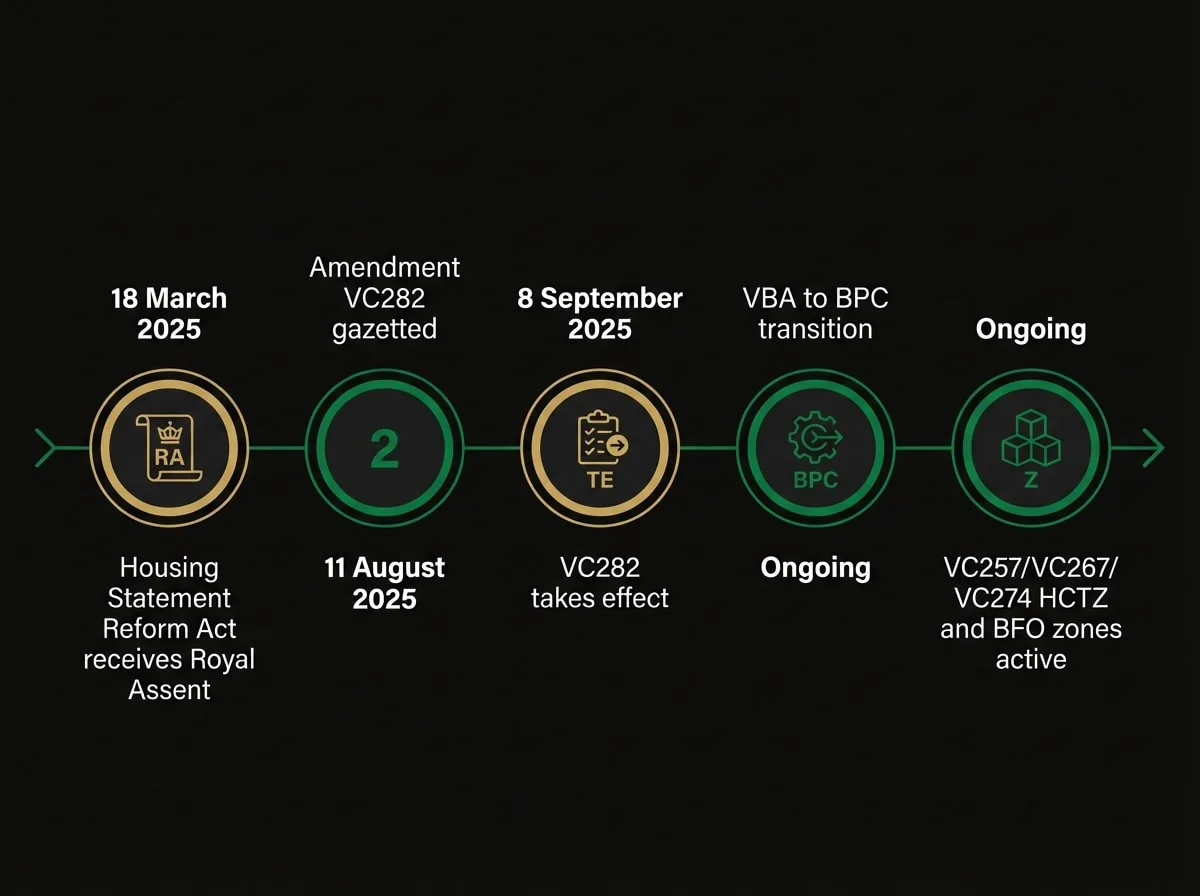
Amendment VC282, gazetted on 11 August 2025 and effective from 8 September 2025, updated Clause 54 of all planning schemes to introduce a ‘deemed to comply’ assessment pathway for single dwellings and small second dwellings on lots under 300 square metres. If the new standards are met — covering street setbacks, tree canopy requirements, daylight, overshadowing, and new sustainability standards for solar energy — no further assessment is required, and the existing VicSmart 10-day permit process applies. This could represent a meaningful efficiency gain for smaller residential projects.
The Consumer and Planning Legislation Amendment (Housing Statement Reform) Act 2025, which received Royal Assent on 18 March 2025, introduces significant procedural changes to planning permit decision-making and VCAT proceedings. These include new powers for Responsible Authorities to void deficient applications, new VCAT powers to confine issues in dispute and summarily dismiss proceedings lacking substantive merit, and streamlined hearing procedures. For developers, this could mean faster pathways for well-prepared applications and reduced tolerance for poorly documented ones.
Amendments VC257, VC267, and VC274 introduced new zones and overlays — including the Housing Choice and Transport Zone (HCTZ) and Built Form Overlay (BFO) — to support housing growth in key activity centres. Several Melbourne activity centres are within scope of these reforms, potentially opening new development opportunities with greater built form certainty.
Frequently Asked Questions
Do I need a White Card as a property developer if I’m not doing any physical construction work?
Yes, in most cases. If you access your construction site at any point during the build — even for a brief inspection or progress check — you are legally required to hold a valid White Card. The requirement applies to anyone entering an operational construction site, not just those performing hands-on work. The only narrow exception is for visitors under continuous direct supervision of a site supervisor who remain within designated safe zones.
Can my subcontractors use a White Card from another state on my Victorian site?
Yes. The White Card is a nationally recognised credential and is valid across all Australian states and territories. A subcontractor who obtained their White Card in Queensland, New South Wales, or any other state can use it on your Victorian construction site, provided it was issued by an accredited RTO and meets the national CPCCWHS1001 standard.
How long does it take to get a White Card in Victoria?
The course itself typically takes 6 to 8 hours and can be completed in a single day. Upon completion, the RTO issues a Statement of Attainment immediately, which can be used to access construction sites straight away. The physical White Card arrives by post shortly afterwards. The entire process from enrolment to having a usable credential can generally be completed within one to two days.
Does the White Card expire?
The White Card does not have a formal expiry date. However, if a cardholder has been absent from the construction industry for more than two consecutive years, they may need to complete the course again before returning to site. It is advisable to keep your White Card active if you are regularly involved in development activity, even in a supervisory or oversight capacity.
What is the difference between a White Card and a High Risk Work (HRW) licence?
The White Card is a general construction induction credential required for anyone entering a construction site. A High Risk Work (HRW) licence is a separate, additional licence required for specific high-risk activities such as operating cranes, forklifts, or scaffolding. HRW licences are issued by WorkSafe Victoria and require more specialised training and assessment. Workers performing these activities need both a White Card and the relevant HRW licence.
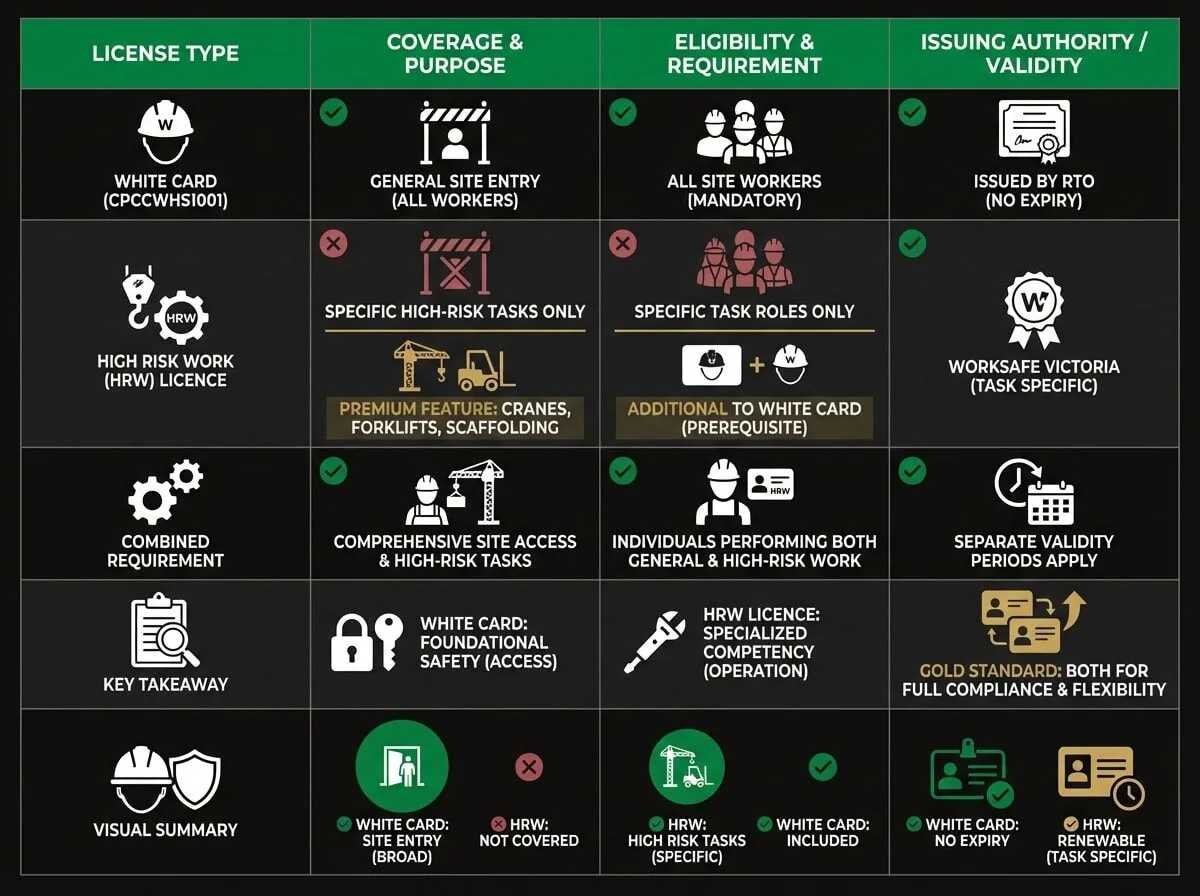
Can the White Card course be completed online in Victoria?
No. As of 2025, the White Card course must be completed face-to-face in a classroom setting in Victoria. WorkSafe Victoria’s licensing requirements mandate in-person delivery, including active participation, real-time assessment, and identity verification. Any provider offering an online White Card course to Victorian residents is not delivering a compliant credential, and cards obtained through such providers may not be accepted on site.
How does the transition from the BPC to the BPC affect my development projects?
The Building and Plumbing Commission (BPC) is being granted new consumer protection powers, including rectification orders, a new warranty scheme for buildings up to three storeys, and a developer bond for apartment buildings above three storeys. These changes may affect your insurance obligations, defect liability exposure, and the documentation requirements associated with your building permit. It is worth reviewing these changes with your building surveyor and legal advisers as the new regulations are finalised.
Conclusion
The White Card is a foundational compliance requirement for anyone involved in Victorian construction — including property developers who access their own sites. Obtaining one is straightforward: complete the CPCCWHS1001 course in person through an accredited RTO, meet the basic eligibility requirements, and carry your card whenever you’re on site. The broader context matters too: Victoria’s building and planning systems are undergoing substantial reform in 2025 and beyond, from the transition to the BPC and new consumer protection powers, to streamlined planning pathways under Amendment VC282 and the Housing Statement Reform Act. Staying across these changes is part of running a compliant, efficient development programme in Melbourne.
SQM Architects has supported property developers across the City of Whitehorse, City of Boroondara, Manningham City Council, City of Monash, Knox City Council, and Maroondah City Council for over a decade, delivering a range of residential and mixed-use projects. If you’d like to understand how current regulatory changes may affect your next development, we’re here to help.
Book a Strategy Call — call us on (03) 9005 6588 or reach out online to discuss your project with the SQM Architects team.
This article provides general information about Victorian construction compliance and planning for property developers. It does not constitute professional advice. For specific guidance on your project, contact SQM Architects for a complimentary site assessment.