
Understanding Building Setbacks in Victoria: What Property Developers Need to Know
Building setbacks represent one of the most variable aspects of Victorian planning schemes, with significant differences between councils that can make or break a development’s feasibility. For property developers working across Melbourne’s Eastern Suburbs, understanding these variations isn’t just about compliance—it’s about maximising yield while maintaining approval certainty. A site that achieves four dwellings in Whitehorse might only support three in Boroondara under identical dimensions, purely due to setback requirements.
The challenge intensifies because setback requirements operate across multiple layers: ResCode standards under Clause 54 and 55, local planning scheme schedules, and council-specific policies. Recent amendments including VC282 (September 2025) and VC267 (March 2025) have further refined these requirements, introducing new street setback standards and deemed-to-comply pathways that vary in application across different councils. This guide breaks down the practical variations developers encounter, with specific examples from the six major Eastern Suburbs councils.
With SQM Architects’ 210+ projects delivered across these municipalities and a 98% planning approval rate, we’ve identified the critical setback variations that impact development feasibility. Understanding these differences early in your site assessment can save months of redesign and thousands in consultant fees.
The Three-Tier Setback Framework in Victorian Planning
Victorian planning schemes apply building setbacks through three distinct regulatory layers, each with different objectives and flexibility. Understanding this hierarchy is essential because councils can—and do—modify requirements at each level, creating significant variations even between neighbouring municipalities.
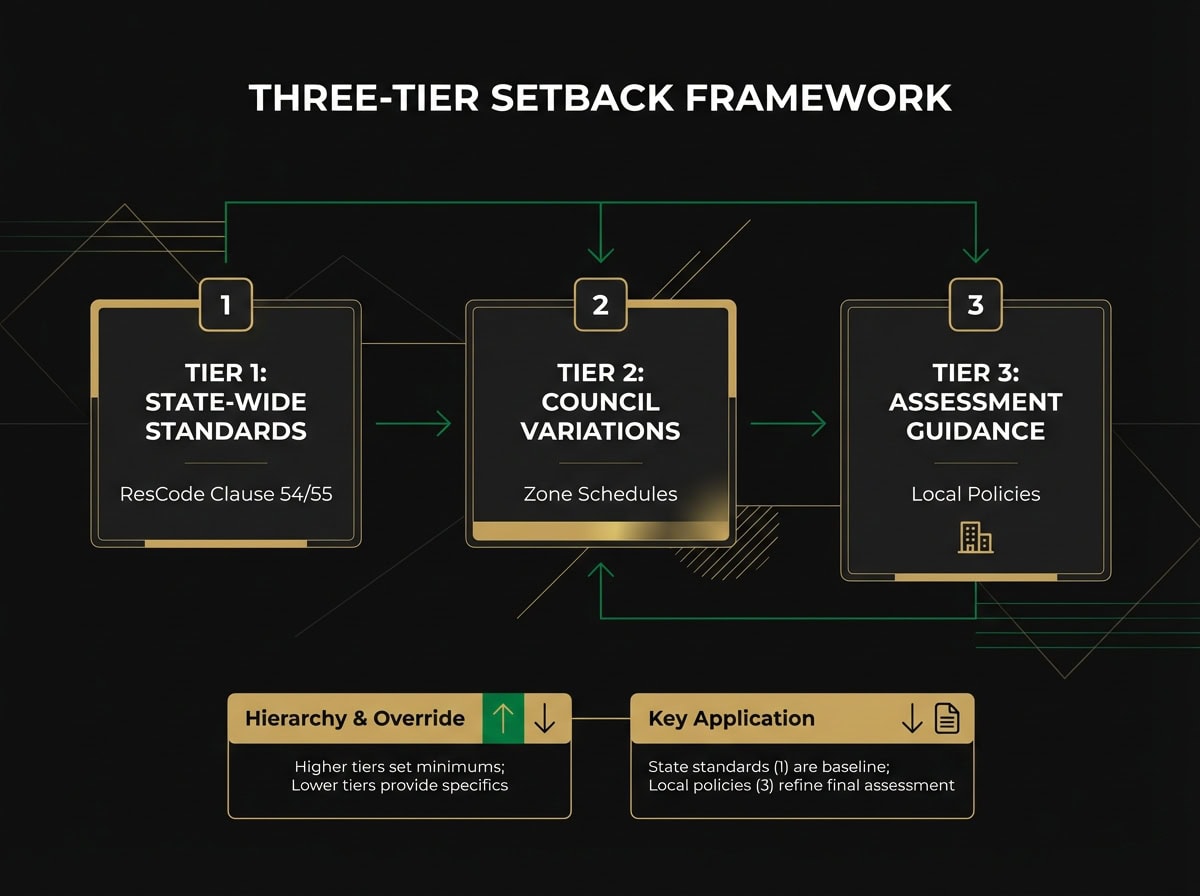
The first tier comprises ResCode standards under Clause 54 (one dwelling on a lot) and Clause 55 (two or more dwellings). These provide state-wide objectives and standards, including street setbacks, side and rear setbacks, and walls on boundaries. Following VC282, Clause 54 now includes specific street setback requirements of 9 metres from a road in a Road Zone Category 1, 6 metres from other roads, and 3 metres from rear or side streets. However, these standards include performance-based alternatives, allowing councils to accept variations where objectives are met.
The second tier involves zone schedules, where councils can specify different setback requirements for their municipality. The General Residential Zone Schedule (GRZ), Neighbourhood Residential Zone Schedule (NRZ), and Residential Growth Zone Schedule (RGZ) all permit councils to mandate specific setbacks that override ResCode standards. This is where major variations occur—City of Boroondara’s NRZ1 requires 9-metre front setbacks in some precincts, while Manningham City Council’s GRZ1 may accept 6 metres in comparable areas.
The third tier encompasses local policies and design guidelines, which councils use to interpret how setback objectives should be met. These don’t legally override planning scheme requirements but heavily influence how planners assess applications. Knox City Council’s residential design guidelines, for example, provide detailed guidance on how side setback variations might be considered, while City of Whitehorse’s neighbourhood character studies inform expectations for front setback consistency.
Front Setback Variations Across Eastern Suburbs Councils
Front setbacks generate the most visible differences between councils because they directly impact neighbourhood character—a priority that varies significantly across municipalities. These variations affect not just the building envelope but also car parking arrangements, landscaping requirements, and overall site yield.
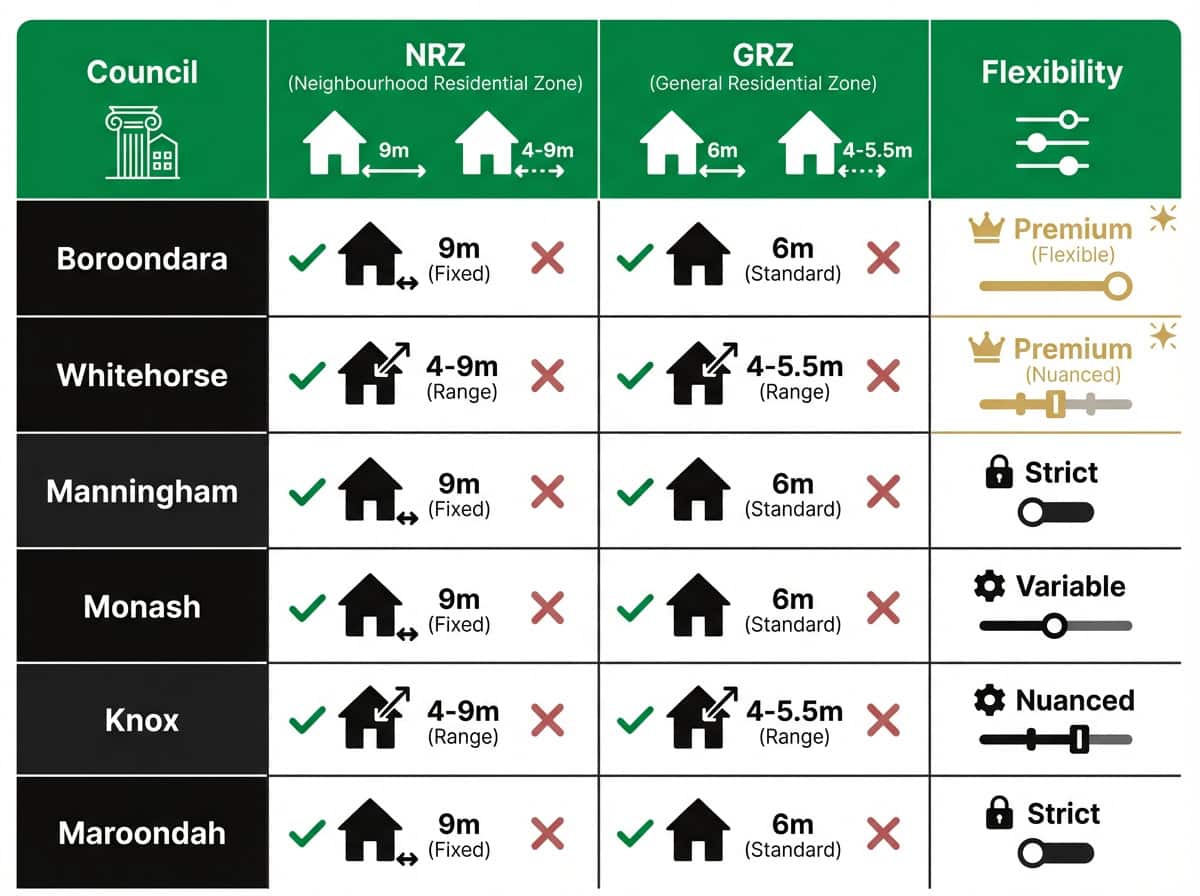
City of Boroondara applies the strictest front setback controls among Eastern Suburbs councils, particularly in Neighbourhood Residential Zones. In NRZ precincts covering areas like Kew, Camberwell, and Hawthorn, front setbacks of 9 metres are common, with some heritage precincts requiring matching the predominant setback of the street (often 10-12 metres in established areas). The council’s neighbourhood character policy strongly resists variations, even where ResCode performance criteria might technically be met. For a 600-square-metre site in Camberwell’s NRZ1, this typically means accepting a smaller building footprint rather than negotiating reduced setbacks.
City of Whitehorse takes a more nuanced approach, with front setbacks varying by precinct character. In established areas like Box Hill South and Blackburn, the GRZ schedule requires 6-metre front setbacks, but council officers regularly accept 5-5.5 metres where this matches the street pattern. In growth areas near activity centres, setbacks of 4-5 metres are achievable, particularly for townhouse developments under the deemed-to-comply pathways introduced by VC267. The council’s focus is on consistency with the immediate streetscape rather than absolute measurements.
Manningham City Council demonstrates the widest internal variation, with front setbacks ranging from 4 metres in urban renewal precincts near Doncaster Hill to 9 metres in low-density residential areas like Warrandyte. The council’s planning scheme includes detailed precinct schedules that specify different requirements for different character areas. Developers working across multiple sites in Manningham need to check the specific schedule for each location—assumptions from one project rarely transfer to another.
City of Monash generally applies 6-metre front setbacks in residential zones but shows flexibility in higher-density areas near Clayton and Glen Waverley activity centres. The council’s recent design guidelines (updated 2024) provide clear guidance on when variations might be supported, typically where developments include substantial canopy tree planting or demonstrate superior architectural design. For sites within 400 metres of railway stations, front setbacks of 4-5 metres are routinely approved.
Side and Rear Setback Requirements: The Yield Impact
Side and rear setbacks directly determine how many dwellings fit on a site, making council variations in these requirements critical for development feasibility. The differences between councils can mean a variation of one or two dwellings on a typical 800-square-metre site—representing $200,000-$400,000 in potential gross development value.
ResCode Clause 55 provides the baseline: side setbacks should be one-third the wall height (minimum 1 metre) for walls up to 3.6 metres, increasing for taller walls. Rear setbacks should be one-third the wall height (minimum 4 metres for single-storey, 5 metres for double-storey). However, councils interpret and apply these standards very differently, particularly regarding walls on boundaries and variations for specific building elements.
City of Boroondara strictly enforces side setback requirements with minimal flexibility. For a standard two-storey development (wall height 6-7 metres), expect side setbacks of 2-2.5 metres to be required, even where ResCode might permit less. The council rarely supports walls on side boundaries except for garages and carports, and even these must be carefully designed to minimise visual bulk. On a 15-metre-wide lot, this effectively limits development to a 10-11 metre building width, significantly constraining internal layouts.
City of Whitehorse applies ResCode standards more flexibly, particularly for infill developments in established areas. Side setbacks of 1.5 metres are regularly approved for two-storey walls where neighbouring properties have similar setbacks, and the council accepts walls on boundaries for habitable rooms where this improves overall site layout. This flexibility can add 15-20 square metres of internal floor area per dwelling—enough to upgrade from two to three bedrooms or add a study.
Knox City Council takes a performance-based approach to side setbacks, focusing on amenity impacts rather than strict numerical compliance. The council’s assessment considers overshadowing, overlooking, and visual bulk holistically. For developments demonstrating good design outcomes—high-quality materials, articulated facades, substantial landscaping—side setback variations of 20-30% are achievable. A development requiring 2-metre side setbacks under ResCode might be approved at 1.4-1.5 metres with appropriate design responses.
Rear setbacks show similar variations. Maroondah City Council applies the ResCode minimums (4 metres single-storey, 5 metres double-storey) but requires additional setbacks for balconies and upper-floor windows to address overlooking. City of Monash accepts reduced rear setbacks where sites back onto commercial zones or public open space, recognising that amenity impacts differ from residential interfaces. These variations can be critical for narrow sites where every metre of building depth affects feasibility.
Walls on Boundaries: Council-Specific Limitations
Walls on boundaries represent one of the most contentious setback variations, with councils applying dramatically different standards despite ResCode providing clear performance criteria. Understanding these differences is essential because walls on boundaries can significantly improve site efficiency, particularly on narrow lots.
ResCode Clause 55.04-5 permits walls on boundaries up to 3.6 metres high and 9 metres long (or two-thirds the boundary length, whichever is less) on one side boundary. However, councils frequently impose additional restrictions through local policies and assessment practices that go beyond these standards.
City of Boroondara rarely supports walls on side boundaries for habitable rooms, limiting approval to garages, carports, and service areas. Even for these permitted uses, the council requires high-quality materials and architectural treatment to minimise visual impact. For a townhouse development, this typically means garages can be built to one boundary, but the main dwelling must maintain full side setbacks. This restriction significantly impacts site efficiency on lots narrower than 12 metres.
Manningham City Council applies a precinct-based approach. In established residential areas, walls on boundaries face similar restrictions to Boroondara. However, in designated growth areas and near activity centres, the council accepts walls on boundaries for habitable rooms where this facilitates better overall site layout. The key is demonstrating that the wall-on-boundary approach delivers superior outcomes compared to a setback alternative—better private open space, improved solar access, or enhanced streetscape presentation.
City of Whitehorse shows the most flexibility among Eastern Suburbs councils, regularly approving walls on boundaries for townhouse developments where this enables better site planning. The council’s focus is on the overall design quality rather than strict adherence to setback requirements. For a four-townhouse development on an 800-square-metre site, walls on boundaries might be approved for two of the dwellings where this creates larger private courtyards and better internal layouts for all units.
Knox City Council requires detailed justification for walls on boundaries but will support them where clear amenity benefits are demonstrated. The council’s assessment considers the cumulative impact—a wall on boundary might be supported if it enables increased side setbacks elsewhere on the site, better tree retention, or improved solar access to neighbouring properties. Documentation is critical: shadow diagrams, 3D visualisations, and detailed material specifications significantly improve approval prospects.
Upper-Level Setback Requirements and Variations
Upper-level setbacks have become increasingly important following VC282, which introduced new standards for daylight to existing windows. These requirements interact with traditional setback controls to create complex assessment scenarios that vary significantly between councils.
The updated Clause 54.04-2 (applicable to one dwelling on a lot) now requires buildings to be setback from boundaries to ensure existing habitable room windows on adjoining lots receive adequate daylight. The standard requires a minimum 3-metre setback from the boundary for walls within 3 metres of existing windows, increasing to 4 metres for walls over 3.6 metres high. However, councils interpret and apply these requirements differently, particularly for infill sites in established areas.
City of Monash applies upper-level setback requirements strictly, particularly in areas with consistent two-storey development patterns. For second-storey additions or new two-storey dwellings, expect upper-level setbacks of 5-6 metres from side boundaries where neighbouring properties have habitable room windows facing the boundary. This requirement can significantly reduce the feasible upper-floor area, particularly on narrow lots. On a 12-metre-wide site, upper-level setbacks might reduce the second floor to 6-7 metres width, compared to 10 metres for the ground floor.
Manningham City Council takes a more flexible approach, considering the existing context. In areas where two-storey development is established, upper-level setbacks of 3-4 metres are typically acceptable. The council’s assessment focuses on the incremental impact—if neighbouring properties already experience some overshadowing or visual bulk from existing development, modest additional impacts may be acceptable. This contextual approach can make significant difference to feasibility in established areas.
City of Whitehorse requires upper-level setbacks to be increased where developments include balconies or large windows that might create overlooking impacts. The standard approach is 4-5 metres for upper-level habitable rooms, increasing to 6-9 metres for balconies depending on orientation and screening. However, the council accepts reduced setbacks where privacy screens, obscure glazing, or strategic window placement address overlooking concerns. For a townhouse development, this might mean 4-metre upper-level setbacks with highlight windows facing side boundaries, rather than 6-metre setbacks with standard windows.
Practical Strategies for Managing Setback Variations
Successfully navigating setback variations requires strategic planning from initial site assessment through to planning permit application. The following approaches, refined through SQM Architects’ 210+ projects across Eastern Suburbs councils, can significantly improve approval prospects and development feasibility.

Conduct council-specific research before purchasing sites. Review recent planning permits for similar developments in the immediate area using council planning registers. This reveals how the council actually applies setback requirements, which often differs from strict planning scheme interpretation. For example, City of Boroondara’s planning register shows that while the scheme requires 9-metre front setbacks in certain NRZ precincts, variations to 8-8.5 metres are occasionally approved where this matches the predominant street setback. This 0.5-1 metre difference can be critical for site feasibility.
Engage with council planners early through pre-application meetings. Most Eastern Suburbs councils offer this service, and it’s particularly valuable for sites where setback variations will be required. Present preliminary concepts showing both compliant and varied setback options, with clear documentation of the design benefits of the variation. Council planners can provide guidance on which variations might be supported and what additional design responses would strengthen the application. This feedback, obtained before significant design investment, can save months of redesign.
Develop design responses that address setback variation impacts. Councils are more likely to support setback variations where developments demonstrate superior outcomes in other areas. For reduced side setbacks, this might include enhanced materials, articulated facades, or increased landscaping. For front setback variations, street tree planting or high-quality front fence design can demonstrate commitment to streetscape quality. These design responses should be clearly documented in planning permit applications, with specific references to how they address ResCode objectives.
Consider the deemed-to-comply pathways introduced by VC267 for townhouse and low-rise developments. These pathways provide clearer assessment criteria and faster processing for developments meeting specific standards. However, the pathways include setback requirements that may differ from standard ResCode provisions, and councils apply them variably. City of Whitehorse actively encourages use of deemed-to-comply pathways, while City of Boroondara maintains stricter assessment even for complying developments. Understanding which pathway offers the best approval prospects for your specific site and council is critical.
Budget for professional planning support where significant setback variations are required. While some developers attempt to navigate variations independently, the cost of refusal and redesign typically far exceeds professional fees. Experienced planning consultants understand council-specific assessment patterns and can frame variation requests in ways that align with council priorities. For developments requiring multiple setback variations—common on constrained infill sites—professional support can be the difference between approval and refusal.
Common Setback Variation Scenarios and Solutions
Certain site configurations and development types consistently require setback variations across Eastern Suburbs councils. Understanding these scenarios and proven solutions can inform site selection and preliminary design.
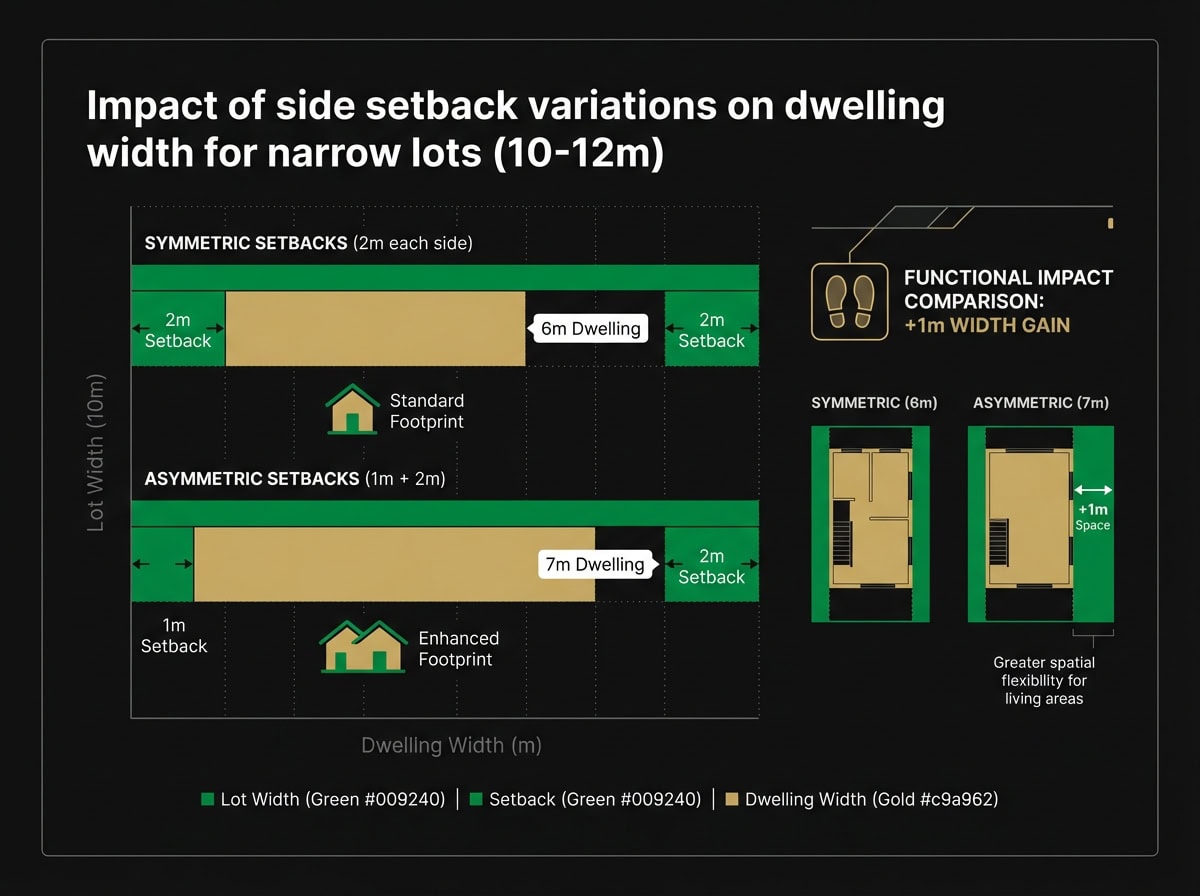
Narrow lots (10-12 metres wide) almost always require side setback variations to achieve viable dwelling widths. The standard approach is to minimise setbacks on one side (often to 1-1.5 metres) while maintaining or exceeding requirements on the other side. This asymmetric approach maintains the total setback area while enabling functional internal layouts. City of Whitehorse and Knox City Council regularly approve this approach, while City of Boroondara requires stronger justification. For a 10-metre-wide lot, this strategy might enable a 7-metre dwelling width compared to 6 metres with symmetric setbacks—enough to accommodate a functional kitchen and living area.
Corner sites face competing setback requirements from multiple street frontages. ResCode requires setbacks from both streets, but councils vary in how they apply these requirements, particularly for secondary street frontages. Manningham City Council often accepts reduced setbacks to secondary streets (3-4 metres instead of 6 metres) where this enables better site utilisation. City of Monash requires full setbacks to both frontages in most cases, significantly constraining development potential. For a corner site in Manningham, this flexibility might enable an additional dwelling compared to the same site in Monash.
Rear-loaded sites (access via right-of-way or rear laneway) can sometimes justify reduced front setbacks because car parking is accessed from the rear. City of Whitehorse accepts this logic, approving front setbacks of 4-5 metres for townhouses with rear garage access, compared to 6 metres for front-loaded developments. The reduced setback enables larger private open space areas at the rear. However, City of Boroondara maintains standard front setback requirements regardless of access configuration, viewing front setbacks as primarily about streetscape character rather than parking functionality.
Sites adjacent to public open space or commercial zones can sometimes achieve reduced rear setbacks because amenity impacts differ from residential interfaces. Knox City Council and City of Monash both accept this approach, approving rear setbacks of 3-4 metres where sites back onto parks or shopping centres. This variation can add 1-2 metres of building depth, significantly improving internal layouts. However, detailed justification is required, demonstrating that reduced setbacks won’t create overlooking or visual bulk issues from public spaces.
How do setback requirements differ between General Residential Zone and Neighbourhood Residential Zone?
Neighbourhood Residential Zones typically impose stricter setback requirements than General Residential Zones, reflecting their objective to preserve neighbourhood character. In City of Boroondara, NRZ areas require 9-metre front setbacks compared to 6 metres in GRZ areas. Side and rear setbacks are also less flexible in NRZ, with variations rarely supported. The practical impact is that NRZ sites generally support fewer dwellings than comparable GRZ sites.
Can I apply for a planning permit variation if my development doesn’t meet setback requirements?
Yes, setback requirements in ResCode include both standards and objectives. If your development doesn’t meet the standard (numerical requirement) but achieves the objective (performance outcome), councils can approve variations. However, you must demonstrate how the variation meets objectives through design responses like enhanced materials, landscaping, or improved amenity outcomes. Success rates vary significantly between councils—City of Whitehorse approves variations more readily than City of Boroondara.
Do setback requirements apply to balconies and pergolas?
Yes, balconies and pergolas are typically included in setback measurements, though councils apply this differently. Most Eastern Suburbs councils measure setbacks to the outer edge of balconies, including any balustrades or privacy screens. Pergolas are included if they’re enclosed or create overlooking opportunities. However, open pergolas with minimal visual bulk may be excluded from setback measurements in some councils. City of Whitehorse provides the clearest guidance, specifying that open structures under 2.4 metres high may be excluded from setback calculations.
How do recent planning amendments affect setback requirements?
VC282 (September 2025) introduced new street setback standards under Clause 54, requiring 9 metres from Road Zone Category 1, 6 metres from other roads, and 3 metres from rear/side streets. VC267 (March 2025) introduced deemed-to-comply pathways with specific setback requirements that may differ from standard ResCode provisions. These amendments are applied variably across councils—some have updated local schedules to align, while others maintain existing requirements. Check the specific planning scheme schedule for your municipality.
What setback variations are most likely to be approved?
Variations most likely to gain approval are those that deliver clear design benefits while minimising amenity impacts. Front setback variations of 0.5-1 metre to match existing street patterns are regularly approved. Side setback reductions where walls include high-quality materials and articulation are often supported. Upper-level setback variations with privacy screening or highlight windows are achievable. The key is demonstrating that the variation enables better overall outcomes—improved solar access, larger private open space, or enhanced streetscape presentation.
Do setback requirements differ for subdivisions versus multi-unit developments?
Setback requirements apply to buildings, not subdivision boundaries, so the assessment differs. For a subdivision creating multiple lots, each future dwelling must meet setback requirements from its lot boundaries. This means subdivision layouts must account for future building setbacks when determining lot sizes and configurations. For multi-unit developments, setbacks are measured from the overall site boundaries, not between individual units. This distinction can significantly affect feasibility—a four-lot subdivision might require larger overall site area than a four-unit development due to cumulative setback requirements.
How can I find the specific setback requirements for my site?
Start with the Victorian Planning Provisions online, searching for your site address to identify the applicable zone and overlays. Review the zone schedule for your municipality—this specifies any local variations to standard ResCode setbacks. Check council planning policies and neighbourhood character studies for additional guidance. Review recent planning permits for similar developments in your street using the council planning register. For complex sites or where significant variations are required, engage a planning consultant familiar with your specific council’s assessment practices.
Moving Forward with Setback Compliance
Building setback variations across Victorian councils represent both a challenge and an opportunity for property developers. Understanding these variations enables more accurate site feasibility assessment, better preliminary design, and higher approval certainty. The difference between councils can be substantial—a site achieving four dwellings in City of Whitehorse might only support three in City of Boroondara, purely due to setback requirements. This knowledge should inform site selection, purchase price negotiations, and development strategy.
The key to successful navigation is early, detailed research into council-specific requirements and recent assessment patterns. Generic assumptions about setback requirements lead to costly redesigns and delayed approvals. Council-specific knowledge, obtained through planning register reviews, pre-application meetings, and professional advice, provides the foundation for feasible development proposals. With recent amendments like VC282 and VC267 introducing new requirements and pathways, staying current with regulatory changes is essential.
For property developers working across Melbourne’s Eastern Suburbs, partnering with professionals who understand these council variations can significantly improve outcomes. SQM Architects’ 210+ projects across Whitehorse, Boroondara, Manningham, Monash, Knox, and Maroondah councils provide detailed knowledge of how each municipality applies setback requirements in practice. This experience translates to designs that maximise yield while maintaining the 98% approval rate that keeps projects on schedule and on budget.
Get Your Free Site Assessment to understand how setback requirements affect your development potential. Call SQM Architects on (03) 9005 6588 or visit our office in Melbourne’s Eastern Suburbs to discuss your project with architects who know the local planning landscape.
This article provides general information about Victorian planning for property developers. It does not constitute professional advice. For specific guidance on your project, contact SQM Architects (ARBV Reg. No. 51498) for a complimentary site assessment.