Why Fence Height Regulations Matter for Melbourne Property Developers
If you are planning a residential development, subdivision, or site upgrade in Melbourne, fence height regulations are one of those compliance details that can quietly derail a project if overlooked. Get the heights wrong, use the wrong materials, or miss a permit trigger, and you may face enforcement notices, costly rebuilds, or delays to your planning approvals — none of which are welcome on a tight development programme.
Boundary treatments matter when planning two dwellings on one title.
Victoria’s fencing rules draw from multiple sources: the Building Regulations 2018, the Fences Act 1968, the Victorian Planning Provisions (VPP), and individual council planning schemes. Each layer can modify what the previous one permits. For developers working across councils such as the City of Whitehorse, City of Boroondara, Manningham City Council, City of Monash, Knox City Council, or Maroondah City Council, the variation between jurisdictions adds another layer of complexity that warrants careful attention before lodging any planning permit application.
This article outlines the key fence height rules that apply across Victoria, how they interact with planning approvals, and what Melbourne developers may need to consider when preparing or amending a planning permit. It reflects the current regulatory framework as at 2025–26, including the updated Fences Regulations 2024 (SR 84/2024), which came into effect in September 2024.
Own a block in Melbourne?
Your land may be worth more than the house on it — see what your block could fit.
Many established Melbourne blocks may support a second dwelling, dual occupancy or subdivision under current planning rules. SQM’s free screener checks your address against zoning and lot-size rules in about 60 seconds.
Check my block — freeFree indicative screening based on public planning data. Results are general information, not planning or financial advice.
The Regulatory Framework: Where Fence Rules Come From
Understanding fence height regulations in Victoria starts with recognising that no single document contains all the rules. Instead, three overlapping frameworks apply simultaneously, and a fence must comply with all of them.
Building Regulations 2018 (Part 5 — Siting)
The Building Regulations 2018 set the baseline statewide standards for fence heights, particularly for front fences and corner lots. The key clauses for developers to understand are:
- Regulation 89 — governs front fence height within 3 metres of the front street alignment
- Regulation 90 — setback requirements for fences exceeding 2 metres in height
- Regulation 91 — controls on fences constructed on or within 150mm of side or rear boundaries
- Regulation 92 — visibility controls at street intersections (corner lots)
- Regulation 95 — solar access protections for north-facing habitable room windows on adjoining allotments
Where a proposed fence does not comply with these regulations, the developer or owner may need to seek Report and Consent from the Responsible Authority (typically the relevant council) in addition to obtaining a building permit.
Fences Regulations 2024
The Fences Regulations 2024 (SR 84/2024), which came into effect in September 2024, updated the procedural framework governing dividing fences in Victoria. These regulations sit under the Fences Act 1968 and primarily address cost-sharing obligations, fencing notices, and dispute resolution processes between adjoining owners. For developers managing multi-lot subdivisions or sites with shared boundaries, understanding the fencing notice process under this updated framework may be relevant to project delivery timelines.
Victorian Planning Provisions and Local Planning Schemes
The Victorian Planning Provisions (VPP), including ResCode Standards A2-7 and B2-8 (renumbered from A20 and B32 by Amendment VC267 on 31 March 2025), establish front fence height requirements that apply within residential zones. These standards specify that a front fence within 3 metres of a street should not exceed:
- 2 metres on streets in a Transport Zone 2
- 1.5 metres on all other streets
Local planning schemes can modify these defaults through zone schedules or overlays. Heritage overlays, Neighbourhood Character overlays, and Design and Development overlays are all capable of imposing stricter or different fence height controls than the statewide baseline.
Front Fence Height Rules: The Key Numbers
Front fences — those facing the street — attract the most regulatory attention because they directly affect streetscape character, driver sightlines, and pedestrian safety. The rules vary depending on the street type, the fence material, and the zone in which the property sits.
Standard Residential Zones
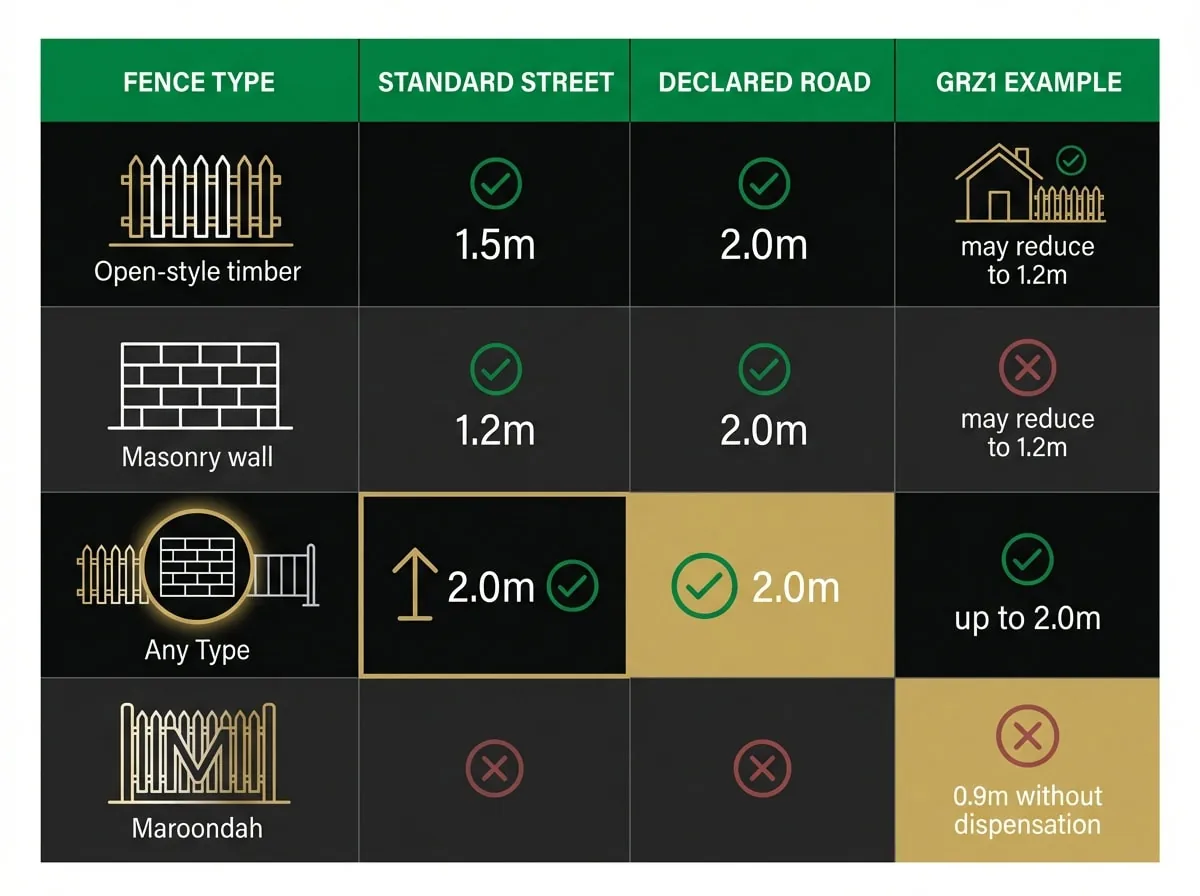
For most residential properties in Victoria, the permit-free thresholds for front fences are:
- Timber or steel picket (open-style) fences: up to 1.5 metres without a building permit, provided they maintain visual transparency
- Masonry fences (brick, concrete, Hebel panels): up to 1.2 metres without a building permit
- Declared roads (major roads): front fences may be permitted up to 2 metres in height
Any front fence exceeding these heights will generally require both a building permit and Report and Consent from the Responsible Authority. Solid masonry fences are more strictly regulated across most Melbourne councils, and developers proposing precast concrete or sandstone feature fences should also engage a structural engineer to prepare a Regulation 126 Certificate of Compliance for the structural design and footing system.
General Residential Zone 1 (GRZ1)
Properties within a General Residential Zone 1 (GRZ1) may face a reduced maximum front fence height of 1.2 metres, as specified in the schedule to that zone. Developers should always check the applicable zone schedule via VicPlan before finalising fence specifications on a development site.
Maroondah City Council Example
Maroondah City Council provides a useful illustration of how local variations operate. Under the Maroondah Planning Scheme, properties in certain residential zones (including GRZ1) may only construct a front fence up to 0.9 metres without a dispensation or building permit — or up to 1.2 metres on a declared road. For all other zones, the standard 1.5 metre threshold applies (or 2 metres on a declared road). If a previous planning permit has been issued for the site — including for a unit development — any fence change may require an amendment to that planning permit rather than a separate building dispensation.
A granny flat for family, an extension, or two homes where one stands — the seven rules that decide it, in plain English, verified against the current planning provisions. Free PDF, instant download.
- Your zone, overlays & the 60m² granny flat rule
- When you need a permit — and when you don’t
- The free two-minute check for your address
Something went wrong. Please try again.
No spam. Unsubscribe anytime. Or skip ahead: see what your block allows →
Check your inbox — your checklist is on its way.
Side and Rear Boundary Fence Height Rules
Side and rear boundary fences are generally subject to more permissive height limits than front fences, reflecting their reduced impact on streetscape and sightlines. However, permit triggers still apply, and the rules become more complex as fence height increases.
Standard Boundary Fence Heights
- Fences up to 2 metres in height: generally permitted without a building permit on side and rear boundaries
- The section of a boundary fence within 3 metres of the front boundary must not exceed 1.5 metres in height
- Typical boundary fences across Victoria range from 1.6 to 1.8 metres, with back fences commonly at 2 metres
Fences Exceeding 2 Metres
Under Building Regulation 90, a fence exceeding 2 metres in height must be set back from a side or rear boundary by at least the following distances:
- More than 2m but not more than 3.6m: minimum 1 metre setback from the boundary
- More than 3.6m but not more than 6.9m: 1 metre plus 300mm for every metre of height over 3.6 metres
- More than 6.9m: 2 metres plus 1 metre for every metre of height over 6.9 metres
Under Building Regulation 91, fences constructed on or within 150mm of a side or rear boundary must not exceed an average height of 3 metres and a maximum height of 3.6 metres along the boundary. The total length of such fences is also subject to controls based on the length of the adjoining boundary. Any trellis or screen attached to an existing or new fence is included in the overall height calculation — a detail that frequently catches developers off guard during construction.
Overlooking and Solar Access Considerations
Building Regulation 95 introduces an additional constraint where a fence exceeding 2 metres is proposed on an allotment that has a north-facing habitable room window on an adjoining property within 3 metres of the shared boundary. In these circumstances, the fence height and design may need to be modified to protect solar access to that window. For multi-dwelling developments, this interaction between fence height and ResCode overlooking and solar access standards warrants early assessment during the design phase.
Corner Lot Fencing Rules
Corner lots are subject to additional height restrictions to maintain safe sightlines at road intersections. Under Building Regulation 92, fences within 9 metres of a point of intersection of street alignments are limited as follows:
- 1 metre maximum height within 9 metres of the intersection (the “traffic sight triangle”)
- 1.5 metres along the front boundary beyond the 9-metre zone
- 2 metres along the side street boundary beyond the 9-metre zone
Any fence exceeding these heights on a corner lot will require both Report and Consent from the Responsible Authority and a building permit. Knox City Council, for example, requires a building permit and Report and Consent for any front fence over 1 metre within 9 metres of an intersection. Developers designing townhouse or unit developments on corner lots should factor these constraints into site layout and landscaping plans from the outset. Where a dispute arises over corner lot fencing, the matter may be referred to VCAT for resolution.
Swimming Pool and Spa Barrier Requirements
Pool and spa safety barriers are governed by the Building Regulations 2018 and operate as a separate, mandatory regime that overrides standard fencing permissions. A building permit is always required for pool and spa barriers, regardless of height. Key requirements include:
- Barrier height of at least 1.2 metres (measured from the outside of the barrier)
- Non-climbable zones on the outside of the barrier
- Self-closing, self-latching gates that open outward from the pool area
- Compliance with Australian Standard AS 1926.1
For developers including pools or spas in multi-dwelling projects, early engagement with a registered building surveyor is advisable to ensure barrier design is integrated into the overall development layout rather than treated as an afterthought.
Planning Permits, Overlays, and Special Conditions
Beyond building permits, a separate planning permit may be required for fencing in certain circumstances. Developers should check whether any of the following apply to their site before finalising fence specifications:
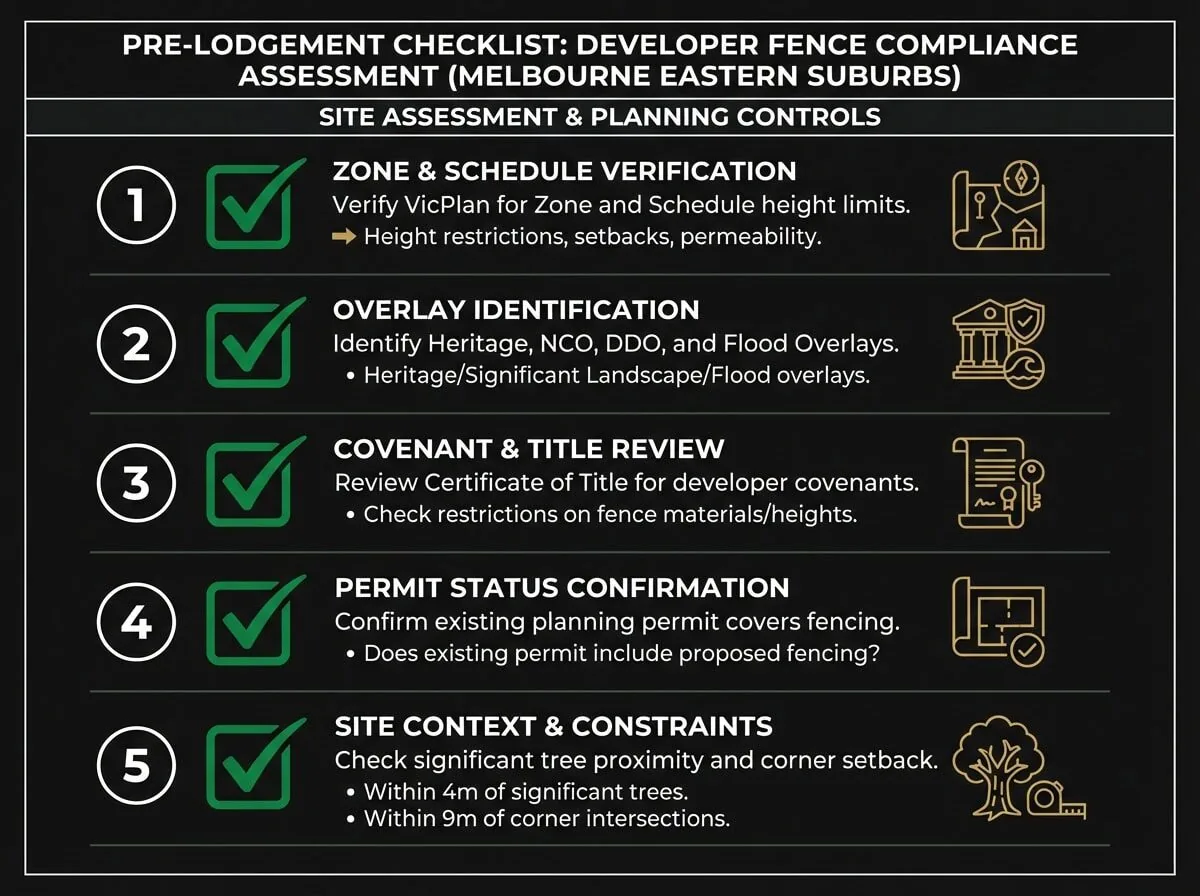
- Heritage Overlay (HO): fences visible from the street in heritage precincts may require a planning permit, with design required to complement the heritage character of the area
- Neighbourhood Character Overlay (NCO): some overlays impose specific fence height, material, or transparency requirements
- Design and Development Overlay (DDO): may specify maximum fence heights or design standards
- Significant Tree proximity: fences within 4 metres of a significant tree may require additional assessment
- Easements: fences proposed over easements (drainage, sewerage, or other) require consent from the relevant authority
- Flood overlays (LSIO, SBO): fences in flood-prone areas may require specific design to allow water flow
- Previous planning permit on site: if the site has an existing planning permit (including for a unit development), any change to fence position, height, or material may require an amendment to that permit
For developments in the City of Boroondara or City of Whitehorse — both of which contain substantial heritage precincts — the planning permit implications of fencing decisions deserve particular attention. SQM Architects works across Melbourne, and heritage overlay fencing requirements are among the most common compliance issues we assist developers in navigating.
Developer Covenants and Title Restrictions
In addition to council and state regulations, many properties — particularly in newer estates — are subject to developer covenants or estate design guidelines registered on the Certificate of Title. These private restrictions may:
- Prohibit front fences entirely
- Specify maximum fence heights lower than council minimums
- Restrict fence materials, colours, or styles
- Require developer approval before construction commences
Title covenants operate independently of planning and building regulations. Even if a fence complies with all council and state requirements, a breach of a title covenant may expose the developer to legal action from the original estate developer or neighbouring owners. Always review the Certificate of Title — including any Memorandum of Common Provisions — before finalising fence specifications on a development site.
When Do You Need a Building Permit for a Fence in Victoria?
As a general guide, a building permit is likely required in the following circumstances:
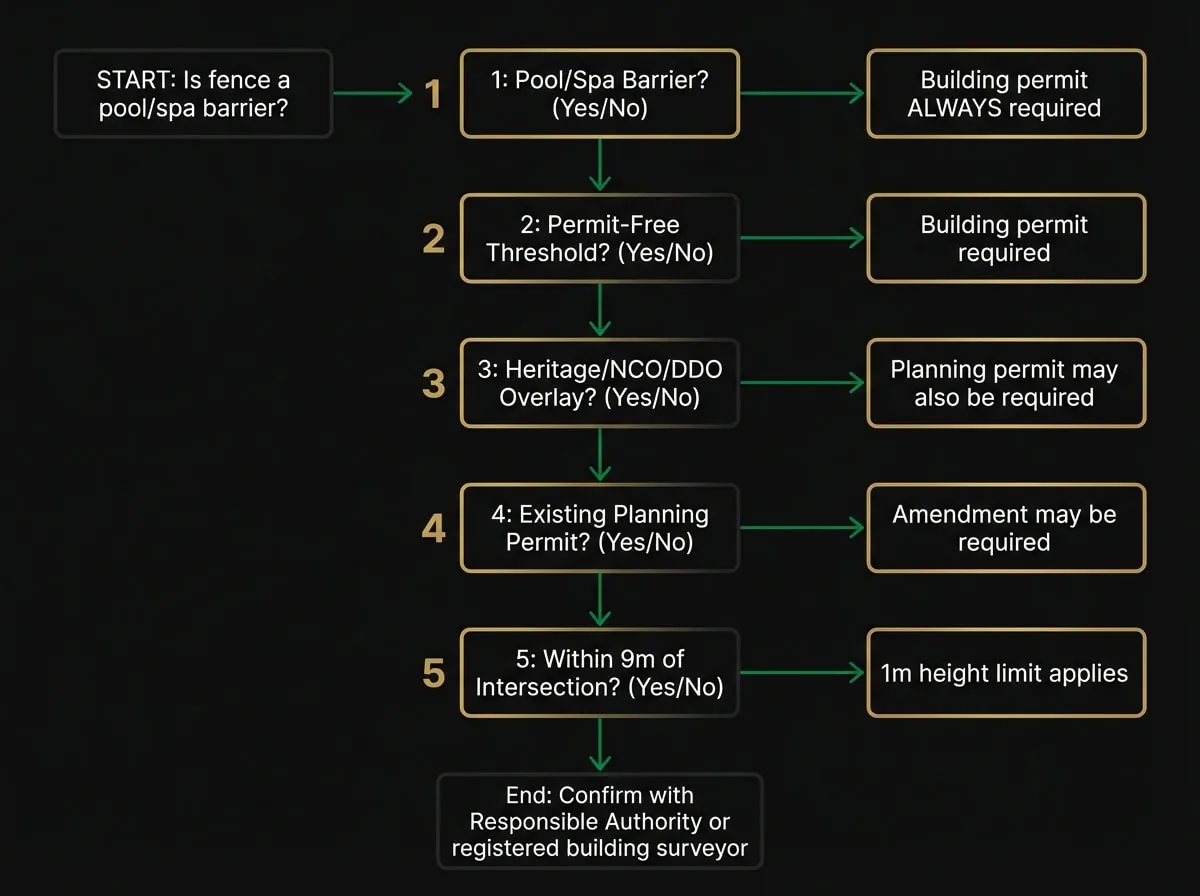
- A timber or lightweight front fence higher than 1.5 metres
- A masonry front fence higher than 1.2 metres
- Any side or rear boundary fence higher than 2 metres
- Any fence over 1 metre within 9 metres of a street intersection
- Any fence forming part of a swimming pool or spa barrier
- A fence on a declared road exceeding the applicable height limit
- A fence incorporating a barbed wire element adjacent to a street alignment
- Any fence where the site is subject to a planning overlay that triggers permit requirements
Note that replacing an existing fence “like for like” — same height, same materials, same location — generally does not require a new building permit. However, any change to height, materials, or position will likely trigger permit requirements. Always confirm with the Responsible Authority or a registered building surveyor before commencing works.
FAQ: Fence Height Regulations in Victoria
Do I need a planning permit as well as a building permit for a fence?
In many cases, only a building permit is required. However, a planning permit may also be needed if the site is subject to a Heritage Overlay, Neighbourhood Character Overlay, Design and Development Overlay, or if the site has an existing planning permit that covers fencing. Always check both the planning scheme and building regulations before commencing works.
Can I attach a trellis to an existing fence to increase its effective height?
No — under the Building Regulations 2018, any trellis or screen attached to a new or existing fence is included in the overall height calculation. If the combined height of the fence and trellis exceeds the permit-free threshold, a building permit and potentially Report and Consent from the Responsible Authority will be required.
How do fence height rules interact with ResCode on a multi-dwelling development?
ResCode Standards A2-7 and B2-8 govern front fence heights within 3 metres of a street on residential development sites. Where a schedule to the zone specifies no maximum, Table B2-8 applies: 2 metres for streets in a Transport Zone 2 and 1.5 metres for other streets. A schedule to the zone may specify a different maximum, and where it does, the schedule governs. Boundary fences on multi-dwelling sites must also comply with overlooking and solar access provisions under ResCode, which can influence fence height and design on internal boundaries between dwellings.
What is the difference between Report and Consent and a planning permit for fencing?
Report and Consent is a building approval process under the Building Regulations 2018, sought from the Responsible Authority (usually the council) where a proposed fence does not comply with the building regulations. A planning permit is a separate approval under the planning scheme, required where the planning scheme triggers permit requirements for fencing. Both may be required simultaneously in some circumstances.
Do fence height rules differ between Melbourne councils?
Yes — while the statewide Building Regulations 2018 set baseline standards, each council’s planning scheme can modify these through zone schedules and overlays. Maroondah City Council, for example, applies a 0.9 metre front fence height limit in certain residential zones without a dispensation. Knox City Council requires a building permit and Report and Consent for front fences over 1 metre within 9 metres of an intersection. Always check the specific planning scheme for the relevant council.
What happens if I build a fence without the required permits?
Building a fence without the required permits may result in enforcement notices, fines, and orders to remove or modify the fence at your own cost. On a development site, non-compliant fencing could also affect the issuing of an occupancy permit or Statement of Compliance for a subdivision, creating downstream delays to project settlement. If a dispute arises, the matter may be referred to VCAT for resolution.
Are there special rules for fences near significant trees?
Yes — if a proposed fence is within 4 metres of a significant tree (as defined under the relevant planning scheme or overlay), additional assessment may be required. Some councils, particularly in the City of Boroondara and Manningham City Council, have specific significant tree protections that can affect fence placement and construction methods. A planning permit may be required in these circumstances.
Conclusion: Getting Fence Compliance Right From the Start
Fence height regulations in Victoria are more layered than they first appear. For property developers in Melbourne, the interaction between the Building Regulations 2018, the Fences Regulations 2024, ResCode standards, local planning schemes, overlays, and title covenants means that a fence that looks straightforward on paper can quickly become a compliance issue if not assessed carefully. The cost of getting it wrong — enforcement action, permit amendments, or structural rebuilds — is almost always greater than the cost of getting proper guidance at the start of a project.
SQM Architects works across Melbourne and is familiar with the specific fencing requirements across the City of Whitehorse, City of Boroondara, Manningham City Council, City of Monash, Knox City Council, and Maroondah City Council. Our team can assist developers in identifying permit triggers and planning approval requirements early in the design process. To discuss your site’s specific requirements, contact SQM Architects for a Book a Strategy Call or call (03) 9005 6588.
This article provides general information about Victorian planning for property developers. It does not constitute professional advice. For specific guidance on your project, contact SQM Architects (ARBV Reg. No. 51498) for a complimentary site assessment.