
Understanding Domestic Building Insurance in Victoria
Domestic building insurance (DBI) represents one of the most significant regulatory requirements for property developers undertaking residential projects in Victoria. From 1 July 2026, the insurance landscape has undergone substantial transformation under the Building Legislation Amendment (Buyer Protections) Act 2025, changing how developers and builders approach risk management on projects up to three storeys.
For developers in Melbourne—spanning Whitehorse, Boroondara, Manningham, Monash, Knox, and Maroondah—understanding these changes may be important for project feasibility, cash flow management, and compliance. The transition from "last-resort" to "first-resort" insurance, combined with new developer bond requirements for larger projects, may impact development economics and timelines.
This guide examines the current DBI framework, upcoming reforms administered by the Building and Plumbing Commission (BPC), and practical implications for developers navigating Victoria’s evolving regulatory environment.
Current Domestic Building Insurance Framework
Under existing legislation, builders must obtain domestic building insurance for any major domestic building contract exceeding $16,000 (including materials and labour). This insurance protects homeowners if the builder dies, becomes insolvent, disappears, or fails to comply with a VCAT or court order. The current scheme provides coverage up to $300,000 (inclusive of legal costs) for structural defects over six years and non-structural defects over two years.
The builder purchases DBI on behalf of the building owner and must provide a copy of the certificate of insurance within seven days of receiving it. Without valid DBI in place, builders cannot enforce the contract, commence work, or receive any payments—including deposits. Building surveyors have a legal obligation under section 24A of the Building Act 1993 to verify that the builder named on the building permit matches the builder named on both the major domestic building contract and the certificate of insurance before issuing a permit.
Currently, the Victorian Managed Insurance Authority (VMIA) serves as the primary DBI provider, though a small number of commercial insurers now operate in this market. The scheme operates on a "last-resort" basis, meaning homeowners must exhaust dispute resolution processes before accessing insurance benefits. This limitation has historically created significant gaps in consumer protection, particularly when builders remain operational but refuse to rectify defects.
Building and Plumbing Commission: Consolidated Regulation
On 1 July 2025, the Victorian Government established the Building and Plumbing Commission (BPC), consolidating the functions of the Victorian Building Authority (VBA), Domestic Building Dispute Resolution Victoria (DBDRV), and the domestic building insurance arm of VMIA. This represents the first time regulation, dispute resolution, and domestic building insurance have been integrated within a single agency.
For developers, this consolidation means dealing with one regulator across all aspects of building quality control. The BPC website (bpc.vic.gov.au) now serves as the central portal for registration, insurance, and dispute resolution matters. The former VBA website redirects to the new BPC domain, though many practitioners continue to reference outdated terminology during this transition period.
The BPC’s expanded powers include issuing rectification orders, administering the new statutory insurance scheme, and managing the developer bond program for buildings exceeding three storeys. These enhanced regulatory capabilities aim to address longstanding issues with serious defects, design quality, and financial instability in Victoria’s domestic building sector.
Get the 7-point site check to run before committing to a permit application — zoning, overlays, setbacks and council red flags, in plain English. Free PDF, instant download.
- Zone, overlay & setback checks
- What council assesses first
- Permit-readiness red flags
Something went wrong. Please try again.
No spam. Unsubscribe anytime.
Check your inbox — your checklist is on its way.
First-Resort Insurance: Statutory Insurance Scheme
From 1 July 2026, the BPC operates a first-resort insurance scheme — marketed as Home Warranty — for residential developments up to three storeys. This fundamental shift means building owners can access insurance assistance as soon as they suffer loss from incomplete, defective, or non-compliant domestic building work—without first proving the builder is dead, insolvent, or has disappeared.
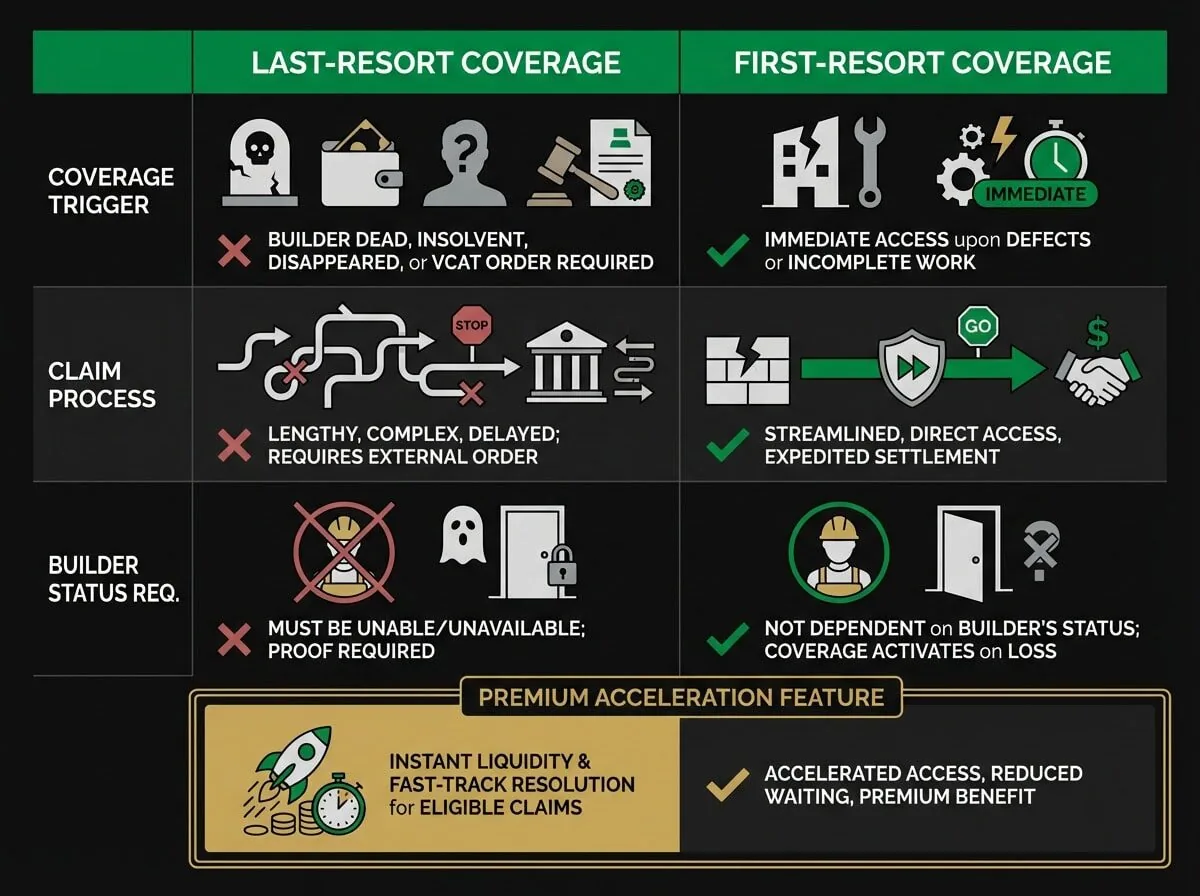
The SIS applies to domestic building contracts valued at $20,000 or more (increased from the current $16,000 threshold). Builders must pay insurance premiums to the BPC within 10 business days of entering into an insurable domestic building contract, or before work commences—whichever occurs first. For speculative domestic building work, builders must pay the applicable premium before starting work.
Assistance under the SIS may include rectification or completion of works on behalf of the BPC, or payment of compensation. However, developers, builders, and prescribed persons are not entitled to assistance under the scheme—coverage protects building owners only. The BPC will set premiums and maintain a monopoly on policy issuance, leveraging its enforcement and disciplinary powers to manage the risk of insurance payouts.
Critically, cover applies whether or not the premium has been paid or a notice of cover has been issued. This protects consumers from practices that emerged following high-profile builder collapses, where homeowners discovered their insurance was invalid. The BPC may recover any unpaid premium from the builder, potentially through enforcement proceedings or registration sanctions.
Developer Bond Scheme for Buildings Above Three Storeys
As an interim measure pending expansion of the SIS to high-rise developments, the Act introduces a mandatory developer bond scheme for residential apartment buildings exceeding three storeys. Developers must secure a bond equivalent to 2% of the total build cost (some sources reference 3%, pending final regulations) before applying for an occupancy permit. The BPC holds this bond for approximately two years after the occupancy permit is issued to fund defect rectification.
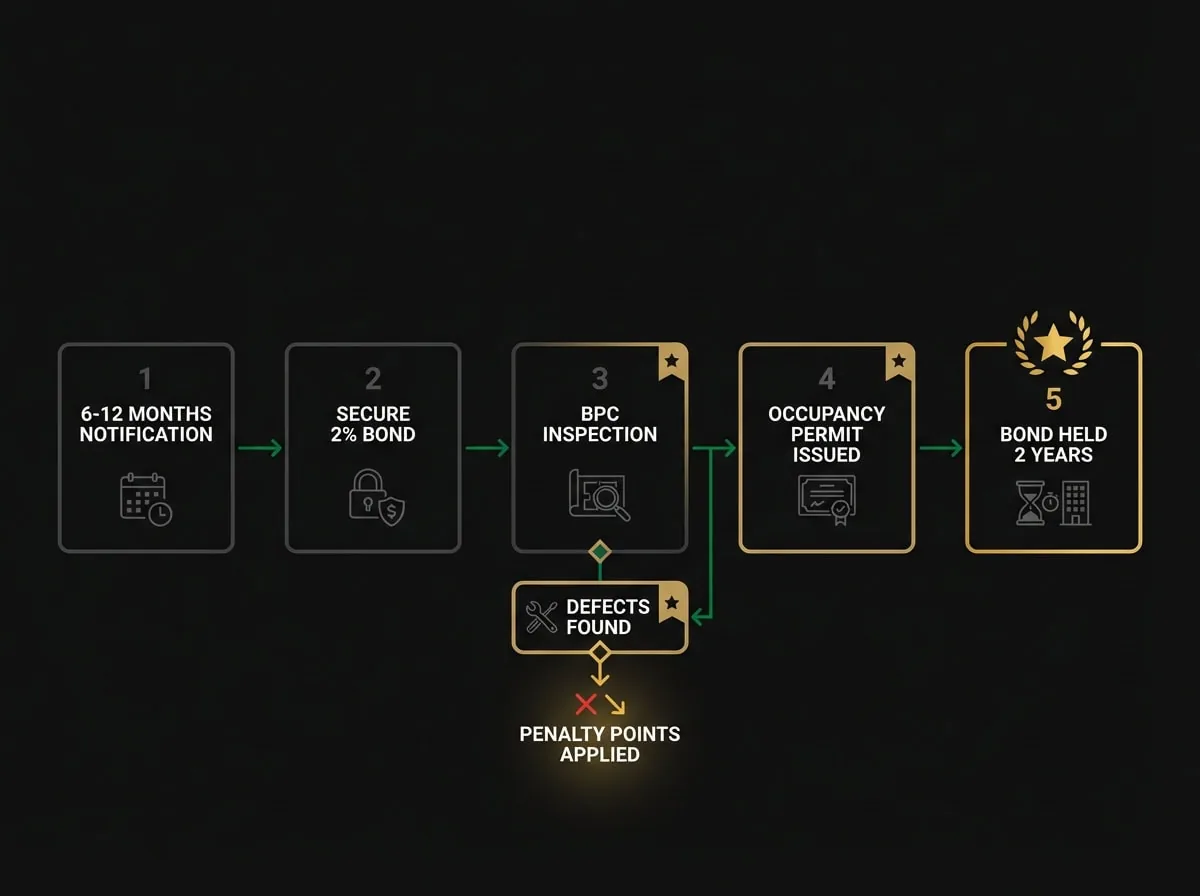
Developers must notify the BPC of their intention to apply for an occupancy permit between six and twelve months before submitting the application. For projects with construction periods under six months, notification is required 30 days before applying. Developers must also notify the BPC within five business days of becoming aware of any change in circumstances affecting the anticipated application date.
Failure to provide the required bond or notification may attract penalties up to 2,500 penalty units (approximately $500,000). The BPC may withhold occupancy permits if no bond is lodged or if the bond amount is insufficient. Additionally, developers cannot register subdivision plans or complete off-the-plan sales until the bond is in place and any outstanding rectification orders are resolved.
This requirement introduces significant financial exposure for developers at project completion. Unlike traditional defects liability periods under construction contracts, the developer bond creates a direct regulatory obligation to the BPC, independent of contractual arrangements with builders. Developers may wish to review how this interacts with performance securities, bank guarantees, and retention amounts typically required under development agreements and construction contracts.
Enhanced Rectification Powers
The BPC will have expanded authority to issue rectification orders for defective, incomplete, or non-compliant building work for up to 10 years following issuance of an occupancy permit. These orders replace the limited "directions to fix" previously available and apply to all building work—not just domestic building projects covered by insurance schemes.
If a serious defect prompts the BPC to issue a rectification order, developers may be restrained from applying for occupancy permits, registering subdivision plans, or completing off-the-plan sales until the order is complied with. Purchasers gain the right to rescind contracts if an occupancy permit is not issued or a developer bond not paid, creating additional commercial pressure on developers to resolve defects promptly.
The BPC will conduct inspections prior to occupancy permit applications for high-rise developments. If serious defects are identified during these inspections, the resulting rectification orders effectively block project completion and settlement. This inspection regime represents a significant shift from the current system, where building surveyors conduct final inspections with limited regulatory oversight of defect identification and rectification.
For developers, these enhanced powers may necessitate more rigorous quality assurance processes throughout construction. Extended defect liability periods in construction contracts could align with the BPC’s 10-year rectification window. Developers may need to negotiate specific provisions addressing how rectification orders interact with builder obligations, particularly regarding cost allocation and timeframes for compliance.
Exclusions and Limitations
The Statutory Insurance Scheme includes specific exclusions that developers may wish to understand when assessing project risk. Domestic building work not covered by the scheme includes:
- Work carried out or intended under cost-plus contracts
- Buildings with a rise in storeys exceeding three (except Class 1a buildings under the National Construction Code)
- Work on buildings or swimming pools not on the site of a home or proposed home
- Work on buildings used wholly or predominantly for non-residential purposes
- Structures not fixed to land
- Landscaping, paving, retaining structures, driveways, or fencing (unless integral to building construction, requiring a building permit, potentially causing water penetration, affecting health/safety, or impacting structural adequacy)
Building owners may be denied assistance under the SIS in certain circumstances, including where the owner has unreasonably refused to allow access to the building site, undertaken completion or rectification work without the BPC’s written approval when not reasonably necessary to mitigate loss, or knew or ought reasonably to have known about defects before purchasing the land.
For common property in multi-lot developments, assistance is only available if at least half of the lots used as homes were occupied as homes when the claim was made. This limitation may create coverage gaps in staged developments or projects with slow sales absorption, where common property defects emerge before sufficient occupancy is achieved.
Financial Requirements and Compliance
Beyond insurance premiums and developer bonds, builders will be required to meet minimum financial requirements to obtain or renew registration with the BPC. While specific thresholds await regulatory prescription, these requirements aim to ensure builders maintain adequate financial capacity to complete projects and honour warranty obligations.
The BPC requires evidence that a person holds required insurance or is eligible to purchase required insurance before granting or renewing building registration. Builders can access the BuildVic portal (the BPC’s secure domestic building insurance portal) to purchase insurance, view certificates, access letters of eligibility, and check current job limits and premium rates.
Penalties for non-compliance have been strengthened. Since February 2024, amendments to the Domestic Building Contracts Act 1995 and Building Act 1993 give the BPC additional powers to penalise builders who demand or receive money under major domestic building contracts exceeding $16,000 without valid DBI in place. These penalties may include fines, registration suspension, or prohibition orders preventing the builder from undertaking domestic building work.
For developers engaging builders, verifying current registration status and insurance eligibility before contract execution may be advisable. The BPC maintains public registers showing practitioner registration status, conditions, and disciplinary history. Developers may wish to incorporate specific warranties in construction contracts requiring builders to maintain valid registration and insurance throughout the project duration.
Implications for Development Feasibility
The transition to first-resort insurance and introduction of developer bonds may impact development feasibility, particularly for projects in the three-to-four storey range where both requirements potentially apply. Developers may wish to consider modelling several financial implications:
Insurance Premium Costs: While the BPC will set premium rates, the shift to first-resort coverage may result in higher premiums than the current last-resort scheme. Developers may wish to budget for increased insurance costs when preparing feasibility analyses for projects commencing after 1 July 2026.
Developer Bond Cash Flow: A 2% bond on total build cost represents substantial capital tied up for two years post-completion. For a $10M project, this equates to $200,000 held by the BPC. Developers may wish to factor this into project funding models and consider whether bank guarantees or insurance bonds offer more cost-effective approaches than cash deposits.
Extended Defect Liability: The BPC’s 10-year rectification powers extend well beyond typical defects liability periods in construction contracts. Developers may need to negotiate extended warranties from builders or maintain additional contingency reserves for potential rectification orders years after project completion.
Occupancy Permit Timing: The requirement to notify the BPC 6-12 months before applying for occupancy permits (or 30 days for shorter projects) adds administrative steps to project timelines. Developers may wish to incorporate these notification requirements into construction programs and settlement schedules to avoid delays.
Practical Compliance Steps for Developers
Developers may wish to consider several practical steps to support compliance with the evolving DBI framework:
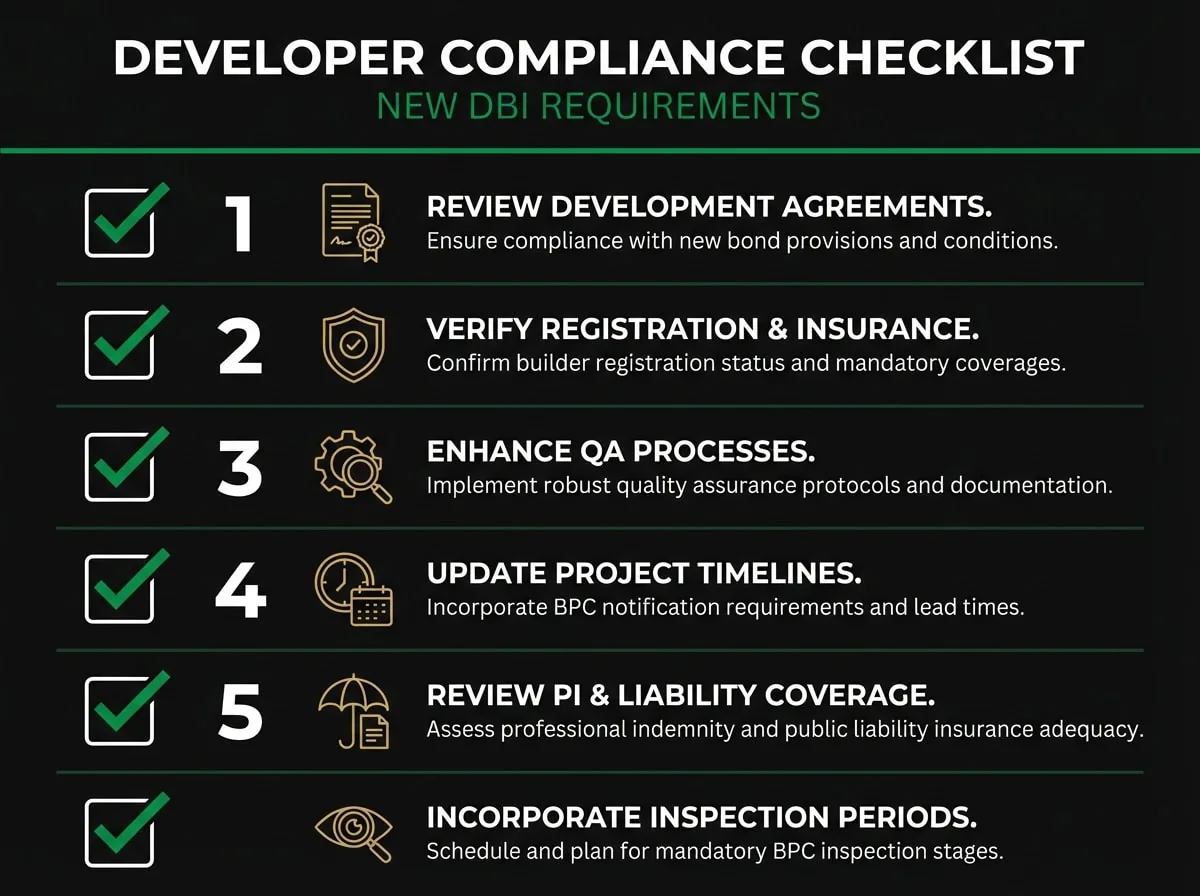
Review Development Agreements: Update standard development agreements to address developer bond requirements, BPC notification obligations, and allocation of costs for rectification orders. Consider how these regulatory requirements interact with existing performance security and defects liability provisions.
Assess Builder Financial Capacity: Verify that proposed builders can meet the BPC’s minimum financial requirements (once prescribed) and maintain adequate insurance coverage. Request evidence of current registration status and insurance eligibility before contract execution.
Enhance Quality Assurance: Implement more rigorous quality assurance processes throughout construction to minimise the risk of defects that could trigger BPC rectification orders. Consider engaging independent building consultants for critical stages beyond standard building surveyor inspections.
Update Project Timelines: Incorporate BPC notification requirements and inspection periods into construction programs. Allow additional time for potential rectification work if serious defects are identified during pre-occupancy inspections.
Review Insurance Coverage: Assess whether existing professional indemnity, public liability, and project-specific insurance policies adequately cover risks associated with the new regulatory framework. Consider whether additional coverage may be appropriate for potential BPC enforcement actions or rectification orders.
Council-Specific Considerations
While DBI requirements apply uniformly across Victoria, developers may wish to be aware of council-specific factors that could interact with insurance obligations:
City of Whitehorse: Projects in established residential areas may face heightened scrutiny regarding building quality and neighbourhood character. The BPC’s enhanced inspection regime aligns with council expectations for high-quality outcomes in sensitive locations.
City of Boroondara: Heritage overlays and design review processes in Boroondara may extend project timelines, affecting when developers must notify the BPC of intended occupancy permit applications. Early coordination between heritage consultants, building surveyors, and the BPC may streamline approval processes.
Manningham City Council: Bushfire management overlays in parts of Manningham create additional construction requirements that must be verified during BPC inspections. Ensure construction documentation clearly demonstrates compliance with bushfire attack level (BAL) ratings.
City of Monash: Monash’s focus on medium-density development in activity centres means many projects fall within the three-storey threshold for the Statutory Insurance Scheme. Developers may wish to carefully assess whether projects exceed three storeys (triggering developer bond requirements) or remain eligible for the SIS.
Knox City Council: Projects in Knox’s growth areas may involve staged development where common property defects could emerge before sufficient lot occupancy is achieved. Review SIS eligibility criteria for common property assistance when planning staged releases.
Maroondah City Council: Maroondah’s residential development typically involves smaller-scale projects where the $20,000 insurance threshold may apply to renovations and extensions. Ensure builders understand their insurance obligations even for modest alterations to existing dwellings.
Transition Period Considerations
The staged implementation of reforms creates a transition period where different rules may apply depending on when contracts are executed and when work commences. Key transition considerations include:
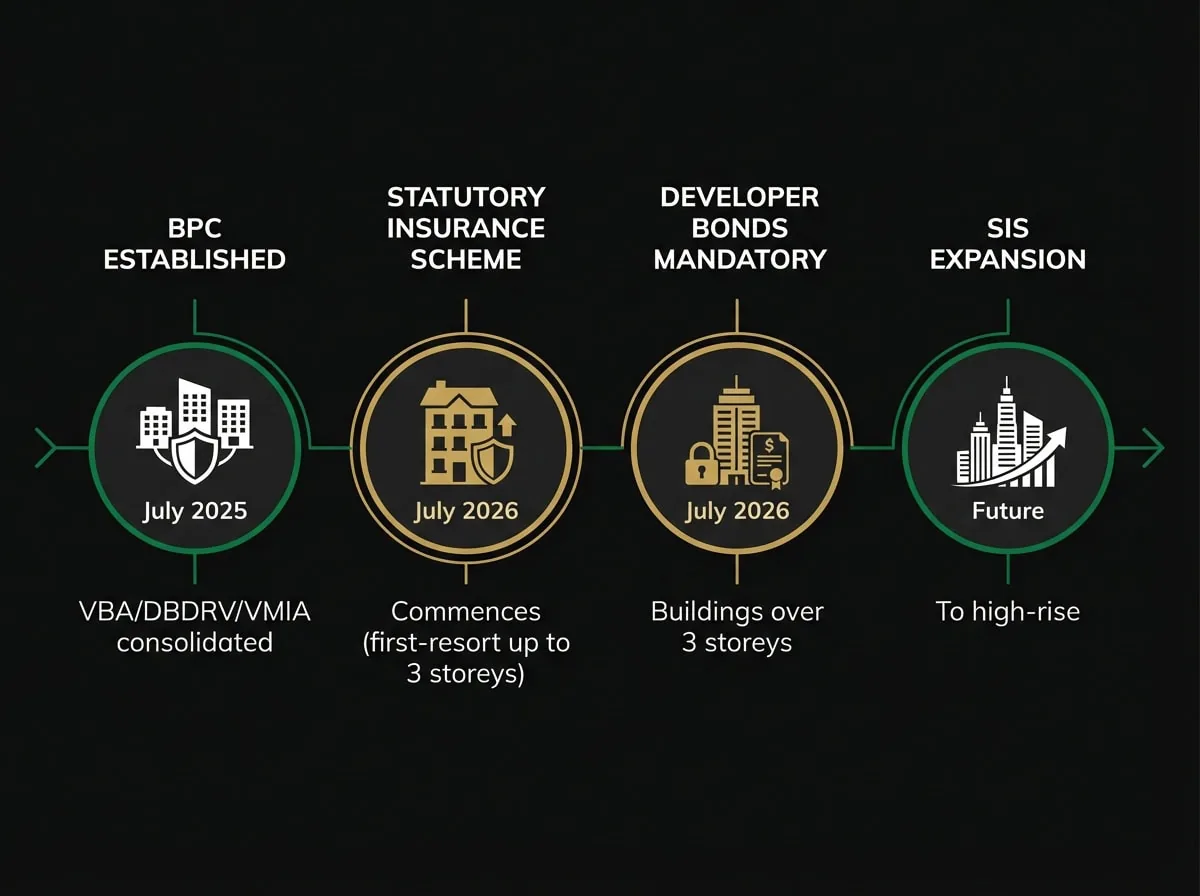
Contracts Executed Before 1 July 2026: Existing contracts entered before the commencement date are unlikely to be subject to new requirements retrospectively (except for the BPC’s enhanced rectification powers, which may apply to all building work regardless of contract date). Developers with projects in planning may wish to consider whether executing contracts before the transition date offers commercial advantages.
Projects Spanning the Transition: For projects where contracts are executed before 1 July 2026 but work continues after that date, clarify which insurance regime applies. Seek legal advice on whether contract variations after the commencement date trigger new insurance requirements.
Regulatory Guidance: The BPC is currently consulting with industry to develop regulations underpinning the new schemes. Monitor bpc.vic.gov.au for updated guidance, policy statements, and regulatory impact statements as implementation details are finalised.
Insurance Market Response: The closure of the mandatory DBI market to general insurers (with the BPC holding a monopoly on policy issuance) may affect commercial insurance products for risks outside the mandatory scheme. Developers may wish to maintain relationships with insurance brokers to understand evolving market conditions.
Frequently Asked Questions
What is the difference between the current DBI scheme and the new Statutory Insurance Scheme?
The current scheme operates on a "last-resort" basis, meaning building owners can only access insurance if the builder dies, becomes insolvent, disappears, or fails to comply with a court or VCAT order. The new Statutory Insurance Scheme (commencing 1 July 2026) provides "first-resort" coverage, allowing building owners to access assistance as soon as they suffer loss from incomplete, defective, or non-compliant work—without first proving the builder is unavailable.
Do developer bonds apply to all residential projects?
No. Developer bonds only apply to residential apartment buildings with a rise in storeys exceeding three. Projects up to three storeys are covered by the Statutory Insurance Scheme instead. The bond requirement is an interim measure pending expansion of the SIS to high-rise developments in future.
Can developers pass insurance costs to purchasers?
Builders (not developers) are responsible for paying insurance premiums to the BPC, and builders typically incorporate these costs into contract prices. For speculative development where the developer is also the builder, insurance costs become part of the project’s overall development costs. Off-the-plan contracts may specify which party bears responsibility for insurance premiums.
What happens if a builder refuses to pay the insurance premium?
Cover under the Statutory Insurance Scheme applies whether or not the premium has been paid or a notice of cover has been issued. This protects building owners from invalid insurance. The BPC may recover unpaid premiums from the builder through enforcement proceedings, registration sanctions, or legal action. Builders who fail to maintain valid insurance face penalties including fines and potential registration suspension.
How do rectification orders interact with construction contract defects liability periods?
The BPC’s rectification orders operate independently of contractual defects liability provisions. The BPC can issue orders for up to 10 years after an occupancy permit is issued, extending well beyond typical 12-month defects liability periods in construction contracts. Developers may wish to negotiate extended warranties from builders or maintain contingency reserves for potential rectification orders years after contractual defects liability expires.
Are renovations and extensions covered by the new insurance requirements?
Yes, if the work constitutes domestic building work under a contract exceeding $20,000 (including materials and labour). This includes renovations, extensions, and alterations to existing dwellings. However, certain work types are excluded, including landscaping, paving, and fencing (unless integral to building construction or requiring a building permit).
What notification is required before applying for an occupancy permit?
For residential apartment buildings exceeding three storeys, developers must notify the BPC of their intention to apply for an occupancy permit between six and twelve months before submitting the application (or 30 days before for projects with construction periods under six months). Developers must also notify the BPC within five business days of any change affecting the anticipated application date. Failure to provide required notification may attract penalties up to approximately $500,000.
Conclusion
Victoria’s domestic building insurance reforms represent the most significant regulatory change to the residential development sector in decades. The transition from last-resort to first-resort insurance, combined with developer bonds for high-rise projects and enhanced BPC rectification powers, may alter the risk landscape for property developers.
For developers in Melbourne, understanding these changes may support project feasibility, cash flow management, and regulatory compliance. The staged implementation provides an opportunity to adapt business practices, update standard contracts, and enhance quality assurance processes before the 1 July 2026 commencement date.
While the reforms introduce additional financial obligations and administrative requirements, they also aim to improve building quality and consumer confidence—potentially supporting stronger sales absorption and reduced reputational risk for developers who consistently deliver high-quality outcomes. Developers who engage with the new framework may find that regulatory compliance and quality assurance could become relevant factors in a changing market.
Book a Strategy Call: SQM Architects has delivered 210+ projects across Melbourne with a 98% planning approval rate. Contact us on (03) 9005 6588 for a free site assessment to discuss how the new insurance requirements may affect your next development project.
This article provides general information about Victorian planning for property developers. It does not constitute professional advice. For specific guidance on your project, contact SQM Architects (ARBV Reg. No. 51498) for a free site assessment.