
Understanding Doncaster’s Development Landscape
Doncaster presents Melbourne developers with one of Melbourne’ most dynamic planning environments. The suburb spans two distinct development contexts: the high-density Doncaster Hill Activity Centre and the established residential areas surrounding it. For developers targeting this market, understanding how Manningham City Council applies its planning scheme determines whether projects achieve approval within 58 days or face extended delays.
The planning framework governing Doncaster differs substantially from neighbouring councils. Manningham operates with a 97.44% VicSmart approval rate and maintains one of Melbourne’s most efficient assessment processes. However, this efficiency depends on developers understanding the specific zone requirements, overlay controls, and officer expectations that shape decision-making. The 2025-2026 planning reforms have introduced new pathways that further streamline approvals for compliant proposals.
This guide provides developers with actionable intelligence on Doncaster’s planning scheme, covering the zones and overlays that apply across different precincts, the specific built-form standards Council enforces, and the practical considerations that influence application outcomes. Whether you’re planning a townhouse development in Doncaster East or a mixed-use project within the Activity Centre, understanding these requirements positions your project for efficient approval.
Manningham City Council: Development Context
Manningham City Council governs approximately 113 square kilometres across Melbourne, with Doncaster representing the municipality’s primary growth area. The council has processed over 1,200 planning applications annually since 2024, maintaining approval rates that exceed regional averages. For developers, this translates to predictable assessment processes when applications align with planning scheme requirements.
The council’s planning approach centres on the Doncaster Hill Strategy, which guides development within the 58-hectare Activity Centre Zone. This precinct has delivered over 3,500 new dwellings since 2002, with Council targeting an additional 2,000 dwellings by 2030. Outside the Activity Centre, Manningham applies standard residential zones with specific local variations that affect setbacks, site coverage, and tree canopy requirements.
Current assessment timeframes average 58 days for standard applications, compared to the regional average of 140+ days. VicSmart applications receive decisions within the statutory 10-day period in 97.44% of cases. These timeframes assume complete applications that address all planning scheme requirements. Applications requiring further information or triggering objections extend beyond these averages, with complex proposals potentially reaching 120+ days.
Manningham’s planning officers prioritise neighbourhood character protection in established residential areas whilst encouraging higher-density development within designated growth precincts. This dual approach means developers must tailor their proposals to the specific planning context, with built-form standards varying significantly between the Activity Centre and surrounding residential zones.
Key Planning Zones in Doncaster
Activity Centre Zone – Schedule 1 (ACZ1)
The Activity Centre Zone Schedule 1 applies to the Doncaster Hill precinct, bounded approximately by Doncaster Road, Williamsons Road, Tram Road, and Council Street. This 58-hectare area represents Manningham’s primary high-density development opportunity, with planning provisions designed to facilitate mixed-use development up to 12 storeys in core locations.
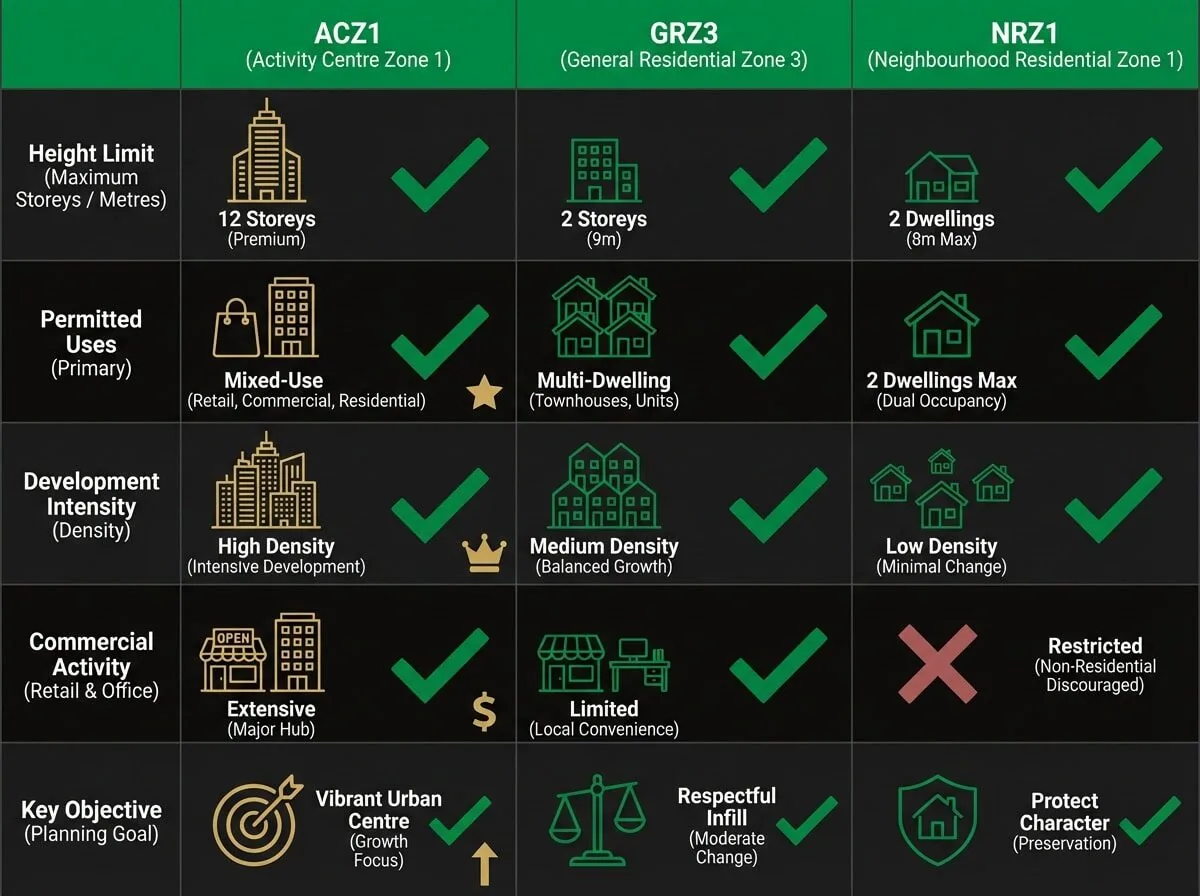
ACZ1 permits residential development, retail premises, offices, food and drink premises, and entertainment venues as-of-right in most locations. The zone encourages ground-floor commercial uses along key boulevards (Doncaster Road, Williamsons Road) whilst allowing predominantly residential development on secondary streets. Developers should note that the zone requires a minimum of 60% residential floor area across the precinct, ensuring the Activity Centre maintains its mixed-use character.
The zone works in conjunction with Design and Development Overlay Schedule 6 (DDO6), which specifies height limits ranging from 4 storeys at residential interfaces to 12 storeys in the precinct core. These height limits apply to specific sub-precincts, with Council requiring developments to demonstrate compliance with the "stepping down" principle that protects lower-scale residential areas from overshadowing and visual bulk impacts.
General Residential Zone – Schedule 3 (GRZ3)
The General Residential Zone Schedule 3 applies to established residential areas throughout Doncaster, including suburbs such as Doncaster East, Templestowe Lower, and parts of Donvale. This zone permits two dwellings per lot as-of-right, with multi-dwelling developments (3+ dwellings) requiring planning permits. The zone aims to provide housing diversity whilst respecting existing neighbourhood character.
GRZ3 includes specific local variations that affect development potential. On height, start from the zone itself: Clause 32.08-11 sets a mandatory maximum of 11 metres and 3 storeys for a dwelling or residential building where no maximum is specified in a schedule to the zone, and the schedule is what can change that figure — so read the current GRZ3 schedule rather than assuming a lower number, and expect Council to enforce whichever figure applies through shadow diagram requirements. On site coverage, Table B2-5 sets 65 per cent across the General Residential Zone. There is no separate figure for dwellings and apartments, and a schedule to the zone may only specify a percentage greater than the table, never a lesser one.
The zone sets the minimum garden area by lot size, not by dwelling count — 25% for lots of 400–500m², 30% above 500m² and up to 650m², and 35% above 650m². It is a zone requirement rather than a ResCode standard, and Council places considerable weight on it, reflecting an emphasis on maintaining landscape character in established residential areas. Developers should incorporate this requirement early in site planning, as Council rarely grants variations that reduce garden area below the specified threshold.
Neighbourhood Residential Zone – Schedule 1 (NRZ1)
The Neighbourhood Residential Zone Schedule 1 applies to limited areas within Doncaster where Council seeks to maintain lower-scale residential character. This zone restricts development to a maximum of two dwellings per lot, with no pathway for multi-dwelling proposals. The zone typically applies to areas with significant vegetation, heritage values, or established low-density character that Council aims to protect.
NRZ1 includes stricter built-form controls than GRZ3. Clause 32.09-11 sets a mandatory maximum of 9 metres and 2 storeys where no maximum is specified in a schedule, and Table B2-5 sets site coverage at 60 per cent in the Neighbourhood Residential Zone — again, a schedule may specify a greater percentage but not a lesser one, so check the NRZ1 schedule for the figures that actually apply to your site. The zone requires larger setbacks from boundaries and mandates retention of existing canopy trees where practicable. Developers considering sites within NRZ1 should recognise that Council’s policy framework strongly favours retention of existing character over intensification.
Get the 7-point site check to run before committing to a permit application — zoning, overlays, setbacks and council red flags, in plain English. Free PDF, instant download.
- Zone, overlay & setback checks
- What council assesses first
- Permit-readiness red flags
Something went wrong. Please try again.
No spam. Unsubscribe anytime.
Check your inbox — your checklist is on its way.
Critical Overlays Affecting Development
Design and Development Overlay – Schedule 6 (DDO6)
DDO6 applies across the entire Doncaster Hill Activity Centre, working in conjunction with ACZ1 to specify detailed built-form requirements. The overlay divides the precinct into seven sub-precincts, each with specific height limits, setback requirements, and design objectives. Understanding which sub-precinct applies to your site determines the maximum development potential and the specific design standards Council will assess.
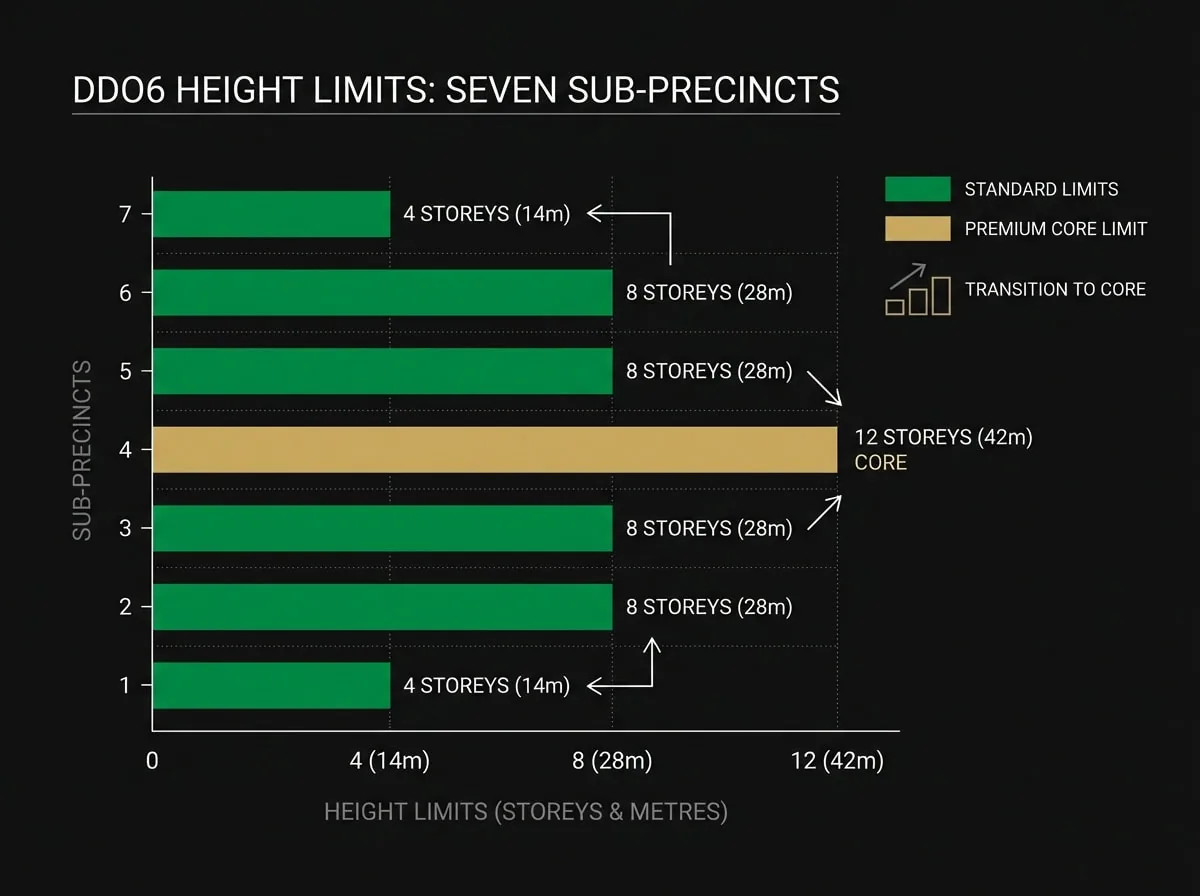
The overlay specifies mandatory maximum heights ranging from 4 storeys (14 metres) at residential interfaces to 12 storeys (42 metres) in the precinct core. These heights are mandatory maximums—Council cannot approve developments that exceed them. The overlay also specifies minimum street setbacks of 3-6 metres depending on location, with larger setbacks required along key boulevards to accommodate street tree planting and pedestrian amenity.
DDO6 requires all major applications to include 3D visualisations demonstrating compliance with overshadowing controls. Council assesses shadow impacts on Doncaster Road and Williamsons Road to protect the "treed boulevard" character that defines the precinct. Developments must demonstrate that shadows do not exceed specified limits on these streets between 10am and 2pm on 22 September (spring equinox).
Development Contributions Plan Overlay – Schedule 1 (DCPO1)
DCPO1 applies across the Doncaster Hill Activity Centre, requiring developers to pay infrastructure levies that fund local improvements. For the 2025-2026 financial year, the levy stands at $6,847 per dwelling and $142 per square metre of commercial floor area. These contributions fund public realm improvements, community facilities, and transport infrastructure within the precinct.
The overlay requires payment before Council issues a Statement of Compliance for subdivision or before a building permit is issued for multi-dwelling developments. Developers should incorporate these costs into feasibility analysis, as they represent a significant component of total development costs. The levy increases annually based on CPI adjustments, with Council publishing updated rates each July.
Special Building Overlay (SBO)
The Special Building Overlay applies to properties within the Koonung Creek catchment, affecting parts of Doncaster East and Templestowe Lower. The overlay requires specific floor levels to manage flood risk from 1-in-100-year storm events. Developments within SBO areas must demonstrate that habitable floor levels sit above the designated flood level, typically requiring site-specific flood assessments.
Council requires detailed drainage plans for all developments within SBO areas, with particular attention to stormwater management and overland flow paths. Developers should engage civil engineers early in the design process to address these requirements, as retrospective modifications to floor levels can significantly impact project feasibility.
Environmental Significance Overlay – Schedule 5 (ESO5)
ESO5 protects identified "Biosites" and areas of native vegetation significance, primarily affecting properties in Doncaster East and the transition areas between urban and rural zones. The overlay requires planning permits for vegetation removal and mandates specific offset requirements where removal is approved. Council’s assessment focuses on protecting remnant indigenous vegetation and maintaining habitat corridors.
Developments within ESO5 areas require detailed arborist reports and vegetation assessments prepared by qualified ecologists. Council applies strict standards for vegetation retention, with preference given to designs that avoid removal of indigenous canopy trees. Where removal is unavoidable, Council requires offset planting at ratios specified in the overlay schedule, typically 3:1 for canopy trees.
Setback and Height Standards
Activity Centre Zone Standards
Within the Doncaster Hill Activity Centre, setback requirements vary by street type and sub-precinct location. Primary boulevards (Doncaster Road, Williamsons Road) require minimum 6-metre setbacks to accommodate street tree planting and pedestrian zones. Secondary streets require 3-metre setbacks, with Council accepting reduced setbacks where developments provide enhanced ground-floor activation or public realm contributions.
Side and rear setbacks within the Activity Centre follow a performance-based approach rather than prescriptive standards. Council assesses setbacks based on their ability to provide adequate separation between buildings, protect solar access to neighbouring properties, and maintain reasonable amenity for future occupants. Typical expectations include 3-4 metres for walls up to 3 storeys, increasing to 6+ metres for taller buildings.
Height limits within the Activity Centre range from 4 storeys (14 metres) at residential interfaces to 12 storeys (42 metres) in core locations. These limits are mandatory maximums specified in DDO6. Council measures height from natural ground level, with mechanical plant and lift overruns permitted to extend 3.6 metres above the specified maximum. Developers should note that Council strictly enforces these limits—applications exceeding mandatory heights face certain refusal.
General Residential Zone Standards
The General Residential Zone applies standard ResCode setbacks with specific local variations. Front setbacks must match the predominant setback of adjoining dwellings or achieve 6 metres, whichever is lesser. Council assesses front setback compliance by measuring the average setback of dwellings on either side of the subject site, with variations of up to 1 metre generally acceptable.
Side setbacks follow the ResCode formula: 1 metre for walls up to 3.6 metres in height, plus 0.3 metres for every metre of wall height above 3.6 metres. For a standard two-storey wall (approximately 6 metres), this translates to a minimum 1.72-metre setback. Council applies these standards strictly, with variations only granted where applicants demonstrate exceptional circumstances or where the variation produces superior amenity outcomes.
Clause 55 sets no separate rear-setback minimum. Standard B2-3 applies the same test to side and rear boundaries: at least 1 metre, plus 0.3 metres for every metre of wall height over 3.6 metres up to 6.9 metres, plus 1 metre for every metre over 6.9 metres — or the flat alternative under B2-3.2. Council assesses rear setback compliance in conjunction with overlooking and overshadowing standards, with particular attention to impacts on neighbouring private open space areas. Developments that meet minimum setbacks but produce poor amenity outcomes may face requests for increased setbacks or design modifications.
Site Coverage and Permeability
Site coverage in the General Residential Zone is 65 per cent under Table B2-5, applying equally to dwellings and apartment developments; the Neighbourhood Residential Zone figure is 60 per cent. Council calculates site coverage by measuring all roofed areas, including garages, carports, and covered outdoor areas. Uncovered decks, pergolas without solid roofs, and at-grade paving do not count towards site coverage, allowing developers to maximise outdoor amenity without triggering coverage limits.
The minimum garden area is set by the zone according to lot size, not dwelling count — 25% for lots of 400–500m², 30% above 500m² and up to 650m², and 35% above 650m². Manningham applies it firmly, reflecting Council’s emphasis on landscape character and urban greening. The garden area must be provided at ground level and planted with a mix of canopy trees, shrubs, and groundcovers. Council does not accept rooftop gardens or planter boxes as contributions to the garden area requirement.
Planning Application Process
Pre-Application Advice
Manningham City Council offers formal pre-application advice services with fees ranging from $550 for basic advice to $2,200 for complex proposals. The service provides written feedback within 2-4 weeks, covering planning scheme compliance, likely assessment issues, and recommended design modifications. Developers should utilise this service for sites with complex planning controls or where design approaches may test policy boundaries.
Pre-application meetings with planning officers provide valuable insights into Council’s assessment approach and officer expectations. These meetings allow developers to discuss design concepts before committing to detailed documentation, potentially saving significant costs where initial approaches face policy concerns. Council’s planning officers focus pre-application discussions on zone and overlay compliance, neighbourhood character considerations, and likely objector concerns.
Application Lodgement Requirements
Standard planning applications require comprehensive documentation including site plans, floor plans, elevations, shadow diagrams, and planning reports. For developments within the Activity Centre, Council requires 3D visualisations showing the proposal in its streetscape context. Applications for 3+ dwellings require landscape plans prepared by qualified landscape architects, demonstrating compliance with garden area and tree canopy requirements.
Application fees for 2025-2026 range from $1,874.70 for single dwellings to $3,874.70 for developments costing $1-5 million. Council charges additional fees for applications requiring planning scheme amendments or where development costs exceed $5 million. Developers should confirm current fees before lodgement, as Council updates fee schedules annually each July.
Assessment Timeframes
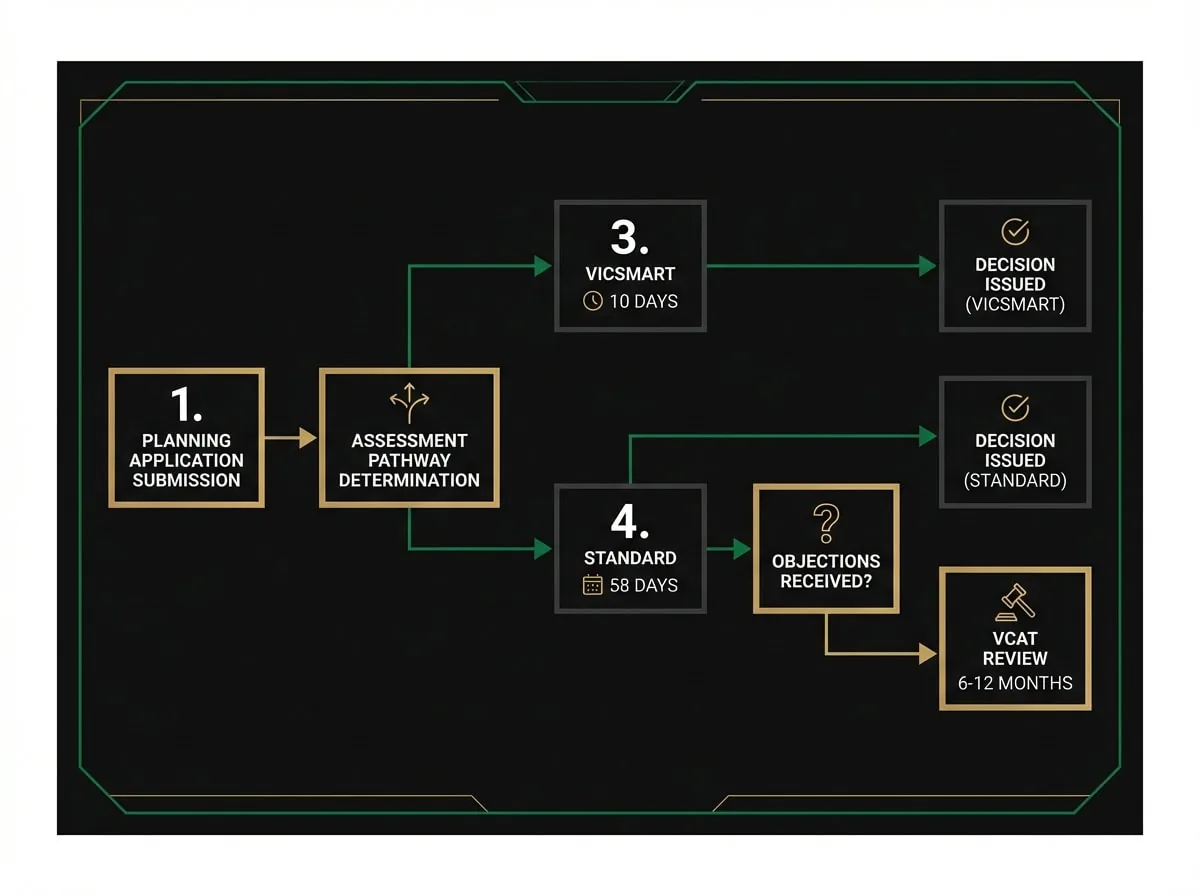
VicSmart applications receive decisions within 10 business days in 97.44% of cases, making this pathway highly efficient for eligible proposals. Standard applications average 58 days from lodgement to decision, assuming complete documentation and no objections. Applications triggering objections extend to 90+ days, with Council typically allowing 21 days for objector responses and additional time for applicant responses to objections.
Council issues requests for further information within 14 days of lodgement where applications lack required documentation. These requests pause the statutory clock, with timeframes recommencing once applicants provide the requested information. Developers can minimise delays by ensuring applications include all required plans, reports, and supporting documentation at lodgement.
Public Notification
Council notifies neighbouring properties for most residential developments, with notification extending to properties within 60 metres of the site boundary. The notification period runs for 14 days, during which neighbours may lodge objections. Council considers all objections received during this period, with planning officers required to address objector concerns in assessment reports.
Applications that comply with the Townhouse and Low-Rise Code (introduced March 2025) may qualify for exemption from third-party notice and appeal rights. This exemption applies where proposals meet all 13 applicable standards of Clause 55, effectively "de-risking" projects by removing VCAT appeal pathways. Developers should carefully assess code compliance to determine whether this exemption applies.
What Planning Officers Look For
Neighbourhood Character Compliance
Manningham planning officers place significant emphasis on neighbourhood character assessment, particularly in established residential areas outside the Activity Centre. Officers assess whether proposed developments respect the existing pattern of development, including building scale, setbacks, roof forms, and landscape character. Applications that demonstrate clear understanding of local character through design responses receive more favourable assessment.
Council’s preferred character outcomes vary by location. In established areas of Doncaster East, officers favour designs that incorporate pitched roofs, articulated facades, and generous landscape setbacks. Within the Activity Centre, officers expect contemporary architectural responses that contribute to the precinct’s urban character whilst respecting the boulevard landscape setting. Developers should reference Council’s neighbourhood character studies when preparing design responses.
Amenity Impact Management
Planning officers carefully assess amenity impacts on neighbouring properties, with particular attention to overshadowing, overlooking, and visual bulk. Officers expect applications to demonstrate compliance with ResCode standards for these matters, with shadow diagrams showing impacts at 9am, 12pm, and 3pm on 22 September. Applications that exceed ResCode standards for overshadowing or overlooking face likely requests for design modifications or may receive refusal recommendations.
Council’s assessment of visual bulk focuses on building height, setbacks, and facade articulation. Officers favour designs that break down building mass through varied setbacks, material changes, and architectural detailing. Developments that present as single, monolithic forms typically receive requests for increased articulation, even where they comply with height and setback standards.
Landscape and Tree Canopy
Manningham requires retention of existing canopy trees where practicable, with planning officers closely scrutinising arborist reports and tree protection measures. Applications proposing removal of significant trees require clear justification, with officers favouring designs that modify building footprints to retain trees over designs that maximise built form at the expense of vegetation.
New tree planting requirements follow Council’s local variation: 1 tree per 100 square metres of site area, scaling up to 3 trees for lots between 200-300 square metres. Officers expect landscape plans to specify canopy tree species with mature heights exceeding 8 metres, planted in locations that allow full canopy development. Council does not accept small ornamental trees as contributions to canopy requirements.
Car Parking and Access
Council applies standard car parking rates of 1 space per 1-2 bedroom dwelling and 2 spaces per 3+ bedroom dwelling. Within the Activity Centre, Council may accept reduced parking rates where developments demonstrate proximity to public transport and provide car-share facilities. Applications seeking parking reductions require traffic engineering reports demonstrating that reduced parking will not generate on-street parking demand.
Access design receives careful assessment, with officers favouring rear-lane access over front crossovers where available. Council requires swept path diagrams for all vehicle access points, demonstrating that service vehicles can enter and exit in forward gear. Applications proposing shared driveways require legal agreements ensuring ongoing maintenance and access rights.
Common Application Issues
Incomplete Documentation
Incomplete applications represent the most common cause of assessment delays. Council frequently issues requests for further information where applications lack required shadow diagrams, landscape plans, or detailed elevations. Developers can avoid these delays by reviewing Council’s application checklist before lodgement and ensuring all required plans meet the specified scale and detail requirements.
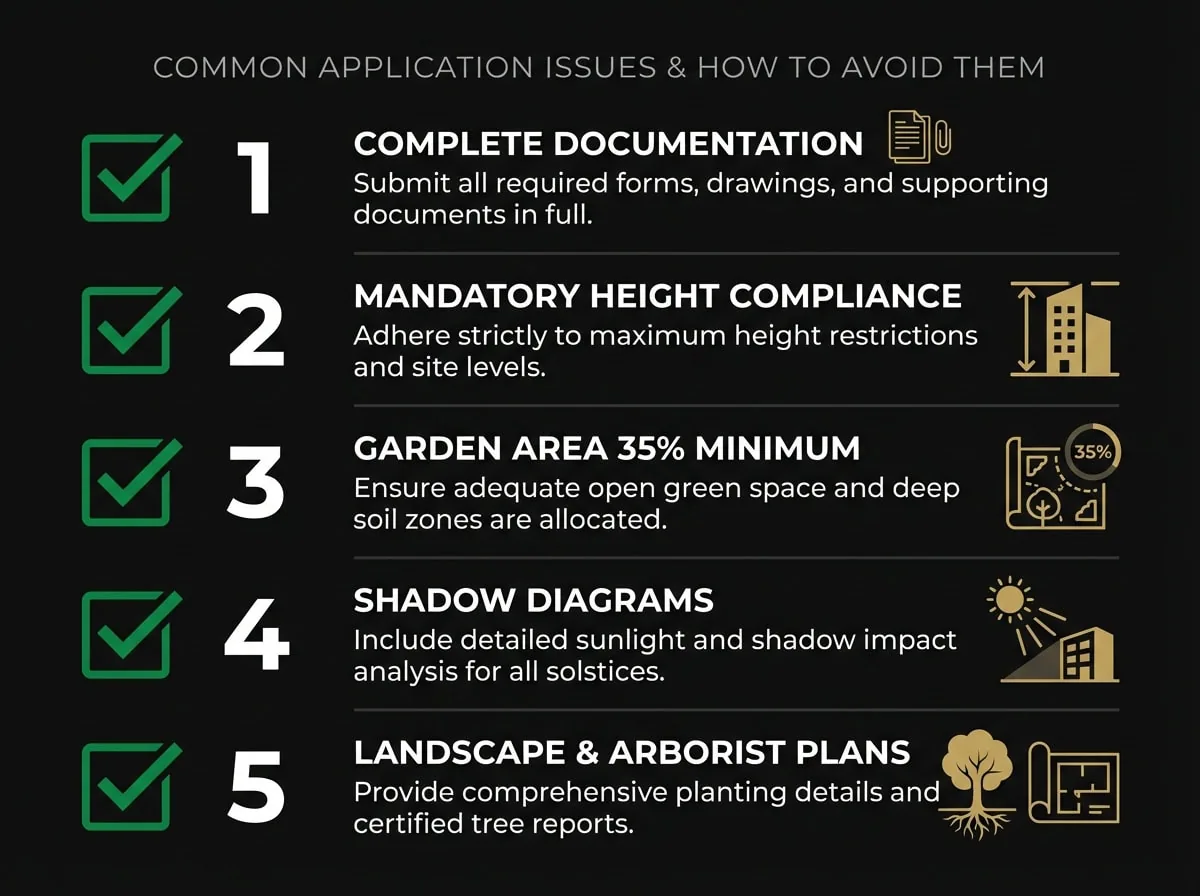
Planning reports should address all relevant planning scheme provisions, including zone objectives, overlay requirements, and relevant policies. Officers expect reports to demonstrate clear understanding of planning controls and to provide reasoned responses to potential concerns. Generic planning reports that fail to address site-specific issues typically generate requests for additional information.
Non-Compliance with Mandatory Controls
Applications that fail to comply with mandatory height limits in DDO6 face certain refusal. Council cannot approve developments that exceed mandatory maximums, regardless of design quality or other merits. Developers should carefully verify height compliance before lodgement, measuring from natural ground level and accounting for any site grading proposed.
Similarly, applications that fail to meet minimum garden area requirements in the General Residential Zone face likely refusal unless applicants demonstrate exceptional circumstances. Council’s policy framework provides limited scope for variations to this local standard, with officers typically recommending refusal where garden area falls below 35%.
Objector Concerns
Objections from neighbouring properties can extend assessment timeframes and may result in applications proceeding to Council meetings for determination. Common objection grounds include overshadowing, overlooking, visual bulk, and neighbourhood character impacts. Developers can minimise objection risk by ensuring designs comply with all ResCode standards and by engaging with neighbours early in the design process.
Where objections are received, Council requires applicants to respond in writing, addressing each objector concern. Officers assess whether proposed designs produce acceptable amenity outcomes, considering both ResCode compliance and broader policy objectives. Applications that demonstrate clear compliance with standards whilst addressing objector concerns typically receive approval recommendations, even where objections remain unresolved.
VCAT Appeals
Applications refused by Council or subject to unacceptable permit conditions may proceed to VCAT for review. However, the 2025 planning reforms have abolished third-party appeal rights for developments that comply with the Townhouse and Low-Rise Code. This change significantly reduces VCAT risk for compliant townhouse and low-rise apartment developments, providing greater certainty for developers.
Where VCAT proceedings are necessary, Council’s planning officers typically maintain their original assessment position unless new information demonstrates compliance with planning scheme requirements. Developers considering VCAT appeals should obtain legal advice on prospects of success and likely costs, as VCAT proceedings typically extend timeframes by 6-12 months and incur significant professional fees.
Strategic Considerations for Developers
Activity Centre Opportunities
The Doncaster Hill Activity Centre presents Melbourne’ most significant medium-density development opportunity. Council’s planning framework actively encourages higher-density development within the precinct, with streamlined assessment processes for proposals that comply with DDO6 requirements. Developers should focus on sites within the core sub-precincts where 8-12 storey development is permitted, as these locations offer the strongest feasibility outcomes.
The Eastern Busway project (currently in planning) will enhance public transport connectivity to the Activity Centre, potentially increasing development values within the 800-metre walkable catchment. Developers should monitor this project’s progress, as improved transport access typically drives demand for higher-density residential development and supports reduced car parking rates.
Residential Zone Strategy
Sites within the General Residential Zone offer townhouse development opportunities, with the 2025 planning reforms providing streamlined approval pathways for code-compliant proposals. Developers should target sites exceeding 800 square metres where 4+ townhouses can achieve feasible yields whilst meeting all ResCode standards. Compliance with the 13 applicable standards eliminates third-party appeal rights, significantly reducing project risk.
Council’s emphasis on landscape character means developments that incorporate generous tree planting and garden areas receive more favourable assessment. Developers should engage landscape architects early in the design process to ensure landscape plans demonstrate compliance with Council’s tree canopy requirements whilst supporting overall site layout objectives. For comparison with neighbouring municipalities, review the Whitehorse Council Development Guide and Boroondara Council Guide to understand how Manningham’s requirements differ from adjacent areas.
Infrastructure Levy Planning
Development contribution levies within the Activity Centre ($6,847 per dwelling for 2025-2026) represent a significant cost component that developers must incorporate into feasibility analysis. These levies increase annually, meaning projects with extended development timeframes face higher contribution costs. Developers should structure project timelines to minimise exposure to levy increases, with particular attention to the timing of subdivision and building permit applications.
Frequently Asked Questions
What planning zones apply in Doncaster and what can I build in each?
Doncaster includes three primary zones: Activity Centre Zone Schedule 1 (ACZ1) covering Doncaster Hill, General Residential Zone Schedule 3 (GRZ3) across most residential areas, and limited Neighbourhood Residential Zone Schedule 1 (NRZ1) in character protection areas. ACZ1 permits mixed-use development up to 12 storeys in core locations, GRZ3 allows multi-dwelling development up to the height set by its schedule (11 metres and 3 storeys applies under Clause 32.08-11 where the schedule specifies no maximum), and NRZ1 restricts development to a maximum of two dwellings per lot.
How long does Manningham City Council take to assess planning applications?
Manningham averages 58 days for standard planning applications, significantly faster than the regional average of 140+ days. VicSmart applications receive decisions within 10 business days in 97.44% of cases. Applications requiring further information or triggering objections extend beyond these averages, with complex proposals potentially reaching 120+ days. The 2025 planning reforms have introduced 10-day, 30-day, and 60-day assessment streams based on application complexity.
What are the mandatory height limits in Doncaster Hill?
Design and Development Overlay Schedule 6 (DDO6) specifies mandatory maximum heights ranging from 4 storeys (14 metres) at residential interfaces to 12 storeys (42 metres) in the precinct core. These limits vary by sub-precinct location, with Council unable to approve developments that exceed the specified maximums. Heights are measured from natural ground level, with mechanical plant and lift overruns permitted to extend 3.6 metres above the mandatory maximum.
Do I need to pay development contributions in Doncaster?
Development Contributions Plan Overlay Schedule 1 (DCPO1) applies across the Doncaster Hill Activity Centre, requiring levies of $6,847 per dwelling and $142 per square metre of commercial floor area for 2025-2026. These contributions fund public realm improvements, community facilities, and transport infrastructure. Payment is required before Council issues a Statement of Compliance for subdivision or before building permits are issued for multi-dwelling developments.
What setbacks does Council require for townhouse developments?
Front setbacks must match the predominant setback of adjoining dwellings or achieve 6 metres, whichever is lesser. Side and rear setbacks are both governed by Standard B2-3, which offers two alternative routes and is met by either. B2-3.1 is the calculation: at least 1 metre, plus 0.3 metres for every metre of wall height over 3.6 metres up to 6.9 metres, plus 1 metre for every metre over 6.9 metres. B2-3.2 is a flat setback: 3 metres up to 11 metres in height where the boundary is not to the south, or 6 metres where it is. There is no separate numerical rear-setback minimum in the standard, so any fixed single-storey or two-storey rear figure comes from Council policy rather than ResCode. Council applies these standards strictly, with variations only granted where exceptional circumstances exist.
Can I remove existing trees on my development site?
Manningham requires planning permits for removal of trees with trunk circumference exceeding 0.5 metres or height exceeding 5 metres within 6 metres of street frontages (introduced September 2025). Council’s policy strongly favours retention of canopy trees, with planning officers requiring clear justification for removal. Where removal is approved, Council requires replacement planting equalling at least 20% of site area, with new canopy trees specified in landscape plans.
What happens if neighbours object to my planning application?
Council considers all objections received during the 14-day notification period, with planning officers required to address objector concerns in assessment reports. Applications that comply with the Townhouse and Low-Rise Code (introduced March 2025) may qualify for exemption from third-party appeal rights where all 13 applicable standards are met. This exemption significantly reduces project risk by eliminating VCAT appeal pathways for compliant developments.
Conclusion
Doncaster’s planning framework presents Melbourne developers with clear opportunities for both high-density development within the Activity Centre and medium-density townhouse projects in surrounding residential areas. Manningham City Council’s efficient assessment processes and high approval rates reward developers who understand the specific zone requirements, overlay controls, and officer expectations that shape decision-making. The 2025 planning reforms have further streamlined approval pathways for code-compliant proposals, reducing VCAT risk and providing greater project certainty.
Success in Doncaster’s development market requires early engagement with Council’s planning framework, comprehensive documentation that addresses all scheme requirements, and design responses that demonstrate clear understanding of neighbourhood character and amenity considerations. Developers who invest time in understanding these requirements position their projects for efficient approval and optimal development outcomes. SQM Architects has guided 210+ projects through Melbourne council approvals with a 98% success rate—experience that enables us to navigate Manningham’s planning scheme efficiently whilst maximising development potential.
Book a Strategy Call: Contact SQM Architects on (03) 9005 6588 to discuss your Doncaster development opportunity and receive expert guidance on planning scheme compliance and approval strategy.
This article provides general information about Victorian planning for property developers. It does not constitute professional advice. For specific guidance on your project, contact SQM Architects (ARBV Reg. No. 51498) for a complimentary site assessment.