
Rowville sits within Knox City Council’s jurisdiction and has long been one of Melbourne’ most active development corridors. With strong owner-occupier demand, established infrastructure, and proximity to major employment nodes along Stud Road and Wellington Road, the suburb presents genuine opportunities for developers pursuing townhouse, medium-density, and mixed-use projects. However, the planning landscape governing Rowville development has shifted considerably — and understanding those shifts is now essential to protecting feasibility and programme certainty.
Between 2025 and 2026, Victoria’s planning system has undergone its most significant legislative transformation in decades. The Consumer and Planning Legislation Amendment (Housing Statement Reform) Act 2025, the introduction of the Townhouse and Low-Rise Code, and the passage of the Planning Amendment (Better Decisions Made Faster) Act 2026 have collectively reshaped how planning permits are assessed, who can object, and what can be built across residential zones — including those that apply across Rowville. For developers with sites in this area, getting across these changes early may meaningfully improve development outcomes.
This guide provides an updated overview of the planning framework applying to Rowville development as at mid-2025, incorporating the most current legislative context, Knox City Council’s local strategic direction, and the state-level reforms now in effect or scheduled to commence. It covers zoning, permit pathways, the Townhouse and Low-Rise Code, subdivision, and the emerging reforms that will shape the next planning cycle through to 2027 and beyond.
Rowville’s Strategic Planning Context
Rowville’s planning framework is anchored by the Rowville Plan, a strategic document prepared by Knox City Council that sets out a vision for the Stud Park Shopping Centre precinct and surrounding neighbourhoods. The plan addresses the area broadly bounded by Wellington Road, Taylors Lane, Kelletts Road, and Corhanwarrabul Creek. Its central challenge — balancing community desire to preserve established neighbourhood character against the need to accommodate housing growth — remains as relevant today as when the plan was first prepared.
The Rowville Plan concentrates higher-density development opportunities within and immediately adjacent to the Stud Park Major Activity Centre, while seeking to protect the lower-density residential character of surrounding neighbourhoods. Townhouses, apartments, and multi-unit dwellings are directed toward a defined set of locations where infrastructure capacity and strategic context support increased density. This approach is broadly consistent with Plan for Victoria’s target of directing 70% of new dwellings into established suburbs, closer to transport, jobs, and services.
Knox City Council’s Housing Strategy provides the broader residential development framework across the municipality, informing zone applications across Rowville’s residential precincts. Developers should review both documents as part of any early-stage site assessment, as they provide important context for how Knox City Council is likely to assess applications for medium-density development outside the immediate activity centre catchment.
Zoning Framework Across Rowville
Rowville’s residential land is distributed across three primary zones under the Knox Planning Scheme: the Neighbourhood Residential Zone (NRZ), the General Residential Zone (GRZ), and the Residential Growth Zone (RGZ). Each zone carries different development expectations, height controls, and ResCode standards — and the zone applying to a specific site will significantly influence what could be achievable.
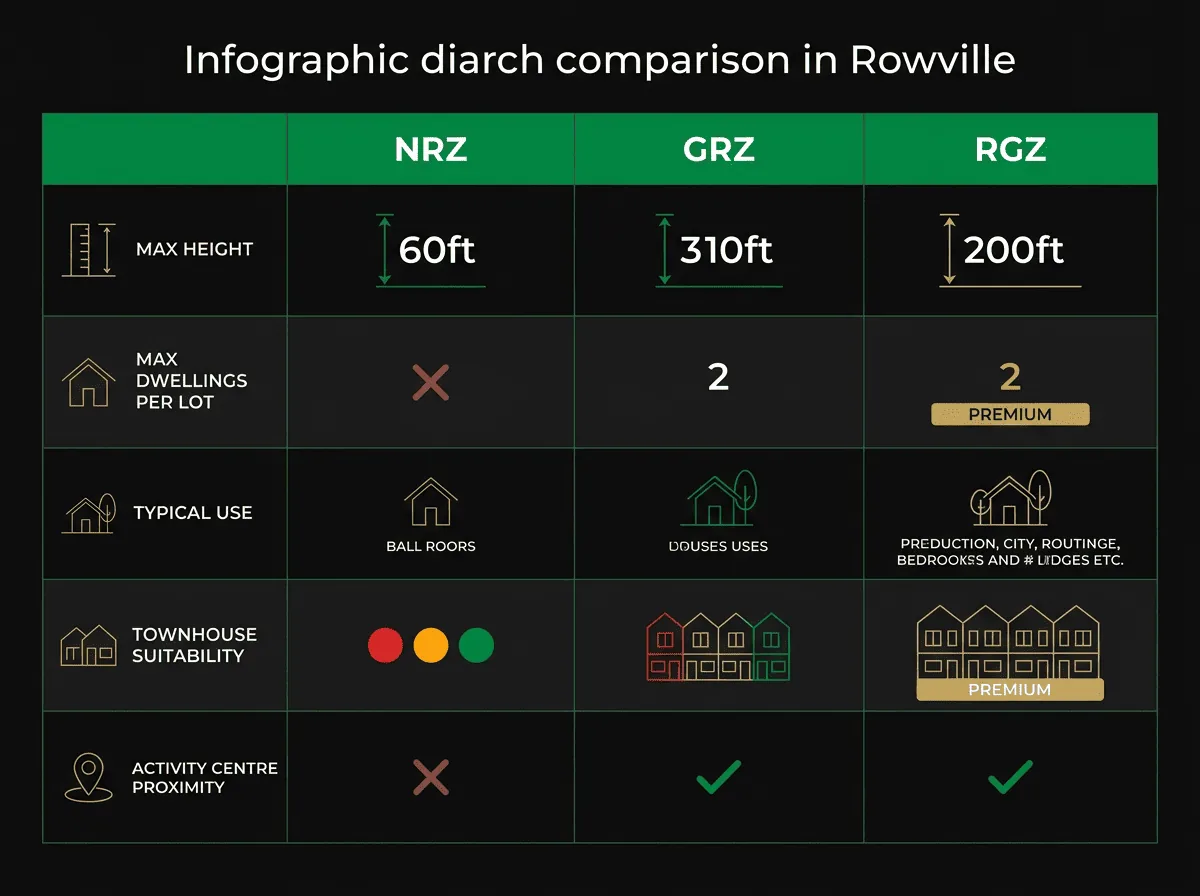
The Neighbourhood Residential Zone applies across much of Rowville’s established residential fabric. It is intended to protect low-density neighbourhood character, with a maximum building height of two storeys and a limit of two dwellings per lot. Development opportunities in the NRZ are constrained, and feasibility for multi-dwelling projects is generally limited unless sites can be consolidated or rezoning is pursued through a planning scheme amendment.
The General Residential Zone applies to areas where incremental housing change is anticipated. It permits up to three storeys (or taller where a schedule specifies) and supports townhouse and medium-density development. The GRZ is the most common zone for townhouse development across Rowville’s transitional precincts, and it is where the Townhouse and Low-Rise Code has the most immediate practical impact.
The Residential Growth Zone applies to locations where substantial housing change is supported — typically within or adjacent to the Stud Park activity centre. The RGZ supports higher-density apartment and mixed-use development, with greater height flexibility subject to any applicable overlay controls. Sites in the RGZ may also benefit from the new Built Form Overlay framework being rolled out across activity centre catchments statewide.
The Townhouse and Low-Rise Code: What Changed in 2025
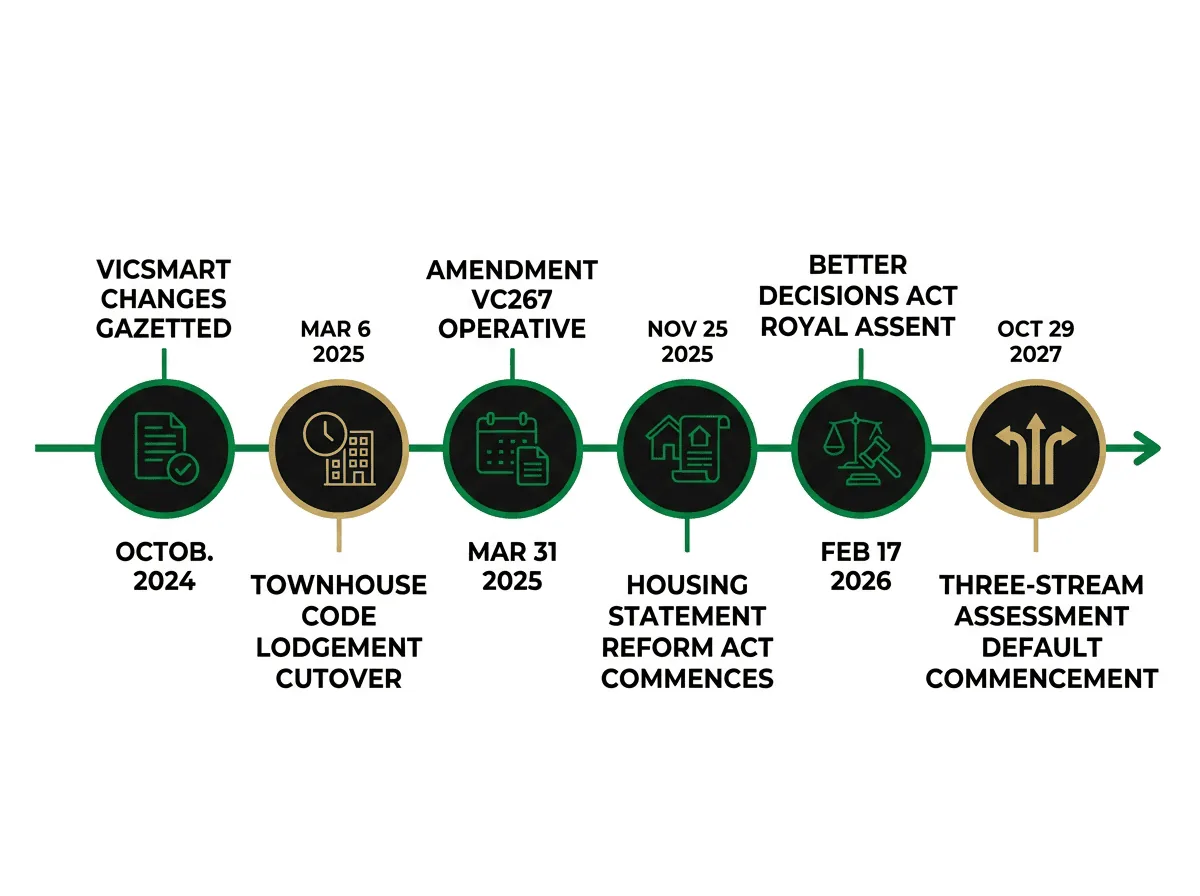
The most immediately significant reform for Rowville townhouse developers is the introduction of the Townhouse and Low-Rise Code, which came into operation on 31 March 2025 via Amendment VC267. The Code replaces the previous version of Clause 55 of the Knox Planning Scheme (and all Victorian planning schemes) and introduces a deemed-to-comply assessment pathway for residential buildings up to three storeys.
Under the new Code, if a development meets all applicable standards, the corresponding objectives are automatically deemed to be met. Knox City Council, as the Responsible Authority, is not required to consider the corresponding decision guidelines — and critically, cannot refuse the application on the basis of those standards. This represents a fundamental shift from the previous framework, where subjective neighbourhood character assessments could be used to resist compliant development.
Key changes under the Code that are particularly relevant to Rowville development include:
- Reduced street setback requirements (now 6 metres in many circumstances, down from the 9 metres previously required under some Knox Planning Scheme schedules)
- Increased site coverage allowances
- Removal of neighbourhood character as a primary design consideration, replaced by objective, measurable standards
- Removal of the requirement to screen bedroom windows from overlooking
- Deletion of more restrictive residential zone schedule provisions that previously applied across Knox, following gazettal of Amendment VC276
Equally significant is the change to third-party appeal rights. Where all applicable standards under the Code are met — including neighbourhood character standards covering street setback, building height, side and rear setbacks, walls on boundaries, site coverage, access, tree canopy, and front fencing — there are no third-party VCAT appeal rights. Objectors may still submit to Knox City Council, but they cannot appeal a compliant decision to VCAT. For developers who have previously experienced costly and time-consuming objector appeals in Rowville, this change may meaningfully improve programme certainty.
It is important to note that applications lodged before 6 March 2025 continue to be assessed under the previous Clause 55 provisions, including existing objection and appeal rights. Developers with applications already in the system should confirm with their planning consultant which version of Clause 55 applies to their specific application.
Get the 7-point site check to run before committing to a permit application — zoning, overlays, setbacks and council red flags, in plain English. Free PDF, instant download.
- Zone, overlay & setback checks
- What council assesses first
- Permit-readiness red flags
Something went wrong. Please try again.
No spam. Unsubscribe anytime.
Check your inbox — your checklist is on its way.
Planning Permit Pathways and Timeframes
A planning permit is required from Knox City Council for most residential development in Rowville, including the construction of two or more dwellings on a lot, subdivision, and any development that triggers overlay requirements. The planning permit process under the Knox Planning Scheme follows the standard Victorian statutory pathway, with Knox City Council acting as the Responsible Authority.
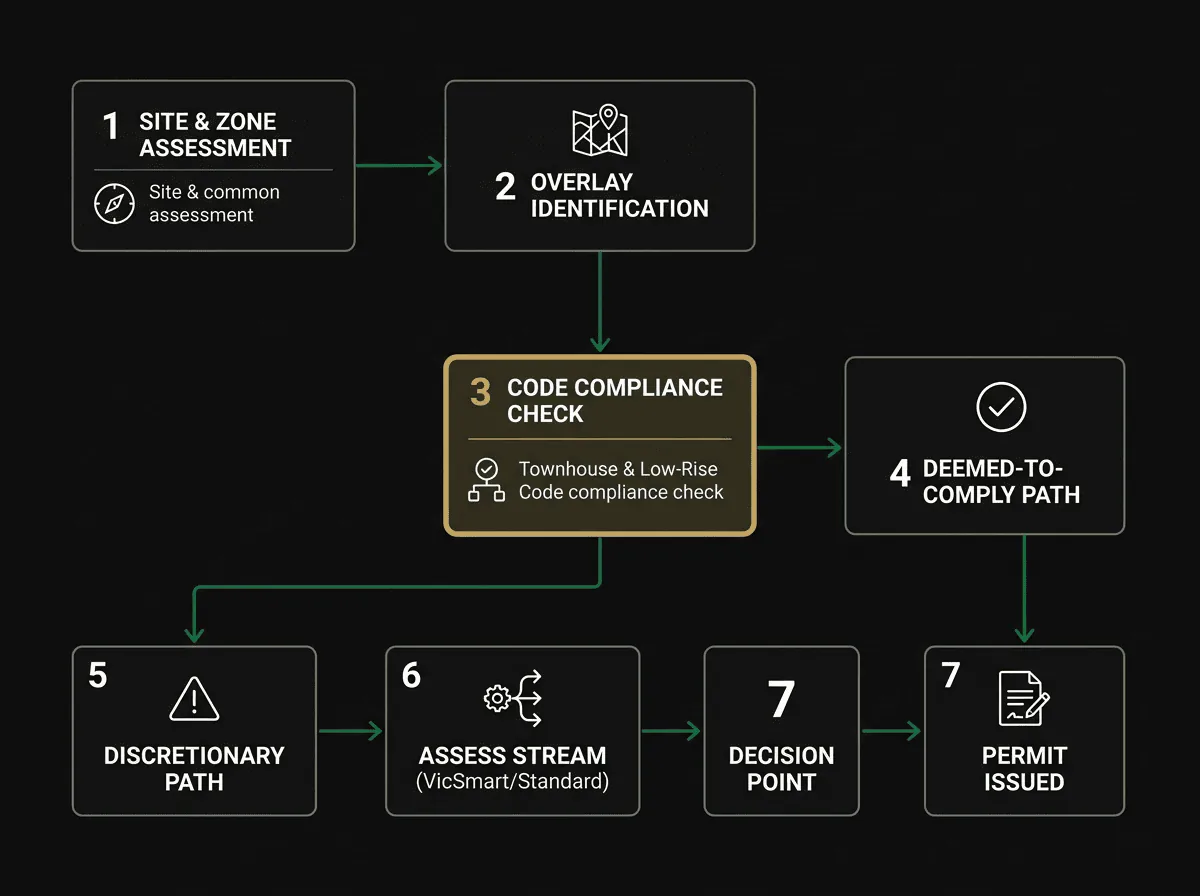
Typical planning permit timeframes for residential development in Rowville have historically ranged from 60 to 120 days for straightforward townhouse applications, with more complex or contested applications taking considerably longer. The reforms introduced by the Housing Statement Reform Act 2025 — which commenced progressively from 25 November 2025 — are intended to reduce delays by introducing tiered assessment processes calibrated to the complexity and impact of each application.
One immediately practical change for Rowville developers is the extension of default planning permit expiry timeframes. Where a permit does not specify its own timeframe, the new defaults are:
- 3 years to commence a use or development (previously 2 years)
- 5 years to complete a development (previously 4 years)
- 3 years from commencement of a use
These extended defaults apply to permits issued both before and after the Act commenced, provided the permit had not already expired. For developers managing staged projects or navigating construction market delays, this is a meaningful improvement that may reduce the need to apply for permit extensions.
The Planning Amendment (Better Decisions Made Faster) Act 2026, which received Royal Assent on 17 February 2026, will introduce three formal planning permit assessment streams once fully implemented (default commencement: 29 October 2027). These streams are expected to operate broadly as follows:
- Stream 1 — Standalone homes and duplexes: Indicative target of 10 days. No public notice required, no third-party appeal rights.
- Stream 2 — Townhouses and low-rise developments: Indicative target of 30 days. No public notice required, no third-party appeal rights.
- Stream 3 — Higher-density apartments and larger developments: Indicative target of 60 days. Notice to directly impacted neighbours, with limited third-party appeal rights at VCAT.
While these streams are not yet operative, developers planning projects with longer lead times should factor these changes into their programme assumptions and feasibility modelling.
Overlays Affecting Rowville Development
In addition to zone controls, a number of overlays may apply to Rowville sites and will need to be assessed as part of any development proposal. The most commonly encountered overlays in Rowville include:
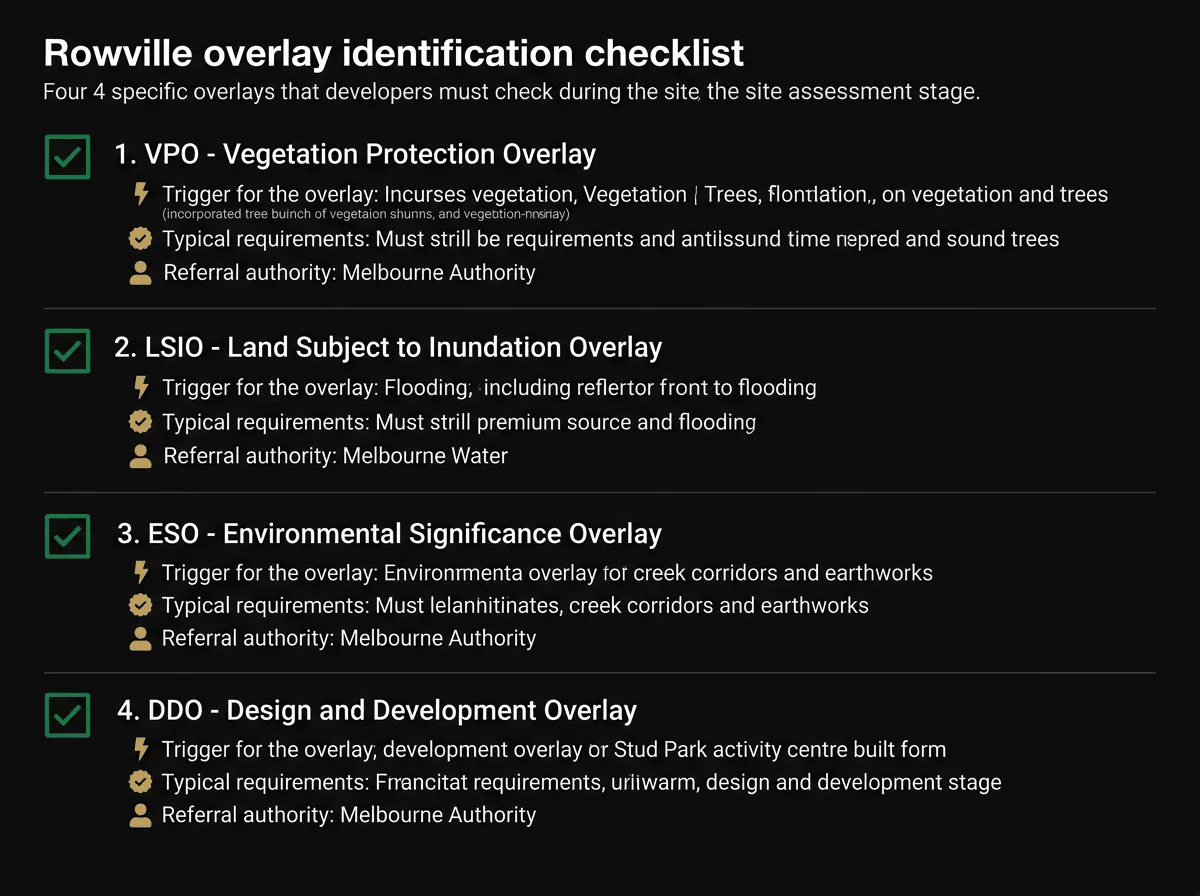
- Vegetation Protection Overlay (VPO): Rowville contains significant areas of remnant vegetation, and the VPO may apply to sites with established trees. Permit requirements for vegetation removal and development near protected trees may apply, and arborist reports are typically required as part of any planning permit application.
- Land Subject to Inundation Overlay (LSIO): Parts of Rowville near Corhanwarrabul Creek and its tributaries may be affected by flood risk. Development in LSIO-affected areas may require referral to Melbourne Water and may need to demonstrate compliance with flood level requirements.
- Environmental Significance Overlay (ESO): Some Rowville sites near creek corridors or remnant vegetation areas may be subject to ESO controls, which can affect vegetation removal, earthworks, and drainage.
- Design and Development Overlay (DDO): DDO controls may apply in and around the Stud Park activity centre, specifying built form requirements including height limits, setbacks, and design standards.
Identifying applicable overlays at the earliest stage of site assessment is essential. Overlay requirements can materially affect development yield, design parameters, and permit timeframes — and in some cases, may affect feasibility. SQM Architects routinely undertakes overlay analysis as part of its site assessment process across Rowville and the broader Knox City Council area.
Subdivision in Rowville
Subdivision in Rowville is governed by the Subdivision Act 1988 and requires both a planning permit from Knox City Council and a Statement of Compliance from the relevant servicing authorities. The subdivision process typically runs concurrently with the planning permit process for multi-dwelling developments, though the two approvals follow separate statutory pathways.
For two-lot subdivisions — including the subdivision of a residential block into two lots — the VicSmart process may now apply following changes gazetted in October 2024. VicSmart provides a streamlined, 10-business-day assessment pathway for eligible applications and may significantly reduce timeframes for straightforward two-lot subdivisions in appropriate zones.
For larger subdivisions, the standard planning permit pathway applies. Referrals to servicing authorities including South East Water, AusNet Services, and Melbourne Water are typically required, and infrastructure contributions may be payable depending on the nature and scale of the subdivision. Developers should confirm applicable infrastructure contribution requirements with Knox City Council at the pre-application stage.
Restrictive Covenants in Rowville
Single-dwelling restrictive covenants remain a practical constraint on medium-density development across parts of Rowville, particularly in established residential precincts developed during the 1970s and 1980s. Where a covenant restricts development to a single dwelling, it may need to be removed or varied before a planning permit for multi-dwelling development can be acted upon.
The Better Decisions Made Faster Act 2026 introduces changes to how restrictive covenants are treated in planning permit decisions. Once operative (default commencement 29 October 2027), the Act will allow planning policy — including state planning strategies and planning scheme objectives — to be considered when assessing applications to remove or vary a restrictive covenant. This may make it more straightforward to pursue covenant removal on sites where state housing policy clearly supports increased density.
In the interim, covenant removal applications continue to be assessed under the existing framework, which requires demonstrating that removal will not cause material detriment to the persons entitled to the benefit of the covenant. Developers with Rowville sites affected by restrictive covenants may wish to begin assessing their options now, ahead of the 2027 reforms.
Council Intelligence: Working With Knox City Council
Knox City Council has historically taken a considered approach to residential development, with a strong emphasis on protecting established neighbourhood character in lower-density precincts while supporting growth in and around the Stud Park activity centre. The council’s planning team is generally responsive to pre-application meetings, and early engagement is strongly encouraged for any development that involves overlays, non-standard design parameters, or sites near sensitive interfaces.
The state-level reforms introduced in 2025–26 have changed the dynamic between applicants and Knox City Council in meaningful ways. The deemed-to-comply pathway under the Townhouse and Low-Rise Code reduces the council’s discretion on compliant applications, and the removal of more restrictive zone schedule provisions means that some previously contentious design parameters are no longer available as grounds for refusal or conditions. Developers who invest in thorough pre-application engagement and submit well-documented, code-compliant applications may experience more predictable outcomes.
SQM Architects maintains an active practice across Knox City Council, with council intelligence and planning expertise developed across a broad range of residential and mixed-use projects across Melbourne. This depth of local knowledge — understanding how Knox City Council’s planning team interprets specific policies, which referral authorities are likely to be triggered, and how to structure applications to minimise delays — may be a material advantage in a market where programme certainty directly affects feasibility.
Frequently Asked Questions
What zones apply to residential land in Rowville, and which is most suitable for townhouse development?
Rowville’s residential land is distributed across the Neighbourhood Residential Zone (NRZ), General Residential Zone (GRZ), and Residential Growth Zone (RGZ). The GRZ is generally the most suitable zone for townhouse development, permitting up to three storeys and supporting medium-density outcomes. The NRZ limits development to two dwellings per lot and is generally not suitable for multi-dwelling projects without rezoning.
Does the new Townhouse and Low-Rise Code apply to my Rowville development?
The Townhouse and Low-Rise Code applies to applications for two or more dwellings on a lot and residential buildings up to three storeys, lodged on or after 6 March 2025, in the GRZ, NRZ, RGZ, and other residential zones. If your application was lodged before that date, the previous version of Clause 55 continues to apply. A planning permit is always required for these developments in residential zones.
Can neighbours still object to my Rowville townhouse development?
Neighbours may still submit objections to Knox City Council, but where all applicable standards under the Townhouse and Low-Rise Code are met, there are no third-party VCAT appeal rights. Knox City Council also has discretion not to give notice of a fully compliant application. This represents a significant change from the previous framework and may reduce the risk of objector-driven delays on compliant projects.
How long does a planning permit last in Victoria after the 2025 reforms?
Following the Housing Statement Reform Act 2025, the default planning permit expiry periods are 3 years to commence a use or development and 5 years to complete a development, where the permit does not specify its own timeframe. These extended defaults apply to permits issued both before and after the Act commenced, provided the permit had not already expired.
What is the VicSmart process, and can it apply to my Rowville subdivision?
VicSmart is a streamlined planning permit assessment pathway with a 10-business-day target for eligible applications. Following changes gazetted in October 2024, two-lot subdivisions and the construction of two new dwellings on a residential lot may be eligible for VicSmart assessment. Eligibility depends on the specific site, zone, and overlay context — a pre-application assessment with Knox City Council or a planning consultant is recommended to confirm eligibility.
Are there restrictive covenants affecting development in Rowville?
Single-dwelling restrictive covenants affect a number of established residential properties in Rowville, particularly in precincts developed during the 1970s and 1980s. Where a covenant applies, it may need to be removed or varied before a planning permit for multi-dwelling development can proceed. The Better Decisions Made Faster Act 2026 introduces changes to covenant removal processes, though these are not expected to commence before 29 October 2027.
What overlays commonly affect Rowville development sites?
The most commonly encountered overlays in Rowville include the Vegetation Protection Overlay, Land Subject to Inundation Overlay, Environmental Significance Overlay, and Design and Development Overlay. Each overlay may impose additional permit requirements, referral obligations, or design constraints. Identifying applicable overlays at the earliest stage of site assessment is essential to accurate feasibility analysis and programme planning.
Conclusion
Rowville remains one of Melbourne’ more active development markets, with genuine opportunities across townhouse, medium-density, and activity centre-adjacent projects. The planning reforms introduced between 2025 and 2026 — including the Townhouse and Low-Rise Code, extended permit expiry defaults, and the forthcoming three-stream assessment framework — have collectively shifted the landscape in ways that may benefit developers who invest in thorough site analysis and code-compliant design. At the same time, the local strategic context established by Knox City Council’s Rowville Plan and Housing Strategy continues to shape where and how growth is directed across the suburb.
Navigating this environment effectively requires current knowledge of both state-level reforms and Knox City Council’s specific planning approach. SQM Architects maintains an active practice across Melbourne, with council intelligence and planning expertise developed across a broad range of residential and mixed-use projects. If you have a Rowville site under consideration, a structured pre-application assessment may help clarify what could be achievable, what constraints may apply, and how to structure your planning permit application for the best possible outcome.
Book a Strategy Call — contact SQM Architects on (03) 9005 6588 to discuss your Rowville development project.
This article provides general information about Victorian planning for property developers. It does not constitute professional advice. For specific guidance on your project, contact SQM Architects (ARBV Reg. No. 51498) for a complimentary site assessment.