
Understanding Manningham Council’s Development Landscape
Manningham City Council oversees one of Melbourne’s most sought-after development markets, encompassing established suburbs from Doncaster to Warrandyte. For property developers, understanding Manningham’s planning framework means navigating a council that balances heritage character with strategic growth corridors. The council processes approximately 1,200 planning applications annually, with residential development comprising 65% of submissions.
This guide provides actionable intelligence on Manningham’s planning scheme, typical approval timeframes, and what planning officers prioritise during assessment. Whether you’re subdividing in Templestowe Lower or developing townhouses in Doncaster East, understanding local requirements can reduce your approval timeline by 4-8 weeks and minimise costly amendments.
Manningham’s planning scheme reflects Victorian planning reforms including VC267 (deemed-to-comply pathways for townhouses) and VC282 (updated ResCode standards). The council’s Responsible Authority processes applications with an average statutory timeframe of 68 days for straightforward residential developments, though complex proposals may extend to 90+ days.
Manningham Council Overview: Key Development Suburbs
Manningham City Council covers 113 square kilometres across Melbourne’s north-Melbourne. The municipality contains distinct development precincts, each with specific planning controls and market characteristics:
- Doncaster and Doncaster East: Major activity centres with General Residential Zone (GRZ) and Neighbourhood Residential Zone (NRZ). High development activity, particularly townhouse subdivisions. Council prioritises design quality and neighbourhood character retention.
- Templestowe and Templestowe Lower: Predominantly NRZ with pockets of GRZ. Significant heritage overlays near the Yarra River. Council scrutinises vegetation removal and slope development.
- Bulleen: Mixed residential zones with industrial precincts. Development opportunities near Manningham Road corridor. Council focuses on interface treatments between residential and commercial uses.
- Donvale and Warrandyte: Low-density residential with Green Wedge Zone constraints. Limited subdivision potential. Council strictly enforces bushfire management overlays and significant landscape overlays.
- Wonga Park and Park Orchards: Rural Living Zone and Low Density Residential Zone. Larger lot subdivisions only. Council prioritises environmental protection and rural character.
The council’s Municipal Strategic Statement identifies Doncaster Hill as a Principal Activity Centre, with planning scheme amendments encouraging higher-density development within 400 metres of the Doncaster Road/Williamsons Road intersection. This precinct operates under specific design and development overlays that supersede standard residential zone controls.
Key Planning Zones and Development Potential
Manningham’s residential zones determine baseline development rights. Understanding zone-specific controls helps developers assess site feasibility before engaging architects or lodging applications.
General Residential Zone (GRZ)
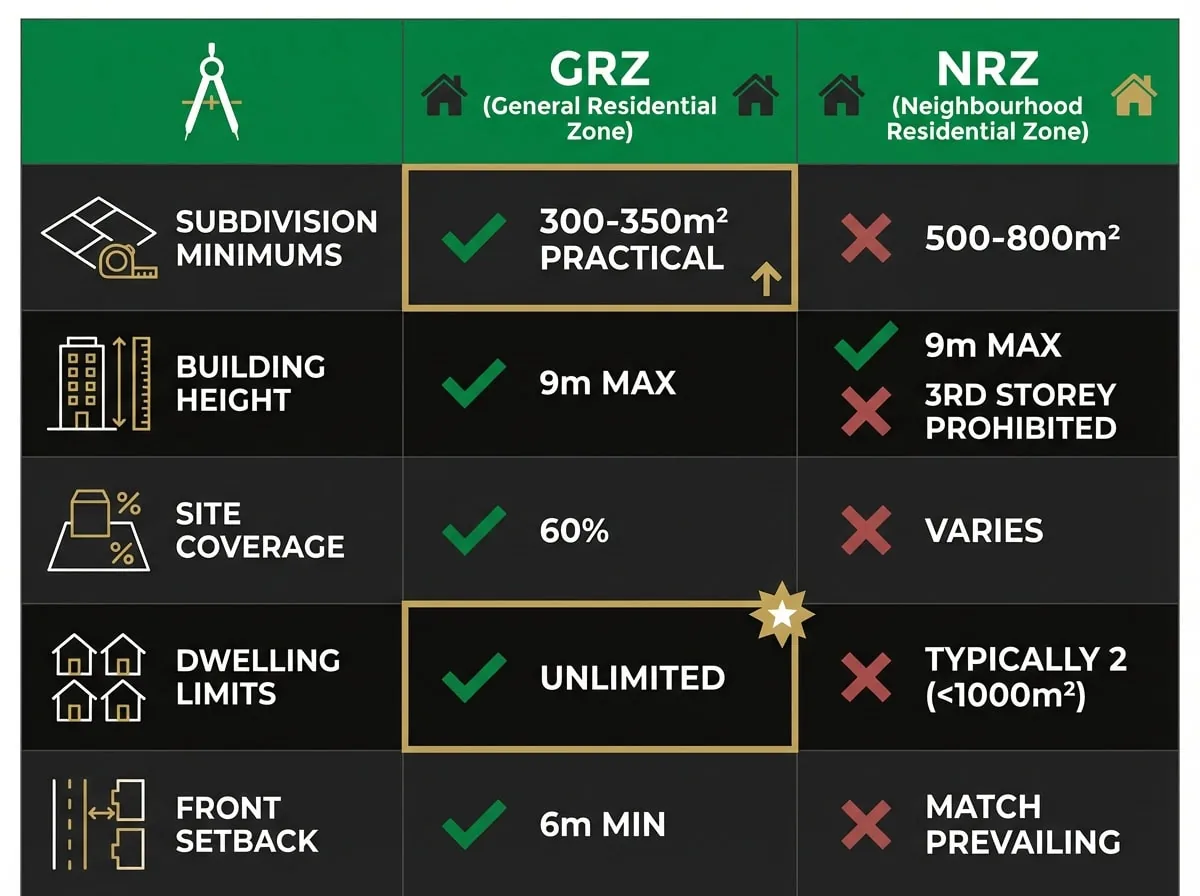
The GRZ is Manningham’s principal zone for incremental housing change, concentrated in Doncaster, Doncaster East, and parts of Templestowe. Confirm the zone and any schedule that applies to your site with a VicPlan planning property report before you commit to a yield. Standard ResCode provisions apply, with local schedules modifying certain requirements:
- Subdivision: No minimum lot size specified in most GRZ schedules. Practical minimum 300-350 square metres for townhouse lots, subject to ResCode compliance.
- Building height: 9 metres (two storeys) standard. Some GRZ schedules permit 11 metres with design response statement.
- Site coverage: 60% maximum under Clause 54 (ResCode for one dwelling per lot) or Clause 55 (ResCode for two or more dwellings per lot).
- Garden area: tiered by lot size under the zone — 25% for lots of 400–500m², 30% above 500m² and up to 650m², and 35% above 650m².
Council officers assess GRZ applications against neighbourhood character objectives. Developments exceeding four dwellings typically require detailed landscape plans and materials schedules demonstrating design quality.
Neighbourhood Residential Zone (NRZ)
The NRZ covers approximately 55% of residential land, protecting established neighbourhood character in suburbs like Templestowe Lower, Bulleen, and parts of Doncaster East. Key controls include:
- Subdivision: Minimum lot sizes vary by schedule. Common minimums: 500 square metres (NRZ1), 650 square metres (NRZ2), 800 square metres (NRZ3).
- Building height: 9 metres maximum (two storeys). Third-storey elements generally prohibited.
- Dwelling limit: Some NRZ schedules specify maximum dwellings per lot (typically two dwellings on lots under 1,000 square metres).
- Front setback: Must match prevailing street setback, typically 6-9 metres in established areas.
NRZ applications receive heightened scrutiny regarding neighbourhood character. Council officers expect detailed context analysis showing how proposals respond to existing streetscape patterns, building forms, and vegetation.
Mixed Use Zone and Commercial Zones
Manningham’s activity centres (Doncaster, Bulleen Plaza precinct) operate under Mixed Use Zone or Commercial 1 Zone provisions. These zones permit residential development above ground floor commercial uses:
- Building height: Varies by location. Doncaster Hill precinct permits up to 8 storeys (24 metres) in core areas, reducing to 4 storeys (12 metres) at residential interfaces.
- Setbacks: Street wall heights limited to 3-4 storeys before upper-level setbacks required (typically 3-5 metres).
- Car parking: Reduced rates apply near public transport. Doncaster Hill: 0.5-1 space per dwelling depending on bedroom count.
Mixed-use developments require demonstrated compliance with Clause 58 (Apartment Developments) rather than ResCode. Council officers prioritise pedestrian amenity, active frontages, and design excellence in these precincts.
Get the 7-point site check to run before committing to a permit application — zoning, overlays, setbacks and council red flags, in plain English. Free PDF, instant download.
- Zone, overlay & setback checks
- What council assesses first
- Permit-readiness red flags
Something went wrong. Please try again.
No spam. Unsubscribe anytime.
Check your inbox — your checklist is on its way.
Standard Setback and Height Requirements
Manningham Council applies ResCode standards with local variations. Understanding typical setback and height expectations helps developers maximise site yield while ensuring planning permit approval.
Street Setbacks
Front setback requirements vary by zone and streetscape context:
- GRZ areas: Minimum 6 metres to habitable rooms, 4 metres to garages. Where existing streetscape shows consistent setbacks, match prevailing pattern (typically 7-9 metres in established areas).
- NRZ areas: Match prevailing setback. Council officers measure setbacks to neighbouring dwellings within 40 metres either side. Variations exceeding 1 metre from prevailing pattern typically refused.
- Corner lots: Secondary street setback minimum 3 metres to habitable rooms, 2 metres to garages. Council expects corner splay treatments (45-degree truncation) for vehicle sightlines.
The VC282 amendments introduced updated street setback standards under Clause 54.03-1, requiring developments to respond to neighbourhood character through appropriate setback depths. Manningham officers interpret this as maintaining consistency with established patterns rather than minimum compliance.
Side and Rear Setbacks
ResCode provides standard setback formulas, but Manningham officers apply discretion based on site context:
- Standard B2-3: 1 metre minimum side setback, then 0.3 metres for every metre of wall height over 3.6 metres — an increment per metre, not a step to a fixed 1.5 metres — and 1 metre for every metre over 6.9 metres.
- Two storey: Ground floor 1 metre minimum, upper floor 2 metres minimum (or calculated using ResCode formula: wall height ÷ 3 + 1 metre).
- Rear setback: Minimum 4 metres to habitable rooms, 3 metres to non-habitable. Developments backing onto public open space may require increased setbacks (6-8 metres) for privacy protection.
- Boundary walls: Maximum 3.6 metres height, 9 metres length on one boundary only. Council officers scrutinise boundary wall locations relative to neighbouring windows and private open space.
Variations to standard setbacks require demonstrated compliance with ResCode objectives. Council officers assess visual bulk, overlooking impacts, and daylight access to neighbouring properties. Applications showing detailed shadow diagrams and privacy treatments achieve higher approval rates.
Building Height Controls
Height limits in Manningham reflect zone provisions and local character objectives:
- Residential zones: 9 metres maximum measured from natural ground level. Roof features (chimneys, services) may extend additional 1 metre.
- Sloping sites: Height measured from natural ground level at centre of building footprint. Council officers reject applications manipulating ground levels to exceed height limits.
- Third-storey elements: Generally prohibited in NRZ. May be considered in GRZ if setback minimum 5 metres from all boundaries and designed as recessive element (maximum 50% of floor below).
The VC282 amendments maintain existing height limits but introduce stricter design requirements for upper-storey elements. Manningham officers expect detailed elevation drawings showing building height compliance and contextual fit with neighbouring development.
Planning Application Process and Timeframes
Understanding Manningham’s application process helps developers plan project timelines and avoid common delays. The council processes applications through a structured workflow with defined assessment stages.
Pre-Application Meetings
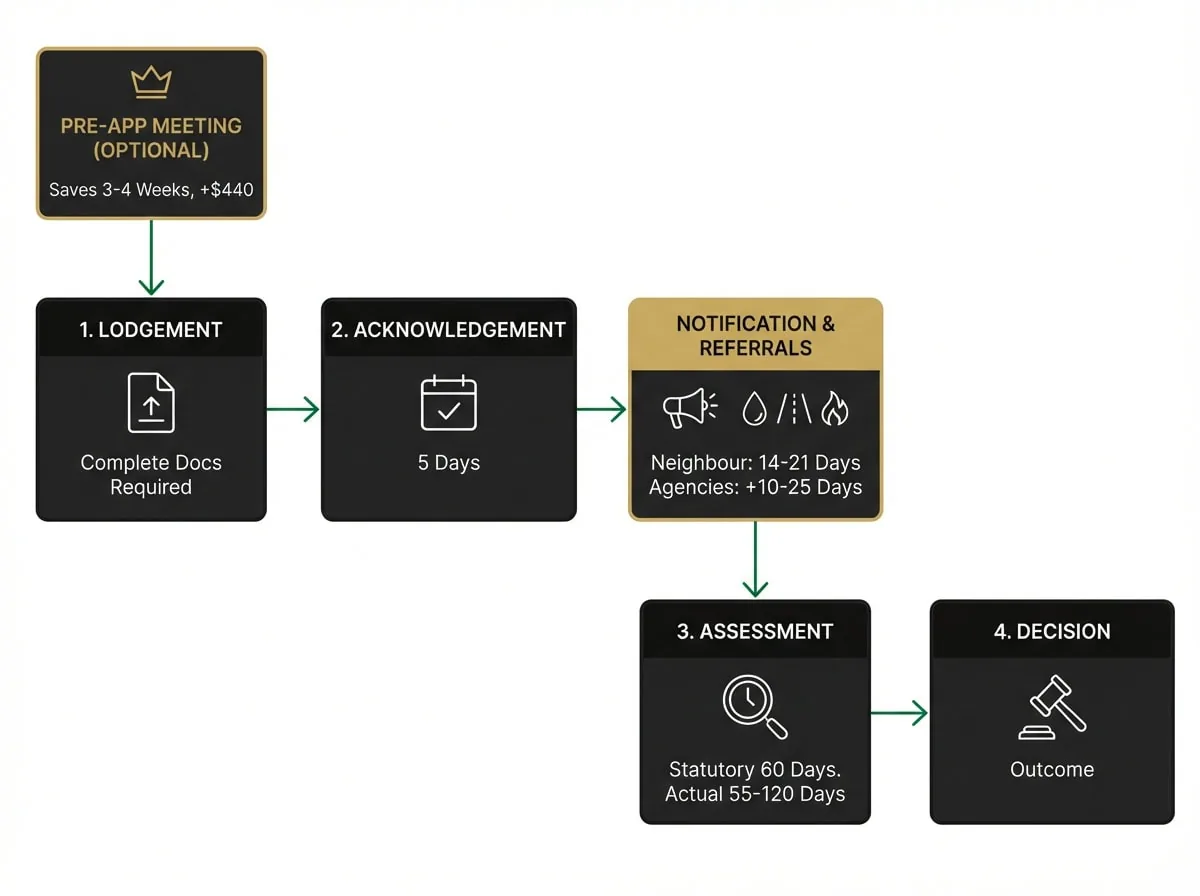
Manningham offers pre-application meetings for developments exceeding three dwellings or involving complex planning issues. These meetings cost $440 (2025 fee) and provide 45 minutes with planning officers. Developers should prepare:
- Preliminary site plan showing proposed layout, setbacks, and access
- Context analysis identifying planning controls and overlays
- Specific questions regarding council expectations or policy interpretation
Pre-application meetings reduce subsequent application delays by 3-4 weeks on average. Officers provide guidance on likely issues, required documentation, and design modifications that improve approval prospects.
Application Lodgement Requirements
Complete applications include:
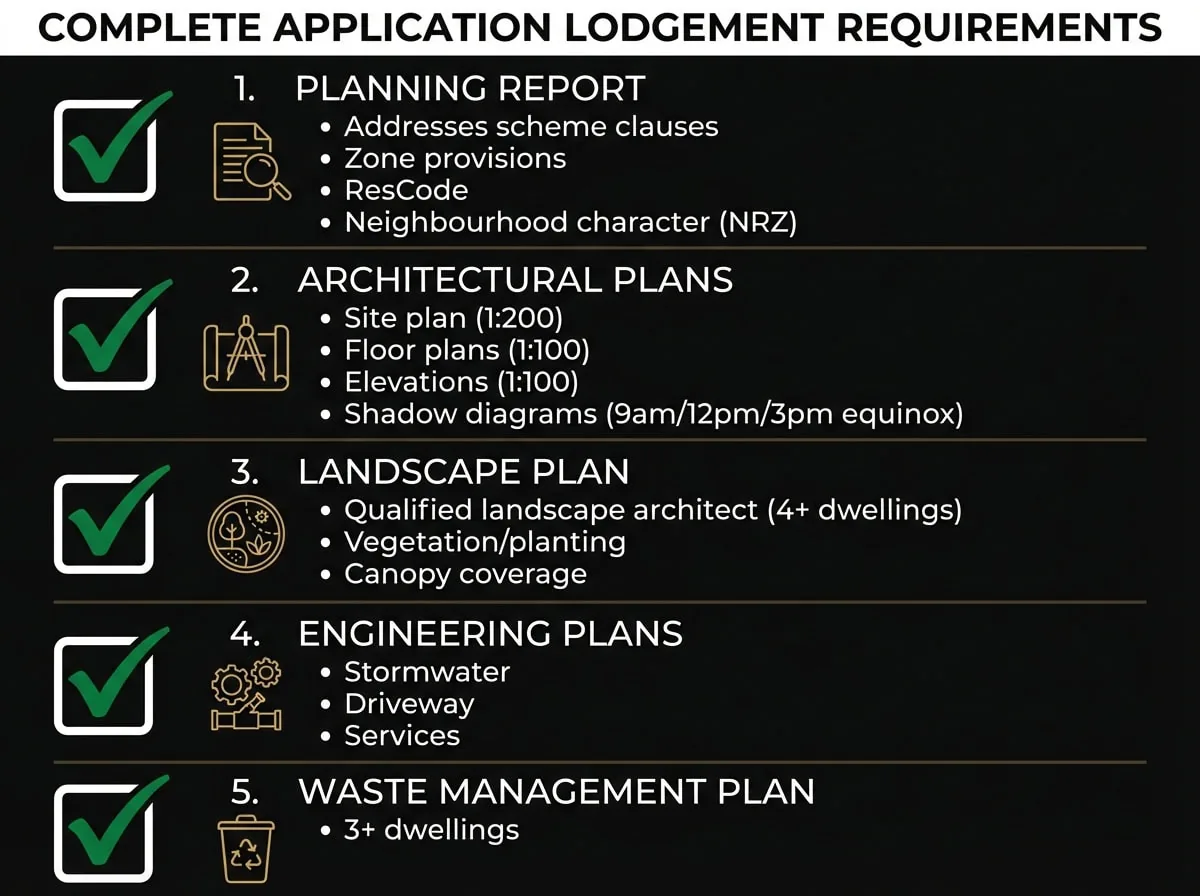
- Planning report: Addressing relevant planning scheme clauses, zone provisions, and ResCode standards. Include neighbourhood character assessment for NRZ applications.
- Architectural plans: Site plan (1:200), floor plans (1:100), elevations (1:100), shadow diagrams (9am, 12pm, 3pm at equinox).
- Landscape plan: Prepared by qualified landscape architect for developments exceeding four dwellings. Show existing vegetation, proposed planting, and canopy coverage calculations.
- Engineering plans: Stormwater management, driveway crossover details, services connection.
- Waste management plan: Required for developments with three or more dwellings.
Incomplete applications trigger Requests for Further Information (RFI), adding 2-4 weeks to assessment timeframes. SQM Architects’ experience shows complete initial submissions achieve 40% faster approval than applications requiring multiple RFIs.
Statutory Timeframes
Manningham’s planning permit process operates under Victorian planning legislation timeframes:
- Acknowledgement: 5 business days from lodgement
- Neighbour notification: 14 days for standard applications, 21 days for applications requiring public notice
- Statutory decision period: 60 days from application date (or end of notification period if later)
- Extended timeframes: Council may request extension with applicant consent. Complex applications typically extend to 90-120 days.
Actual timeframes vary by application complexity and officer workload. Simple two-lot subdivisions average 55-65 days. Townhouse developments (4-8 dwellings) average 75-85 days. Developments requiring Design Review Panel assessment extend to 100+ days.
Referral Authorities
Applications trigger referrals to external authorities based on site constraints:
- Melbourne Water: Sites within 300 metres of waterways or drainage infrastructure. Adds 15-20 days to assessment.
- VicRoads: Developments accessing arterial roads (Manningham Road, Blackburn Road, Thompsons Road). Adds 20-25 days.
- CFA: Properties within Bushfire Management Overlay areas. Adds 10-15 days.
Developers should identify referral requirements during feasibility stage. Early engagement with referral authorities (particularly Melbourne Water for sites near Ruffey Creek or Mullum Mullum Creek) prevents late-stage design changes.
What Manningham Planning Officers Prioritise
Understanding officer assessment priorities helps developers prepare applications that address key concerns proactively. Manningham’s planning team focuses on specific design and amenity outcomes.
Neighbourhood Character Protection
Manningham officers apply neighbourhood character objectives rigorously, particularly in NRZ areas. Applications must demonstrate:
- Streetscape consistency: Building setbacks, heights, and roof forms matching established patterns. Officers reject developments that appear visually dominant or out-of-character.
- Vegetation retention: Existing trees (particularly natives exceeding 8 metres height) should be retained where possible. Removal requires arborist reports and offset planting.
- Front fence design: Low, visually permeable fences (maximum 1.2 metres height) preferred. Solid front fences typically refused in established areas.
- Materials and colours: Natural materials (brick, timber, render) in subdued colours. Highly reflective or bright-coloured cladding receives scrutiny.
The council’s Neighbourhood Character Study (2018) identifies specific character precincts with detailed design guidelines. Officers reference these guidelines during assessment, expecting applications to respond to identified character elements.
Amenity Protection for Neighbours
Manningham officers prioritise existing resident amenity. Applications must address:
- Overlooking: Windows within 9 metres of neighbouring habitable room windows or private open space require screening (1.7-metre sill heights, obscure glazing, or fixed screens). Officers reject developments with direct sightlines to neighbouring living areas.
- Overshadowing: Developments must not overshadow more than 40% of neighbouring private open space between 9am-3pm at equinox. Officers apply this standard strictly, particularly for north-facing neighbours.
- Visual bulk: Upper-storey setbacks, articulated building forms, and varied rooflines reduce perceived bulk. Officers refuse developments appearing as single, monolithic forms.
The VC282 amendments introduced updated daylight-to-existing-windows standards under Clause 54.04-6. Manningham officers now require detailed analysis showing developments maintain reasonable daylight access to neighbouring habitable room windows.
Car Parking and Access
Parking requirements reflect council policy balancing car dependency with urban consolidation:
- Standard rate: 2 spaces per dwelling (1-2 bedrooms: 1 space; 3+ bedrooms: 2 spaces). Visitor parking: 1 space per 5 dwellings for developments exceeding 5 dwellings.
- Driveway design: Minimum 3 metres width for shared driveways serving 3+ dwellings. Maximum 6% grade for first 5 metres from street. Officers scrutinise driveway grades on sloping sites.
- Crossover location: Minimum 2 metres from street trees, 1 metre from service pits. Officers reject crossovers requiring significant street tree removal.
Developments near Doncaster Park & Ride or within 400 metres of bus routes may justify reduced parking rates. Council officers require traffic impact assessments for developments generating 50+ vehicle movements daily.
Sustainable Design
While not always mandatory, Manningham officers favour applications demonstrating environmental performance:
- Water-sensitive urban design: Rainwater tanks (minimum 2,000 litres per dwelling), permeable paving, rain gardens for stormwater treatment.
- Energy efficiency: Solar panel provision, double glazing, appropriate orientation for passive solar access.
- Tree canopy: VC282 introduced 30% canopy coverage target for new developments. Officers expect landscape plans showing canopy calculations and species selection achieving this target within 10 years.
Applications incorporating these elements receive more favourable officer reports and smoother approval processes, particularly for developments requiring discretionary assessment.
Common Application Issues and How to Avoid Them
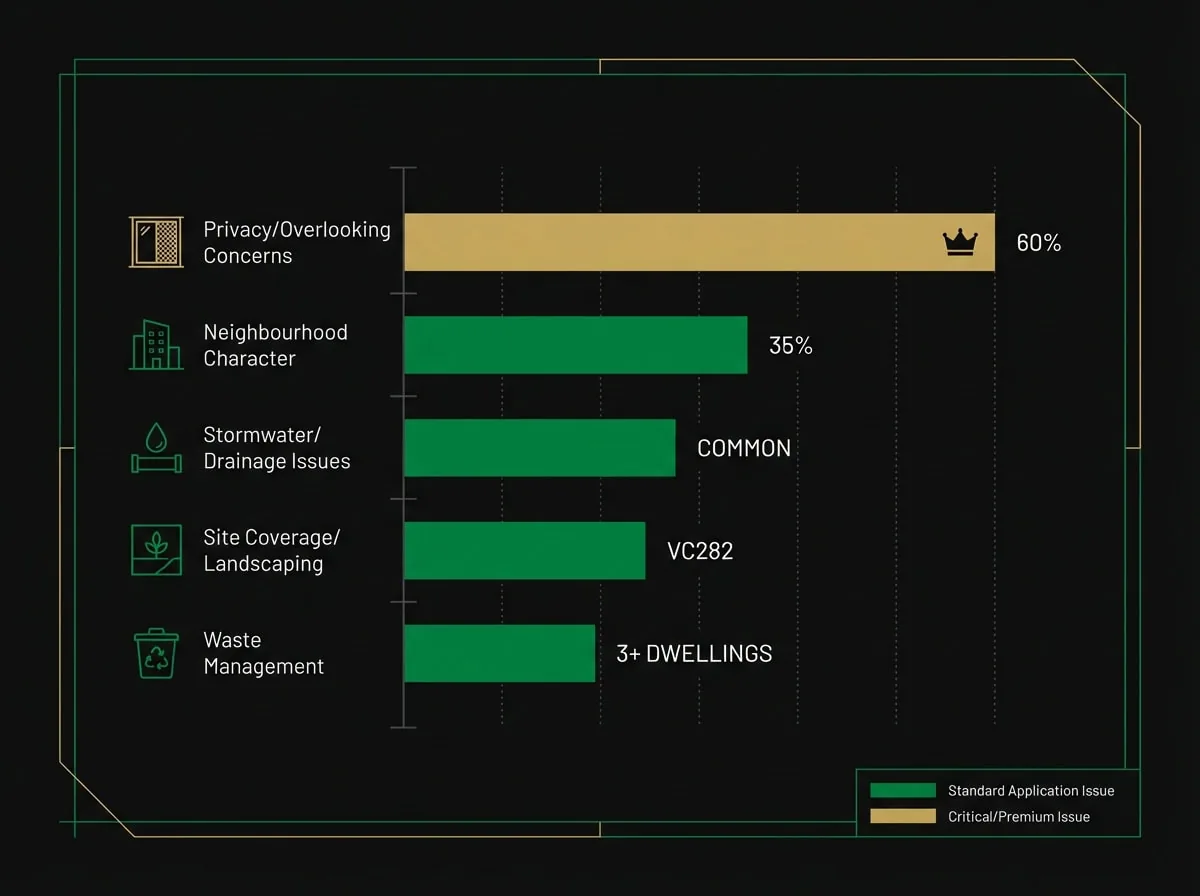
Analysis of Manningham’s planning decisions reveals recurring issues causing delays or refusals. Developers can avoid these problems through careful design and documentation.
Inadequate Neighbourhood Character Response
A thin neighbourhood character analysis is one of the most common reasons an NRZ application attracts a request for further information rather than a decision. Common deficiencies include:
- Generic character descriptions not specific to immediate streetscape context
- Failure to identify and respond to prevailing building setbacks, heights, and forms
- Insufficient detail on materials, colours, and architectural style compatibility
Solution: Prepare detailed context analysis including photographs of neighbouring properties within 40 metres either side. Identify specific character elements (setback ranges, roof forms, fence styles, vegetation patterns) and demonstrate how the proposal responds to these elements.
Overlooking and Privacy Impacts
Privacy is among the most frequently raised grounds in neighbour objections in Manningham, and officers refuse applications with inadequate privacy protection, particularly:
- Upper-storey windows or balconies within 9 metres of neighbouring habitable room windows without screening
- Roof terraces or decks with direct sightlines to neighbouring private open space
- Inadequate screen heights or ineffective screening treatments (e.g., planter boxes instead of fixed screens)
Solution: Conduct detailed overlooking analysis during design stage. Use 1.7-metre sill heights for upper-storey windows facing neighbours, specify fixed obscure glazing (minimum 25% obscurity), or install permanent privacy screens. Avoid relying on landscaping for privacy protection—officers require fixed architectural solutions.
Excessive Site Coverage and Insufficient Landscaping
The zone sets the minimum garden area by lot size — 25% for lots of 400–500m², 30% above 500m² and up to 650m², and 35% above 650m². Manningham officers interpret this strictly:
- Paved areas, driveways, and crossovers don’t count toward garden area requirement
- Planter boxes and podium gardens receive limited credit (maximum 5% of total site area)
- Garden areas must support meaningful vegetation, including canopy trees
Solution: Design site layouts achieving 25-30% garden area to provide buffer for officer discretion. Locate garden areas to support canopy tree planting (minimum 6-metre mature height). Specify appropriate species for site conditions and demonstrate 30% canopy coverage achievement within 10 years.
Inadequate Waste Management
Developments with three or more dwellings require detailed waste management plans. Common deficiencies include:
- Insufficient bin storage area (minimum 1.5 cubic metres per dwelling required)
- Bin collection points exceeding 10 metres from street or requiring bins to cross driveways
- Inadequate access for waste collection vehicles (minimum 3.5-metre width, 4.2-metre height clearance)
Solution: Design dedicated bin storage areas with direct access to street. For developments exceeding 8 dwellings, consider communal bin storage with collection service. Consult council’s waste management guidelines during design development.
Stormwater and Drainage Issues
Manningham’s hilly topography creates stormwater challenges. Applications fail when:
- Stormwater discharge increases peak flows to neighbouring properties or council drainage systems
- Inadequate on-site detention provided (council requires 1:20 year storm retention for most developments)
- Retaining walls exceed 1 metre height without engineering certification
Solution: Engage civil engineers early to design compliant stormwater systems. Incorporate rainwater tanks, permeable paving, and rain gardens to reduce stormwater discharge. For sites within Melbourne Water referral areas (near Ruffey Creek, Mullum Mullum Creek), obtain preliminary advice before lodging applications.
Frequently Asked Questions
What’s the minimum lot size for subdivision in Manningham?
Minimum lot sizes vary by zone and schedule. GRZ areas typically have no specified minimum, with practical minimums around 300-350 square metres for townhouse lots. NRZ areas specify minimums ranging from 500-800 square metres depending on the schedule. Check the planning scheme zone schedule for your specific site to confirm requirements.
How long does a planning permit take in Manningham?
Statutory timeframe is 60 days, but actual timeframes vary by complexity. Simple two-lot subdivisions average 55-65 days. Townhouse developments (4-8 dwellings) average 75-85 days. Complex applications or those requiring Design Review Panel assessment may extend to 100-120 days. Pre-application meetings and complete initial submissions reduce timeframes significantly.
Does Manningham Council require Design Review Panel assessment?
Design Review Panel assessment is required for developments exceeding 10 dwellings or four storeys in height, and for developments within the Doncaster Hill Activity Centre exceeding specific thresholds. The panel provides design advice to council officers but doesn’t make approval decisions. Panel review adds approximately 4-6 weeks to assessment timeframes.
Can I build three-storey townhouses in Manningham?
Three-storey development is generally prohibited in NRZ areas. In GRZ areas, third-storey elements may be considered if designed as recessive elements (maximum 50% of floor below), setback minimum 5 metres from all boundaries, and demonstrating neighbourhood character compatibility. Most successful three-storey applications occur in Doncaster and Doncaster East GRZ areas with established multi-storey development patterns.
What car parking rates apply to townhouse developments?
Standard rates are 1 space per 1-2 bedroom dwelling, 2 spaces per 3+ bedroom dwelling. Visitor parking required at 1 space per 5 dwellings for developments exceeding 5 dwellings. Reduced rates may apply within 400 metres of bus routes or near Doncaster Park & Ride, subject to traffic impact assessment demonstrating adequate on-street capacity.
How does Manningham assess neighbourhood character?
Officers assess neighbourhood character using the council’s Neighbourhood Character Study (2018) and site-specific context analysis. Applications must demonstrate response to prevailing building setbacks, heights, roof forms, materials, and vegetation patterns within 40 metres either side of the site. Generic character descriptions receive RFIs—detailed, site-specific analysis is essential for approval.
What happens if my application receives objections?
Neighbour objections don’t automatically trigger refusal. Officers assess objections against planning scheme provisions and determine whether concerns are valid planning grounds. Applications may be approved despite objections if they comply with relevant standards. Objectors have rights to appeal approved permits to VCAT. Multi-dwelling applications in established Manningham streets attract objections routinely, and many are approved regardless where they meet the relevant standards — an objection is a submission to be answered on planning grounds, not a veto.
Maximising Development Success in Manningham
Manningham City Council offers significant development opportunities for property developers who understand local planning requirements and officer expectations. The council’s planning scheme balances strategic growth in activity centres like Doncaster Hill with neighbourhood character protection in established residential areas.
Successful applications demonstrate thorough understanding of zone provisions, ResCode standards (particularly VC282 amendments), and neighbourhood character objectives. Developers who invest in pre-application engagement, complete documentation, and design responses addressing officer priorities give themselves the best prospect of approval and avoid the request-for-further-information cycles that add months to an assessment.
SQM Architects has delivered 210+ projects across Melbourne, including 45+ successful planning permits in Manningham. Our 98% planning approval rate reflects detailed understanding of council requirements and officer expectations. For developers seeking to maximise site potential while ensuring planning permit approval, early architectural engagement provides the strategic advantage that separates successful projects from costly redesigns.
Book a Strategy Call: Contact SQM Architects on (03) 9005 6588 to discuss your Manningham development opportunity. Our complimentary site assessment identifies planning constraints, development potential, and strategies for achieving planning permit approval within optimal timeframes.
This article provides general information about Victorian planning for property developers. It does not constitute professional advice. For specific guidance on your project, contact SQM Architects (ARBV Reg. No. 51498) for a complimentary site assessment.