Why Medium Density Development in Melbourne Is a Strong Opportunity Right Now
Melbourne’s housing landscape is shifting faster than at any point in the past three decades. Victoria’s medium density approvals have grown substantially over the past five years, and demand for attached dwellings has grown across Melbourne’s established suburbs, reflecting broader shifts in housing preferences and planning policy direction. For property developers in Melbourne’s Eastern Suburbs, this isn’t background noise. It’s a direct signal about where planning policy, population growth, and market demand are converging.
The regulatory environment has also fundamentally changed. Amendment VC267, the new Housing Choice and Transport Zone (HCTZ), and the Better Decisions Made Faster Act 2026 have collectively rewritten the rules for medium density development. Approval timelines are tighter, third-party appeal rights have been curtailed in many circumstances, and the state government has made clear it will intervene where councils fail to meet housing targets. For developers who understand the new framework, the opportunity is substantial.
This guide covers everything you may need to know: the updated ResCode standards under Clause 55, how the new three-tiered permit system could affect your timeline, council-specific considerations across the Eastern Suburbs, and the practical steps that may help you move from site assessment to planning permit with greater certainty.
See How We Achieved Approval for This Complex Site
Understanding the Updated ResCode Framework: Clauses 54, 55, and 57
As of 31 March 2025, Amendment VC267 introduced the most significant overhaul of ResCode since its inception. The changes shift the system from a largely qualitative, discretionary model toward a codified framework with clearer numeric standards — a development that may meaningfully reduce subjectivity in how the Responsible Authority assesses your application.
Clause 55: The Townhouse and Low-Rise Code (Up to Three Storeys)
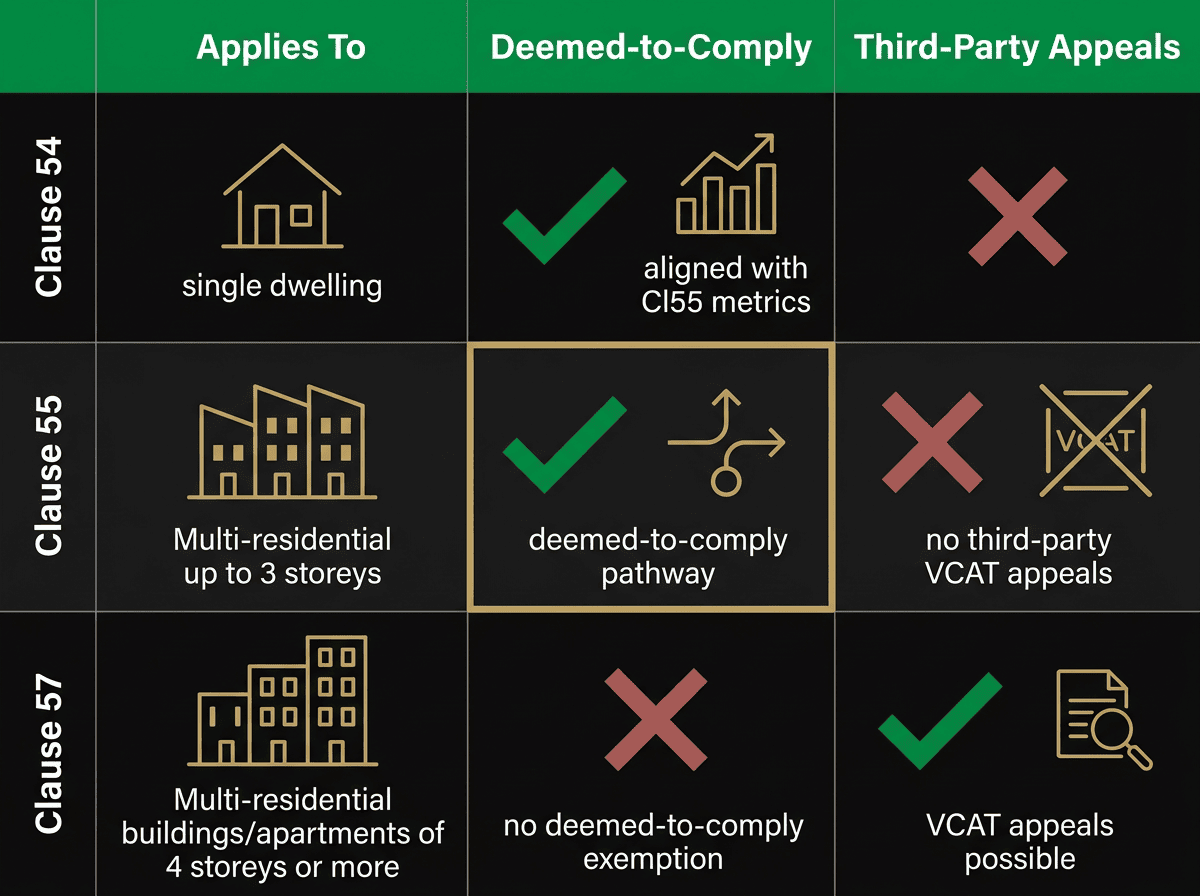
Clause 55 now governs residential buildings up to three storeys and introduces a critical "Deemed-to-Comply" pathway. Where a project meets all numeric standards, the objectives are automatically satisfied. Crucially, third-party appeal rights at VCAT are removed for compliant applications. This is a significant shift for developers who have historically faced objections on subjective neighbourhood character grounds.
Key updated standards under Clause 55 include:
- Front setback (Clause 55.03-1): Reduced to 6 metres (down from 9 metres) or matching the nearest neighbour — whichever is the lesser. See our guide to building setbacks in Victoria for further context.
- Site coverage (Clause 55.03-3): Increased to 65% in the General Residential Zone (GRZ) and 70% in the Residential Growth Zone (RGZ) and HCTZ
- Private open space (Clause 55.05-4): Standardised to 25 square metres per dwelling (previously up to 80 square metres in some councils)
- Tree canopy requirement: 10% of site area for lots under 1,000 square metres; 20% for lots over 1,000 square metres
One important constraint remains: the garden area requirement in the GRZ. For lots over 650 square metres, 35% must be retained as garden area. This can effectively cap density on larger suburban blocks, even where the 65% site coverage allowance might otherwise permit greater yield. Developers should model both constraints carefully during feasibility. For dual occupancy outcomes specifically, see our detailed guide to dual occupancy in Melbourne.
Clause 57: Four-Storey Apartment Standards
A new Clause 57 has been introduced specifically for four-storey developments. Unlike Clause 55, this clause does not currently carry a deemed-to-comply exemption from third-party appeals, meaning applications assessed under Clause 57 may still be subject to objection and VCAT review. Developers targeting four-storey outcomes should factor this into their risk assessment and programme accordingly.
Clause 54: Single Dwellings
Clause 54 continues to govern single dwellings but has been aligned with the updated Clause 55 metrics to ensure consistency across small-scale development. For developers pursuing dual occupancy or multi-unit outcomes, Clause 55 will be the primary reference point.
The Three-Tiered Permit System: What It Means for Your Timeline
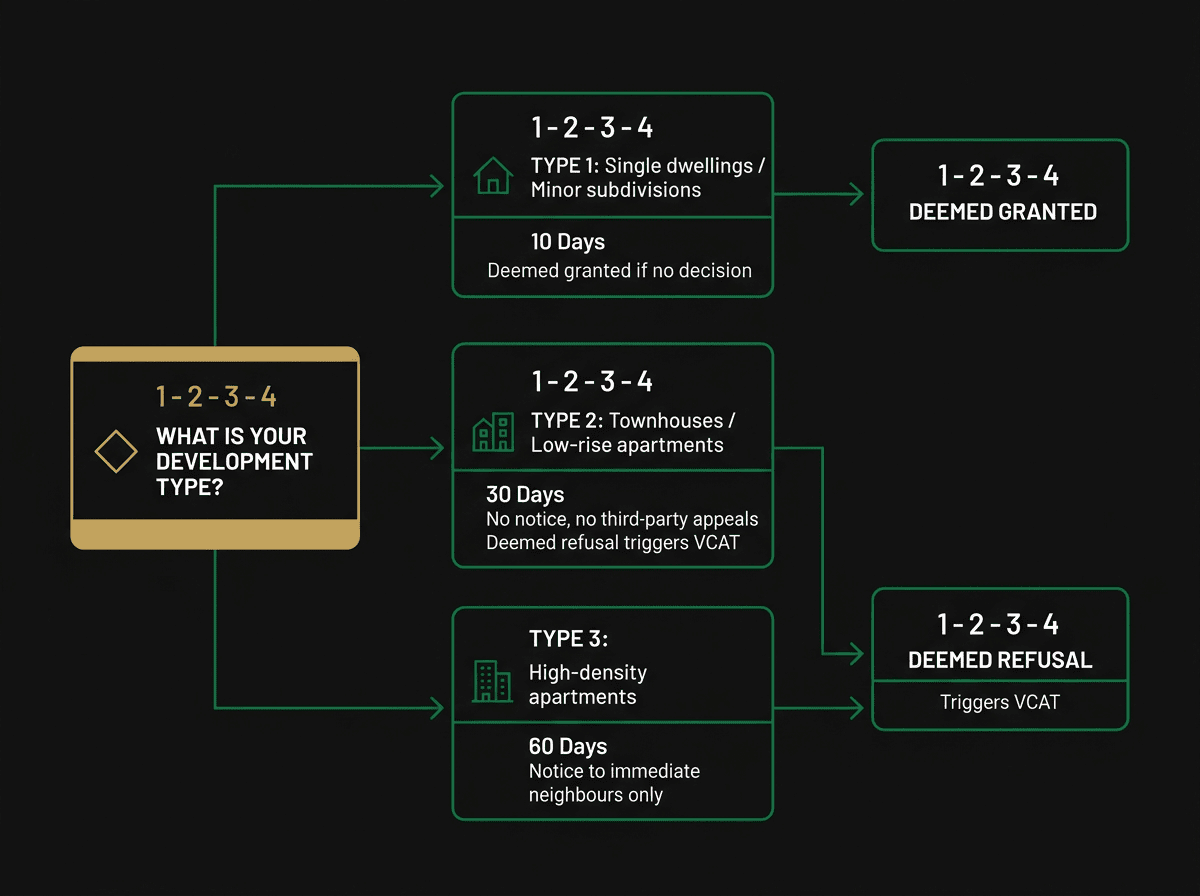
The Better Decisions Made Faster Act 2026 introduces a differentiated assessment framework that may significantly compress approval timelines for medium density projects. Under the previous system, a planning permit for a townhouse development could follow the same assessment pathway as a high-rise apartment — with timelines extending well beyond 100 days where objections were lodged. The new system creates three distinct streams. For a broader overview of how accelerated permit pathways work in practice, see our dedicated guide.
The 10-page PDF checklist Melbourne developers use to evaluate sites before committing capital.
- Zone, overlay & setback checks
- Dwelling capacity estimation
- Council-specific red flags
Something went wrong. Please try again.
No spam. Unsubscribe anytime.
Check your inbox — your checklist is on its way.
Type 1 — 10 Days (Single Dwellings and Minor Subdivisions)
The fastest pathway, applicable to single dwellings and minor subdivisions. Critically, if the Responsible Authority fails to determine a Type 1 application within the statutory period, the permit is deemed granted. This shifts the burden of delay from the developer to the council — a meaningful change for straightforward applications.
Type 2 — 30 Days (Townhouses and Low-Rise Apartments)
This stream covers townhouse and low-rise apartment applications — the core of most medium density development in Melbourne’s Eastern Suburbs. Type 2 applications are processed without public notice or third-party appeal rights. For developers, this removes one of the most significant sources of delay and cost uncertainty in the planning process. A deemed refusal applies if no decision is made within 30 days, enabling the developer to proceed to VCAT. For council-by-council context on typical planning permit timelines in Melbourne, see our reference guide.
Type 3 — 60 Days (High-Density Apartments)
Applicable to high-density apartment projects. Notice and appeal rights are limited to immediate neighbours only — a substantial reduction from the previous open objection process. The 60-day statutory clock creates a clearer programme for developers managing construction finance and presales timelines.
It is worth noting that the automatic approval mechanism in the 2026 Act represents a genuine shift in the balance of power between developers and councils. Where councils have historically used delays as an informal mechanism to discourage certain development types, the statutory timeframes now carry real consequences.
Activity Centres, the HCTZ, and Where Density Is Being Directed
Plan for Victoria, released in February 2025, establishes a 30-year framework mandating that 70% of all new housing be built in established areas rather than greenfield sites. The regulatory mechanism for delivering this target is the expansion of activity centre planning controls and the introduction of the Housing Choice and Transport Zone (HCTZ) under Clause 32.10.
The Housing Choice and Transport Zone (HCTZ)
The HCTZ applies in walkable catchments of 400 to 800 metres around major transport hubs. Building heights under the HCTZ range from 11 metres to 21.5 metres depending on the applicable schedule and site size, with exceptions available for large sites. The zone is designed to create a transitional density gradient between commercial activity centre uses and lower-density residential areas.
For developers with landholdings near train stations and established activity centres across the Eastern Suburbs, the HCTZ may unlock development potential well beyond what was available under existing residential zones. Sites in and around Box Hill, Ringwood, Mitcham, Nunawading, Blackburn, and Doncaster East warrant close assessment against the HCTZ mapping.
Activity Centre Programme Expansion
The Victorian Government is expanding from 10 pilot activity centres to 60 train and tram zone activity centres across Melbourne. These areas utilise the Built Form Overlay (Clause 43.06), which sets mandatory height limits — typically 3 to 12 storeys — and offers notice-free permit tracks for compliant designs. In these areas, the state is effectively the primary planning authority, reducing local council discretionary power considerably.
The "Great Design Fast Track" Pathway
Launched in April 2025, the Great Design Fast Track (GDFT) is available for projects of 8 or more homes across 2 to 8 storeys. To qualify, projects must meet high sustainability benchmarks — including an 8-star NatHERS rating for apartments — and pass a review by the Office of the Victorian Government Architect (OVGA). Projects that qualify may access a streamlined, state-led approval process that bypasses many local council hurdles. For developers with the design capability to meet these standards, the GDFT may offer a compelling combination of speed and certainty.
Council-Specific Considerations Across Melbourne’s Eastern Suburbs
While the state is centralising planning power, meaningful differences remain in how individual councils manage their housing targets and apply local overlays. Developers operating across the Eastern Suburbs should be across the specific context of each municipality.
City of Whitehorse
Box Hill is one of Melbourne’s most significant activity centre redevelopment precincts, with the HCTZ and Built Form Overlay already applying across much of the centre. Developers should note that the City of Whitehorse has existing Design and Development Overlays (DDOs) in place across several precincts — these interact with the new state controls and may require careful navigation. Sites within 800 metres of Box Hill station may qualify for HCTZ provisions.
City of Boroondara
Historically one of Melbourne’s more restrictive councils for medium density development, the City of Boroondara now faces a target of 65,500 new homes by 2051 — a substantial increase on current stock. The state government has signalled it will override local neighbourhood character overlays in designated zones where councils are not meeting targets. Developers should monitor rezoning activity closely, particularly around Camberwell, Hawthorn, and Kew activity centres.
Manningham City Council
Doncaster Hill remains the primary activity centre focus for Manningham, with existing DDOs establishing height and built form controls. The HCTZ mapping around Doncaster East and Templestowe Lower warrants assessment for sites within the 400 to 800 metre catchment. Manningham’s Vegetation Protection Overlay (VPO) applies broadly across the municipality and may affect tree removal approvals — factor arborist reports into your pre-application programme.
City of Monash
The Victorian Government’s housing target for the City of Monash represents a substantial increase in dwelling stock by 2051. Glen Waverley and Clayton are both designated activity centres with existing built form controls, and the SRL East corridor through Clayton is driving significant rezoning activity. Developers with sites near Monash University or along the SRL East alignment may find development potential has increased materially under the new framework.
Knox City Council and Maroondah City Council
Ringwood is Maroondah’s primary activity centre and is already subject to significant built form controls under the Ringwood Metropolitan Activity Centre framework. Knox City Council’s focus is centred on Knox Central and Bayswater, with medium density encouraged in and around these precincts. Both councils are subject to the state’s housing targets and the expanded activity centre programme.
Practical Steps to Maximise Your Development Outcome
Understanding the regulatory framework is necessary but not sufficient. The developers who achieve the strongest outcomes in planning approval rates and development yield are those who approach the process systematically from the outset.
Step 1: Conduct a Thorough Site Assessment Before Committing
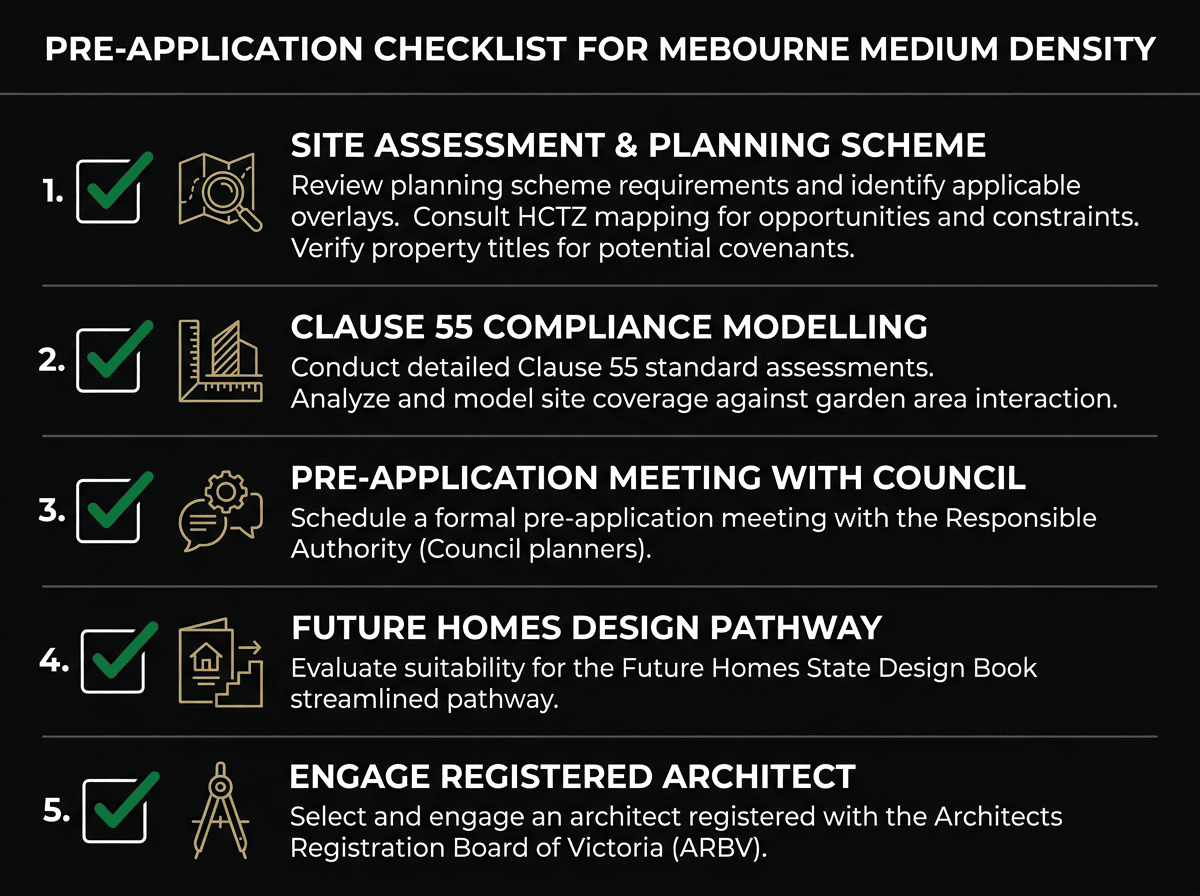
Before exchanging contracts, assess the site against the planning scheme, applicable overlays, zone provisions, and the HCTZ mapping. Check for restrictive covenants — the 2026 reforms make it significantly easier to override single-dwelling covenants that are inconsistent with Plan for Victoria density targets, but this still requires a planning permit and takes time. Identify any Heritage Overlays, Vegetation Protection Overlays, or Significant Landscape Overlays early, as these can materially affect yield and programme. If you are weighing up development formats, our knockdown rebuild, dual occupancy, or subdivide decision guide may help clarify your options.
Step 2: Model the Clause 55 Standards Against Your Site
Run a detailed Clause 55 compliance check across all numeric standards before committing to a design direction. Pay particular attention to the interaction between the 65% site coverage allowance and the 35% garden area requirement for lots over 650 square metres — these can pull in opposite directions and effectively determine your maximum yield. The Metropolitan Planning Levy (MPL) applies to projects with a cost of works exceeding $1,311,000 in the 2025-26 financial year, at a rate of $1.30 per $1,000 of cost. Factor this into your feasibility modelling.
Step 3: Engage the Responsible Authority Early
Pre-application meetings with the Responsible Authority remain valuable, particularly for sites with complex overlay interactions or where you are seeking to test the boundaries of the new HCTZ provisions. Most Eastern Suburbs councils offer pre-application services, and a well-prepared pre-application submission — including architectural planning drawings prepared to the required standard — can identify potential issues before they become permit conditions or grounds for refusal.
Step 4: Consider the "Future Homes" State Design Book
The Victorian Government’s Future Homes exemplar designs are available for approximately $150 per design. Purchasing these designs grants access to a streamlined, state-led approval process that bypasses many local council hurdles. For developers targeting straightforward townhouse typologies, this may represent a cost-effective pathway to a faster planning permit.
Step 5: Engage an Architect Registered with the ARBV
All architectural services in Victoria must be provided by a registered architect or architectural practice. Ensure your architect holds current registration with the Architects Registration Board of Victoria (ARBV). SQM Architects has worked across planning permit applications in Melbourne’s Eastern Suburbs and may be able to assist with your specific site context.
Frequently Asked Questions
What is the difference between Clause 55 and Clause 57 under the updated ResCode?
Clause 55 (the Townhouse and Low-Rise Code) applies to residential buildings up to three storeys and includes a Deemed-to-Comply pathway that removes third-party VCAT appeal rights where all numeric standards are met. Clause 57 applies specifically to four-storey developments and does not currently carry the same deemed-to-comply exemption, meaning these applications may still be subject to objection and VCAT review. Developers should consider this distinction when assessing whether a three-storey or four-storey outcome is preferable for a given site.
How does the Housing Choice and Transport Zone (HCTZ) affect my development potential?
The HCTZ, introduced under Clause 32.10, applies in walkable catchments of 400 to 800 metres around major transport hubs and allows building heights of 11 to 21.5 metres depending on the applicable schedule. For sites currently zoned General Residential or Neighbourhood Residential, rezoning to the HCTZ may unlock significantly greater development yield. Developers should check current HCTZ mapping and monitor rezoning activity in their target areas.
What does the garden area requirement mean for my yield on a larger block?
In the General Residential Zone, lots over 650 square metres must retain 35% as garden area. This interacts with the 65% site coverage allowance and can effectively cap the footprint of development on larger suburban blocks. Careful site planning — including the use of upper-level setbacks and cantilevered elements — may help optimise yield within these constraints. An experienced architect can model multiple configurations to identify the most efficient outcome.
Can the state government override a restrictive covenant on my site?
The Better Decisions Made Faster Act 2026 introduces significant changes to how restrictive covenants are treated in planning permit decisions. Single-dwelling covenants that are inconsistent with Plan for Victoria density targets may now be more readily overridden, but this still requires a planning permit application and is not automatic. Developers should seek specific guidance on their site’s covenant status before committing to a development programme.
What is the Metropolitan Planning Levy and when does it apply?
The Metropolitan Planning Levy (MPL) applies to planning permit applications for projects with a cost of works exceeding $1,311,000 in the 2025-26 financial year. The levy rate is $1.30 per $1,000 of estimated cost of works. It must be paid before a planning permit application can be lodged with the Responsible Authority. Factor this cost into your feasibility modelling for any medium density project of meaningful scale.
How does the Type 2 permit stream affect my programme for a townhouse development?
Under the Better Decisions Made Faster Act 2026, townhouse and low-rise apartment applications are assessed as Type 2 applications with a 30-day statutory timeframe, no public notice, and no third-party appeal rights. If the Responsible Authority fails to determine the application within 30 days, a deemed refusal applies, enabling the developer to proceed to VCAT. This represents a significant compression of the traditional planning timeline for medium density projects.
What sustainability standards apply to medium density development in 2025-26?
Standard medium density applications must comply with the energy efficiency provisions of the National Construction Code (NCC) and any applicable planning scheme sustainability requirements. Projects seeking access to the Great Design Fast Track pathway must meet an 8-star NatHERS rating for apartments and pass an OVGA review. Even outside the GDFT, incorporating strong sustainability credentials — including solar access, cross-ventilation, and EV charging infrastructure — may support a more favourable assessment by the Responsible Authority.
Your Next Step: Turn Policy Change Into Development Opportunity
The regulatory reforms reshaping Melbourne’s medium density landscape represent the most significant opportunity for property developers in the Eastern Suburbs in a generation. The combination of compressed approval timelines, reduced third-party appeal rights, increased site coverage allowances, and state-driven housing targets creates conditions where well-prepared developers could achieve more efficient planning outcomes than under previous frameworks in many cases. The key is understanding which provisions apply to your site, how the new standards interact with local overlays, and how to structure your application to take full advantage of the Deemed-to-Comply pathway.
SQM Architects has delivered projects across Melbourne’s Eastern Suburbs over many years, with extensive experience across planning permit applications and a high proportion of repeat clients. If you are assessing a site or preparing to lodge a planning permit application, we can help you understand your options.
Get Your Free Site Assessment — or call us directly on (03) 9005 6588.
This article provides general information about Victorian planning for property developers. It does not constitute professional advice. For specific guidance on your project, contact SQM Architects (ARBV Reg. No. 51498) for a complimentary site assessment.