Understanding ResCode for Dual Occupancy: What Melbourne Developers Need to Know
For property developers in Melbourne, dual occupancy developments represent a strategic opportunity to maximise site value whilst meeting growing housing demand. However, navigating ResCode compliance—specifically Clause 54 and 55 of the Victorian Planning Provisions—can determine whether your planning permit sails through or faces costly delays. With recent amendments including VC282 and VC267 introducing new design requirements and deemed-to-comply pathways, understanding the current compliance framework is more critical than ever.
This comprehensive checklist breaks down the essential ResCode requirements for dual occupancy developments across Whitehorse, Boroondara, Manningham, Monash, Knox, and Maroondah councils. Whether you’re planning side-by-side units or front-rear configurations, this guide provides the practical framework to assess feasibility, avoid common pitfalls, and position your application for approval. SQM Architects has achieved a 98% planning approval rate across 210+ projects by systematically addressing these requirements from day one.
ResCode Framework: Clause 54 vs Clause 55
Before diving into specific requirements, developers must understand which ResCode provisions apply to their dual occupancy project. The Victorian Planning Provisions distinguish between two key clauses based on dwelling configuration and lot characteristics.
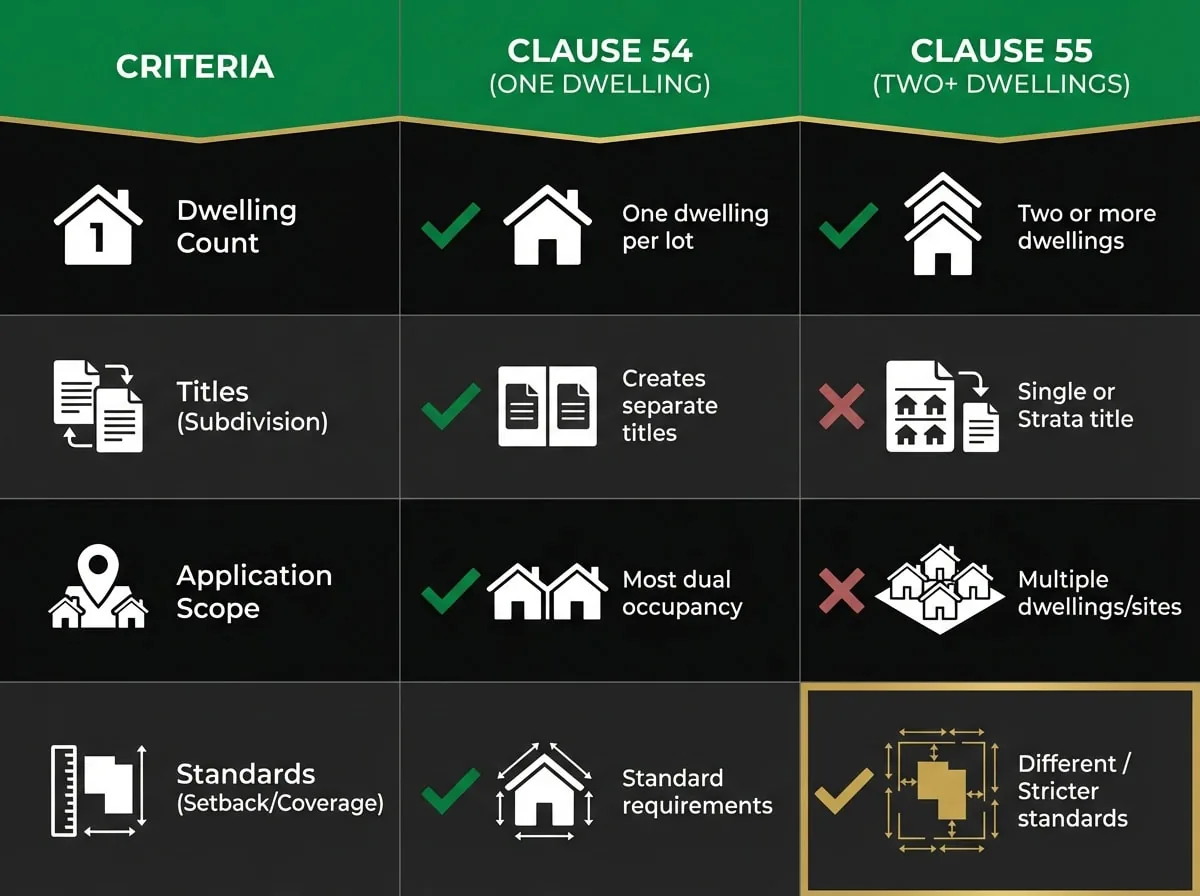
Clause 54 applies to one dwelling on a lot—typically relevant for dual occupancy developments where subdivision creates two separate titles, each with one dwelling. Following VC282 (effective 8 September 2025), Clause 54 now includes updated street setback requirements, tree canopy coverage standards, and enhanced daylight-to-existing-windows provisions. Be careful with this distinction, because it is commonly got backwards: a dual occupancy is two dwellings on a lot, so the application is assessed under Clause 55, and proposing subdivision alongside it does not move the assessment to Clause 54. Clause 54 governs where the land is already two lots and one dwelling is proposed on each.
Clause 55 applies to two or more dwellings on a lot and apartment developments. This becomes relevant for dual occupancy on a single title or where strata subdivision is contemplated. Amendment VC267 (31 March 2025) introduced deemed-to-comply pathways for certain configurations, potentially streamlining assessment for qualifying projects. On that basis most traditional dual occupancy developments in residential zones are assessed under Clause 55.
The distinction matters because each clause contains different standards for setbacks, site coverage, and amenity provisions. City of Whitehorse and Manningham City Council, for example, apply strict interpretation of which clause governs, impacting everything from minimum garden area to car parking requirements. Confirming the applicable clause with your architect before commencing design prevents costly redesign later.
Site Coverage and Permeability Requirements
Site coverage limitations represent one of the most fundamental constraints on dual occupancy feasibility. ResCode establishes maximum site coverage percentages that vary by zone, with additional permeability requirements to manage stormwater and maintain neighbourhood character.
Standard Site Coverage Limits — set by zone under Table B2-5, not by lot size:
- Neighbourhood Residential Zone and Township Zone: 60%
- General Residential Zone: 65%
- Residential Growth Zone, Mixed Use Zone and Housing Choice and Transport Zone: 70%
A schedule to the zone may specify a greater percentage than the table, but never a lesser one. Site coverage has never been tiered by lot area — where a project feels more constrained on a larger lot, that is the minimum garden area requirement at Clause 32.08-4 or 32.09-4 biting, which is tiered (25% at 400–500m², 30% above 500 and up to 650m², 35% above 650m²).
Site coverage includes all buildings, covered decks, and roofed structures but excludes eaves up to 600mm, unroofed terraces at ground level, and basement car parking where the roof is less than 1 metre above natural ground level. This calculation becomes critical when maximising built form—many developers initially overlook covered entry porches or bin store roofs in preliminary feasibility assessments.
Permeability requirements for a dual occupancy sit at Clause 55.05-1, Standard B5-1 (Permeability and stormwater management). The standard requires that pervious surfaces cover at least 20% of the site, and that the development include a stormwater management system meeting the best practice objectives in EPA Publication 1739.1, though City of Monash and Knox City Council frequently apply 25% through local schedules. Permeable surfaces include garden beds, lawn areas, and permeable paving systems that meet specific infiltration rates.
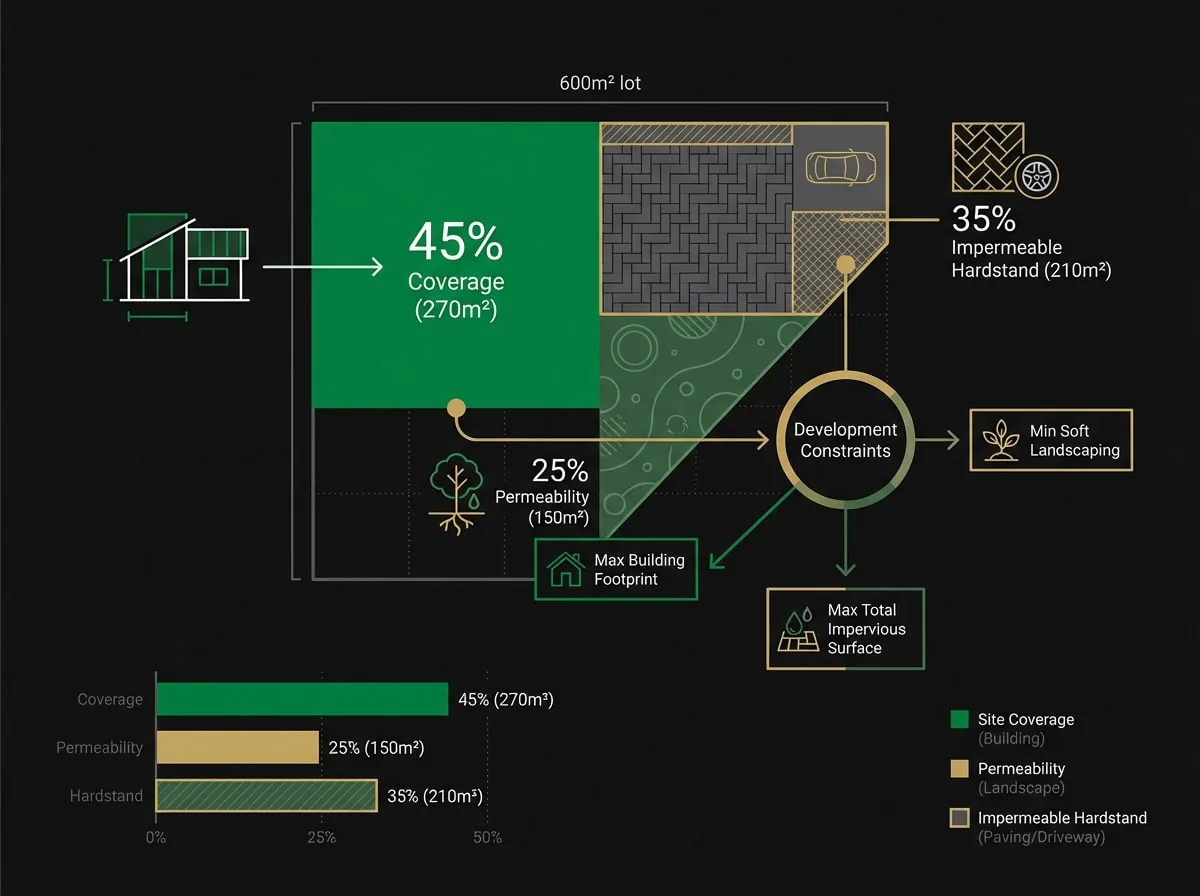
The interaction between site coverage and permeability creates a practical constraint: on a 600m² lot in the General Residential Zone, the 65% cap allows 390m² of buildings while Standard B5-1 reserves at least 20% (120m²) as pervious surface, leaving only 90m² (15%) for impermeable hardstand including driveways, paths, and paved courtyards. In practice the 30% minimum garden area at Clause 32.08-4 (180m² on that lot) usually binds before the coverage cap does. This calculation directly impacts car parking layouts and private open space design. SQM Architects typically models these constraints during initial site assessment to confirm dual occupancy feasibility before clients commit to purchase.
Get the 7-point site check to run before committing to a permit application — zoning, overlays, setbacks and council red flags, in plain English. Free PDF, instant download.
- Zone, overlay & setback checks
- What council assesses first
- Permit-readiness red flags
Something went wrong. Please try again.
No spam. Unsubscribe anytime.
Check your inbox — your checklist is on its way.
Setback Standards: Street, Side, and Rear
Setback requirements under ResCode balance development intensity with neighbourhood amenity, with specific standards varying by street frontage, boundary orientation, and building height. Recent VC282 amendments introduced more prescriptive street setback requirements that now include minimum landscaping zones.
Street Setbacks
Standard street setbacks for dual occupancy developments typically range from 6 to 9 metres, depending on the prevailing neighbourhood character and council-specific schedules. City of Whitehorse generally requires 7.6 metres in established residential areas, whilst Manningham City Council may specify up to 9 metres in low-density character zones. The setback is measured from the property boundary to the building facade, excluding eaves, porches, and architectural features projecting less than 1 metre.
VC282 now requires that at least 50% of the street setback area must be soft landscaping capable of supporting canopy tree growth. This provision specifically targets developments that previously maximised driveway hardstand within front setbacks. For dual occupancy with side-by-side configuration requiring two driveway crossovers, this creates a design challenge—typically resolved through shared driveway access or tandem parking arrangements that preserve landscaping area.
Side and Rear Setbacks
Side boundary setbacks follow a tiered approach based on wall height and length:
- Route B2-3.1 (the calculation): at least 1 metre, plus 0.3 metres for every metre of wall height over 3.6 metres up to 6.9 metres, plus 1 metre for every metre over 6.9 metres. A 6.9-metre wall therefore needs 1.99 metres, and a 9-metre wall 4.09 metres — the increment is continuous, not a step to a fixed figure
- Route B2-3.2 (the flat alternative): at least 3 metres up to 11 metres in height where the boundary is not to the south, 4.5 metres above 11 metres; or 6 metres up to 11 metres where the boundary is to the south (between south 30 degrees west and south 30 degrees east), 9 metres above 11 metres
- Standard B2-3 is met by either route — the ordinance says so expressly, “rather than needing to comply with both”. On that 9-metre wall, B2-3.2 gives 3 metres against B2-3.1's 4.09 metres on a non-south boundary
- Wall length on a boundary is governed separately by Standard B2-4; the 0.3 metres per metre increment in B2-3 applies to wall height over 3.6 metres, not to length
Clause 55 sets no separate rear-setback minimum — Standard B2-3 applies the same formula to side and rear boundaries, so a 3.6-metre wall needs 1 metre and a 6.9-metre wall needs 1.99 metres, with the B2-3.2 flat alternative available instead. The rear setback serves multiple functions: providing visual separation, enabling deep soil planting, and protecting solar access to adjoining properties. Developments proposing reduced rear setbacks must demonstrate compliance with overshadowing and overlooking provisions—a common point of objection from neighbouring properties.
On corner lots, dual occupancy developments face additional complexity as both street frontages require compliance with street setback standards. This effectively creates two “front” setbacks, significantly constraining buildable area. Maroondah City Council has specific corner lot provisions that may allow reduced secondary street setbacks where the lot configuration would otherwise prevent reasonable development.
Private Open Space and Garden Area
ResCode mandates minimum private open space for each dwelling to ensure residential amenity, with additional garden area requirements introduced to maintain neighbourhood vegetation and character. These provisions directly impact dual occupancy layouts, particularly on constrained sites.
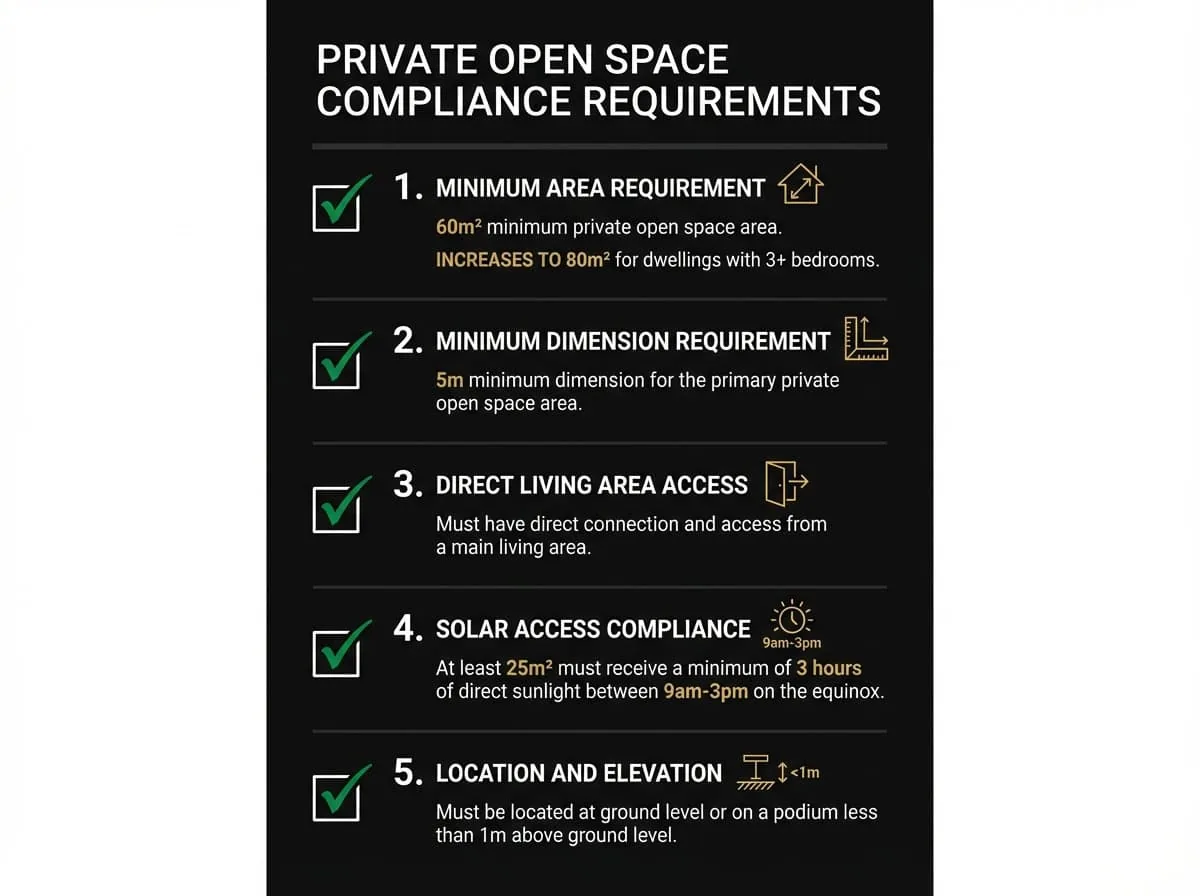
Private Open Space Standards:
- Minimum 60m² per dwelling (80m² for dwellings with 3+ bedrooms in some council areas)
- Minimum dimension of 3 metres width under Standard B3-5 — the 25m² area, not the width, is normally the binding constraint
- Direct access from a living area (kitchen, dining, or living room)
- Minimum 25m² must receive at least 3 hours of sunlight between 9am-3pm on 22 September (equinox)
- Located at ground level or on a podium less than 1 metre above natural ground level
The solar access requirement frequently constrains south-facing private open space areas. On east-west oriented lots, positioning private open space on the northern side of each dwelling ensures compliance, but this may conflict with vehicle access requirements. SQM Architects typically resolves this through careful unit orientation—placing living areas and private open space to the north, with garages and service areas to the south.
Garden Area Requirements under Clause 54 specify minimum deep soil zones capable of supporting canopy tree growth. Standard requirements mandate garden area equal to at least 25% of the site area, with minimum dimensions of 4 metres in one direction. City of Whitehorse and City of Boroondara apply these standards strictly, requiring landscape plans demonstrating canopy tree planting (minimum 8-metre mature height) within garden areas.
The practical challenge: garden area must be permeable, cannot include buildings or impermeable paving, and must be consolidated rather than fragmented. On a 600m² lot requiring 150m² garden area (25%), this represents substantial land that cannot accommodate buildings, driveways, or paved courtyards. Front setback landscaping, side setbacks with deep soil planting, and rear yard areas typically combine to meet this requirement, but careful site planning is essential from the outset.
Overlooking, Overshadowing, and Visual Bulk
Amenity protection provisions under ResCode aim to minimise impacts on neighbouring properties—the most common source of planning objections for dual occupancy developments. Understanding these requirements enables proactive design responses that address concerns before they derail applications.
Overlooking and Privacy
Windows, balconies, and terraces with views into habitable room windows or private open space of adjoining properties within 9 metres (measured horizontally) must incorporate privacy screening. Acceptable solutions include:
- Sill heights minimum 1.7 metres above floor level for windows
- Fixed obscure glazing in lower panels with clear glazing above 1.7 metres
- Permanent privacy screens with maximum 25% openings, extending 1.7 metres above floor level
- Recessed balconies with solid or screened side panels preventing oblique views
First-floor windows facing side boundaries represent the most common overlooking concern. Standard responses include highlight windows (sill heights 1.7m+) for bathrooms and secondary bedrooms, with primary bedroom and living area windows oriented toward street frontages or rear yards. City of Monash has specific requirements for corner lots where upper-floor windows face secondary street frontages—typically requiring screening despite the public nature of the street.
Overshadowing Standards
ResCode limits overshadowing of adjoining properties’ private open space and solar panels. The standard requires that shadows cast by buildings must not reduce sunlight to neighbouring private open space below 3 hours between 9am-3pm on 22 September, or reduce existing sunlight by more than 20% where less than 3 hours currently exists.
Two-storey dual occupancy developments on north-south oriented lots create the greatest overshadowing risk to southern neighbours. Shadow diagrams at 9am, 12pm, and 3pm on the equinox demonstrate compliance—or identify where variations are required. Manningham City Council and City of Boroondara closely scrutinise overshadowing impacts in heritage areas where existing vegetation and garden character are priorities.
Solar panel overshadowing provisions, introduced in recent amendments, protect existing solar installations on neighbouring properties. Standard B5-2 works as a setback rule rather than a shadow prohibition. Any part of a new building that would reduce sunlight to an existing domestic solar energy system on an adjoining roof at any time between 9am and 4pm on 22 September must be set back from that boundary by at least 1 metre at 3.6 metres above ground level, plus 0.3 metres for every metre of building height over 3.6 metres up to 6.9 metres, plus 1 metre for every metre over 6.9 metres. Note the assessment date is 22 September, not the winter solstice, and the window runs to 4pm rather than 3pm — an hour longer than the overshadowing test in B4-3. This provision can constrain building height and setbacks on sites with solar-equipped neighbours.
Visual Bulk and Building Height
Wall height and length provisions manage visual bulk impacts on neighbouring properties. Standard B2-4 governs walls built on or within 200mm of a side or rear boundary: the wall may abut the boundary for the greater of 10 metres plus 25 per cent of the remaining length of the adjoining lot’s boundary, or the length of existing or simultaneously constructed walls already abutting on the abutting lot. Its height must not exceed an average of 3.2 metres, with no part above 3.6 metres, unless it abuts a higher existing or simultaneously constructed wall. Articulation of longer walls is a design response councils commonly ask for, not a numerical requirement of the standard.
Overall building height limits vary by council but typically range from 9 to 11 metres in residential zones. City of Whitehorse applies 9-metre height limits in Neighbourhood Residential Zones, whilst City of Boroondara may permit 10 metres in General Residential Zones. Height is measured from natural ground level to the highest point of the roof, excluding chimneys and minor architectural features.
Car Parking, Access, and Services
Vehicle accommodation requirements under ResCode and council-specific planning schemes significantly impact dual occupancy site layout. Inadequate car parking provision remains a common reason for planning permit refusal or VCAT appeals.
Standard Car Parking Rates:
- 1-2 bedroom dwellings: 1 space per dwelling
- 3+ bedroom dwellings: 2 spaces per dwelling
- Visitor parking: 1 space per 5 dwellings (typically not required for dual occupancy)
City of Whitehorse and Manningham City Council apply these rates strictly, with limited scope for reduction even where public transport accessibility is high. Each car space must meet minimum dimensions of 5.4m x 2.6m (or 6.0m x 3.0m for accessible spaces), with additional clearance for door opening and vehicle manoeuvring.
Driveway access and crossover requirements vary by council but generally require minimum 3-metre width for single driveways and 5.5 metres for double driveways. Shared driveway access serving both dwellings may be permitted where site width constraints prevent two separate crossovers, though this requires easement arrangements and may complicate future subdivision. Knox City Council has specific shared driveway standards requiring minimum 3.5-metre width and passing bays where driveway length exceeds 30 metres.
Services and Waste Management: Each dwelling requires dedicated bin storage areas with minimum 6m² capacity, screened from street view and accessible for collection. Stormwater detention systems may be required where site permeability is reduced—particularly relevant in City of Monash and Maroondah City Council areas with specific water-sensitive urban design requirements. Detention tanks typically require 2-4m³ capacity for dual occupancy developments, located underground or within side setbacks.
Council-Specific Variations and Local Schedules
Whilst ResCode provides the baseline framework, each council in Melbourne applies local variations through planning scheme schedules. Understanding these council-specific requirements prevents costly design revisions after lodgement.
City of Whitehorse applies stringent neighbourhood character provisions in established residential areas, often requiring 40% site coverage limits and 9-metre street setbacks in Garden Suburban precincts. The council’s Design and Development Overlay (DDO) schedules specify additional requirements for building materials, roof forms, and front fence heights that impact dual occupancy design.
City of Boroondara has extensive heritage overlay coverage affecting dual occupancy feasibility in suburbs like Kew, Camberwell, and Hawthorn. Heritage requirements may mandate specific architectural styles, material palettes, and building setbacks that override standard ResCode provisions. Dual occupancy in heritage areas typically requires heritage impact assessment and may face additional design review.
Manningham City Council applies minimum lot size requirements for dual occupancy—typically 650m² in Neighbourhood Residential Zones and 800m² in areas with specific character overlays. The council’s vegetation protection provisions require permits for tree removal and mandate replacement planting, impacting site layout where existing canopy trees are present.
City of Monash has specific requirements for front fence heights (maximum 1.2 metres for solid fences, 1.8 metres for visually permeable fences) and mandates water-sensitive urban design features including rainwater tanks (minimum 2,000 litres per dwelling) and permeable paving for driveways.
Knox City Council applies additional car parking requirements in areas with limited public transport access and has specific landscaping requirements mandating minimum canopy tree planting (one tree per 100m² of site area). The council’s bushfire management overlay affects dual occupancy in areas bordering bushland reserves.
Maroondah City Council has detailed neighbourhood character guidelines that influence dual occupancy design, particularly regarding building materials, roof pitch, and front setback landscaping. The council encourages contemporary interpretations of traditional residential forms rather than strict replication.
Practical Compliance Strategies for Developers
Achieving ResCode compliance whilst maximising development potential requires strategic design decisions from the earliest feasibility stage. SQM Architects has refined these approaches across 210+ projects, identifying patterns that consistently achieve planning approval.
Site Selection Criteria: Prioritise lots with minimum 15-metre frontage and 600m² area in General Residential Zones. North-south orientation enables optimal solar access to private open space and minimises overshadowing impacts. Corner lots offer design flexibility but require compliance with dual street setback requirements. Avoid sites with significant vegetation protection overlays unless prepared for extended approval timeframes and potential tree retention constraints.
Early Council Engagement: Pre-application meetings with council planners identify site-specific constraints and local policy priorities before committing to design. City of Whitehorse and City of Boroondara offer formal pre-application advice services (fees typically $500-800) that provide written feedback on preliminary concepts. This investment prevents costly redesign and signals professional approach to council officers.
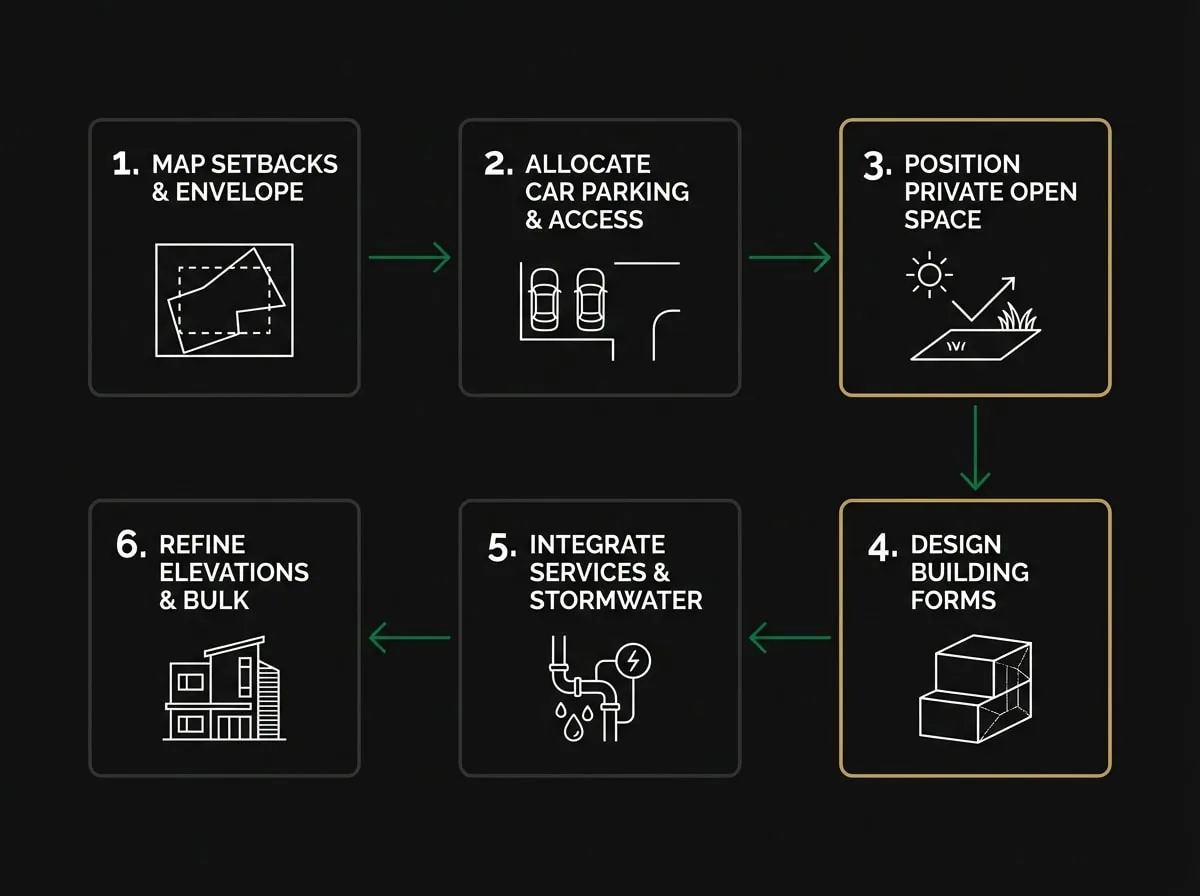
Design Optimisation Sequence:
- Map all setback requirements and calculate maximum building envelope
- Allocate car parking and vehicle access, ensuring compliance with driveway grades and sight lines
- Position private open space to achieve solar access requirements (north-facing where possible)
- Design building forms within remaining envelope, prioritising upper-floor setbacks to minimise overlooking
- Integrate services, bin storage, and stormwater management within side setbacks
- Refine elevations to address visual bulk through articulation and material variation
This sequence ensures compliance requirements drive design decisions rather than retrofitting compliance into predetermined layouts—a common cause of planning permit refusal.
Documentation Standards: Planning permit applications require comprehensive documentation demonstrating ResCode compliance. Essential plans include site analysis showing existing conditions, proposed site plan with setback dimensions, floor plans with room labels and areas, elevations from all sides, shadow diagrams, and landscape plan with plant schedule. SQM Architects includes compliance tables cross-referencing each ResCode provision with supporting documentation—this structured approach reduces requests for further information and accelerates assessment.
Common Pitfalls and How to Avoid Them
Despite careful planning, certain ResCode compliance issues recur across dual occupancy applications. Recognising these patterns enables proactive mitigation.
Inadequate Garden Area: Developers frequently underestimate the 25% garden area requirement, discovering late in design that driveways, paved courtyards, and building footprints consume available space. Solution: Calculate garden area requirement during initial feasibility (site area x 0.25) and map potential garden zones before designing buildings. Front setback landscaping, consolidated side setbacks, and rear yard areas must combine to meet the total requirement.
Overlooking from Upper-Floor Bathrooms: Bathroom windows facing side boundaries within 9 metres trigger overlooking provisions, even though bathrooms aren’t habitable rooms. Many applications propose obscure glazing without considering ventilation requirements under the Building Code. Solution: Specify fixed obscure glazing with highlight openable panels above 1.7 metres, or use louvre windows with fixed obscure blades.
Insufficient Private Open Space Dimensions: Providing 60m² private open space is straightforward, but ensuring minimum 5-metre dimension whilst maintaining solar access proves challenging on constrained sites. L-shaped or fragmented open space areas fail to meet the standard. Solution: Design consolidated rectangular open space areas (typically 5m x 12m or 6m x 10m) directly accessible from living areas, positioned to receive northern sun.
Driveway Grade Non-Compliance: Sloping sites may require steep driveways that exceed maximum 1:4 (25%) grade or fail to provide compliant transitions at the street boundary. This triggers referral to council’s engineering department and potential redesign. Solution: Commission detailed site survey including cross-sections before finalising driveway layout. Where grades exceed limits, consider split-level garages or alternative access arrangements.
Inadequate Waste Management: Bin storage areas squeezed into side setbacks may not meet minimum 6m² requirement or lack weather protection. Collection access becomes problematic where bins must traverse through garages or narrow side paths. Solution: Allocate dedicated bin storage zones during initial site planning, ensuring direct access to street frontage and minimum 1.5-metre path width for bin movement.
Frequently Asked Questions
What is the minimum lot size for dual occupancy in Melbourne?
Minimum lot size varies by council and zone. City of Whitehorse typically requires 500m² in General Residential Zone, whilst Manningham City Council mandates 650m² in Neighbourhood Residential Zone. City of Boroondara has no specific minimum but practical compliance with ResCode setbacks, site coverage, and garden area requirements generally necessitates 550-600m² minimum. Always verify council-specific requirements through planning scheme schedules before purchasing.
Can I reduce car parking requirements if the site is near public transport?
Unlike apartment developments, dual occupancy projects rarely qualify for car parking reductions in Melbourne councils. City of Whitehorse, Manningham, and Boroondara apply standard rates (1 space per 1-2 bedroom dwelling, 2 spaces per 3+ bedroom dwelling) regardless of public transport proximity. Knox City Council may consider reductions within 400 metres of railway stations, but this requires formal variation request with supporting traffic assessment.
How do I demonstrate compliance with overshadowing requirements?
Shadow diagrams showing building shadows at 9am, 12pm, and 3pm on 22 September (equinox) are required. These must illustrate existing shadows and proposed shadows, with neighbouring private open space clearly marked. Diagrams must demonstrate that neighbouring properties retain at least 3 hours of sunlight to private open space, or that existing sunlight is not reduced by more than 20%. Professional shadow analysis software ensures accuracy—hand-drawn diagrams are generally unacceptable to councils.
What happens if my dual occupancy design doesn’t meet all ResCode standards?
ResCode operates on a performance-based system—standards are preferred solutions, but alternative solutions may be accepted if they achieve the underlying objective. Applications must specifically identify variations, explain why the standard cannot be met, and demonstrate how the alternative solution achieves the objective. However, variations increase assessment complexity and objection risk. City of Boroondara and Manningham City Council are particularly stringent on variations, often requiring additional justification through urban design reports.
Do I need a landscape plan for dual occupancy planning permits?
Yes, landscape plans are mandatory for dual occupancy applications across all Melbourne councils. Plans must show existing vegetation (including trees to be removed and retained), proposed planting with botanical names and mature sizes, garden bed areas, permeable and impermeable surfaces, and irrigation systems. City of Whitehorse requires landscape plans prepared by qualified landscape designers for developments removing significant trees. Plans must demonstrate compliance with garden area requirements and canopy tree planting provisions introduced under VC282.
How long does dual occupancy planning permit assessment take?
Statutory assessment timeframe is 60 days from application lodgement, though this rarely reflects actual timeframes. City of Whitehorse averages 90-120 days for dual occupancy permits, City of Boroondara 120-150 days (longer in heritage areas), and Manningham City Council 90-110 days. Timeframes extend where requests for further information are issued or where objections trigger mediation. Well-documented applications with comprehensive ResCode compliance demonstration typically achieve faster assessment. SQM Architects’ 98% approval rate reflects systematic compliance documentation that minimises delays.
Can I subdivide before obtaining planning permit approval?
No, subdivision cannot proceed before planning permit approval. The planning permit for dual occupancy development typically includes subdivision approval as a concurrent application. Once the planning permit is granted and dwellings are constructed, a Statement of Compliance is issued by a licensed surveyor confirming the subdivision complies with approved plans. Only then can titles be registered. Attempting to subdivide before permit approval will be rejected by the Responsible Authority and may complicate future development applications.
Positioning Your Dual Occupancy for Approval Success
ResCode compliance for dual occupancy developments demands systematic attention to site coverage, setbacks, private open space, amenity protection, and council-specific variations. The framework is detailed but navigable—developers who address requirements proactively during design rather than reactively during assessment achieve superior outcomes with fewer delays and variations.
The recent VC282 and VC267 amendments have introduced additional complexity around street setback landscaping and deemed-to-comply pathways, making current regulatory knowledge essential. Working with architects experienced in Melbourne planning schemes ensures your dual occupancy design responds to both ResCode standards and local policy priorities from the outset. SQM Architects’ 67% repeat client rate reflects the value developers place on reliable compliance guidance that translates directly to planning approval and project feasibility.
For developers evaluating dual occupancy opportunities, the compliance checklist outlined here provides the foundation for informed site selection and preliminary feasibility assessment. However, site-specific constraints—existing vegetation, easements, heritage overlays, and neighbouring development patterns—require detailed analysis before committing to purchase or design.
Book a Strategy Call: SQM Architects offers complimentary dual occupancy feasibility assessments for Melbourne developers. Our team reviews your site against ResCode requirements, identifies compliance challenges, and outlines design strategies to maximise development potential. Call (03) 9005 6588 or visit our office to discuss your project with architects who have delivered 210+ projects across Whitehorse, Boroondara, Manningham, Monash, Knox, and Maroondah.
This article provides general information about Victorian planning for property developers. It does not constitute professional advice. For specific guidance on your project, contact SQM Architects (ARBV Reg. No. 51498) for a complimentary site assessment.