Private open space requirements are among the most consequential planning standards affecting development yield in Melbourne’s Eastern Suburbs. Getting them wrong can cost buildable area. Getting them right may support compliant, marketable dwellings that could move through the approval process more efficiently. With Victoria’s planning system undergoing its most significant overhaul in decades — including the replacement of the original ResCode with the Townhouse and Low-Rise Code (Clause 55) in March 2025 and the updated Clause 54 in September 2025 — understanding Standard B28 and its current equivalents is essential for any developer active in the region.
This article outlines the current private open space requirements under Victoria’s reformed residential planning provisions, explains how the 2025–26 reforms have changed the landscape for multi-dwelling and single-dwelling projects, and identifies the practical implications for development feasibility across councils including City of Whitehorse, City of Boroondara, Manningham City Council, City of Monash, Knox City Council, and Maroondah City Council.
SQM Architects has delivered 210+ projects across Melbourne’s Eastern Suburbs over 15+ years, with extensive experience navigating planning permit approvals across the region. The information below draws on that experience alongside the latest regulatory changes to help developers make informed decisions about site planning and dwelling design.
What Is Standard B28 and How Has It Changed?
Standard B28 was the private open space provision under the original ResCode (Clause 55), which applied to multi-dwelling developments. Under the pre-March 2025 framework, a dwelling in a multi-dwelling development was required to have a minimum of 40 square metres of private open space, with at least one part consisting of secluded private open space (SPOS) of 25 square metres with a minimum dimension of 3 metres, accessible from a living room.

For a single dwelling on a lot (governed by Clause 54 / Standard A17), the requirement was more demanding: 80 square metres of private open space, or 20% of the lot area — whichever was lesser — but not less than 40 square metres, with 25 square metres of SPOS at the side or rear of the dwelling.
These standards have now been substantially reformed. On 6 March 2025, Amendment VC267 replaced the original Clause 55 ResCode provisions with the Townhouse and Low-Rise Code. Then, on 8 September 2025, Amendment VC282 introduced a reformed Clause 54 for single dwellings and small second dwellings on lots under 300 square metres. Together, these amendments represent the most significant restructuring of residential planning standards in Victoria in over two decades.
Current Private Open Space Standards: Clause 55 (Multi-Dwelling)
Under the Townhouse and Low-Rise Code (Clause 55), which applies to two or more dwellings on a lot and residential buildings up to three storeys, the private open space requirement has been reduced and restructured. The new standard moves away from the previous 40 square metre minimum and introduces a more flexible, performance-based approach.
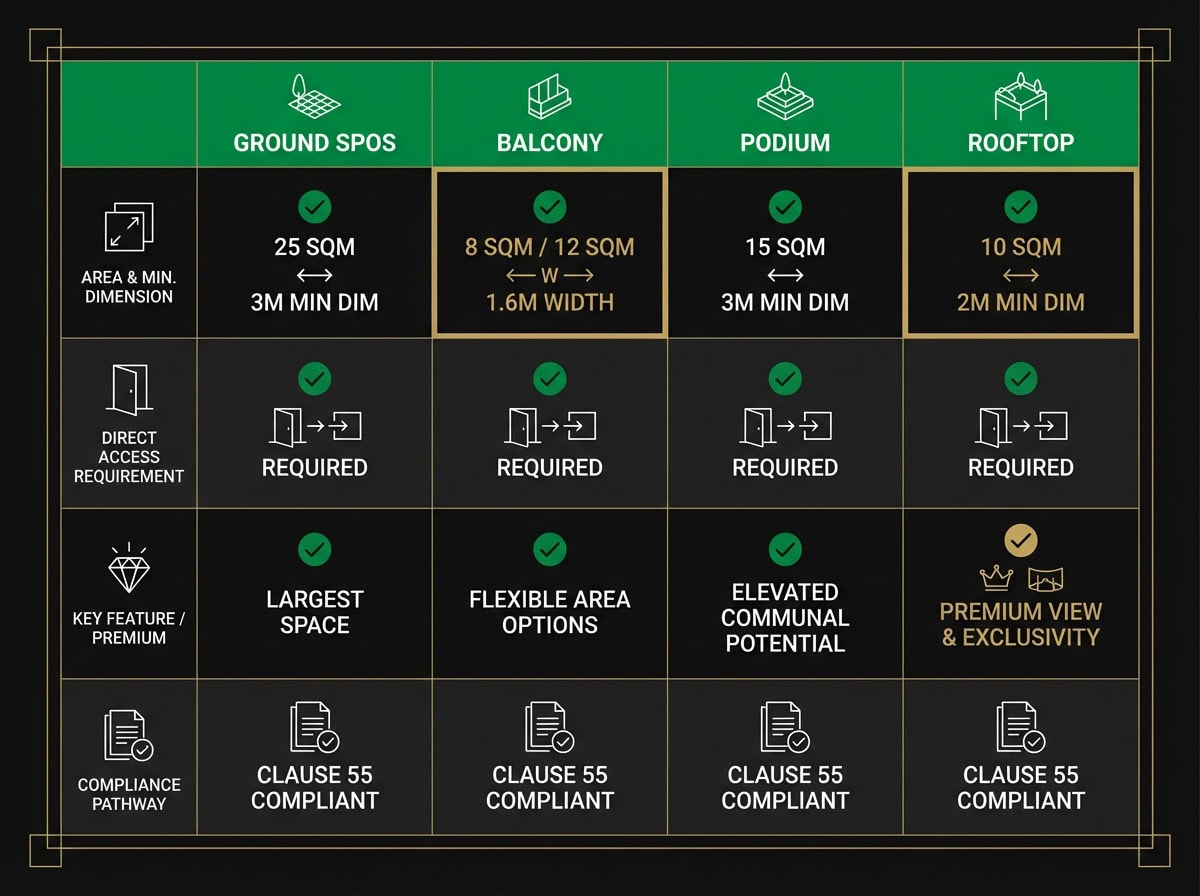
The current Clause 55 private open space standard requires a dwelling to provide one of the following options:
- Ground-level secluded private open space: A minimum area of 25 square metres with a minimum dimension of 3 metres, with direct access from a living area, dining area, or kitchen.
- Balcony: Either 8 square metres (with minimum width of 1.6 metres) or 12 square metres depending on dwelling type and size, with direct access from a living area, dining area, or kitchen.
- Podium or similar area: At least 15 square metres with a minimum dimension of 3 metres, with direct access from a living area, dining area, or kitchen.
- Rooftop area: At least 10 square metres with a minimum dimension of 2 metres, with direct access from a living area, dining area, or kitchen.
The reduction from 40 square metres to 25 square metres at ground level is a meaningful change for developers. On a typical Eastern Suburbs townhouse site, this may free up several square metres per dwelling — potentially enabling an additional dwelling on constrained lots, or allowing more generous internal floor plans without compromising compliance.
Critically, the new Clause 55 framework introduces a deemed to comply pathway. Where a development meets all applicable standards — including private open space — objectors cannot appeal to VCAT on those matters, and the responsible authority cannot assess the proposal against neighbourhood character objectives. This significantly reduces approval risk and timeline uncertainty for compliant projects. For more on navigating the planning permit process, see our dedicated guide.
Current Private Open Space Standards: Clause 54 (Single Dwelling and Small Second Dwellings)
Amendment VC282, effective 8 September 2025, reformed Clause 54 to align more closely with the Clause 55 framework. The updated Standard A3-2 (Private Open Space) now requires:
- Private open space of 20% of the area of the lot, but not less than 25 square metres, with a minimum dimension of 3 metres.
- At least one part must consist of secluded private open space of 25 square metres with a minimum dimension of 3 metres.
- Alternative compliance through a balcony or rooftop area is now permitted.
- For small second dwellings (SSDs): 8 square metres of private open space is retained.
This represents a significant reduction from the previous 80 square metre requirement for single dwellings. For lots under 300 square metres — the threshold for the new Clause 54 to apply — the 20% rule means a 250 square metre lot may only need 50 square metres of private open space, with 25 square metres of that being secluded. Balcony and rooftop alternatives further expand design flexibility.
Importantly, local variations to private open space standards under Clause 54 are now restricted. Councils can only apply local variations where they are more permissive than the state standard — meaning councils can no longer impose more onerous private open space requirements on lots under 300 square metres than the state baseline.
What Counts as Private Open Space? Key Definitions
Understanding what qualifies as private open space — and what does not — is critical to compliance. The following principles apply under the current framework:
- Secluded private open space (SPOS) must be located at the side or rear of the dwelling (for ground-level provision), have a minimum dimension of 3 metres, and be directly accessible from a living area, dining area, or kitchen.
- Balconies must meet minimum area and width requirements and be directly accessible from a living area, dining area, or kitchen — not a bedroom or corridor.
- Rooftop areas must meet minimum area and dimension requirements and have direct access from a living area, dining area, or kitchen.
- Driveways, carports, and service areas do not count toward private open space calculations.
- Front yards may count toward total private open space area in some configurations, but the secluded component must still meet the side or rear requirement for ground-level SPOS.
The 25 square metres of SPOS is included within — not in addition to — the total private open space area. This is a point of frequent confusion in planning permit applications. Developers and their design teams should ensure documentation clearly demonstrates how the SPOS component is calculated as part of the overall private open space provision. These spatial requirements also interact with building setback standards, which determine how much of the site perimeter is available for open space placement.
The Garden Area Requirement: A Separate but Related Constraint
Private open space requirements under B28/Clause 55 are distinct from the Minimum Garden Area (MGA) requirement, which remains unchanged under the 2025 reforms. For lots over 650 square metres, 35% of the site must be set aside as garden area — uncovered, open, and unencumbered by buildings, driveways, decks, or services.
For lots over 1,000 square metres, tree canopy requirements add a further layer of constraint. Under Clause 55, developments on sites over 1,000 square metres may need to demonstrate 20% canopy cover at maturity. This can materially affect site layout, driveway placement, and the number of dwellings achievable on larger Eastern Suburbs sites. These constraints interact closely with overshadowing standards and overlooking regulations, both of which should be assessed concurrently during feasibility.
Developers should be aware that the garden area and tree canopy requirements can interact with private open space planning in ways that reduce overall site efficiency. A site that appears to comfortably meet the 25 square metre SPOS requirement may still be constrained by garden area or canopy obligations that limit where buildings, driveways, and open space can be located. Early feasibility analysis that addresses all three requirements simultaneously is strongly advisable.
How the 2025–26 Reforms Affect Development Feasibility
The shift from 40 square metres to 25 square metres of ground-level private open space under Clause 55 is one of the more developer-friendly changes in the 2025 reforms. For a typical three or four-townhouse development in the Eastern Suburbs, this reduction may recover 15–45 square metres of previously mandated open space per dwelling — area that could be redistributed to internal floor space, additional dwellings, or landscaping that supports tree canopy compliance.
The introduction of balcony and rooftop alternatives under both Clause 54 and Clause 55 is particularly significant for higher-density configurations. A two-bedroom apartment or upper-level townhouse dwelling that previously required 40 square metres of ground-level open space may now comply with an 8 or 12 square metre balcony — a potentially substantial improvement in buildable area efficiency.
The deemed to comply pathway under Clause 55 also changes the risk profile for developers. Where private open space and other standards are met, third-party objectors lose the right to appeal to VCAT on those matters. For projects in established Eastern Suburbs neighbourhoods where objector appeals have historically added months to approval timelines, this may represent a material reduction in approval risk.
SQM Architects has observed that the 2025 reforms, taken together, may support improved development outcomes on mid-sized infill sites — particularly in the General Residential Zone (GRZ) and Neighbourhood Residential Zone (NRZ) areas that dominate the Eastern Suburbs. However, the garden area and tree canopy requirements continue to constrain yield on larger lots, and council-specific overlays may introduce additional considerations that the state standards do not override.
Council-Specific Considerations in the Eastern Suburbs
While the 2025 reforms have reduced the scope for councils to impose more onerous private open space requirements than the state standard, zone schedules and overlays can still affect how private open space requirements apply in practice. Developers active across Melbourne’s Eastern Suburbs should be aware of the following:
- City of Whitehorse: City of Whitehorse submitted concerns about the removal of secluded private open space requirements during the consultation process, indicating a preference for stronger SPOS protections. Developers should anticipate that Whitehorse planners may scrutinise private open space quality and accessibility carefully, even where the minimum area is met.
- Maroondah City Council: Maroondah has published detailed comparisons of pre- and post-reform standards, noting that smaller boundary setbacks and private open spaces are now required in most areas. The garden area requirement remains unchanged in Maroondah.
- City of Boroondara: Boroondara’s established residential character and significant heritage overlay coverage mean that private open space planning must often be considered alongside heritage and neighbourhood character requirements that operate independently of the Clause 55 deemed to comply pathway.
- Manningham City Council, City of Monash, Knox City Council: These councils contain a mix of residential zones, with larger lot sizes in some areas triggering garden area and tree canopy requirements that interact with private open space planning. Early engagement with zone schedules is advisable.
With 15+ years of experience across all six Eastern Suburbs councils, SQM Architects can provide site-specific guidance on how zone schedules, overlays, and council planning cultures may affect private open space compliance and approval outcomes for your project.
Practical Checklist: Private Open Space Compliance Under Current Standards
The following checklist outlines the key considerations for private open space compliance under the current framework (post-September 2025). This information is indicative and should be verified against the specific zone, overlay, and site conditions applicable to your project.

- Identify whether your project is governed by Clause 54 (single dwelling or SSD on lots under 300 square metres) or Clause 55 (two or more dwellings, up to three storeys).
- Confirm the applicable zone schedule to check for any more permissive local variations to private open space standards.
- For Clause 55 projects: determine whether ground-level SPOS (25 square metres, 3 metre minimum dimension), balcony, podium, or rooftop area is the most feasible compliance pathway for each dwelling.
- Ensure SPOS is directly accessible from a living area, dining area, or kitchen — not a bedroom, laundry, or corridor.
- Confirm that the 25 square metres of SPOS is included within — not additional to — the total private open space area.
- Check whether the lot size triggers the Minimum Garden Area requirement (lots over 650 square metres) and tree canopy requirements (lots over 1,000 square metres under Clause 55).
- Assess whether any overlays (heritage, vegetation, flooding) impose additional requirements that may affect where private open space can be located.
- Verify that all applicable Clause 55 deemed to comply standards are met to access the third-party appeal exemption.
Frequently Asked Questions
What is the minimum private open space required for a townhouse under the current Clause 55?
Under the Townhouse and Low-Rise Code (Clause 55), the minimum ground-level private open space for a dwelling in a multi-dwelling development is 25 square metres with a minimum dimension of 3 metres, directly accessible from a living area, dining area, or kitchen. Balcony, podium, and rooftop alternatives may also satisfy the requirement depending on dwelling type and configuration.
Has the 40 square metre private open space requirement been removed?
Yes. The previous 40 square metre minimum for multi-dwelling developments under the original ResCode (Clause 55 / Standard B28) was replaced when Amendment VC267 introduced the Townhouse and Low-Rise Code on 6 March 2025. The current ground-level minimum is 25 square metres of secluded private open space per dwelling.
Can a balcony satisfy the private open space requirement?
Yes, under both the current Clause 54 and Clause 55 frameworks, a balcony may satisfy the private open space requirement. Under Clause 55, the minimum balcony area is 8 or 12 square metres depending on dwelling type, with direct access from a living area, dining area, or kitchen. Rooftop areas of at least 10 square metres with a minimum dimension of 2 metres are also an accepted alternative.
Does the private open space need to be at the rear of the dwelling?
For ground-level secluded private open space under Clause 55, the requirement is that it be directly accessible from a living area, dining area, or kitchen. The current framework is less prescriptive about rear-only location than the previous ResCode, though the secluded nature of the space remains a requirement. Under the previous Clause 54 standard, SPOS was required at the side or rear — the updated Clause 54 (post-September 2025) retains the 25 square metre SPOS requirement but allows balcony and rooftop alternatives.
Can councils impose stricter private open space requirements than the state standard?
Under the post-2025 framework, councils can only apply local variations to private open space standards where those variations are more permissive than the state standard. Councils can no longer impose more onerous private open space requirements through zone schedules for applications governed by the new Clause 54 or Clause 55 provisions. However, overlays and other planning scheme provisions may still impose additional requirements.
Is private open space the same as garden area?
No. Private open space and the Minimum Garden Area (MGA) are separate requirements. Private open space relates to usable outdoor space for residents of each dwelling. The MGA applies at the site level for lots over 650 square metres and requires 35% of the site to be set aside as uncovered, unencumbered garden area. Both requirements may apply simultaneously and should be assessed together during feasibility analysis.
What happens if a development does not meet the private open space standard?
If a development does not meet the deemed to comply private open space standard under Clause 55, it loses the benefit of the third-party appeal exemption on that standard. The responsible authority retains discretion to approve the planning permit application, but objectors may be able to seek VCAT review. Developments that do not meet applicable standards may also face longer assessment timelines and greater uncertainty. Early design review to ensure compliance is strongly advisable.
Conclusion
Victoria’s 2025–26 planning reforms have materially changed the private open space landscape for residential developers. The reduction from 40 square metres to 25 square metres under Clause 55, the introduction of balcony and rooftop alternatives, and the deemed to comply pathway together represent a more developer-friendly framework than existed under the original ResCode — particularly for infill townhouse and low-rise apartment projects in Melbourne’s Eastern Suburbs. However, the garden area requirement, tree canopy obligations, and council-specific overlay conditions continue to shape what is achievable on any given site, and the interaction between these requirements demands careful, integrated feasibility analysis from the earliest stages of a project. For a comprehensive overview of all current residential standards, see our ResCode Victoria reference guide.
SQM Architects brings 15+ years of Eastern Suburbs planning experience to every project assessment. If you are evaluating a site or preparing a planning permit application and want to understand how current private open space requirements may affect your development outcome, we encourage you to take advantage of our complimentary site assessment service.
Get Your Free Site Assessment — contact SQM Architects to discuss your project with our team. Call (03) 9005 6588 or enquire online.
This article provides general information about Victorian planning for property developers. It does not constitute professional advice. For specific guidance on your project, contact SQM Architects (ARBV Reg. No. 51498) for a complimentary site assessment.