
For years, Melbourne property developers in Melbourne faced a frustrating reality: design a townhouse project that met ResCode’s numerical street setback standard, only to have the responsible authority demand a larger setback based on vague “neighbourhood character” arguments. A council planner could invoke local policy to insist your front wall sit 10 or 12 metres from the boundary — even when Standard B2-1 of Clause 55 required nothing of the sort. That discretion cost developers months of negotiation, VCAT appeals, and redesign fees.
A note on numbering: the standard most people still call B6 was renumbered by Amendment VC267 on 31 March 2025 and is now Standard B2-1 at Clause 55.02-1, with its table renumbered Table B2-1. The old B-numbers no longer exist in the scheme. This article uses the current numbers throughout; the old ones appear only in the title and in the historical VCAT discussion below, because that is what the decisions themselves say.
That dynamic has fundamentally shifted. Following Amendment VC267 (effective 31 March 2025) and the introduction of the Townhouse and Low-Rise Code, Standard B2-1 now operates as a deemed-to-comply provision. When your development meets the numerical requirements of Standard B2-1, the street setback objective is deemed to be met — and the responsible authority is prohibited from reaching for local neighbourhood character policy to demand something more. This is not a minor procedural tweak. It is a structural change to how street setbacks are assessed across Victoria’s residential zones.
This guide explains exactly how Standard B2-1 works under the current framework, where council local policy still has teeth, how the six major Melbourne councils are responding, and what practical steps developers can take to lock in the deemed-to-comply pathway on their next project. SQM Architects has worked across Melbourne on residential development projects, and understanding this shift informs every feasibility assessment we undertake.
Understanding Standard B2-1: The Baseline Numbers
Standard B2-1 sits within Clause 55 of the Victorian planning scheme and governs street setbacks for developments of two or more dwellings on a lot. The standard operates from a simple table — Table B2-1 — that produces a required minimum setback based on the development context of your specific site.
Read More Property Development Guides
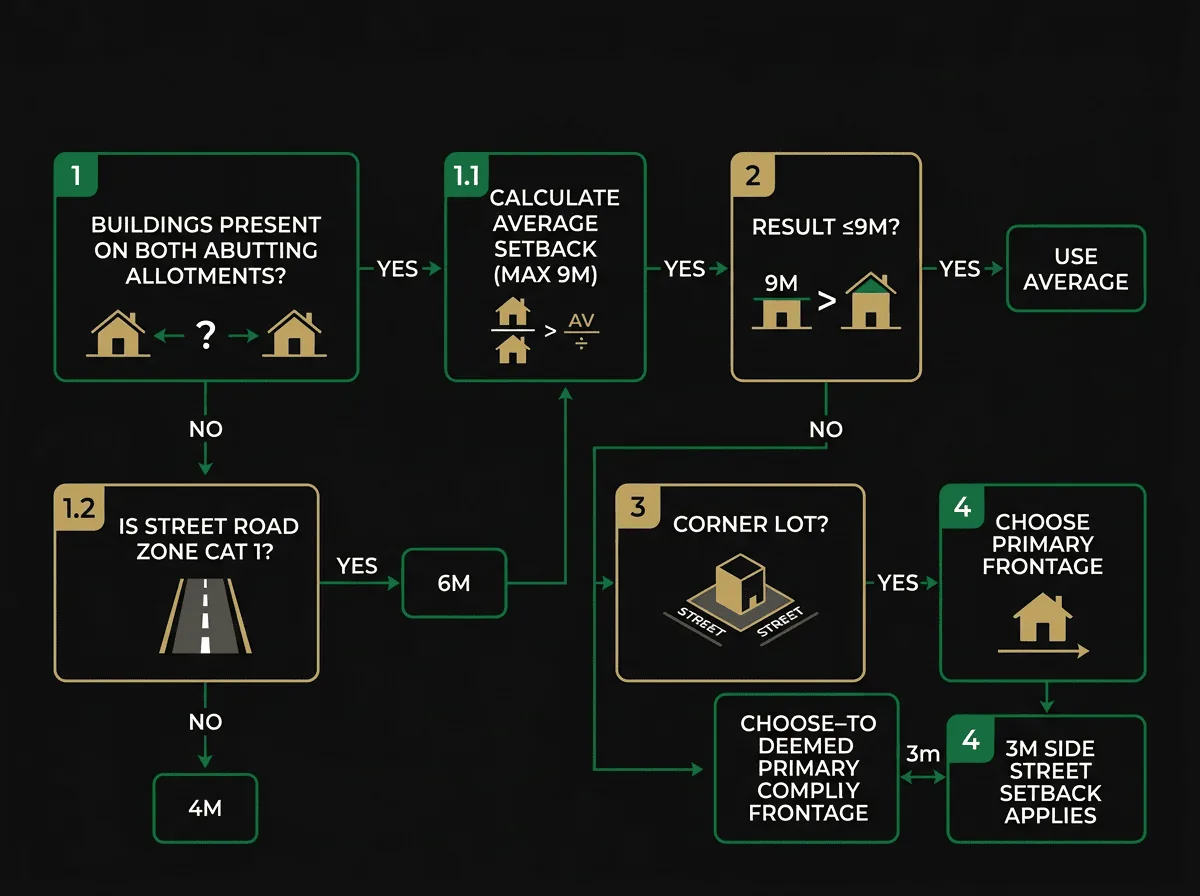
The most common scenario developers encounter is a site where existing buildings are present on both abutting allotments facing the same street. In this case, Standard B2-1 requires the front wall to be set back at least the average of the two abutting dwelling setbacks, or 9 metres — whichever is the lesser. This average-based calculation is the workhorse of the standard. If the neighbour to your left sits 6 metres from the boundary and the neighbour to your right sits 8 metres, your required setback is 7 metres — not the 9 or 10 metres a council might previously have sought through local policy.
Where no existing building is present on either abutting allotment, the standard defaults to 6 metres for streets in a Road Zone Category 1, and 4 metres for other streets. Corner lots introduce additional considerations: the developer may select either street frontage as the front setback, with the remaining frontage treated as a side street setback — requiring 3 metres for two or more dwellings under Clause 55.
One important encroachment allowance is worth noting: porches, pergolas, and verandahs less than 3.6 metres high, as well as eaves, may encroach up to 2.5 metres into the required setback. This provision can meaningfully assist in creating an articulated street presence without compromising the numerical compliance that triggers the deemed-to-comply pathway.
The Deemed-to-Comply Mechanism: How It Switches Off Local Policy
The critical change introduced by Amendment VC267 is the codification of ResCode standards. Under the Townhouse and Low-Rise Code, if a development meets Standard B2-1, two things happen simultaneously. First, the street setback objective under Clause 55.03-1 is deemed to be met. Second — and this is the provision that changes the negotiating landscape — the responsible authority is not required to consider the corresponding decision guidelines, and is exempt from considering any other policy or decision guideline in the planning scheme in relation to that standard.
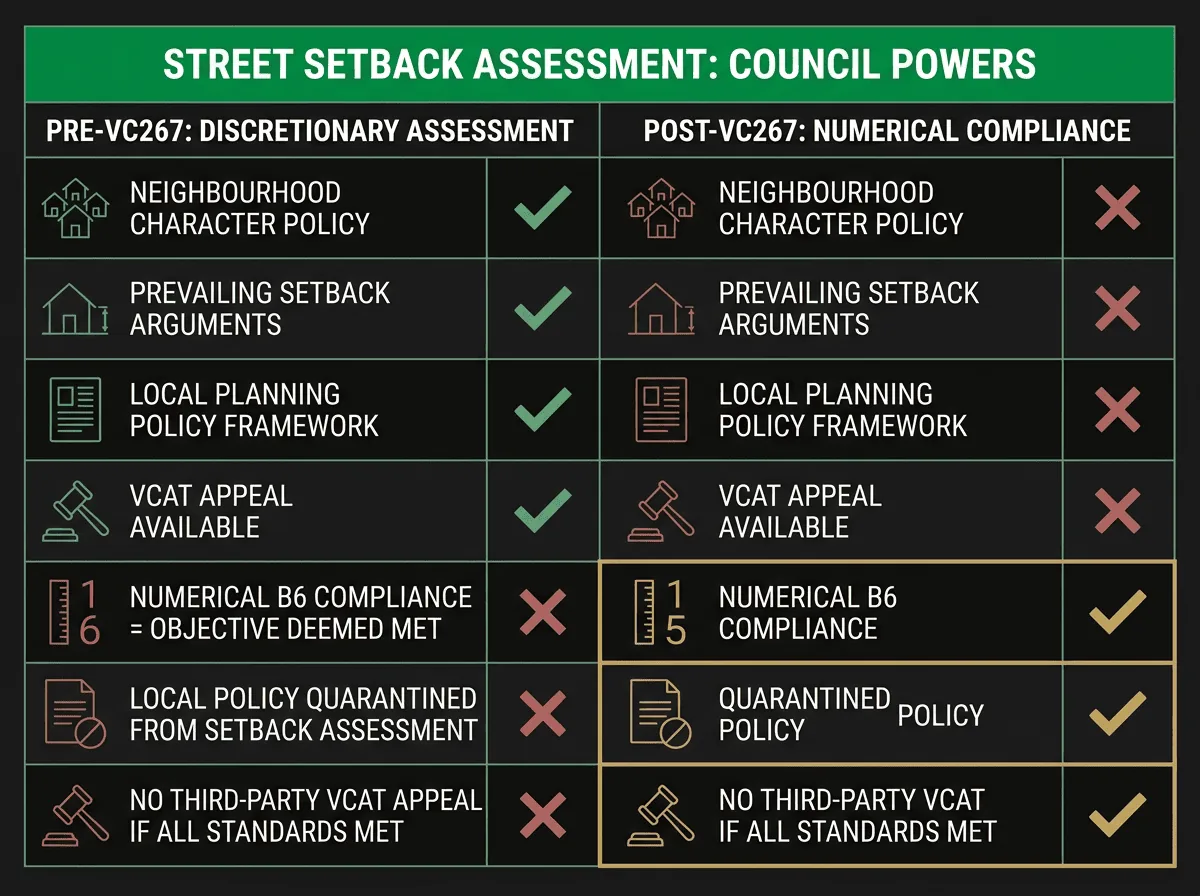
In practical terms, this means a council planner cannot reach into the local planning policy framework — including neighbourhood character policies under Clause 15.01 or council-specific character statements — to demand a larger setback once Standard B2-1 is satisfied numerically. The “rhythm of the street” argument, the “prevailing character” argument, the “garden suburb” argument — none of these can override a compliant B2-1 setback under the current framework.
This interpretation has been confirmed at VCAT. In the Forecho decision, the Tribunal held that where the numeric standard of B2-1 is met, there is no discretion to require a greater front setback by reference to neighbourhood character provisions within Clause 55, policies within the planning scheme, or even the impact on an adjacent heritage building under the then Standards B1 and B2 (neighbourhood character and residential policy, both since removed from Clause 55 by VC267). The Tribunal stated explicitly: if the objective of the standard is met, “the Tribunal does not have any ability to require a greater front setback in relation to Standard B2-1 taking into consideration any neighbourhood character provisions within clause 55, policies within the planning scheme.”
This is a significant protection for developers. It means that a well-prepared planning permit application that demonstrates clear B2-1 compliance may be less likely to be subject to setback-related conditions or refusals based on local character policy alone.
When Local Policy Still Applies: The Non-Compliance Scenario
The deemed-to-comply mechanism is powerful, but it only activates when Standard B2-1 is actually met. If your proposed development does not meet the numerical requirement — even by a small margin — the responsible authority regains full discretion to assess the application against local policy, neighbourhood character objectives, and decision guidelines.
This creates a binary outcome that developers need to understand clearly. Propose a 5-metre setback where 6 metres is required, and the council is entitled to assess that variation against every relevant policy in its planning scheme. Propose a 6-metre setback where 6 metres is required, and local policy is effectively quarantined from the setback assessment.
Local policy retains relevance in several other circumstances. Where a Neighbourhood Character Overlay (NCO) applies to the site, the overlay may impose additional requirements that operate independently of Standard B2-1. Following the 2025 reforms, councils are required to ensure these overlays include measurable criteria rather than vague descriptive text — meaning councils can no longer rely on subjective overlay language to manufacture setback requirements that the standard does not support.
Local policy also remains relevant to matters outside the scope of Standard B2-1 itself. Wall articulation, facade materials, front fence design, and landscaping within the setback zone are all matters that councils may legitimately address through local policy, even where B2-1 compliance is established. The deemed-to-comply mechanism switches off the setback quantum argument — it does not switch off all design-related considerations.
Get the 7-point site check to run before committing to a permit application — zoning, overlays, setbacks and council red flags, in plain English. Free PDF, instant download.
- Zone, overlay & setback checks
- What council assesses first
- Permit-readiness red flags
Something went wrong. Please try again.
No spam. Unsubscribe anytime.
Check your inbox — your checklist is on its way.
Council Variations Across Melbourne
While the state-wide deemed-to-comply framework has curtailed the most aggressive council interventions on setbacks, meaningful variations persist across the six Melbourne councils. Understanding these variations before commencing design may save significant time and cost.
City of Boroondara
Boroondara was historically one of the more restrictive councils in Melbourne on street setbacks, with some Neighbourhood Residential Zone schedules requiring setbacks of 9 metres or more in established precincts. Amendment VC276 systematically removed zone schedule provisions that were more restrictive than the new state-wide standards, significantly curtailing Boroondara’s ability to mandate setbacks beyond what Standard B2-1 requires. However, the council’s NCO schedules remain active in many precincts, and these may still impose measurable setback requirements. Developers should check whether an NCO applies to their specific site before assuming full B2-1 deemed-to-comply protection. The council’s neighbourhood character policies remain detailed and well-resourced — expect scrutiny on design quality matters even where setback compliance is established.
City of Whitehorse
City of Whitehorse applies its planning scheme across a range of residential character precincts, with General Residential Zone and Neighbourhood Residential Zone schedules that have historically specified setback requirements. Following VC267 and VC276, local schedule provisions that exceeded state standards have been curtailed. Whitehorse is generally considered more pragmatic in its assessment approach than Boroondara, and its planners tend to engage constructively with compliant applications. For sites in established Garden Suburban precincts, the average-based B2-1 calculation will typically produce setbacks in the 7–9 metre range, which aligns with the prevailing streetscape character in any case.
Manningham City Council
Manningham’s residential areas span a wide range of characters, from established low-density suburbs to areas earmarked for increased density near activity centres. The council’s GRZ schedules have historically accepted 6-metre setbacks in comparable areas where Boroondara might have sought 9 metres. Following the 2025 reforms, Manningham’s approach to B2-1 compliance is broadly consistent with the state framework. Developers targeting sites near the Doncaster activity centre corridor should investigate whether Housing Choice and Transport Zone provisions apply, as these may enable reduced setbacks of 3–4 metres to facilitate higher density outcomes.
City of Monash
Monash covers a diverse range of residential precincts, including areas around Oakleigh and Glen Waverley that are subject to activity centre policies. The council’s planning scheme includes DDO schedules in some precincts that may interact with Standard B2-1 assessments. As confirmed in the Forecho decision, a DDO provision that is discretionary in nature does not override Standard B2-1 compliance — though mandatory DDO requirements may operate differently. Developers in Monash should carefully review whether any applicable DDO schedule contains mandatory or discretionary setback provisions before finalising their design.
Knox City Council
Knox applies a relatively straightforward approach to residential development assessment, with its planning scheme reflecting the state-wide ResCode framework without the layers of additional local policy that characterise some inner-suburban councils. Standard B2-1 compliance in Knox is generally assessed on its numerical merits, and the deemed-to-comply pathway is accessible for well-prepared applications. The council’s areas around Boronia and Bayswater are subject to activity centre policies that may affect setback requirements for sites within or adjacent to activity centre boundaries.
Maroondah City Council
Maroondah’s residential areas are predominantly General Residential Zone, with Neighbourhood Residential Zone applying in lower-density precincts. The council’s approach to Standard B2-1 is consistent with the state framework following the 2025 reforms. Developers in Maroondah should note that the council has been active in applying tree canopy and landscaping requirements within front setback areas — matters that remain within council discretion even where B2-1 compliance is established.
The VCAT Appeal Advantage: Why B2-1 Compliance Is Now Worth More Than Ever
Beyond the immediate planning permit assessment, Standard B2-1 compliance delivers a significant strategic benefit under the current framework: elimination of third-party VCAT appeal rights.
Under the Townhouse and Low-Rise Code, where all applicable neighbourhood character standards are met — including Standard B2-1 (street setback), B2-2 (building height), B2-5 (site coverage), B2-3 (side and rear setbacks), B2-4 (walls on boundaries), and the access and front fence standards — there is no third-party right of appeal to VCAT. Objectors who might previously have lodged a VCAT application challenging a setback decision on neighbourhood character grounds lose that avenue entirely when the standards are met.
For Melbourne developers, this is a material change to project risk. A VCAT objector appeal can add significant time to a project timeline and substantial legal and holding costs. Designing to achieve full deemed-to-comply compliance across all applicable standards — with Standard B2-1 as a foundational element — may substantially reduce exposure to that risk category.
SQM Architects’ design approach prioritises deemed-to-comply compliance from the earliest feasibility stage. The time invested in getting the numbers right at concept design may pay dividends throughout the permit process.
Practical Steps for Developers: Locking In B2-1 Compliance
Understanding the framework is one thing — applying it to a specific site is another. The following steps outline a practical approach to Standard B2-1 assessment that developers and their architects should work through before committing to a design direction.
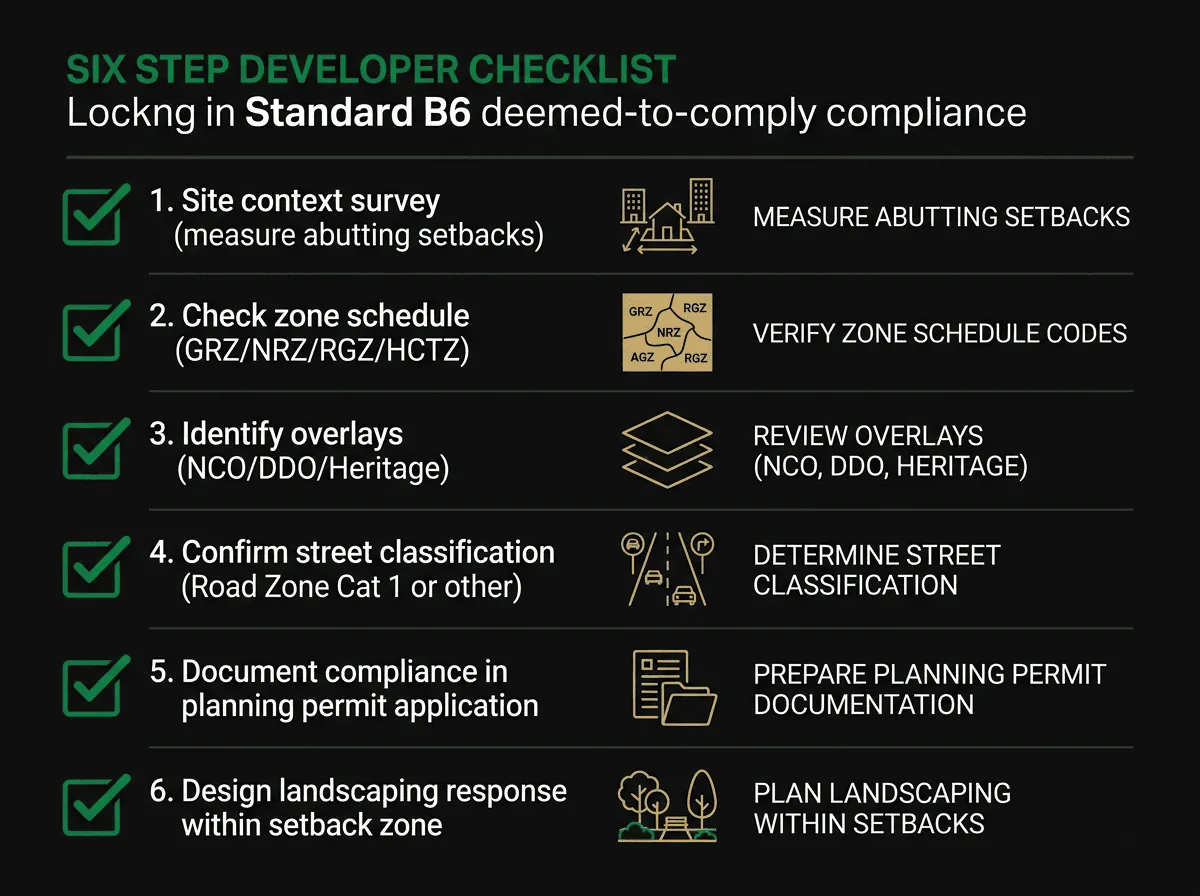
- Conduct a site context survey early. Standard B2-1’s average-based calculation depends on the actual setbacks of existing buildings on both abutting allotments. Commission a site survey or conduct a careful site inspection to measure these setbacks accurately. An error of 0.5 metres in your context assessment can mean the difference between compliance and non-compliance.
- Check the zone schedule first. Before applying Table B2-1, confirm whether the applicable zone schedule (GRZ, NRZ, RGZ, or HCTZ) specifies a different setback requirement. Following VC276, local schedules are generally only permitted to vary the standard in a more permissive direction — but some schedules may still contain provisions that affect your calculation.
- Identify any applicable overlays. Search the planning scheme for NCO, DDO, or Heritage Overlay provisions affecting the site. These may impose additional requirements that operate alongside Standard B2-1, particularly where mandatory rather than discretionary provisions are involved.
- Confirm the street classification. The applicable setback for sites without abutting buildings depends on whether the street is in a Road Zone Category 1 (6 metres) or another street type (4 metres). Confirm the road classification through the planning scheme maps.
- Document compliance clearly in your application. A planning permit application should include a clear written statement demonstrating how Standard B2-1 is met, with reference to the specific development context row in Table B2-1 and the measured setbacks of abutting dwellings. This documentation supports the deemed-to-comply pathway and reduces the scope for council to raise setback-related concerns.
- Design the setback zone to address landscaping requirements. Even where B2-1 compliance is established, councils retain discretion over landscaping and canopy tree requirements within the front setback area. Designing a meaningful landscaping response within the setback zone reduces the scope for conditions and demonstrates a considered response to the streetscape context.
Frequently Asked Questions
What is the standard street setback under ResCode Standard B2-1 for a typical townhouse development?
For a site where existing buildings are present on both abutting allotments facing the same street, Standard B2-1 requires a setback equal to the average of the two abutting dwelling setbacks, or 9 metres — whichever is the lesser. In practice, this typically produces required setbacks in the 5–9 metre range across Melbourne, depending on the prevailing neighbourhood context. The average-based calculation means the required setback is site-specific and must be calculated from actual measurements of the abutting properties.
Can a council still require a larger street setback than Standard B2-1 specifies?
Following Amendment VC267 and the introduction of the Townhouse and Low-Rise Code, councils are generally prohibited from requiring a larger setback than Standard B2-1 specifies once the numerical standard is met. The deemed-to-comply mechanism prevents the responsible authority from invoking local neighbourhood character policy to demand additional setback. However, where a Neighbourhood Character Overlay or Design and Development Overlay imposes mandatory setback requirements, those provisions may still apply — developers should check for applicable overlays on their specific site.
What happens if my development doesn’t meet Standard B2-1?
If Standard B2-1 is not met, the deemed-to-comply pathway is not available and the responsible authority regains full discretion to assess the application against local policy, neighbourhood character objectives, and decision guidelines. The council may approve the variation if satisfied that the alternative design solution meets the street setback objective — but this is a discretionary assessment, not a guaranteed outcome. Third-party VCAT appeal rights also remain available where the standards are not met.
Does Standard B2-1 compliance eliminate all VCAT appeal rights?
Standard B2-1 compliance alone does not eliminate VCAT appeal rights — the no-third-party-appeal protection applies where all applicable neighbourhood character and amenity impact standards are met, including B2-1, B2-2, B2-5, B2-3, B2-4, B4-1, B4-2, B4-3, B4-4, and the relevant amenity standards. Meeting B2-1 is a necessary but not sufficient condition for the full appeal protection. Your architect should assess compliance across all applicable standards to confirm whether the full deemed-to-comply pathway is available.
How do the 2025 planning reforms affect council zone schedules for street setbacks?
Amendment VC276 removed local zone schedule provisions that were more restrictive than the new state-wide standards. Following this amendment, councils can only vary Standard B2-1 through a zone schedule if the variation is more permissive — that is, allowing a smaller setback than the state standard. Councils can no longer use zone schedules to mandate setbacks larger than Standard B2-1 requires. This change particularly affected councils like City of Boroondara, which had previously used NRZ schedules to require setbacks beyond the ResCode standard.
Are there reduced setback options available for sites near activity centres?
Yes. For sites within or adjacent to activity centres, or sites rezoned to the Housing Choice and Transport Zone (HCTZ), Standard B2-1 may be replaced by or supplemented with reduced setback provisions — potentially as low as 3–4 metres — to facilitate higher density outcomes. Developers with sites near major activity centres in Doncaster, Box Hill, Glen Waverley, or Ringwood should investigate whether HCTZ provisions apply, as these may improve development yield by enabling reduced front setbacks.
Can eaves and porches encroach into the Standard B2-1 setback?
Yes. Porches, pergolas, and verandahs that are less than 3.6 metres high, as well as eaves, may encroach up to 2.5 metres into the setbacks required by Standard B2-1. This encroachment allowance can be used to create an articulated street presence — with a covered entry porch or verandah projecting forward of the main building line — without compromising numerical compliance with the standard. This is a useful design tool for creating streetscape interest within a compliant setback envelope.
Conclusion: Compliance Is Now the Competitive Advantage
Standard B2-1 has always been the entry point for street setback assessment in Victoria’s residential planning system. What has changed is the consequence of meeting it. Under the current deemed-to-comply framework, a development that satisfies Standard B2-1’s numerical requirements may gain meaningful protection from local policy override, reduced exposure to VCAT objector appeals, and a generally clearer pathway toward planning permit approval. For Melbourne developers navigating councils that have historically used neighbourhood character policy as a tool to constrain development yield, this shift represents a genuine improvement in planning certainty.
The practical implication is straightforward: invest the time and expertise at concept design stage to get the B2-1 calculation right, document it clearly, and design the front setback zone to address landscaping and canopy requirements within council’s remaining discretion. SQM Architects has supported developers across Melbourne — across City of Whitehorse, City of Boroondara, Manningham City Council, City of Monash, Knox City Council, and Maroondah City Council — to navigate exactly these planning complexities. Our experience across these councils informs a design approach focused on compliant, commercially viable outcomes.
Book a Strategy Call — contact SQM Architects on (03) 9005 6588 to discuss how Standard B2-1 and the current deemed-to-comply framework apply to your specific site and development objectives.
This article provides general information about Victorian planning for property developers. It does not constitute professional advice. For specific guidance on your project, contact SQM Architects for a complimentary site assessment.