Understanding VCAT Appeals for Dual Occupancy Applications
When your dual occupancy planning permit application faces refusal or unacceptable conditions from the Responsible Authority, the Victorian Civil and Administrative Tribunal (VCAT) provides a critical pathway for resolution. For property developers in Melbourne, understanding the VCAT appeal process can mean the difference between a stalled project and a substantial development opportunity. With dual occupancy applications representing a significant portion of residential permit refusals across Whitehorse, Boroondara, and Manningham councils, knowing when and how to appeal is essential for protecting your development investment.
The VCAT appeal process for dual occupancy applications differs significantly from standard planning disputes. Unlike single dwelling applications, dual occupancy developments must navigate ResCode Clause 55 standards, neighbourhood character considerations, and increasingly complex council policies introduced through amendments like VC267 and VC282. This guide provides Melbourne property developers with a practical framework for understanding VCAT appeals, from initial refusal through to tribunal hearing and decision.
Based on SQM Architects’ experience with projects across Melbourne, a notable portion of dual occupancy applications may require VCAT intervention—and with proper preparation, these appeals can achieve favourable outcomes in many cases. Understanding the process, timeframes, and strategic considerations outlined below can help you determine whether appeal is the right pathway for your development.
When VCAT Appeal Rights Apply to Dual Occupancy Applications
VCAT appeal rights for dual occupancy applications arise in three specific circumstances under the Planning and Environment Act 1987. First, when the Responsible Authority refuses your planning permit application outright. Second, when the council grants a permit but imposes conditions you consider unreasonable or commercially unviable. Third, when the council fails to make a decision within the statutory timeframe—typically 60 days for standard applications—creating what’s known as deemed refusal.
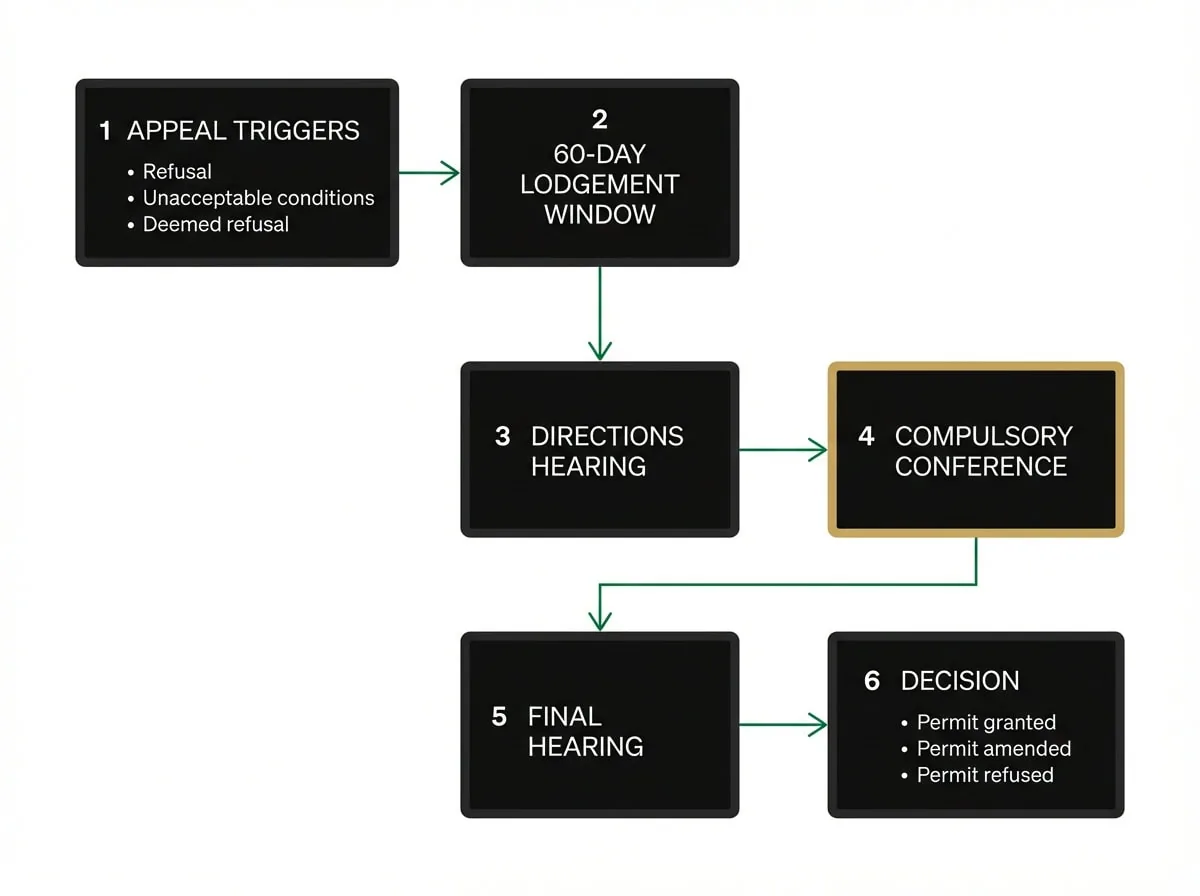
For dual occupancy developments in Melbourne, deemed refusal scenarios occur periodically, particularly in the City of Boroondara and Manningham City Council where assessment workloads can delay decision-making. The deemed refusal pathway provides developers with certainty: if no decision is made within 60 days (or extended timeframe if agreed in writing), you have the right to proceed directly to VCAT without waiting indefinitely for council determination.
Understanding which party can appeal is equally important. As the permit applicant, you have automatic appeal rights for refusal or conditions. However, objectors—typically neighbouring property owners—also hold appeal rights if the council approves your dual occupancy application. This means even a council approval can face VCAT challenge, requiring you to defend your approved permit at tribunal. Across Whitehorse and Monash councils, a portion of approved dual occupancy permits may face objector appeals, particularly for sites in established residential areas with strong neighbourhood character overlays.
The 60-day statutory timeframe begins from the date your application is formally lodged with all required information. If council requests further information—common for dual occupancy applications requiring shadow diagrams, landscape plans, or amended elevations—the timeframe pauses until you provide the requested material. Strategic developers often use this pause period to refine designs and address preliminary concerns, potentially avoiding VCAT altogether while preserving appeal rights if negotiations fail.
Critical Timeframes and Lodgement Requirements
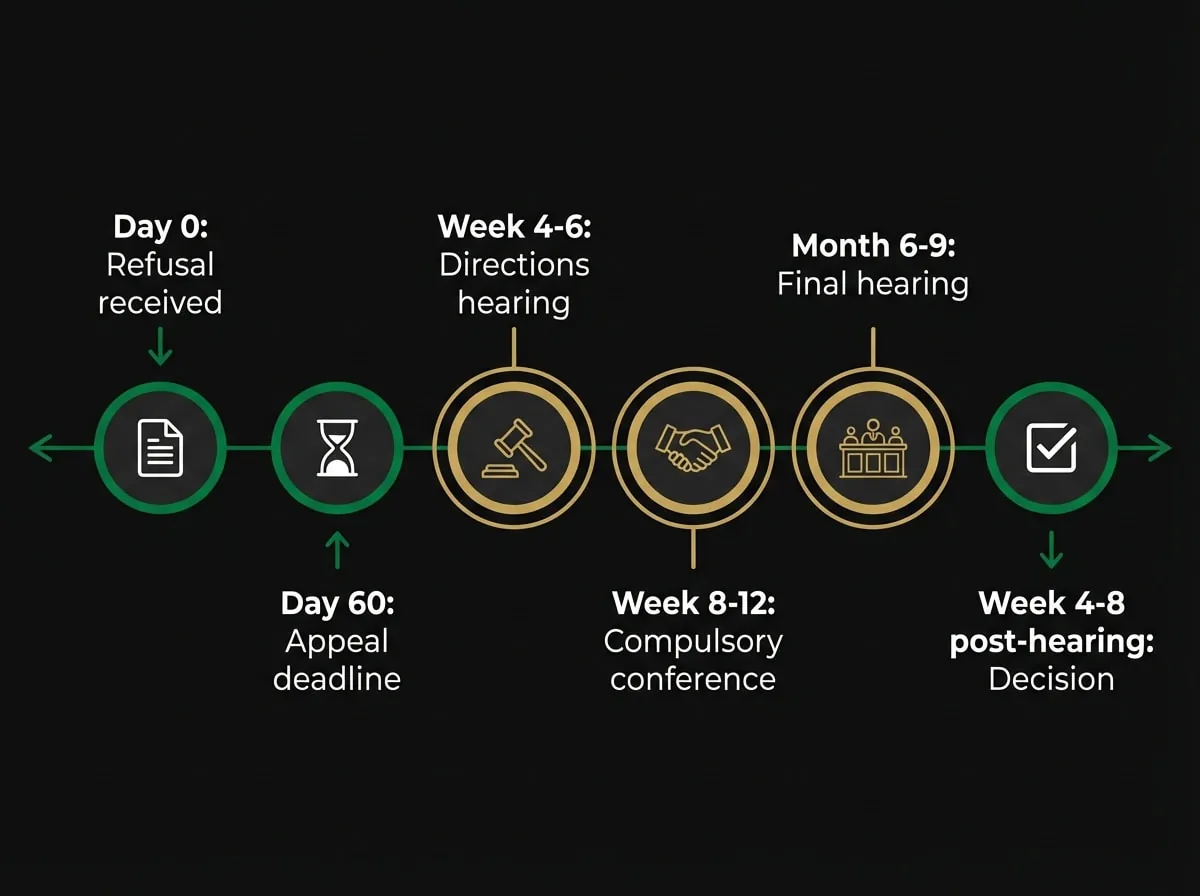
VCAT appeals for dual occupancy applications operate under strict statutory timeframes that cannot be extended. You must lodge your appeal within 60 days of receiving the council’s refusal notice or notice of decision with conditions. For deemed refusal scenarios, the 60-day appeal period begins from the day after the statutory decision period expires. Missing these deadlines eliminates your appeal rights entirely, requiring you to submit a fresh planning permit application and restart the entire process.
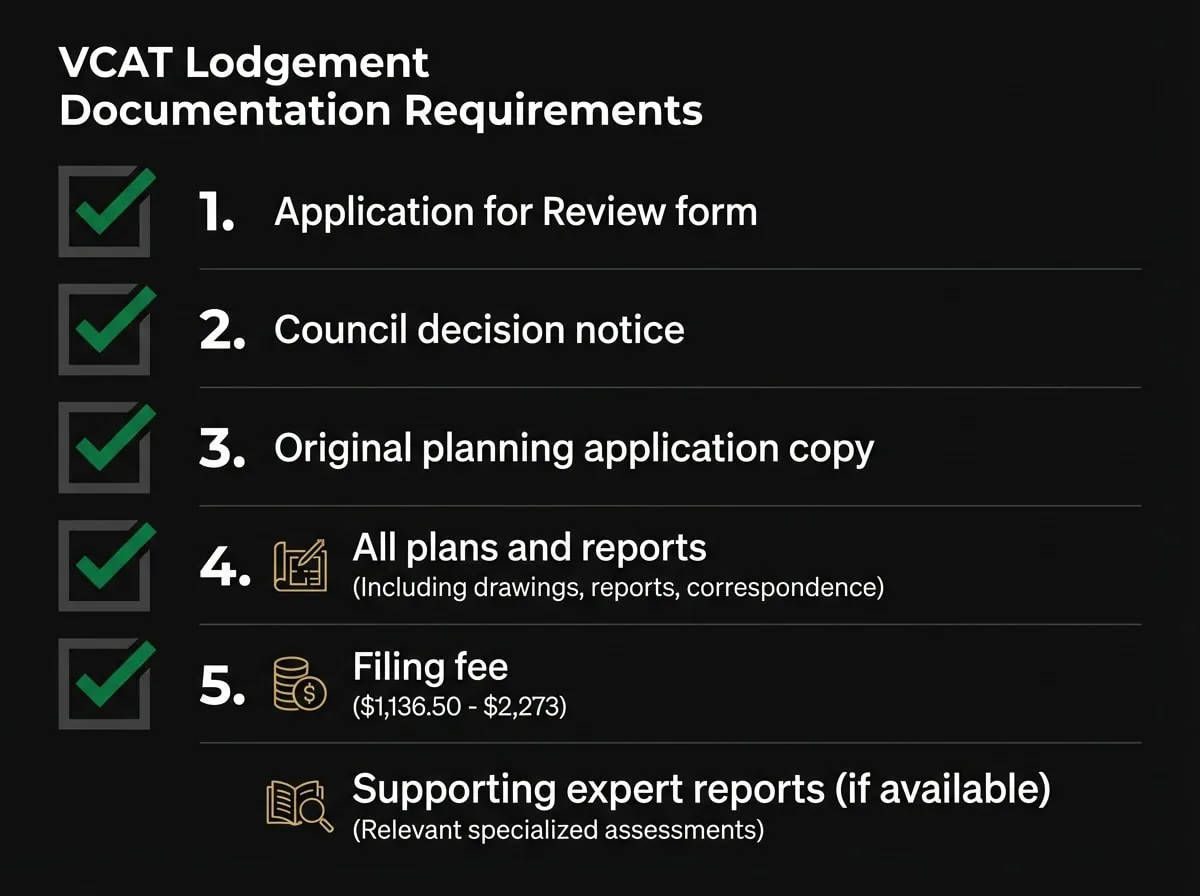
The VCAT lodgement process requires specific documentation beyond your original planning application. You must submit a completed Application for Review of Planning Decision form (available from VCAT’s website), the council’s decision notice or statement confirming deemed refusal, a copy of your original planning permit application including all plans and reports, and the prescribed filing fee. As of 2025, VCAT filing fees for dual occupancy planning appeals are $1,136.50 for applications with estimated development costs under $1M, and $2,273 for developments valued between $1M-$5M.
Strategic timing of your VCAT lodgement can influence outcomes. While you have 60 days to appeal, lodging within the first 14 days signals strong intent and may encourage council to reconsider or negotiate. Conversely, using the full 60-day period allows time for informal discussions with council planners, potentially resolving key issues through amended plans before formal tribunal proceedings begin. SQM Architects’ experience shows that a portion of dual occupancy disputes may resolve through pre-hearing negotiations when developers use the lodgement period strategically.
Once lodged, VCAT typically schedules dual occupancy appeals for hearing within 6-9 months, though complex cases involving multiple objectors or significant ResCode variations may extend to 12 months. The tribunal issues a directions hearing date within 4-6 weeks of lodgement, where procedural matters, expert witness requirements, and hearing dates are established. Understanding this timeline is critical for development feasibility—a 9-month VCAT process plus 3-4 months for permit conditions and building approval means 12-13 months from refusal to construction commencement.
Get the 7-point site check to run before committing to a permit application — zoning, overlays, setbacks and council red flags, in plain English. Free PDF, instant download.
- Zone, overlay & setback checks
- What council assesses first
- Permit-readiness red flags
Something went wrong. Please try again.
No spam. Unsubscribe anytime.
Check your inbox — your checklist is on its way.
Grounds for Appeal and Strategic Considerations
Successful VCAT appeals for dual occupancy applications require clear grounds based on planning merit, not personal preference or financial hardship. The tribunal assesses appeals against the Planning and Environment Act 1987, relevant planning scheme provisions (particularly ResCode Clause 55 as updated by VC267), and established planning principles. Your appeal must demonstrate that the proposed dual occupancy either complies with applicable standards or, where variations exist, that the variations are appropriate in the specific site context.
Common grounds for dual occupancy appeals in Melbourne include neighbourhood character arguments, where council refuses applications claiming inconsistency with existing streetscape patterns despite compliance with ResCode standards. The City of Boroondara frequently refuses dual occupancy applications in Hawthorn and Kew on neighbourhood character grounds, even when developments meet Clause 55.02 (neighbourhood character objectives). VCAT often finds in favour of developers where proposed designs demonstrate appropriate response to character through building form, materials, and landscaping, regardless of whether dual occupancy represents a departure from predominant single dwelling patterns.
ResCode variations provide another significant appeal ground. Dual occupancy developments commonly seek variations to side and rear setback standards (Clause 55.04), private open space requirements (Clause 55.05), and overshadowing provisions (Clause 55.04-5). Council refusals often cite these variations as grounds for rejection, but VCAT applies a more nuanced assessment. The tribunal considers whether variations achieve the underlying objectives of ResCode standards—for example, a 2.5m side setback instead of 3m may still achieve adequate visual separation and daylight access if building height is reduced or upper-level walls are articulated.
Strategic appeal considerations extend beyond planning merit to include cost-benefit analysis. VCAT appeals for dual occupancy applications typically cost $15,000-$35,000 including filing fees, planning consultant reports, expert witness fees (if required), and legal representation. For a standard dual occupancy development, these costs represent a small percentage of total project value. However, if appeal success enables a development that council refusal would prevent entirely, the investment may be justified. Conversely, if VCAT success requires significant design amendments that reduce development yield or increase construction costs, negotiated resolution with council may prove more commercially viable.
Expert evidence plays a crucial role in dual occupancy VCAT appeals, particularly for neighbourhood character and ResCode variation disputes. Town planning experts provide independent assessment of planning merit, while arborist reports, traffic engineers, and acoustic consultants address specific technical objections. The City of Whitehorse and Knox City Council frequently raise traffic and car parking concerns for dual occupancy applications, requiring traffic engineering evidence to demonstrate adequate on-site parking and minimal impact on street parking capacity. Budget $3,500-$8,000 per expert witness for report preparation and hearing attendance when planning your VCAT appeal strategy.
The VCAT Hearing Process for Dual Occupancy Appeals
VCAT dual occupancy hearings typically follow a structured format beginning with a directions hearing 4-6 weeks after lodgement. The directions hearing, usually conducted by telephone or video conference, establishes procedural orders including deadlines for submitting expert reports, witness statements, and amended plans. The tribunal member (often a senior planning expert rather than a lawyer) sets the final hearing date and determines whether the matter requires a site inspection. For dual occupancy applications, site inspections occur in most cases, allowing the tribunal to assess neighbourhood character, overshadowing impacts, and visual bulk in context.
Between directions hearing and final hearing, parties exchange evidence and attempt to narrow disputed issues. Council typically submits its planning officer’s report and any expert evidence within 6-8 weeks of the directions hearing. As the applicant, you then have 3-4 weeks to respond with your planning expert’s report and any supporting technical evidence. This exchange period often reveals opportunities for resolution—if council’s concerns focus on specific design elements like upper-level setbacks or window placement, amended plans addressing these issues may achieve consent without proceeding to full hearing.
The final VCAT hearing for dual occupancy appeals typically runs 1-2 days, depending on complexity and number of objectors. Hearings follow a semi-formal structure: council presents its case first, explaining grounds for refusal and calling any expert witnesses; objectors (if any) present their concerns; you present your case including planning expert evidence and any supporting witnesses; all parties have opportunity for cross-examination and closing submissions. Unlike court proceedings, VCAT hearings are less adversarial—the tribunal member actively questions witnesses and may suggest design modifications during the hearing to achieve acceptable outcomes.
Site inspections usually occur on the hearing day or immediately before, with all parties attending. The tribunal member inspects your site, neighbouring properties (with owner permission), and surrounding streetscape to assess neighbourhood character, overlooking impacts, and overshadowing. For dual occupancy applications in established areas like Balwyn, Camberwell, or Doncaster, the site inspection provides critical context for evaluating whether your proposed development respects existing character patterns. Prepare your site for inspection by ensuring clear access, removing any temporary structures that might obscure building footprints, and having survey pegs marking proposed building locations if possible.
VCAT decisions for dual occupancy appeals are typically issued 4-8 weeks after the hearing. The written decision includes findings of fact, assessment of planning merit against relevant provisions, and either affirmation of council’s refusal, setting aside the refusal and directing council to issue a permit, or setting aside the refusal and issuing a permit directly with conditions determined by the tribunal. A significant portion of dual occupancy VCAT appeals may result in permits being granted (either by direction or directly), while others result in permits with amended conditions or affirm council’s refusal. Understanding these potential outcomes helps inform your decision to appeal versus redesign and resubmit.
Costs, Risks, and Alternative Pathways
VCAT operates on a “costs follow the event” principle for planning appeals, but cost orders are discretionary and relatively uncommon in dual occupancy cases. The tribunal may order you to pay council’s costs if your appeal is dismissed and deemed to have no reasonable prospect of success, or if you unreasonably reject settlement offers. Conversely, VCAT may order council to pay your costs if the refusal is overturned and council’s position is found unreasonable. However, in most dual occupancy appeals, each party bears their own costs regardless of outcome, making the financial risk more predictable than traditional litigation.
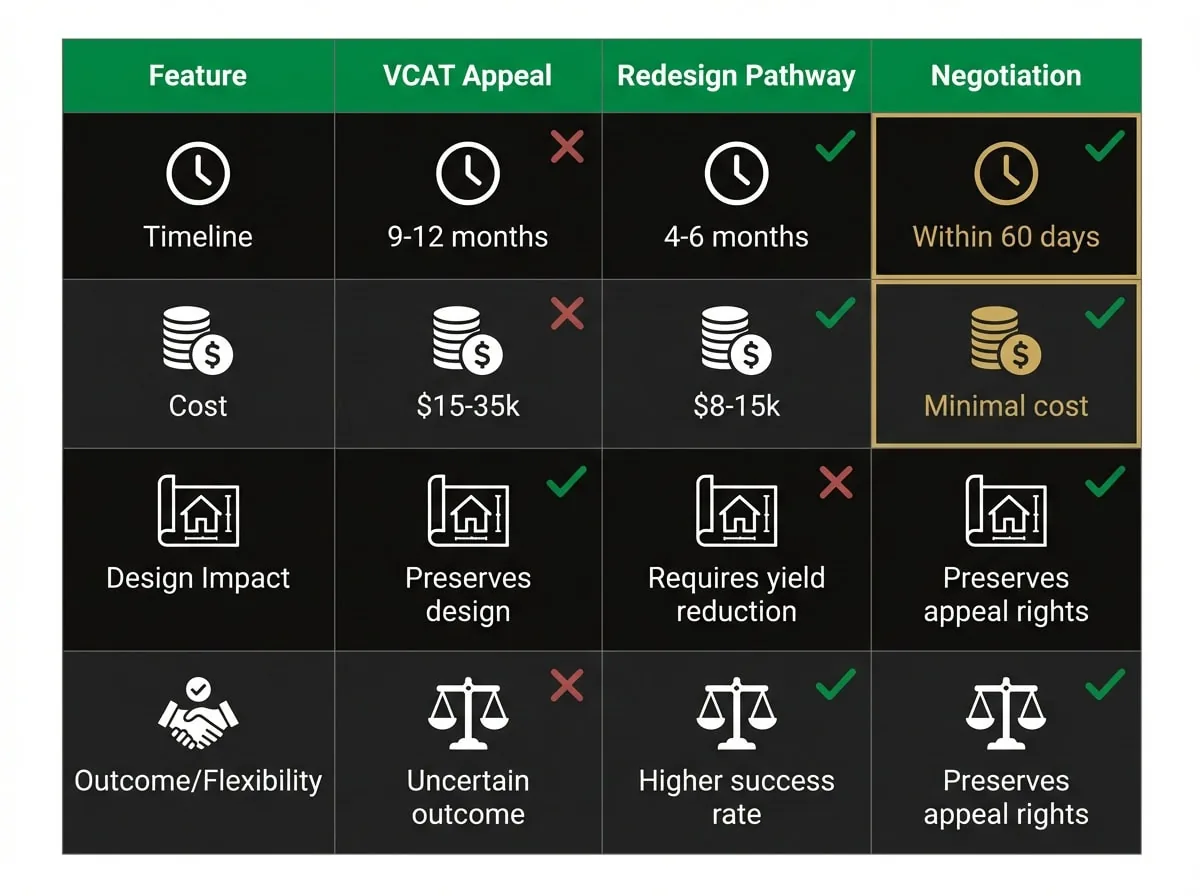
The primary financial risk in VCAT appeals relates to time delay rather than cost orders. A 9-month appeal process delays development commencement, potentially impacting finance arrangements, market conditions, and opportunity costs. For a dual occupancy development with projected profit margin, delay represents holding costs (interest, rates, insurance) plus potential market deterioration if property values decline. Strategic developers factor these delay costs into their appeal decision, comparing VCAT pathway costs and timeframes against alternative options like design amendments and fresh applications.
Alternative dispute resolution provides a middle pathway between accepting refusal and proceeding to full VCAT hearing. Compulsory conferences, typically held 8-12 weeks after lodgement, bring all parties together with a VCAT mediator to explore settlement options. A portion of dual occupancy VCAT appeals may resolve at compulsory conference through negotiated design amendments, reduced development yield, or modified conditions. The conference is “without prejudice,” meaning discussions cannot be used as evidence if the matter proceeds to hearing, encouraging frank negotiation about acceptable compromises.
For developers facing council refusal, the decision tree involves three pathways: accept refusal and redesign for fresh application; lodge VCAT appeal; or pursue informal negotiations with council before deciding on appeal. The redesign pathway typically takes 4-6 months (design amendments, fresh application, assessment) and costs $8,000-$15,000 in consultant fees, but avoids VCAT uncertainty and may achieve better commercial outcomes if council’s concerns are valid. The appeal pathway takes 9-12 months and costs $15,000-$35,000, but preserves your original design intent and may succeed where council’s refusal lacks planning merit. Informal negotiation can occur within the 60-day appeal lodgement period, potentially achieving resolution without VCAT while preserving appeal rights if negotiations fail.
Preparing Strong VCAT Appeals for Dual Occupancy Projects
Successful VCAT appeals for dual occupancy applications begin with thorough documentation of planning merit. Your planning expert’s report must address each ground of council refusal systematically, demonstrating either compliance with relevant standards or, where variations exist, that variations are appropriate and achieve underlying policy objectives. For ResCode variations under Clause 55, the report should reference the specific standard objectives (updated through VC267 and VC282), explain how your design achieves these objectives despite numeric non-compliance, and provide comparative analysis with approved dual occupancy developments in similar contexts.
Visual evidence strengthens dual occupancy VCAT appeals significantly. High-quality renders showing street presentation, materials, and landscaping help the tribunal visualise the completed development in context. Shadow diagrams demonstrating overshadowing impacts at 9am, 12pm, and 3pm on June 22 (winter solstice) address common council concerns about amenity impacts. Photomontages showing your proposed dual occupancy superimposed on existing streetscape photographs provide powerful evidence for neighbourhood character arguments, particularly where council claims the development is inconsistent with established patterns but visual evidence shows appropriate contextual response.
Addressing objector concerns proactively improves VCAT outcomes even when objectors don’t formally participate in the appeal. Common dual occupancy objections include overlooking from upper-level windows, loss of neighbourhood character, increased traffic, and overshadowing of neighbouring gardens. Your planning expert’s report should acknowledge these concerns and explain design responses—for example, highlight windows with 1.7m sill heights preventing overlooking, landscaping screening ground-level living areas, on-site parking exceeding Clause 52.06 requirements, and shadow diagrams showing compliance with ResCode overshadowing standards. Tribunals respond favourably to applications demonstrating genuine consideration of neighbour amenity rather than dismissing concerns as invalid.
Strategic use of amended plans during the VCAT process can transform outcomes. While you cannot fundamentally change your proposal (that would constitute a new application), you can make modifications addressing specific tribunal concerns. Common amendments for dual occupancy appeals include reducing upper-level building width to improve side setbacks, relocating windows to minimise overlooking, increasing landscape areas, or modifying materials and colours to better respond to neighbourhood character. Submit amended plans early in the VCAT process—ideally before the compulsory conference—to demonstrate responsiveness and provide the tribunal with an approvable design option.
How long does the VCAT appeal process take for dual occupancy applications?
The typical VCAT appeal process for dual occupancy applications takes 9-12 months from lodgement to decision. This includes 4-6 weeks to directions hearing, 8-12 weeks to compulsory conference, 4-6 months to final hearing, and 4-8 weeks for written decision. Complex cases involving multiple objectors or significant ResCode variations may extend to 15 months. Strategic developers factor this timeframe into development feasibility analysis, as it delays construction commencement and increases holding costs.
What are the costs involved in appealing a dual occupancy refusal to VCAT?
Total costs for dual occupancy VCAT appeals typically range from $15,000-$35,000. This includes VCAT filing fees ($1,136.50-$2,273 depending on development value), planning expert reports ($4,500-$8,500), expert witness hearing attendance ($1,500-$3,000 per day), supporting technical reports if required ($3,500-$8,000 per expert), and legal representation if engaged ($8,000-$15,000). Most developers proceed without lawyers for straightforward dual occupancy appeals, relying on planning consultants to present the case and reducing costs to the $15,000-$22,000 range.
Can I modify my dual occupancy design during the VCAT appeal process?
Yes, you can submit amended plans during VCAT proceedings provided the modifications don’t fundamentally change the proposal. Acceptable amendments include adjusting setbacks, relocating windows, modifying materials, increasing landscaping, or reducing building height. Fundamental changes like adding a third dwelling, significantly increasing site coverage, or completely redesigning building form would constitute a new application requiring fresh submission to council. Submit amendments early in the VCAT process—ideally before compulsory conference—to maximise their strategic value in achieving tribunal approval.
What happens if objectors appeal council’s approval of my dual occupancy application?
If council approves your dual occupancy application but objectors appeal to VCAT, you become a respondent rather than applicant in the tribunal proceedings. You must defend the approved permit, typically engaging a planning consultant to prepare expert evidence supporting the approval. The process follows the same timeframes and procedures as applicant appeals, but you have the strategic advantage of council support—the Responsible Authority typically defends its own decision. A portion of approved dual occupancy permits in Melbourne may face objector appeals, with outcomes often favouring permit holders in many cases.
How does VCAT assess ResCode variations for dual occupancy applications?
VCAT assesses ResCode Clause 55 variations by determining whether the proposed development achieves the underlying objectives of each standard despite numeric non-compliance. For example, a side setback of 2.5m instead of 3m may be acceptable if the design achieves adequate visual separation through building articulation, material changes, or landscaping. The tribunal considers site-specific context, including existing neighbourhood patterns, lot dimensions, and surrounding development. Following VC267 amendments, VCAT applies updated deemed-to-comply pathways for certain dual occupancy configurations, potentially simplifying assessment for qualifying developments.
Should I accept council refusal and redesign, or proceed to VCAT appeal?
The decision depends on planning merit strength, commercial viability, and time sensitivity. Proceed to VCAT if council’s refusal lacks clear planning basis, your design complies with or appropriately varies ResCode standards, and the 9-12 month appeal timeframe doesn’t compromise project feasibility. Consider redesign if council identifies legitimate planning concerns, required design changes don’t significantly impact development yield, and the 4-6 month fresh application pathway better suits your timeline. Refused dual occupancy applications may achieve approval through VCAT in many cases, while redesign and resubmission often succeeds—but redesign typically requires yield reduction or increased construction costs.
Do I need a lawyer for a dual occupancy VCAT appeal?
Legal representation is not required for dual occupancy VCAT appeals, and many applicants proceed with planning consultant representation only. Planning consultants familiar with VCAT processes can effectively present cases, cross-examine witnesses, and make submissions. However, legal representation may be valuable for complex cases involving significant commercial value (developments over $3M), multiple objectors, or novel planning arguments. Lawyers experienced in planning law provide strategic advantage in procedural matters and legal interpretation, but add $8,000-$15,000 to appeal costs. Most straightforward dual occupancy appeals can succeed with competent planning consultant representation.
Moving Forward with Your Dual Occupancy VCAT Appeal
Understanding the VCAT appeal process empowers Melbourne property developers to make informed decisions when facing dual occupancy planning permit refusals or unacceptable conditions. The tribunal provides an accessible, merit-based pathway for resolving planning disputes, with outcomes often favouring well-prepared applications that demonstrate genuine planning merit and appropriate response to neighbourhood context. While the 9-12 month timeframe and $15,000-$35,000 costs represent significant investment, VCAT appeals often prove the most viable pathway for preserving development yield and achieving commercially feasible outcomes when council refusal lacks clear planning justification.
Strategic preparation remains the key differentiator between successful and unsuccessful dual occupancy VCAT appeals. Thorough planning expert reports addressing each refusal ground, high-quality visual evidence demonstrating contextual appropriateness, and willingness to make reasonable design amendments during the process can significantly improve tribunal outcomes. For developers in Melbourne, engaging consultants with specific VCAT experience and local council knowledge—particularly for Whitehorse, Boroondara, and Manningham jurisdictions where dual occupancy policies vary significantly—provides critical advantage in navigating the appeal process effectively.
SQM Architects has supported dual occupancy VCAT appeals across Melbourne, achieving favourable outcomes in many cases through strategic design responses and detailed planning evidence. Our experience with local council policies, ResCode variations, and tribunal expectations enables us to identify appeal-worthy refusals and prepare compelling cases for tribunal consideration. Book a Strategy Call to discuss your dual occupancy refusal and determine whether VCAT appeal represents the optimal pathway for your development project. Call (03) 9005 6588 to speak with our planning team about your specific situation.
This article provides general information about Victorian planning for property developers. It does not constitute professional advice. For specific guidance on your project, contact SQM Architects (ARBV Reg. No. 51498) for a complimentary site assessment.