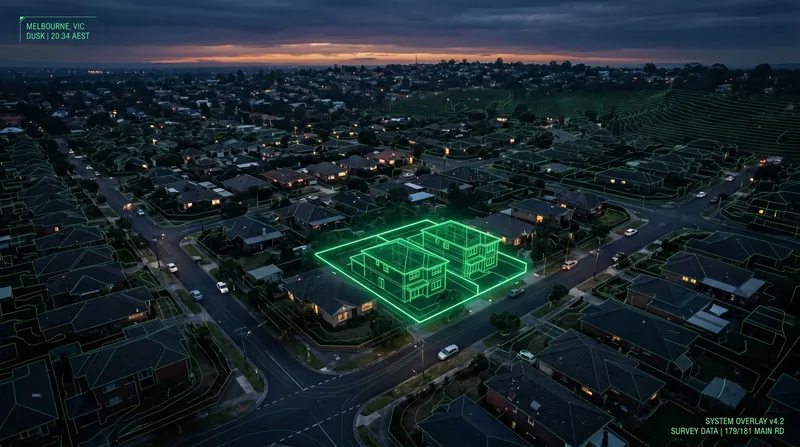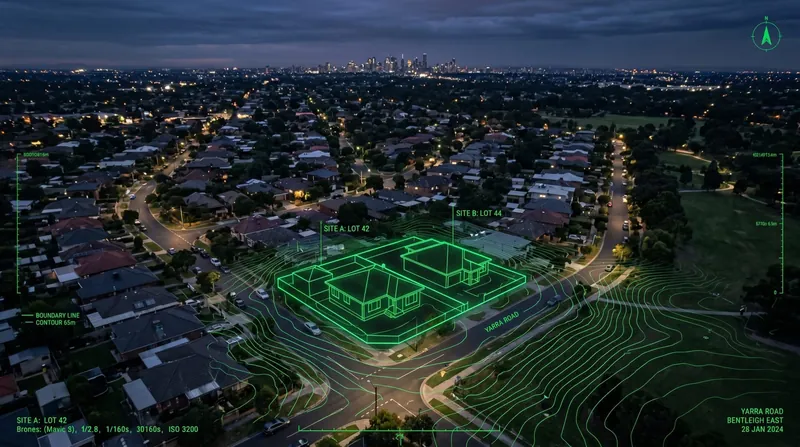
Yes — building a dual occupancy on a small block in Melbourne became easier on 8 September 2025, when Amendment VC282 introduced a deemed-to-comply pathway under Clause 54 for single dwellings and small second dwellings on lots under 300m². Where a design meets the updated standards, the responsible authority cannot apply extra discretionary assessment, and a qualifying application may be processed through the faster VicSmart pathway. This guide explains what is now possible on a small lot and how to qualify. For the broader site requirements that apply to any dual occupancy, see our dual occupancy site requirements guide.
The amendment introduces a deemed-to-comply framework that mirrors the Townhouse and Low-Rise Code (Amendment VC267) introduced earlier in 2025 for Clause 55 applications. When a proposal meets the updated Clause 54 standards, the Responsible Authority cannot apply additional discretionary assessment, neighbourhood character considerations, or broader planning scheme guidelines to those standards. Subject to council workload and application completeness, qualifying applications may be processed through the VicSmart pathway in as few as 10 business days, with no third-party notice and no VCAT appeal rights for objectors.
This guide outlines what changed, how the new standards apply to dual occupancy development on small lots, how council-specific variations work across Melbourne, and what developers need to do to take advantage of the faster approval pathway.
Understanding the Deemed-to-Comply Framework Under Clause 54
The core concept behind Amendment VC282 is binary compliance. Under the previous Clause 54, a Responsible Authority retained broad discretion to weigh neighbourhood character, local policy, and qualitative amenity considerations even when a proposal technically met the numerical standards. That discretion created uncertainty, extended assessment timeframes, and gave objectors grounds for VCAT challenges based on subjective criteria.
Under the new framework, if a proposal meets the relevant Clause 54 standard, the corresponding objective is automatically satisfied. The Responsible Authority is exempt from considering the purposes of the zone, the decision guidelines in Clause 65, certain matters under Section 60 of the Planning and Environment Act 1987, and broader environmental, social, and economic effects. Neighbourhood character is no longer a ResCode standard in itself — a significant change that removes one of the most common grounds for objection and delay.
For dual occupancy development, this matters because the small second dwelling provisions under Standard A2-8 are now assessed within this same deemed-to-comply structure. A developer proposing to retain an existing dwelling and construct a new dwelling in the rear yard — a common dual occupancy configuration in Melbourne — can now pursue a streamlined approval pathway provided the design meets all applicable Clause 54 standards. Where all neighbourhood character and external amenity standards are met, the application is also exempt from third-party notice and review.
It is important to note that overlays — including Heritage Overlays, Neighbourhood Character Overlays, Vegetation Protection Overlays, and Flood Overlays — can still trigger additional assessment requirements regardless of Clause 54 compliance. Developers should confirm overlay status for any site before assuming VicSmart eligibility.
Key Standard Changes That Affect Development Feasibility
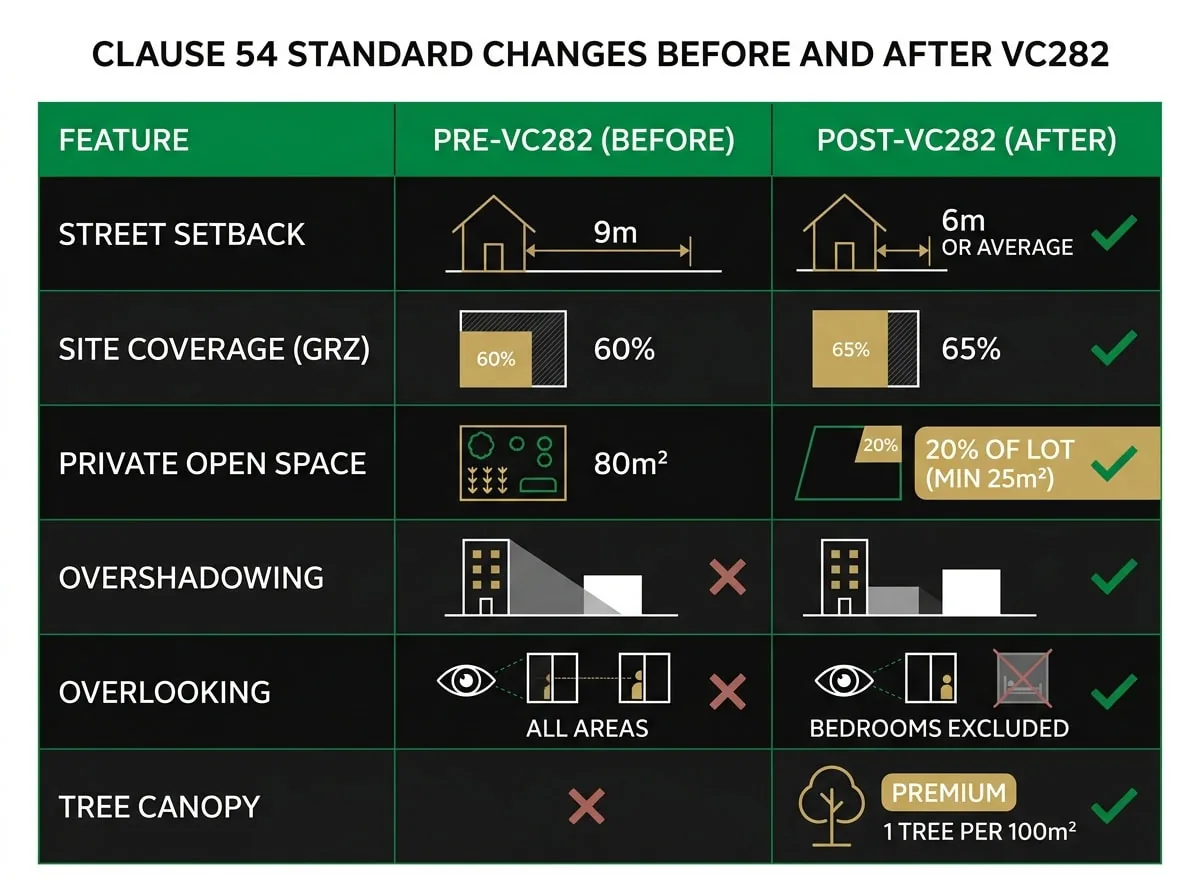
Amendment VC282 updated a number of Clause 54 standards in ways that directly improve development feasibility on small lots. Understanding the specific changes — and how they compare to the previous requirements — is essential for accurate feasibility modelling.
Street Setback (Standard A2-1)
The minimum street setback has been reduced from the previous 9m requirement to the lesser of 6m or the average setback of the two adjoining dwellings. On streets in Transport Zone 2, the minimum is 4m. For a 250m² lot with a 10m frontage, this change alone could recover meaningful usable site area — potentially significant for accommodating an additional bedroom, larger living areas, or improved private open space configuration. For a detailed overview of how building setbacks in Victoria affect compliant residential design, see our related guide.
Site Coverage (Standard A2-5)
Site coverage is no longer a flat 60% across all residential zones. The new zone-specific rates are:
- Neighbourhood Residential Zone: 60% (unchanged)
- General Residential Zone: 65% (increased from 60%)
- Residential Growth Zone, Mixed Use Zone, Housing Choice and Transport Zone: 70% (increased from 60%)
On a 250m² lot in the General Residential Zone, the increased coverage limit allows up to 162.5m² of building footprint, compared to 150m² previously. This additional footprint may meaningfully improve the viability of dual occupancy configurations where both dwellings need to achieve minimum floor areas.
Private Open Space (Standard A3-2)
The private open space requirement has been significantly reduced — from 80m² down to 20% of the lot area, with a minimum of 25m² and a minimum dimension of 3m. Balconies and rooftop terraces are now acceptable alternative compliance pathways. For small second dwellings, the minimum remains 8m². This change may substantially improve the feasibility of dual occupancy configurations on lots where achieving 80m² of private open space for each dwelling was previously impractical. Understanding how minimum garden area requirements in Victoria interact with the new private open space standards is important for accurate feasibility modelling. For further detail on how overshadowing and open space interact in dual occupancy design, see our related guide.
Overshadowing (Standard A4-3)
The allowable overshadowing of secluded private open space has increased from 25% to 50%. This more permissive standard gives designers greater flexibility in building massing and orientation, particularly on north-facing lots where rear dwelling configurations may previously have triggered overshadowing non-compliance.
Overlooking (Standard A4-4)
The overlooking standard no longer applies to bedrooms. This change reduces the number of screening or setback solutions required in typical dual occupancy layouts, simplifying design and potentially reducing construction costs. For a full overview of how overlooking regulations in Victoria affect property development, see our dedicated guide.
Tree Canopy (Standard A2-6)
A new tree canopy requirement has been introduced: one canopy tree per 100m² of site area. For a 250m² lot, this means a minimum of two trees (rounding up from 2.5). For a 300m² lot, three trees are required. Importantly, the Clause 54 standard is based on a specific number of trees rather than canopy coverage at maturity as a percentage of site area — making it less onerous than the equivalent Clause 55 standard that applies to multi-dwelling developments. Trees must be shown on landscape plans submitted with the application.
How Council Variations Work Across Melbourne
One of the most practically significant aspects of Amendment VC282 is the restriction on local council variations. Previously, councils could specify more restrictive local standards in zone schedules for a wide range of Clause 54 provisions. Under the new framework, the ability for councils to specify local variations for permeability, side and rear setbacks, and walls on boundaries has been removed entirely. For street setback, private open space, and site coverage, local variations may only apply if they are more permissive than the state standards — not more restrictive.
This is a material change for developers working across Melbourne, where councils have historically used zone schedule variations to enforce more conservative development standards than the state baseline. The practical effect is that the state standards now function as a genuine floor, not a starting point for further restriction.
City of Whitehorse
The City of Whitehorse contains a mix of General Residential Zone and Neighbourhood Residential Zone land, with Residential Growth Zone corridors along key transport routes including Box Hill and Nunawading. Under VC282, General Residential Zone sites may now achieve 65% site coverage, and any previous local schedule variations that were more restrictive than the state standard for setbacks or permeability no longer apply. Heritage Overlays remain active across parts of Box Hill South and Surrey Hills — developers should confirm overlay status before assuming VicSmart eligibility.
City of Boroondara
The City of Boroondara has historically been one of the more conservative councils in Melbourne, with significant Neighbourhood Character Overlay coverage and Heritage Overlay designations across Camberwell, Hawthorn, and Kew. While VC282 removes the ability for the council to apply more restrictive Clause 54 variations, Neighbourhood Character Overlays and Heritage Overlays remain in force and may require a full planning permit application rather than VicSmart. Developers should conduct thorough due diligence on overlay status for any Boroondara site.
Manningham City Council
Manningham City Council contains a higher proportion of Low Density Residential Zone land in its outer areas — and it is important to note that Amendment VC282 does not apply to the Low Density Residential Zone. For sites in Doncaster, Templestowe, and Bulleen that are zoned General Residential or Neighbourhood Residential, the new Clause 54 standards apply in full. Vegetation Protection Overlays are common across Manningham and may trigger additional assessment requirements.
City of Monash
The City of Monash has a substantial General Residential Zone footprint across Glen Waverley, Mount Waverley, and Clayton, with Residential Growth Zone designations around activity centres. The increased site coverage limit of 65% in the General Residential Zone and 70% in the Residential Growth Zone may improve feasibility for dual occupancy configurations on the smaller infill lots common in this area. Monash has relatively fewer Heritage Overlays than inner-eastern councils, which may make VicSmart eligibility more achievable across a broader range of sites.
Knox City Council and Maroondah City Council
Knox City Council and Maroondah City Council contain a mix of residential zones with generally fewer overlay complications than inner-eastern councils, though Bushfire Management Overlays apply to some outer areas. For standard residential infill sites in Bayswater, Ringwood, and Croydon, the VC282 changes may offer genuine VicSmart pathway opportunities for compliant dual occupancy proposals. Developers should confirm that sites are not within the Low Density Residential Zone, which remains outside the scope of the amendment.
Get the 7-point site check to run before committing to a permit application — zoning, overlays, setbacks and council red flags, in plain English. Free PDF, instant download.
- Zone, overlay & setback checks
- What council assesses first
- Permit-readiness red flags
Something went wrong. Please try again.
No spam. Unsubscribe anytime.
Check your inbox — your checklist is on its way.
The VicSmart Pathway: What Developers Need to Know
The VicSmart planning permit pathway has been updated to work with the new Clause 54 requirements. For eligible applications — those that meet all applicable deemed-to-comply standards — the statutory assessment timeframe is 10 business days, though actual processing times may vary by council and application completeness. For council-by-council planning permit timelines, see our Planning Permit Timeline Melbourne guide. There is no public notification, no advertising period, and no third-party VCAT appeal rights where all neighbourhood character and external amenity standards are met.
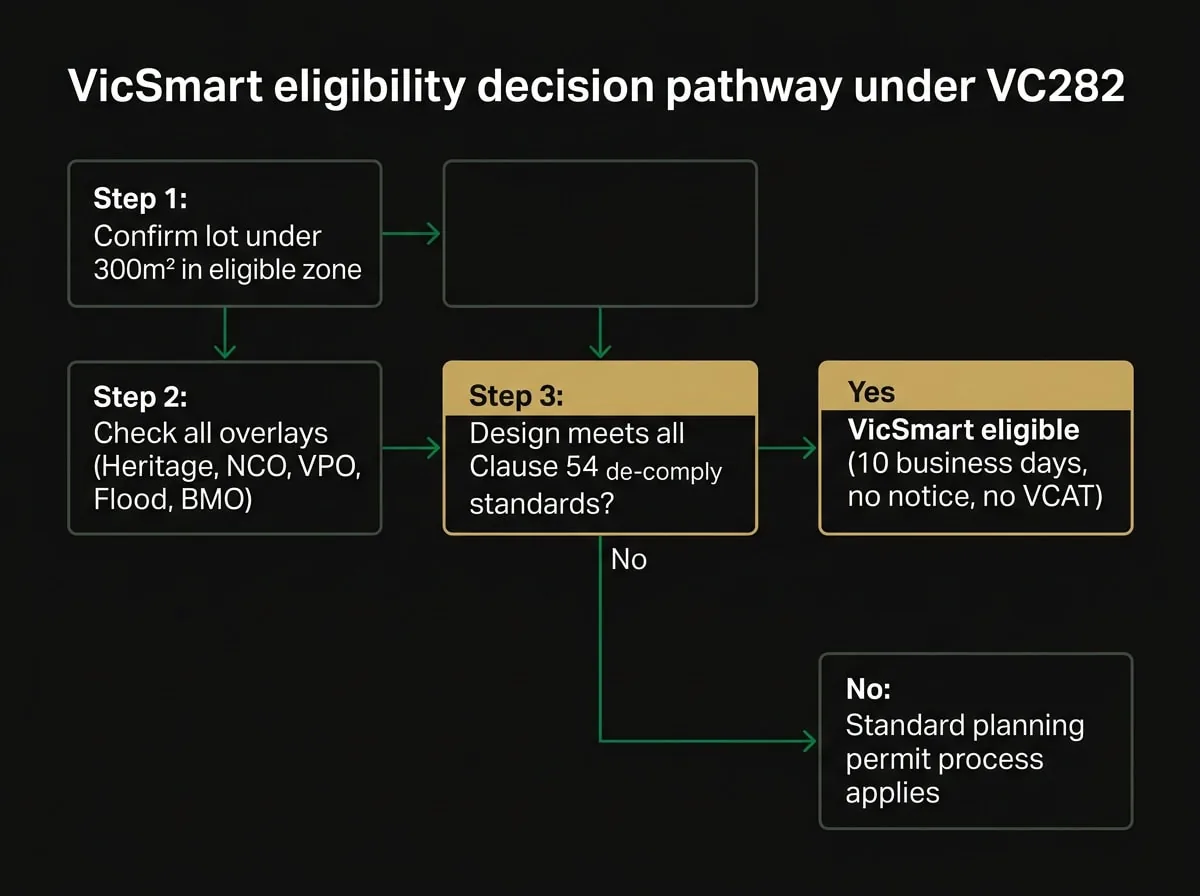
To be eligible for VicSmart under the updated Clause 54, an application must meet an updated list of deemed-to-comply standards. The application is assessed according to the new provisions rather than separate information requirements and decision guidelines. This means the documentation package submitted at lodgement must be complete and fully compliant — there is limited scope for negotiation or iterative amendment during the assessment window.
For dual occupancy developers, the practical implication is that design compliance must be resolved before lodgement, not during assessment. SQM Architects treats compliance as a design input from the earliest feasibility stage — not a checklist completed at the point of lodgement. This is particularly important under the new binary compliance framework.
Applications lodged before 8 September 2025 continue to be assessed under the previous Clause 54 provisions, providing transitional protection for projects already in the system. Developers with applications lodged under the old provisions should confirm with the Responsible Authority which framework applies to their specific application.
Practical Tips for Dual Occupancy Developers Under VC282
The following guidance outlines practical steps developers may consider when assessing and progressing dual occupancy projects under the new Clause 54 framework.
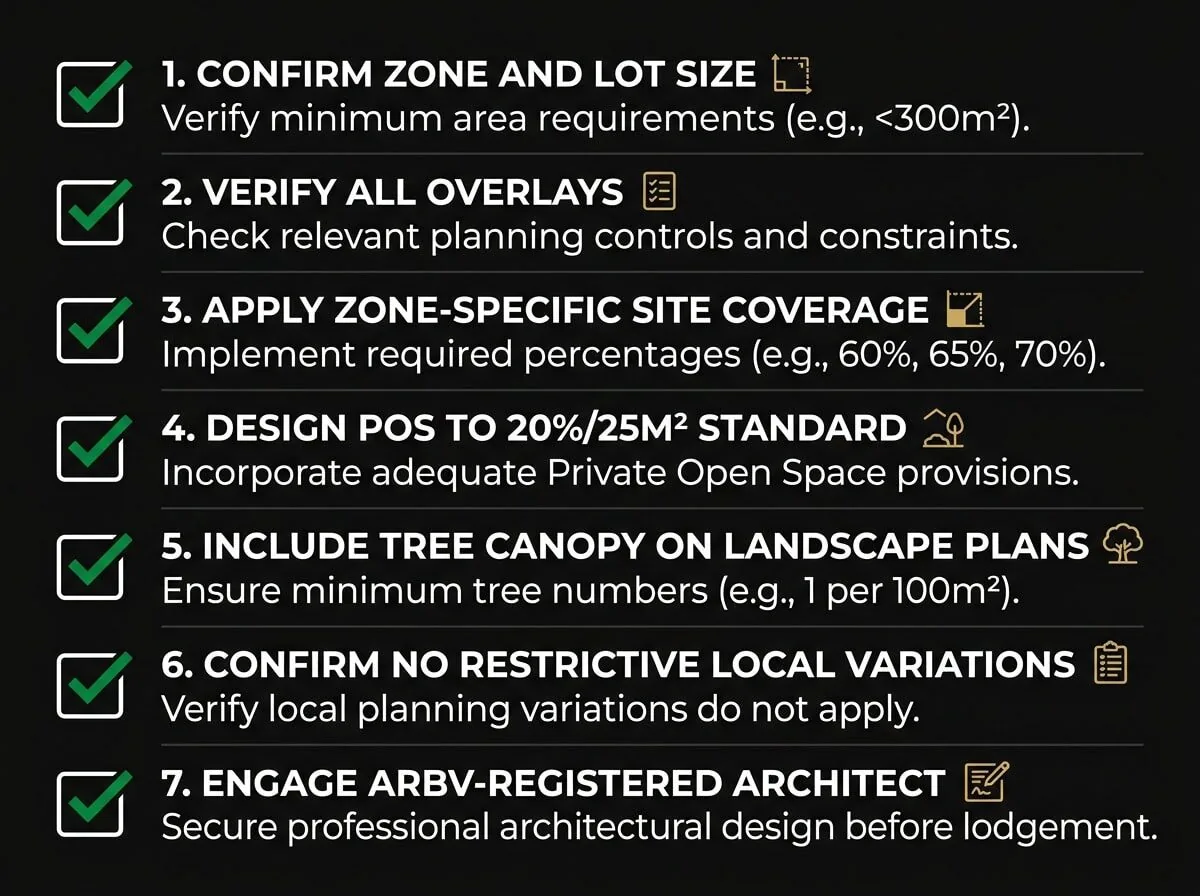
- Confirm lot size and zone first. Amendment VC282 applies to lots under 300m² in the General Residential Zone, Neighbourhood Residential Zone, Residential Growth Zone, Mixed Use Zone, Housing Choice and Transport Zone, and Township Zone. Low Density Residential Zone sites are excluded.
- Check all overlays before assuming VicSmart eligibility. Heritage Overlays, Neighbourhood Character Overlays, Vegetation Protection Overlays, Flood Overlays, and Bushfire Management Overlays may all trigger additional assessment requirements that remove VicSmart eligibility regardless of Clause 54 compliance.
- Model feasibility using the new zone-specific site coverage rates. The shift from a flat 60% to zone-specific rates (60%, 65%, or 70%) may materially change the buildable footprint on your site and should be reflected in updated feasibility modelling.
- Design private open space to the new 20% / 25m² standard. The reduction from 80m² is significant for dual occupancy configurations. Consider balcony or rooftop terrace alternatives where ground-level private open space is constrained.
- Include tree canopy on landscape plans from the outset. The new requirement of one canopy tree per 100m² of site area must be shown on landscape plans submitted with the application. Omitting this is a common compliance issue that can delay or disqualify VicSmart applications.
- Do not rely on local council variations to be more restrictive. The removal of council authority to apply more restrictive local variations for setbacks, permeability, and walls on boundaries means the state standards now apply uniformly. Designs that previously needed to meet more conservative local standards may now comply under the state baseline.
- Engage an architect registered with ARBV early in the feasibility process. The binary compliance framework means design errors identified during assessment carry greater consequences than under the previous discretionary system. Early engagement with a registered architect may reduce the risk of non-compliance at lodgement.
Frequently Asked Questions
Does Amendment VC282 apply to all dual occupancy projects in Melbourne?
Amendment VC282 applies specifically to single dwellings and small second dwellings on lots under 300m² in eligible residential zones. It does not apply to the Low Density Residential Zone, and it does not replace the Townhouse and Low-Rise Code (Clause 55) for developments of two or more dwellings where both are new constructions. Developers should confirm which clause applies to their specific project configuration before proceeding. For a broader comparison of development options, see our guide on knockdown rebuild, dual occupancy, or subdivide.
What is a "small second dwelling" under the new Clause 54?
A small second dwelling is an additional dwelling on the same lot as an existing dwelling, typically located in the rear yard. Under Standard A2-8, the second dwelling must be set back behind the front wall of the main dwelling and must have safe, independent pedestrian access from the street at least 1m wide. Small second dwellings must meet applicable Clause 54 standards, including a minimum of 8m² of private open space.
Can a small second dwelling be separately titled and sold under VC282?
Amendment VC282 addresses planning permit requirements for small second dwellings but does not in itself enable separate titling. Subdivision into two separate titles requires a separate planning permit process and may be eligible for a VicSmart two-lot subdivision pathway — developers should confirm current amendment provisions and the applicable subdivision pathway with the Responsible Authority or via planning.vic.gov.au.
What happens if my design meets some but not all deemed-to-comply standards?
If a proposal does not meet all applicable deemed-to-comply standards, it is not eligible for the VicSmart pathway and is not exempt from third-party notice and review. The application would be assessed under the standard planning permit process, with the Responsible Authority retaining discretion to consider broader planning scheme matters. This is why achieving full compliance before lodgement is important under the new framework.
Do Heritage Overlays or Neighbourhood Character Overlays override the VC282 standards?
Yes. Overlays operate independently of Clause 54 and may impose additional requirements or trigger a full planning permit process regardless of Clause 54 compliance. In councils such as the City of Boroondara, where Heritage Overlays and Neighbourhood Character Overlays are widespread, many sites may not be eligible for the VicSmart pathway even if the Clause 54 design standards are fully met. Always confirm overlay status as part of initial site due diligence.
How do the new tree canopy requirements affect dual occupancy design?
Standard A2-6 requires one canopy tree per 100m² of site area. For a 250m² lot, this means a minimum of two canopy trees must be provided and shown on landscape plans. The Clause 54 standard is less onerous than the equivalent Clause 55 requirement, which is based on canopy coverage at maturity as a percentage of site area. Trees should be integrated into the landscape design from the earliest design stage to avoid conflicts with building footprint, private open space, or drainage infrastructure.
Are applications lodged before 8 September 2025 affected by VC282?
In most cases, applications for planning permits or amendments to planning permits lodged before 8 September 2025 continue to be assessed under the provisions that applied before Amendment VC282 commenced. Developers with applications already in the system should confirm the applicable framework with the Responsible Authority, as transitional provisions may affect assessment timelines and applicable standards.
What Amendment VC282 Means for Your Next Melbourne Project
Amendment VC282 represents a genuine opportunity for property developers working on small lot infill and dual occupancy projects across Melbourne. The deemed-to-comply framework, reduced street setbacks, increased site coverage limits, more permissive private open space and overshadowing standards, and the updated VicSmart pathway collectively may improve development feasibility and reduce approval risk for compliant projects. The removal of council authority to apply more restrictive local variations for key standards also creates greater consistency across Melbourne councils — a meaningful improvement for developers working across multiple local government areas.
The critical shift is that compliance is now binary. Projects that meet all applicable Clause 54 standards may achieve 10-business-day approvals with no third-party objections. Projects that do not meet the standards face the full discretionary assessment process with no discretionary buffer. Getting the design right before lodgement is no longer just good practice — it is the only reliable path to the faster approval outcomes these reforms are designed to deliver. SQM Architects has worked across numerous projects in Melbourne, with a consistent focus on navigating planning scheme changes and supporting compliant residential development outcomes.
Book a Strategy Call — contact SQM Architects on (03) 9005 6588 to discuss how Amendment VC282 may affect your next Melbourne project.
This article provides general information only. For project-specific guidance, consult with qualified professionals.
SQM Architects – ABN 32 600 928 390, ARBV Reg. No. 51498