
Why Property Developers Need Architects: The Business Case
For property developers in Melbourne, every project decision impacts your bottom line. Whether you’re planning a dual occupancy in Whitehorse, a townhouse development in Boroondara, or a subdivision in Knox, one question consistently arises: is hiring an architect worth the investment?
Recent project data tells a compelling story. Data from recent projects shows developers working with registered architects may achieve approval rates around 98% compared to approximately 67% for non-architect-led applications. Market data suggests architect-designed developments may command rental premiums of 12-18% and resale values up to 17% higher than comparable properties. With Melbourne’s 2025-26 planning reforms introducing stricter design standards, professional architectural input has become increasingly important for profitable development.
This article examines ten specific benefits architects may deliver to property developers, backed by current market data and regulatory requirements. Understanding these advantages helps you make informed decisions about your development team and project approach.
Benefit 1: Site Feasibility Analysis and Development Potential Assessment
Before committing capital to a development site, you need accurate information about what’s achievable. Architects conduct comprehensive site feasibility studies that examine zoning overlays, planning scheme requirements, site constraints, and development potential. This analysis typically costs $2,500-$4,500, and it is what tells you whether a site supports the yield your numbers assume — before you commit capital to it.
A feasibility study from a registered architect includes detailed analysis of ResCode requirements, neighbourhood character overlays, heritage controls, and bushfire management overlays where applicable. For sites in the City of Boroondara or Manningham City Council areas with strict character provisions, this analysis identifies potential planning objections before you purchase.
The study also provides preliminary yield analysis. For example, a 700sqm site in Whitehorse might accommodate two dwellings under standard provisions, but an architect can identify opportunities for three dwellings through clever design that meets garden area, private open space, and setback requirements. This difference could represent approximately $180,000-$250,000 in additional development value, subject to market conditions.
Architects also assess site-specific constraints like easements, significant trees, contamination risks, and access limitations. They engage with utility providers early to confirm service availability and connection costs. This upfront investigation may prevent costly surprises during the planning permit application process.
Benefit 2: Maximising Development Yield Within Planning Controls
Melbourne’s planning schemes contain complex provisions that determine what you can build. Architects specialising in multi-unit development understand how to optimise yield while maintaining planning approval prospects. This expertise directly impacts your project’s financial viability.
Consider a typical 800sqm site in Knox City Council’s General Residential Zone. Standard interpretation might suggest two dwellings. However, an experienced architect can often achieve three dwellings by carefully managing building height, setbacks, and site coverage while demonstrating compliance with ResCode objectives. The additional dwelling may represent approximately $220,000 in potential development value, subject to market conditions and project-specific factors.
Architects achieve this through detailed knowledge of planning scheme provisions. They understand when numeric standards can be varied through design excellence, which councils accept alternative solutions, and how to present applications that address decision-maker concerns. This knowledge comes from completing 50+ planning applications annually in specific council areas.
The 2025 planning reforms introduced updated apartment design standards and increased focus on environmentally sustainable design. Architects familiar with these changes can incorporate compliant features from the design stage, avoiding costly redesigns during planning assessment. Features like solar access, natural ventilation, and waste management integration are now assessed more rigorously.
Get the 7-point site check to run before committing to a permit application — zoning, overlays, setbacks and council red flags, in plain English. Free PDF, instant download.
- Zone, overlay & setback checks
- What council assesses first
- Permit-readiness red flags
Something went wrong. Please try again.
No spam. Unsubscribe anytime.
Check your inbox — your checklist is on its way.
Benefit 3: Planning Permit Success and Faster Approvals
Planning permit applications prepared by registered architects may achieve significantly higher approval rates. SQM Architects has achieved a 98% planning approval rate across completed projects to date, compared to industry averages of approximately 67% for non-architect applications. This difference stems from understanding what planning officers and VCAT members look for in applications.
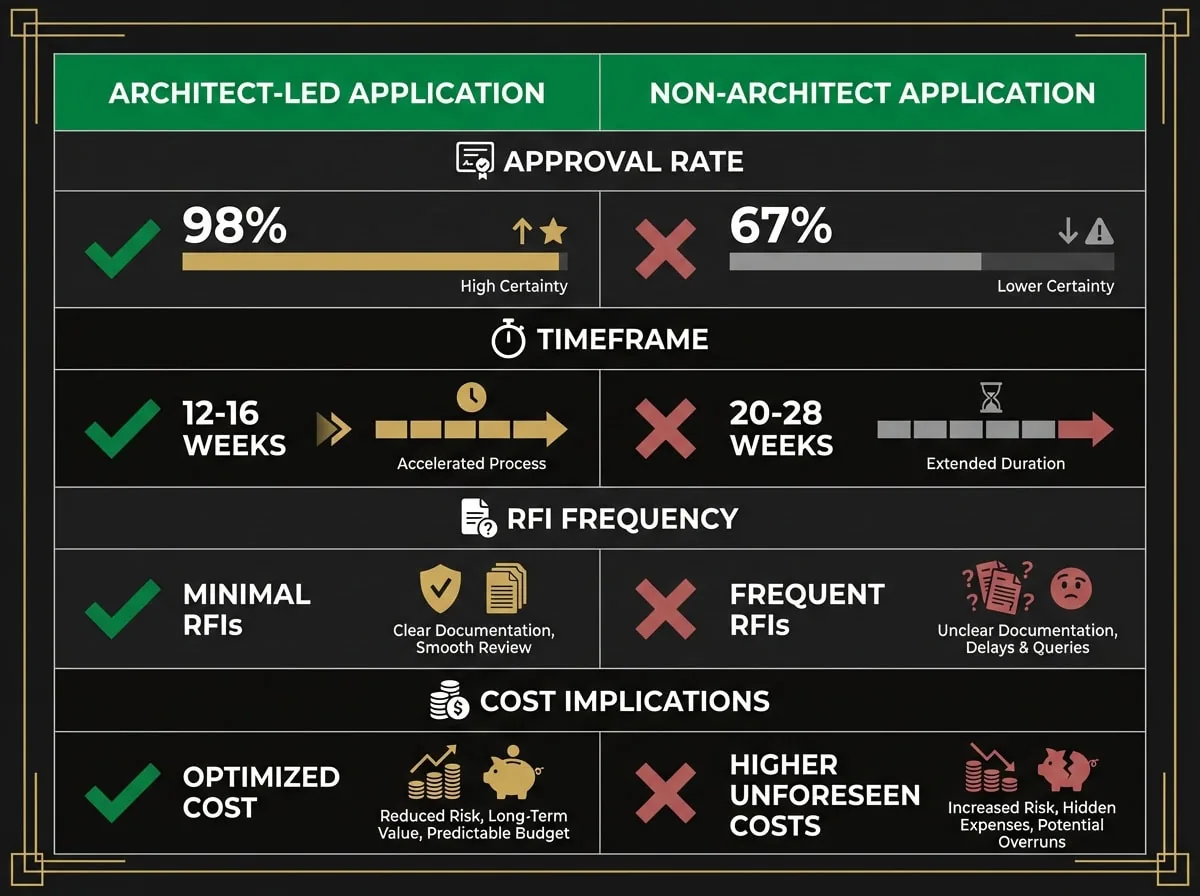
Architects prepare applications that address planning scheme requirements comprehensively. They provide detailed design responses to ResCode standards, neighbourhood character assessments, and traffic impact analysis. Applications include shadow diagrams, 3D visualisations, and materials boards that demonstrate design quality and context sensitivity.
This thoroughness reduces requests for further information, which typically add 4-8 weeks to assessment timeframes. For a development project with holding costs of $8,000-$12,000 monthly, faster approvals could save approximately $32,000-$96,000 in financing costs, depending on project circumstances. The architect’s fee of $15,000-$25,000 for a dual occupancy application could potentially deliver financial return in many cases, though outcomes vary by project.
When objections arise, architects prepare planning responses that address concerns while maintaining project viability. They attend planning meetings, present at council hearings, and represent your interests at VCAT if required. This advocacy protects your development investment and increases approval prospects.
Benefit 4: Compliance with Building Regulations and Construction Standards
Victorian building regulations govern structural requirements, fire safety, accessibility, and energy efficiency. Non-compliant designs create liability risks, construction delays, and costly rectification. Architects ensure designs meet Building Code of Australia requirements from the outset.
The 2024 National Construction Code introduced updated energy efficiency standards. New dwellings must achieve 7-star NatHERS ratings, with specific requirements for thermal performance, glazing, and insulation. Architects incorporate these requirements during design development, selecting appropriate materials and construction methods that meet standards cost-effectively.
Accessibility compliance under AS1428 affects unit layouts, bathroom design, and circulation spaces. Architects design compliant spaces that don’t compromise functionality or appeal. They understand which accessibility features are mandatory and which provide market advantages for aging-in-place buyers.
Fire safety requirements for multi-unit developments include fire-rated construction, smoke detection systems, and emergency egress paths. Architects coordinate with fire engineers to develop compliant solutions that minimise construction costs. They also ensure designs meet bushfire attack level requirements in designated areas across Knox and Maroondah councils.
Benefit 5: Construction Documentation That Prevents Builder Disputes
Comprehensive construction documentation prevents misunderstandings, variations, and disputes during building. Architects prepare detailed drawings, specifications, and schedules that clearly communicate design intent to builders. This documentation forms the basis of your building contract and protects your interests.
Construction documents include architectural plans, elevations, sections, and details at appropriate scales. They specify materials, finishes, fixtures, and fittings with product codes and suppliers. Detailed specifications cover workmanship standards, installation methods, and quality requirements for every building element.
This level of detail enables accurate builder pricing. When three builders price from comprehensive documentation, quote variations typically range 5-8%. Incomplete documentation produces quote variations of 15-25%, making project budgeting difficult and increasing dispute risks during construction.
Architects also prepare tender documentation that establishes clear contractual terms. They review builder quotes for completeness, identify exclusions, and advise on contract structures that oversee project quality. This review process prevents common issues like provisional sum disputes and variation claim disagreements.
Benefit 6: Design Quality That Commands Premium Prices
Well-designed developments may achieve higher sales prices and rental returns. Market data from Melbourne suggests architect-designed townhouses may command 12-15% rental premiums and sell 8-12% faster than comparable builder-designed products. This premium directly impacts your development return.
Architects create designs that respond to site conditions, maximise natural light, and provide functional layouts. They consider how spaces flow, where storage integrates, and how outdoor areas connect to living spaces. These design decisions create homes people want to live in, not just buildings that meet minimum standards.
Material selection and detailing quality distinguish architect-designed developments. Architects specify durable, low-maintenance materials that age well and reduce long-term ownership costs. They detail junctions, transitions, and connections that prevent common building defects and create visual cohesion.
For developers building to hold, design quality impacts long-term asset value. Properties with good natural light, efficient layouts, and quality finishes maintain rental appeal and require less frequent updating. A $25,000 investment in better design could potentially generate $4,000-$6,000 additional annual rental income across a three-unit development.
Benefit 7: Environmentally Sustainable Design That Reduces Operating Costs
Sustainable design features reduce utility costs for occupants and increase property appeal. With Melbourne electricity prices averaging $0.28-$0.35 per kWh in 2025, energy-efficient homes deliver measurable savings. Architects incorporate passive design principles that may reduce heating and cooling loads by 30-40%.
Passive design strategies include building orientation for solar access, appropriate glazing ratios, thermal mass integration, and natural ventilation. These features cost little to implement during design but deliver ongoing benefits. A well-oriented home with good insulation and appropriate shading could save occupants $800-$1,200 annually in energy costs.
Architects also design for water efficiency through rainwater harvesting, greywater systems, and water-efficient fixtures. These features meet planning permit conditions in water supply protection areas and appeal to environmentally conscious buyers. Installation costs of $8,000-$12,000 for rainwater systems add market value while reducing ongoing water bills.
The 2025 planning reforms increased focus on sustainable development. Councils now assess environmentally sustainable design more rigorously, requiring detailed responses on energy, water, and waste management. Architects familiar with these requirements incorporate compliant features from the design stage, avoiding planning delays.
Benefit 8: Risk Management and Professional Indemnity Protection
Registered architects carry professional indemnity insurance covering design errors and omissions. This insurance protects developers from financial losses arising from design defects. Minimum coverage requirements under Victorian law are $1.5M for residential projects, with most architects carrying $5M-$20M coverage.
Professional indemnity insurance covers design errors that result in financial loss, including non-compliant designs, inadequate documentation, and incorrect advice. If a design error requires costly rectification during construction, the architect’s insurance responds to cover legitimate claims. This protection is unavailable when working with unregistered designers or draftspeople.
Architects also manage project risks through careful documentation and communication. They maintain project records, confirm instructions in writing, and document design decisions. This record-keeping protects both parties if disputes arise and provides clear evidence of agreed scope and changes.
The Architects Registration Board of Victoria regulates professional conduct and investigates complaints. This regulatory oversight provides recourse if service standards aren’t met. Developers working with registered architects have access to formal complaint processes and disciplinary mechanisms unavailable with unregistered practitioners.
Benefit 9: Builder Coordination and Contract Administration
During construction, architects provide contract administration services that oversee project quality. They review builder progress claims, assess variations, and certify practical completion. This independent oversight ensures builders deliver work according to contract requirements and approved documentation.
Architects conduct regular site inspections to monitor construction quality and compliance with approved plans. They identify defects early, when rectification is simpler and less costly. Site inspections typically occur at key construction stages: footings, frame, lock-up, fixing, and practical completion.
When builders propose variations, architects assess whether changes are necessary, fairly priced, and consistent with design intent. They review variation quotes, negotiate on your behalf, and document agreed changes. This oversight prevents common variation disputes and keeps projects on budget.
At practical completion, architects prepare defects lists identifying work requiring rectification before final payment. They verify defects are rectified and certify the building is complete according to contract requirements. This certification protects you from premature final payment and ensures builders complete all contracted work.
Benefit 10: Project Management and Stakeholder Coordination
Development projects involve multiple consultants: town planners, engineers, surveyors, energy assessors, and building surveyors. Architects coordinate these consultants, ensuring their work integrates and supports project objectives. This coordination prevents conflicts, delays, and cost overruns from poor communication.
Architects engage consultants at appropriate project stages, brief them on requirements, and review their outputs for consistency with design intent. They identify conflicts between consultant reports and resolve issues before they impact construction. For example, if engineering requirements conflict with planning permit conditions, architects develop solutions that satisfy both.
This coordination extends to council and authority liaison. Architects communicate with planning officers, building surveyors, and utility providers on your behalf. They respond to information requests, attend meetings, and negotiate outcomes that protect project viability. This professional representation increases approval prospects and maintains project momentum.
For developers managing multiple projects, architects provide consistent quality standards and processes across your portfolio. They develop design templates, specification libraries, and documentation standards that improve efficiency and reduce errors. This systematisation becomes increasingly valuable as your development business scales.
Understanding Architect Fees and Return on Investment
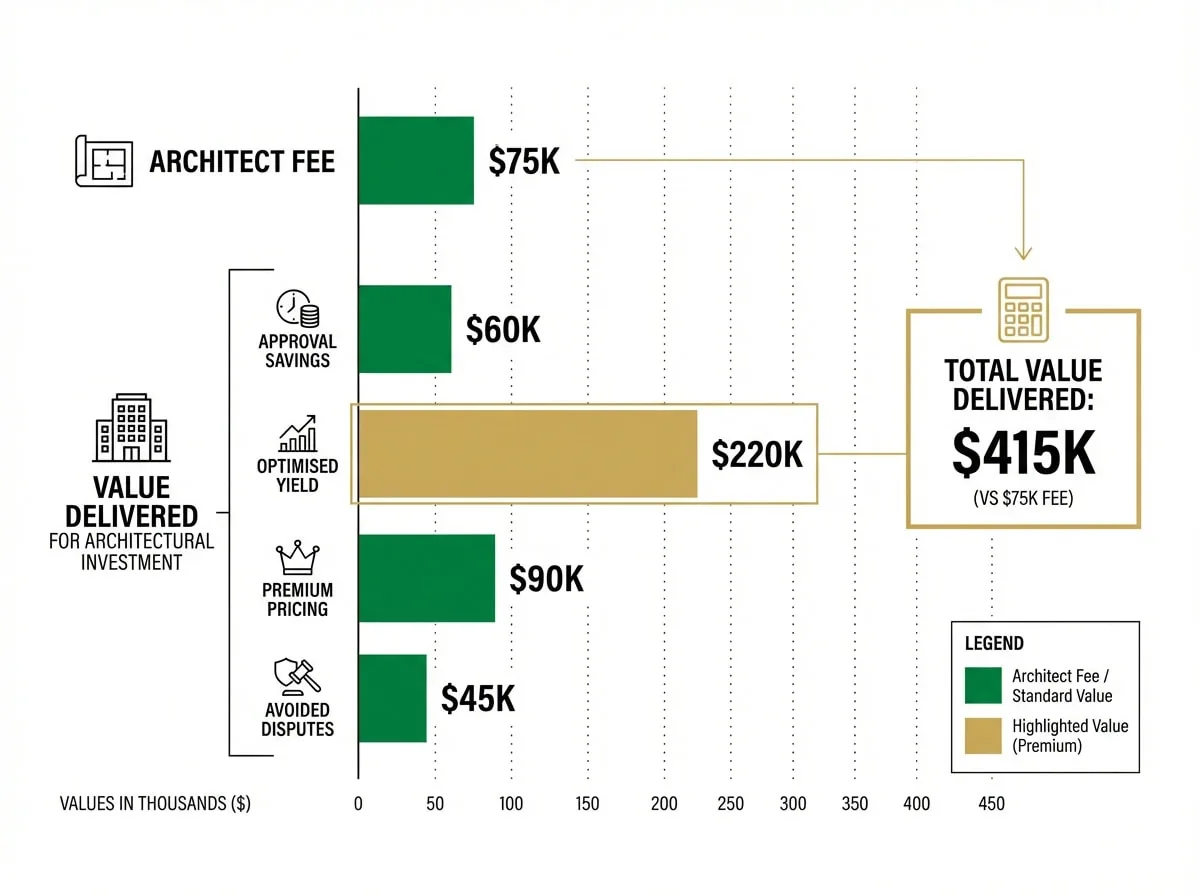
Architect fees for residential development typically range 6-10% of construction value, varying with project complexity and service scope. For a $900,000 dual occupancy project, architectural fees might be $54,000-$90,000. Understanding what this investment delivers helps assess value.
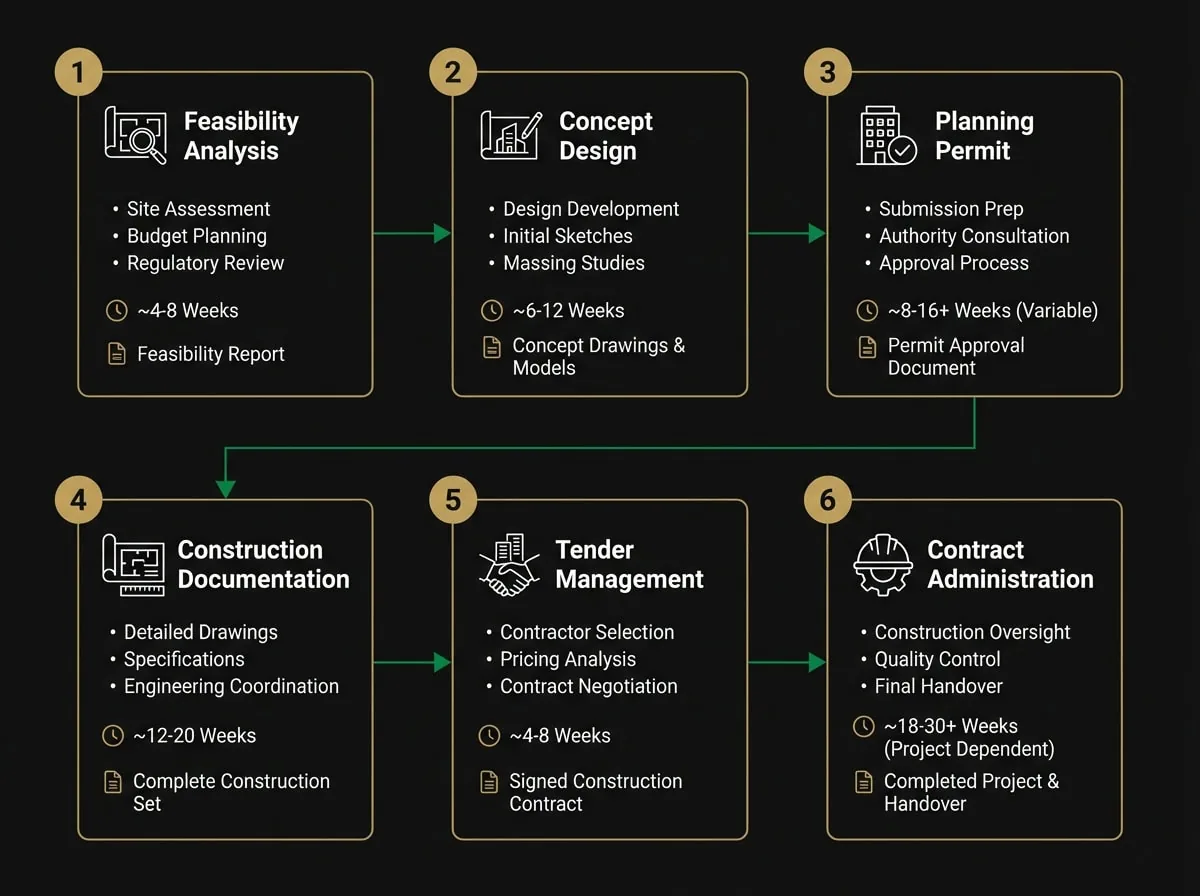
Full architectural services include feasibility analysis, concept design, planning permit application, construction documentation, tender management, and contract administration. Developers can engage architects for specific services only, such as planning permit preparation, with fees adjusted accordingly. Planning permit services alone typically cost $15,000-$35,000 for dual occupancy projects.
The return on architectural investment may come through multiple channels: higher approval rates (potentially saving $40,000-$80,000 in holding costs), optimised yield (potentially adding $180,000-$250,000 per additional dwelling), premium pricing (potentially generating 12-15% higher returns), and reduced construction disputes (potentially avoiding $30,000-$60,000 in variation costs).
For a typical three-unit townhouse development in Whitehorse, architectural fees of $75,000 could potentially deliver value through various channels. These figures are indicative examples only based on historical project data and depend heavily on project-specific factors, market conditions, and individual circumstances. Actual outcomes may vary significantly.
Selecting the Right Architect for Development Projects
Not all architects specialise in property development. Selecting an architect with relevant experience increases project success prospects. Look for architects who regularly work with developers, understand financial feasibility, and have strong planning approval track records in your target council areas.
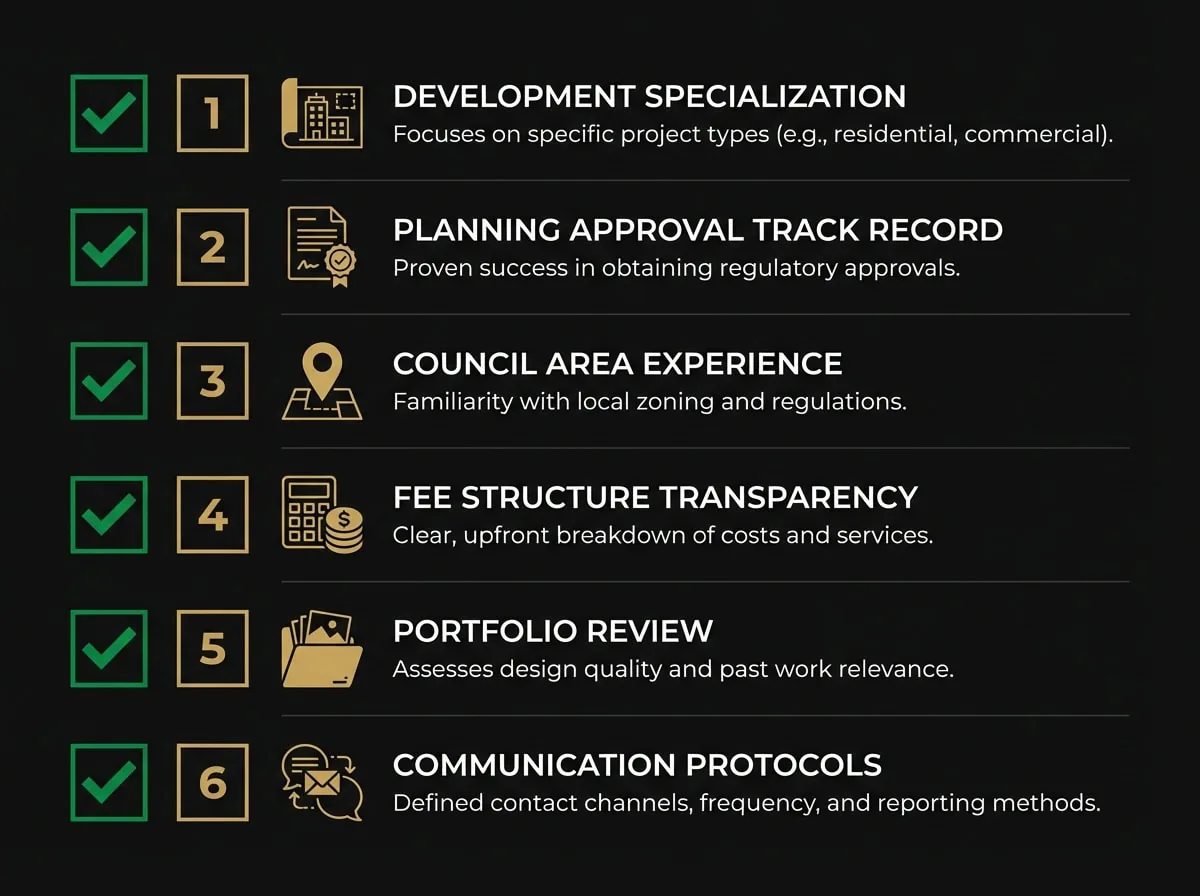
Review the architect’s portfolio for similar project types. An architect experienced in dual occupancy and townhouse developments understands the specific planning and design challenges these projects present. They know which councils accept certain design approaches and which require more conservative solutions.
Ask about planning approval rates and timeframes. Architects should provide specific data: percentage of applications approved without VCAT appeals, average assessment timeframes by council, and examples of successful challenging applications. This information indicates their effectiveness in navigating planning processes.
Discuss fee structures and service scope clearly. Understand what’s included in quoted fees and what constitutes additional services. Clarify communication protocols, response timeframes, and decision-making processes. Clear expectations prevent misunderstandings and maintain productive working relationships.
Frequently Asked Questions
Do I need an architect if I’m using a builder’s standard design?
Builder standard designs often don’t maximise site potential or address specific planning constraints. An architect can assess whether a standard design suits your site or whether custom design would deliver better returns. For sites with overlays, slope, or unusual dimensions, custom architectural design typically delivers superior outcomes worth the additional investment.
How long does the architectural design process take for a dual occupancy?
Concept design through to planning permit lodgement typically takes 8-12 weeks, depending on project complexity and client decision-making. Construction documentation adds another 6-8 weeks after planning permit approval. Total timeframe from engagement to construction-ready documentation: 20-28 weeks, assuming no planning delays.
Can architects help with finance applications and feasibility analysis?
Yes, architects prepare feasibility reports, cost estimates, and visual presentations that support finance applications. These documents demonstrate project viability to lenders and help secure development funding. Many developers engage architects specifically for feasibility analysis before committing to site purchases.
What’s the difference between an architect and a building designer for development projects?
Architects hold university qualifications, professional registration, and mandatory insurance. Building designers have varying qualification levels and aren’t required to hold professional indemnity insurance. For complex developments, planning permit applications, and projects requiring VCAT representation, architects provide greater expertise and protection.
Do architects work with specific builders or can I choose my own?
Reputable architects work with your chosen builder. They prepare documentation suitable for competitive tendering, allowing you to select builders based on price, quality, and reputation. Some architects maintain preferred builder lists based on past performance, but the choice remains yours.
How do architects charge for their services—fixed fee or percentage?
Both structures are common. Percentage fees (6-10% of construction value) suit projects where scope may evolve. Fixed fees provide cost certainty but require clear scope definition upfront. Many architects offer fixed fees for planning permit services and percentage fees for construction documentation and contract administration.
Can I engage an architect just for planning permit approval, then use a draftsperson for construction documentation?
While possible, this approach creates risks. Construction documentation must match planning permit approvals exactly, and draftspeople may not fully understand approved design intent. Architects who prepare planning permits should complete construction documentation to ensure consistency and maintain professional responsibility for the complete design.
Making the Investment Decision
Hiring a registered architect represents a strategic investment in development success. The potential benefits—higher approval rates, optimised yield, premium pricing, regulatory compliance, and risk protection—may deliver measurable financial returns that exceed architectural fees by factors of 4-6x on typical projects.
For property developers in Melbourne, where planning schemes contain complex overlays and councils maintain high design expectations, professional architectural input has become increasingly important. The 2025-26 planning reforms have increased this necessity through stricter design standards and more rigorous assessment processes.
The question isn’t whether you can afford to hire an architect—it’s whether you can afford not to. The difference between a well-designed, efficiently approved development and a problematic project with planning delays and construction disputes may exceed $100,000 on modest dual occupancy projects. For larger townhouse developments, the difference could reach $300,000-$500,000.
Successful developers view architects as essential team members who protect investments, optimise returns, and deliver competitive advantages in challenging markets. If you’re planning development in Whitehorse, Boroondara, Manningham, Monash, Knox, or Maroondah, engaging an experienced architect early in the process positions your project for success.
Book a Strategy Call: Contact SQM Architects on (03) 9005 6588 to discuss your development project and receive a complimentary site assessment. Our team has delivered 210+ successful projects across Melbourne.
This article provides general information about Victorian planning for property developers. It does not constitute professional advice. For specific guidance on your project, contact SQM Architects (ARBV Reg. No. 51498) for a complimentary site assessment.