Building Setbacks Victoria: What Property Developers Need to Know About VC282
Victoria’s building setback rules changed fundamentally on 8 September 2025 when Amendment VC282 took effect. For property developers working on single dwellings and small second dwellings on lots under 300m², these changes represent the most significant shift in residential planning standards in a generation. The new rules align Clause 54 (single dwellings) with the Townhouse and Low-Rise Code introduced earlier in 2025, creating a streamlined, deemed-to-comply framework that removes much of the discretionary assessment that previously delayed projects.
Understanding these updated setback requirements is critical for developers in Melbourne’s Eastern Suburbs. The changes affect everything from street frontage distances to side boundary setbacks, tree canopy requirements, and solar protection standards. More importantly, projects that meet the new standards may qualify for VicSmart assessment—a 10-business-day approval pathway with no third-party objection rights. This article outlines the practical implications of VC282 for developers, with specific focus on how the changes could affect development feasibility and approval timeframes.
What Changed Under Amendment VC282
Amendment VC282 restructured Clause 54 to create consistency with Clause 55 (the Townhouse and Low-Rise Code) that was updated via Amendment VC267 in April 2025. The changes apply to single dwellings and small second dwellings on lots under 300m² in the General Residential Zone, Neighbourhood Residential Zone, Residential Growth Zone, Mixed Use Zone, Housing Choice and Transport Zone, and Township Zone.
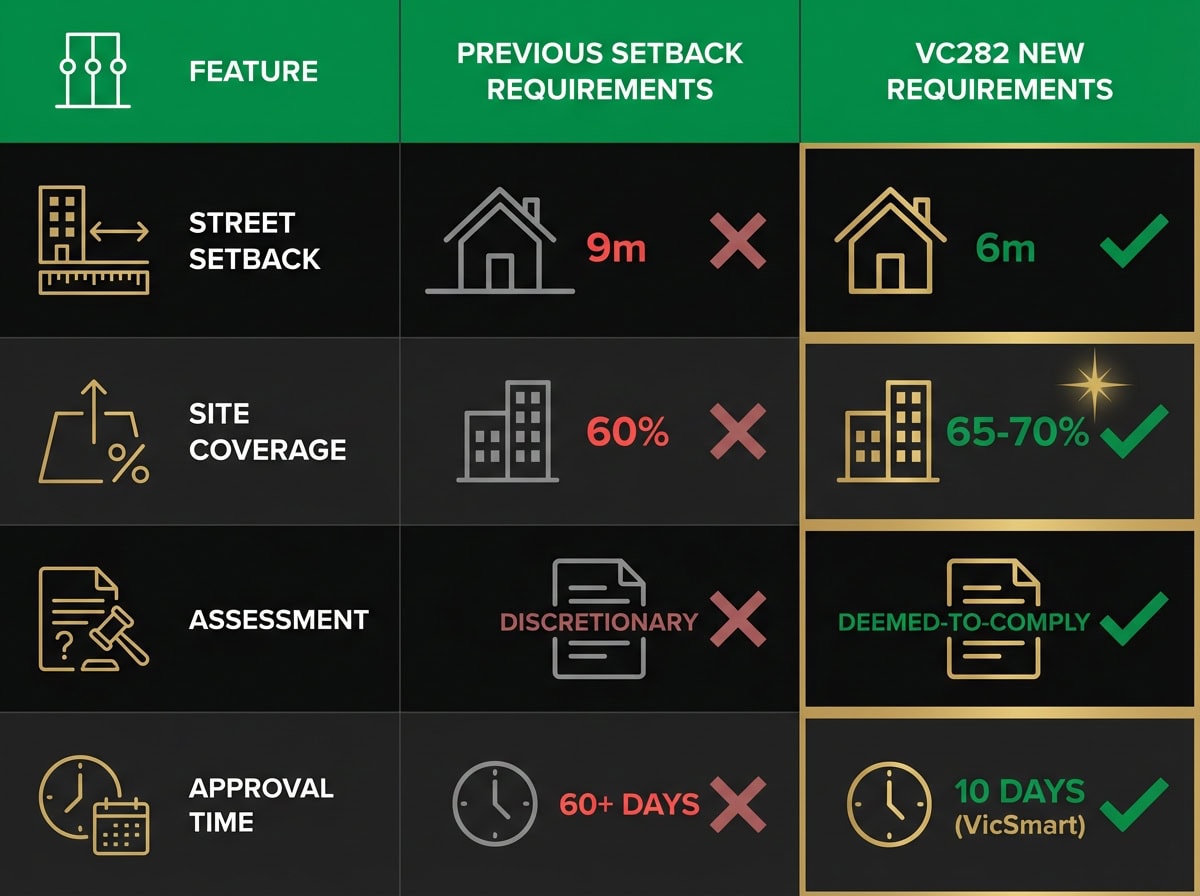
The most significant change is the introduction of deemed-to-comply standards. When your design meets a standard, the corresponding objective is automatically satisfied. The Responsible Authority cannot apply additional guidelines, policies, or discretionary assessment to that standard. This removes the subjective neighbourhood character considerations that previously caused delays and uncertainty in the approval process.
For developers, this means projects that comply with all Clause 54 standards may be approved within 10 business days under the VicSmart pathway, with no advertising and no third-party appeal rights. Applications lodged before 8 September 2025 continue under the previous rules, providing transitional protection for projects already in the system.
Street Setback Requirements Under VC282
The standard street setback has been reduced from the previous 9m requirement to a more development-friendly formula. Under Standard A2-1, the required street setback is now the lesser of 6m or the average of the two adjoining dwellings. On streets in Transport Zone 2 (typically main roads), the minimum setback is 4m.
This change could significantly improve development feasibility on smaller lots. For example, on a 250m² lot with a 10m frontage, the previous 9m setback consumed 90m² of site area before any side or rear setbacks were applied. The new 6m standard reduces this to 60m², providing an additional 30m² for building footprint or private open space.
The setback is measured from the title boundary to the front wall of the dwelling, excluding eaves, fascias, gutters, masonry chimneys, landings, and unenclosed porches that project no more than 1m. Balconies and verandahs at ground floor level can also project into the setback, provided they remain at least 2m from the boundary.
In the City of Boroondara and City of Whitehorse, where many properties have established street setbacks of 7-8m, the new rules provide flexibility. If neighbouring properties have setbacks of 7m and 8m, your required setback is 7.5m (the average), not the full 9m that would have applied previously. This averaging approach recognises existing streetscape patterns while allowing more efficient use of land.
Side and Rear Setback Standards
Standard A2-3 clarifies the formulas for side and rear setbacks, removing previous ambiguities that caused disputes during assessment. For walls up to 3.6m in height, the minimum setback is 1m from the side or rear boundary. As wall height increases, the setback increases proportionally.
The formula works as follows: for walls between 3.6m and 6.9m in height, add 0.3m of setback for each metre of height above 3.6m. For walls exceeding 6.9m, add 1m of setback for each metre of height above 6.9m. This means a 5m high wall requires a 1.42m setback, while an 8m high wall requires a 2.1m setback.
These setbacks apply to habitable room windows and walls containing them. Non-habitable spaces like garages, bathrooms, and laundries can be built closer to boundaries, subject to the Building Regulations in Victoria. This distinction allows more efficient site planning, particularly on narrow lots where maximising internal layout flexibility is critical.
Standard A2-4 retains the ability to build walls on boundaries, subject to specific height and length limits. A wall on a side or rear boundary can be up to 3.6m high and 9m long, or up to 3.2m high if the length exceeds 9m. This provision is particularly useful for garages, carports, and service areas that don’t require setbacks for amenity reasons.
Site Coverage and Building Envelope Changes
Standard A2-5 introduces zone-specific site coverage limits that replace the previous one-size-fits-all approach. In the Neighbourhood Residential Zone and Township Zone, maximum site coverage is 60%. In the General Residential Zone, it increases to 65%. In the Residential Growth Zone, Mixed Use Zone, and Housing Choice and Transport Zone, coverage can reach 70%.
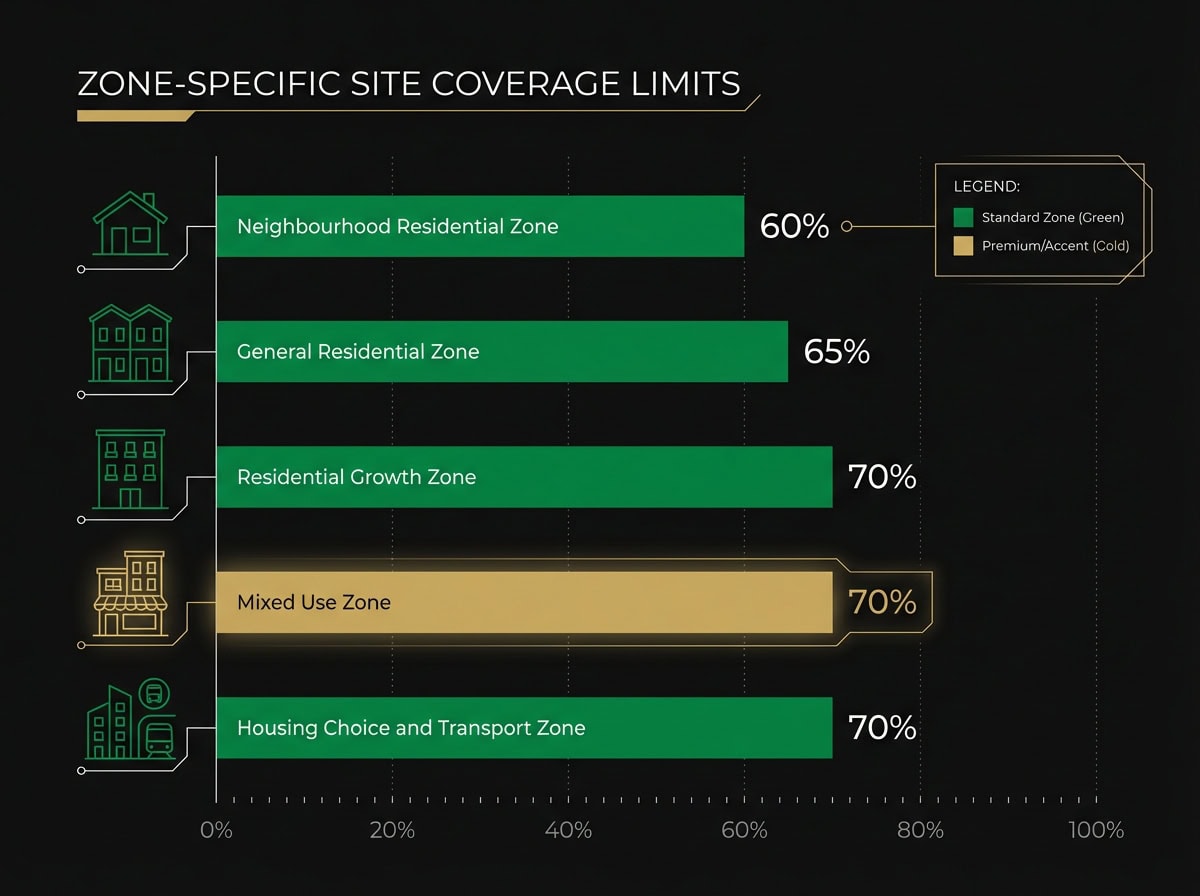
These increased coverage limits reflect the Victorian Government’s housing supply objectives. On a 250m² lot in the General Residential Zone, you can now build up to 162.5m² of building footprint (65% coverage), compared to 150m² under the previous 60% limit. This additional 12.5m² of footprint could accommodate an extra bedroom, larger living areas, or improved circulation space.
Site coverage includes all roofed areas, including garages, carports, and covered outdoor areas. Eaves and fascias projecting less than 600mm are excluded from the calculation. Uncovered decks, terraces, and pathways are also excluded, allowing you to maximise outdoor amenity without consuming coverage allowance.
Building height under Standard A2-2 remains at 9m, or 10m on sloping sites where the natural ground level falls more than 2.5m across the building footprint. Height is measured from natural ground level to the roof ridge, excluding chimneys and other minor projections. This standard hasn’t changed under VC282, maintaining consistency with previous requirements.
Tree Canopy Requirements: Standard A2-6
Standard A2-6 introduces mandatory tree canopy requirements that didn’t exist in previous versions of Clause 54. The number of canopy trees required depends on lot size: one tree for lots between 100-200m², two trees for lots between 200-300m², and three trees for lots over 300m² (though Clause 54 primarily applies to lots under 300m²).
Each canopy tree must be planted in a minimum soil volume of 10m³, with at least 4m² of surface area available for planting. The trees must be capable of reaching at least 6m in height and 4m in canopy diameter at maturity. This requirement aligns with the broader urban forest strategy and Amendment VC289, which introduced Clause 52.37 (Canopy Trees) across multiple zones.
For developers, this means allocating space for tree planting during site layout design. On a 250m² lot requiring two canopy trees, you need to provide 8m² of planting area (2 trees × 4m² each) with adequate soil depth. This can be achieved through in-ground planting, raised planters, or a combination of both, provided the soil volume and surface area requirements are met.
The tree canopy standard includes exemptions for lots where existing canopy trees are retained, or where site constraints make compliance impractical. However, these exemptions require specific justification and may trigger discretionary assessment. For VicSmart eligibility, meeting the standard as written is typically the most reliable approach.
New Sustainability Standards Under Clause 54.05
VC282 introduced an entirely new section—Clause 54.05 (Sustainability)—that includes four standards not present in previous versions. These standards reflect the Victorian Government’s commitment to energy efficiency and climate adaptation in residential development.
Standard A5-1 requires at least 20% of the site to remain pervious (unpaved). This means permeable surfaces like garden beds, lawns, or permeable paving that allow water infiltration. On a 250m² lot, 50m² must remain pervious. This standard works in conjunction with the site coverage limits, as covered areas are typically impervious.
Standard A5-2 protects existing rooftop solar installations on adjoining properties. New buildings cannot overshadow more than 20% of an adjoining solar panel array between 9am and 3pm on 22 September (the equinox). This protection applies to solar installations that existed before your planning permit application was lodged. For developers, this means conducting solar access analysis early in the design process, particularly on north-facing boundaries where adjoining properties may have solar panels.
Standard A5-3 requires each new dwelling to provide a solar-ready roof area—an unshaded, north-facing roof plane of at least 20m² with a pitch between 10° and 30°. This area must be free from obstructions like chimneys, vents, or complex roof forms that would prevent solar panel installation. The standard doesn’t require actual solar panel installation, but ensures the dwelling can accommodate panels in the future.
Standard A5-4 mandates shading for north-facing windows to block summer sun while admitting winter sunlight. This can be achieved through eaves, awnings, pergolas, or external blinds. The shading must prevent direct sun penetration at noon on 22 December (summer solstice) while allowing sun penetration at noon on 22 June (winter solstice). This passive solar design requirement could improve thermal comfort and reduce cooling energy consumption.
Private Open Space and Liveability Changes
Clause 54.03 (Liveability) includes updated standards for private open space, solar access, and dwelling integration. Standard A3-1 reduces the minimum private open space requirement to 20% of lot area, with at least 25m² having a minimum dimension of 3m. On a 250m² lot, this means 50m² of private open space, with 25m² in a usable configuration.
Importantly, balconies and rooftop terraces now count toward the private open space requirement, provided they meet minimum size and dimension standards. This change is particularly valuable for two-storey developments on small lots, where ground-level open space is limited. A 25m² first-floor balcony can satisfy the minimum usable open space requirement, freeing ground-level area for building footprint or vehicle access.
Standard A3-2 requires private open space to receive at least three hours of sunlight between 9am and 3pm on 22 September. This solar access requirement ensures outdoor areas are usable and comfortable, rather than permanently shaded. On north-facing lots, this is typically straightforward. On south-facing lots, careful design is required to position open space where it receives adequate sunlight.
Standard A3-3 addresses overlooking from new habitable room windows and balconies. Windows and balconies within 9m of a secluded private open space or habitable room window on an adjoining lot must be screened, offset, or sill-raised to prevent direct views. Notably, bedroom windows are no longer subject to overlooking requirements—a significant change from previous standards that required screening for all habitable rooms.
Small Second Dwelling Provisions
VC282 includes specific standards for small second dwellings—additional dwellings on the same lot as an existing dwelling, typically located in the rear yard. Standard A2-8 requires the second dwelling to be set back behind the front wall of the main dwelling, maintaining the primary building’s street presence.
Small second dwellings must have safe, independent pedestrian access from the street, separate from the main dwelling’s entry. This can be a side path, rear lane access, or shared driveway with a clearly defined pedestrian route. The access must be at least 1m wide and comply with accessibility standards.
The same setback, coverage, and sustainability standards apply to small second dwellings as to primary dwellings. On a 250m² lot, both dwellings combined must comply with the 65% coverage limit (in the General Residential Zone), the tree canopy requirement (two trees), and the permeability standard (50m² pervious area). This means careful site planning is essential to accommodate two dwellings while meeting all standards.
Small second dwellings are particularly relevant for developers pursuing subdivision projects. A 500m² lot could potentially be subdivided into two 250m² lots, each with a dwelling, or retained as one lot with two dwellings. The financial and approval implications differ, but both scenarios must comply with Clause 54 standards.
VicSmart Pathway and Approval Timeframes
Projects that meet all Clause 54 standards may qualify for VicSmart assessment under Clause 59. The VicSmart pathway provides 10-business-day assessment, no advertising requirements, and no third-party appeal rights. The Responsible Authority’s CEO or delegate makes the decision, streamlining the approval process.
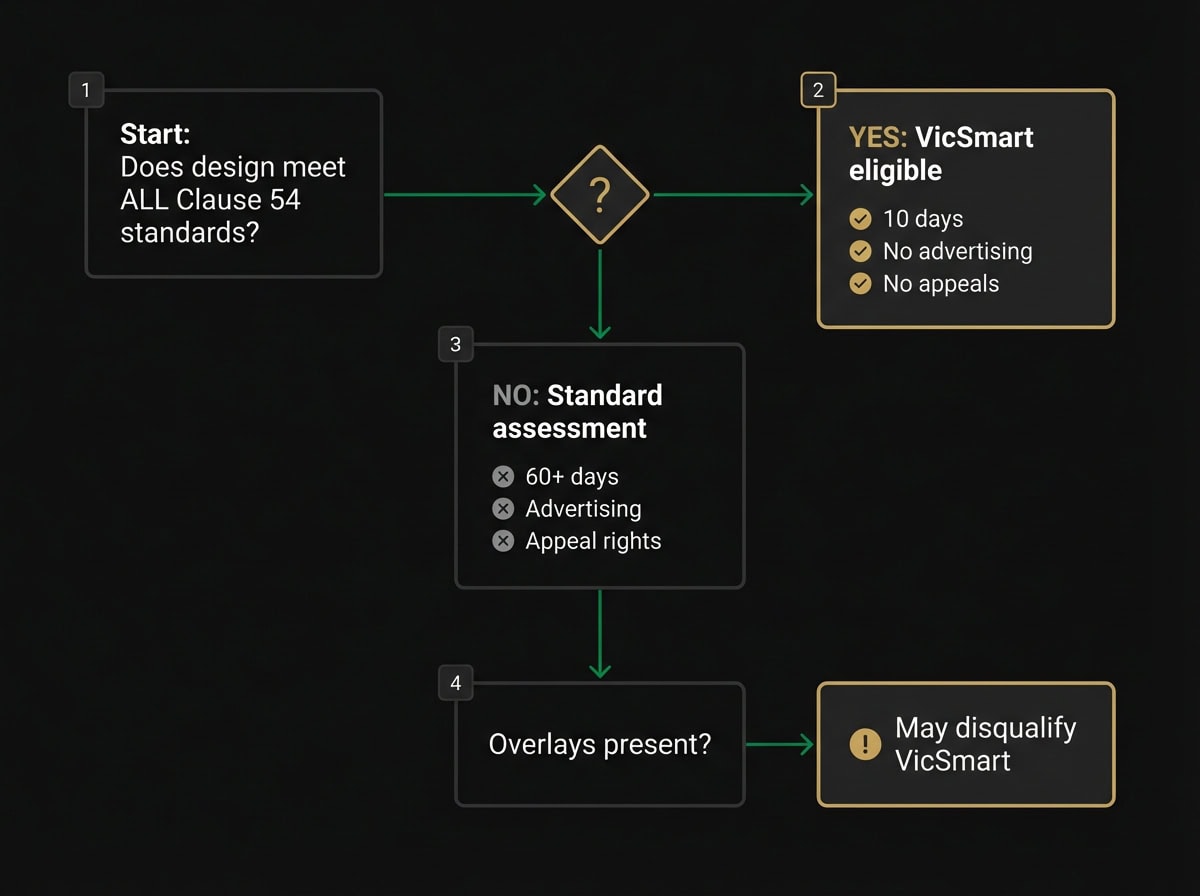
For developers, VicSmart eligibility depends on meeting every applicable standard. If your design complies with street setbacks, side setbacks, site coverage, tree canopy, sustainability standards, and all other requirements, you may qualify. If even one standard isn’t met, the application reverts to standard planning permit assessment with full discretionary consideration, advertising, and appeal rights.
This creates a strong incentive to design for compliance from the outset. The difference between a 10-day VicSmart approval and a 60-day (or longer) standard assessment could significantly affect project cashflow and holding costs. For a development, reducing approval time by 50 days could reduce holding costs substantially (depending on financing arrangements).
Applications lodged before 8 September 2025 continue under the previous Clause 54 rules, including the old VicSmart provisions. Amendments to existing permits also follow the rules that applied when the original permit was issued. This transitional arrangement protects projects already in the system from retrospective application of new standards.
Council-Specific Variations and Overlays
While VC282 standardises Clause 54 across Victoria, local variations still apply through planning scheme schedules and overlays. In the City of Whitehorse, the Neighbourhood Residential Zone Schedule may specify different street setback requirements in certain precincts. In the City of Boroondara, Heritage Overlay controls add design requirements beyond the base Clause 54 standards.
Overlays including the Neighbourhood Character Overlay, Significant Landscape Overlay, Heritage Overlay, and Environmental Significance Overlay continue to apply. These overlays can impose stricter setbacks, material requirements, or design controls than Clause 54. Projects in overlay areas may not qualify for VicSmart, even if they meet all Clause 54 standards, because overlay requirements trigger discretionary assessment.
In Manningham City Council areas with the Neighbourhood Character Overlay, additional design guidelines may require larger street setbacks, specific roof forms, or particular landscaping treatments. These requirements don’t override Clause 54 but add to it, creating a layered assessment framework. Developers should review both Clause 54 and any applicable overlays during feasibility assessment.
The City of Monash and Knox City Council have Vegetation Protection Overlays in certain areas that protect significant trees. These overlays can prevent removal of protected trees and may require design modifications to accommodate tree retention. Tree protection zones typically extend 12 times the trunk diameter, creating substantial constraints on building location and site access.
Practical Implications for Development Feasibility
The VC282 changes could improve development feasibility on small lots in several ways. Reduced street setbacks (6m instead of 9m) provide additional building footprint. Increased site coverage limits (65-70% depending on zone) allow larger dwellings. The deemed-to-comply framework removes discretionary assessment delays and costs.

For a typical 250m² lot in the General Residential Zone, the changes may enable approximately 10-15% more building area compared to previous standards. A dwelling that previously maxed out at 140m² could now reach 155-160m², accommodating an additional bedroom or larger living spaces. This additional area could translate to increased end value (depending on construction costs and market conditions).
The VicSmart pathway reduces approval timeframes from 60+ days to 10 days, potentially saving holding costs and accelerating project commencement. For developers with multiple projects, this efficiency could compound across the portfolio. A developer completing 10 projects per year may save approximately 500 days of cumulative approval time, equivalent to 1.4 years of project delivery capacity.
However, the new sustainability standards add design complexity and cost. Tree canopy requirements consume site area and require ongoing maintenance provisions. Solar protection standards may limit building height or require design modifications. Permeability requirements reduce paving options. These factors must be incorporated into feasibility modelling from project inception.
For related information on setback and site planning considerations in Victoria, you may also find these resources helpful: Overlooking Regulations in Victoria, Site Coverage in Victoria, and ResCode Standards.
Frequently Asked Questions
What is the minimum front setback requirement under VC282?
The minimum street setback is the lesser of 6m or the average of the two adjoining dwellings. On streets in Transport Zone 2 (main roads), the minimum is 4m. This applies to single dwellings and small second dwellings on lots under 300m² in applicable residential zones.
What is the side setback for a single-storey dwelling in Victoria?
Under Standard A2-3, for walls up to 3.6m in height, the minimum side setback is 1m from the boundary. As wall height increases beyond 3.6m, additional setback of 0.3m per metre of extra height is generally required. Non-habitable rooms such as garages may be built closer to or on the boundary, subject to specific height and length limits.
What are the corner lot setback rules under VC282?
Corner lots have two street frontages, each with its own setback requirement. The primary frontage follows the standard 6m (or average of adjoining) setback. The secondary frontage typically requires a minimum 2m setback under Standard A2-1. Both frontages must comply with front fence height limits (1.5m or 2m depending on road zone).
Can I build on the boundary in Victoria?
Yes, under Standard A2-4, a wall on a side or rear boundary may be up to 3.6m high and 9m long, or up to 3.2m high if the length exceeds 9m. This provision is commonly used for garages, carports, and service areas. However, habitable room walls with windows generally need to be set back from boundaries.
Can I apply for a setback variation under the new rules?
If your design does not meet a deemed-to-comply standard, the application reverts to standard planning permit assessment with full discretionary consideration. The Responsible Authority may still approve the application, but it would no longer qualify for VicSmart assessment, meaning longer assessment timeframes, advertising, and potential third-party appeals.
Do tree canopy requirements apply to all lots under 300m²?
Yes, Standard A2-6 requires one canopy tree for lots between 100-200m² and two canopy trees for lots between 200-300m². Each tree must be planted in 10m³ of soil with 4m² of surface area and be capable of reaching 6m height and 4m canopy diameter at maturity.
Do Heritage Overlay controls override Clause 54 standards?
Heritage Overlay controls apply in addition to Clause 54 standards, not instead of them. Projects in Heritage Overlay areas must meet both Clause 54 requirements and Heritage Overlay design guidelines. This typically means stricter setbacks, specific materials, and design review, which may prevent VicSmart eligibility.
How does the solar protection standard work for adjoining properties?
Standard A5-2 requires that new buildings cannot overshadow more than 20% of an adjoining solar panel array between 9am and 3pm on 22 September. This applies to solar installations that existed before your planning permit application. Developers must conduct solar access analysis to ensure compliance.
What happens to applications lodged before 8 September 2025?
Applications lodged before 8 September 2025 continue under the previous Clause 54 rules. Amendments to existing permits also follow the rules that applied when the original permit was issued. This transitional protection ensures projects already in the system aren’t disadvantaged by the changes.
Need Professional Guidance?
If you’re planning a residential development in Victoria and need to understand how corner lot setback rules, side boundary requirements, or the new VC282 standards may affect your project, getting the right advice early is an important step. Contact SQM Architects to discuss how we can assist with your site assessment and planning permit application.
Conclusion
Amendment VC282 represents a fundamental shift in Victoria’s approach to residential development on small lots. The deemed-to-comply framework, reduced setbacks, increased coverage limits, and VicSmart pathway create genuine opportunities for developers to deliver housing more efficiently. Projects that meet the new standards may benefit from 10-day approvals with no third-party objections—a significant improvement over previous discretionary assessment processes.
However, the new sustainability standards, tree canopy requirements, and solar protection provisions add design complexity that must be addressed from project inception. Developers working in Melbourne’s Eastern Suburbs should engage with these requirements early in feasibility assessment, ensuring designs comply with all standards to maintain VicSmart eligibility. The difference between compliant and non-compliant designs could be the difference between 10-day approval and 60+ day assessment with appeal risk.
For developers with existing projects lodged before 8 September 2025, the transitional provisions provide protection. For new projects, designing to the VC282 standards from the outset is essential. The rules are clearer, more objective, and more development-friendly than previous versions—but only if your design meets every applicable standard. SQM Architects has delivered 210+ projects with a 98% planning approval rate, including extensive experience with the new Clause 54 framework across Whitehorse, Boroondara, Manningham, Monash, Knox, and Maroondah council areas.
Get Your Free Site Assessment – Contact SQM Architects on (03) 9005 6588 to discuss how VC282 affects your development project and receive a complimentary feasibility assessment for your site.
This article provides general information about Victorian planning for property developers. It does not constitute professional advice. For specific guidance on your project, contact SQM Architects for a complimentary site assessment.