
Overview: How Clause 58 Shapes Apartment Development in Melbourne
Clause 58 of the Victoria Planning Provisions — the Apartment Developments provisions — is the design framework for Melbourne’s taller apartment buildings. Since Amendment VC300 came into operation in April 2026, it applies to apartment developments of seven storeys or more in the residential zones, and to apartment developments in a set of listed commercial and precinct zones. Projects of four to six storeys are now assessed under Clause 57, and developments of up to three storeys under Clause 55 (the Townhouse and Low-Rise Code).
Clause 58 grew out of the Better Apartments Design Standards, introduced in 2017 to lift the standard of apartment design across Victoria. It covers the full arc of a design — internal room dimensions, daylight, ventilation, balconies, storage, communal open space, landscaping, noise, wind and waste — through a structure of objectives, standards and decision guidelines. Understanding how that structure works, and which figures actually bind a design, is the difference between a feasibility model that survives assessment and one that does not.
When Clause 58 Applies
Under the current clause (Amendment VC300), the provisions apply to an application to construct or extend an apartment development, or a dwelling forming part of one, if either:
- The apartment development is seven storeys or more (excluding a basement) and is in the General Residential Zone, Residential Growth Zone, Housing Choice and Transport Zone, Mixed Use Zone or Township Zone; or
- The apartment development is in the Commercial 1 Zone, Commercial 3 Zone, Special Use Zone, Comprehensive Development Zone, Capital City Zone, Docklands Zone, Priority Development Zone, Activity Centre Zone or Precinct Zone — where the seven-storey threshold does not apply.
The second limb matters for Melbourne: apartment projects inside activity centre and commercial zonings can fall under Clause 58 without reaching seven storeys. Checking the zoning first — not the storey count — is the reliable way to identify the applicable clause. For the broader regulatory picture, see our guide to Victorian building regulations.
Objectives, Standards and Alternative Design Solutions
Clause 58 does not work as a list of fixed rules. It contains three layers, and the distinction between them drives every assessment:
- Objectives must be met. A development must meet all of the objectives of the clause — this is the binding requirement.
- Standards should be met. A standard sets out the requirements to meet its objective, and a design should normally comply. But if the responsible authority is satisfied that an alternative design solution meets the objective, it may consider that alternative.
- Decision guidelines set out what the responsible authority must consider in deciding whether the objectives are met.
Two consequences follow. First, the numbers in Clause 58’s standards are not absolute caps and floors — a well-argued alternative design solution can depart from a standard if it still achieves the objective. Second, the discretion cuts both ways: technical compliance with a standard does not remove the need to satisfy the objectives.
One feature of Clause 58 is unusual and worth knowing: a zone schedule or overlay schedule generally cannot vary its standards. If a schedule specifies a requirement different from a Clause 58 standard, the Clause 58 requirement applies — with one exception, building setbacks under Clause 58.04-1, where the zone or overlay schedule prevails. This is the opposite of how much of the planning scheme works, and it means the clause reads the same in every municipality.
Get the 7-point site check to run before committing to a permit application — zoning, overlays, setbacks and council red flags, in plain English. Free PDF, instant download.
- Zone, overlay & setback checks
- What council assesses first
- Permit-readiness red flags
Something went wrong. Please try again.
No spam. Unsubscribe anytime.
Check your inbox — your checklist is on its way.
Does Clause 58 Set Minimum Apartment Sizes? No — and the Distinction Matters
Victoria’s Clause 58 contains no minimum internal floor areas for apartments. Figures like 50 square metres for a one-bedroom or 65 square metres for a two-bedroom apartment come from the New South Wales Apartment Design Guide — they have no status in a Victorian planning scheme, and importing them into a Victorian feasibility model will misstate both constraint and yield.
What Clause 58 regulates instead is the dimensions of rooms (Standard D26, Clause 58.07-1):
- Main bedroom: minimum 3 metres wide × 3.4 metres deep, plus additional area for a wardrobe
- All other bedrooms: minimum 3 metres × 3 metres, plus wardrobe area
- Living areas (excluding dining and kitchen): minimum 3.3 metres wide and 10 square metres for studios and one-bedroom dwellings; minimum 3.6 metres wide and 12 square metres for two or more bedrooms
Three companion standards shape the floor plate around those rooms:
- Room depth (D27): a single-aspect habitable room should not exceed a depth of 2.5 times its ceiling height. An open-plan room combining living, dining and kitchen may extend to 9 metres if the kitchen is furthest from the window and the ceiling is at least 2.7 metres.
- Windows (D28): habitable rooms should have a window in an external wall. A bedroom may borrow daylight from a smaller secondary area within the room only if that area is at least 1.2 metres wide, no deeper than 1.5 times its width, and the window is clear to the sky.
- Cross ventilation (D29): at least 40 per cent of dwellings should have effective cross ventilation, with a breeze path between openings on different building orientations of at least 5 metres and no more than 18 metres.
In practice these standards, not a floor-area table, are what discipline apartment layouts in Victoria — they make very deep, dark floor plates hard to justify without forcing a uniform apartment size.
Private Open Space, Balconies and Storage
Balconies and Private Open Space (Standard D20)
Each dwelling should have private open space in one of four forms: an area at ground level of at least 25 square metres (minimum dimension 3 metres), a podium area of at least 15 square metres (minimum dimension 3 metres), a roof area of at least 10 square metres (minimum dimension 2 metres) — each with convenient access from a living room — or a balcony meeting Table D8:
- North-facing dwellings (north 20° west to north 30° east): 8 square metres, minimum dimension 1.7 metres — all dwelling types
- South-facing dwellings (south 30° west to south 30° east): 8 square metres, minimum dimension 1.2 metres — all dwelling types
- Any other orientation: studio and one-bedroom 8 square metres / 1.8 metres; two-bedroom 8 square metres / 2 metres; three or more bedrooms 12 square metres / 2.4 metres
Two refinements catch developers out. If a cooling or heating unit sits on the balcony, the minimum area increases by at least 1.5 square metres. And for dwellings with a finished floor level 40 metres or more above ground, the balcony requirement can be substituted with additional internal living or bedroom area — 8 square metres for studios, one- and two-bedroom dwellings, 12 square metres for three or more bedrooms — on top of the minimum room dimensions.
Storage (Standard D21)
Each dwelling should have convenient access to usable, secure storage. Table D10 sets the volumes, split between total storage and storage within the dwelling itself:
- Studio: 8 cubic metres total, of which 5 within the dwelling
- One bedroom: 10 cubic metres total, 6 within the dwelling
- Two bedrooms: 14 cubic metres total, 9 within the dwelling
- Three or more bedrooms: 18 cubic metres total, 12 within the dwelling
The in-dwelling component includes kitchen, bathroom and bedroom storage, and the balance is typically delivered as basement storage cages — which in turn interacts with car park layout and services planning.
Accessibility (Standard D18)
At least 50 per cent of dwellings should provide an accessible suite of features: a clear 850mm opening at the dwelling entrance and main bedroom, a 1.2-metre-wide clear path connecting entrance, main bedroom, adaptable bathroom and living area, and at least one adaptable bathroom meeting the detailed dimensional requirements of Design A or Design B in Table D7.
Communal Open Space, Energy, Noise and Wind
Communal Open Space (Standards D7 and D8)
A development of 10 or more dwellings should provide at least 30 square metres of communal outdoor open space. At 13 or more dwellings, an additional 2.5 square metres per dwelling applies (capped at 220 square metres); the additional component may be indoors or outdoors and split across multiple areas. Communal outdoor areas should be landscaped and include canopy trees.
Solar access is tested at the winter solstice: at least 50 per cent or 125 square metres (whichever is less) of the primary communal outdoor open space should receive a minimum of two hours of sunlight between 9am and 3pm on 21 June. Note the date — apartment communal open space is a winter-sun test, unlike the overshadowing standards for neighbouring open space elsewhere in the scheme, which are assessed at the September equinox. A rooftop communal space strategy should be shadow-tested against the winter figure before it anchors the design; early shadow analysis is far cheaper than a redesign.
Energy Efficiency (Standard D6)
Beyond orientation and solar access principles, D6 sets a measurable ceiling: dwellings should not exceed the maximum NatHERS annual cooling load for their climate zone — 30 MJ/m² in NatHERS climate zone 21 (Melbourne), 21 MJ/m² in zone 62 (Moorabbin) and 22 MJ/m² in zone 60 (Tullamarine), among others. Which zone applies depends on the site, and the figure belongs in the ESD consultant’s brief from day one.
Noise (Standard D16)
Buildings within a defined noise influence area — within 300 metres of an Industrial 1, 2 or 3 zone boundary or of a road carrying 40,000 vehicles a day, within 80 metres of a passenger railway track, or within 135 metres of a metropolitan freight track — should be designed and constructed to achieve internal noise levels of no more than 35dB(A) in bedrooms overnight (LAeq,8h, 10pm–6am) and 40dB(A) in living areas by day (LAeq,16h). Sites along Melbourne’s arterial corridors and rail lines routinely trigger this standard, and it is usually satisfied through an acoustic consultant’s report and façade attenuation measures.
Wind (Standard D17)
For developments of five or more storeys, the built form should not cause unsafe wind conditions, and should achieve comfortable conditions, in public and publicly accessible areas — assessed against quantified gust and mean-speed criteria in Table D6, over a distance of half the building’s greatest length or half its height, whichever is greater. Trees and landscaping cannot be relied on as the mitigation. For taller proposals this generally means specialist wind assessment, and sometimes wind-tunnel testing, before the built form settles.
Landscaping, Canopy and Deep Soil (Standard D10)
Canopy cover and deep soil requirements scale with site area: on sites up to 1,000 square metres, canopy cover of 5 per cent of site area (including at least one tree of 4-metre mature canopy) and deep soil of 5 per cent or 12 square metres, whichever is greater; the requirements step up through the 1,001–1,500, 1,501–2,500 and 2,501-plus bands, reaching 15 per cent deep soil on the largest sites, with larger tree types required. Where deep soil cannot be provided, trees may sit in planters meeting minimum soil volumes. These figures compete directly with basement footprint, and resolving that tension early is one of the more consequential siting decisions on a constrained site.
The Application Package: Urban Context Report and Design Response
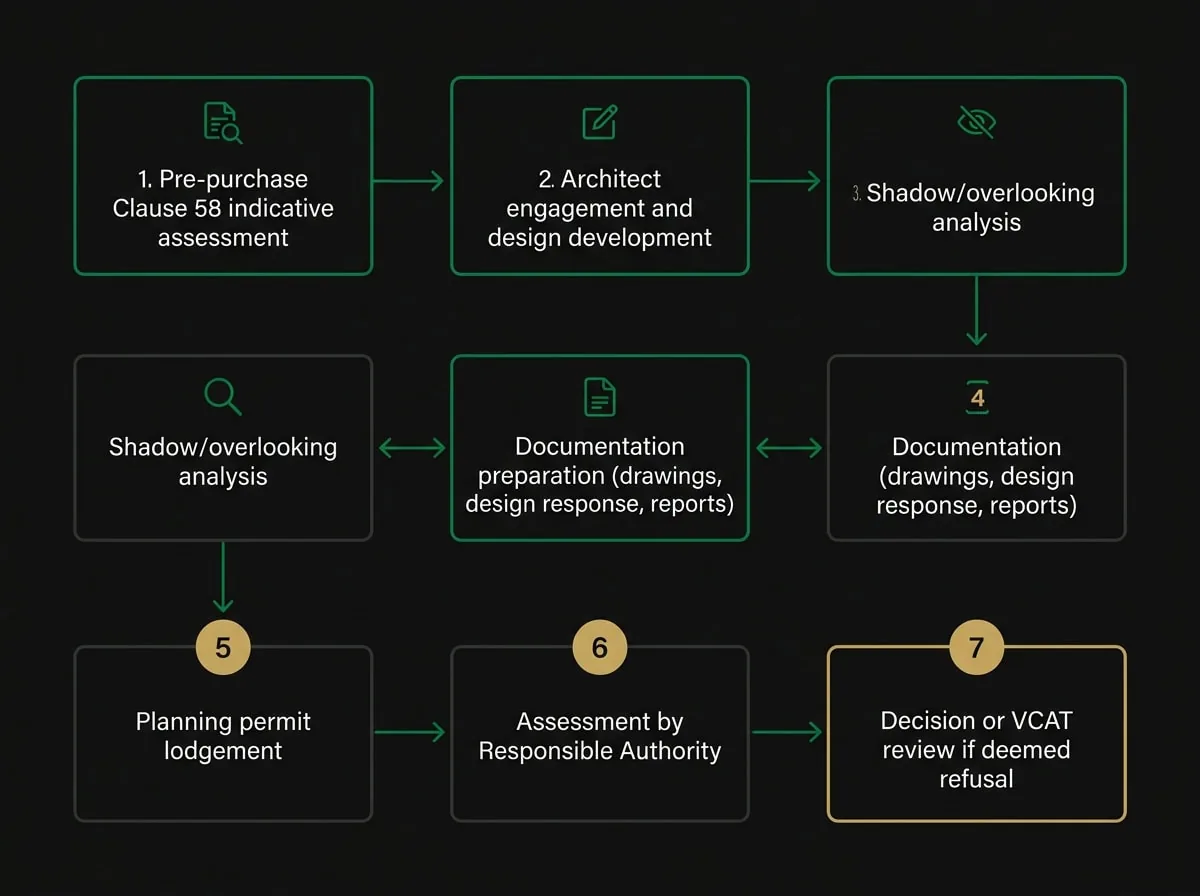
Clause 58.01 requires every application to be accompanied by an urban context report — documenting the site, its levels, surrounding buildings and uses, open space, solar access, movement networks and area character — and a design response explaining how the design derives from that context, meets the objectives of Clause 58, and responds to relevant policy, with correctly proportioned street elevations showing the development against adjacent buildings.
These are not formalities: the responsible authority must not give notice of the application or decide it until it is satisfied the urban context report is satisfactory. A thin report is therefore an invitation for a further-information request before assessment even begins. Our overview of planning drawings covers the documentation set in more detail.
Practical Guidance for Melbourne Developers
Confirm the applicable clause before modelling yield
Since Amendment VC300, the storey bands decide the framework: Clause 55 up to three storeys, Clause 57 for four to six, Clause 58 for seven or more — unless the site sits in one of the listed commercial or precinct zones, where Clause 58 applies to apartment developments regardless of the seven-storey test. Modelling a six-storey project against Clause 58, or a seven-storey activity-centre project against Clause 57, produces the wrong constraint set from the first sketch.
Test the yield against room dimensions, not imported floor areas
Because Victoria regulates room dimensions rather than whole-apartment areas, the honest feasibility question is whether each apartment type can deliver compliant bedrooms, living areas, storage and a balcony within the floor plate — not whether it clears an area threshold from another state’s guide. A preliminary design assessment against D20, D21 and D26–D29 before contract settlement is inexpensive relative to what it prevents.
Front-load the specialist inputs
Noise (D16), wind (D17), the winter-solstice communal open space test (D8) and the NatHERS cooling load (D6) each have quantified pass marks, and each is far easier to meet when the consultant’s input shapes the design rather than audits it. Applications lodged without the supporting technical work tend to accumulate further-information requests, extending the planning permit timeline by weeks or months.
Address overlooking and overshadowing proactively
Objections to taller residential development commonly centre on overlooking and overshadowing. Clause 58’s setback standard (D14) directs designs to avoid direct views into neighbouring habitable rooms and open space without relying on screening, and internal views between dwellings within the development are limited by D15. Preparing the shadow and sightline analysis as part of the application, rather than in response to objections, consistently produces better outcomes.
Frequently Asked Questions
Does Clause 58 set minimum apartment sizes in Victoria?
No. Victoria’s Clause 58 contains no minimum internal floor areas for apartments. Figures such as 50m² for one-bedroom or 65m² for two-bedroom apartments come from the New South Wales Apartment Design Guide and do not apply in Victoria. Clause 58 instead sets minimum room dimensions: a main bedroom of at least 3 × 3.4 metres, other bedrooms at least 3 × 3 metres (each plus wardrobe area), and living areas of at least 10m²/3.3m width for studios and one-bedroom dwellings or 12m²/3.6m width for larger dwellings (Standard D26).
When does Clause 58 apply, as opposed to Clause 55 or Clause 57?
Since Amendment VC300 (April 2026): Clause 55 applies to residential development of up to three storeys, Clause 57 to apartment developments of four to six storeys, and Clause 58 to apartment developments of seven storeys or more in the residential zones. In the listed commercial and precinct zones — including the Commercial 1, Activity Centre and Capital City zones — Clause 58 applies to apartment developments without the seven-storey threshold.
Are Clause 58 standards mandatory?
The objectives are mandatory — a development must meet all of them. The standards should normally be met, but the responsible authority may accept an alternative design solution that it is satisfied meets the objective. Unusually, council zone and overlay schedules generally cannot vary Clause 58 standards; the one exception is building setbacks under Clause 58.04-1, where the zone or overlay schedule prevails.
What are the minimum balcony sizes under Clause 58?
Under Standard D20, a north- or south-facing dwelling needs a balcony of at least 8 square metres (minimum dimension 1.7 metres north-facing, 1.2 metres south-facing). For other orientations: 8m²/1.8m for studios and one-bedroom dwellings, 8m²/2m for two-bedroom, and 12m²/2.4m for three or more bedrooms. A cooling or heating unit on the balcony adds at least 1.5m² to the requirement, and dwellings 40 metres or more above ground can substitute additional internal area instead.
How much storage does each apartment need?
Standard D21 sets total minimum storage volumes of 8 cubic metres for a studio, 10 for one-bedroom, 14 for two-bedroom and 18 for three or more bedrooms — of which 5, 6, 9 and 12 cubic metres respectively must be within the dwelling.
What communal open space does an apartment development need?
Developments of 10 or more dwellings should provide at least 30 square metres of communal outdoor open space; at 13 or more dwellings an additional 2.5 square metres per dwelling applies, capped at 220 square metres (Standard D7). At least 50 per cent or 125 square metres of the primary outdoor area, whichever is less, should receive two hours of sunlight between 9am and 3pm on 21 June (Standard D8).
Does Clause 58 require car parking for apartment developments?
Clause 58 does not set car parking rates — those come from Clause 52.06 of the planning scheme and any applicable local variation. Clause 58 does regulate parking design and location: shared accessways and car parks should sit at least 1.5 metres from habitable room windows (reducible to 1 metre with a 1.5-metre fence or 1.4-metre sills), crossovers should be minimised, and parking entries integrated into the façade.
Designing to Clause 58 From Day One
Clause 58 rewards developers who treat it as a design brief rather than a compliance checklist. Its numbers — room dimensions, balcony tables, storage volumes, the winter-sun test, the noise limits — are specific enough to model at feasibility stage, and its alternative-design-solution pathway gives a well-argued response genuine room to move. SQM Architects has delivered 210+ projects across Melbourne with a 98% planning approval rate, and works with these provisions from the first site assessment.
Book a Strategy Call — contact SQM Architects on (03) 9005 6588 to discuss your apartment project.
This article provides general information about Victorian planning for property developers. It does not constitute professional advice. For specific guidance on your project, contact SQM Architects (ARBV Reg. No. 51498).