Understanding Dual Occupancy Planning Permit Costs in Melbourne
For property developers in Melbourne, dual occupancy developments represent one of the most accessible entry points into medium-density residential projects. However, understanding the true cost of obtaining a planning permit extends well beyond the council application fee. A comprehensive dual occupancy planning permit typically costs between $8,500 and $18,000 when factoring in all professional fees, consultant reports, and council charges—with significant variations depending on your site’s complexity and the responsible authority.
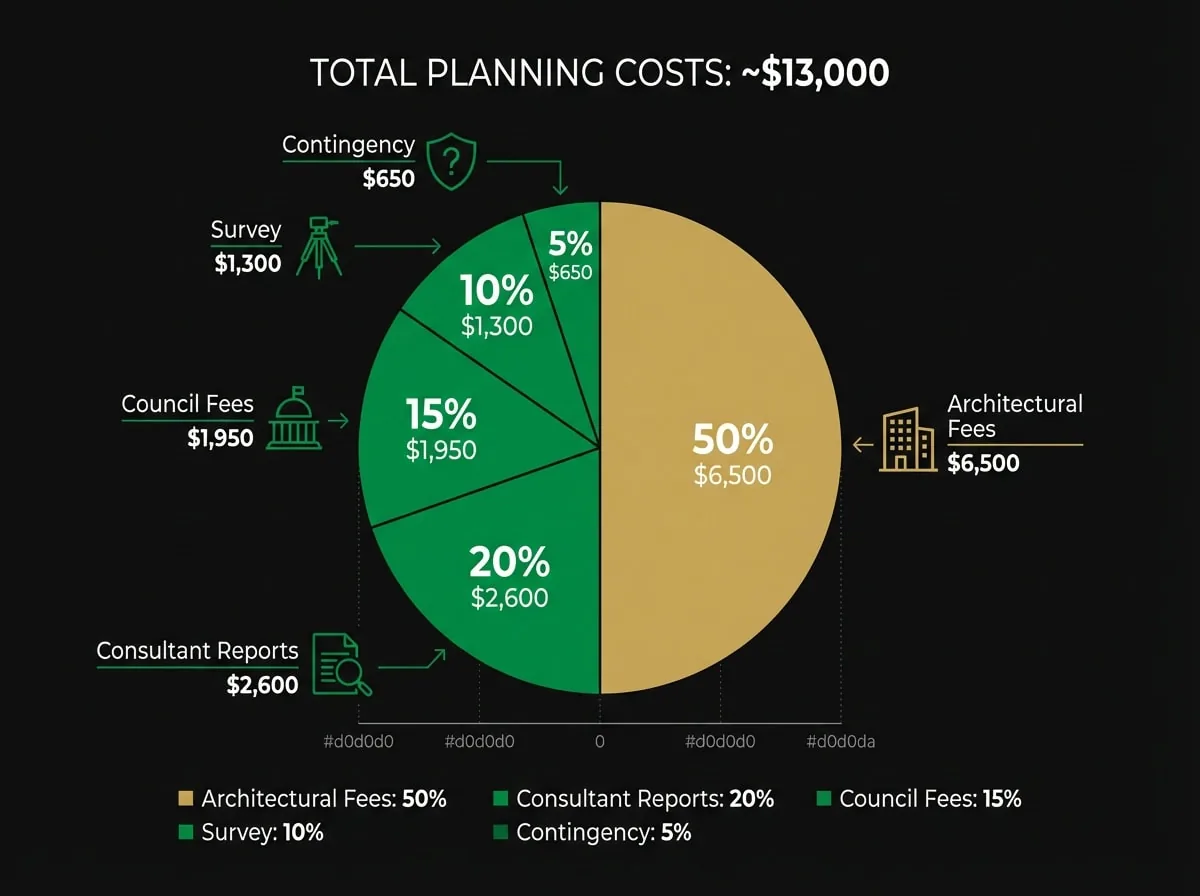
This breakdown matters because underestimating planning costs can erode your development margin before construction even begins. With SQM Architects’ 98% planning approval rate across 210+ projects, we’ve identified that developers who accurately budget for the full planning process from the outset achieve better project outcomes and avoid costly delays. This guide provides a detailed cost breakdown specific to Melbourne’s planning framework, helping you budget accurately for your dual occupancy project.
The planning permit process for dual occupancy in Victoria operates under ResCode (Clause 54 and Clause 55 of the Victorian Planning Provisions), with recent amendments including VC267 and VC282 introducing new deemed-to-comply pathways and updated design standards. Understanding these costs upfront allows you to assess project feasibility before committing significant capital.
The Planning Application Fee Is Set by the State, Not by Your Council
The planning application fee represents your first direct cost, and it is the one cost in this guide that does not vary by municipality. Planning permit application fees are prescribed statewide by the Planning and Environment (Fees) Regulations 2016 and are the same in every Victorian council. Whitehorse, Boroondara, Manningham, Monash, Knox and Maroondah all charge the identical prescribed fee for an identical application. What changes the fee is the class of application and the estimated cost of development — not the responsible authority.
A dual occupancy is a development of two dwellings, so it does not fall into the single-dwelling classes. It is assessed under the development classes in Regulation 9, priced by the estimated cost of development. For the 2026–27 financial year the prescribed fees are $1,338.40 where the estimated cost of development is $100,000 or less (class 11), $1,804.70 where it is more than $100,000 but not more than $1 million (class 12), and $3,980.70 where it is more than $1 million but not more than $5 million (class 13). Most dual occupancy projects in Melbourne sit in class 12. The fees are expressed in fee units and are adjusted on 1 July each year, so confirm the current figure before you lodge.
Amending a permit is priced the same way. Under the amendment classes, an amendment to a class 12 permit attracts the same $1,804.70, and an amendment to a class 11 permit the same $1,338.40 — again prescribed statewide rather than set by the council assessing your application.
Two costs sit outside the prescribed schedule and can genuinely differ between councils. The cost of giving public notice is not covered by the application fee and is quoted separately by each council, so where your dual occupancy triggers third-party notification the notice cost is additional. Councils also set their own charges in their annual budgets for non-statutory services such as extended pre-application advice. Ask your council for both figures before lodgement rather than assuming they are included.
Architectural and Design Fees for Dual Occupancy
Architectural fees for dual occupancy planning applications typically range from $4,500 to $9,500, representing the largest component of your planning permit costs. This investment covers site analysis, concept design, planning drawings, ResCode compliance assessment, and response to council requests for further information. The fee variation depends on site complexity, design requirements, and the level of customisation needed to achieve planning approval.
A standard dual occupancy on a regular rectangular lot with minimal constraints might attract fees at the lower end of this range—around $4,500 to $6,000. This assumes straightforward compliance with ResCode standards under Clause 54 or Clause 55, minimal heritage or vegetation overlays, and a site that doesn’t require extensive design responses to neighbourhood character. SQM Architects structures fees to reflect actual project complexity rather than applying blanket rates, ensuring you pay for the service level your project requires.
More complex sites—those with significant slope, irregular boundaries, heritage overlays, or challenging neighbourhood character requirements—may require fees between $7,000 and $9,500. These projects demand additional design iterations, detailed shadow diagrams, comprehensive landscape plans, and more extensive documentation to demonstrate compliance with planning scheme requirements. Sites in areas like Kew, Camberwell, or Canterbury often fall into this category due to heritage considerations and stringent design guidelines.
The architectural fee should include preparation of all planning drawings: site plan, floor plans, elevations, sections, shadow diagrams, and materials/colours schedule. It should also cover a detailed planning report addressing all relevant ResCode standards and any applicable overlays. Following the introduction of VC267 in March 2025, architects can now utilise deemed-to-comply pathways for certain dual occupancy configurations, potentially reducing design complexity and associated fees for qualifying projects.
Expect 2-3 rounds of revisions included in standard architectural fees, with additional revision rounds charged at hourly rates (typically $180 to $250 per hour). Most dual occupancy applications require at least one response to council’s request for further information, which should be covered within the base fee. However, if council requests substantial redesign—such as reducing building height or increasing setbacks—this may attract additional fees of $1,200 to $2,800 depending on the extent of changes required.
Get the 7-point site check to run before committing to a permit application — zoning, overlays, setbacks and council red flags, in plain English. Free PDF, instant download.
- Zone, overlay & setback checks
- What council assesses first
- Permit-readiness red flags
Something went wrong. Please try again.
No spam. Unsubscribe anytime.
Check your inbox — your checklist is on its way.
Consultant Reports and Technical Assessments
Beyond architectural fees, dual occupancy applications frequently require specialist consultant reports to address specific planning scheme requirements. The need for these reports depends on your site’s characteristics, applicable overlays, and council requirements. Budgeting $1,500 to $4,500 for consultant reports provides realistic coverage for most dual occupancy projects in Melbourne.
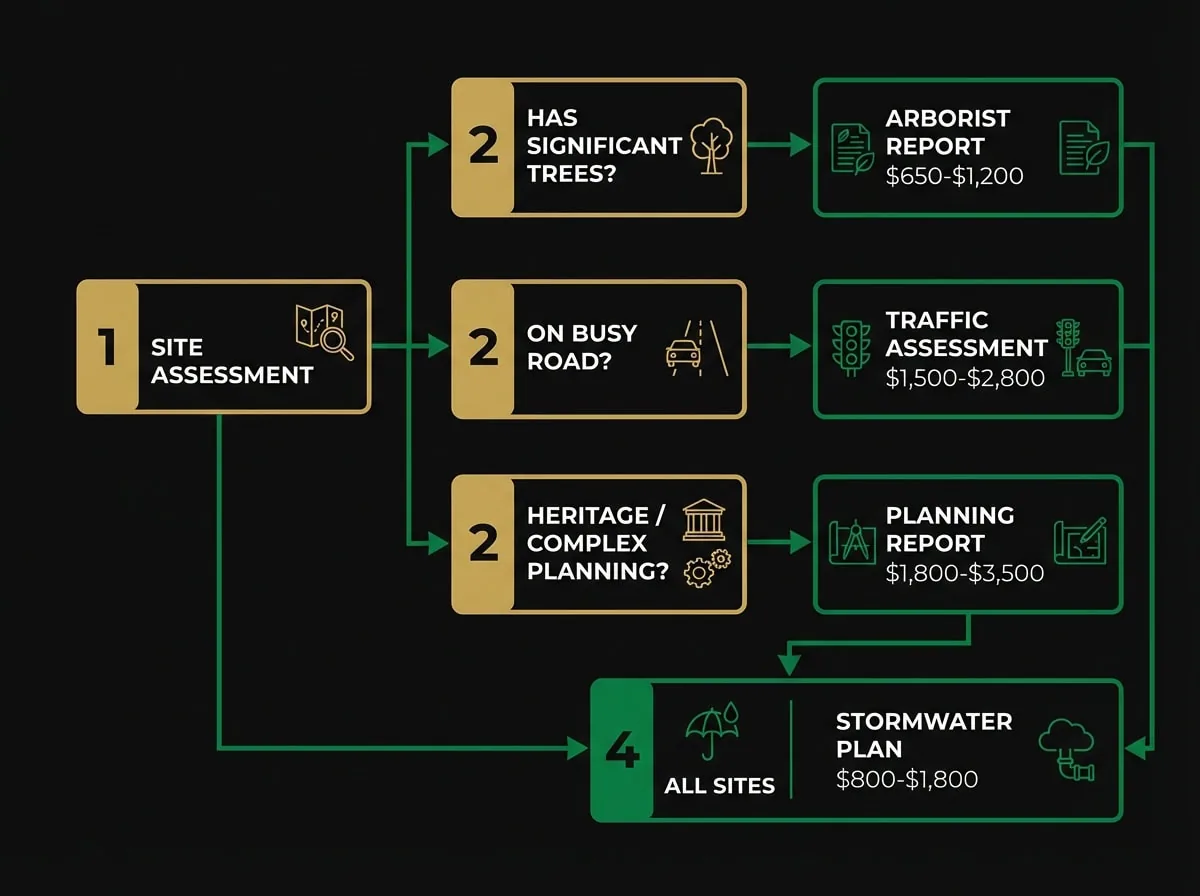
A Town Planning Report is often required for dual occupancy applications, particularly where your proposal seeks variations to ResCode standards or involves complex planning considerations. Town planners charge between $1,800 and $3,500 to prepare a comprehensive planning report that addresses all relevant planning provisions, demonstrates compliance with policy objectives, and provides strategic justification for any standard departures. This report can significantly strengthen your application, particularly in councils with rigorous assessment processes like City of Boroondara or Manningham City Council.
Arborist Reports become necessary when your site contains significant trees or falls within a Vegetation Protection Overlay. Most councils in Melbourne have vegetation protection controls that require assessment of trees with trunk circumferences exceeding 110cm (measured at 1 metre above ground). Arborist reports cost $650 to $1,200 and must be prepared by a qualified arborist (AQF Level 5 or equivalent). The report assesses tree health, structural integrity, and impacts from proposed development, providing recommendations for tree retention or removal.
Stormwater Management Plans are increasingly required by councils to demonstrate compliance with best practice environmental management. These plans, prepared by civil engineers or hydraulic consultants, cost between $800 and $1,800 for dual occupancy developments. They detail how stormwater will be managed on-site, typically incorporating water-sensitive urban design principles such as rainwater tanks, permeable paving, and rain gardens. Following recent updates to Clause 54 and Clause 55 under VC282, councils are placing greater emphasis on sustainable stormwater management.
Traffic Impact Assessments are occasionally required for dual occupancy developments on busy roads or where access arrangements raise safety concerns. These assessments, costing $1,500 to $2,800, evaluate vehicle sight lines, traffic generation, and parking adequacy. They’re most commonly required in Manningham City Council and City of Whitehorse where developments front arterial roads or involve shared driveways serving multiple dwellings.
Waste Management Plans detail how bins will be stored and collected, addressing council requirements for dual occupancy developments. While some architects include basic waste management details in planning drawings, councils may request a dedicated Waste Management Plan prepared by a waste consultant. These plans cost $450 to $850 and demonstrate compliance with council waste management guidelines, particularly important in areas with limited street frontage or shared access arrangements.
Additional Costs and Contingencies
Beyond the core fees outlined above, several additional costs can impact your total planning permit budget. Building a 15-20% contingency into your planning budget accounts for these variables and prevents cost overruns that affect project feasibility.
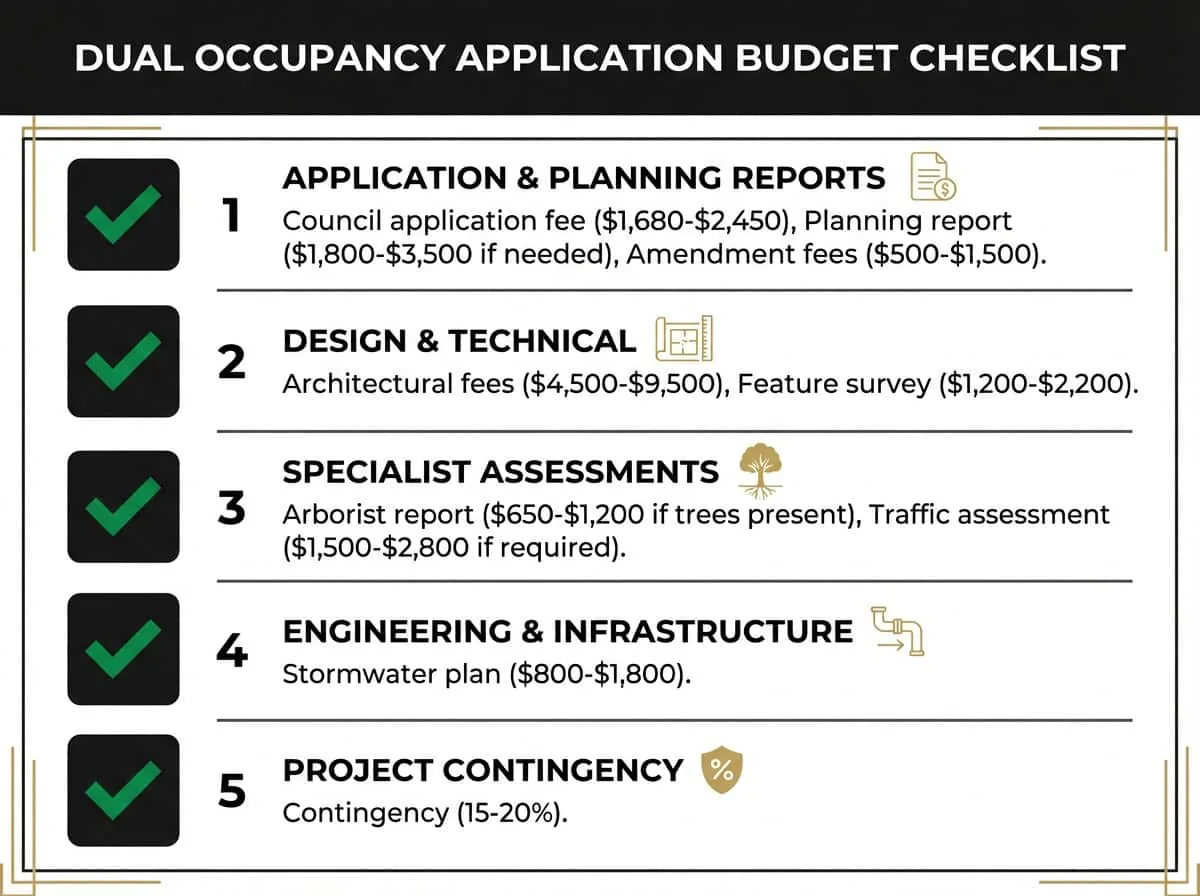
Survey and Feature Survey costs range from $1,200 to $2,200 for dual occupancy sites. A detailed feature survey is essential for accurate planning drawings, showing existing buildings, trees, services, easements, and site levels. Most architects require a current feature survey (prepared within the last 12 months) before commencing design work. The survey cost varies based on site size, complexity, and the number of features requiring documentation.
VCAT appeal costs represent a significant potential expense if your application is refused or if you choose to appeal council conditions. Whilst SQM Architects achieves a 98% approval rate, understanding VCAT costs helps you assess risk. A VCAT hearing for a dual occupancy typically costs $8,000 to $18,000 when factoring in additional planning evidence, expert witness fees, and potential architectural revisions. The VCAT application fee itself is $1,095.60 for planning matters, with hearing costs accumulating through expert witness preparation and attendance.
Deemed refusal applications occur when councils fail to determine your application within the statutory timeframe (60 days for most dual occupancy applications, or 90 days if public notice is required). If you proceed to VCAT on deemed refusal grounds, you’ll incur VCAT costs even though council hasn’t formally refused the application. This scenario is relatively uncommon in Melbourne councils, which generally meet statutory timeframes, but remains a possibility for complex applications.
Amendment and resubmission fees apply when you need to modify your application during assessment. The statutory amendment fee is prescribed on the same class basis as the original application — $1,804.70 for an amendment to a class 12 permit in 2026–27 — and does not scale with how minor or substantial the change is. What does scale is the professional cost: minor amendments such as adjusting window locations or materials typically add $600 to $1,200 in architectural fees, whilst substantial amendments requiring re-notification can add $2,000 to $3,500 for redesign work, plus the separately quoted cost of giving notice again. Minimising amendments through thorough pre-application research and quality initial submissions reduces these costs.
Pre-application meetings with council planners are offered by most Melbourne councils, typically at no charge or for a nominal fee ($150 to $300). Whilst not mandatory, these meetings can identify potential issues early, potentially saving thousands in redesign costs later. City of Whitehorse and City of Boroondara both offer free pre-application advice for dual occupancy proposals, providing valuable insight into council expectations before you commit to full design development.
Cost Variations by Site Complexity
Understanding how site characteristics influence planning permit costs allows more accurate budgeting for your specific dual occupancy project. We’ve identified three complexity tiers based on our experience across 210+ projects in Melbourne.
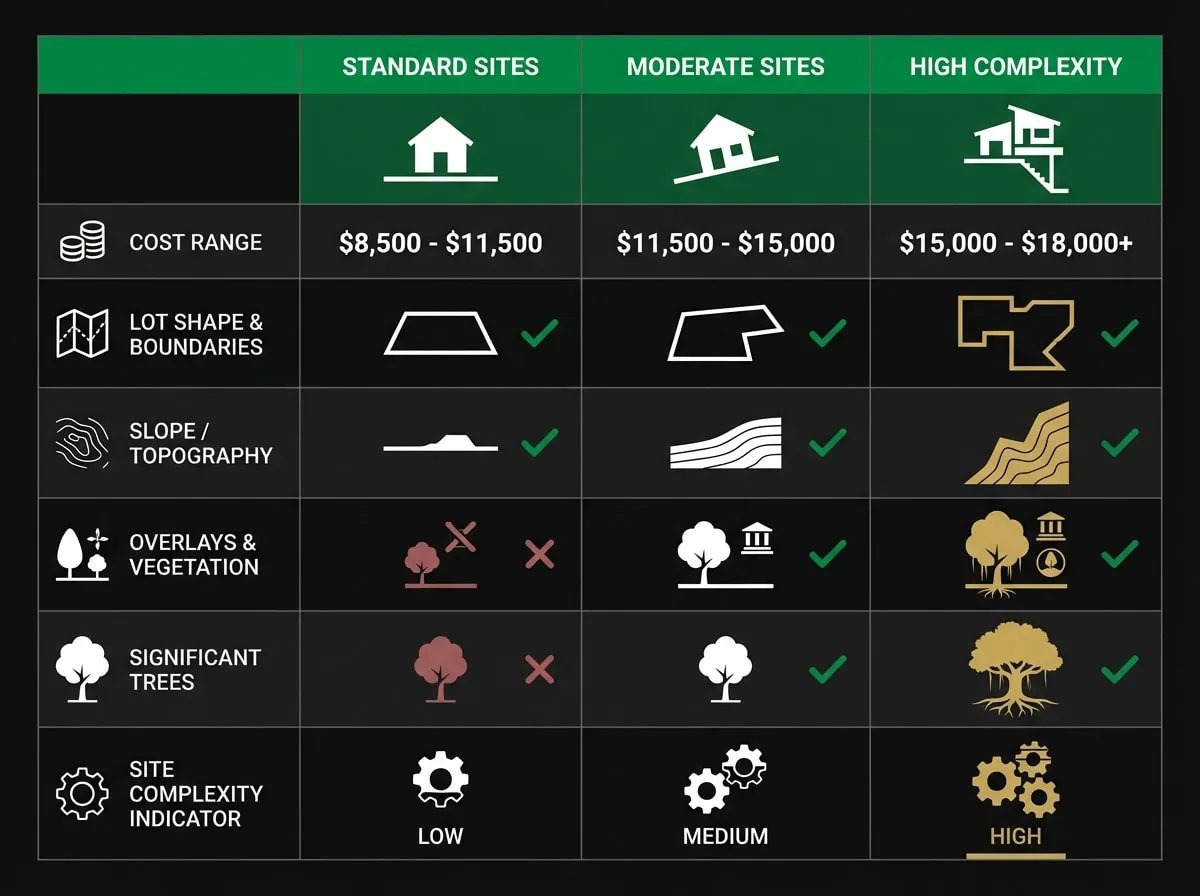
Standard Complexity Sites ($8,500 to $11,500 total): These sites feature regular rectangular lots, minimal slope (less than 1:20), no significant vegetation, and straightforward compliance with ResCode standards. They’re typically located in General Residential Zone or Neighbourhood Residential Zone areas without heritage or design overlays. The prescribed application fee (typically $1,804.70 at class 12) plus architectural fees ($4,500 to $6,000) plus basic consultants ($800 to $1,500) plus survey ($1,200 to $1,800) comprise the total cost. These projects rarely require planning reports or extensive consultant input, with architects able to demonstrate clear ResCode compliance through standard documentation.
Moderate Complexity Sites ($11,500 to $15,000 total): Sites with irregular boundaries, moderate slope (1:20 to 1:10), heritage overlays, or neighbourhood character considerations fall into this category. They require more detailed design responses to address planning scheme requirements and may need variations to one or two ResCode standards. The prescribed application fee ($1,804.70 at class 12) plus architectural fees ($6,000 to $8,000) plus planning report ($1,800 to $2,500) plus arborist report ($650 to $1,000) plus survey ($1,400 to $2,000) plus stormwater plan ($800 to $1,200) represent typical costs. Areas like Box Hill, Blackburn, and parts of Doncaster often present moderate complexity due to established neighbourhood character and vegetation.
High Complexity Sites ($15,000 to $18,000+ total): Sites with significant constraints—steep slopes (greater than 1:10), multiple overlays, significant trees, heritage buildings, or challenging access—require comprehensive consultant input and detailed design responses. The prescribed application fee ($1,804.70 at class 12, or $3,980.70 where the estimated cost of development exceeds $1 million) plus architectural fees ($7,500 to $9,500) plus planning report ($2,500 to $3,500) plus arborist report ($900 to $1,200) plus traffic assessment ($1,500 to $2,800) plus stormwater plan ($1,200 to $1,800) plus survey ($1,800 to $2,200) comprise the investment. Premium suburbs like Kew, Canterbury, and Camberwell frequently present high complexity due to heritage controls and established garden character.
The introduction of deemed-to-comply pathways under VC267 has created opportunities to reduce costs for qualifying dual occupancy developments. Projects that meet all deemed-to-comply standards may achieve faster assessment and potentially lower consultant costs, though this pathway applies primarily to straightforward sites without significant constraints.
Maximising Value from Your Planning Investment
Strategic approaches to the planning process can optimise your investment whilst maintaining high approval prospects. These practical strategies reflect insights from 210+ projects delivered across Melbourne.
Engage architects early in site acquisition to assess planning feasibility before purchase. A preliminary feasibility assessment costs $800 to $1,500 but can prevent purchasing sites with insurmountable planning constraints. This assessment reviews planning scheme provisions, identifies applicable overlays, and provides indicative development potential. For developers acquiring sites specifically for dual occupancy, this upfront investment prevents costly mistakes.
Invest in quality consultant reports rather than seeking the cheapest option. A comprehensive arborist report that provides clear retention strategies costs marginally more than a basic report but significantly improves approval prospects where vegetation is contentious. Similarly, a well-prepared planning report that addresses council concerns proactively can prevent requests for further information that delay determination and increase costs.
Utilise pre-application meetings strategically, preparing preliminary concepts that demonstrate serious intent whilst remaining flexible enough to incorporate council feedback. Councils respond more favourably to developers who engage constructively in pre-application discussions, potentially smoothing the formal assessment process. Document all pre-application advice in writing to reference during formal assessment.
Consider staging consultant reports based on application requirements rather than commissioning all reports upfront. For example, if your site has no significant trees, an arborist report is unnecessary. If council doesn’t request a traffic assessment during initial review, you may not need one at all. However, be prepared to commission additional reports if council requests them during assessment—building this contingency into your budget prevents surprises.
Maintain realistic expectations about approval timeframes and build holding costs into your feasibility analysis. Standard dual occupancy applications take 60-90 days for determination, with complex applications potentially extending to 120 days or more. Factor these timeframes into your project program and financing arrangements to avoid pressure to accept unfavourable permit conditions simply to expedite approval.
Frequently Asked Questions
How much does a dual occupancy planning permit cost in total?
Total costs typically range from $8,500 to $18,000 including the state-prescribed application fee ($1,804.70 for most dual occupancy applications in 2026–27), architectural fees ($4,500 to $9,500), consultant reports ($1,500 to $4,500), and survey costs ($1,200 to $2,200). Site complexity, the estimated cost of development, and applicable overlays determine where your project falls within this range.
Can I reduce planning costs by doing some work myself?
Whilst you can prepare some preliminary research yourself, planning applications require drawings and reports prepared by qualified professionals. Attempting to reduce costs through DIY approaches typically results in incomplete applications, requests for further information, and ultimately higher costs through delays and resubmissions. Engaging qualified professionals from the outset proves more cost-effective.
Do all dual occupancy applications require a town planning report?
Not all applications require a formal planning report, but they significantly strengthen applications seeking variations to ResCode standards or involving complex planning considerations. For straightforward sites with clear compliance, architects can address planning provisions within the application documentation without a separate planning report, potentially saving $1,800 to $3,500.
What happens if council requests additional information during assessment?
Councils commonly issue requests for further information, particularly for dual occupancy applications. Most architectural fees include one round of responses to council requests, covering minor clarifications or additional documentation. Substantial redesign requested by council may attract additional fees of $1,200 to $2,800 depending on the extent of changes required.
Are planning costs tax deductible for property developers?
Planning permit costs are generally capitalised as part of your development costs rather than claimed as immediate tax deductions. They form part of your cost base for capital gains tax purposes when you sell the completed development. Consult your accountant for specific tax treatment based on your development structure and circumstances.
How do planning costs compare between different Melbourne councils?
The application fee itself does not vary at all. It is prescribed statewide by the Planning and Environment (Fees) Regulations 2016, so an identical dual occupancy application attracts an identical fee in Whitehorse, Boroondara, Manningham, Monash, Knox and Maroondah. Total planning costs are driven by site complexity, the estimated cost of development, and design requirements — not by which council assesses the application. The council-specific variables are the separately quoted cost of giving public notice, and how much design work a particular council’s expectations demand.
Should I budget for potential VCAT costs?
Whilst VCAT appeals are relatively uncommon for well-prepared dual occupancy applications (SQM Architects achieves 98% approval rate), prudent developers include a 10-15% contingency in their planning budget to cover potential appeals or substantial amendments. This contingency provides financial flexibility without assuming VCAT costs will definitely occur.
Moving Forward with Your Dual Occupancy Project
Understanding the complete cost structure for dual occupancy planning permits allows you to assess project feasibility accurately and avoid budget surprises during the approval process. The investment of $8,500 to $18,000 in professional planning services represents approximately 1-2% of typical dual occupancy construction costs, yet this investment directly determines whether your project proceeds and on what terms.
Quality planning applications prepared by experienced professionals achieve faster approvals with fewer conditions, ultimately saving money through reduced holding costs and smoother project delivery. With recent planning amendments including VC267 and VC282 introducing new assessment pathways and updated standards, engaging professionals who understand current Victorian planning requirements becomes increasingly valuable.
For property developers in Melbourne, the planning permit represents your project’s foundation—investing appropriately in this phase sets up successful development outcomes. Ready to discuss your dual occupancy project and receive accurate cost estimates based on your specific site? Call SQM Architects on (03) 9005 6588 for a Book a Strategy Call.
This article provides general information about Victorian planning for property developers. It does not constitute professional advice. For specific guidance on your project, contact SQM Architects (ARBV Reg. No. 51498) for a complimentary site assessment.