
Understanding Planning and Building Permits in Victoria
For property developers in Melbourne, understanding the distinction between planning permits and building permits is fundamental to project success. These two separate approvals serve different purposes, follow different processes, and require different documentation—yet both are typically required for residential development projects.
The confusion between these permits costs developers time and money. A significant portion of permit delays stem from applicants submitting incorrect documentation or applying for permits in the wrong sequence. This article clarifies the differences, outlines when each permit is required, and provides practical guidance for navigating both approval processes efficiently.
For developers working across Whitehorse, Boroondara, Manningham, Monash, Knox, and Maroondah, understanding these distinctions is particularly important given the varying planning scheme requirements across these municipalities.
What Is a Planning Permit?
A planning permit is a legal document issued by the Responsible Authority (typically your local council) that authorises the use or development of land in a specific way. Under the Planning and Environment Act 1987, planning permits regulate what you can build and how land can be used, rather than the technical construction details.
Planning permits assess proposals against the relevant planning scheme, which includes zones, overlays, and particular provisions. The assessment considers factors such as neighbourhood character, setbacks, site coverage, overshadowing, traffic impact, and visual amenity. For multi-dwelling developments, planning permits also address density, car parking requirements, and compliance with ResCode standards.
In Melbourne, planning permit requirements vary significantly by location. The City of Boroondara, for example, has extensive Heritage Overlay areas where planning permits are required for most alterations. Manningham City Council applies Neighbourhood Character Overlays across much of its municipality, triggering permit requirements for developments that might be exempt elsewhere.
When Planning Permits Are Required
Planning permits are typically required for:
- Multi-dwelling developments: Building two or more dwellings on a lot always requires a planning permit across all Melbourne councils
- Subdivisions: Creating additional lots, including two-lot subdivisions, requires planning approval
- Buildings in overlay areas: Heritage Overlays, Neighbourhood Character Overlays, and Design and Development Overlays often trigger permit requirements even for single dwellings
- Developments exceeding standard requirements: Projects that don’t meet ResCode standards for setbacks, site coverage, or building height
- Change of use: Converting a building from residential to commercial use, or vice versa
- Demolition in certain zones: Demolishing buildings in Heritage Overlays or within certain residential zones
Importantly, you may not need a planning permit for building a single dwelling on a lot in a General Residential Zone, provided the lot meets minimum area requirements and the proposal complies with all relevant standards. However, this exemption doesn’t apply in areas with overlays or in Neighbourhood Residential Zones with specific requirements.
Planning Permit Application Process
The planning permit process involves several stages:
Pre-application consultation (1-2 weeks): Most councils offer pre-application meetings to discuss your proposal and identify potential issues. This step is optional but highly recommended for complex developments.
Application lodgement: Submit your application with required documents including site plans, elevations, shadow diagrams, planning reports, and the application fee. Fees range from $199.90 for developments under $10,000 to $57,670.10 for projects over $10 million.
Referrals (2-4 weeks): Council may refer your application to external authorities such as Melbourne Water, VicRoads, or the relevant water authority. Referral authorities have statutory timeframes to respond.
Public notice (14 days): Most applications require public advertising, allowing neighbours and interested parties to lodge objections. Not all applications require notice—this depends on the proposal and planning scheme provisions.
Assessment (30-60 days): The statutory timeframe for council to decide an application is 60 days, though this can be extended by agreement. If council doesn’t decide within the statutory timeframe, you have the right to appeal to VCAT for deemed refusal.
Decision: Council may approve the application (with or without conditions), refuse it, or request amendments. Conditions typically address matters such as landscaping, materials, car parking, and waste management.
What Is a Building Permit?
A building permit is written approval from a Registered Building Surveyor (RBS) that authorises building work to proceed. Unlike planning permits, building permits focus on technical compliance with the Building Act 1993, Building Regulations 2018, and the National Construction Code (NCC).
Building permits ensure that construction meets minimum standards for structural adequacy, fire safety, health and amenity, energy efficiency, and accessibility. The building surveyor who issues the permit becomes the Relevant Building Surveyor for the project, responsible for conducting mandatory inspections throughout construction.
You can obtain a building permit from either a private building surveyor or a municipal building surveyor employed by council. However, your builder cannot appoint the building surveyor on your behalf—this must be done by you as the owner to maintain independence in the inspection process.
When Building Permits Are Required
Building permits are required for most building work, including:
- New buildings: All new residential, commercial, and industrial buildings
- Structural alterations: Extensions, additions, and structural modifications to existing buildings
- Demolition: Demolishing buildings or structures (though some minor demolition may be exempt)
- Change of building classification: Altering a building’s use in ways that affect its classification under the NCC
- Swimming pools and spas: In-ground and above-ground pools and spas
- Retaining walls: Walls exceeding certain heights or supporting buildings
Some minor works are exempt from building permit requirements, including:
- Repairs and maintenance that don’t alter the building’s structure
- Pergolas and verandahs under 20m² that don’t support a building
- Fences under 2 metres high (though planning permits may still apply)
- Sheds under 10m² in certain circumstances
Building Permit Application Process
The building permit process follows these steps:
Appoint a building surveyor (1 week): Select and formally appoint either a private or municipal building surveyor. Private surveyors typically process applications faster but charge higher fees than municipal surveyors.
Prepare documentation (2-6 weeks): Your architect, designer, or draftsperson prepares detailed construction drawings, specifications, engineering calculations, energy reports, and other required documentation. This documentation must be far more detailed than planning permit drawings.
Submit application: Lodge your application with the appointed building surveyor along with the building permit levy (if applicable). The levy is calculated based on the project’s cost and is remitted to the state building regulator, not retained by council.
Assessment (2-4 weeks): The building surveyor assesses your application against the Building Regulations and NCC. They may request additional information or modifications to ensure compliance.
Permit issue: Once satisfied that the proposal complies, the building surveyor issues the building permit. This authorises construction to commence and specifies mandatory inspection stages.
Construction and inspections: Throughout construction, the building surveyor conducts mandatory inspections at key stages including footings, frame, waterproofing, and final inspection.
Occupancy permit or Certificate of Final Inspection: Upon completion, the building surveyor issues either an Occupancy Permit (for habitable buildings) or Certificate of Final Inspection, confirming the work complies with the approved permit.
Get the 7-point site check to run before committing to a permit application — zoning, overlays, setbacks and council red flags, in plain English. Free PDF, instant download.
- Zone, overlay & setback checks
- What council assesses first
- Permit-readiness red flags
Something went wrong. Please try again.
No spam. Unsubscribe anytime.
Check your inbox — your checklist is on its way.
Key Differences Between Planning and Building Permits
Understanding the fundamental differences between these permits helps developers plan their project timeline and budget accurately:
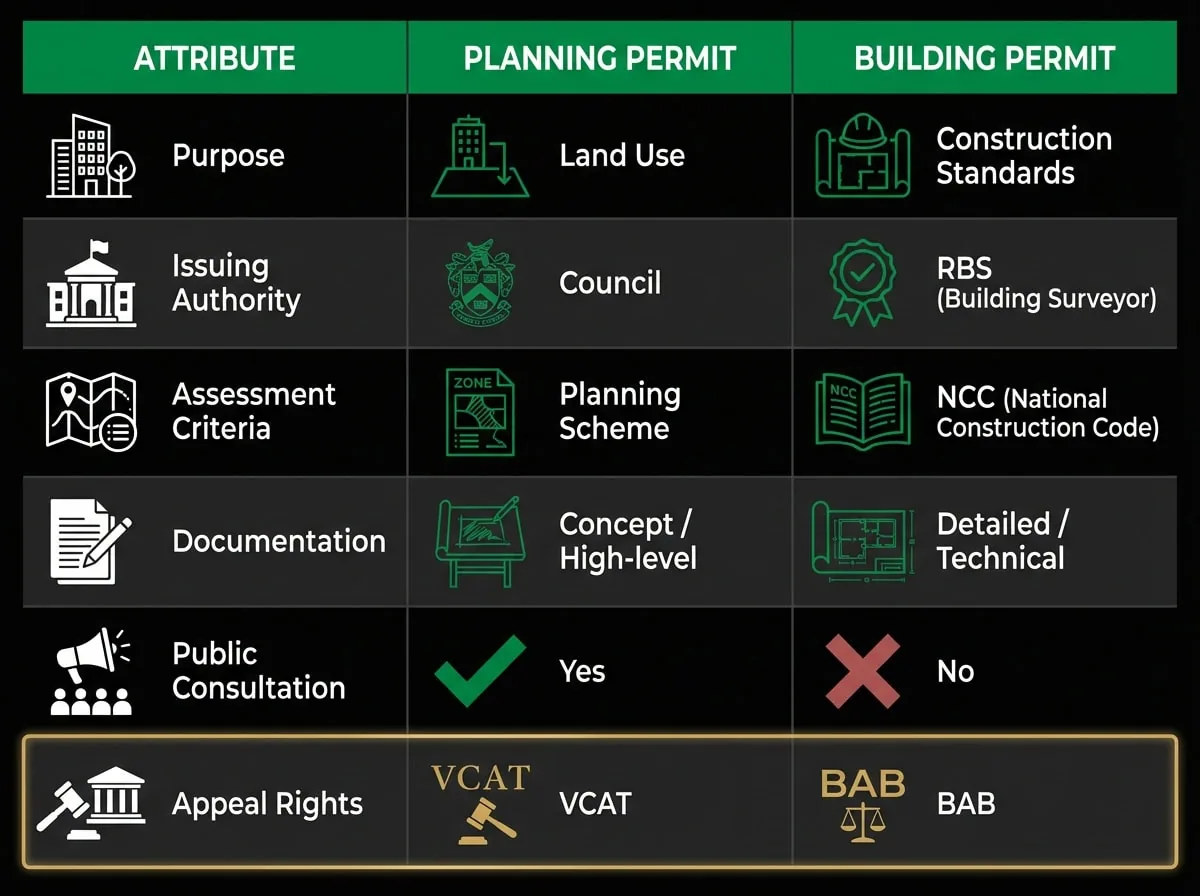
Purpose and focus: Planning permits regulate land use and development impact on the surrounding area. Building permits ensure technical compliance with construction standards and building safety.
Issuing authority: Planning permits are issued by the Responsible Authority (usually council, sometimes the Minister for Planning). Building permits are issued by Registered Building Surveyors (private or municipal).
Assessment criteria: Planning permits are assessed against the planning scheme, including zones, overlays, and policy. Building permits are assessed against the Building Act, Building Regulations, and National Construction Code.
Documentation requirements: Planning applications require concept-level drawings showing site layout, elevations, and design intent. Building applications require detailed construction drawings, engineering calculations, and technical specifications suitable for construction.
Public consultation: Planning applications typically involve public notice and neighbour consultation. Building permit applications are administrative and don’t involve public notification.
Appeal rights: Planning permit decisions can be appealed to VCAT by applicants or objectors. Building permit decisions can be appealed to the Building Appeals Board, but only by the applicant.
Timeframes: Planning permits have a 60-day statutory timeframe (often extended). Building permits are typically processed within 2-4 weeks once complete documentation is submitted.
Costs: Planning permit fees are set by regulation and based on development cost. Building surveyor fees are negotiable and vary between providers.
The Correct Sequence: Planning First, Building Second
When both permits are required, you must obtain the planning permit before applying for a building permit. This sequence is mandated by Section 24 of the Building Act 1993, which prohibits building surveyors from issuing building permits for work that requires a planning permit unless that planning permit has been obtained.
This requirement exists because planning permits may include conditions that affect the building design. Common planning permit conditions include requirements for specific materials, landscaping, car parking layouts, or design modifications. If you prepared detailed building permit documentation before obtaining planning approval, you might need to modify those plans to comply with planning permit conditions—resulting in wasted time and consultant fees.
The Building and Plumbing Commission’s Building Practice Note BP-06 outlines the building surveyor’s obligations to verify planning permit compliance. Before issuing a building permit, the surveyor must:
- Obtain copies of the planning permit and endorsed plans
- Verify that the building permit application is consistent with the planning permit
- Confirm that all planning permit conditions required to be satisfied before construction commences have been met
- Ensure the proposed building work doesn’t otherwise breach the planning scheme
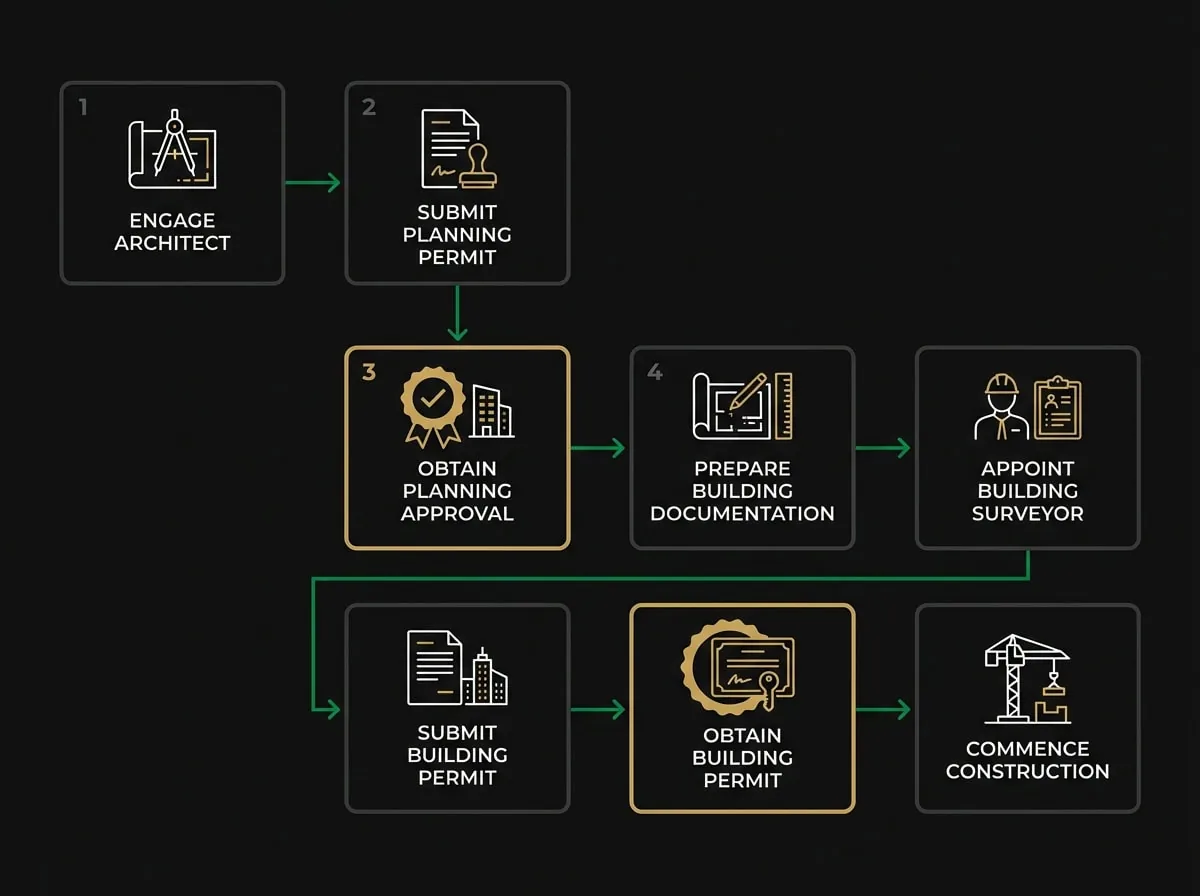
For developers, this means you should progress through these stages:
- Engage an architect or designer to prepare planning permit documentation
- Submit planning permit application and obtain approval
- Engage consultants to prepare detailed building permit documentation based on the approved planning permit
- Appoint a building surveyor
- Submit building permit application
- Obtain building permit and commence construction
Consistency Between Planning and Building Permits
Ensuring consistency between planning and building permits is critical. The building surveyor has a statutory obligation under Section 24 of the Building Act to ensure building work is consistent with any applicable planning permit. Inconsistencies can result in building permit refusal, construction delays, or enforcement action.
Common inconsistencies include:
- Dimensional changes: Building heights, setbacks, or floor areas that differ from planning-approved plans
- Material changes: Using different external materials than those approved in the planning permit
- Design modifications: Altering roof forms, window locations, or other design elements shown on endorsed planning plans
- Use changes: Proposing a different use than approved in the planning permit
If inconsistencies arise during building permit preparation, you have several options:
Minor changes: For very minor variations that don’t materially alter the planning permit approval, you may be able to proceed if the building surveyor is satisfied the changes don’t breach the planning scheme. However, this is a grey area and should be approached cautiously.
Planning permit amendment: For material changes, you’ll need to apply to council for a planning permit amendment under Section 72 of the Planning and Environment Act. Amendment applications follow a similar process to original applications, including potential public notice.
New planning permit: For substantial changes, you may need to lodge a new planning permit application rather than seeking an amendment.
To avoid these issues, developers should involve their building surveyor and structural engineer early in the planning permit stage. This allows identification of potential building regulation compliance issues before the planning permit is finalised, reducing the likelihood of required changes later.
Timeframes and Project Planning
Understanding realistic timeframes for both permits is essential for project planning and feasibility analysis. Based on 2024-25 data from Melbourne councils, typical timeframes are:
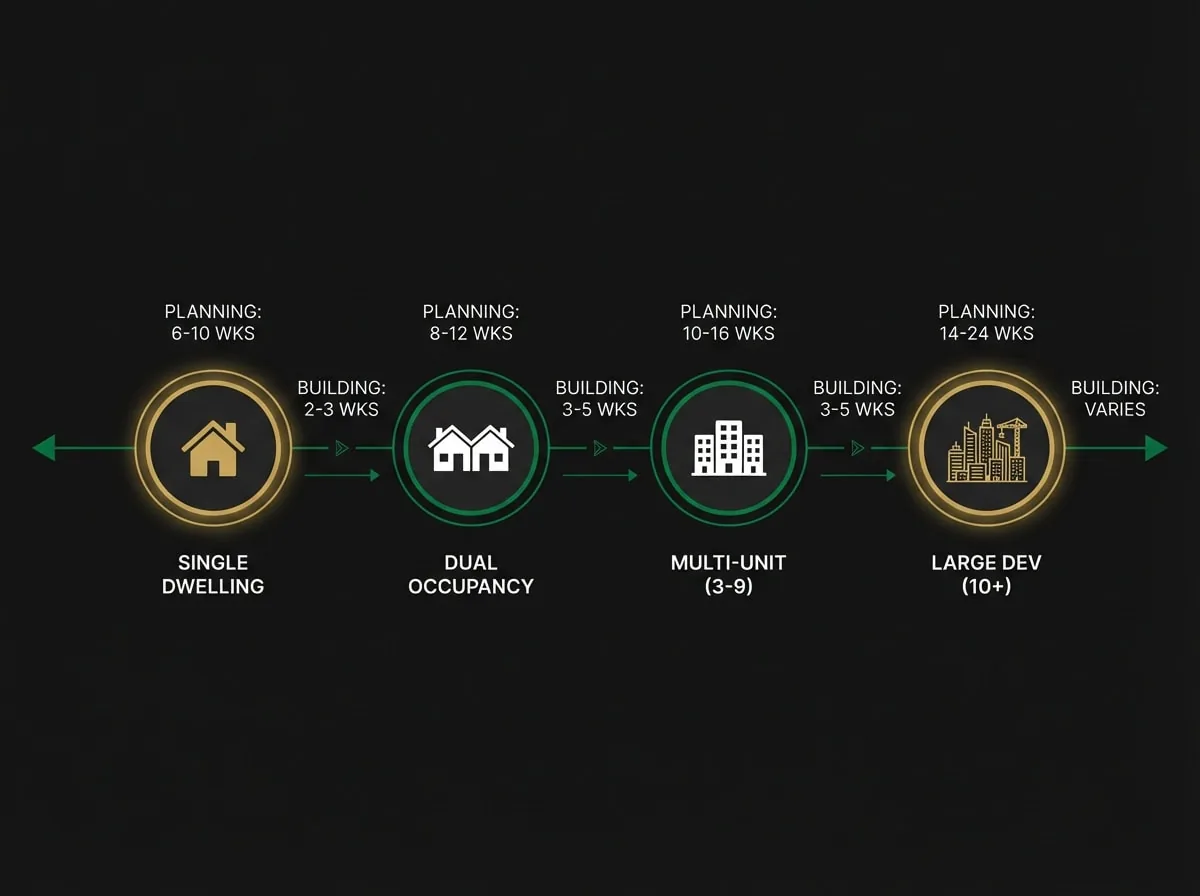
Planning permits:
- Simple single dwelling: 6-10 weeks from lodgement to decision
- Two-dwelling development: 8-12 weeks
- Multi-unit development (3-9 dwellings): 10-16 weeks
- Large-scale development (10+ dwellings): 14-24 weeks
- Applications with VCAT appeal: Add 6-12 months
Building permits:
- Single dwelling: 2-3 weeks with private surveyor, 4-6 weeks with municipal surveyor
- Multi-dwelling development: 3-5 weeks with private surveyor, 6-10 weeks with municipal surveyor
- Complex projects requiring additional referrals: Add 2-4 weeks
These timeframes assume complete applications with all required documentation. Incomplete applications or requests for further information can add weeks or months to the process.
For project planning purposes, developers should allow:
- 3-4 weeks for pre-application consultation and documentation preparation
- Planning permit timeframe as above
- 2-4 weeks to satisfy planning permit conditions and prepare building permit documentation
- Building permit timeframe as above
- 1-2 weeks buffer for unexpected issues
This means a straightforward two-dwelling development might require 16-22 weeks from initial design to construction commencement, while a multi-unit project could take 24-36 weeks or longer.
Costs and Budgeting
Permit costs represent a significant component of development feasibility. Understanding these costs helps with accurate project budgeting:
Planning permit application fees (2024-25):
- Development under $10,000: $199.90
- Development $10,000-$50,000: $399.80
- Development $50,001-$250,000: $1,199.40
- Development $250,001-$500,000: $1,999.00
- Development $500,001-$1 million: $2,798.60
- Development $1-5 million: $5,597.20
- Development $5-10 million: $11,194.40
- Development over $10 million: $57,670.10
Building permit levy (remitted to the state regulator):
Calculated at 0.128% of the cost of building work under section 205G of the Building Act 1993, and not payable at all where the cost of the work is $10,000 or less. There is no statutory minimum or maximum: the levy is a flat proportion of cost, so for a $400,000 dwelling it is $512, and for a $2 million project it is $2,560. A separate cladding rectification levy applies to some non-residential and multi-storey work costing $800,000 or more.
Building surveyor fees:
Private building surveyors charge fees based on project complexity and value. Typical fees for Melbourne projects:
- Single dwelling: $2,000-$3,500
- Dual occupancy: $3,500-$5,500
- 4-6 unit development: $6,000-$10,000
- 8-12 unit development: $10,000-$18,000
Municipal building surveyors typically charge lower fees but have longer processing times.
Consultant fees:
Additional costs include:
- Town planner: $3,000-$8,000 for planning permit applications
- Architect/designer: $15,000-$50,000+ depending on project scale
- Structural engineer: $3,000-$12,000
- Energy assessor: $400-$800 per dwelling
- Land surveyor: $1,500-$3,500
- Arborist report: $800-$2,000
- Traffic engineer: $3,000-$8,000 (if required)
Common Mistakes and How to Avoid Them
Developers frequently encounter preventable issues with permit applications. Understanding these common mistakes helps avoid costly delays:
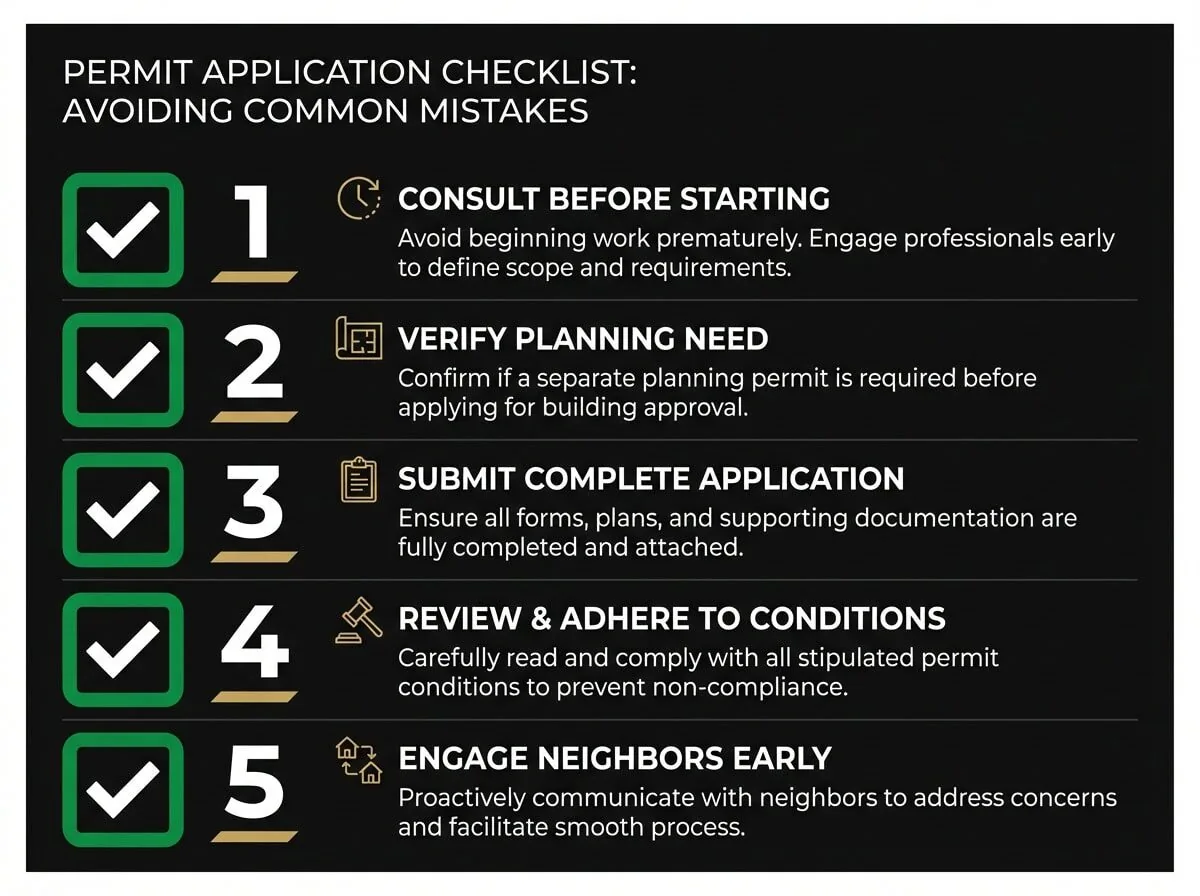
Starting building permit preparation before planning approval: This wastes consultant fees when planning permit conditions require design changes. Always wait for planning approval before commissioning detailed building documentation.
Assuming no planning permit is required: Many developers incorrectly assume single dwellings don’t need planning permits. Always check the planning scheme, including all overlays affecting your site. A $200 planning enquiry to council can save months of delays.
Incomplete applications: Missing documents or inadequate plans are the primary cause of assessment delays. Use council checklists and engage experienced consultants to ensure complete applications.
Ignoring planning permit conditions: Planning permits typically include conditions that must be satisfied before construction commences. Failing to address these before applying for a building permit causes delays.
Not engaging neighbours early: For planning permits requiring public notice, early consultation with neighbours can identify concerns that might otherwise result in objections and VCAT appeals.
Choosing the wrong building surveyor: Select a building surveyor experienced with your project type and council area. Check their availability for inspections and responsiveness to queries.
Inadequate site analysis: Failing to identify site constraints such as easements, covenants, contamination, or heritage significance early in the design process leads to expensive redesigns.
Not allowing buffer time: Project programs that don’t include contingency for permit delays create pressure throughout the development process. Allow 20-30% buffer time for permit stages.
Recent Reforms and Future Changes
Victoria’s planning and building systems are undergoing significant reform. Developers should be aware of these changes:
Planning system reforms (2024-2026): The Victorian Government is implementing reforms to streamline planning processes, including:
- New residential zones with clearer development standards
- Reformed ResCode standards for multi-dwelling developments
- Expanded code assessment pathways for compliant developments
- Digital planning permit applications across all councils
Building system reforms: Following the 2019 Building System Review, ongoing changes include:
- Enhanced building surveyor oversight and accountability
- Mandatory professional indemnity insurance requirements
- Strengthened cladding and fire safety requirements
- New compliance and enforcement powers for the Building and Plumbing Commission
Energy efficiency requirements: From May 2024, new residential buildings must achieve 7-star energy efficiency ratings (up from 6-star), affecting building permit documentation requirements.
Accessible housing requirements: New minimum accessibility standards for residential buildings are being progressively introduced, affecting both planning and building permit requirements.
Working with Professionals
Successfully navigating both permit processes requires engaging qualified professionals:
Architects and designers: Victorian law does not restrict who may prepare building plans. What registration governs is title: only practitioners registered with the Architects Registration Board of Victoria (ARBV) may call themselves architects, and only practitioners registered with the Building and Plumbing Commission (BPC) may represent themselves as registered building designers. Check registration status before engagement.
Town planners: While registration isn’t mandatory, engaging planners with Planning Institute of Australia membership ensures professional standards and insurance coverage.
Building surveyors: Must be registered with the BPC. You can search the BPC register to verify registration and check for any disciplinary history.
Engineers: Structural and civil engineers should be registered with Engineers Australia and hold appropriate professional indemnity insurance.
When engaging professionals, clarify:
- Scope of services and deliverables
- Fee structure and payment terms
- Timeframes for documentation preparation
- Who is responsible for permit applications
- Professional indemnity insurance coverage
- Copyright ownership of plans and documentation
Council-Specific Considerations
Each Melbourne council has specific requirements and processes that affect permit applications:
City of Whitehorse: Known for detailed neighbourhood character assessments. Pre-application meetings are highly recommended for multi-dwelling developments. Average planning permit timeframe: 58 days for VicSmart applications, 68 days for standard applications.
City of Boroondara: Extensive Heritage Overlay coverage means most developments require planning permits. Council has strict design guidelines for heritage areas. Average planning permit timeframe: 62 days.
Manningham City Council: Strong focus on neighbourhood character and vegetation protection. Arborist reports frequently required. Average planning permit timeframe: 65 days.
City of Monash: Progressive approach to medium-density development in activity centres. Detailed urban design requirements for multi-dwelling projects. Average planning permit timeframe: 59 days.
Knox City Council: Emphasis on bushfire risk management in northern areas. Bushfire Management Plans often required. Average planning permit timeframe: 61 days.
Maroondah City Council: Focus on sustainable development and water-sensitive urban design. Stormwater management plans required for most developments. Average planning permit timeframe: 64 days.
Frequently Asked Questions
Can I start construction with just a planning permit?
No. A planning permit authorises the use or development of land but doesn’t permit construction to commence. You must obtain a building permit before starting any building work. Starting construction without a building permit is an offence under the Building Act and can result in stop-work orders and penalties.
How long are planning and building permits valid?
Planning permits typically expire if development doesn’t commence within two years, though this can vary based on permit conditions. Building permits must specify commencement and completion dates—typically construction must start within 12 months and finish within 24 months. Extensions can be requested before expiry.
What happens if my building surveyor finds my plans don’t comply with the planning permit?
The building surveyor cannot issue a building permit if the proposed work is inconsistent with the planning permit. You’ll need to either modify your building plans to match the planning permit, or apply to council for a planning permit amendment to authorise the changes.
Do I need both permits for a renovation or extension?
It depends on the scope of work and your property’s zoning and overlays. Most structural alterations require a building permit. A planning permit may be required if the extension exceeds certain sizes, affects setbacks, or your property is in a Heritage Overlay or other restricted area. Check with council and a building surveyor.
Can I appeal if my planning permit is refused?
Yes. You can appeal to the Victorian Civil and Administrative Tribunal (VCAT) within 60 days of council’s decision. VCAT conducts a full merits review of the application. Objectors can also appeal if council approves a permit they opposed.
What’s the difference between a private and municipal building surveyor?
Both are qualified Registered Building Surveyors with the same powers and responsibilities. Private surveyors typically process applications faster and offer more flexible service, but charge higher fees. Municipal surveyors are council employees who charge lower fees but may have longer processing times due to higher workloads.
Do I need a planning permit for a two-lot subdivision?
Yes. All subdivisions in Victoria require planning permits, regardless of the number of lots created. The application must demonstrate compliance with subdivision standards including lot sizes, access, services, and any applicable overlay requirements. After planning approval, you’ll also need a Statement of Compliance from the council before titles can be issued.
Conclusion
Understanding the distinction between planning and building permits is fundamental for property developers in Melbourne. Planning permits regulate what you can build and how land can be used, assessed against planning scheme requirements. Building permits ensure technical compliance with construction standards and building safety regulations.
The key principles to remember: planning permits must be obtained before building permits when both are required; each permit serves a distinct purpose with different assessment criteria; and engaging experienced professionals early in the process helps avoid costly delays and redesigns. Outright refusal is uncommon across Melbourne councils — the greater risk to a programme is the request-for-further-information cycle, not a "no" — so proper preparation and a complete application at lodgement are what determine whether a project runs to its 8-16 week expectation or drifts well past it.
For developers planning projects in Whitehorse, Boroondara, Manningham, Monash, Knox, or Maroondah, investing time in understanding local planning scheme requirements and engaging qualified consultants delivers significant returns through faster approvals and reduced risk. Book a Strategy Call to understand which permits your project requires and how to navigate the approval process efficiently. Call (03) 9005 6588 to discuss your development.
This article provides general information about Victorian planning for property developers. It does not constitute professional advice. For specific guidance on your project, contact SQM Architects (ARBV Reg. No. 51498) for a complimentary site assessment.