
Why Melbourne Developers Need to Understand Planning Permits in 2026
Victoria’s planning system is undergoing significant reform. The Planning Amendment (Better Decisions Made Faster) Act 2026 — enacted, but not commencing before 29 October 2027 — will introduce a three-tiered permit system, clearer assessment pathways, and new deemed approval mechanisms designed to reward well-prepared applications. For property developers active in Melbourne, understanding the current Victorian planning regulation framework is no longer optional. It is a core site assessment skill.
The stakes are substantial. Average processing times across Victoria have historically exceeded statutory timeframes, with planning delays widely recognised as contributing to increased holding costs for developers. For a developer managing financing arrangements on a multi-dwelling project in the City of Whitehorse or City of Manningham, every additional month of holding costs may erode potential value. The proposed 2026 reforms may create real opportunities to compress those timelines, but only for developers who understand how the new system may work and how to position their applications accordingly.
This guide covers the end-to-end planning permit process for Melbourne property developers: from initial site assessment and permit triggers through to VCAT review proceedings and the decision criteria that determine outcomes. It incorporates the proposed 2026 legislative changes, council-specific considerations across Melbourne, and practical guidance on ResCode compliance — giving you a clear picture of what the current planning permit process framework requires at every stage.
Read More Property Development Guides
Planning Permit Triggers: What Requires a Permit in Melbourne
Whether a planning permit is required depends on three intersecting factors: your site’s zoning, any overlays that apply, and the nature of the proposed use or development. These are set out in each council’s planning scheme, which operates under the Victoria Planning Provisions (VPP) framework. Because every council administers its own planning scheme, permit triggers can vary meaningfully between municipalities — even for comparable sites and proposals.
Common triggers for residential development in Melbourne include:
- Constructing two or more dwellings on a lot (including dual occupancies and townhouse developments)
- Subdividing land, including two-lot subdivisions
- Development within a Heritage Overlay, Design and Development Overlay, or Vegetation Protection Overlay
- Proposals that seek to vary ResCode standards (such as side setbacks, overlooking, or overshadowing)
- Removal of native vegetation
- Changing the use of land (for example, from residential to short-stay accommodation)
- Development on land affected by a Significant Landscape Overlay
Council-specific overlays add another layer of complexity. The City of Boroondara, for example, applies Heritage Overlays across a significant portion of its residential land — meaning that even modest alterations to existing dwellings may trigger a permit requirement in many areas. The City of Manningham applies Significant Landscape Overlays across hillside precincts in Doncaster East and Templestowe, which can affect setbacks, site coverage, and vegetation retention requirements. The City of Knox and Maroondah City Council may contain areas affected by Bushfire Management Overlays — confirm current overlay status via planning.vic.gov.au before relying on this for site assessment. Confirming your permit triggers through a thorough overlay analysis before committing to a site is an essential early step.
The Proposed Three-Tier Permit System: What It May Mean for Your Development Timeline
One of the most significant structural changes proposed in the Fast-Track Planning Bill is the formalisation of three distinct planning permit assessment streams. This would replace the previous single statutory timeframe with differentiated pathways calibrated to development complexity, risk, and community impact. Understanding which tier your project may fall into is a critical input to preliminary feasibility planning and programme scheduling, should the reforms proceed as proposed.
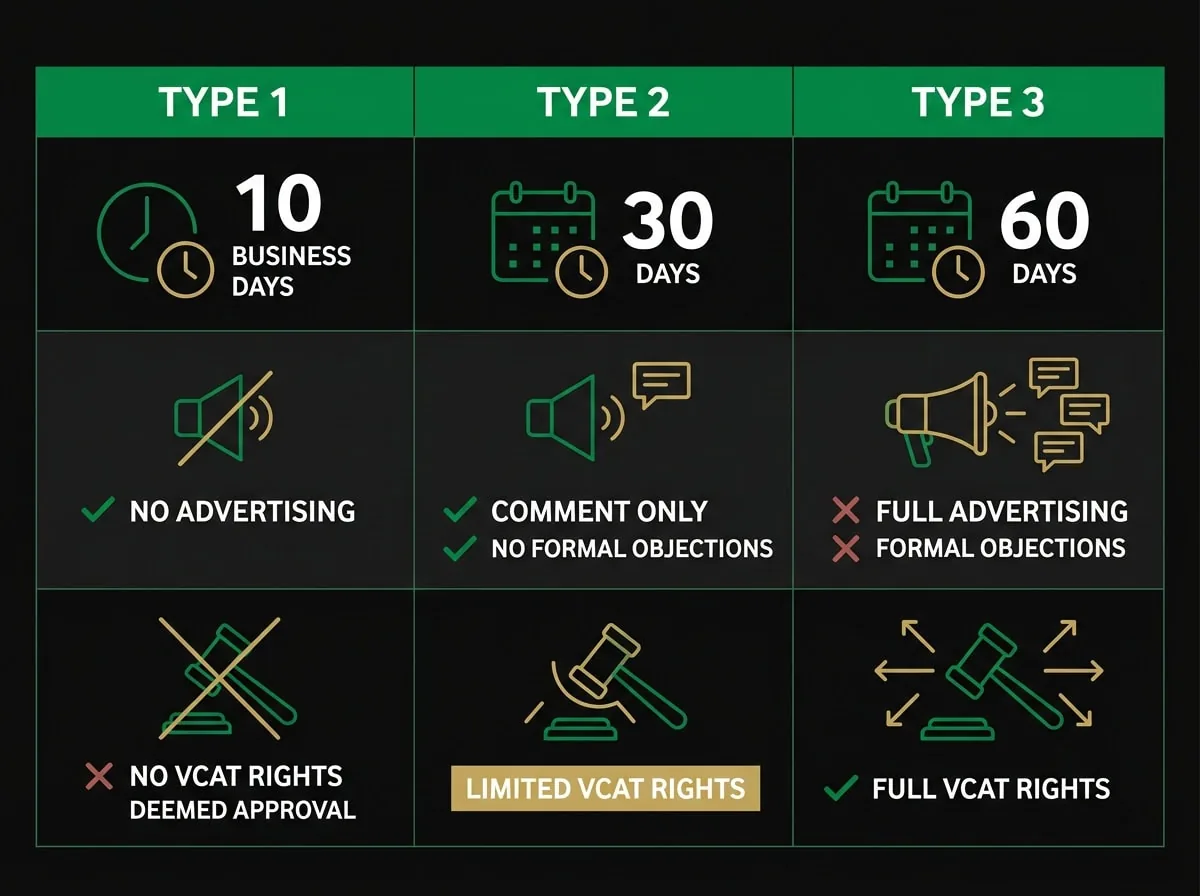
Type 1 — 10 Business Days (Simple, Low-Risk Projects)
Type 1 applications would cover simple, low-risk proposals that are clearly envisaged by the applicable zone — including single dwellings and minor subdivisions that comply with all applicable standards. These applications would not be publicly advertised, and there would be no third-party VCAT appeal rights. The proposed reforms include a deemed approval mechanism: if the Responsible Authority fails to make a decision within the prescribed 10-business-day timeframe on a complete application, the permit may be taken to be granted. This would be a meaningful shift that rewards thorough, compliant submissions.
Type 2 — 30 Days (Moderate Impact, Code-Compliant Developments)
Type 2 applications would apply to moderate impact developments that comply with, or significantly comply with, specified planning codes. Townhouses and low-rise apartment developments are expected to fall within this category under the regulations to be developed prior to any default commencement date. Type 2 applications would not be subject to formal objections, though some specified applications may require notice — with recipients able to comment rather than formally object. This distinction may be significant: it could limit the scope for third-party delay on compliant medium-density projects.
Type 3 — 60 Days (Complex, Higher-Impact Developments)
Type 3 would be the default category, applying to large or complex developments with greater potential community impact — including high-density residential, commercial, and industrial proposals. Type 3 applications would be subject to the full assessment process: public notice, formal objections, referral authority input, and VCAT appeal rights for both applicants and objectors. Most multi-dwelling projects of five or more dwellings in Melbourne are likely to fall within Type 3 under the proposed framework. A 60-day statutory timeframe would apply, though in practice, complex applications with advertising periods and objections may extend to six to twelve months or more from lodgement to decision, depending on complexity and council workload.
A critical practical note under the proposed reforms: a five-business-day initial information review period is proposed. Councils may be able to void applications that are missing fees or required documentation before assessment begins. An incomplete application would not start the statutory clock — it would reset it entirely. This makes pre-lodgement preparation more consequential than ever.
Get the 7-point site check to run before committing to a permit application — zoning, overlays, setbacks and council red flags, in plain English. Free PDF, instant download.
- Zone, overlay & setback checks
- What council assesses first
- Permit-readiness red flags
Something went wrong. Please try again.
No spam. Unsubscribe anytime.
Check your inbox — your checklist is on its way.
The Planning Permit Application Process: Step by Step
Understanding the current planning permit process framework means knowing what happens at each stage — and where delays typically occur. The following outlines the standard process for complex applications, which covers the majority of multi-dwelling and subdivision projects in Melbourne.
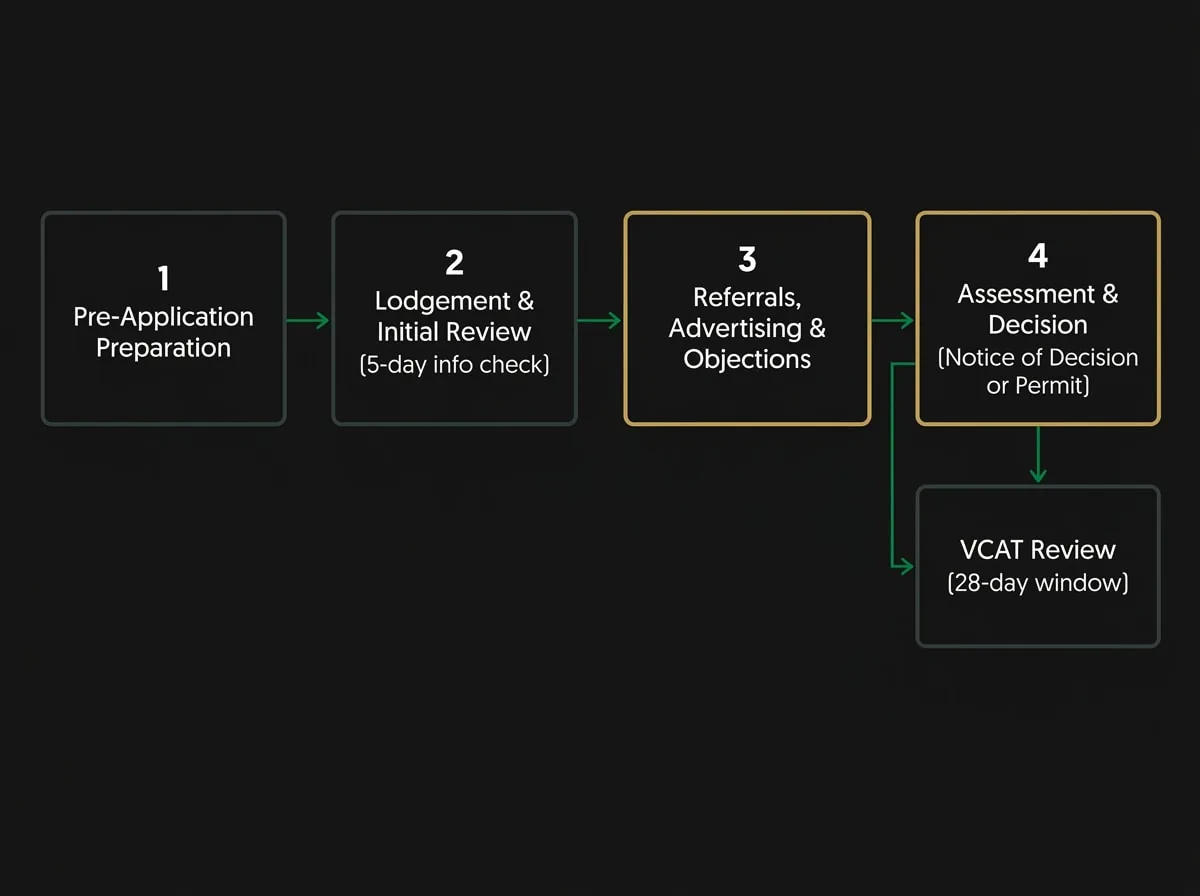
Stage 1: Pre-Application Preparation
Before lodging, a thorough site analysis should confirm zoning, overlays, applicable ResCode standards, and any council-specific local policies. Most Melbourne councils offer pre-application meetings, which can be valuable for complex sites — particularly those affected by overlays or where a variation to ResCode standards is anticipated. The City of Whitehorse, City of Boroondara, and City of Manningham all offer pre-application services, though lead times and the depth of feedback vary. A pre-application meeting does not bind the Responsible Authority, but it can surface issues early and inform design decisions before significant documentation costs are incurred.
Stage 2: Lodgement and Initial Review
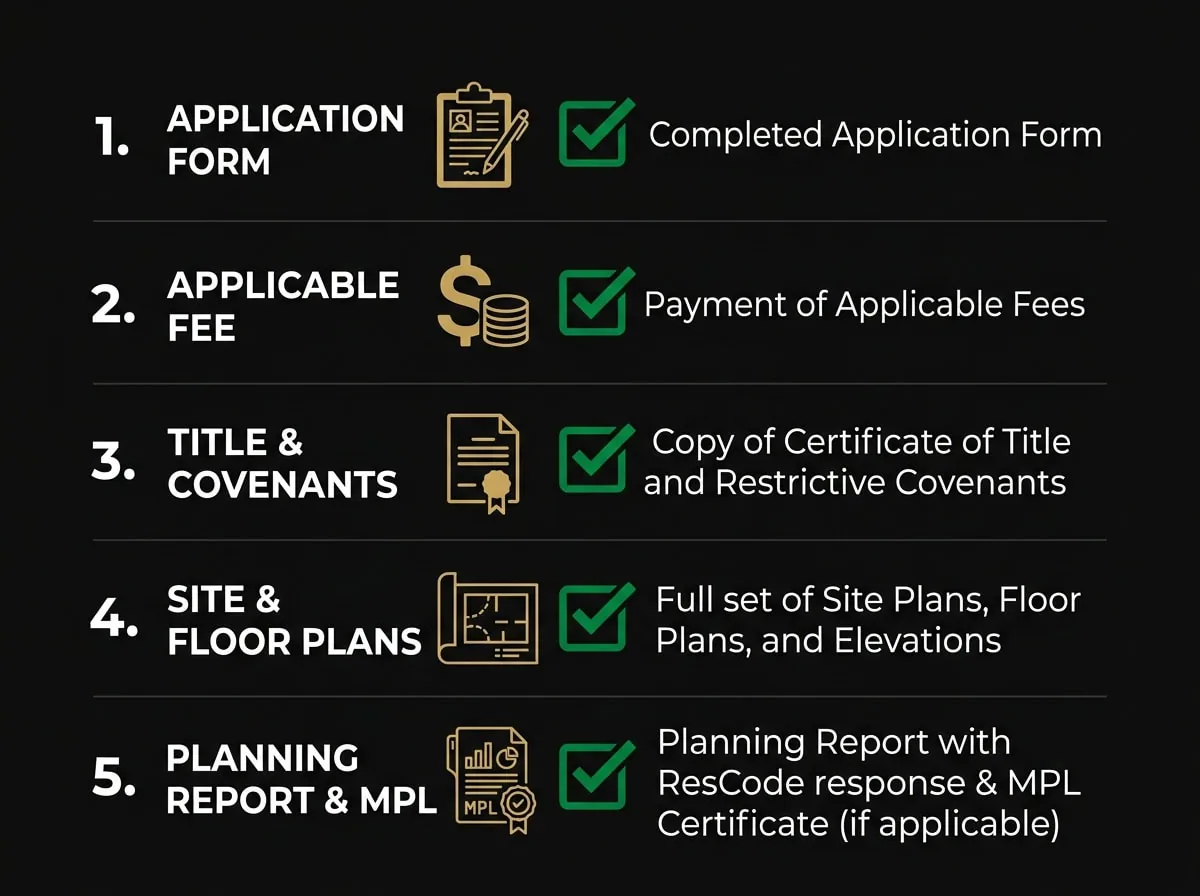
A complete application must include the prescribed application form, the applicable fee, a copy of title and any registered restrictive covenants, a site plan, floor plans and elevations at an appropriate scale, and a planning report addressing policy compliance — including a clause-by-clause ResCode assessment where applicable. For applications above the Metropolitan Planning Levy threshold, an MPL certificate is also required. Under the proposed reforms, councils would have five business days to conduct an initial information check. If required documentation or fees are missing and not subsequently provided, the application may be voided.
Stage 3: Referrals, Further Information, and Advertising
Once a complete application is registered, the Responsible Authority may refer it to relevant authorities (such as Melbourne Water, VicRoads, or the Country Fire Authority for applicable sites), request further information, and issue notice of the application. Advertising typically involves letters to adjoining and nearby owners and occupiers, and may require an on-site notice. The advertising period provides an opportunity for affected parties to lodge formal objections. Under the proposed reforms, referral authority requirements may be limited to complex applications, and referral authorities that fail to respond within prescribed timeframes may be deemed to have no objection.
Stage 4: Assessment and Decision
Following the close of the advertising period, the Responsible Authority assesses the application against the planning scheme — including zone and overlay provisions, state and local planning policies, and applicable ResCode standards. Where objections have been received and the Responsible Authority proposes to approve the application, it issues a Notice of Decision to Grant a Planning Permit rather than the permit itself. This triggers a 28-day review period during which objectors may apply to VCAT. Where no objections were received, the permit may be issued directly. A Notice of Decision is not a planning permit — development cannot commence on the basis of a Notice of Decision alone.
ResCode: The Standards That Determine Permit Outcomes
ResCode — set out in Clauses 54, 55, and 56 of the Victoria Planning Provisions — establishes the standards against which residential development applications are assessed. For multi-dwelling developments, Clause 55 (two or more dwellings on a lot) is the primary assessment tool. Clause 54 applies to single dwellings where a permit is required. Clause 56 governs residential subdivision. For a detailed reference on current ResCode requirements, see our ResCode Victoria developer’s reference.
ResCode standards cover a broad range of design and amenity considerations, including:
- Neighbourhood character and street setbacks
- Site coverage and permeability
- Energy efficiency and orientation
- Open space provision (private and communal)
- Overlooking and overshadowing
- Side and rear setbacks
- Car parking and access
- Landscaping
ResCode standards are divided into objectives and standards. Meeting the standard is generally taken as meeting the objective. However, where a proposal does not meet a standard, the Responsible Authority must assess whether the objective is still met through alternative design measures. This creates both risk and opportunity for developers: a well-argued case for an alternative solution may succeed, but an unexplained departure from a standard is likely to attract objections and potential refusal.
Council-specific local policies can supplement ResCode requirements. The City of Boroondara’s Neighbourhood Character Policy, for example, places significant weight on maintaining the predominant character of established residential areas — which can affect acceptable building heights, setbacks, and materials even where ResCode standards are technically met. Developers should review local policy frameworks carefully alongside ResCode when assessing preliminary feasibility.
VCAT: Decision Criteria and What Developers Need to Know
The Victorian Civil and Administrative Tribunal (VCAT) plays a central role in Melbourne’s planning system. Developers may apply to VCAT to review a refusal, a failure to decide within the statutory timeframe (a deemed refusal), or conditions imposed on a permit. Objectors may apply to review a Notice of Decision to Grant a Planning Permit. Understanding how VCAT approaches planning matters is essential for developers who may need to pursue or defend a review.
VCAT’s Assessment Framework
VCAT does not simply review whether the Responsible Authority made the right decision — it conducts a merits review, meaning it considers the application afresh against the applicable planning scheme provisions. The Tribunal is required to consider all relevant policies, zone and overlay provisions, and ResCode standards. It may affirm, vary, or set aside the Responsible Authority’s decision, and may impose, vary, or remove permit conditions.
Key factors VCAT typically weighs in residential development matters include:
- Compliance with ResCode objectives and standards (or the merits of alternative solutions)
- Consistency with state planning policy, including housing supply objectives recognised in the planning framework
- Neighbourhood character — both existing and the character the planning scheme seeks to achieve
- Amenity impacts on adjoining properties, including overlooking, overshadowing, and noise
- Council’s local planning policies and any applicable design guidelines
- The weight to be given to objector concerns relative to broader planning objectives
Recent Reforms Affecting VCAT Proceedings
Recent housing statement reforms have introduced changes to VCAT proceedings designed to improve efficiency. VCAT may now treat multiple objectors as a group where their submissions raise similar grounds or issues — reducing the procedural weight of coordinated objection campaigns. VCAT has also been given enhanced case management powers, including the ability to conduct proceedings entirely on the basis of documents, impose time limits on submissions and witness examination, and encourage parties to settle. These changes are designed to reduce the time and cost of VCAT proceedings for all parties.
Under the proposed 2026 reforms, Type 1 and Type 2 applications would have no third-party VCAT appeal rights — a significant proposed reform that may reduce the risk of delay for compliant lower-density projects. For Type 3 applications, VCAT review rights would be preserved, but the Responsible Authority may have the power to reject objections it considers frivolous, vexatious, irrelevant, or made to secure a commercial advantage before they reach VCAT.
Deemed Refusal Applications
Where a Responsible Authority fails to decide a planning permit application within the statutory timeframe, the applicant may apply to VCAT for a review on the basis of deemed refusal. This is a useful tool for developers whose applications have stalled — VCAT will then determine the application on its merits. Should the proposed reforms proceed, deemed refusal applications may become a more commonly used pathway for developers managing programme-critical approvals.
Practical Tips for Stronger Planning Permit Applications
SQM Architects has identified the preparation factors that may most consistently influence permit outcomes across Melbourne. The following guidance reflects what separates applications that proceed smoothly from those that attract objections, requests for further information, or refusal.
- Conduct thorough due diligence before site acquisition. Overlay analysis, ResCode compliance modelling, and a review of comparable VCAT decisions for the council area should inform your preliminary site assessment — not follow it.
- Engage in pre-application consultation where the site is complex. Heritage overlays, significant landscape overlays, and sites with restrictive covenants all benefit from early dialogue with the Responsible Authority.
- Submit a complete application from day one. The proposed five-business-day initial information review means incomplete applications may be voided before assessment begins. Prepare all documentation — including a thorough ResCode clause-by-clause response — before lodgement.
- Address neighbourhood character proactively. In councils such as the City of Boroondara and City of Manningham, neighbourhood character is a frequent basis for objection and refusal. A well-reasoned character assessment that engages with the planning scheme’s preferred future character — not just the existing character — may strengthen your position.
- Document any departures from ResCode standards with a clear alternative solution argument. An unexplained variation is far more vulnerable than one supported by a well-reasoned design response that demonstrates the objective is still achieved.
- Monitor the statutory clock. Know your permit type, the applicable timeframe, and when deemed refusal rights arise. Proactive follow-up with the Responsible Authority can prevent unnecessary delays from becoming entrenched.
Frequently Asked Questions
What is the difference between a Notice of Decision and a planning permit?
A Notice of Decision to Grant a Planning Permit is issued when the Responsible Authority proposes to approve an application but objections have been received. It is not a planning permit — development cannot commence on the basis of a Notice of Decision. A 28-day period follows during which objectors may apply to VCAT for a review. Once that period expires without a VCAT application, the planning permit is issued.
How long does a planning permit take in Melbourne?
Under the proposed three-tier system, Type 1 applications may be decided within 10 business days, Type 2 within 30 days, and Type 3 within 60 statutory days. In practice, complex multi-dwelling applications in Melbourne may take six to twelve months or more from lodgement to permit, particularly where advertising is required and objections are received. Incomplete applications may reset the statutory clock entirely.
What is a deemed refusal, and when can I apply to VCAT?
A deemed refusal arises when a Responsible Authority fails to make a decision on a planning permit application within the applicable statutory timeframe. At that point, the applicant may apply to VCAT for a merits review of the application. VCAT will then assess the application against the planning scheme as if it were the decision-maker.
Can objectors appeal a planning permit decision to VCAT?
Under the current framework, objectors to complex applications may apply to VCAT to review a Notice of Decision to Grant a Planning Permit within 28 days of the notice being issued. Under the proposed 2026 reforms, lower-complexity applications may have no third-party VCAT appeal rights — a significant proposed change that may reduce delay risk for compliant lower-density projects.
How does ResCode apply to multi-dwelling developments in Melbourne?
Clause 55 of the Victoria Planning Provisions sets out the ResCode standards for two or more dwellings on a lot. These standards cover setbacks, site coverage, open space, overlooking, overshadowing, and a range of other amenity and design matters. Where a proposal does not meet a standard, the applicant must demonstrate that the relevant objective is still achieved through an alternative design solution — a well-reasoned argument may succeed, but unexplained departures are vulnerable to objection and refusal.
What are the most common reasons planning permits are refused in Melbourne?
Common grounds for refusal include non-compliance with ResCode standards (particularly overlooking, overshadowing, and open space), failure to respond adequately to neighbourhood character policies, inadequate car parking provision, and insufficient landscaping. In heritage overlay areas, failure to demonstrate that a proposal is sympathetic to the heritage significance of the area or adjoining properties is a frequent basis for refusal or VCAT challenge.
Do restrictive covenants affect my planning permit application?
Restrictive covenants registered on title can affect development proposals. Recent legislative reforms have addressed this area — permits may now be granted despite a potential breach of a restrictive covenant in certain circumstances, and financial loss to the covenant beneficiary may be excluded from the matters a Responsible Authority must consider. Developers should seek specific legal advice regarding any restrictive covenants affecting their site, as this area of law continues to evolve.
What This Means for Your Next Development Project
Victoria’s planning permit system in 2026 is more structured and navigable for well-prepared developers than in previous years. The proposed three-tier permit system may create clearer timeframe expectations. The explicit housing supply objective may limit councils’ ability to refuse compliant projects on character grounds alone. And recent restrictive covenant reforms may unlock infill sites that were previously unviable. Developers who are well-positioned to benefit are typically those who invest in thorough due diligence, engage early with councils through pre-application consultation, and submit complete, well-documented applications that address every applicable ResCode standard and overlay requirement from the outset.
SQM Architects has delivered projects across Melbourne over many years, with extensive experience navigating planning approvals across the City of Whitehorse, City of Boroondara, City of Manningham, City of Monash, City of Knox, and Maroondah City Council — and how to position applications effectively under the current framework. If you have a site under consideration or an application in progress, we can help you assess your options.
Book a Strategy Call — or call us directly on (03) 9005 6588.
This article provides general information only. For project-specific guidance, consult with qualified professionals.
SQM Architects – ABN 32 600 928 390, ARBV Reg. No. 51498