

If you are developing property in Melbourne’s Eastern Suburbs, the National Construction Code (NCC) is one of the most consequential regulatory frameworks affecting your project’s design, cost, and timeline. From energy efficiency thresholds to liveable housing requirements, the NCC sets the minimum technical standards that every building permit application must satisfy — and the code is evolving faster than at any previous point in its history.
NCC 2022 introduced the most significant changes to residential construction standards in a generation, with mandatory provisions now fully in force across Victoria. Meanwhile, NCC 2022 Amendment 2 took effect from 29 July 2025, and a preview draft of NCC 2025 was released in February 2026 — signalling further change on the horizon. For developers working across the City of Whitehorse, City of Boroondara, Manningham City Council, City of Monash, Knox City Council, and Maroondah City Council, understanding these shifts is not optional. It may directly affect feasibility, design scope, and your ability to secure a building permit without costly redesigns.
This guide outlines the current NCC framework as it applies in Victoria, the key changes already in force, what is coming next, and how proactive compliance planning may protect your development programme. SQM Architects has delivered many projects across Melbourne’s Eastern Suburbs, and our experience navigating successive NCC editions may inform every stage of the design and approvals process.
What Is the National Construction Code?
The National Construction Code is Australia’s primary set of technical design and construction provisions for buildings. Produced and maintained by the Australian Building Codes Board (ABCB) on behalf of the Commonwealth, state, and territory governments, the NCC sets the minimum required level for the safety, health, amenity, accessibility, and sustainability of certain buildings. It is a performance-based code, meaning it defines outcomes rather than prescribing a single method of achieving them.
The NCC is structured across three volumes. Volume One covers Class 2 to Class 9 buildings — the commercial, multi-residential, and mixed-use building types most relevant to Eastern Suburbs property developers. Volume Two addresses Class 1 and Class 10 buildings, which includes houses, townhouses, and ancillary structures. Volume Three is the Plumbing Code of Australia. Collectively, Volumes One and Two are also referred to as the Building Code of Australia (BCA).
In Victoria, the NCC is given legal effect through the Building Act 1993 and the Building Regulations 2018. The Building and Plumbing Commission (BPC) — which replaced the Building and Plumbing Commission (BPC) in April 2025 — manages regulatory compliance through building and plumbing practitioners. For each project, the appointed building surveyor is responsible for issuing the building permit and confirming that the proposed design complies with both Victorian regulations and the NCC.
NCC 2022: The Current Edition and What Changed
NCC 2022 became mandatory across Victoria from 1 May 2023, with an extended transition period for several significant provisions. Those transitional arrangements have now concluded, and all key NCC 2022 requirements are fully in force. Developers and their design teams must apply these standards to all new building permit applications.

7-Star Energy Efficiency
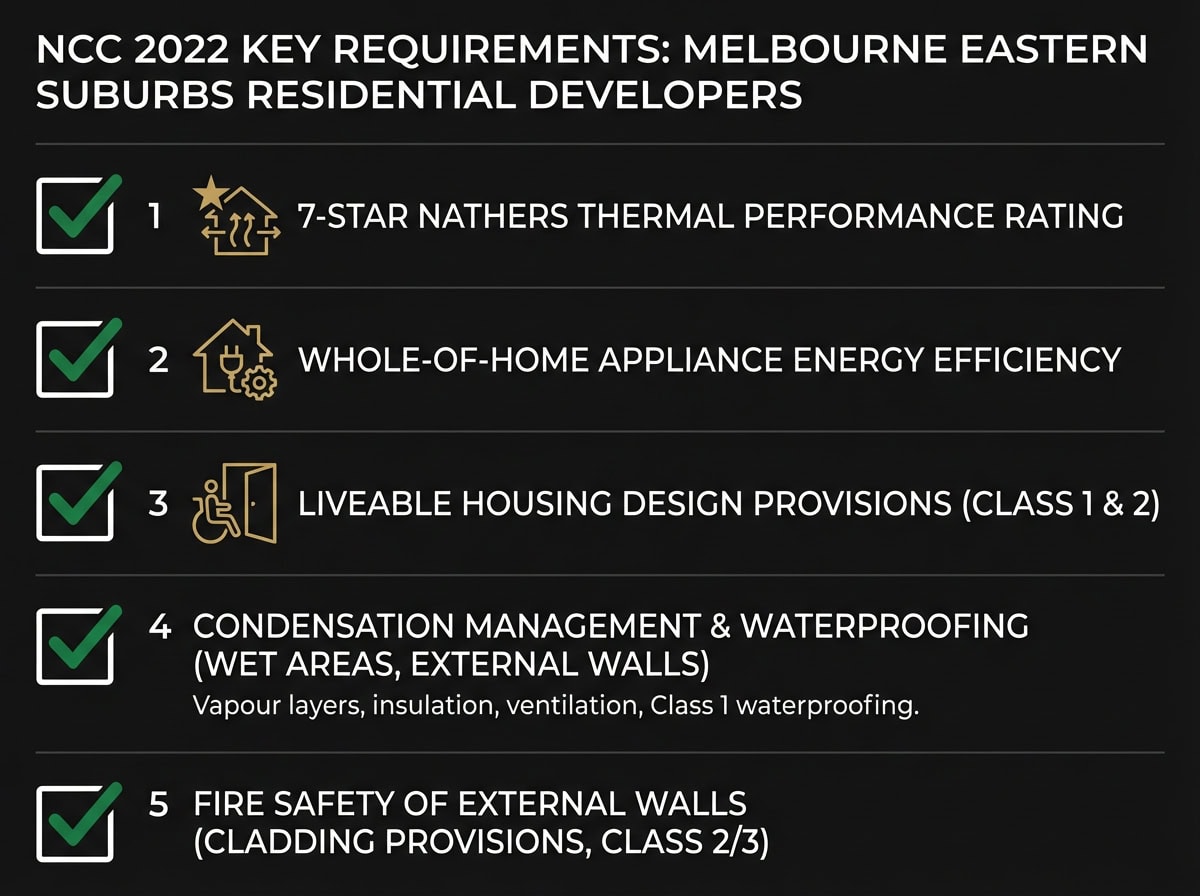
The most widely discussed change in NCC 2022 was the increase in minimum thermal performance requirements for Class 1 (houses) and Class 2 (apartment) buildings from 6 to 7 stars under the National Home Energy Rating Scheme (NatHERS). This requirement became mandatory in Victoria from 1 May 2024. In practical terms, achieving 7 stars typically requires improved insulation, higher-performance glazing, and more deliberate building orientation — all of which influence design decisions from the earliest concept stage.
Alongside the NatHERS star rating, NCC 2022 introduced Whole-of-Home appliance performance requirements. These provisions address the energy efficiency of key household appliances including heating, cooling, and hot water systems. Victoria also removed barriers to the installation of efficient electric hot water systems as part of this reform, supporting all-electric new homes and households investing in solar panels. For developers targeting sustainability-conscious buyers in suburbs such as Camberwell, Doncaster, or Glen Waverley, these provisions align with market expectations as much as regulatory requirements.
Liveable Housing Design Requirements
New liveable housing design requirements under NCC 2022 commenced in Victoria on 1 May 2024. These provisions improve the suitability of new homes for people with reduced mobility, older Australians, and those with mobility-related disabilities. The requirements are based on the Livable Housing Design Standard and apply to Class 1 and Class 2 buildings.
For Class 2 apartment developments — which represent a significant proportion of medium-density projects in Melbourne’s Eastern Suburbs — these requirements interact with Victoria’s Better Apartment Design Standards (Apartment Standards) under the Victoria Planning Provisions. Developers should note that since 2017, Class 2 dwellings in Victoria have been subject to accessibility and energy efficiency requirements beyond the NCC minimum, and the 1 May 2024 commencement introduced new minimum performance requirements that must be read alongside those existing obligations. The BPC has published a fact sheet on minimum requirements for design compliance with both the NCC 2022 liveable housing provisions and the Apartment Standards.
Condensation Management
Updated condensation management provisions also became mandatory from 1 May 2024. These requirements address health risks associated with condensation in new homes, particularly in climate zones relevant to Melbourne. Compliance typically involves specifying appropriate vapour management layers, insulation continuity, and ventilation strategies — considerations that need to be resolved at design development stage, not during construction documentation.
Waterproofing and Weatherproofing
NCC 2022 introduced updated standards for weatherproofing of external walls and new standards for waterproofing of wet areas in Class 1 buildings. These changes have practical implications for bathroom and laundry detailing in townhouse and house projects, and require careful coordination between architectural documentation and hydraulic engineering.
Fire Safety of External Walls
Clarifications to non-combustibility concessions and new provisions preventing the fixing of certain bonded laminated cladding panels by adhesive only were introduced in NCC 2022. These changes reflect the ongoing regulatory response to external wall cladding risks and have direct implications for façade specification on Class 2 and Class 3 buildings.
NCC 2022 Amendment 1 and Amendment 2
The NCC does not remain static between major editions. NCC 2022 Amendment 1 was adopted by states and territories from 1 May 2025, introducing variations and additions for Western Australia, a variation for Tasmania, and minor corrections applicable nationally. From 29 July 2025, NCC 2022 Amendment 2 superseded Amendment 1. Amendment 2 aligns the NCC with recent amendments to the Disability (Access to Premises – Buildings) Standards 2010 (Premises Standards).
For Victorian developers, this means that from 29 July 2025, NCC 2022 must be read in conjunction with Amendment 2. Building permit applications lodged after this date need to reflect the updated accessibility provisions. This is particularly relevant for Class 2 apartment projects and any Class 3 to Class 9 buildings with public access requirements. SQM Architects monitors these amendments as they are released to ensure our documentation remains current at the time of building permit lodgement.
Lead-Free Plumbing: The Next Mandatory Deadline
One significant NCC 2022 provision that has not yet reached its mandatory commencement date is the requirement for lead-free plumbing products. From 1 May 2026, new standards will ban trace lead elements from plumbing products intended for use in contact with drinking water. This applies across Victoria and will affect product specification for all new residential and commercial projects.
Developers with projects currently in design or documentation should confirm with their hydraulic engineers that specified plumbing products will meet the lead-free standard ahead of the May 2026 deadline. Projects where building permits are issued close to or after this date will need to demonstrate compliance. Early specification decisions made now may help avoid substitution costs and procurement delays during construction.
NCC 2025: What Is Coming and What Has Been Paused
A preview draft of NCC 2025 was released by the ABCB on 1 February 2026. NCC 2025 is primarily focused on the commercial building sector, though it contains new standards, processes, and assessment methods that affect all building classes. Key areas progressing for NCC 2025 include waterproofing for balconies of apartment buildings, commercial energy efficiency, carpark fire safety, and condensation management.
Significantly, Building Ministers agreed in October 2024 to pause NCC residential changes — excluding those with urgent safety implications — until mid-2029. This decision was made to allow the industry to focus on housing supply and to streamline the NCC rather than introducing further major residential compliance obligations in the near term. For developers of Class 1 and Class 2 residential buildings, this provides a period of relative regulatory stability, with NCC 2022 (as amended) remaining the applicable standard for residential construction through to at least mid-2029.
Two proposals that will not progress as part of NCC 2025 are electric vehicle charging requirements and embodied emissions provisions. These had been anticipated by some in the development industry, and their removal from NCC 2025 reduces the compliance burden for projects currently in feasibility and design.
Victoria’s Building System Reforms: The BPC and Beyond
The NCC does not operate in isolation. Victoria’s broader building system is undergoing substantial reform, and these changes affect how NCC compliance is managed and enforced on development projects.
In April 2025, the Building and Plumbing Commission transitioned into the Building and Plumbing Commission (BPC), a consolidated regulator that unifies the functions of the BPC, Domestic Building Dispute Resolution Victoria (DBDRV), and the domestic building insurance function of the Victorian Managed Insurance Authority (VMIA). The BPC has new powers including rectification orders that can direct builders and developers to fix defective work after occupancy, a new first-resort warranty scheme for projects up to three storeys, and a bond requirement for developers of apartment buildings above three storeys.
For developers of Class 2 buildings, mandatory building inspections are now required six months before occupancy for apartments over four storeys. Building surveyors are also required to provide an information statement to building owners within 10 working days of issuing a building permit, improving transparency around the permit process. A new building manual requirement is also being introduced, which will require a single repository of construction and maintenance documentation to be created and maintained for each new building — a change with long-term implications for owners corporations and strata management.
How NCC Compliance Affects Your Development Feasibility
For property developers in Melbourne’s Eastern Suburbs, NCC compliance is not simply a technical matter to be resolved by the design team. It has direct implications for development feasibility, construction cost, and programme. The 7-star NatHERS requirement, liveable housing provisions, and updated waterproofing standards all add design complexity and, in some cases, construction cost. However, early integration of these requirements into the design process — rather than retrofitting compliance at documentation stage — may help reduce their cost impact.
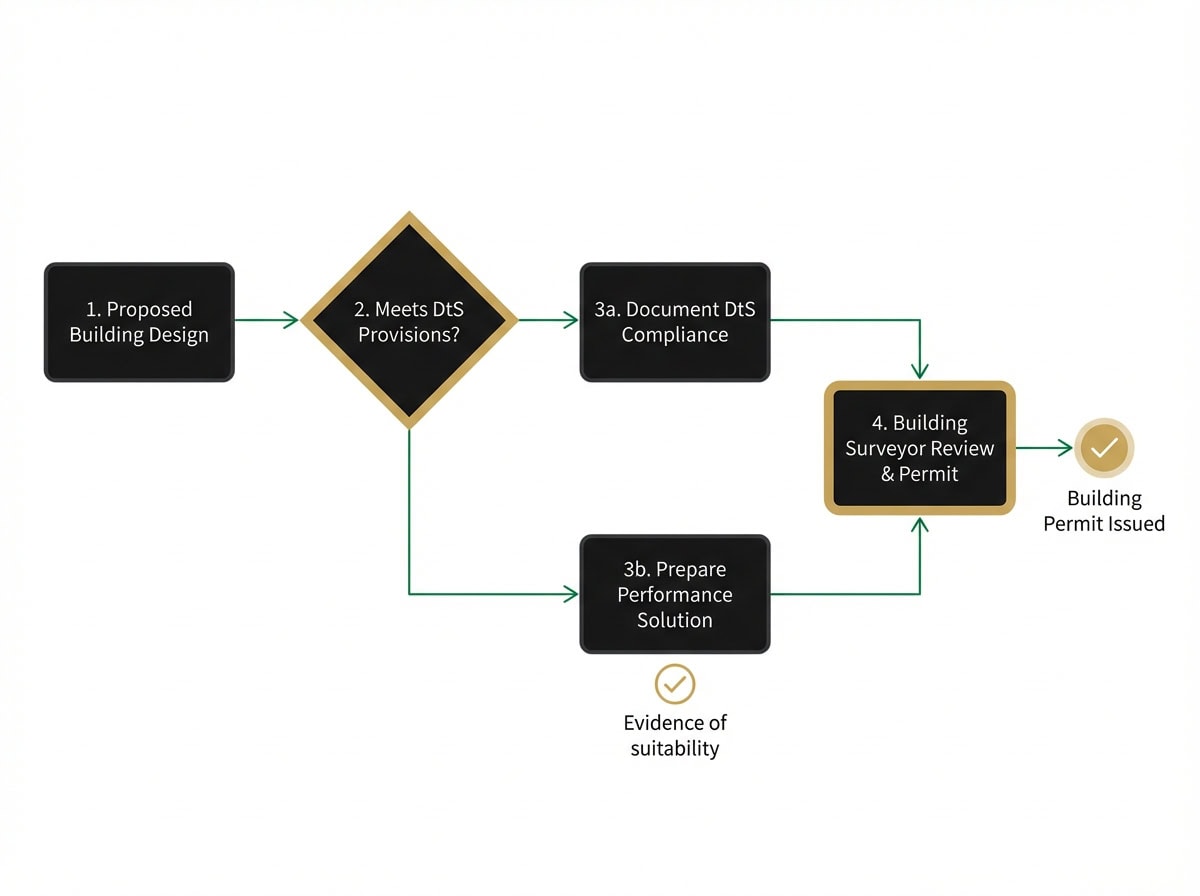
Performance solutions offer an alternative pathway to compliance for projects where Deemed-to-Satisfy provisions are difficult or costly to meet. A performance solution demonstrates that a proposed design achieves the same outcome as the Deemed-to-Satisfy provisions through an alternative means, supported by evidence of suitability. This pathway requires careful documentation and assessment but can unlock design flexibility on complex sites or building typologies. SQM Architects has experience preparing and coordinating performance solution documentation across our project portfolio, drawing on our experience across planning permit applications in Melbourne’s Eastern Suburbs and our understanding of both planning and building compliance requirements.
Developers should also be aware that NCC compliance requirements interact with planning permit conditions. A planning permit may impose requirements — such as specific façade materials, setbacks, or building heights — that in turn affect how NCC provisions can be satisfied. Coordinating planning and building compliance from the earliest design stage, rather than treating them as sequential processes, is one of the most effective ways to protect your development programme and budget.
Frequently Asked Questions
What is the difference between a planning permit and a building permit under the NCC?
A planning permit is issued by the Responsible Authority (typically the relevant council) and addresses land use, built form, and amenity under the relevant planning scheme. A building permit is issued by a registered building surveyor and confirms that the proposed construction complies with the NCC and Victorian building regulations. Both may be required for a development project, and they operate under separate legislative frameworks. The NCC is relevant to the building permit stage, not the planning permit stage.

When did the 7-star NatHERS energy efficiency requirement become mandatory in Victoria?
The 7-star NatHERS minimum energy efficiency requirement for Class 1 and Class 2 buildings became mandatory in Victoria on 1 May 2024. Building permit applications lodged after this date must demonstrate compliance with the updated energy efficiency and condensation management provisions of NCC 2022.
What is NCC 2022 Amendment 2 and does it affect my project?
NCC 2022 Amendment 2 was adopted from 29 July 2025 and aligns the NCC with recent amendments to the Disability (Access to Premises – Buildings) Standards 2010. It supersedes Amendment 1 from the same date. If your building permit application was lodged after 29 July 2025, your design documentation may need to reflect the updated accessibility provisions, particularly for buildings with public access requirements.
Will NCC 2025 affect my residential development project?
NCC 2025 is primarily focused on commercial buildings, and Building Ministers have agreed to pause residential NCC changes (excluding urgent safety matters) until mid-2029. For Class 1 and Class 2 residential projects, NCC 2022 as amended will remain the applicable standard for the foreseeable future. However, developers of Class 2 apartment buildings should monitor the waterproofing for balconies provisions progressing under NCC 2025.
What is a performance solution and when might it be relevant to my project?
A performance solution is an alternative compliance pathway under the NCC that demonstrates a proposed design achieves the required performance outcome through means other than the Deemed-to-Satisfy provisions. It may be relevant where standard provisions are difficult or costly to satisfy on a particular site or building type. Performance solutions require supporting evidence of suitability and assessment by a suitably qualified person, and must be accepted by the building surveyor.
What is the lead-free plumbing deadline and how does it affect my project?
From 1 May 2026, NCC 2022 requires that plumbing products intended for use in contact with drinking water must be free of trace lead elements. Developers with projects currently in design or documentation should confirm with their hydraulic engineers that specified products will meet this standard ahead of the deadline, particularly if building permits are likely to be issued close to or after May 2026.
How does the new Building and Plumbing Commission affect developers of apartment buildings?
The BPC, which replaced the BPC in April 2025, has new powers including rectification orders post-occupancy, a bond requirement for developers of apartment buildings above three storeys, and mandatory inspections six months before occupancy for Class 2 buildings over four storeys. Developers should factor these requirements into their project programmes and financial planning, as they represent additional compliance obligations beyond the building permit process.
Conclusion
The National Construction Code is a living regulatory framework, and the pace of change over the past three years has been substantial. NCC 2022 — now fully in force across Victoria, including Amendment 2 from July 2025 — has raised the bar on energy efficiency, accessibility, condensation management, and waterproofing for all new buildings. The lead-free plumbing deadline in May 2026 represents the next mandatory milestone, while NCC 2025 introduces further changes for commercial buildings and apartment balcony waterproofing. Victoria’s broader building system reforms, including the establishment of the BPC and new consumer protection measures, add further regulatory context that developers need to understand and plan for.
For property developers across Melbourne’s Eastern Suburbs, the most effective approach is to engage an experienced architectural team early — one that understands how NCC compliance interacts with planning permit requirements, development feasibility, and construction programming. SQM Architects has spent many years working across the City of Whitehorse, City of Boroondara, Manningham City Council, City of Monash, Knox City Council, and Maroondah City Council, with extensive experience across planning permit applications in the region. To understand how current NCC requirements may affect your next development, contact our team for a Free 48-Hour Site Assessment or call us on (03) 9005 6588.
This article provides general information about Victorian building regulations for property developers. It does not constitute professional advice. For specific guidance on your project, contact SQM Architects for a complimentary site assessment.


