

For property developers in Melbourne’s Eastern Suburbs, overlooking regulations are among the most frequently misunderstood — and most consequential — aspects of residential development compliance. Get them wrong, and you risk planning permit refusals, costly redesigns, and delays that may affect project viability. Getting them right from the outset may create a smoother pathway to approval, fewer objections, and stronger development outcomes.
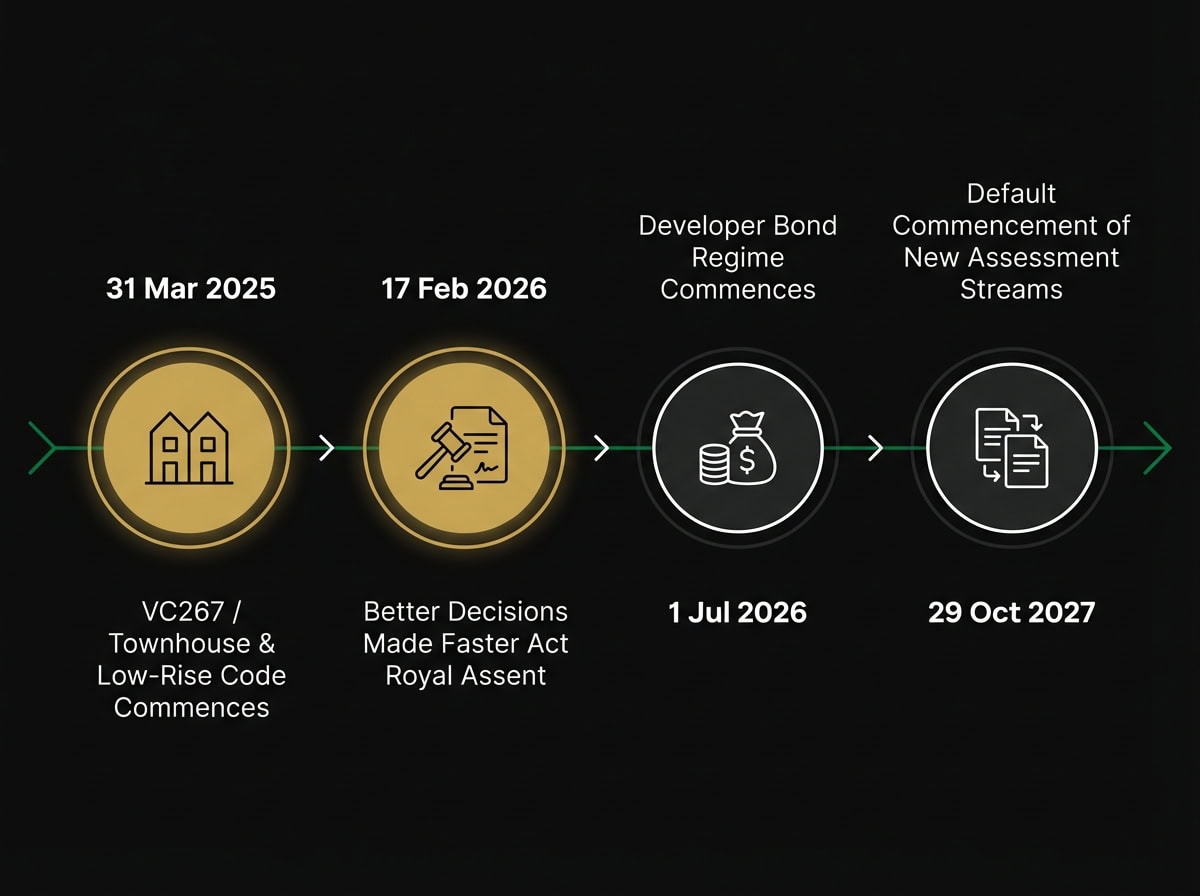
Victoria’s overlooking provisions have long been embedded in ResCode (Clause 55), but the landscape shifted significantly when Amendment VC267 took effect on 31 March 2025. The introduction of the Townhouse and Low-Rise Code brought meaningful changes to how overlooking standards are applied — including a notable exemption for bedroom windows. At the same time, broader reforms under the Planning Amendment (Better Decisions Made Faster) Act 2026 are reshaping the entire planning permit assessment framework, with staged implementation through to 2027.
In this guide, SQM Architects — with extensive experience delivering projects across Melbourne’s Eastern Suburbs — outlines what overlooking regulations mean for your development, how recent reforms affect compliance, and what practical steps you can take to protect your project’s viability.
What Are Overlooking Regulations and Why Do They Matter?
Overlooking regulations are designed to protect the privacy of occupants in adjoining properties. Specifically, they restrict direct lines of sight from a new development into the habitable rooms and secluded private open space (SPOS) of neighbouring dwellings. In established residential areas — which characterise much of Whitehorse, Boroondara, Manningham, Monash, Knox, and Maroondah — these regulations carry significant weight in the planning permit assessment process.
The practical implication for developers is straightforward: if your proposed building has windows, balconies, or decks that overlook a neighbour’s living room, bedroom, or private garden, you may need to demonstrate compliance with the overlooking standard — or provide an acceptable alternative solution. Failure to address this early in the design process is one of the most common reasons planning permit applications attract objections from adjoining owners, which can extend assessment timeframes considerably.
Planning permit applications that attract objections can take significantly longer to resolve than those without — a gap that the 2025–26 reforms aim to narrow. Overlooking compliance remains a critical factor in whether your application qualifies for streamlined assessment pathways.
See How We Achieved Approval for This Complex Site
Key Definitions: Habitable Rooms and Secluded Private Open Space
Habitable Rooms
Under the Building Code of Australia, a habitable room is any room in which occupants spend a significant amount of time. This includes bedrooms, living rooms, dining rooms, and kitchens. Utility spaces — such as laundries, garages, bathrooms, and pantries — are not classified as habitable rooms and are therefore not subject to overlooking provisions.
This distinction matters practically. A window in a laundry or garage that looks directly into a neighbour’s backyard does not trigger the overlooking standard. However, a kitchen window at the same location would. When SQM Architects prepares planning documentation for Eastern Suburbs developments, careful room labelling and layout planning can make a material difference to how overlooking is assessed.
Secluded Private Open Space (SPOS)
A secluded private open space is an outdoor area — typically to the side or rear of a dwelling — that is screened for privacy and intended for outdoor recreation. Under Victorian building regulations, an SPOS must be screened for at least 90% of its perimeter by a wall or barrier that is a minimum of 1.5 metres high, with no more than 25% of its area open.
In the Eastern Suburbs, where established homes often feature substantial rear gardens, SPOS protection is a common point of contention in multi-dwelling developments. Identifying the SPOS of adjoining properties early in the design process — and modelling potential lines of sight — is essential to avoiding compliance issues later.
How the Direct Line of Sight Is Measured
The technical measurement of a direct line of sight is defined clearly in the Victorian building regulations. It is measured from a point 1.7 metres above the finished floor level, projecting outward in a 45-degree fan across a 9-metre radius from the edge of the window, balcony, or deck — measured from ground level.
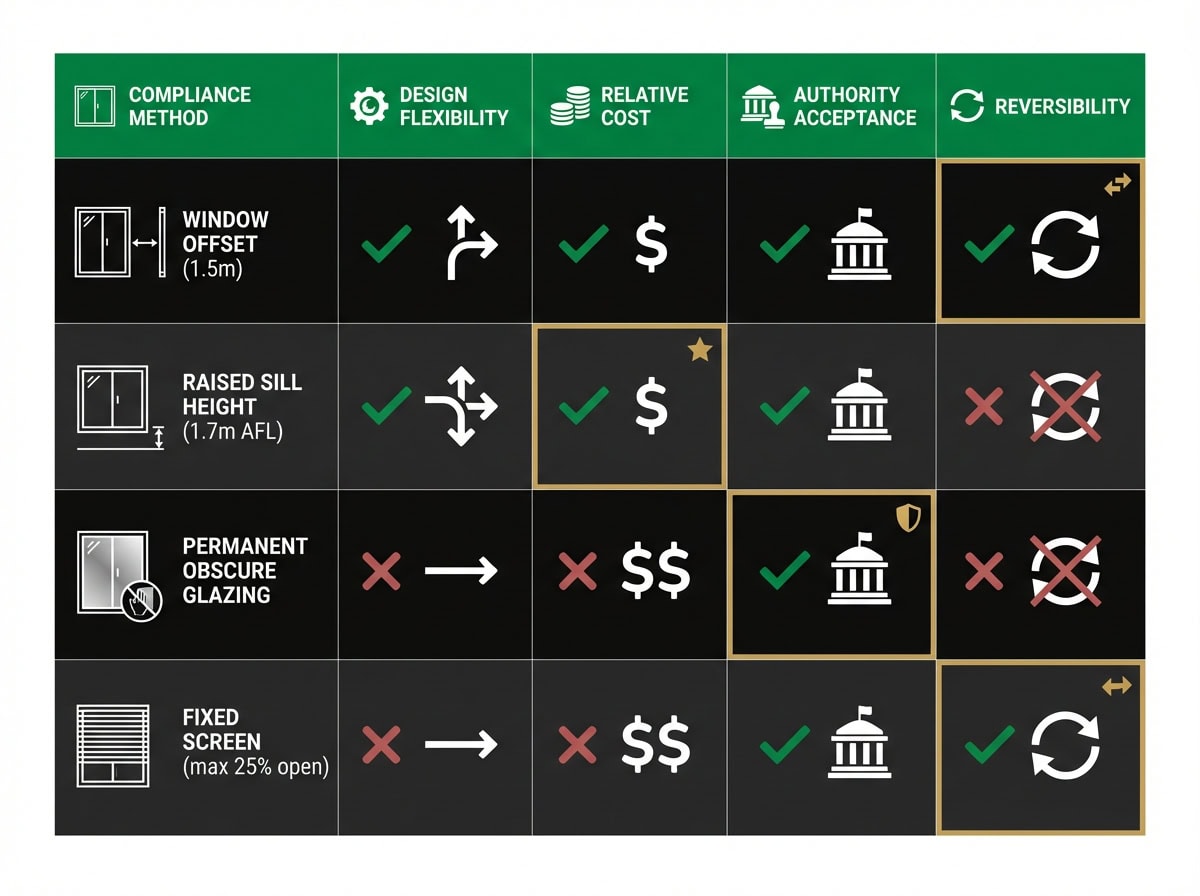
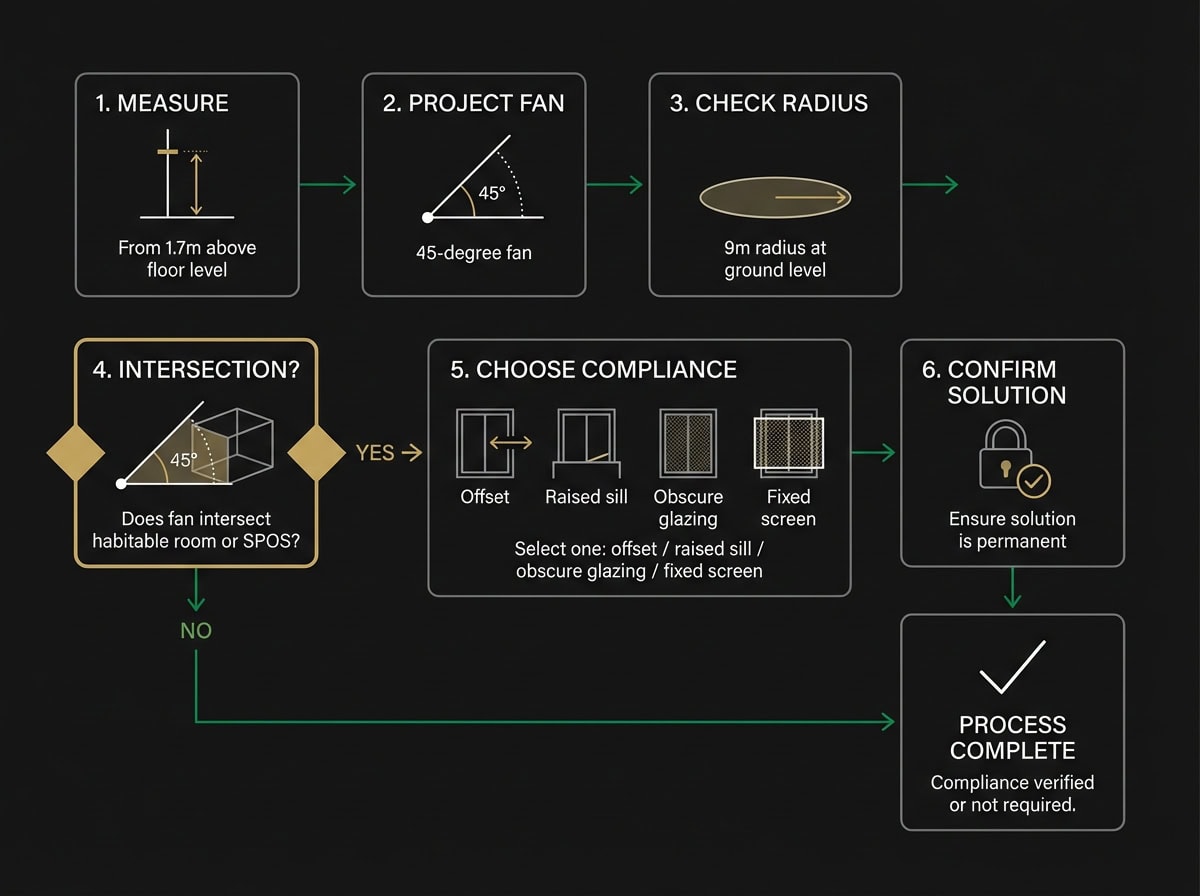
If that 45-degree fan intersects with a neighbouring habitable room or SPOS, a direct line of sight exists and the development must demonstrate compliance. There are four accepted methods of achieving compliance:
- Window offset: The window is offset by a minimum of 1.5 metres from the edge of one window to the edge of the other, so that the direct line of sight does not fall within the 45-degree fan.
- Raised sill height: The window sill is positioned at least 1.7 metres above the finished floor level, preventing a direct line of sight at standing eye level.
- Obscure glazing: Any part of the window below 1.7 metres from the floor level is fitted with permanent obscure glazing. Importantly, adhesive obscure film is no longer accepted by responsible authorities — the glazing must be permanently obscured, either through frosted glass or an equivalent fixed solution.
- Fixed screening: A permanent, fixed screen is installed that obscures the direct line of sight, with no more than 25% of its area open. The screen must be fixed — not operable or removable.
Each of these solutions has design and cost implications. SQM Architects routinely models overlooking compliance during the schematic design phase to identify the most cost-effective and architecturally coherent solution for each project.
Exemptions to Overlooking Provisions
Victorian building regulations include two key exemptions to the overlooking standard. These apply to a habitable room or raised open space where:
- There are visual barriers at least 1.8 metres high at the boundary of the adjoining property; or
- The floor level of the habitable room or raised open space is less than 800 mm above the ground level at the boundary.
The first exemption is particularly relevant in Eastern Suburbs developments where existing boundary fencing or vegetation may already provide adequate screening. However, developers should not assume that existing fencing will remain in place — or that a responsible authority will accept it as a permanent solution — without careful documentation and, where appropriate, a condition of permit requiring its maintenance.
What Changed Under Amendment VC267 (Effective 31 March 2025)
Amendment VC267, which introduced the Townhouse and Low-Rise Code, brought one of the most significant changes to overlooking provisions in recent years: bedroom windows are now exempt from overlooking provisions under the updated Clause 55 standards.
This is a meaningful concession for developers of townhouses and low-rise multi-dwelling developments up to three storeys. Previously, bedroom windows were subject to the same overlooking assessment as living rooms and kitchens. The exemption reduces the number of windows requiring compliance solutions, which may allow for more flexible floor plan layouts and could reduce the cost of screening or glazing treatments.
Beyond the bedroom window exemption, VC267 introduced a "deemed-to-comply" framework for the Townhouse and Low-Rise Code. Under this framework, if a development meets all standards in the Code, the responsible authority is generally required to issue the planning permit — and objectors cannot appeal the decision to VCAT. This is a significant shift from the previous discretionary framework, where objections could trigger lengthy VCAT proceedings regardless of technical compliance.
Other key changes under VC267 relevant to overlooking and amenity include:
- Minimum street setback reduced from 9 metres to 6 metres
- Private open space at ground level reduced from 40 m² to 25 m²
- Tree canopy cover requirements of 10% on sites up to 1,000 m² and 20% on larger sites
- Site coverage limits varying by zone: 60% (Neighbourhood Residential and Township Zones), 65% (General Residential Zone), 70% (Mixed Use and Housing Choice and Transport Zones)
- Neighbourhood character policies removed from Clause 55 assessment criteria
For developers in the City of Monash, Knox City Council, and Manningham City Council — where neighbourhood character was previously a significant discretionary consideration — the removal of character objectives from Clause 55 may reduce the grounds on which objections can be sustained, provided the development meets all deemed-to-comply standards.
The 2025–26 Planning Reform Context: What Developers Need to Know
Overlooking compliance does not exist in isolation. The broader Victorian planning reform programme is reshaping the context in which these standards are assessed and enforced.
Planning Amendment (Better Decisions Made Faster) Act 2026
The Planning Amendment (Better Decisions Made Faster) Act 2026 received Royal Assent on 17 February 2026 and represents the most significant update to Victoria’s planning legislation in decades. The Act establishes three planning permit assessment streams, calibrated to the complexity and risk of the application:
- Stream 1 (standalone homes and duplexes): Target assessment timeframe of 10 days, no notice required, no third-party appeals
- Stream 2 (townhouses and low-rise developments): Target assessment timeframe of 30 days, no notice required, no third-party appeals
- Stream 3 (larger apartment buildings): Target assessment timeframe of 60 days, notice to directly impacted neighbours, limited appeal rights
The default commencement date for most provisions is 29 October 2027, allowing time for supporting changes to the Planning and Environment Regulations 2015, Ministerial guidelines, and the Victoria Planning Provisions. Developers should note that transitional provisions will apply, and applications lodged before key commencement dates may be assessed under existing rules.
Developer Bond Regime (From 1 July 2026)
Developers of residential apartment buildings over three storeys will be required to lodge a financial bond — equivalent to 2% of total build cost — with the Building and Plumbing Commission (BPC) before applying for an occupancy permit. This requirement, introduced under the Building Legislation Amendment (Buyer Protections) Bill 2025, takes effect from 1 July 2026 and has significant implications for project finance structuring and settlement timing. Non-compliance may attract penalties of up to $500,000 for corporations.
Building and Plumbing Commission
A new Building and Plumbing Commission (BPC) has been established, consolidating the functions of the Building and Plumbing Commission, Domestic Building Dispute Resolution Victoria, and the domestic building insurance arm of the VMIA. The BPC will have new powers including rectification orders and a new first-resort warranty scheme for buildings up to three storeys — changes that affect post-completion risk management for developers.
Practical Implications for Eastern Suburbs Developers
For developers active in the City of Whitehorse, City of Boroondara, Manningham City Council, City of Monash, Knox City Council, and Maroondah City Council, overlooking compliance in 2025–26 requires a more nuanced approach than in previous years. The deemed-to-comply framework under VC267 creates a clearer pathway to approval — but only if all standards are met. A single non-compliant element removes the protection against third-party appeals.
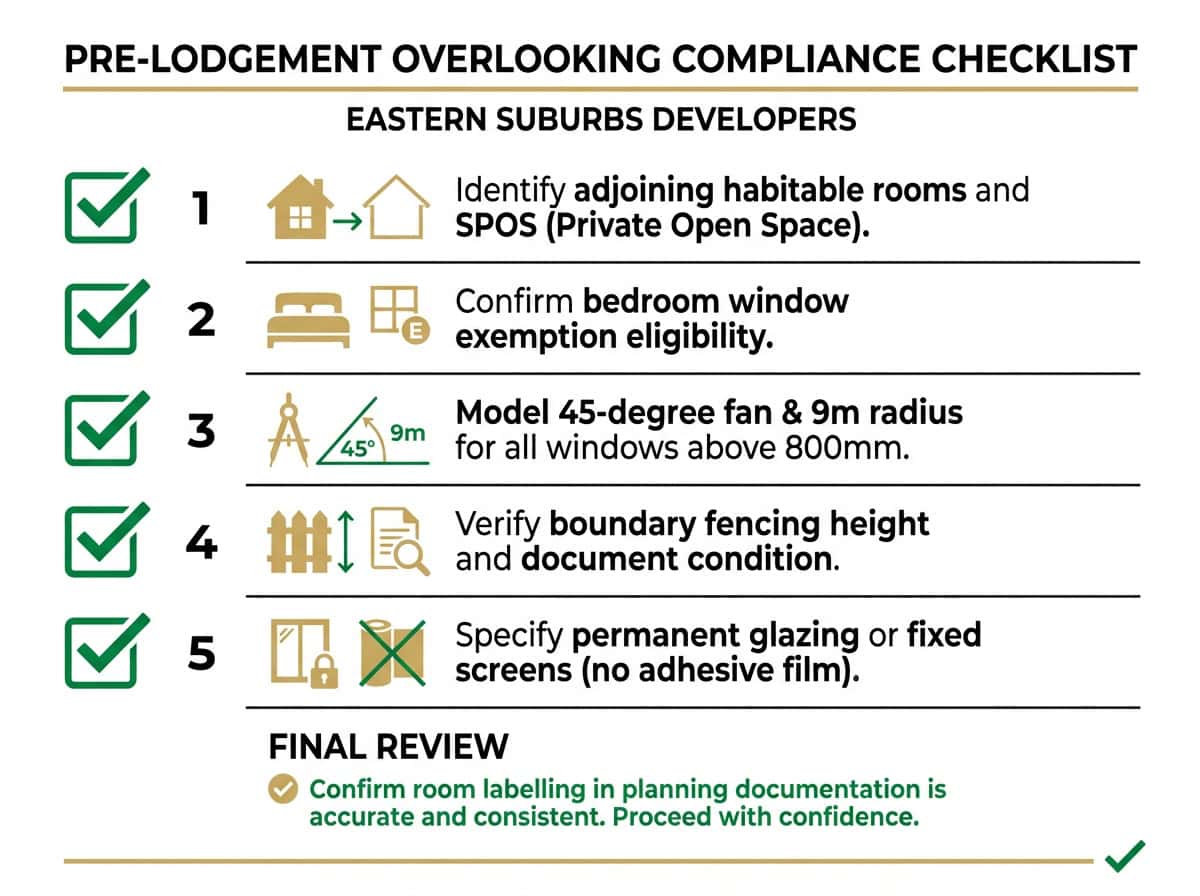
Key practical considerations include:
- Early site analysis: Identify the location and floor levels of habitable rooms and SPOS in adjoining properties before finalising floor plan layouts. This information should inform window placement from the earliest design stages.
- Bedroom window exemption: Consider the new exemption for bedroom windows under VC267, but ensure room labelling in planning documentation accurately reflects intended use.
- Permanent screening solutions: Where fixed screens or obscure glazing are required, permanent solutions are typically required from the outset. Adhesive film is not accepted, and operable screens may not satisfy the "fixed" requirement.
- Boundary fencing documentation: Where existing boundary fencing provides the basis for an exemption, document its height and condition carefully. Consider whether a permit condition requiring its maintenance is appropriate.
- Multi-storey developments: Upper-level windows and balconies are more likely to trigger overlooking issues due to elevated sightlines. Three-dimensional modelling of lines of sight is advisable for developments of two or more storeys.
SQM Architects has developed a detailed understanding of how each responsible authority interprets and applies overlooking standards in practice across Melbourne’s Eastern Suburbs.
Frequently Asked Questions
Are bedroom windows now fully exempt from overlooking provisions under the new Townhouse and Low-Rise Code?
Under Amendment VC267, which took effect on 31 March 2025, bedroom windows are exempt from overlooking provisions under the updated Clause 55 (Townhouse and Low-Rise Code). This exemption applies to multi-dwelling developments up to three storeys assessed under the Code. Developers should confirm with SQM Architects or a planning consultant whether their specific project falls within the scope of the Code before relying on this exemption.
What happens if my development does not meet the deemed-to-comply overlooking standard?
If a development does not meet one or more standards under the Townhouse and Low-Rise Code, the responsible authority is required to assess those non-compliant elements on their merits and may issue a Notice of Decision to Grant a Permit. In that scenario, objectors may appeal the decision to VCAT on grounds directly related to the non-compliant standard. This is why achieving full deemed-to-comply status is generally preferable for streamlined approvals.
Can I use adhesive obscure film on windows to satisfy the overlooking standard?
No. Responsible authorities in Victoria no longer accept adhesive obscure film as a compliant solution. The glazing must be permanently obscured — typically through frosted or sandblasted glass — or an alternative compliance method such as a raised sill height or fixed screen must be used instead.
How is the 9-metre radius for overlooking measured on a sloped site?
The 9-metre radius is measured from the window or the perimeter of the overlooking balcony or deck at ground level, not at the floor level of the window. On sloped sites, this can create complex measurement scenarios, particularly where the ground level varies significantly between the development and the adjoining property. SQM Architects recommends engaging a surveyor to establish accurate ground levels before undertaking overlooking analysis on sloped sites.
Do the new planning permit assessment streams under the Better Decisions Made Faster Act affect how overlooking is assessed?
The three-stream assessment framework introduced by the Planning Amendment (Better Decisions Made Faster) Act 2026 affects process and timeframes rather than the technical standards themselves. Overlooking compliance is still assessed against the relevant ResCode or Code standards. However, the stream your application falls into will determine whether neighbours receive notice and whether third-party appeals to VCAT are available — which makes achieving full compliance more commercially important than ever.
What is the difference between the overlooking standard and the privacy provisions in Clause 57 for four-storey apartments?
Clause 57, introduced under VC267 for four-storey apartment developments, includes external amenity provisions (Clause 57.04) that address overlooking and privacy. Unlike the deemed-to-comply framework under Clause 55, Clause 57 does not include deemed-to-comply standards — meaning third-party appeals remain possible for four-storey developments. The external amenity standards under Clause 57 are broadly consistent with the Clause 55 framework but are assessed with greater discretion by the responsible authority.
How do overlooking regulations interact with the developer bond regime commencing 1 July 2026?
The developer bond regime applies to residential apartment buildings over three storeys and operates at the occupancy permit stage — it does not directly affect how overlooking is assessed during the planning permit process. However, developers of larger projects should be aware that any defects identified post-completion — including those related to screening or glazing solutions — may be subject to bond claims through the BPC. Specifying robust, permanent overlooking solutions during design may reduce this post-completion risk.
Conclusion
Overlooking regulations remain a fundamental compliance requirement for residential development in Victoria, and the 2025–26 reform cycle has introduced both new opportunities and new complexities. The bedroom window exemption and deemed-to-comply framework under Amendment VC267 may offer developers greater certainty and design flexibility — but only for projects that achieve full compliance across all Code standards. The broader reform programme, including the Better Decisions Made Faster Act 2026 and the developer bond regime, is reshaping the risk and compliance landscape for Eastern Suburbs developers in ways that extend well beyond the planning permit stage.
SQM Architects works with property developers across the City of Whitehorse, City of Boroondara, Manningham City Council, City of Monash, Knox City Council, and Maroondah City Council to navigate these requirements from the earliest stages of site assessment through to planning permit approval. Drawing on extensive Eastern Suburbs experience, our team has developed a practical understanding of what responsible authorities typically look for — and how to approach a compliant development with stronger commercial outcomes from the outset.
Get Your Free Site Assessment — contact SQM Architects today to discuss how overlooking regulations and the 2025–26 planning reforms may affect your next development.
This article provides general information about Victorian planning for property developers. It does not constitute professional advice. For specific guidance on your project, contact SQM Architects for a complimentary site assessment.


