
For property developers targeting Melbourne’s south-eastern growth corridor, Knox City Council represents one of the most active and opportunity-rich planning jurisdictions in Melbourne. Spanning established suburbs such as Bayswater, Boronia, Rowville, and Ferntree Gully through to emerging precincts around Knox Central, the municipality offers genuine medium-density development potential — provided you understand how its approval pathway operates and how Victoria’s sweeping 2025–26 planning reforms are reshaping the landscape.
The planning environment governing Knox has changed substantially since 2024. Two landmark pieces of legislation — the Consumer and Planning Legislation Amendment (Housing Statement Reform) Act 2025 and the Planning Amendment (Better Decisions Made Faster) Act 2026 — have introduced new assessment streams, deemed-to-comply pathways, and restructured objection rights that directly affect how development applications are processed and what timelines developers can realistically expect. Layered on top of these reforms are council-specific policies, overlay controls, and engineering requirements that remain firmly in place.
This article outlines the Knox City Council planning permit approval pathway as it stands in 2025–26, incorporating the latest legislative context, council intelligence specific to Knox, and practical guidance for developers assessing sites across the municipality. SQM Architects has delivered projects across Melbourne, including work within Knox, and this information draws on that depth of local experience.
Understanding the Knox Planning Scheme
Knox City Council administers the Knox Planning Scheme, which forms the primary regulatory framework governing land use and development across the municipality. Like all Victorian planning schemes, it operates within the Victoria Planning Provisions and is subject to state-level amendments — including the significant changes introduced through Amendments VC257, VC267, VC274, and VC282 between February and September 2025.
Read More Property Development Guides
The Knox Planning Scheme has seen meaningful activity in recent years through a series of completed planning scheme amendments. Amendment GC172 introduced changes to Knox residential zones, while Amendment C186knox established the Knox Municipal Development Contributions Plan — a mechanism that may affect development cost modelling for larger projects. Amendment C189knox rezoned land in Rowville, and Amendment C184knox addressed the Norvel Estate. Developers assessing sites in Knox may need to consider whether any current or recently completed amendments affect their specific land parcel.
Knox Central remains a key strategic focus for the council, with the Knox Central Structure Plan (Amendment C149) guiding built form and land use outcomes in the municipality’s principal activity centre. Developers targeting higher-density or mixed-use outcomes in this precinct may find the structure plan provides a useful framework for understanding what the Responsible Authority is likely to support — and where design parameters are likely to be tested.
Residential Zones and Development Potential
The residential zoning of a site is the single most important determinant of development potential in Knox. The municipality contains land across the Neighbourhood Residential Zone (NRZ), General Residential Zone (GRZ), and Residential Growth Zone (RGZ), each carrying different density expectations, site coverage allowances, and height controls.
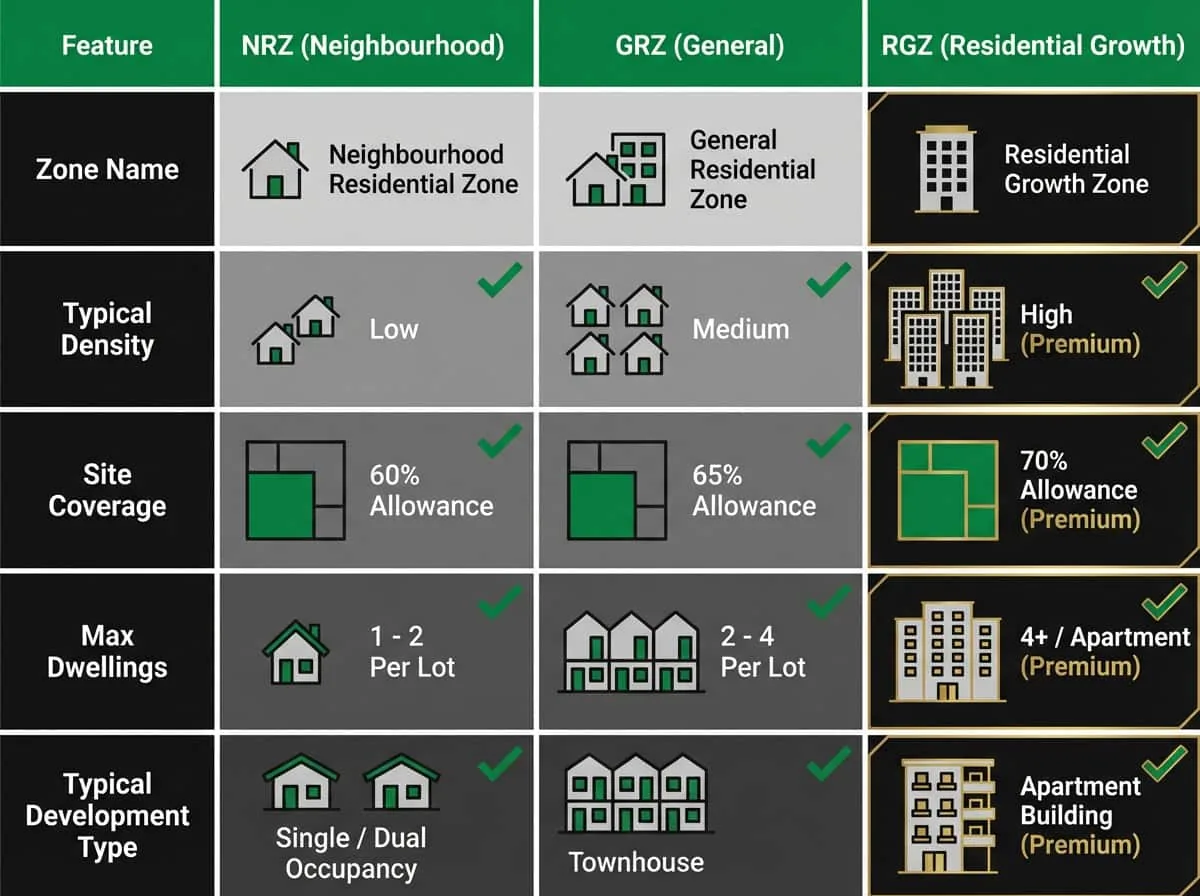
- Neighbourhood Residential Zone (NRZ): Applies to established low-density areas where neighbourhood character is a primary consideration. Site coverage is capped at 60% under the updated Clause 54 and Clause 55 standards. Development is typically limited to two dwellings per lot in many NRZ schedules, though this varies.
- General Residential Zone (GRZ): The most common residential zone in Knox, permitting a broader range of medium-density outcomes. Site coverage allowances of up to 65% apply under the updated ResCode standards. Townhouse and dual-occupancy developments may be well-suited to GRZ sites where lot size and configuration support them.
- Residential Growth Zone (RGZ): Applies to areas earmarked for higher-density outcomes, including parts of Knox Central and activity centre catchments. Site coverage may reach 70% under updated standards, and multi-storey apartment development may be appropriate where height controls permit.
Understanding which zone schedule applies to a specific site — not just the zone itself — is essential. Zone schedules in Knox can modify default standards, including minimum lot sizes for subdivision, maximum building heights, and garden area requirements. A site assessment that identifies the applicable zone schedule early in the feasibility process may help avoid costly redesigns later.
The 2025–26 Reform Context: What’s Changed for Knox Developers
Victoria’s planning system has undergone its most significant transformation in decades, and the reforms are directly relevant to developers operating in Knox. Two legislative instruments now shape how planning permits are assessed across the municipality.
Townhouse and Low-Rise Code (Clause 55 — Deemed to Comply)
Amendment VC267, which came into operation on 31 March 2025, introduced deemed-to-comply standards under Clause 55 of the Knox Planning Scheme. This applies to the construction of two or more dwellings on a lot and residential buildings up to and including three storeys. Where a development meets all applicable Clause 55 standards, the Responsible Authority is deemed to have satisfied the corresponding objectives — and critically, objectors have no third-party right of appeal to VCAT in relation to those compliant elements.
For Knox developers, this represents a meaningful shift. Projects that previously faced subjective neighbourhood character objections — a common source of delay in established Knox suburbs — may now proceed with greater certainty where the Code’s standards are met. Key changes under the updated Clause 55 include reduced street setbacks, increased site coverage allowances, and the replacement of neighbourhood character as a primary design consideration with more objective, uniform standards. Applications lodged before 6 March 2025 continue to be assessed under the previous Clause 55 provisions, including existing objection and appeal rights.
Single Dwelling and Two-Lot Subdivision Reforms
Amendment VC282, effective 8 September 2025, introduced a streamlined VicSmart pathway for single dwellings and small second dwellings on lots under 300 m². Under this pathway, compliant applications may be assessed within 10 business days, with no third-party notice or review. Separately, Amendment VC288 — effective 16 October 2025 — enables two-lot subdivisions to be assessed under the VicSmart pathway in eligible zones, also within a 10-business-day timeframe. These changes may be particularly relevant for Knox developers pursuing dual-occupancy or small subdivision outcomes on appropriately sized sites.
Better Decisions Made Faster Act 2026
The Planning Amendment (Better Decisions Made Faster) Act 2026 received Royal Assent on 17 February 2026 and represents the most significant overhaul of Victoria’s planning legislation in decades. Its default commencement date is 29 October 2027, allowing time for supporting regulatory changes. Once implemented, it will establish three planning permit assessment streams calibrated to complexity and risk:
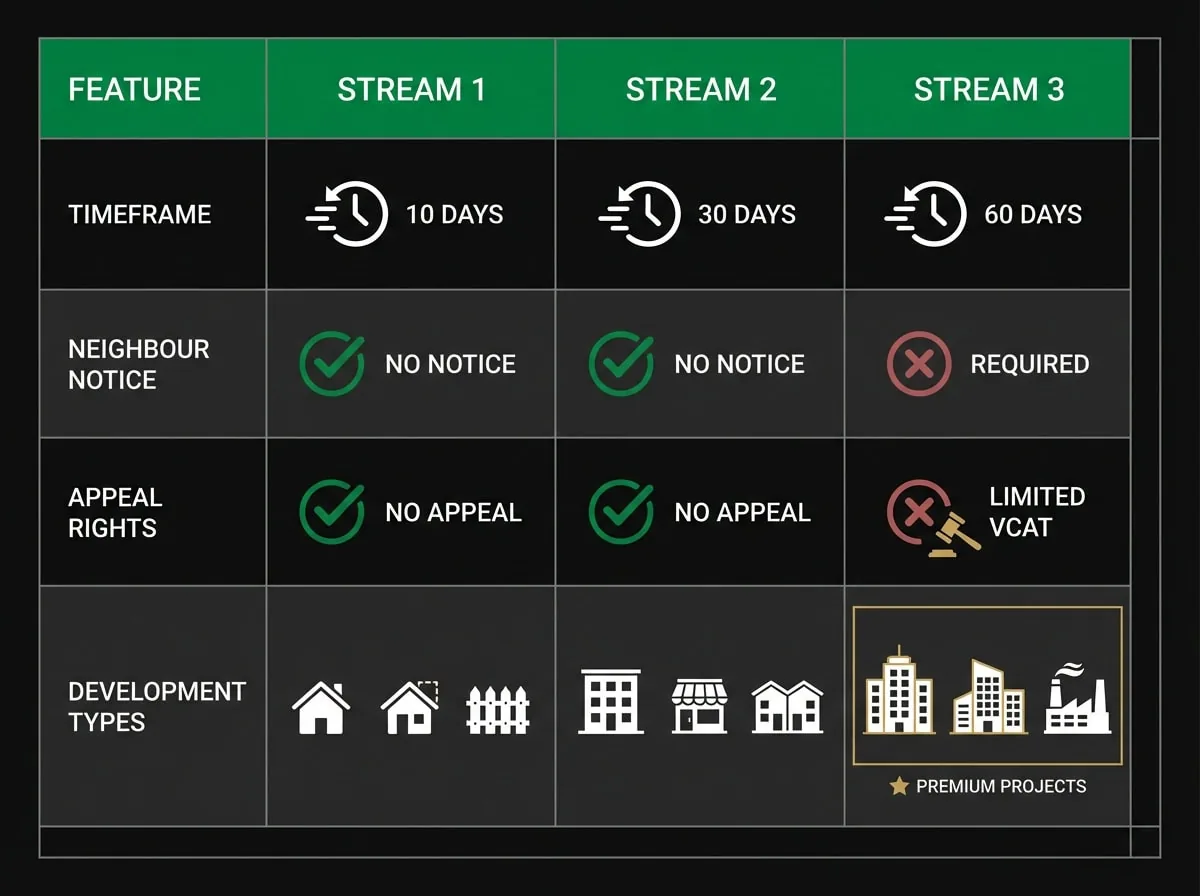
- Stream 1 — Standalone homes and duplexes: Indicative target of 10 days. No public notice required, no third-party appeal rights.
- Stream 2 — Townhouses and low-rise developments: Indicative target of 30 days. No public notice required, no third-party appeal rights.
- Stream 3 — Higher density apartments and larger developments: Indicative target of 60 days. Notice to directly impacted neighbours, with limited third-party appeal rights at VCAT.
The Act also introduces meaningful changes to how restrictive covenants are treated in planning permit decisions — a development that may be particularly relevant in established Knox neighbourhoods where single-dwelling covenants have historically constrained medium-density outcomes. These covenant-related changes are not expected to come into force before 29 October 2027, but developers with affected sites may benefit from beginning their assessment now.
Get the 7-point site check to run before committing to a permit application — zoning, overlays, setbacks and council red flags, in plain English. Free PDF, instant download.
- Zone, overlay & setback checks
- What council assesses first
- Permit-readiness red flags
Something went wrong. Please try again.
No spam. Unsubscribe anytime.
Check your inbox — your checklist is on its way.
The Knox Planning Permit Process: Step by Step
Notwithstanding the reforms described above, the core planning permit process in Knox follows the standard Victorian statutory pathway. Understanding each stage — and where delays typically occur — is essential for realistic project programming.
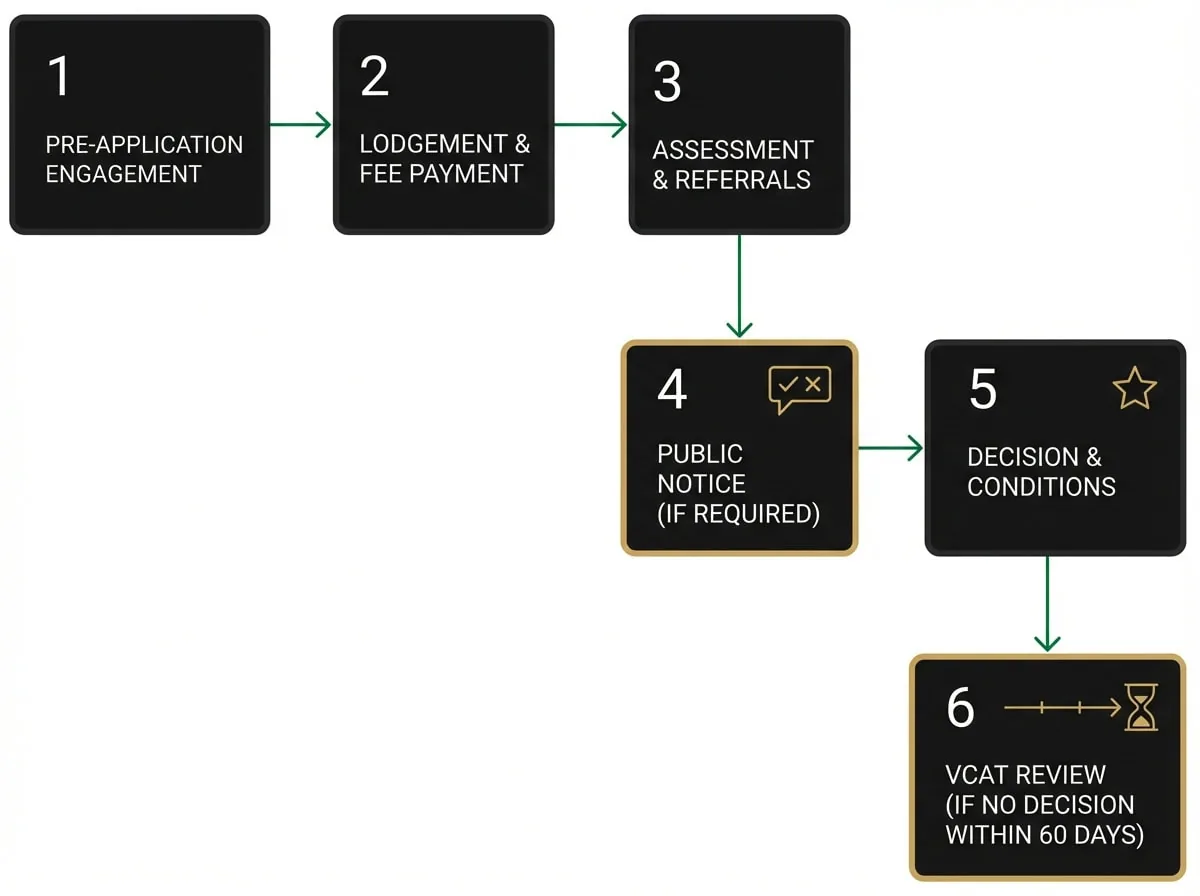
Pre-Application Engagement
Knox City Council offers a "Talk to a Planner" service that allows developers and their consultants to discuss proposals before lodging a formal application. Pre-application engagement may help identify likely issues, overlay triggers, and referral requirements early — potentially reducing the risk of requests for further information after lodgement. For more complex proposals, a formal pre-application meeting may be warranted, particularly where the site is affected by overlays such as the Significant Landscape Overlay, Vegetation Protection Overlay, or Design and Development Overlay.
Application Lodgement and Fee Payment
Planning permit applications in Knox are lodged through the council’s online planning portal. Application fees are set by the state government under the Planning and Environment (Fees) Regulations and are calculated based on the estimated cost of development. Ensuring the application is complete at lodgement — including all required plans, reports, and supporting documentation — is important, as incomplete applications may be voided under new provisions introduced by the Housing Statement Reform Act 2025 if the applicant does not respond to a request for further information within the prescribed timeframe.
Assessment, Referrals, and Notice
Once lodged, the application is assessed by Knox City Council as the Responsible Authority. Where referral to external authorities is required — such as Melbourne Water for drainage, VicRoads for access, or other statutory referral bodies — the assessment period may extend accordingly. Public notice requirements depend on the nature of the application and the applicable assessment pathway. Under the reformed system, applications meeting deemed-to-comply standards under Clause 55 carry no third-party appeal rights where all standards are satisfied.
Decision and Conditions
Knox City Council has a statutory timeframe of 60 days to decide most planning permit applications, though complex applications or those requiring referrals may take longer. Where the council fails to decide within the statutory timeframe, the applicant may apply to VCAT for a deemed refusal review. Planning permit conditions — including requirements for endorsed plans, engineering approvals, and landscape plans — are a standard feature of most approvals and require careful management through to construction.
Overlays and Site-Specific Constraints in Knox
Overlays are a critical layer of the Knox Planning Scheme that can significantly affect development potential, design requirements, and approval timelines. Common overlays affecting Knox development sites include:
- Vegetation Protection Overlay (VPO): Applies across significant portions of Knox, particularly in the foothills and Dandenong Ranges interface areas. A planning permit may be required for the removal of vegetation, and arborist reports are typically required as part of the application.
- Significant Landscape Overlay (SLO): Applies to areas of landscape significance, including parts of the Dandenong Ranges interface. Development in SLO areas may be subject to additional design requirements and assessment criteria.
- Design and Development Overlay (DDO): Applies to specific precincts including parts of Knox Central, where built form controls — including height limits and setback requirements — are specified in the overlay schedule.
- Bushfire Management Overlay (BMO): Applies to land with elevated bushfire risk, particularly in the eastern parts of the municipality. Development in BMO areas requires a Bushfire Management Statement and may be subject to additional referral requirements.
- Heritage Overlay (HO): Applies to places of cultural heritage significance. Development affecting heritage-overlaid properties requires careful design consideration and may involve additional assessment criteria.
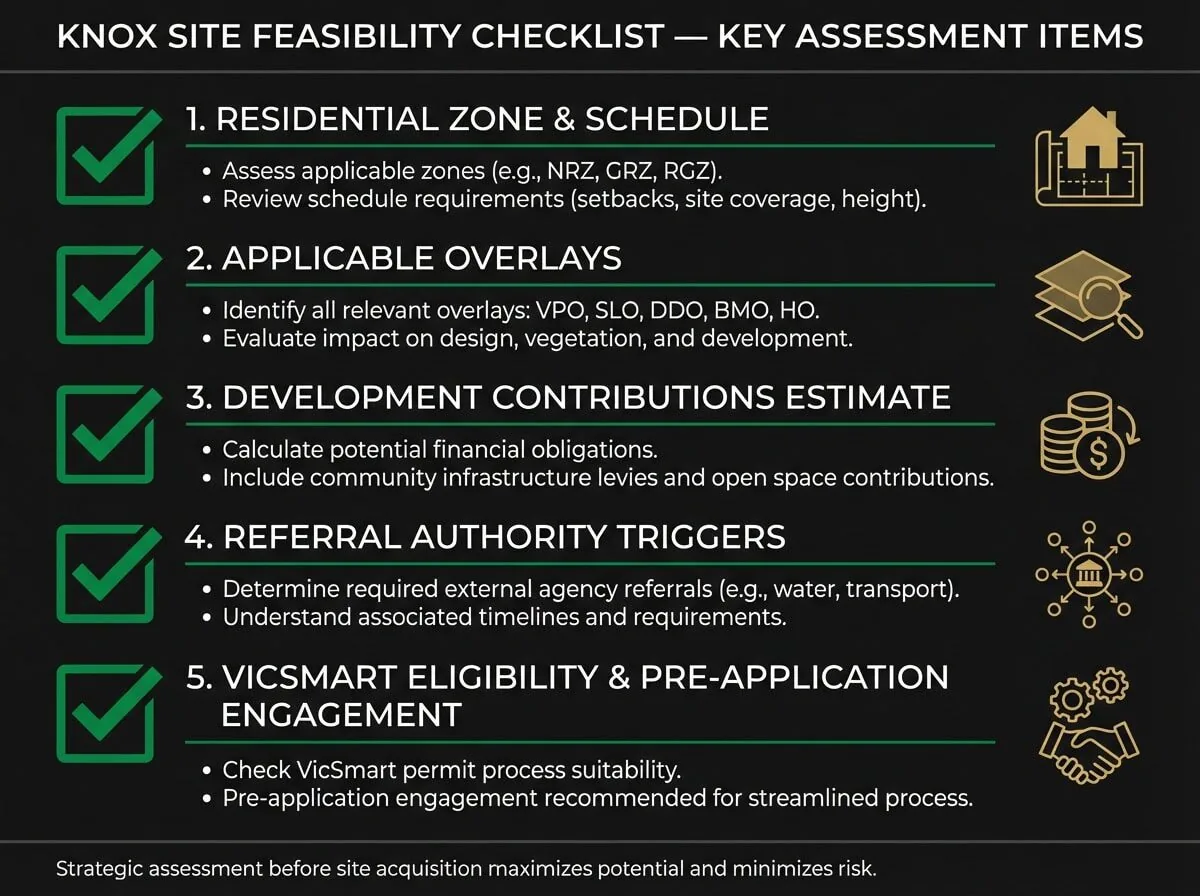
Identifying all applicable overlays at the feasibility stage — before site acquisition — is a fundamental step in any Knox development assessment. SQM Architects routinely conducts overlay analysis as part of its site assessment process, drawing on experience across Melbourne.
Engineering Requirements and Development Contributions
Knox City Council’s engineering guidelines for development set out the technical requirements for infrastructure works associated with new development, including stormwater drainage, road access, and services. These requirements are administered separately from the planning permit process but are directly relevant to development cost modelling and construction programming.
The Knox Municipal Development Contributions Plan (Amendment C186knox) establishes a framework for development contributions — charges levied on new development to fund community infrastructure. Developers should factor these contributions into feasibility assessments, as they represent a real cost that may affect development outcomes. The applicable contribution rate depends on the type and scale of development and the location of the site within the municipality.
Stormwater management is a particular consideration in Knox, given the municipality’s topography and the presence of significant drainage infrastructure. Melbourne Water is a standard referral authority for development in flood-prone areas, and WSUD (Water Sensitive Urban Design) requirements apply across most new residential development.
Knox-Specific Council Intelligence for Developers
Beyond the statutory framework, experienced Knox developers understand that local council intelligence — knowledge of how the Responsible Authority interprets and applies its planning scheme — is as important as technical compliance. Several observations are relevant for developers active in Knox:
- Knox Central precinct: The Knox Central Structure Plan signals the council’s strategic intent for higher-density and mixed-use outcomes in this precinct. Proposals that align with the structure plan’s built form and land use objectives may be viewed more favourably by the Responsible Authority.
- Neighbourhood character in established areas: While the 2025 reforms have reduced the weight of neighbourhood character as a primary assessment criterion for Clause 55 applications, it remains relevant for proposals that do not meet all deemed-to-comply standards. Design quality and contextual responsiveness continue to matter in Knox’s established residential areas.
- Tree and vegetation management: Knox has a strong track record of protecting significant vegetation, and the VPO applies broadly across the municipality. Early arborist assessment and proactive tree management strategies are advisable for sites with established vegetation.
- Referral management: Proactive engagement with referral authorities — particularly Melbourne Water and utility providers — before lodgement may help reduce delays during the formal assessment period.
Frequently Asked Questions
How long does a planning permit take in Knox City Council?
The statutory timeframe for most planning permit decisions in Knox is 60 days from lodgement. In practice, applications involving referrals, public notice, or requests for further information may take longer. Under the new VicSmart pathways introduced in 2025, eligible single dwelling and two-lot subdivision applications may be assessed within 10 business days. Where Knox City Council fails to decide within the statutory timeframe, applicants may apply to VCAT for a deemed refusal review.
What is the deemed-to-comply pathway and how does it apply in Knox?
The deemed-to-comply pathway under Clause 55 (introduced via Amendment VC267 from 31 March 2025) means that where a townhouse or low-rise development meets all applicable ResCode standards, Knox City Council must issue a planning permit and objectors have no right of appeal to VCAT. This pathway applies to developments of two or more dwellings up to three storeys in residential zones. Applications lodged before 6 March 2025 continue to be assessed under the previous provisions.
Do I need a planning permit to remove a tree in Knox?
In many parts of Knox, a planning permit may be required to remove or prune significant vegetation, particularly where the Vegetation Protection Overlay (VPO) or Significant Landscape Overlay (SLO) applies to the site. The specific requirements depend on the overlay schedule and the species and size of the tree. An arborist report is typically required as part of any application involving vegetation removal.
What are development contributions in Knox and how are they calculated?
Knox City Council’s Municipal Development Contributions Plan (Amendment C186knox) establishes charges on new development to fund community infrastructure. The applicable contribution rate depends on the type and scale of development and the location of the site. Developers may need to factor these contributions into feasibility assessments as a real project cost. Specific rates should be confirmed with Knox City Council or a planning consultant familiar with the current schedule.
How do the 2026 planning reforms affect development in Knox?
The Planning Amendment (Better Decisions Made Faster) Act 2026 — with a default commencement date of 29 October 2027 — will introduce three planning permit assessment streams with indicative timeframes of 10, 30, and 60 days depending on development complexity. It will also restructure third-party objection and VCAT appeal rights, and introduce greater flexibility around restrictive covenants. Developers planning projects in Knox over the next two to three years may benefit from understanding how these reforms could affect their approval strategy.
Can I subdivide a residential lot in Knox under the new VicSmart pathway?
From 16 October 2025, Amendment VC288 enables two-lot subdivisions to be assessed under the VicSmart pathway in eligible zones, with a 10-business-day assessment timeframe. Overlays, zoning controls, and local policies continue to apply, and key design elements including lot layout, access, and services remain subject to assessment. Not all sites or zones will be eligible, so a site-specific assessment is advisable before relying on this pathway.
What role does pre-application engagement play in Knox approvals?
Pre-application engagement with Knox City Council’s planning team — through the "Talk to a Planner" service or a formal pre-application meeting — may help identify likely issues, overlay triggers, and referral requirements before lodgement. For complex proposals or sites with significant constraints, early engagement may reduce the risk of requests for further information and improve the overall efficiency of the approval process. SQM Architects routinely facilitates pre-application engagement as part of its project management process.
Conclusion: Positioning Your Knox Development for Approval
Knox City Council’s planning permit approval pathway rewards developers who invest in thorough upfront analysis — of zoning, overlays, engineering constraints, and the evolving legislative context — before committing to a development strategy. The 2025–26 planning reforms may offer opportunities for faster, more predictable approvals on compliant projects, particularly through the Clause 55 deemed-to-comply pathway and the new VicSmart streams for single dwellings and two-lot subdivisions. At the same time, Knox’s overlay complexity, vegetation sensitivities, and council-specific policies mean that local knowledge remains as important as ever.
SQM Architects has delivered planning permit approvals across Melbourne, including projects in Knox and surrounding councils, and works closely with developers navigating the Knox planning process. To understand what your Knox site may be capable of under the current planning framework, contact us for a Book a Strategy Call or call (03) 9005 6588.
This article provides general information about Victorian planning for property developers. It does not constitute professional advice. For specific guidance on your project, contact SQM Architects for a complimentary site assessment.