
For property developers in Melbourne, building work certification is one of the most consequential — and frequently misunderstood — aspects of the development process. Whether you’re delivering a multi-dwelling townhouse project in Whitehorse, a medium-density development in Manningham, or a mixed-use building in Monash, understanding how certification works under Victorian law may help avoid costly enforcement action and support a smoother settlement process.
The regulatory landscape has shifted considerably in recent years. As of July 2025, the Victorian Building Authority (VBA) has transitioned to the Building and Plumbing Commission (BPC) — a consolidated regulator that now oversees building certification, dispute resolution, and domestic building insurance under one roof. Simultaneously, the Building Legislation Amendment (Buyer Protections) Act 2025 introduced mandatory developer bonds, extended rectification order powers, and tightened enforcement timelines. Developers who aren’t across these changes may face significant financial exposure.
This guide covers the full certification landscape: from building permits and occupancy permits through to the Municipal Building Surveyor (MBS) process, compliance pathways for illegal building work, and the council-specific variations that affect projects across Melbourne. SQM Architects has project experience across this region, and the guidance below reflects the practical realities developers may encounter on the ground.
The Victorian Building Certification Framework
Building certification in Victoria operates under the Building Act 1993 and the Building Regulations 2018. These instruments establish the legal requirements for building permits, mandatory inspections, occupancy permits, and certificates of final inspection. The National Construction Code (NCC) sets the technical performance standards that all building work must satisfy. For a broader overview of how these instruments interact, see our guide to Building Regulations in Victoria.
The key parties in the certification process are:
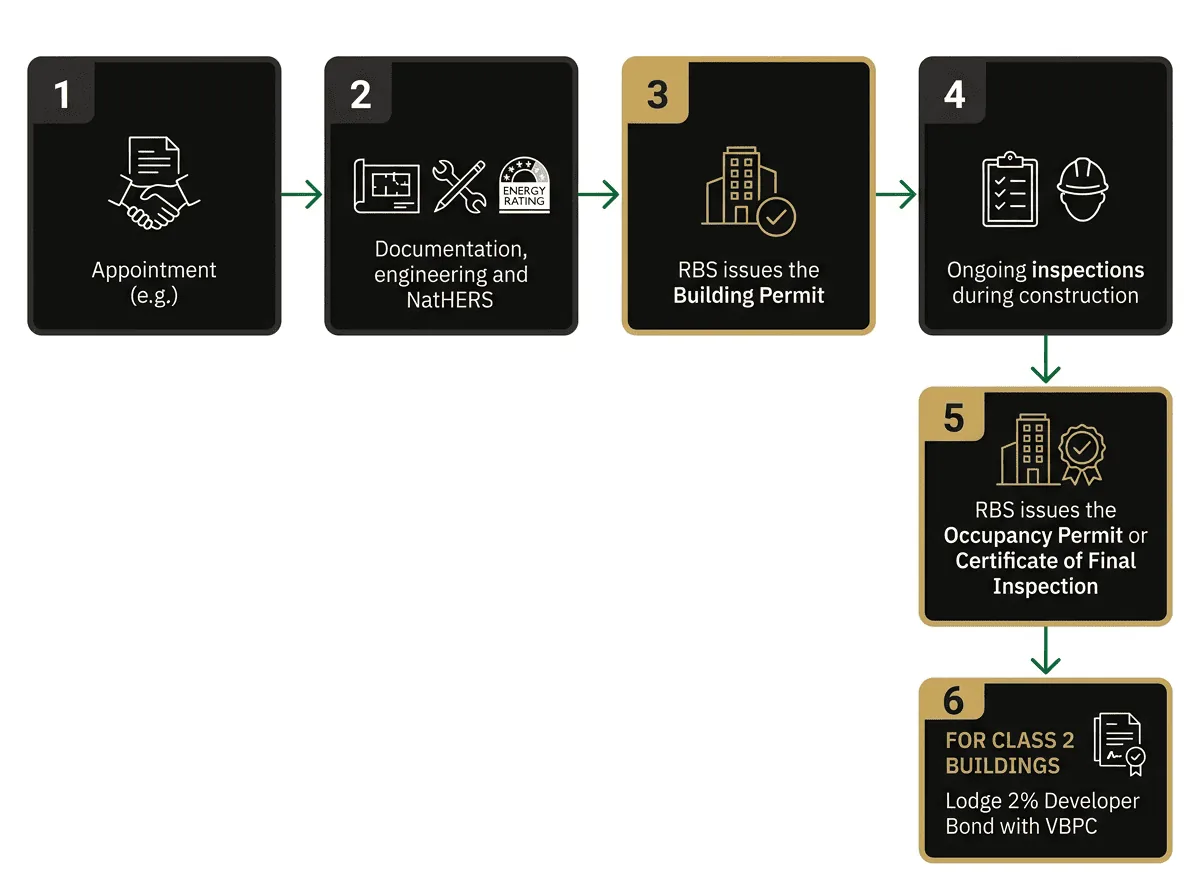
- Relevant Building Surveyor (RBS) — appointed by the developer or owner to issue the building permit, conduct mandatory inspections, and ultimately issue the occupancy permit or certificate of final inspection. The RBS may be a Private Building Surveyor (PBS) or the Municipal Building Surveyor (MBS).
- Municipal Building Surveyor (MBS) — employed by the local council to oversee building compliance within the municipality. The MBS has enforcement powers including the ability to issue Building Notices, Building Orders, Stop Work Orders, and Emergency Orders.
- Building and Plumbing Commission (BPC) — the state regulator responsible for practitioner registration, disciplinary action, and oversight of the broader certification system.
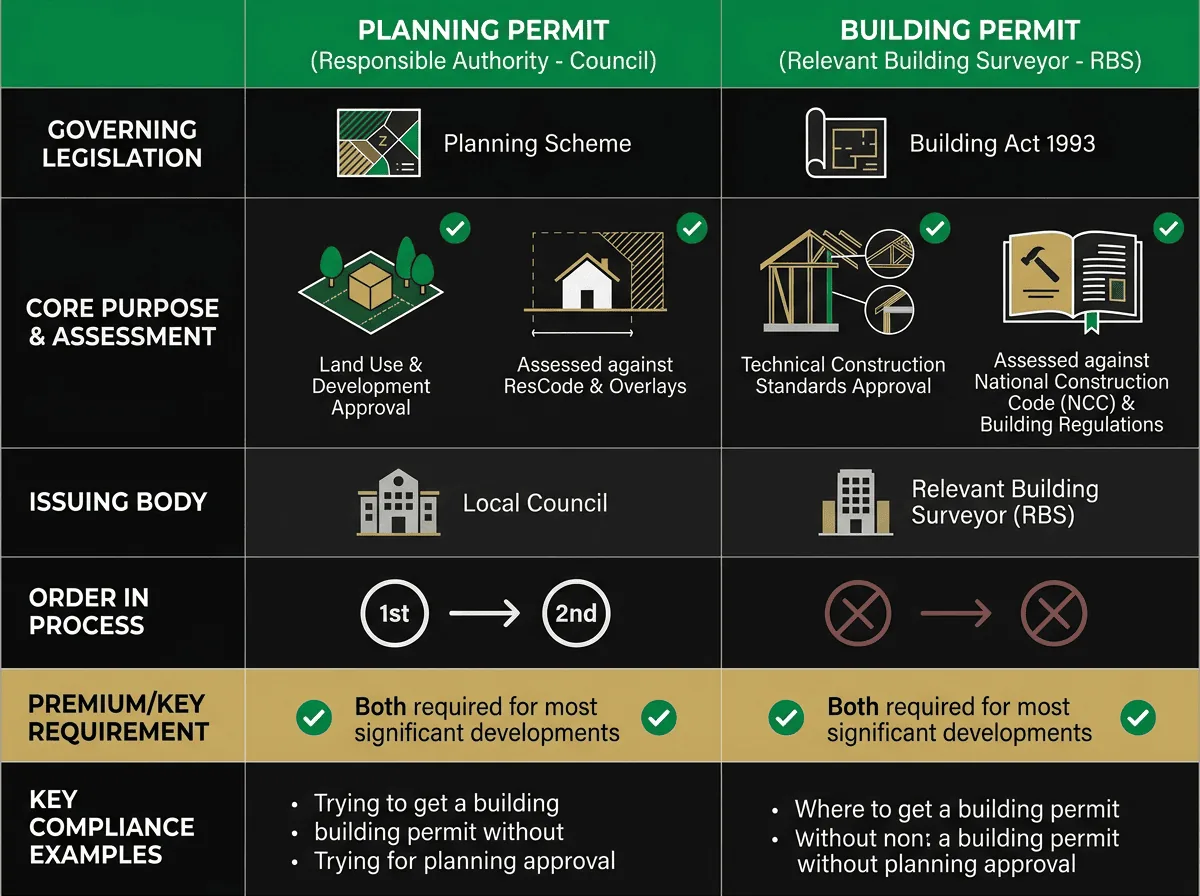
It is important to understand that a planning permit and a building permit are separate instruments. A planning permit (issued by the Responsible Authority under the planning scheme) grants permission for the use or development of land. A building permit (issued by the RBS under the Building Act) confirms that the proposed building work complies with technical construction standards. Most medium and large-scale developments in Melbourne will require both, and the planning permit must generally be obtained before the building permit is issued.
The Building Permit Process: What Developers Need to Know
A building permit is required for the vast majority of building work in Victoria. Under Practice Note BP 01, exemptions are narrow and generally limited to minor works such as small garden sheds, certain fences, and low-level decking. For any development of commercial significance — townhouses, apartments, commercial fitouts, or structural alterations — a building permit will be required.
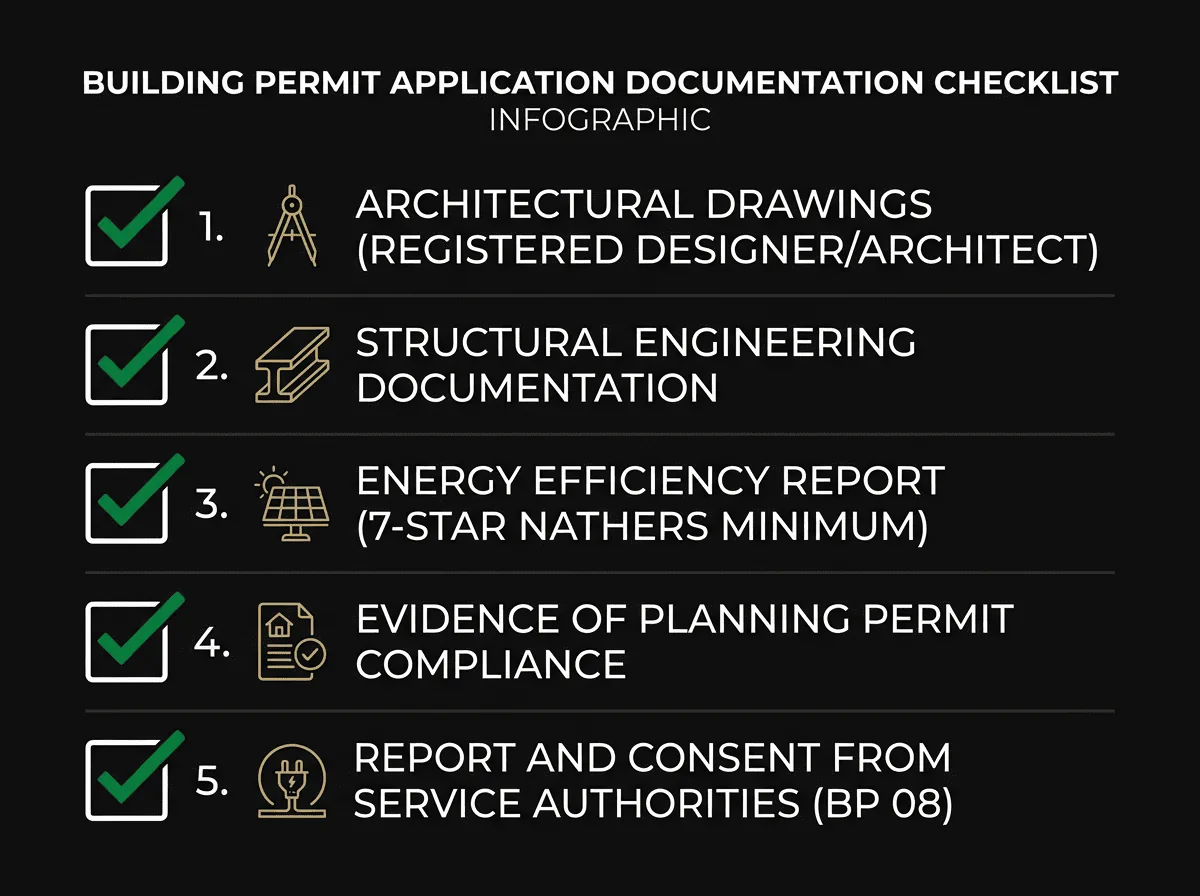
The building permit application must be lodged through the Victoria Building Approvals Portal (VBAP). Manual or paper-based submissions have been largely phased out. The application package typically includes:
- Architectural drawings prepared by a registered building designer or architect
- Structural engineering documentation
- Energy efficiency documentation (minimum 7-star NatHERS rating for new residential builds)
- Evidence of planning permit compliance (where applicable)
- Report and consent from relevant service authorities (where required under Practice Note BP 08)
- Building permit levy payment
Once issued, a building permit has a defined time limit for commencement and completion of work. Under Practice Note BP 07, permits lapse if work does not commence within the specified period. Developers should monitor permit expiry dates carefully, particularly on staged projects where delays between planning approval and construction commencement are common.
For residential developments assessed against ResCode — specifically Clauses 54 (single dwellings), 55 (multi-dwellings and townhouses), and 58 (apartments) of the Victoria Planning Provisions — the RBS will assess compliance with both the planning permit conditions and the technical standards of the NCC. Amendments VC267 and VC282 (2025) introduced “deemed-to-comply” pathways: where a proposal meets all objective ResCode standards, it may be exempt from third-party notice and review rights, which may help reduce approval timeframes in some cases.
Occupancy Permits, Final Certificates, and the New Developer Bond
At the completion of building work, the RBS will issue either an Occupancy Permit (for buildings that will be occupied) or a Certificate of Final Inspection (for works where an occupancy permit is not required). These documents confirm that the building work has been completed in accordance with the building permit and the relevant regulations.
The Building Legislation Amendment (Buyer Protections) Act 2025 introduced a significant new obligation for developers of Class 2 residential apartment buildings over three storeys. Before an occupancy permit can be issued, the developer must lodge a 2% developer bond (calculated on the total construction cost) with the BPC. This bond is held for two years to secure the rectification of any identified building defects. Failure to lodge the bond may give off-the-plan purchasers a statutory right to rescind their contracts — even after the building is complete — which represents a material commercial risk.
Developers of Class 2 buildings must also notify the BPC 6 to 12 months before the anticipated occupancy permit date. This allows the regulator to conduct a pre-occupancy inspection to identify defects before the bond is finalised. Developers should factor this notification requirement into their construction programme from the outset.
The Act also extended the BPC’s power to issue Rectification Orders to up to 10 years after the occupancy permit is issued. These orders can be issued against both builders and developers, and the power applies retrospectively. This extended liability window underscores the importance of thorough documentation throughout the construction process.
Get the 7-point site check to run before committing to a permit application — zoning, overlays, setbacks and council red flags, in plain English. Free PDF, instant download.
- Zone, overlay & setback checks
- What council assesses first
- Permit-readiness red flags
Something went wrong. Please try again.
No spam. Unsubscribe anytime.
Check your inbox — your checklist is on its way.
Illegal Building Work: The MBS Process and Compliance Pathways
Illegal building work — that is, work carried out without a building permit, or work that deviates materially from an approved building permit — is a common issue encountered when developers acquire existing properties for redevelopment. It is also a risk on active construction sites where scope changes are made without the RBS’s knowledge.
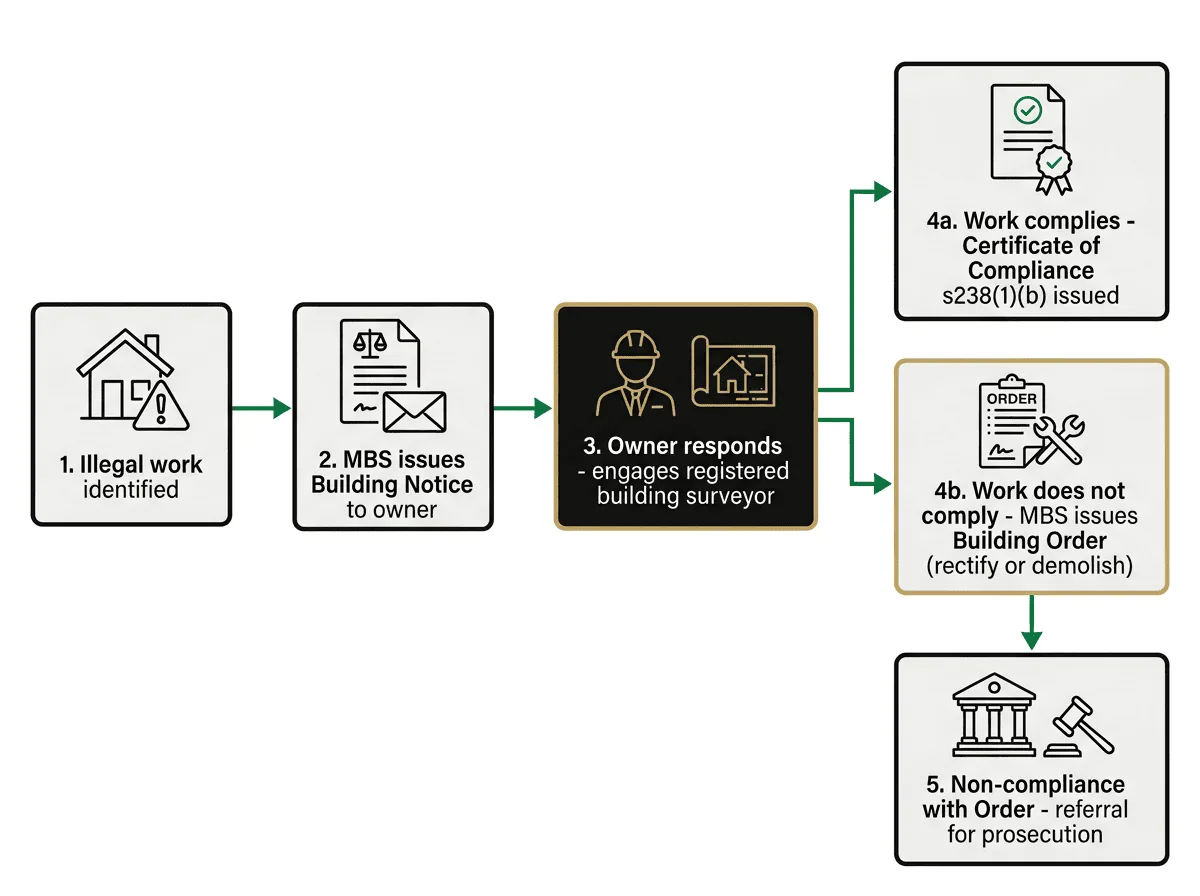
It is critical to understand that a building permit cannot be issued retrospectively for work that has already been completed. The compliance pathway for illegal building work is distinct from the standard permit process and involves the following steps:
- Building Notice — The first step in the enforcement process. Issued by the MBS (or the RBS if they are already appointed to the project), a Building Notice identifies suspected non-compliance and requires the owner to “show cause” why the work should be retained. The notice is issued to the property owner, not the builder or developer.
- Response to Building Notice — The owner (or their appointed representative) must respond within the specified timeframe, typically by engaging a registered building surveyor to assess the work and provide a certification pathway.
- Certificate of Compliance under Section 238(1)(b) — Where the illegal work can be demonstrated to comply with the Building Act, Building Regulations, and NCC, the RBS may issue a Certificate of Compliance. This is not a retrospective building permit; it is a formal certification that the work meets the required standards. The RBS must physically inspect the works and review supporting documentation — including architectural plans and structural engineering reports — before issuing the certificate.
- Building Order — If the owner does not respond to the Building Notice, or if the work cannot be certified as compliant, the MBS may issue a Building Order. This is a legally binding direction to rectify or demolish the non-compliant work. Building Orders come in several forms: General, Minor Works, Stop Work, and Emergency Orders.
- Prosecution — Where an owner fails to comply with a Building Order, the MBS may refer the matter for prosecution. Under the Planning Amendment (Better Decisions Made Faster) Act 2026 — which does not commence before 29 October 2027, and which governs the planning permit process rather than the building permit process described here — providing false or misleading information during the permit process is now a criminal offence under Clause 126A. Corporate penalties of up to 6,000 penalty units (approximately $1.22M, based on the current penalty unit value — indexed annually) and individual penalties of up to 1,200 penalty units (approximately $244K, based on the current penalty unit value — indexed annually) or 10 years imprisonment may apply.
For developers acquiring sites with suspected illegal building work, a thorough due diligence process — including a review of council records and a site inspection by a registered building surveyor — is strongly advisable before exchange of contracts. Unresolved building notices or orders can complicate finance, delay settlements, and affect insurance coverage. See also our guide to building compliance certificates in Victoria for related documentation requirements.
Council Variations Across Melbourne
While the Building Act and Building Regulations provide a state-wide framework, councils in Melbourne apply their own local planning scheme provisions that interact with the certification process. Developers should be aware of the following council-specific considerations:
City of Whitehorse
The City of Whitehorse applies ResCode standards under Clauses 54 and 55 with particular attention to neighbourhood character overlays. Developments in established residential areas may be subject to Design and Development Overlays (DDO) that impose additional height and setback requirements beyond the ResCode baseline. These overlay requirements must be reflected in the building permit documentation.
City of Boroondara
Boroondara is known for rigorous assessment of heritage and neighbourhood character provisions. Many properties in suburbs such as Camberwell, Hawthorn, and Kew are subject to Heritage Overlays (HO), which may require a planning permit even for works that would otherwise be exempt. Developers should confirm overlay status before assuming standard certification pathways apply.
Manningham City Council
Manningham applies Significant Landscape Overlays (SLO) across substantial portions of the municipality, particularly in the Doncaster and Templestowe areas. Tree removal and site coverage requirements under these overlays can affect building footprints and may require additional reporting as part of the building permit process. Under updated Clause 54/55 standards, developers must also adhere to tree planting requirements on a sliding scale based on lot size.
City of Monash
City of Monash is known for strict enforcement of Clause 52.06 (Car Parking) requirements. Shortfalls in car parking provision must be addressed either through design or through a planning permit condition, and the building permit documentation must reflect the approved car parking layout. Monash has also increased scrutiny of pool and spa barrier compliance, with Form 23 certification required for all new pool and spa installations.
Knox City Council and Maroondah City Council
Both Knox and Maroondah include areas subject to Bushfire Management Overlays (BMO), which impose specific construction requirements under AS 3959 (Construction of Buildings in Bushfire-Prone Areas). Building permits for affected sites must include evidence of compliance with the applicable Bushfire Attack Level (BAL) rating, which may require specialist assessment and additional structural measures.
Practical Compliance Tips for Melbourne Developers
Based on project experience across Melbourne, SQM Architects has identified the following practical measures that may help developers navigate the certification process more effectively:
- Appoint your RBS early. Engaging a Private Building Surveyor at the design stage — rather than after planning permit approval — allows certification requirements to be incorporated into the design from the outset, reducing the risk of costly redesigns later.
- Conduct thorough due diligence on acquired sites. Request a copy of the building permit history from the relevant council before purchasing a development site. Unresolved building notices, orders, or illegal works can materially affect your development programme and costs. Our guide to construction problems with builders in Victoria covers related remedies where issues arise post-contract.
- Document all scope changes during construction. Any deviation from the approved building permit must be assessed by the RBS. Undocumented changes are a common source of illegal building work findings at the occupancy permit stage.
- Plan for the 7-star NatHERS requirement. New residential builds are generally required to achieve a minimum 7-star NatHERS energy rating under current NCC provisions. Engage an energy assessor during the design phase to confirm compliance before the building permit application is lodged.
- Ensure roof designs are solar-ready. New standards require a designated solar-ready roof zone that is unshaded and structurally capable of supporting future photovoltaic installations. This requirement must be addressed in the building permit documentation.
- For Class 2 buildings, budget for the developer bond. The 2% bond requirement represents a meaningful cash flow consideration for apartment developers. Factor this into your project finance modelling from the feasibility stage.
- Lodge all applications via VBAP. The Victoria Building Approvals Portal is now the mandated lodgement channel. Ensure your design team is familiar with the portal’s requirements to avoid delays.
For owner builders navigating these requirements independently, our owner builder guide for Victoria provides additional context on permit obligations and registration requirements.
Frequently Asked Questions
What is the difference between a building permit and a planning permit in Victoria?
A planning permit is issued by the Responsible Authority (typically the local council) under the planning scheme and grants permission for the use or development of land. A building permit is issued by the Relevant Building Surveyor under the Building Act 1993 and confirms that the proposed building work complies with technical construction standards. Most significant developments require both, with the planning permit generally obtained first.
Can a building permit be issued after construction work has already been completed?
No. A building permit cannot be issued retrospectively for work that has already been completed. Where illegal building work is identified, the compliance pathway involves a Building Notice process, a site inspection by a registered building surveyor, and — where the work can be demonstrated to comply with the relevant standards — a Certificate of Compliance under Section 238(1)(b) of the Building Act 1993.
Who is responsible for illegal building work found on a property — the previous owner or the current owner?
Under the Building Act 1993, Building Notices and Building Orders are issued to the current owner of the property, regardless of who carried out the work. This is a critical consideration for developers acquiring sites with existing structures, as responsibility for resolving any non-compliant work transfers with the property at settlement.
What is the developer bond requirement for apartment buildings, and when does it apply?
Under the Building Legislation Amendment (Buyer Protections) Act 2025, developers of Class 2 residential apartment buildings over three storeys must lodge a 2% developer bond (calculated on the total construction cost) with the BPC before an occupancy permit can be issued. The bond is held for two years to secure rectification of identified defects. Failure to lodge the bond may give off-the-plan purchasers a statutory right to rescind their contracts.
How does the MBS process work if illegal building work is discovered on a development site?
The MBS will typically issue a Building Notice to the property owner, requiring them to show cause why the work should be retained. The owner should engage a registered building surveyor to inspect the works and assess whether a Certificate of Compliance under Section 238(1)(b) of the Building Act can be issued. If the work cannot be certified as compliant, the MBS may issue a Building Order requiring rectification or demolition.
What are the penalties for carrying out building work without a permit in Victoria?
Penalties for breaches of the Building Act 1993 can be substantial. Corporate entities may face penalties of up to 6,000 penalty units (approximately $1.22M, based on the current penalty unit value — indexed annually), while individuals may face penalties of up to 1,200 penalty units (approximately $244K, based on the current penalty unit value — indexed annually) or up to 10 years imprisonment for serious offences. The prosecution window has been extended to 24 months from the date of the alleged offence.
Do ResCode requirements apply to the building permit, or only to the planning permit?
ResCode standards under Clauses 54, 55, and 58 of the Victoria Planning Provisions are primarily assessed at the planning permit stage by the Responsible Authority. However, the building permit documentation must reflect and be consistent with the planning permit conditions. Where a planning permit has been granted with ResCode conditions attached, the RBS will check that the building permit drawings comply with those conditions before issuing the permit.
Conclusion: Getting Certification Right from the Start
Building work certification in Victoria is a multi-layered process that intersects planning law, building law, and council-specific requirements. For developers in Melbourne, the stakes are significant: delays in certification, unresolved illegal building work, or non-compliance with the new developer bond requirements can affect project timelines, finance arrangements, and ultimately the development outcome. The 2025 regulatory reforms — including the establishment of the BPC, the extended rectification order powers, and the mandatory developer bond — have raised the compliance bar for all participants in the development process.
SQM Architects works with property developers across Whitehorse, Boroondara, Manningham, Monash, Knox, and Maroondah to navigate these requirements from feasibility through to occupancy permit. Our team understands the practical requirements involved in moving projects through the system efficiently. If you have a site under consideration or a project in progress, we invite you to take the next step.
Book a Strategy Call — contact SQM Architects on (03) 9005 6588 to discuss your project’s certification pathway.
This article provides general information about Victorian building certification for property developers. It does not constitute professional advice. For specific guidance on your project, contact SQM Architects for a complimentary site assessment.