On Melbourne green wedge land you generally cannot build a second dwelling or subdivide into smaller residential lots — the Green Wedge Zone (GWZ) and Green Wedge A Zone (GWAZ) typically permit a single dwelling on a large minimum lot (often 40 hectares in the GWZ, sometimes as low as 2 hectares in a GWAZ), and most residential subdivision is prohibited. Genuine opportunity still exists — a single dwelling on a qualifying lot, rural accommodation, agritourism — but only within the zone’s rules. This guide explains what is permitted, what needs a planning permit, and what is off the table before you commit to a green wedge site.
This guide is designed to give Melbourne property developers — particularly those active in Melbourne corridors of City of Manningham, City of Knox, and Maroondah City Council — a practical, working understanding of green wedge zoning. We’ll cover what’s permitted, what requires a planning permit, what’s prohibited outright, and where genuine development opportunities may still exist for informed buyers. Whether you’re assessing a site for the first time or reviewing a portfolio holding, the information here could meaningfully shape your decision-making. For a broader overview of how Victorian planning rules affect development decisions, see our Victoria Planning Regulation: A Comprehensive Overview.
What Is a Green Wedge Zone and Why Does It Exist?
Melbourne’s green wedges are the non-urban land areas that sit between the city’s major arterial corridors — the wedge-shaped buffers that have been protected since Melbourne’s metropolitan planning strategy of the early 1970s. Their purpose is to contain urban sprawl, protect agricultural land, conserve biodiversity, and maintain the landscape character that defines Melbourne’s outer metropolitan identity. They are not simply “rural” land — they are a deliberate planning policy tool with strong legislative backing.
Under the Victorian planning system, green wedge land is governed primarily by two zone types: the Green Wedge Zone (GWZ) and the Green Wedge A Zone (GWAZ). Both appear in the Victoria Planning Provisions and are applied through individual council planning schemes. The GWZ applies to land where non-urban uses are the primary purpose, while the GWAZ is typically applied to land closer to urban edges where some limited residential use may be considered — but both carry significant development constraints.
It’s worth noting that green wedge land is also subject to the Green Wedge Management Plans prepared by the Department of Transport and Planning, which inform how councils apply their planning schemes. These plans add another layer of policy context that the Responsible Authority will weigh when assessing any planning permit application. Developers who approach green wedge sites without understanding this policy hierarchy often find themselves surprised by the strength of opposition to even modest proposals.
See How We Achieved Approval for This Complex Site
Permitted Uses vs. Prohibited Uses: The Core Framework
One of the most important distinctions in any green wedge assessment is understanding which uses are as-of-right (permitted without a planning permit), which require a planning permit, and which are prohibited entirely. This framework is set out in the planning scheme’s zone provisions and varies slightly between GWZ and GWAZ, as well as between individual council planning schemes.
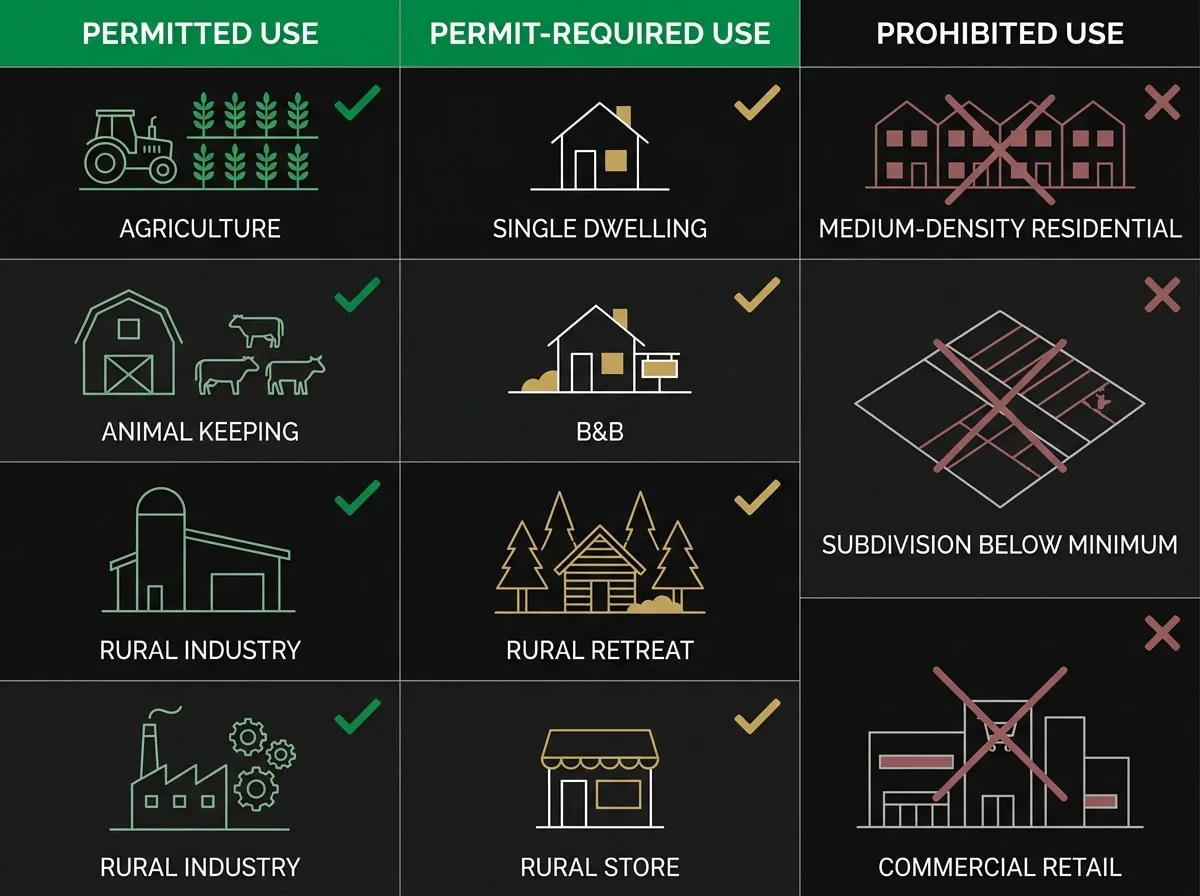
In a standard Green Wedge Zone, uses that are generally permitted without a planning permit include agriculture (subject to conditions), animal keeping, and certain forms of rural industry. Uses that typically require a planning permit include a single dwelling on a lot, rural store, place of worship, and some forms of accommodation such as a bed and breakfast or rural retreat. Prohibited uses — those that cannot be approved regardless of merit — commonly include medium-density residential development, subdivision below the minimum lot size, and most forms of commercial retail.
The minimum lot size for a dwelling in a GWZ is a critical figure. Under some standard provisions, a single dwelling may require a minimum lot size of 40 hectares, though this varies significantly between council planning scheme schedules. In practice, many Melbourne councils have applied schedules that modify this figure — sometimes significantly — so checking the specific schedule that applies to your site is essential before drawing any conclusions about development potential.
Green Wedge Zone vs. Green Wedge A Zone
The GWAZ is generally applied to land that has a closer relationship with the urban edge and where some limited residential use has historically occurred. In a GWAZ, the minimum lot size for a dwelling may be lower than in a GWZ — in some schedules, as low as 2 hectares — and the range of uses that can be considered with a planning permit is marginally broader. However, developers should not interpret the GWAZ as a pathway to conventional residential subdivision. The zone still strongly discourages urban-style development, and any planning permit application will be assessed against the overarching green wedge policy objectives.
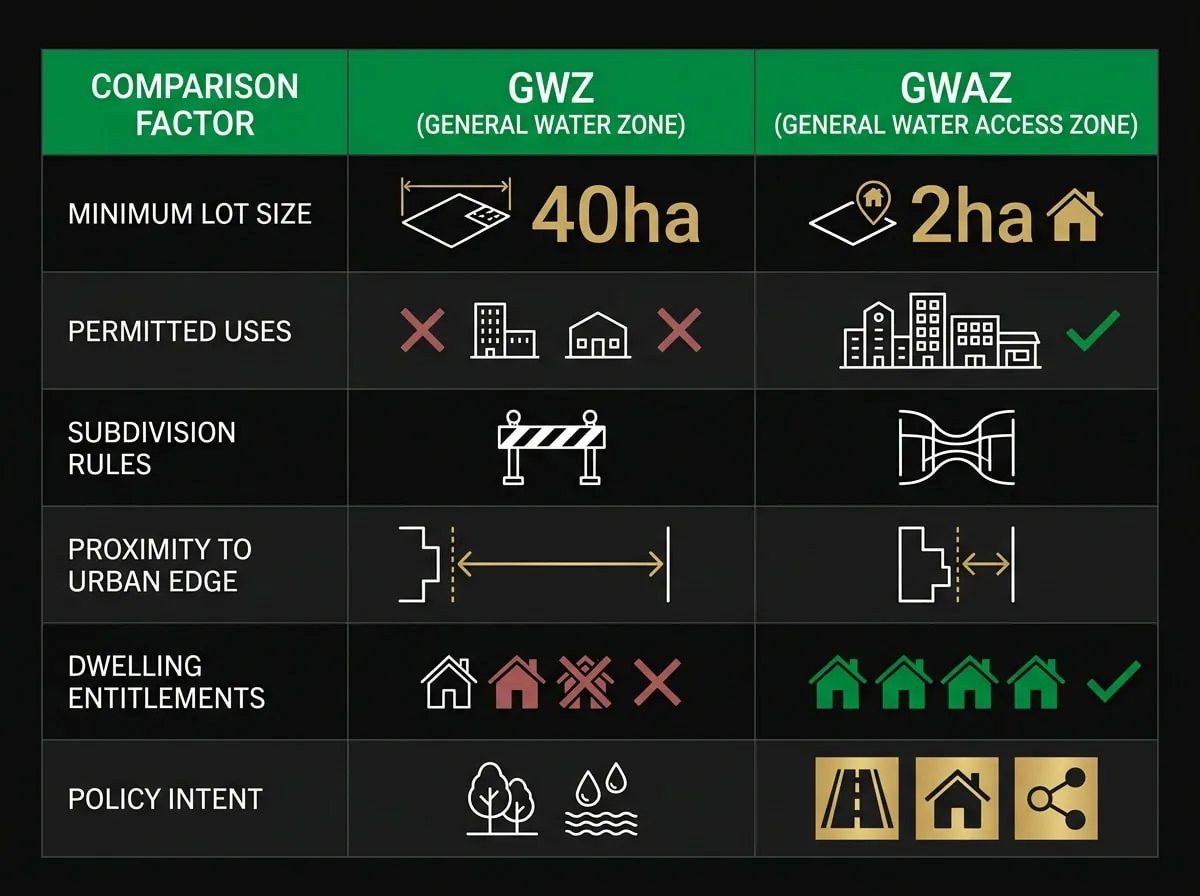
For developers active in City of Manningham’s Warrandyte and Donvale corridors, or City of Knox’s Scoresby and Rowville fringe areas, the distinction between GWZ and GWAZ scheduling is particularly relevant. Sites that appear similar on aerial imagery can carry very different development entitlements depending on which zone and schedule applies.
Subdivision in Green Wedge Areas: What’s Actually Possible
Subdivision is one of the most common aspirations developers bring to green wedge sites — and one of the most frequently frustrated. The planning rules around subdivision in green wedge zones are deliberately restrictive, and understanding them clearly can save significant time and capital. For a detailed overview of the subdivision process in Victoria more broadly, see our guide on How to Subdivide Land Victoria.
Under the GWZ, subdivision is generally prohibited unless it meets specific exemptions or the schedule to the zone permits it. The most commonly applicable exemption relates to realignment of boundaries between existing lots, which does not create additional lots and therefore may not require a planning permit. However, any subdivision that creates a new lot — even a two-lot subdivision — will almost certainly require a planning permit and will be assessed against the zone’s objectives and the broader green wedge policy framework.
The Responsible Authority will consider whether the proposed subdivision is consistent with the purpose of the zone, whether it would facilitate urban-style development, and whether it would fragment agricultural land or compromise landscape values. In most cases, applications that seek to create smaller residential lots in a GWZ will face significant policy opposition and are unlikely to succeed at the planning permit stage. Applicants who proceed to VCAT on such matters generally find the Tribunal equally unsympathetic to arguments that don’t engage substantively with green wedge policy.
Lot Size Schedules and Council Variations
Each council’s planning scheme may include a schedule to the GWZ or GWAZ that modifies the default provisions. For example, City of Manningham’s planning scheme applies specific schedules to its green wedge land that reflect the Warrandyte-Nillumbik Green Wedge Management Plan. City of Knox similarly applies schedules that reflect the Dandenong Ranges and South East Green Wedge Management Plan. Maroondah City Council has green wedge land in its northern precincts that is subject to its own schedule provisions.
Developers should obtain a current copy of the relevant zone schedule from the planning scheme before making any assumptions about subdivision potential. The Victorian Government’s Planning Maps Online tool and the Planning Schemes Online portal at planning.vic.gov.au are the most reliable sources for this information. SQM Architects routinely undertakes this due diligence as part of our site assessment process — it’s a step that should occur before any offer is made on a green wedge parcel.
Get the 7-point site check to run before committing to a permit application — zoning, overlays, setbacks and council red flags, in plain English. Free PDF, instant download.
- Zone, overlay & setback checks
- What council assesses first
- Permit-readiness red flags
Something went wrong. Please try again.
No spam. Unsubscribe anytime.
Check your inbox — your checklist is on its way.
Dwelling Entitlements and Single House Development
While subdivision for multiple dwellings is generally off the table in green wedge zones, single dwelling development on appropriately sized lots may be achievable with a planning permit. This is where some genuine development opportunity may exist — particularly for developers targeting the prestige rural residential market or seeking to add value to large landholdings through a well-designed single dwelling.
A planning permit application for a single dwelling in a GWZ will typically need to demonstrate that the proposal is consistent with the zone’s purpose, that it does not unreasonably impact on agricultural use of the land, that it responds to the landscape character of the area, and that it can be serviced appropriately (particularly with respect to water supply, wastewater management, and bushfire risk). The Responsible Authority will also assess the proposal against any applicable overlay controls — and green wedge land frequently carries multiple overlays.
Overlay Controls That Commonly Apply to Green Wedge Land
Green wedge sites in Melbourne are frequently subject to one or more of the following overlay controls, each of which adds requirements to any planning permit application:
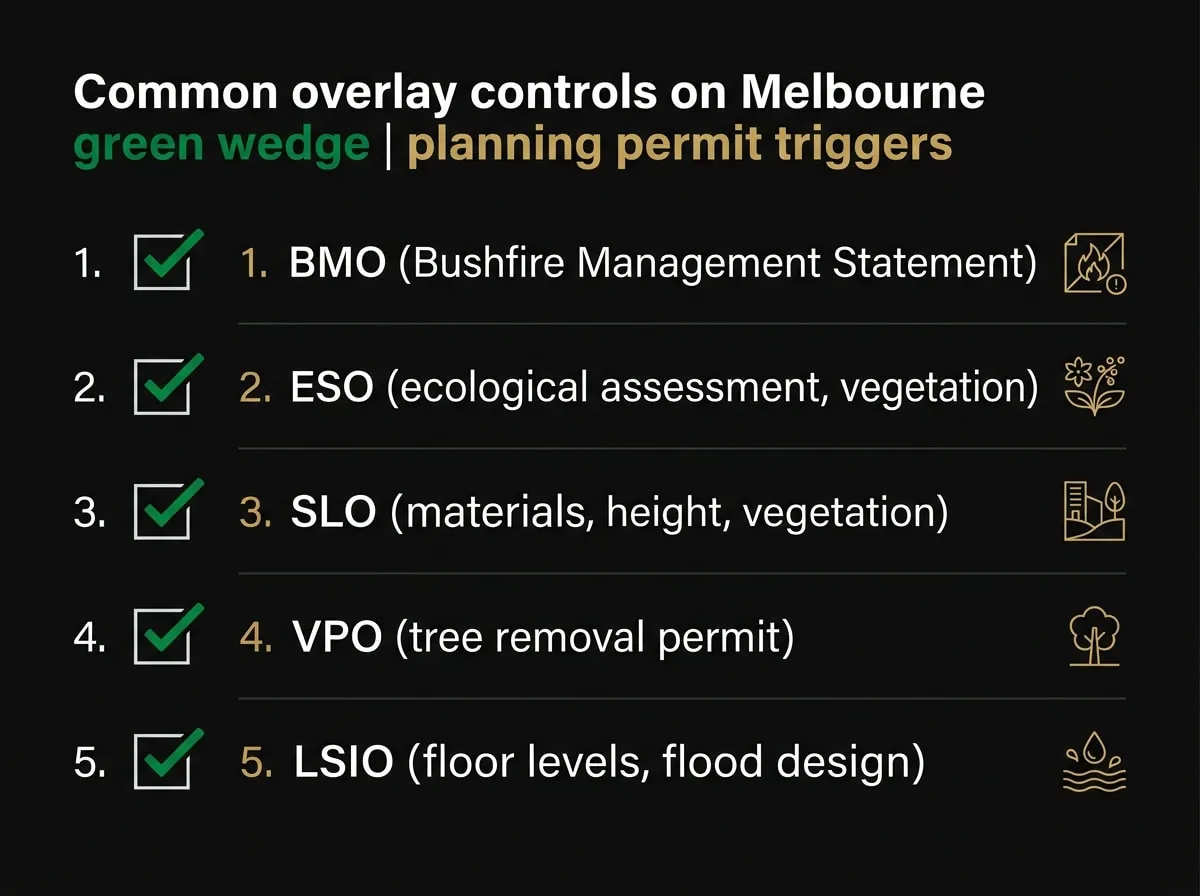
- Bushfire Management Overlay (BMO): Requires a Bushfire Management Statement and may significantly constrain building envelopes, access, and vegetation management. Particularly prevalent in City of Manningham and Maroondah City Council green wedge areas.
- Environmental Significance Overlay (ESO): Protects areas of environmental value including waterways, native vegetation, and habitat corridors. May require ecological assessments and restrict earthworks, vegetation removal, and building footprints.
- Significant Landscape Overlay (SLO): Applies to areas of recognised landscape value and may impose requirements around building materials, colours, heights, and vegetation retention.
- Vegetation Protection Overlay (VPO): Controls the removal of significant trees and vegetation, requiring a planning permit for removal in many circumstances.
- Land Subject to Inundation Overlay (LSIO): Applies to flood-prone land and imposes requirements around floor levels and building design.
The cumulative effect of multiple overlays on a single green wedge site can be substantial. A site carrying a BMO, ESO, and SLO simultaneously will require a considerably more complex planning permit application than a site with no overlays — and the assessment timeframe and cost will reflect that complexity. Developers should factor this into their preliminary cost modelling from the outset.
Permitted Uses That May Offer Development Opportunity
While conventional residential development is largely off the table in green wedge zones, there are permitted and discretionary uses that may offer genuine development opportunity for developers willing to work within the framework rather than against it.
Rural Accommodation and Agritourism
Uses such as a rural retreat, bed and breakfast, or farm stay accommodation may be considered with a planning permit in a GWZ or GWAZ, provided they are consistent with the zone’s purpose and the applicable planning scheme policies. For developers with larger landholdings, these uses can generate yield from land that would otherwise produce limited return. The key is demonstrating that the accommodation use is genuinely ancillary to or compatible with the rural character of the land.
Agritourism — combining agricultural production with visitor experiences — is an emerging use that some councils in Melbourne are beginning to engage with more positively. City of Manningham’s planning scheme, for example, includes policy that acknowledges the role of agritourism in supporting the economic viability of green wedge land. Developers exploring this pathway may find a more receptive Responsible Authority than they would for a conventional accommodation proposal.
Home-Based Business and Rural Industry
A home-based business ancillary to a dwelling may be permitted without a planning permit in some circumstances, subject to conditions around scale, employees, and impact on neighbours. Similarly, certain forms of rural industry — processing of agricultural products, for example — may be considered with a planning permit. These uses are unlikely to generate the development yields that conventional residential projects produce, but they may add value to a landholding and improve its marketability.
Education and Community Uses
Some green wedge planning schemes include provisions that allow for education facilities, places of worship, or community meeting rooms with a planning permit. These uses are typically assessed carefully against the zone’s purpose, but they represent a legitimate pathway for developers with specific end-user relationships or community development objectives.
Practical Due Diligence Steps for Green Wedge Sites
For developers considering a green wedge acquisition, the following due diligence steps may help clarify the development potential of a site before committing capital. For broader guidance on planning considerations across development types, see our Property Development Planning Considerations: Industry Framework and Best Practices.
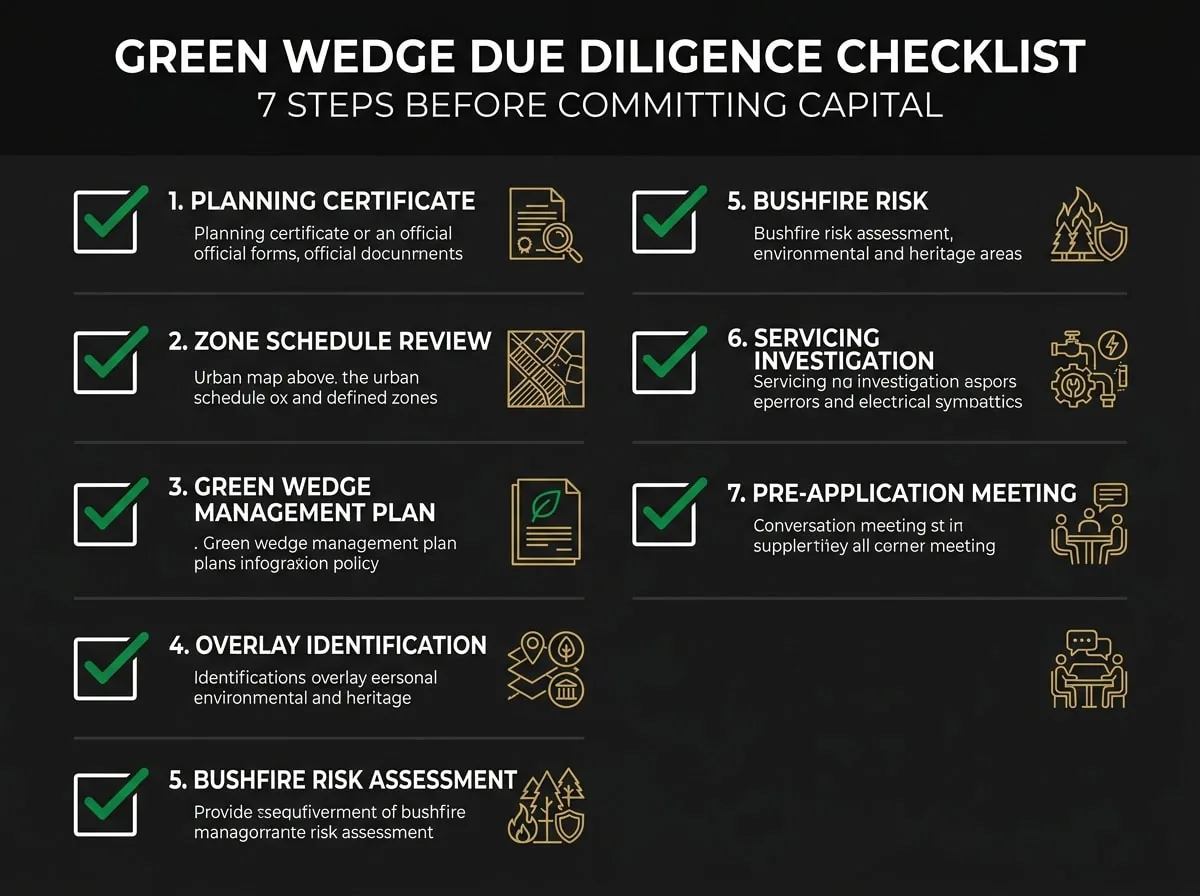
- Obtain a current planning certificate (issued under the Planning and Environment Act): This document, issued by the Responsible Authority, confirms the zone, overlays, and any other planning controls that apply to the land. It is an essential starting point for any green wedge assessment.
- Review the applicable zone schedule: Download the current planning scheme from Planning Schemes Online and review the schedule to the GWZ or GWAZ that applies to your site. Note the minimum lot sizes, permit requirements, and any local variations.
- Check the Green Wedge Management Plan: Identify which management plan applies to your site and review its objectives and strategies. This document will inform how the Responsible Authority approaches planning permit applications in the area.
- Identify all applicable overlays: Use Planning Maps Online to identify every overlay that applies to the site. For each overlay, review the permit triggers and requirements in the planning scheme.
- Assess bushfire risk: If the site carries a BMO or is in a designated Bushfire Prone Area, obtain a preliminary bushfire risk assessment. This may significantly affect building envelopes and access requirements.
- Investigate servicing: Confirm whether reticulated water, sewer, and electricity are available to the site. Many green wedge parcels rely on rainwater tanks, septic systems, and off-grid power — all of which affect development cost and planning permit requirements.
- Seek a pre-application meeting with the Responsible Authority: Most councils offer pre-application meetings for complex or sensitive sites. A meeting with the planning officer responsible for green wedge applications may provide useful early guidance on the likely reception of a proposal.
Frequently Asked Questions
Can I build a second dwelling on my green wedge property?
In most cases, a second dwelling on green wedge land is not permitted under the GWZ or GWAZ. The zone provisions generally allow for a single dwelling per lot, and a second dwelling would typically be considered a prohibited use. There may be limited exceptions for a dependent person’s unit ancillary to the main dwelling, but these are subject to strict conditions and require a planning permit. Developers should check the specific schedule and provisions that apply to their site.
What is the minimum lot size for a dwelling in a Melbourne green wedge zone?
Under some standard provisions, a single dwelling in a GWZ may require a minimum lot size of 40 hectares, though this figure varies significantly between council planning scheme schedules. In a GWAZ, the minimum may be lower — sometimes as little as 2 hectares in specific schedules. Always check the schedule that applies to your specific site in the relevant council’s planning scheme, as the variation between councils can be significant.
Can green wedge land be rezoned to allow residential development?
Rezoning of green wedge land to a residential zone is possible in theory but faces very high policy barriers. The Victorian Government has consistently maintained strong protection for green wedge land, and planning scheme amendments that seek to rezone green wedge land for urban purposes are generally opposed by the Department of Transport and Planning. Developers should not acquire green wedge land on the assumption that rezoning will be achievable — the risk of that pathway is substantial.
Does ResCode apply to dwellings in green wedge zones?
ResCode (Clauses 54 and 55 of the Victoria Planning Provisions) applies to single dwellings and multi-dwelling developments in residential zones. For dwellings in green wedge zones, the applicable standards are different — the planning permit application will be assessed against the zone provisions, any applicable overlay requirements, and the relevant planning scheme policies rather than the full ResCode framework. However, some ResCode principles around setbacks, overlooking, and overshadowing may still be referenced by the Responsible Authority in its assessment. For a comprehensive reference on ResCode requirements, see our ResCode Victoria 2026: Developer’s Reference.
How long does a planning permit application take for a green wedge dwelling?
Planning permit applications for dwellings in green wedge zones are typically more complex than standard residential applications and may take longer to assess. Under the Planning and Environment Act, the Responsible Authority has 60 days before an application may be subject to a deemed refusal, though actual determination timeframes vary considerably by council and application complexity. Developers may wish to allow for at least 3–6 months from lodgement to decision as a general guide, and potentially longer if the application involves multiple overlays, referral authorities (such as CFA for bushfire matters), or third-party objections. For a council-by-council overview of typical permit timeframes, see our Planning Permit Timeline Melbourne by Council guide.
Which councils in Melbourne have green wedge land?
City of Manningham, City of Knox, and Maroondah City Council all have green wedge land within their municipal boundaries. City of Manningham’s green wedge areas include parts of Warrandyte, Donvale, and Park Orchards. City of Knox has green wedge land in its southern and south-eastern precincts. Maroondah City Council has green wedge land in its northern areas. Each council’s planning scheme applies its own schedules and policies to this land, so the specific provisions vary between municipalities.
Can I use green wedge land for a commercial farming operation?
Agriculture is generally a permitted use in a GWZ without a planning permit, subject to conditions. Commercial farming operations that are consistent with the zone’s purpose — growing crops, keeping livestock, market gardening — are typically supported by green wedge policy. However, ancillary uses such as farm buildings, irrigation infrastructure, or processing facilities may require a planning permit depending on their scale and nature. Developers exploring agricultural uses should review the specific permit triggers in the applicable zone schedule.
Conclusion: Green Wedge Land Requires a Different Development Mindset
Melbourne’s green wedge zones are not a development frontier — they are a protected landscape with a clear planning policy purpose. For property developers, that means the conventional metrics of yield, density, and subdivision potential largely don’t apply. What green wedge land may offer instead is potential for well-considered single dwelling development, rural accommodation, agritourism, or long-term landbanking in areas of genuine landscape value. The developers who succeed in these zones are those who understand the rules thoroughly, work within the framework, and bring proposals that genuinely respond to the character and purpose of the land.
SQM Architects has supported developers across Melbourne in navigating complex planning environments — including green wedge sites where the path forward required careful analysis and a realistic assessment of what the planning scheme would support. Our approach is built on providing developers with practical, considered information from the outset, drawing on experience across a range of planning environments in Melbourne. If you’re assessing a green wedge site or reviewing a current holding, we’d welcome the opportunity to provide a complimentary site assessment.
Book a Strategy Call — contact SQM Architects today to discuss your green wedge site or Melbourne development project. Call us on (03) 9005 6588.
This article provides general information only and does not constitute planning or legal advice. For project-specific guidance, consult with a registered architect or qualified planning professional.