
Why Neighbourhood Character Overlay Can Make or Break Your Melbourne Development
If you’ve ever had a planning permit application knocked back — or watched a promising site stall for months in council review — there’s a reasonable chance that Neighbourhood Character Overlay played a role. For property developers working across Melbourne, understanding how this overlay operates isn’t optional. It’s one of the most consequential planning controls you’ll encounter, and getting it wrong early can result in significant redesign fees, delays, and lost opportunity.
Neighbourhood Character Overlay (NCO) is a discretionary planning control embedded within each council’s planning scheme. It doesn’t automatically prohibit development — but it does impose a layer of design scrutiny that goes well beyond standard ResCode requirements. For a detailed breakdown of how neighbourhood character standards shape planning applications in Victoria, it’s worth reviewing the specific requirements before committing to a design direction. Townhouse and apartment development approvals in Melbourne are increasingly shaped by how well an application responds to the character statements and design objectives written into each NCO schedule. Councils including City of Boroondara, City of Whitehorse, Manningham City Council, and Maroondah City Council each apply their own NCO schedules, and the differences between them matter enormously at the permit stage.
This guide outlines what the NCO means in practical terms for developers, how it interacts with ResCode and other planning scheme provisions, and what steps you may need to take to give your application the strongest possible foundation. With 210+ projects delivered across Melbourne, SQM Architects has navigated NCO requirements across the major councils in this region. Here is what that experience has revealed.
What Is Neighbourhood Character Overlay and How Does It Work?
Neighbourhood Character Overlay is a planning scheme tool that councils use to identify and protect areas with distinct or valued built-form character. It sits within the Victorian planning system as a discretionary overlay, meaning it doesn’t create an automatic right of refusal — but it does require the Responsible Authority to consider character objectives when assessing any application for a planning permit.
Under the Planning and Environment Act 1987, each NCO schedule contains a statement of neighbourhood character, a set of design objectives, and decision guidelines that the Responsible Authority must apply. These schedules vary significantly from council to council and even from precinct to precinct within the same municipality. A schedule in Camberwell might prioritise the retention of interwar housing stock and established garden settings, while a schedule in Ringwood East might focus on streetscape setbacks and roof pitch consistency.
It’s important to understand that NCO doesn’t replace ResCode — it operates alongside it. Where ResCode sets minimum standards for setbacks, site coverage, overlooking, and overshadowing, the NCO adds a qualitative layer focused on how a development looks, feels, and relates to its surroundings. In practice, this means your design may fully comply with ResCode and still face objections or conditions if it doesn’t adequately address the NCO schedule’s design objectives. For a broader overview of how these controls fit within the Victorian framework, see our guide to Victoria planning regulation.
How NCO Schedules Vary Across Melbourne Councils
One of the most common mistakes developers make is treating the NCO as a uniform control. In reality, each council’s planning scheme contains its own NCO schedules, and the design expectations they encode can differ substantially. Understanding these variations is essential before you commit to a design direction.
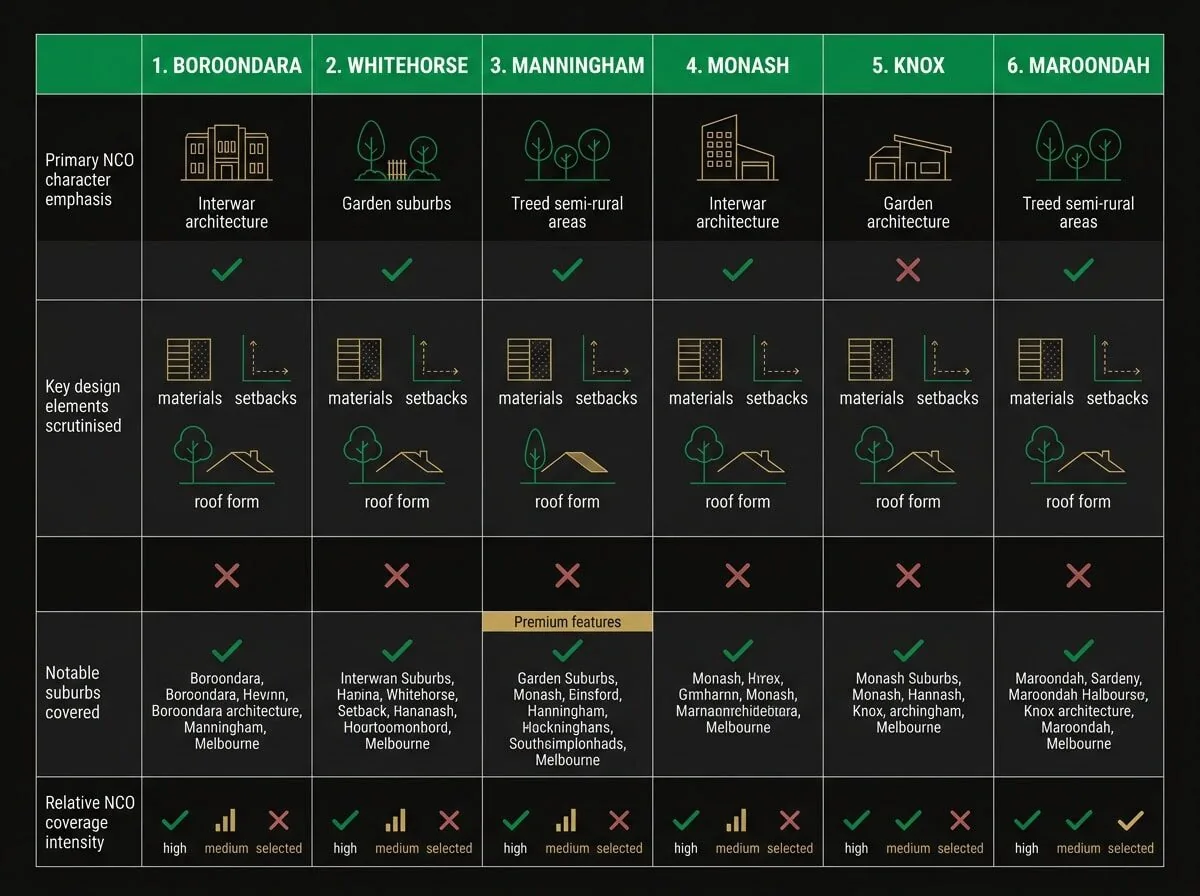
City of Boroondara
Boroondara applies NCO schedules across a significant proportion of its residential land, particularly in suburbs such as Hawthorn, Kew, Camberwell, and Balwyn. The schedules here tend to place strong emphasis on the retention of pre-war and interwar architectural character, including features like verandahs, front setbacks consistent with the established streetscape, and the use of traditional materials such as brick and terracotta tiles. Boroondara’s Responsible Authority is known for scrutinising the visual bulk of new development and its relationship to neighbouring properties, particularly where heritage overlay areas are nearby.
City of Whitehorse
Whitehorse applies NCO schedules across a range of residential precincts, with particular focus on garden suburb character in areas like Box Hill North, Nunawading, and Mitcham. Design objectives in these schedules frequently reference the retention of established trees, generous front setbacks, and low-scale built form. Townhouse and apartment development approvals in Whitehorse are often influenced by how well a proposal maintains the garden character of the streetscape — including canopy coverage and permeable surfaces. Understanding site permeability requirements in Victoria and minimum garden area requirements in Victoria is particularly relevant in these garden suburb precincts.
Manningham City Council
Manningham’s NCO schedules cover large portions of its residential areas, including Doncaster, Templestowe, and Warrandyte. The council places considerable weight on the treed, semi-rural character that distinguishes much of its housing stock. Applications in NCO areas here may need to demonstrate retention of significant trees, generous side and rear setbacks, and built form that avoids a visually dominant street presence. Manningham is also known for applying its NCO objectives rigorously at VCAT, so getting the design response right at the permit stage is particularly important.
City of Monash
Monash applies NCO schedules in selected residential precincts, with design objectives that often focus on maintaining consistent setbacks, roof forms, and the garden character of established streets. In suburbs like Glen Waverley and Mount Waverley, where medium-density development pressure is high, the NCO can be a significant factor in how applications for townhouses and apartments are assessed.
Knox City Council and Maroondah City Council
Both Knox and Maroondah apply NCO schedules in specific residential areas, with objectives that typically emphasise low-scale built form, landscaping, and streetscape consistency. Maroondah in particular has been active in applying its NCO provisions to manage the pace and character of medium-density development in suburbs such as Ringwood, Croydon, and Mooroolbark.
Get the 7-point site check to run before committing to a permit application — zoning, overlays, setbacks and council red flags, in plain English. Free PDF, instant download.
- Zone, overlay & setback checks
- What council assesses first
- Permit-readiness red flags
Something went wrong. Please try again.
No spam. Unsubscribe anytime.
Check your inbox — your checklist is on its way.
How NCO Interacts with ResCode in Practice
ResCode — the residential development standards set out in Clauses 54 and 55 of the Victorian Planning Provisions — establishes a framework of measurable standards for things like setbacks, building height, site coverage, private open space, and overlooking. These standards apply to most residential development across Victoria, and meeting them is a baseline requirement for most planning permit applications. Understanding building setback requirements in Victoria and how they interact with character controls is an important early step in site assessment.
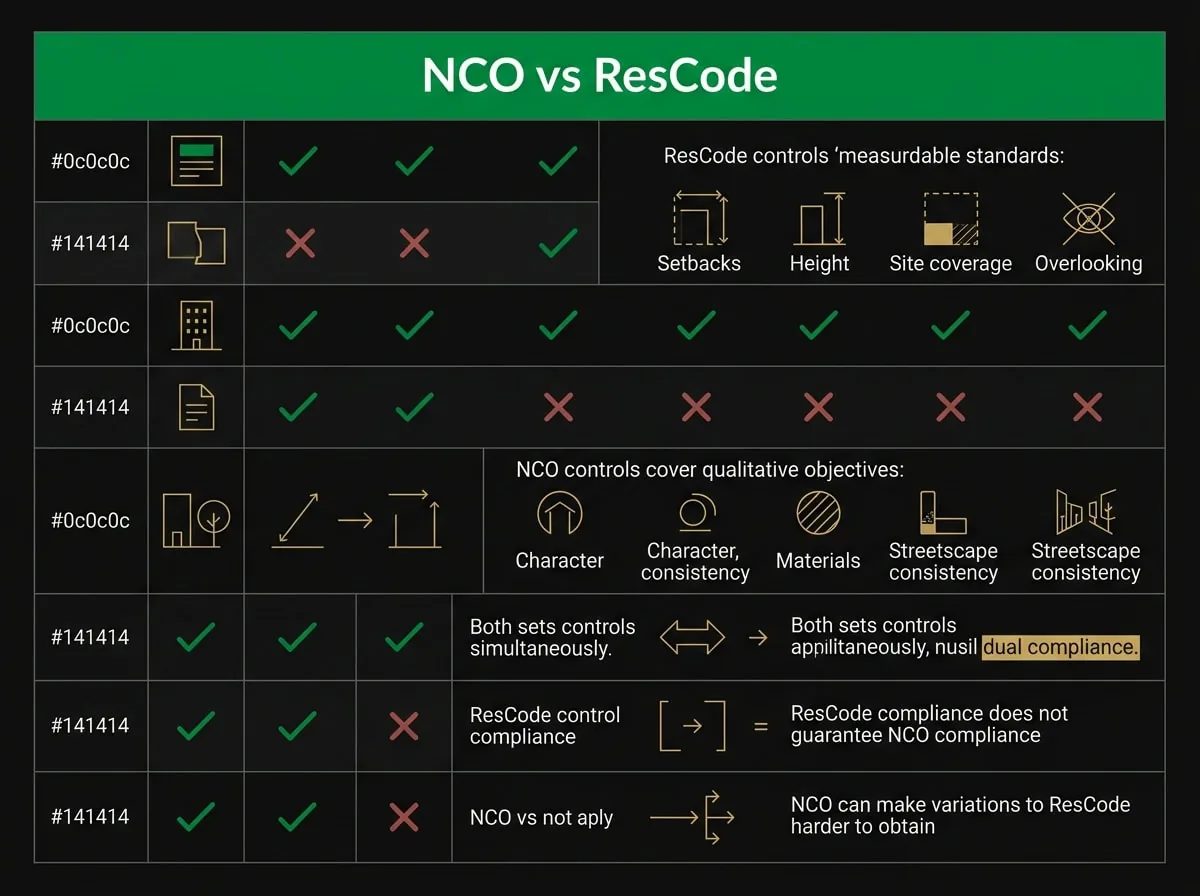
The NCO operates on a different level. Rather than prescribing specific measurements, it asks whether a proposal is consistent with the character of the neighbourhood as defined in the relevant schedule. This means that even a development that satisfies every ResCode standard may still face refusal or conditions if the Responsible Authority considers it inconsistent with the NCO’s design objectives.
In practical terms, this interaction creates a dual compliance challenge for townhouse and medium-density development. Your design team may need to demonstrate ResCode compliance through shadow diagrams, setback calculations, and site coverage figures — and simultaneously produce a neighbourhood character assessment that explains how the proposal responds to the NCO schedule’s objectives. For townhouse development in Victoria, this dual compliance requirement is one of the most common sources of application delays in NCO areas.
It’s also worth understanding the implications of overlooking regulations in Victoria and overshadowing regulations as part of this dual compliance picture. A well-prepared planning permit application in an NCO area will typically include a written character assessment, annotated design response drawings, and photographic documentation of the existing streetscape. Understanding the planning permit timeline across Melbourne councils can also help you plan for the additional assessment time that NCO areas often require.
Where a proposal seeks to vary a ResCode standard — for example, by reducing a side setback — the NCO can become an additional point of contention. Councils may be less willing to exercise discretion in favour of a variation where the NCO schedule emphasises the importance of the very standard being reduced.
Designing for NCO Compliance: Practical Guidance for Developers
Understanding the NCO is one thing — designing for it is another. The following guidance outlines the practical steps that may help your development achieve a favourable outcome in an NCO area.
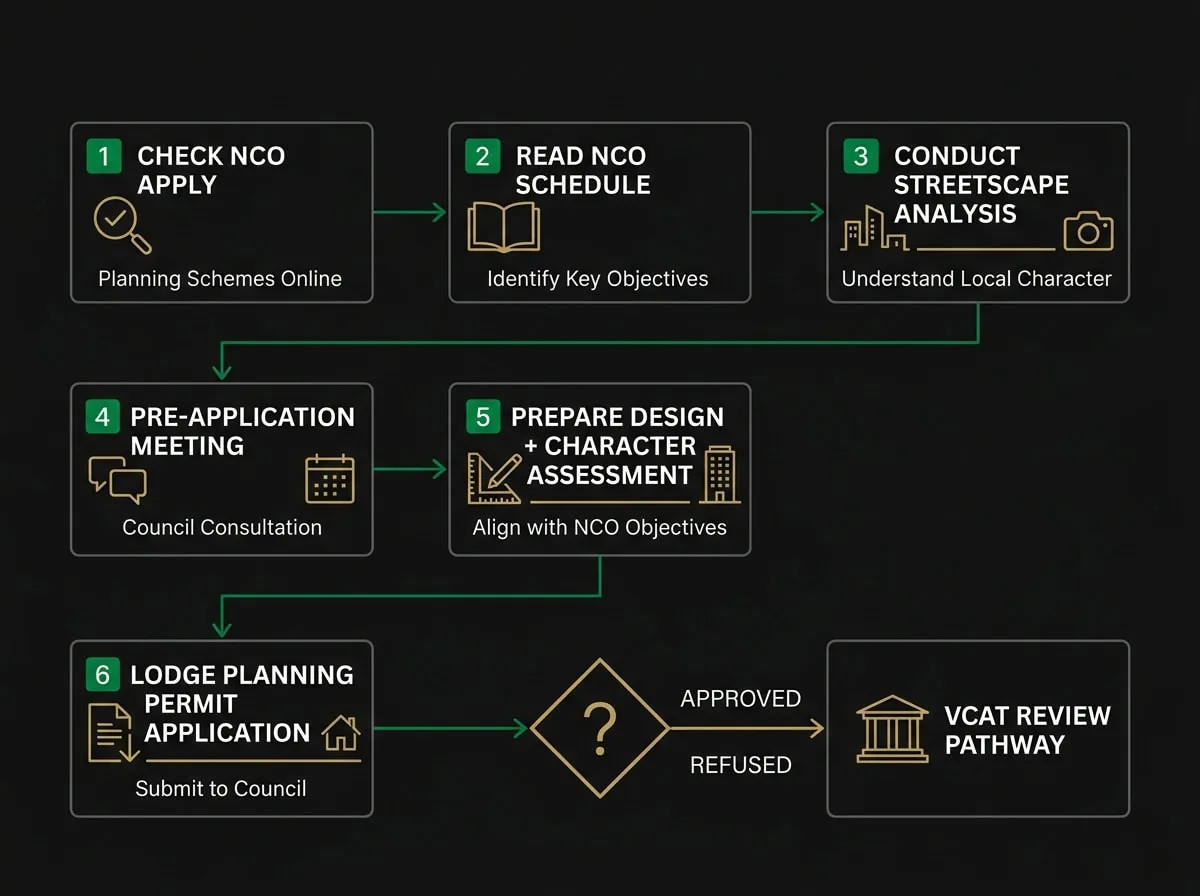
Read the Schedule Before You Brief Your Architect
Every NCO schedule is publicly available through the relevant council’s planning scheme, accessible via the Victorian Government’s Planning Schemes Online portal. Before briefing your design team, read the schedule that applies to your site. Note the statement of neighbourhood character, the design objectives, and the decision guidelines. These documents tell you exactly what the Responsible Authority will be looking for when they assess your application. Understanding what architectural planning drawings are required for a planning permit in Victoria will also help you brief your team effectively from the outset.
Conduct a Streetscape Analysis
A thorough streetscape analysis — including photographs, measurements of existing setbacks, building heights, roof forms, and materials — provides the evidential foundation for your character response. This analysis should inform your design from the outset, not be retrofitted after the design is complete. Councils and VCAT both respond well to applications that demonstrate a genuine, evidence-based engagement with the existing character of the area.
Prioritise the Design Elements the Schedule Emphasises
Different schedules prioritise different design elements. Some focus heavily on front setbacks and landscaping; others emphasise roof pitch, materials, or the retention of trees. Identify the two or three design objectives that carry the most weight in your schedule and ensure your design addresses them directly. This targeted approach is more effective than a generic character response that attempts to address everything equally.
Engage with Council Pre-Application
Pre-application meetings with the Responsible Authority can be valuable in NCO areas. They provide an opportunity to test your design approach before lodging a formal application, and to understand any specific concerns the council may have about development in the relevant precinct. While pre-application feedback is not binding, it can help you avoid costly redesigns after lodgement.
Prepare a Detailed Character Assessment
A written neighbourhood character assessment is a standard component of planning permit applications in NCO areas. This document should explain how the proposal responds to each of the schedule’s design objectives, with specific reference to design features and supporting drawings. A well-structured character assessment can significantly strengthen your application and reduce the likelihood of requests for further information from the Responsible Authority. Understanding how architects and town planners collaborate on planning applications can help you assemble the right team for this work.
Common Reasons NCO Applications Are Refused or Delayed
Based on experience across 210+ projects in Melbourne, several recurring issues tend to create problems for developers in NCO areas. Being aware of these may help you avoid them.
- Generic design responses: Applications that use boilerplate character assessments without specific reference to the site’s streetscape or the schedule’s objectives are frequently questioned by councils and challenged at VCAT.
- Excessive site coverage: Even where site coverage meets ResCode standards, proposals that maximise coverage at the expense of landscaping and garden character may be inconsistent with NCO objectives in garden suburb precincts.
- Inappropriate materials and finishes: Schedules that emphasise traditional materials such as brick, render, or terracotta tiles may view proposals featuring large expanses of glass, metal cladding, or flat roofs unfavourably.
- Inadequate tree retention: In councils like Manningham and Whitehorse, the removal of significant trees to accommodate development can be a major point of contention under the NCO.
- Inconsistent front setbacks: Where the schedule emphasises setback consistency with the established streetscape, proposals that deviate significantly from the prevailing setback pattern may face objections.
- Overlooking the NCO entirely: Some developers focus exclusively on ResCode compliance and fail to address the NCO at all. This is one of the most common — and most avoidable — reasons for delays and refusals.
NCO and VCAT: What Developers Should Know
If a planning permit application in an NCO area is refused by the Responsible Authority, or if conditions are imposed that are unacceptable, the Victorian Civil and Administrative Tribunal (VCAT) provides a review pathway. VCAT has developed a substantial body of decisions on NCO matters, and understanding how the Tribunal approaches these cases may inform both your design strategy and your decision about whether to pursue a review.
VCAT generally approaches NCO assessments by asking whether a proposal is consistent with — not identical to — the existing character of the neighbourhood. This means that well-designed contemporary development can succeed in NCO areas, provided it demonstrates a genuine and considered response to the schedule’s objectives. The Tribunal has also recognised that neighbourhood character evolves over time, and that the presence of some medium-density development in a precinct may be relevant context for assessing a new proposal.
That said, VCAT has upheld refusals in NCO areas where applicants have failed to adequately address character objectives, or where proposals have been found to be visually dominant, inconsistent with prevailing setbacks, or damaging to the garden character of an area. A strong application — one that addresses the NCO thoroughly from the outset — remains your best protection against an adverse outcome at VCAT.
Frequently Asked Questions
Does Neighbourhood Character Overlay apply to all residential land in Melbourne?
No. NCO applies only to land specifically identified in each council’s planning scheme. You can check whether your site is affected by searching the relevant planning scheme on the Victorian Government’s Planning Schemes Online portal, or by requesting a planning property report from the council. Not all residential land in Melbourne is covered, and the extent of NCO coverage varies significantly between councils.
Can a development be approved in an NCO area even if it doesn’t match the existing character exactly?
Yes. The NCO requires that proposals be consistent with the design objectives in the relevant schedule — it does not require that new development replicate existing buildings. VCAT has consistently recognised that neighbourhood character evolves, and that contemporary design can be appropriate in NCO areas provided it responds thoughtfully to the schedule’s objectives. The key is demonstrating a genuine design response, not stylistic mimicry.
How does NCO affect the number of dwellings I can develop on a site?
NCO does not directly prescribe a maximum number of dwellings. However, it can indirectly constrain yield by requiring setbacks, landscaping, and built-form outcomes that reduce the amount of developable area on a site. In practice, NCO compliance may mean that a site that could theoretically accommodate four townhouses under ResCode is better suited to three, in order to achieve a design outcome that satisfies the schedule’s objectives. For a detailed look at site requirements and yield considerations, see our guide to dual occupancy site requirements in Melbourne.
What is the difference between Neighbourhood Character Overlay and Heritage Overlay?
Heritage Overlay (HO) applies to places of cultural heritage significance and imposes more stringent controls, including permit requirements for demolition and alterations. NCO applies to areas valued for their neighbourhood character rather than individual heritage significance. The two overlays can apply simultaneously to the same land, in which case both sets of objectives must be addressed in a planning permit application.
How long does a planning permit application typically take in an NCO area?
Timeframes vary significantly by council and application complexity. Some straightforward applications in NCO areas may be assessed within approximately 60 days, though more complex proposals or those attracting objections may take considerably longer. Pre-application engagement with the Responsible Authority and a well-prepared application can help minimise delays.
Do I need a specialist report to address NCO requirements?
A formal specialist report is not always required, but a written neighbourhood character assessment prepared by your architect or town planner is standard practice for applications in NCO areas. In some cases — particularly where significant trees are involved — an arborist report may also be required. Your design team can advise on what supporting documentation may be needed for your specific site and council.
Can SQM Architects help with NCO applications across different Melbourne councils?
SQM Architects has delivered projects across all major councils in Melbourne, including City of Boroondara, City of Whitehorse, Manningham City Council, City of Monash, Knox City Council, and Maroondah City Council. With extensive experience navigating NCO requirements across Melbourne, the firm is well-positioned to assist developers with NCO applications. Contact us for a complimentary site assessment.
Conclusion: Turning NCO Complexity into a Competitive Advantage
Neighbourhood Character Overlay is one of the more nuanced planning controls that developers encounter in Melbourne — but it doesn’t have to be a barrier. Developers who invest in understanding the specific schedule that applies to their site, engage a design team with genuine NCO experience, and prepare thorough, evidence-based applications are better positioned to pursue favourable outcomes. The developers who struggle are typically those who treat the NCO as an afterthought, or who apply a generic design approach without engaging with the character objectives that the Responsible Authority will be assessing.
With 210+ projects delivered across Melbourne projects and a history of repeat client engagements, SQM Architects understands what it takes to navigate NCO requirements and pursue planning permit approvals that may support your development outcomes. Whether you’re assessing a potential acquisition, preparing a permit application, or reviewing an existing design, a site-specific assessment is the most effective starting point.
Book a Strategy Call — contact SQM Architects on (03) 9005 6588 to discuss your site and how NCO requirements may affect your development outcome.
This article provides general information about Victorian planning for property developers. It does not constitute professional advice. For project-specific guidance, consult with a qualified architect or town planner.