
Why Objector Numbers Matter More Than You Think
You have lodged a planning permit application for a medium-density development in Box Hill or Doncaster. Notification goes out, and within weeks your responsible authority has received 45 written objections. Your first instinct may be to dismiss this as neighbourhood noise — after all, planning decisions are supposed to be made on policy and planning merits, not popularity. That instinct is understandable, but it is only partially correct. Since 2015, Victorian planning law has formally required responsible authorities and VCAT to consider the number of objectors as part of a Social Effects Assessment — a potential indicator of significant social effect. Understanding exactly how this works — and how it does not work — can be the difference between a smooth approval and a protracted VCAT review.
This guide explains the Social Effects Assessment framework as it applies to planning permit applications in Melbourne, covering the legislative basis, how councils in areas such as the City of Whitehorse, City of Boroondara, and City of Manningham approach objector numbers in practice, and what developers can do to manage community opposition strategically. We also cover the significant 2025–2026 legislative reforms that are reshaping how objections are handled at both council and VCAT level.
Read More Property Development Guides
The Legislative Framework: Section 60(1B) and What It Actually Requires
The foundation of this issue is the Planning and Environment Amendment (Recognising Objectors) Act 2015, which inserted sections 60(1B) and 84B(2)(jb) into the Planning and Environment Act 1987 (PE Act). These provisions require responsible authorities and VCAT to have regard — where appropriate — to the number of objectors when considering whether a proposed use or development may have a significant social effect.
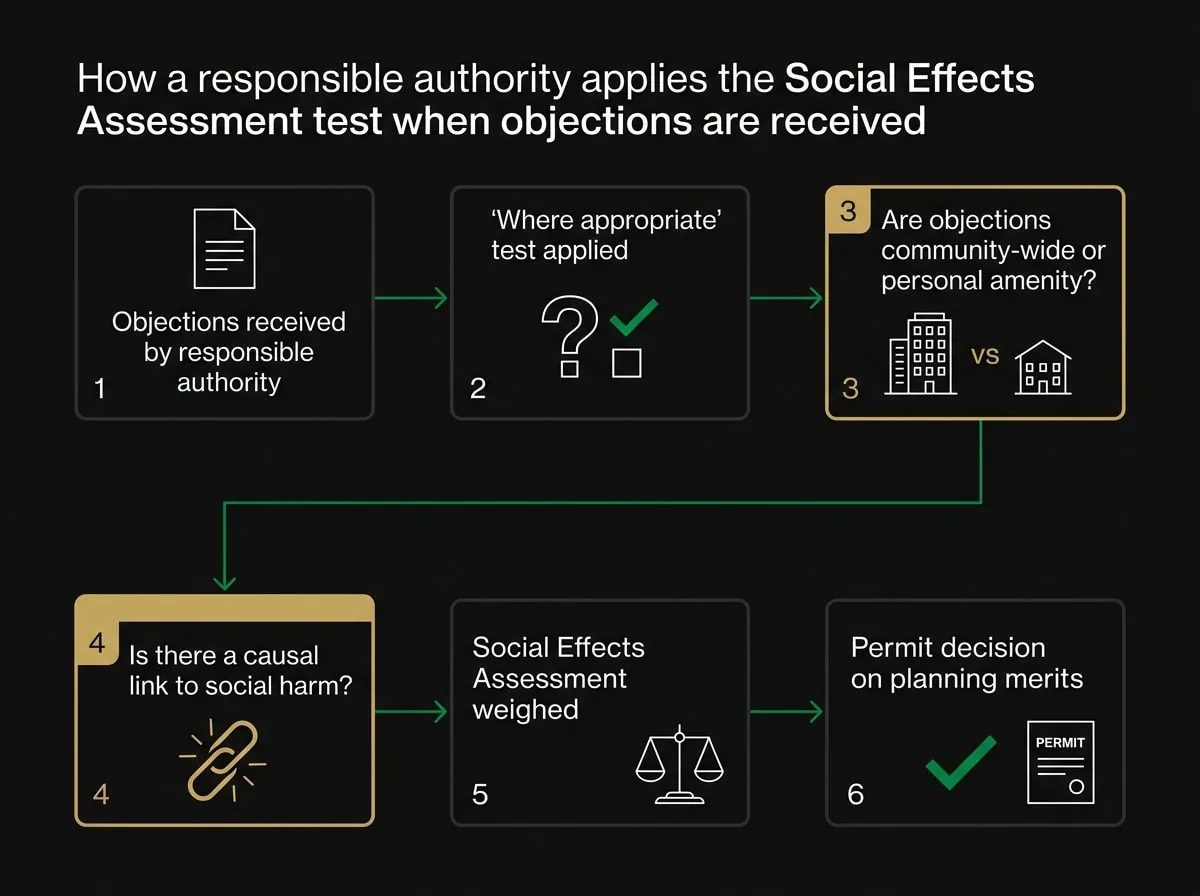
The critical phrase here is “where appropriate.” The legislation does not create an automatic obligation to treat every large volume of objections as evidence of social harm. Rather, it requires the decision-maker to first assess whether it is appropriate to consider the number of objectors in the specific circumstances of the application. This is a nuanced, case-by-case judgement — not a simple numbers game.
Equally important is what the legislation does not do. It does not give responsible authorities discretion to refuse a planning permit simply because many people have objected. The Victorian Supreme Court established in Stonnington City Council v Lend Lease Apartments (Armadale) Pty Ltd [2013] VSC 505 that “mere evidence of opposition by a section of the public is not, in and of itself, evidence of social impact or social effect.” The number of objections must say something meaningful about detrimental effects on the community — not simply reflect how many neighbours dislike the proposal.
For developers, this means two things. First, a high objection count does not automatically doom your application. Second, a high objection count that is accompanied by well-articulated, evidence-based claims about community-wide social harm carries genuine weight and may need to be addressed proactively in your application materials.
What Counts as a “Significant Social Effect”?
Social effects are not defined in the PE Act, but Victorian planning guidance and case law have established a working framework. Social effects typically include impacts on:
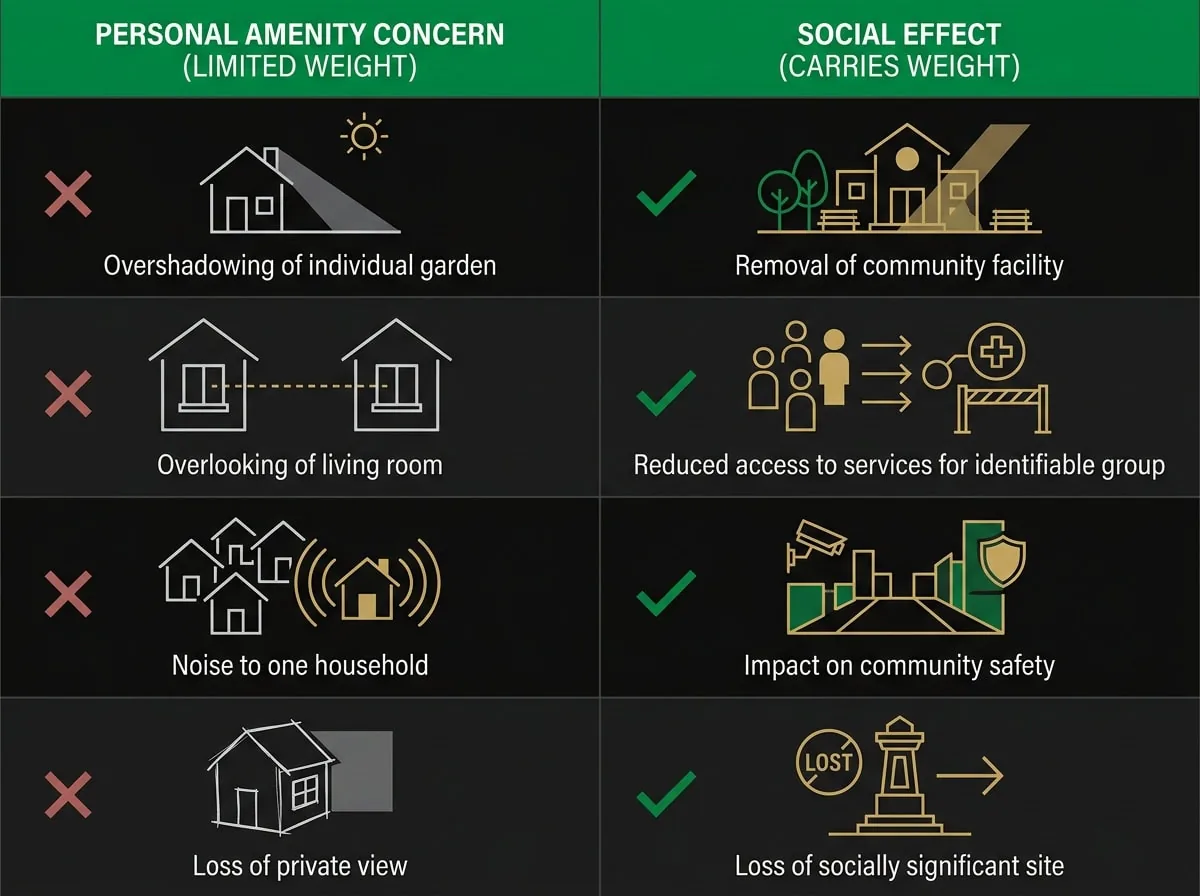
- The demand for or use of community facilities and services
- Access to social and community infrastructure
- Choice in housing, shopping, recreational and leisure services
- Community safety and amenity
- The social significance of a particular site to the community
To determine whether a social effect is significant, the responsible authority must consider several factors: the aspects of the proposed use or development that require a permit; the purpose of the permit requirement; the planning scheme provisions that apply; the causal connection between the social effect and the proposal; the probability of the effect occurring and its likely consequences; and whether the community (or an identifiable section of it) is affected, as distinct from individuals.
This last point is particularly important for developers. An objection that says “this development will overshadow my garden” is a personal amenity concern — it does not constitute evidence of social effect. An objection that says “this development will remove the only community gathering space within 800 metres of a population of 3,000 residents” is a different matter entirely. The distinction between individual grievance and community-wide impact is what separates objections that carry social effects weight from those that do not.
Responsible authorities must also assess whether the number of objectors is indicative of the scale of a social effect on the community, the presence of a specific social need in the community, or the social significance of a site. A large number of objections may be relevant evidence of these things — but only if the content of those objections actually points to community-wide harm supported by objective facts.
Get the 7-point site check to run before committing to a permit application — zoning, overlays, setbacks and council red flags, in plain English. Free PDF, instant download.
- Zone, overlay & setback checks
- What council assesses first
- Permit-readiness red flags
Something went wrong. Please try again.
No spam. Unsubscribe anytime.
Check your inbox — your checklist is on its way.
How Melbourne Councils Handle Objector Numbers in Practice
While the legislative framework is consistent across Victoria, the practical application varies between councils. Developers active in Melbourne should be aware of the following council-specific considerations.
City of Whitehorse
The City of Whitehorse covers high-density corridors along the Whitehorse Road and Box Hill Central precincts, where medium and large-scale residential and mixed-use developments regularly attract significant community interest. Applications in these areas that receive substantial objection volumes are more likely to be escalated for council officer review rather than determined under delegation. Whitehorse planning officers are experienced in distinguishing between amenity-based objections and genuine social effects claims, but developers should not assume that volume alone will be dismissed without consideration.
City of Boroondara
The City of Boroondara is one of the more objection-active councils in metropolitan Melbourne, with established community groups in suburbs such as Camberwell, Hawthorn, and Kew that are experienced in coordinating objection campaigns. The City of Boroondara’s planning scheme includes heritage and neighbourhood character overlays that generate permit requirements across a wide range of development types, meaning the “where appropriate” test for considering objector numbers is frequently engaged. Developers in Boroondara may need to consider a Social Effects Assessment as part of their application documentation for medium to large-scale projects.
City of Manningham
City of Manningham covers established residential areas in Doncaster, Templestowe, and Warrandyte, where community sensitivity to density and character change is high. City of Manningham’s planning scheme includes significant residential character provisions, and objections in this area frequently raise concerns about neighbourhood character that can, in some circumstances, be framed as social effects arguments. Developers should be prepared for objection volumes that reflect genuine community attachment to established streetscapes.
City of Monash, City of Knox, and Maroondah City Council
These councils cover areas undergoing significant housing transition, with activity centres at Glen Waverley, Boronia, and Ringwood attracting increasing development interest. Objection volumes in these areas tend to be lower than in inner-eastern councils, but applications near community facilities, schools, or established open space are more likely to attract objections with a social effects dimension. The City of Knox and Maroondah City Council have both been active in applying the “where appropriate” test carefully, recognising that their communities are undergoing genuine change.
The Delegation Threshold: When Objector Numbers Trigger Escalation
One of the most practical impacts of objector numbers for developers is the delegation threshold — the point at which a planning permit application can no longer be determined by a council officer under delegated authority and must instead be reported to a full council planning meeting.
While delegation thresholds vary between councils, a common benchmark across metropolitan Melbourne is 10 or more objections from different properties. When this threshold is reached, the application is typically escalated to a council planning committee or full council meeting, which introduces additional procedural steps, longer timeframes, and greater political visibility. For a detailed breakdown of how permit timelines are affected across Melbourne councils, see our Planning Permit Timeline Melbourne guide.
It is important to understand how councils count objections for delegation purposes. Petitions with multiple signatories are generally counted as a single objection. Pro-forma objections — where the same text is copied and signed by multiple people — are also typically counted as one objection. Individual, separately authored objections from different properties each count as one. This means that a coordinated campaign using a standard template may be less effective at triggering delegation thresholds than it appears, but a genuine wave of individual objections from neighbouring properties can escalate your application quickly.
For developers, the practical implication is clear: early community engagement before lodgement can reduce the number of objections received, potentially keeping your application within the delegation pathway and avoiding the delays associated with council meeting determination. SQM Architects routinely advises clients on pre-application community engagement strategies as part of the planning permit process.
The 2025–2026 Legislative Reforms: What Has Changed for Developers
The Victorian planning system has undergone its most significant legislative overhaul in decades, with two major Acts reshaping how objections are handled. Developers need to understand these changes and factor them into project timelines and preliminary feasibility considerations.
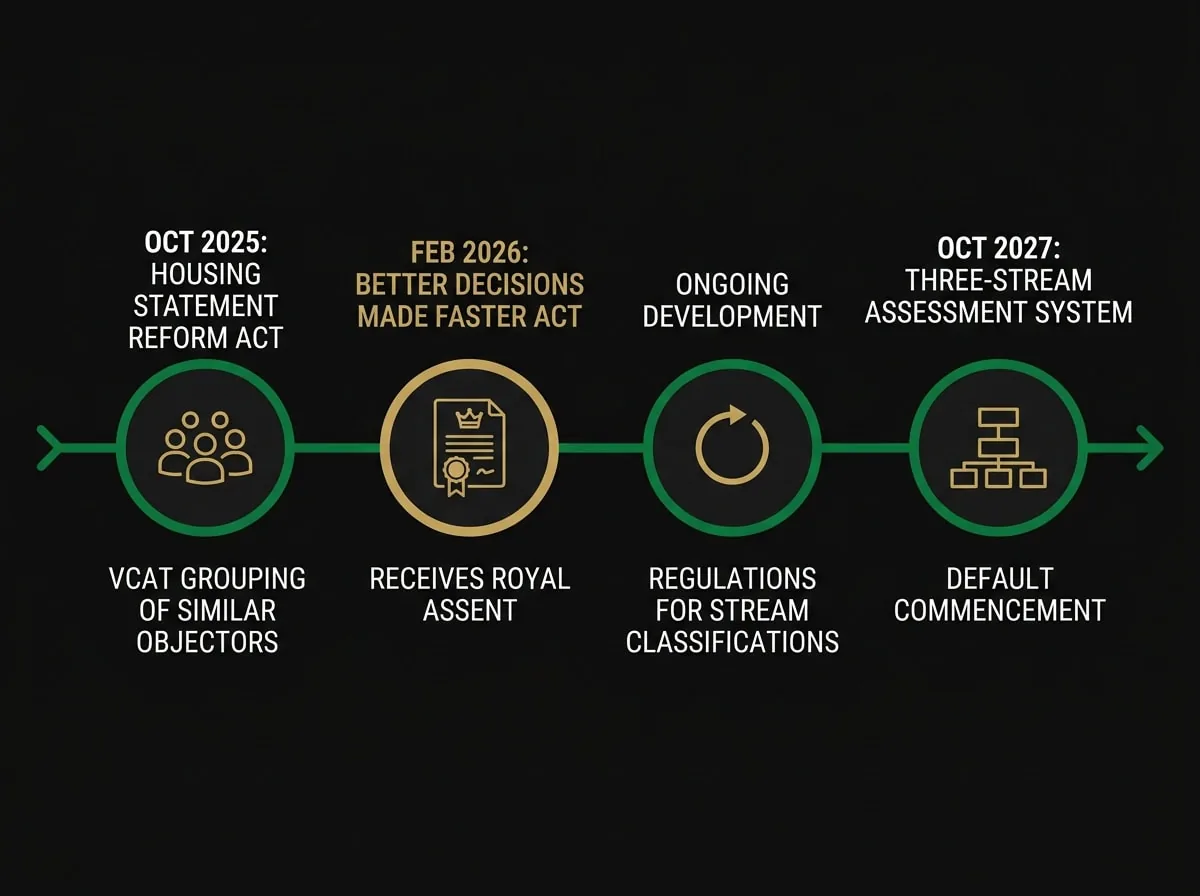
Consumer and Planning Legislation Amendment (Housing Statement Reform) Act 2025
This Act, with some provisions commencing on 15 October 2025, introduced important changes to how VCAT handles objectors. VCAT may now treat two or more objectors as a group if their statements rely on similar grounds or raise similar issues. This is a significant development for developers facing coordinated objection campaigns — it means that a large number of objectors raising identical or near-identical grounds may be consolidated, reducing the procedural burden of responding to each objection individually at VCAT. VCAT has also been given additional case management powers to actively manage proceedings, which may assist in streamlining reviews where objector numbers are high but the substantive issues are limited.
Planning Amendment (Better Decisions Made Faster) Act 2026
Passed by Parliament and receiving Royal Assent on 17 February 2026, this Act establishes three planning permit assessment streams based on the complexity, risk, and potential impacts of the application. While the regulations prescribing which developments fall into each stream are still being developed (with a default commencement date of 29 October 2027), the direction of reform is clear: lower-impact applications will be processed faster with reduced third-party participation rights, while larger and more complex developments will continue to involve public notification and objection rights. For developers of smaller infill projects — typically under four dwellings — the reforms may reduce the practical significance of objector numbers over time. For medium to large-scale developments, community engagement and social effects management will remain critical. Our Fast-Track Planning Bill guide covers these accelerated permit pathways in detail.
Practical Strategies for Managing Objector Numbers
Understanding the framework is useful; knowing what to do about it is essential. The following strategies may assist developers in managing the impact of objector numbers on their planning permit applications.
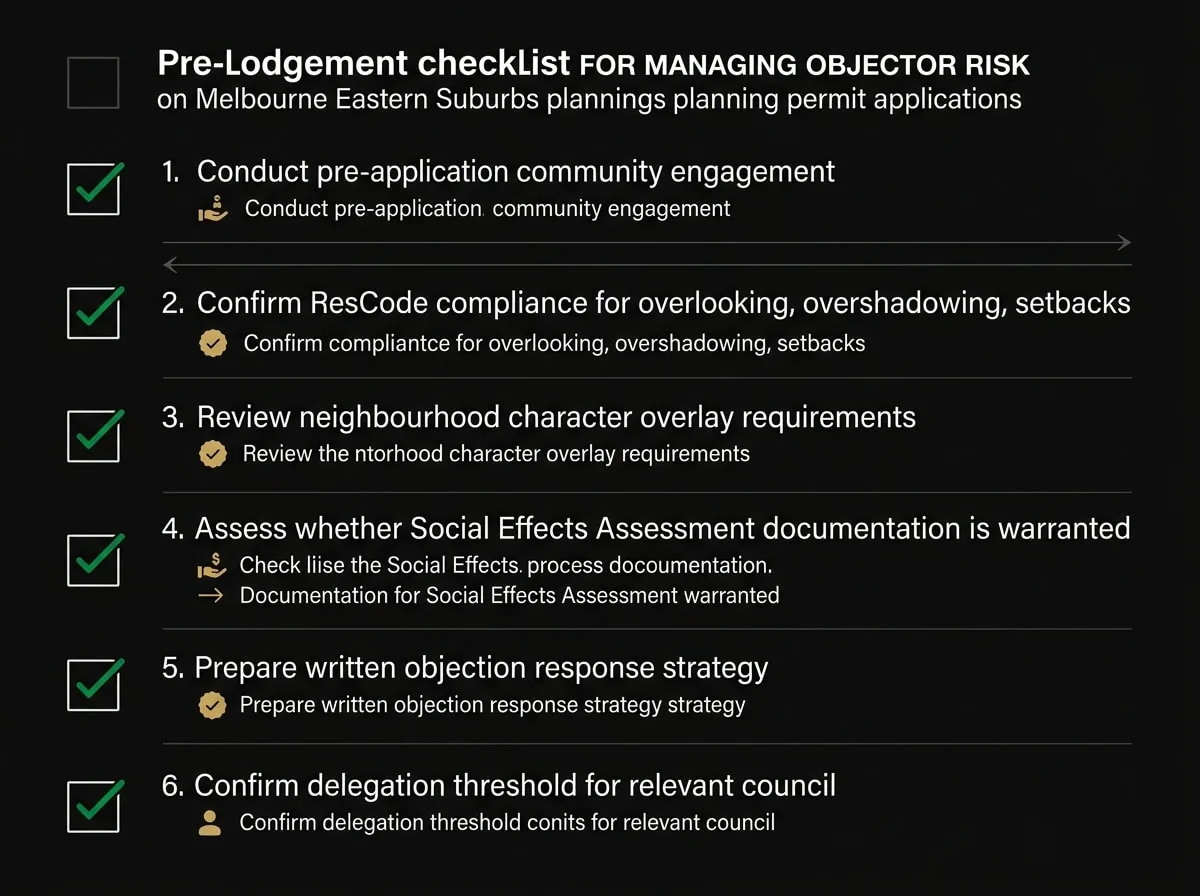
Pre-Application Community Engagement
Early, genuine engagement with neighbouring properties and community groups before lodging a planning permit application can significantly reduce objection volumes. This does not mean seeking approval from neighbours — it means informing them of your proposal, listening to their concerns, and where feasible, making design adjustments that address legitimate issues. A neighbour who feels heard is less likely to lodge a formal objection than one who first learns of your development from a council notification letter.
Design Quality and ResCode Compliance
Many objections in residential development contexts relate to ResCode standards — overlooking, overshadowing, setbacks, and neighbourhood character. A design that demonstrably complies with ResCode Victoria standards and the relevant planning scheme provisions gives council officers a clear basis to assess objections as raising no valid planning grounds. This does not eliminate objections, but it may reduce the weight given to them in the social effects assessment.
Social Effects Assessment Documentation
For medium to large-scale projects in sensitive locations, consider commissioning a Social Effects Assessment as part of your planning permit application. This document proactively addresses the social effects framework, identifies any genuine community impacts, and proposes mitigation measures. A well-prepared Social Effects Assessment may assist the responsible authority in weighing the community dimension of the proposal against any identified impacts, and can demonstrate that you have engaged seriously with the social effects considerations relevant to your project.
Responding to Objections Strategically
When objections are received, developers have the opportunity to respond in writing to the responsible authority. A response that addresses each substantive planning ground raised in objections — rather than dismissing them — demonstrates good faith and assists council officers in their assessment. Where objections raise social effects arguments, your response should address the causal connection (or lack thereof) between your proposal and the claimed community impact, supported by objective evidence where available.
Frequently Asked Questions
Can a responsible authority refuse my planning permit application solely because of a high number of objections?
No. Victorian planning law is clear that a responsible authority cannot refuse a planning permit application based solely on the number of objections received. The decision must be based on planning policy and planning merits. However, a high number of objections that collectively point to a significant social effect — supported by objective evidence — may be a relevant factor in the overall assessment.
Does a petition count as multiple objections for the purposes of the delegation threshold?
Generally, no. Most councils treat a petition as a single objection for delegation purposes, regardless of how many signatures it contains. Similarly, pro-forma objections using identical text are typically counted as one objection. Individual, separately authored objections from different properties each count separately toward the delegation threshold.
What is the difference between a personal amenity concern and a social effect?
A personal amenity concern relates to how an individual objector is affected — for example, overshadowing of their garden or overlooking of their living room. A social effect relates to the impact on the community or an identifiable section of the community — for example, the removal of a community facility or a change in access to services. Only the latter is relevant to the social effects assessment under section 60(1B) of the PE Act.
How do the 2025–2026 reforms affect objector rights at VCAT?
The Housing Statement Reform Act 2025 allows VCAT to treat multiple objectors as a group where they raise similar grounds, which may streamline proceedings for developers facing coordinated objection campaigns. The Better Decisions Made Faster Act 2026, once fully implemented, may reduce third-party participation rights for lower-impact applications, though the detailed regulations are still being developed with a commencement date of 29 October 2027.
Is a Social Effects Assessment required for all planning permit applications?
No, a Social Effects Assessment is not a mandatory requirement for most planning permit applications. However, for medium to large-scale developments in sensitive locations — particularly those near community facilities, in areas with established community groups, or in councils with a history of high objection volumes — a proactive Social Effects Assessment may strengthen your application and assist the responsible authority in its decision-making.
How does the “where appropriate” test work in practice?
The responsible authority must first determine whether it is appropriate to consider the number of objectors in the specific circumstances of the application. This depends on what the objectors have said, whether the issues raised are relevant planning considerations, and whether those issues point to a detrimental effect on the community supported by evidence. If the objections are primarily about personal amenity or matters unrelated to the permit requirement, it may not be appropriate to give weight to the number of objectors.
Can I ask objectors to withdraw their objections?
Yes. Objectors may withdraw their objections at any time before a decision is made. Developers sometimes engage directly with objectors — through council-facilitated Planning Information and Discussion Meetings or independently — to address concerns and seek withdrawal of objections. However, this process requires careful management to avoid creating the impression of improper pressure on objectors.
Conclusion: Objector Numbers Are a Risk Factor, Not a Veto
The Social Effects Assessment framework under section 60(1B) of the PE Act is a genuine planning consideration — but it is one that can be managed effectively with the right approach. Objector numbers matter when they reflect genuine community-wide social harm supported by evidence. They matter less when they reflect coordinated campaigns raising personal amenity concerns or issues unrelated to the permit requirement. The 2025–2026 legislative reforms are shifting the balance further toward streamlined assessment for lower-impact projects, while maintaining meaningful community participation rights for larger developments.
For developers active in Melbourne, the key takeaways are: engage early with the community before lodging your application; design to ResCode standards to reduce the grounds available to objectors; consider a Social Effects Assessment for larger or more sensitive projects; and respond substantively to objections rather than dismissing them. SQM Architects has supported developers across Melbourne with a disciplined, evidence-based approach to planning permit applications. To discuss how your project may be affected by community objections and social effects considerations, contact our team to arrange an initial consultation.
Book a Strategy Call — speak with SQM Architects about your Melbourne development project today. Call us on (03) 9005 6588.
This article provides general information only and does not constitute planning or legal advice. For project-specific guidance, consult with a registered architect or planning professional.