
Stage 2 General Act Changes: What Melbourne Developers Need to Know
Victoria’s Stage 2 changes to the Planning and Environment Act adjust how developments are assessed and approved. This guide gives developers a plain-English overview of what changed and why it matters. For more detail, see our guide on the faster planning permit pathways.
These reforms, introduced under amendments to the Planning and Environment Act 1987, target the structural inefficiencies that have long plagued the approvals pipeline. From streamlined referral processes to revised deemed refusal timeframes and clearer notice requirements, the changes are designed to reduce the administrative burden on both councils and applicants. For developers working across the City of Whitehorse, City of Boroondara, Manningham City Council, City of Monash, City of Knox, and Maroondah City Council, understanding how these reforms apply at a local level could meaningfully improve your project programming and approval predictability. For a broader overview of how these changes fit within Victoria’s accelerated approvals agenda, see our Fast-Track Planning Bill: Melbourne Developer’s Guide to Accelerated Permit Pathways.
This guide breaks down the key Stage 2 changes, explains what they mean in practical terms for permit applications, and outlines the steps developers may consider taking to position their projects for faster, more predictable outcomes.
Background: Why Stage 2 Changes Were Needed
Victoria’s planning system has been under reform pressure for several years. The Andrews and subsequent Allan Government’s planning reform agenda identified a clear problem: the time between lodging a planning permit application and receiving a decision had blown out significantly, particularly for medium-density residential and mixed-use developments. Statutory timeframes were routinely missed, referral bodies were creating bottlenecks, and the notice and objection process was being used in ways that extended timelines without necessarily improving planning outcomes.
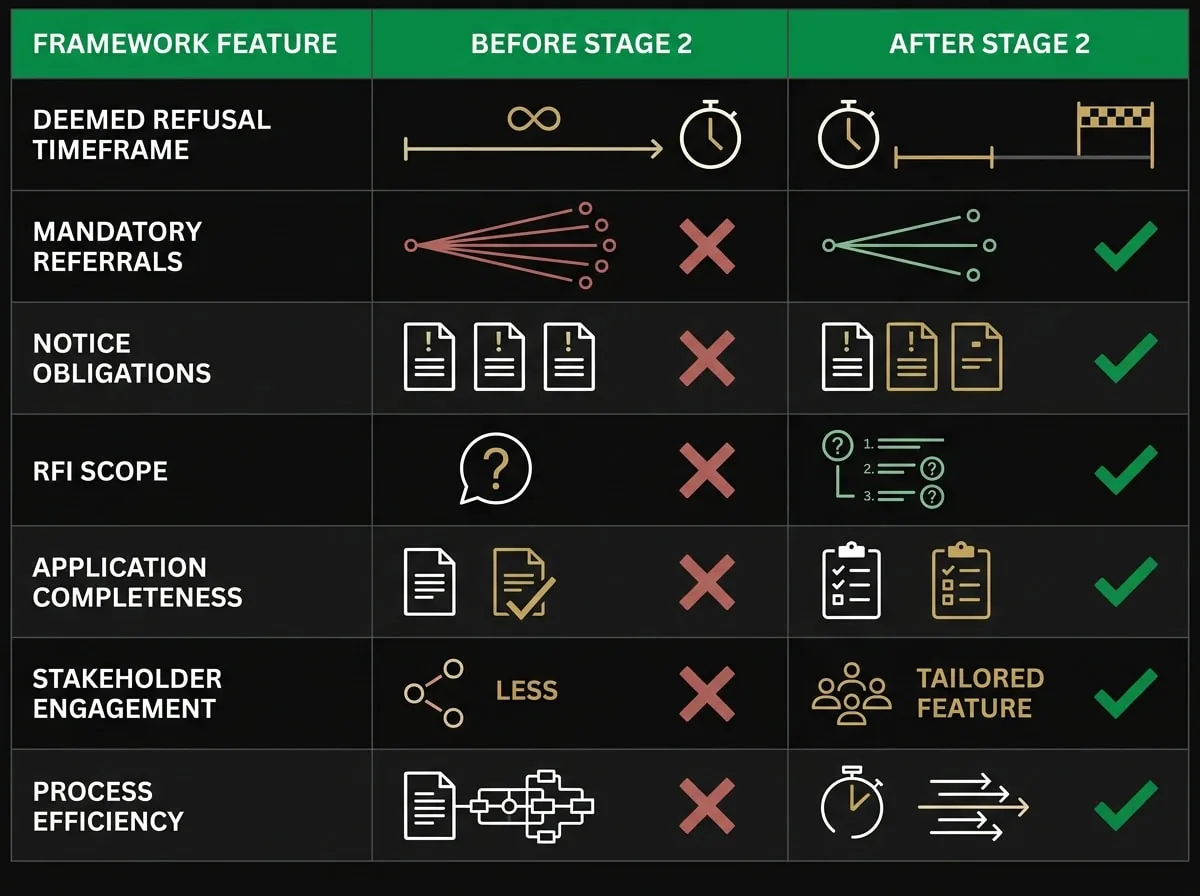
Stage 1 of the General Act reforms addressed some foundational issues, including changes to how applications are categorised and how VCAT reviews are managed. Stage 2 builds on this foundation with a sharper focus on process efficiency. The reforms acknowledge that faster approvals don’t mean lower-quality outcomes — they mean removing unnecessary procedural friction from a system that had become increasingly difficult to navigate.
For developers, the practical effect of these delays has been significant. Holding costs on land, extended finance periods, and the opportunity cost of capital tied up in stalled projects all affect development timelines. Any reform that meaningfully compresses the approvals timeline could reduce holding costs and improve project programming — and that’s precisely what Stage 2 is designed to achieve.
See How We Achieved Approval for This Complex Site
Key Changes Under Stage 2: The Core Reforms Explained
Revised Deemed Refusal Timeframes
One of the most developer-relevant changes under Stage 2 relates to deemed refusal provisions. Previously, the timeframes for when an application could be treated as a deemed refusal — allowing the applicant to appeal to VCAT — were inconsistent and, in some cases, gave Responsible Authorities little incentive to make timely decisions. The Stage 2 amendments tighten these timeframes and clarify the triggers, giving developers a clearer pathway to VCAT if a council fails to act within the prescribed period.
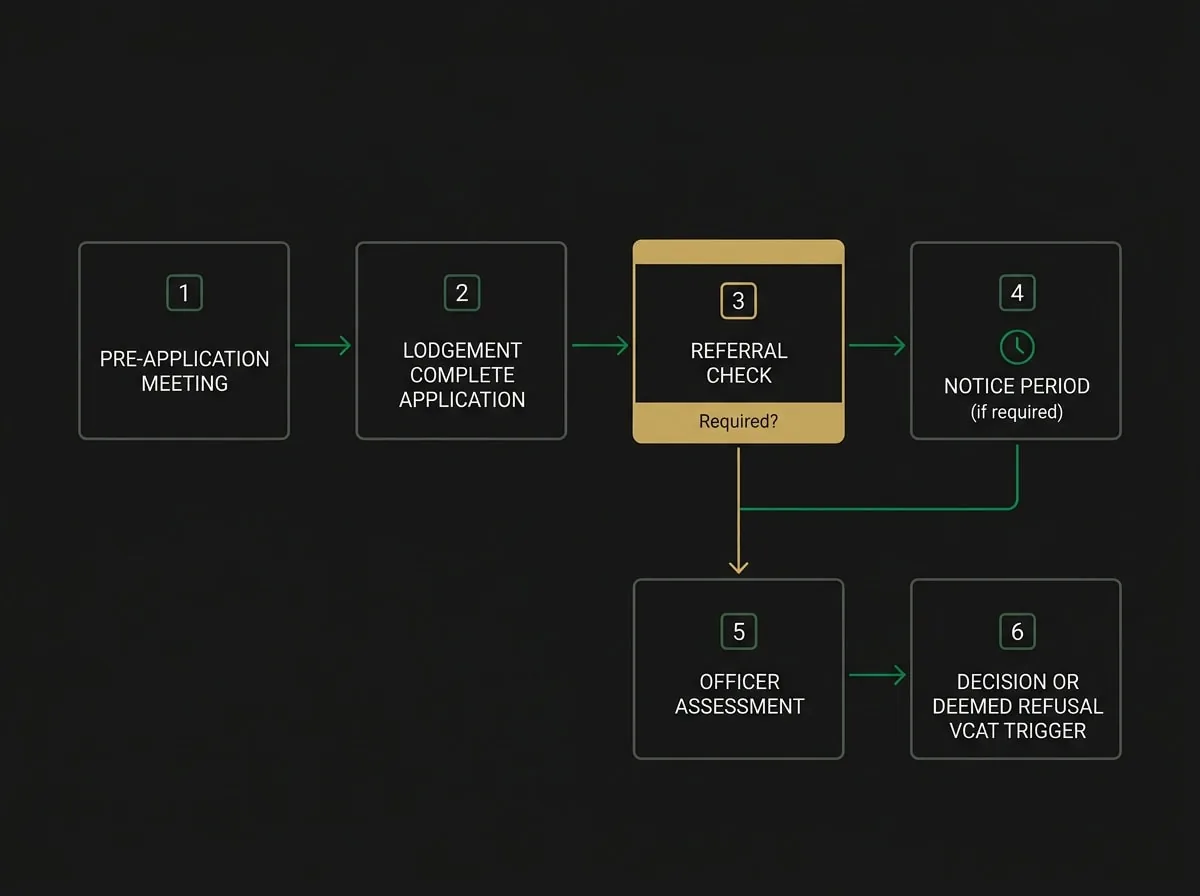
For straightforward residential applications — such as a two-dwelling development in a General Residential Zone — the revised framework may allow developers to initiate VCAT proceedings earlier than was previously possible. This doesn’t mean VCAT should be the default strategy, but having a credible backstop changes the negotiating dynamic with council planning officers. It’s worth noting that timeframes for medium-density applications have historically varied significantly across Melbourne councils, with referral delays often accounting for a substantial portion of that variance. For a detailed breakdown of typical permit timeframes by council, see our Planning Permit Timeline Melbourne by Council: A Complete Guide.
Streamlined Referral Processes
Referrals to external agencies — including Melbourne Water, VicRoads and relevant transport authorities, and utility authorities — have historically been a major source of delay. Under Stage 2, the referral framework has been revised to reduce the number of mandatory referrals for lower-risk applications and to impose stricter response timeframes on referral bodies.
For developers in flood-affected areas of Manningham City Council or City of Knox, Melbourne Water referrals have often added several weeks to application timeframes. The revised framework introduces clearer criteria for when a Melbourne Water referral is actually required, potentially removing this step for applications where flood risk has already been adequately addressed through site-specific assessments. Similarly, infrastructure referrals for smaller-scale subdivisions may now be handled through a more streamlined internal process rather than requiring full external referral.
Notice and Objection Process Reforms
The notice requirements under the Planning and Environment Act 1987 have been refined under Stage 2 to better calibrate the level of public notification to the actual impact of a proposal. Applications that are unlikely to have a material effect on neighbouring properties — such as single-dwelling alterations or minor subdivisions in established residential zones — may now be subject to reduced notice requirements, potentially shortening the objection period and the time before a decision can be made.
This is particularly relevant for developers working in the City of Boroondara and City of Whitehorse, where objection rates for medium-density applications have historically been higher than in outer eastern councils. While the reforms don’t eliminate the right to object, they introduce a more proportionate approach that may reduce the frequency of applications being held up by objections to proposals that are clearly consistent with the applicable planning scheme provisions.
Clearer Application Requirements and Pre-Application Processes
Stage 2 also introduces more standardised application requirements, reducing the scope for councils to request additional information on matters that are not genuinely relevant to the assessment. The reforms clarify what constitutes a “complete” application and limit the circumstances in which a Responsible Authority can issue a request for further information (RFI) after the initial lodgement.
For developers, this has two practical implications. First, a well-prepared application that addresses all statutory requirements is less likely to be delayed by an RFI. Second, the pre-application meeting process — already available at most Melbourne councils — becomes even more valuable as a mechanism for identifying and resolving potential issues before lodgement. SQM Architects has consistently found that thorough pre-application engagement reduces RFI rates and compresses overall approval timeframes, an approach that aligns directly with the intent of the Stage 2 reforms.
Get the 7-point site check to run before committing to a permit application — zoning, overlays, setbacks and council red flags, in plain English. Free PDF, instant download.
- Zone, overlay & setback checks
- What council assesses first
- Permit-readiness red flags
Something went wrong. Please try again.
No spam. Unsubscribe anytime.
Check your inbox — your checklist is on its way.
How These Changes Apply Across Melbourne Councils
While the Stage 2 reforms apply state-wide, their practical effect varies depending on how individual councils have been implementing the existing framework. Understanding the local context is essential for developers making decisions about site selection, application strategy, and project programming. For a comprehensive overview of how Victorian planning provisions apply across different zones and overlays, the Department of Transport and Planning’s planning portal is a useful reference.
City of Whitehorse and City of Boroondara
Both councils have historically maintained thorough assessment processes, with planning officers applying detailed scrutiny to medium-density applications. The City of Boroondara in particular has a well-documented track record of closely examining ResCode compliance — particularly the standards relating to overlooking, overshadowing, and neighbourhood character. Under Stage 2, the clearer application requirements and reduced scope for open-ended RFIs may help developers avoid the prolonged back-and-forth that has sometimes characterised applications in these areas.
For a typical three or four-dwelling development in Box Hill or Camberwell, developers may find that a complete, well-documented application now moves more predictably through the assessment process. The key remains ensuring that the ResCode standards relating to overlooking and overshadowing of open space are addressed comprehensively in the initial submission, as these remain the most common grounds for objection and officer concern in both council areas.
Manningham City Council and City of Monash
Manningham City Council covers areas with significant topographic variation — from the flatter residential precincts of Doncaster to the hillside properties of Templestowe and Warrandyte. The revised referral framework under Stage 2 may have a meaningful impact here, particularly for applications that have historically required Melbourne Water referrals due to proximity to waterways or flood overlays.
The City of Monash, which encompasses substantial residential development activity in areas like Glen Waverley and Wheelers Hill, has been processing a high volume of medium-density applications. The streamlined notice provisions under Stage 2 could reduce the administrative load on the council’s planning department, potentially improving turnaround times for straightforward applications. Developers should note that Monash’s local planning policy framework places particular emphasis on tree canopy retention, and applications that proactively address this — through arborist reports and canopy replacement strategies — are likely to progress more smoothly regardless of the broader reforms.
City of Knox and Maroondah City Council
Both City of Knox and Maroondah City Council cover areas that are increasingly attractive to developers as land values in the inner Melbourne continue to rise. City of Knox’s planning scheme includes several areas subject to the Neighbourhood Residential Zone, where development potential is more constrained, alongside General Residential Zone precincts with stronger medium-density capacity. The Stage 2 changes around application completeness requirements may be particularly beneficial here, as City of Knox has historically issued RFIs on matters that experienced practitioners would consider adequately addressed in a standard application package.
Maroondah City Council, covering areas like Ringwood, Croydon, and Mooroolbark, has been an active participant in the state government’s planning reform agenda. The council’s planning team has been relatively receptive to pre-application engagement, and the Stage 2 emphasis on front-loaded process efficiency aligns well with Maroondah’s existing approach. For developers targeting the Ringwood Activity Centre and surrounding residential precincts, the combination of the reformed approvals process and the activity centre’s strategic planning framework may create a more favourable environment for medium-density proposals.
Practical Steps for Developers: Positioning Your Application for Success
Understanding the reforms is one thing — knowing how to position your application to take full advantage of them is another. The following steps outline a practical approach that may help developers achieve faster, more predictable outcomes under the revised framework. For broader context on how these steps fit within a development feasibility framework, see our guide to Property Development Planning Considerations: Industry Framework and Best Practices.
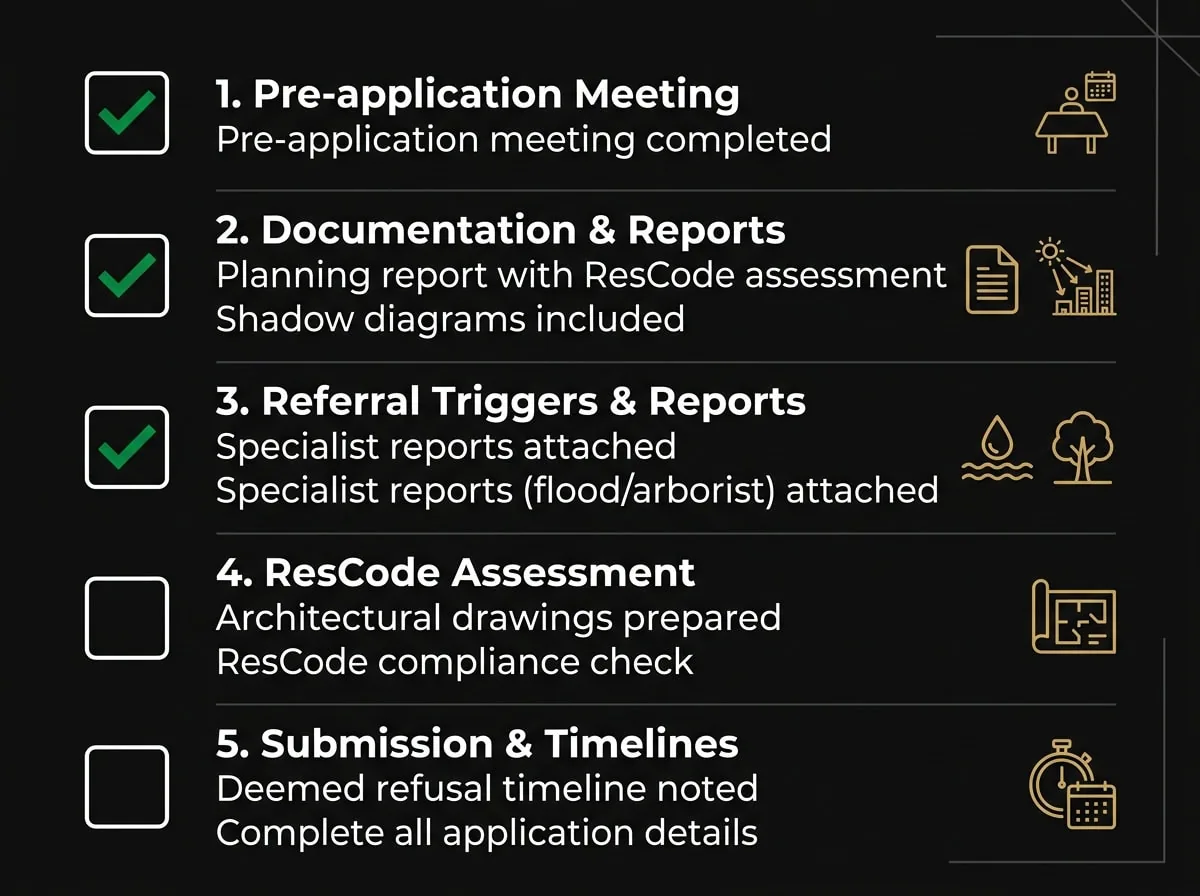
- Invest in pre-application engagement: The Stage 2 reforms reinforce the value of pre-application meetings. Use these sessions to confirm the council’s interpretation of local policy, identify any referral requirements upfront, and establish a clear understanding of what a complete application looks like for your specific site.
- Prepare a comprehensive application package from the outset: Under the revised framework, councils have less latitude to issue open-ended RFIs. A thorough initial submission — including a detailed planning report, ResCode assessment, shadow diagrams, architectural planning drawings, and any required specialist reports — reduces the risk of delays and demonstrates that your application is ready for assessment.
- Address referral triggers proactively: If your site is subject to a flood overlay, vegetation protection overlay, or heritage overlay, engage the relevant specialists early. A site-specific flood assessment or arborist report included with the initial application may remove the need for a formal referral or accelerate the referral response.
- Understand the deemed refusal timeline for your application type: Know the revised statutory timeframes that apply to your application and programme your project accordingly. If a decision is not forthcoming within the prescribed period, you may have grounds to initiate a VCAT review — a lever that can sometimes prompt a council to prioritise assessment.
- Engage a registered architect with local planning experience: The quality and completeness of your application documentation directly affects how quickly it moves through the assessment process. SQM Architects has delivered projects across Melbourne, with application preparation built on thorough, locally-informed documentation.
- Monitor the implementation of Stage 2 provisions at your target council: The reforms are being implemented progressively, and individual councils may have transitional arrangements in place. Staying informed about how your target council is applying the new provisions will help you time your lodgement strategically.
ResCode Considerations Under the Revised Framework
The Stage 2 reforms do not change the substantive ResCode standards that apply to residential development — Standards A and B under Clause 54 and Clause 55 of the Victorian planning scheme remain the primary assessment framework for single dwellings and medium-density development respectively. What changes is the process by which compliance with these standards is assessed and communicated. For a detailed reference on current ResCode requirements, see our ResCode Victoria: Developer’s Reference for Compliant Residential Development.
Under the revised application requirements, a ResCode assessment that clearly addresses each applicable standard — including the decision guidelines where discretion exists — is more likely to be treated as a complete application. Councils will have less scope to request additional information on ResCode matters that have been adequately addressed in the initial submission. This places a premium on the quality of the ResCode analysis included in your planning report.
For developers, this means that cutting corners on ResCode documentation to save time at the application preparation stage is likely to be counterproductive. A thorough ResCode assessment — one that not only demonstrates compliance with the objectives and standards but also addresses the relevant decision guidelines — is the foundation of a complete application under the Stage 2 framework. SQM Architects prepares detailed ResCode assessments as a standard component of every planning permit application, a practice that aligns with the completeness requirements central to the Stage 2 framework.
Frequently Asked Questions
When do the Stage 2 General Act changes take effect for planning permit applications in Melbourne?
The Stage 2 amendments have been progressively implemented, with key provisions already in effect for new applications lodged after the relevant commencement dates. Developers with applications already in the system may be subject to transitional provisions — it is worth confirming with your Responsible Authority or planning consultant which provisions apply to your specific application.
Will the Stage 2 changes reduce the time it takes to get a planning permit in the City of Boroondara or City of Whitehorse?
The reforms are designed to reduce unnecessary procedural delays, but the overall timeframe will still depend on the complexity of your proposal, the level of public notice required, and whether any referrals are needed. Applications that are well-prepared and clearly consistent with the applicable planning scheme provisions are most likely to benefit from the streamlined process.
Do the Stage 2 reforms change the ResCode standards I need to comply with?
No. The substantive ResCode standards under Clause 54 and Clause 55 of the Victorian planning scheme remain unchanged. The reforms affect the process by which applications are assessed and the requirements for what constitutes a complete application, not the underlying planning standards.
Can I use the revised deemed refusal provisions to take my application to VCAT more quickly?
The revised deemed refusal timeframes may allow you to initiate a VCAT review earlier than was previously possible if your Responsible Authority has not made a decision within the prescribed period. However, VCAT proceedings involve their own costs and timeframes, and this pathway may be most appropriate where a council has clearly failed to progress an assessment without good reason.
How do the Stage 2 referral changes affect applications near waterways in Manningham or City of Knox?
The revised referral framework introduces clearer criteria for when a Melbourne Water referral is required, which may reduce the number of applications subject to mandatory referral. However, sites within or adjacent to flood overlays or waterway corridors are still likely to require referral. Including a site-specific flood assessment with your initial application may help streamline the referral process.
Do the notice reforms mean my planning permit application won’t need to be advertised to neighbours?
Not necessarily. The Stage 2 notice reforms introduce a more proportionate approach to notification, but most medium-density applications will still require notice to be given to adjoining and nearby owners and occupiers. The reforms primarily affect the scope and duration of the notice process for lower-impact applications, rather than eliminating notice requirements altogether.
How can SQM Architects help me take advantage of the Stage 2 planning reforms?
SQM Architects prepares comprehensive planning permit applications specifically designed to meet the completeness requirements that are central to the Stage 2 framework. With extensive experience across Melbourne, our team can help you prepare an application that is positioned for the fastest possible assessment under the revised process.
Conclusion: A More Efficient Approvals Process — But Preparation Still Matters
The Stage 2 General Act changes represent a genuine step forward for Melbourne’s planning system. By tightening deemed refusal timeframes, streamlining referral processes, and introducing more proportionate notice requirements, the reforms create a framework that is designed to deliver faster, more predictable outcomes for developers who prepare thorough, well-documented applications. For those working across Melbourne — where planning scrutiny has historically been high and objection rates have sometimes extended timelines significantly — these changes may reduce holding costs and improve approval predictability for developers in these areas.
SQM Architects – ABN 32 600 928 390, ARBV Reg. No. 51498
That said, the reforms are not a substitute for quality application preparation. The developers who are most likely to benefit are those who invest in comprehensive pre-application engagement, prepare complete and well-documented submissions from the outset, and work with planning and design professionals who understand the local policy context. If you’re planning a development in Melbourne and want to understand how the Stage 2 changes may affect your specific project, SQM Architects offers a complimentary site assessment to help you map out the most efficient path to approval.
Book a Strategy Call — speak with the SQM Architects team today about your Melbourne development project. Call us on (03) 9005 6588.
This article provides general information only. For project-specific guidance, consult with qualified professionals.