
Car parking requirements for Melbourne developments changed under Amendment VC277, which introduced a PTAL-based (public transport access level) approach — broadly, better-connected sites may be able to provide less on-site parking. This guide explains how the reform affects parking provision for your project. For more detail, see our guide on Clause 52.06 car parking rules.
This article outlines what changed under VC277, which developers and land uses are most affected, how the transition period works, and what practical steps you may need to take before lodging your next planning permit application. Whether you are planning a residential apartment building near Box Hill station, a mixed-use development in Ringwood, or a townhouse project in Mitcham, understanding the new Clause 52.06 framework is now essential groundwork for any feasibility assessment.
At SQM Architects, our team has been working across Melbourne for over 12 years, delivering a broad portfolio of residential and mixed-use projects across the region. The information below draws on our reading of the amendment and publicly available guidance from the Department of Transport and Planning.
What Changed: The Core of Amendment VC277
Prior to VC277, Clause 52.06 of the Victoria Planning Provisions operated primarily through a single minimum parking rate, with a modest reduction available for sites located within the Principal Public Transport Network (PPTN) area. That system was widely criticised for being blunt — it did not account for the actual frequency, quality, or walkability of public transport at a given address. The PPTN maps were also rarely updated, meaning they failed to reflect improvements to the network over time. For broader context on how this amendment fits within Victoria’s current planning reform agenda, see our overview of the Planning Amendment Bill 2025.
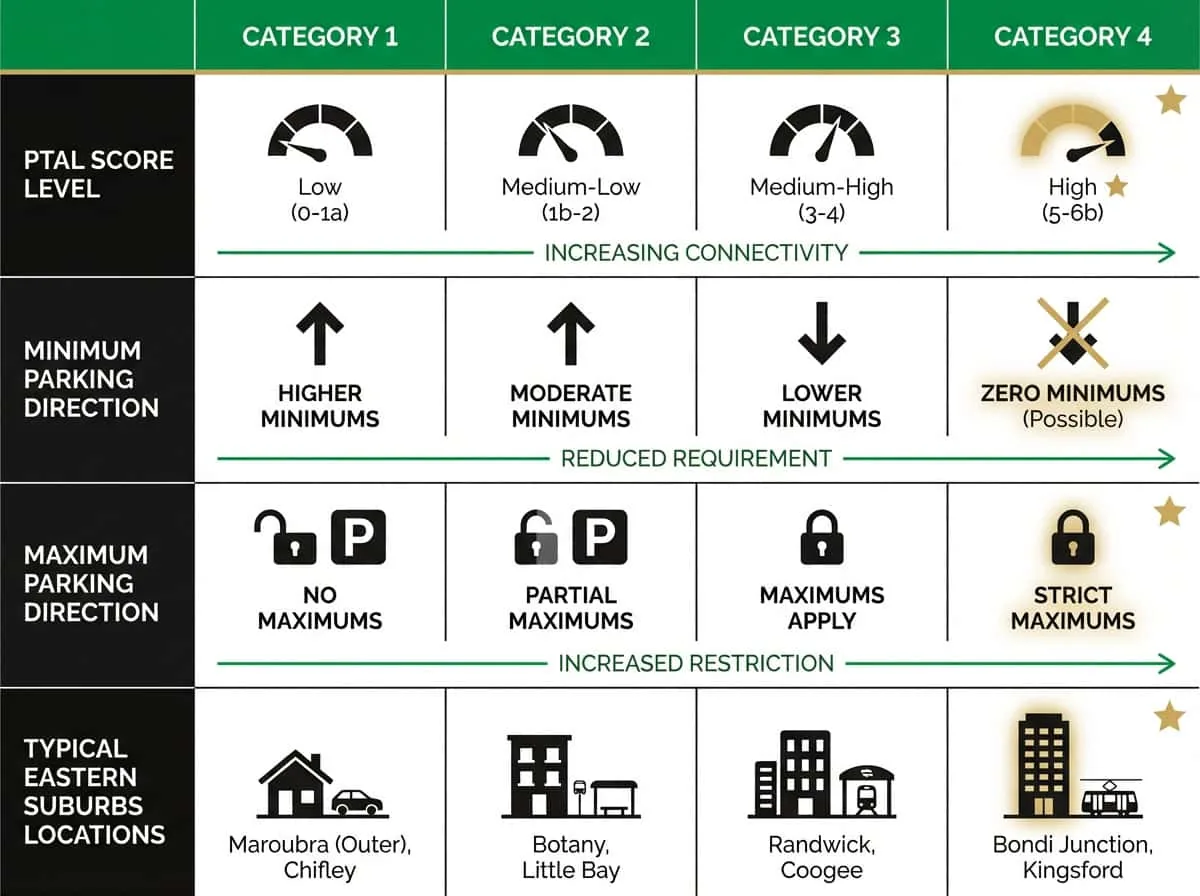
Amendment VC277 replaces this approach with a four-category system underpinned by the Public Transport Accessibility Level (PTAL) methodology. PTAL is a data-driven measure, adapted from a model originally developed in the United Kingdom, that calculates how well a specific location is connected to the public transport network. It factors in walking time to the nearest stops or stations, waiting times, the number of services, and whether major rail stations are nearby. The higher the PTAL score, the better the public transport access — and the lower the required car parking.
These PTAL scores have been translated into Car Parking Requirement (CPR) Maps, which are now incorporated into the Victoria Planning Provisions at Clause 72.04. The maps cover all metropolitan and regional municipalities across 82 individual map sheets and are accessible through VicPlan, the state government’s interactive planning map tool. Category 1 areas have the lowest PTAL scores and the highest parking requirements. Category 4 areas have the highest PTAL scores and the lowest — or in some cases, zero — parking requirements.
Critically, VC277 introduces not just revised minimum parking rates but also new maximum parking rates in higher-category areas. This is a significant departure from the previous system. In Category 3 and Category 4 areas, developers may now be restricted from providing parking above a set ceiling — even if the market or financiers would prefer more spaces. For non-residential uses in particular, these maximums are substantially lower than the old minimums.
Who Is Affected: Land Uses and Developer Types
The reform affects virtually all new use and development requiring a planning permit, but the practical impact varies considerably depending on land use type and location category.
Residential Apartments and Townhouses
Residential developers in well-serviced locations — such as those within walking distance of Box Hill, Ringwood, Glen Waverley, or Mitcham stations — may find their sites now fall into Category 3 or Category 4. In these areas, the maximum parking rate for dwellings is generally 2 spaces per dwelling, which is broadly consistent with previous minimums for larger dwellings. However, the minimum rate may be reduced, potentially allowing developers to provide fewer spaces and reduce construction costs. Given that a single basement car space can typically add significant cost to construction — often tens of thousands of dollars or more depending on site conditions and market rates — even a modest reduction in required spaces could improve project viability. Developers working under the Townhouse and Low-Rise Code should also review how parking provisions interact with that code’s design requirements.
Office and Retail Developments
Non-residential uses face the most dramatic change under VC277. In high-PTAL areas, maximum parking rates for office uses may shift substantially — developers should verify applicable rates against the current Clause 52.06 table for their specific land use and CPR category, as indicative figures vary by use class. This is a fundamental constraint on car-dominant commercial development near activity centres and transport corridors. Developers planning office or retail projects in Melbourne activity centres — including Box Hill Central, Ringwood, and Glen Waverley — may need to revisit design assumptions and tenant expectations accordingly.
Industrial and Unspecified Uses
For land uses not listed in Table 1 of Clause 52.06, a first-principles Car Parking Demand Assessment is now mandatory. This increases the need for professional traffic engineering input from the earliest stages of project planning, particularly for mixed-use or specialised industrial developments.
Landowners in High-PTAL Areas
Landowners whose properties fall into Category 3 or Category 4 may find that reduced parking obligations open up new development possibilities — more net floor area, simplified basement design, or improved project economics. Conversely, sites subject to an existing Parking Overlay (PO) will continue to be assessed against the overlay rates, regardless of their PTAL category, until councils harmonise their overlays with the new Clause 52.06 rates.
The Transition Period: What Applies Now
VC277 did not introduce all changes simultaneously. Understanding the transition arrangements is important for any project currently in design or pre-lodgement.
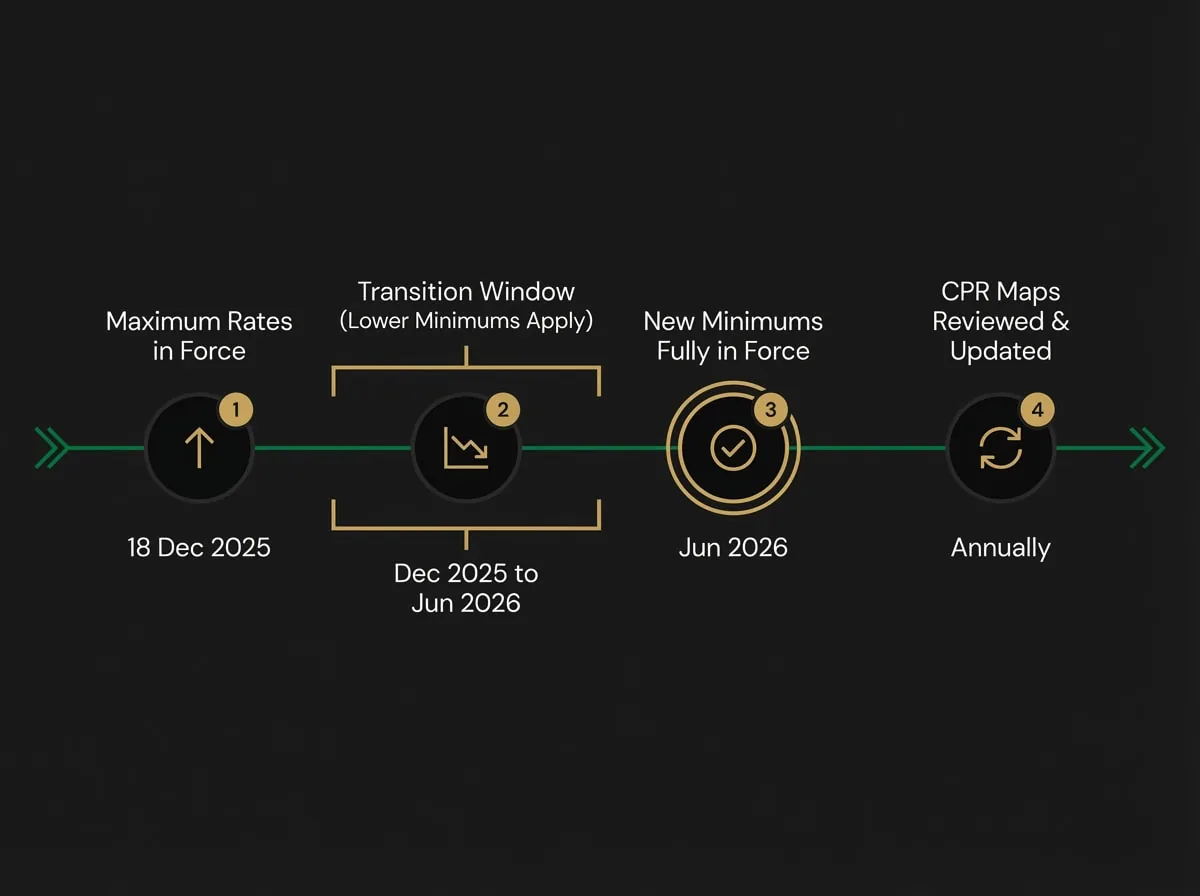
- Maximum parking rates came into effect immediately on 18 December 2025. Any planning permit application lodged from that date onwards must comply with the new maximums in applicable CPR categories.
- Minimum parking rates are subject to a six-month transition period running to approximately June 2026. During this period, the lower of the two applicable rates — either the old Clause 52.06 minimum or the new PTAL-based minimum — applies to a given site.
- Where a site falls across two or more CPR categories, the requirements for the higher category apply to the entire site. This is a conservative approach that developers should factor into early feasibility work.
- Sites with an existing Parking Overlay remain subject to those overlay rates until the Department of Transport and Planning completes its harmonisation work with councils. The timeline for this process has not yet been confirmed.
The amendment was approved without public exhibition to enable timely implementation, reflecting the government’s view that aligning parking with demand is an urgent housing affordability and sustainability priority.
Get the 7-point site check to run before committing to a permit application — zoning, overlays, setbacks and council red flags, in plain English. Free PDF, instant download.
- Zone, overlay & setback checks
- What council assesses first
- Permit-readiness red flags
Something went wrong. Please try again.
No spam. Unsubscribe anytime.
Check your inbox — your checklist is on its way.
Melbourne Implications: What This Means for Your Council Area
Melbourne contain a diverse mix of PTAL categories. Major activity centres and train station precincts — including Box Hill (City of Whitehorse), Ringwood (Maroondah City Council), Glen Waverley (City of Monash), and Croydon (Maroondah City Council) — are likely to fall into higher CPR categories, where both reduced minimums and new maximums will apply. Sites further from these nodes, in areas served primarily by bus routes with lower frequency, are more likely to remain in Category 1 or Category 2, where the changes are less dramatic.
Developers should check their specific site’s CPR category using the VicPlan mapping tool before making any assumptions about parking yield. The CPR Maps are updated annually, meaning a site’s category could change over time as public transport services improve — a dynamic that may affect long-term land value and development potential.
It is also worth noting that several Melbourne councils have existing Parking Overlays in place, particularly around established activity centres. Until those overlays are reviewed and updated, they will continue to govern parking requirements for affected sites, potentially at rates higher than the new PTAL-based minimums would otherwise require.
What Developers Should Do Now
Given the complexity of the transition arrangements and the potential impact on project feasibility, there are several practical steps developers may wish to consider in the near term. Understanding how the forthcoming deemed approval provisions interact with your lodgement timing may also be relevant if you are targeting the transition window; they do not operate before the Better Decisions Made Faster Act 2026 commences, which is not before 29 October 2027.
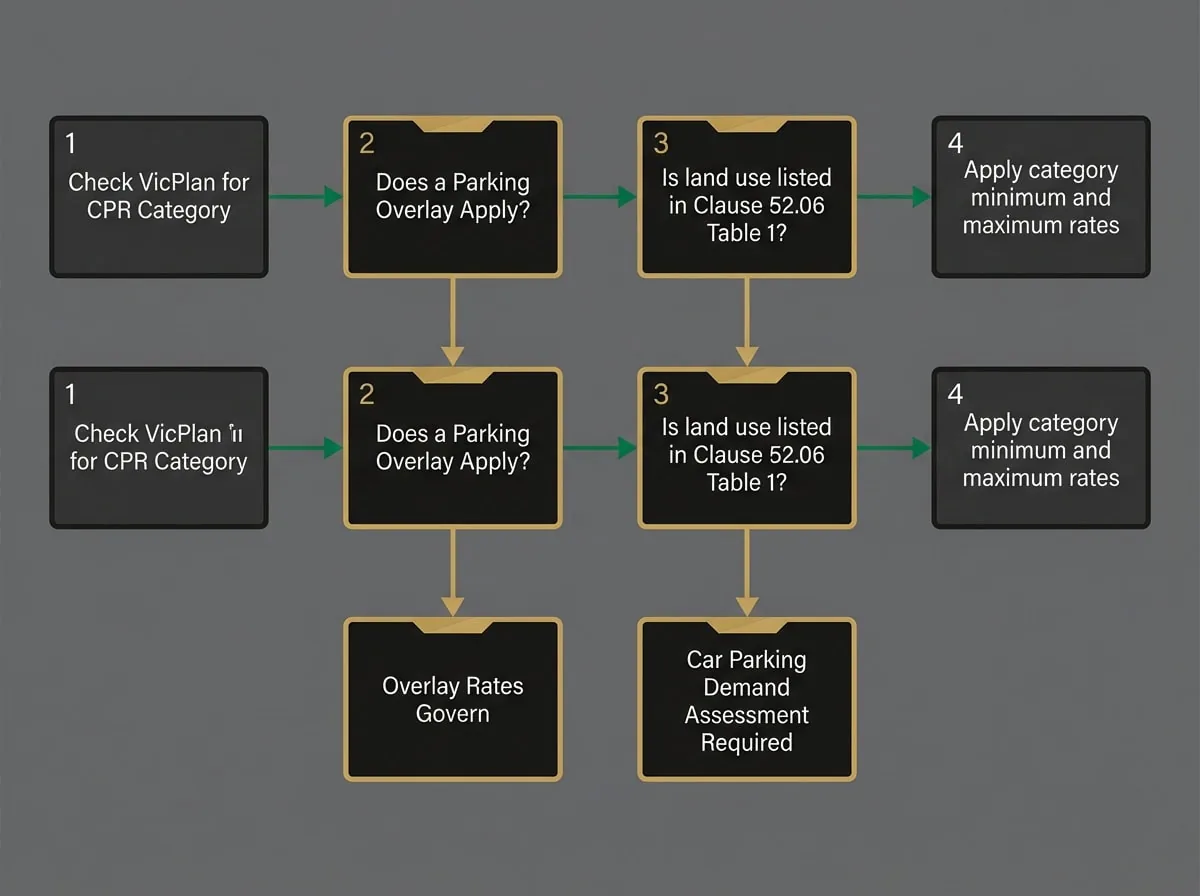
- Check your site’s CPR category using VicPlan before commencing or revising any feasibility assessment. This is a straightforward first step that could significantly affect your parking yield assumptions.
- Review any existing Parking Overlay affecting your site. If a PO applies, the new Clause 52.06 rates may not yet govern your project, and you may need to engage with your council about the harmonisation timeline.
- Engage a traffic engineer early, particularly for non-residential or mixed-use projects. The new framework is more complex than its predecessor, and a Car Parking Demand Assessment may be required for uses not listed in Table 1.
- Revisit basement and podium design for projects in Category 3 or Category 4 areas. Reduced minimum rates may allow for shallower or smaller basement structures, with potential cost savings. However, maximum rates must not be exceeded without strong justification.
- Factor in the transition period when planning your lodgement timeline. If your project is close to ready, lodging before June 2026 means you can take advantage of the lower of the two minimum rates during the transition window.
- Monitor annual CPR Map updates. The Department of Transport and Planning has committed to reviewing the maps yearly. A site currently in Category 1 could move to a higher category as public transport services improve, altering future development parameters.
Frequently Asked Questions
Does VC277 apply to planning permit applications already lodged before 18 December 2025?
Applications lodged before 18 December 2025 are generally assessed under the planning scheme provisions in force at the time of lodgement. However, if your application is still being assessed, it is worth confirming with the Responsible Authority how they are treating the transition. Applications lodged after 18 December 2025 are subject to the new maximum rates immediately.
How do I find out which CPR category applies to my site?
The CPR Maps are incorporated into VicPlan, the state government’s interactive planning map tool available at vicplan.vic.gov.au. Select the Car Parking Requirement Maps layer and enter your property address. If your site spans two or more categories, the higher category’s requirements apply to the entire site.
Can I still provide more parking than the maximum rate if my financier or market research suggests it is needed?
In Category 3 and Category 4 areas, exceeding the maximum parking rate is not permitted without exceptional justification through the planning permit process. This is a significant constraint for developers whose lenders or purchasers expect higher parking ratios. Early engagement with your architect and traffic engineer to understand the ceiling that applies to your site is strongly advisable.
My site has a Parking Overlay. Does VC277 change anything for me?
If your site is subject to an existing Parking Overlay, the overlay rates continue to apply regardless of the new Clause 52.06 PTAL-based rates. The Department of Transport and Planning has indicated it will work with councils to harmonise overlays with the new framework, but the timeline for this process is not yet confirmed. You may wish to monitor your council’s planning scheme amendments over the coming months.
What happens to my project if the CPR Maps are updated annually and my site’s category changes?
Annual map updates will affect future applications, not projects that have already received a planning permit. However, if you are in the early stages of a multi-stage development or holding land for future development, monitoring category changes could be relevant to your long-term planning. A higher PTAL category in the future may reduce parking obligations and potentially improve development economics.
Are townhouses affected differently from apartments under the new framework?
Both townhouses and apartments are assessed as dwellings under Clause 52.06. The applicable minimum and maximum rates depend on the CPR category of the site, not the dwelling type. However, townhouse projects subject to the Small Lot Housing Code may be subject to separate parking provisions — your architect or town planner can clarify which controls govern your specific project type.
Does VC277 affect bicycle parking requirements as well?
Amendment VC277 focuses on car parking. The Department of Transport and Planning has indicated that equivalent reforms to bicycle parking requirements are underway but have not yet been implemented. Developers should monitor future planning scheme amendments for updates to bicycle parking and end-of-trip facility requirements.
Conclusion
Amendment VC277 represents a genuine structural shift in how Victoria approaches car parking — moving from a one-size-fits-all minimum to a location-responsive framework with both floors and ceilings. For developers in Melbourne, the practical implications range from potential cost savings on residential projects near major transport nodes to significant design constraints on non-residential uses in high-PTAL activity centres. The six-month transition period for minimum rates provides a window to assess how the new framework affects your current and pipeline projects, but the maximum rates are already in force and must be factored into any application lodged from 18 December 2025 onwards.
SQM Architects has been working across Melbourne for over 12 years, helping developers navigate planning scheme changes and deliver viable projects across a broad portfolio of residential and mixed-use developments. If you are assessing how VC277 may affect a current or upcoming development, we encourage you to seek site-specific guidance early. Contact SQM Architects for a Book a Strategy Call or call us on (03) 9005 6588.
This article provides general information about Victorian planning for property developers. It does not constitute professional advice. For specific guidance on your project, contact SQM Architects for a complimentary site assessment.