
Why Victorian Planning Provisions Matter More Than Ever for Melbourne Developers
If you’re developing residential property in Melbourne, understanding Victorian planning provisions isn’t optional — it’s the difference between a project that settles on time and one that stalls in VCAT for 18 months. The Victorian planning system operates through a layered framework of state-wide policies, local planning schemes, and ResCode standards that collectively determine what you can build, where you can build it, and how long it will take to get a planning permit. For developers working across City of Whitehorse, City of Boroondara, City of Manningham, and neighbouring municipalities, navigating these provisions efficiently may contribute meaningfully to your development outcome.
This guide outlines the key planning provisions shaping residential development across Melbourne. Whether you’re assessing a site for a dual occupancy, planning a medium-density townhouse project, or exploring subdivision potential, the information here will help you understand the regulatory landscape before you commit capital.
This article covers the core structure of the Victorian planning system, the residential zones most relevant to Melbourne developers, ResCode requirements, council-specific variations, and the practical steps that may help you move from site assessment to planning permit with greater confidence.
See How We Achieved Approval for This Complex Site
The Structure of the Victorian Planning System
Victoria’s planning system is governed by the Planning and Environment Act 1987, which establishes the framework under which each council administers its local planning scheme. Unlike some other states, Victoria does not use Development Applications (DAs) — the correct term is a planning permit, and the body that assesses it is the Responsible Authority, typically the relevant council. Understanding this distinction matters when you’re communicating with consultants, solicitors, and financiers who may be familiar with other state systems.
Each council’s planning scheme incorporates state-wide provisions through the Victoria Planning Provisions (VPP), which include zones, overlays, and particular provisions. The State Planning Policy Framework (SPPF) and Local Planning Policy Framework (LPPF) — now largely consolidated into a single policy structure under recent reforms — set the strategic direction that decision-makers must consider when assessing permit applications. For residential development, the most directly applicable provisions are the residential zones, ResCode (Clause 54 and Clause 55), and any applicable overlays such as the Neighbourhood Character Overlay (NCO) or Significant Landscape Overlay (SLO).
The Responsible Authority has statutory timeframes for assessing applications: 60 days for straightforward applications and 90 days for applications requiring referral to other authorities. If a decision is not made within these timeframes, a developer may apply to VCAT on the grounds of deemed refusal — a mechanism that can be strategically useful when council assessment is delayed without good reason.
Residential Zones: What Each Zone Means for Your Development Potential
The residential zone applying to your site is the single most important planning provision affecting development yield. Victoria’s residential zones were reformed in 2013 and further refined since, and each carries distinct expectations about density, building height, and neighbourhood character. Across Melbourne, you’ll encounter four primary residential zones.
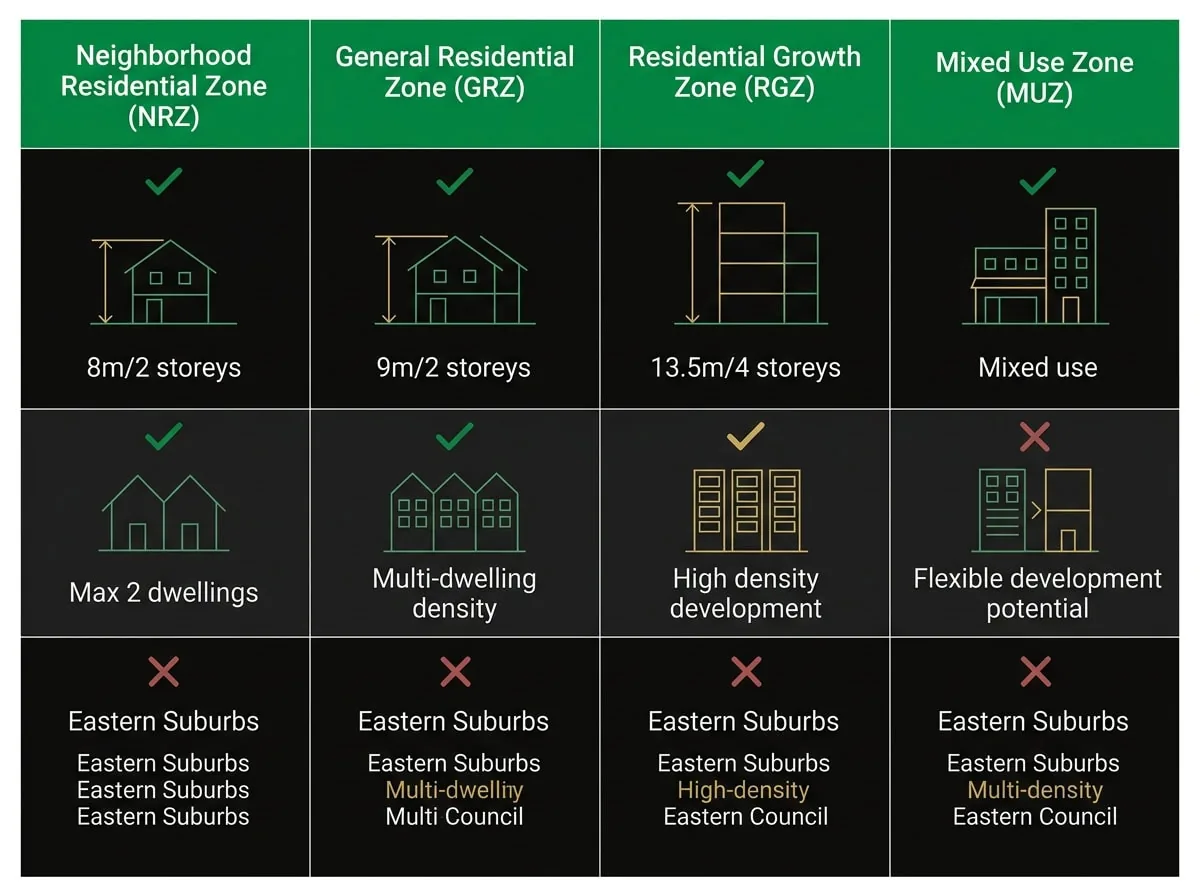
Neighbourhood Residential Zone (NRZ)
The Neighbourhood Residential Zone (NRZ) is the most restrictive residential zone and applies to large portions of established suburbs in City of Boroondara, City of Whitehorse, and City of Manningham. The NRZ typically limits development to a maximum of two dwellings per lot (unless a schedule specifies otherwise) and imposes, under Clause 32.09-11, a mandatory maximum building height of 9 metres and 2 storeys where no maximum is specified in a schedule to the zone. For developers, NRZ sites are generally suited to dual occupancy or high-quality renovation projects rather than multi-unit townhouse developments.
It’s worth noting that NRZ schedules vary between councils. City of Boroondara’s NRZ schedules, for example, include specific minimum lot size requirements and garden area controls that may further constrain yield. Always review the specific schedule applying to your site — not just the zone itself.
General Residential Zone (GRZ)
The General Residential Zone (GRZ) is the workhorse zone for medium-density residential development across Melbourne. It applies to a broad band of established suburbs and permits multi-dwelling developments subject to ResCode compliance and neighbourhood character considerations. Under Clause 32.08-11 the mandatory maximum is 11 metres and 3 storeys where no maximum is specified in a schedule to the zone, so three storeys is the zone default rather than a concession granted in particular locations. City of Monash and City of Knox both contain substantial GRZ-zoned land that may be suitable for three to six-unit townhouse projects.
Residential Growth Zone (RGZ)
The Residential Growth Zone (RGZ) signals council’s intention to accommodate higher-density development and is typically applied near activity centres, train stations, and tram corridors. The default maximum height is 13.5 metres or four storeys, and the zone is designed to facilitate apartment and larger townhouse developments. In Melbourne, RGZ land is concentrated around activity centres such as Box Hill, Mitcham, and Ringwood. If your site falls within an RGZ, the development potential may be considerably higher than neighbouring GRZ land — but competition for these sites is correspondingly intense.
Mixed Use Zone (MUZ)
The Mixed Use Zone (MUZ) permits both residential and commercial uses and is found in activity centre locations across Melbourne. Residential development in the MUZ is not subject to ResCode in the same way as purely residential zones, which can provide greater design flexibility — but also introduces additional complexity around interface with commercial uses, car parking, and amenity standards.
Get the 7-point site check to run before committing to a permit application — zoning, overlays, setbacks and council red flags, in plain English. Free PDF, instant download.
- Zone, overlay & setback checks
- What council assesses first
- Permit-readiness red flags
Something went wrong. Please try again.
No spam. Unsubscribe anytime.
Check your inbox — your checklist is on its way.
ResCode: The Practical Standards Every Developer Needs to Understand
ResCode is the colloquial name for the residential development standards contained in Clause 54 (one dwelling on a lot) and Clause 55 (two or more dwellings on a lot) of the Victoria Planning Provisions. These clauses set out the standards against which your planning permit application will be assessed, covering everything from site coverage and setbacks to private open space and overlooking. Understanding ResCode is not just a compliance exercise — it’s a design tool that, when used strategically, can help you maximise yield while minimising objections.
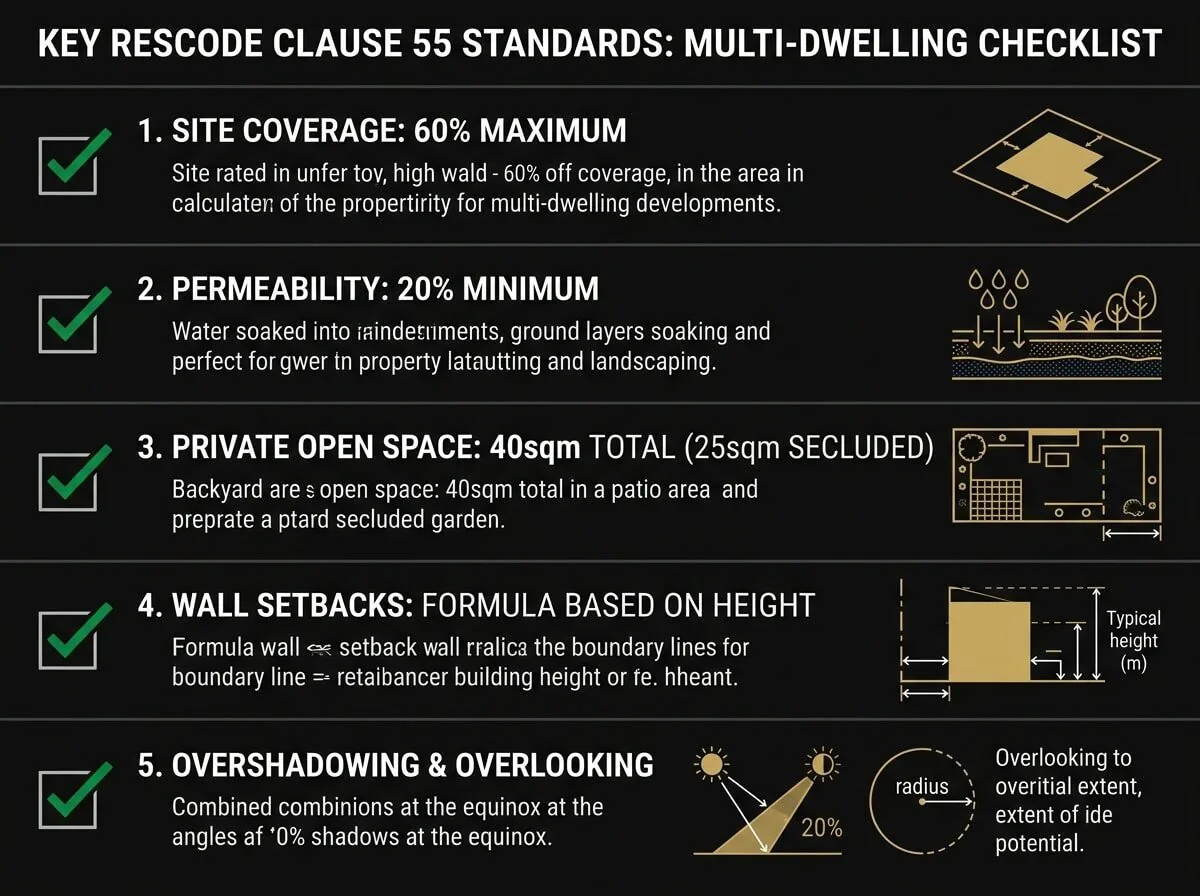
Key ResCode Standards for Multi-Dwelling Developments (Clause 55)
- Site coverage: Set by zone under Table B2-5 — 60% in the Neighbourhood Residential and Township zones, 65% in the General Residential Zone, 70% in the Residential Growth, Mixed Use and Housing Choice and Transport zones. A schedule to the zone may specify a greater percentage but never a lesser one. In practice, well-designed townhouse projects typically sit below the applicable cap.
- Permeability: A minimum of 20% of the site must be permeable (unsealed) to manage stormwater. This standard interacts with car parking and landscaping requirements. For more detail, see our guide to site permeability in Victoria.
- Private open space: Standard B3-5 requires 25 square metres of secluded private open space with a minimum dimension of 3 metres width, accessed directly from a living area, dining area or kitchen. There is no separate larger total-area figure. The standard is alternatively met by a balcony meeting Table B3-5, a podium area of at least 15 square metres with a 3-metre minimum dimension, or a roof area of at least 10 square metres with a 2-metre minimum dimension.
- Side and rear setbacks: Standard B2-3 offers two routes and is met by either. B2-3.1 calculates from wall height — at least 1 metre, plus 0.3 metres for every metre over 3.6 metres up to 6.9 metres, plus 1 metre for every metre over 6.9 metres. B2-3.2 is a flat alternative — 3 metres up to 11 metres in height where the boundary is not to the south, or 6 metres where it is. Run both: on a 9-metre wall the calculation gives 4.09 metres where the flat route gives 3 metres.
- Overlooking: Under Standard B4-4, windows, balconies, terraces, decks and patios must avoid direct views into the secluded private open space or habitable room windows of an existing dwelling within a horizontal distance of 9 metres measured at ground level, assessed within a 45 degree angle from the plane of the window and from a height of 1.7 metres above floor level. This standard drives many of the screening and window placement decisions in townhouse design. See our overview of overlooking regulations in Victoria.
- Overshadowing: Standard B4-3 is expressed as the area left unshadowed, not the area shadowed. The secluded private open space of an adjoining dwelling that is not overshadowed must be greater than 50%, or 25 square metres with a minimum dimension of 3 metres, whichever is the lesser area, for a minimum of five hours between 9am and 3pm on 22 September. This standard is particularly relevant for north-facing sites and taller developments. For further guidance, see overshadowing regulations in Victoria.
- Car parking: Dwellings with fewer than three bedrooms require one car space; three or more bedrooms require two car spaces. Visitor parking requirements apply to developments of five or more dwellings.
ResCode standards are either "mandatory" (must be met) or "discretionary" (can be varied with justification). Most Clause 55 standards are discretionary, which means a well-prepared planning permit application can seek variations where design quality and amenity outcomes support a departure from the standard. This is where experienced architectural input can directly affect your development outcome — a design that thoughtfully addresses the objectives behind each standard, even where it varies the standard itself, is far more likely to achieve planning permit approval than one that simply ticks boxes.
Overlays: The Hidden Constraints That Can Make or Break a Site
Overlays apply additional planning controls on top of the underlying zone and are among the most common sources of unexpected complexity for developers. Before committing to a site, a thorough overlay check is essential. The following overlays are particularly relevant across Melbourne.
Neighbourhood Character Overlay (NCO)
The NCO applies in areas where council has identified a distinctive neighbourhood character that warrants additional protection. City of Boroondara applies NCO controls across significant portions of suburbs including Camberwell, Hawthorn, and Kew, with detailed schedules specifying preferred architectural responses, materials, and landscaping. Developments in NCO areas may need to demonstrate consistency with a neighbourhood character statement, which can influence building form, setbacks, and materials selection.
Significant Landscape Overlay (SLO) and Vegetation Protection Overlay (VPO)
Both the SLO and VPO can restrict the removal of trees and vegetation on a site, which may affect site coverage, setbacks, and construction methodology. City of Manningham and Maroondah City Council both apply these overlays across substantial areas of their municipalities. A site with significant trees protected by an SLO or VPO may require an arborist report and tree protection plan as part of the planning permit application, and in some cases, tree removal permits may be refused entirely.
Design and Development Overlay (DDO)
The DDO applies specific design requirements or height controls to particular areas, often near activity centres or along key corridors. City of Whitehorse applies DDO controls in parts of Box Hill that specify maximum building heights, setback requirements, and design objectives for development near the Box Hill Metropolitan Activity Centre. If your site is within a DDO area, the schedule will specify what additional requirements apply.
Heritage Overlay (HO)
The Heritage Overlay is one of the most significant constraints a developer can encounter. Sites within an HO — or adjacent to a heritage-listed property — may face restrictions on demolition, alterations, and new development. City of Boroondara has one of the most extensive heritage overlays in metropolitan Melbourne, covering individual properties and entire precincts. A planning permit is required for most works on heritage-affected sites, and the assessment process typically involves referral to a heritage advisor.
Council-Specific Variations: What Melbourne Developers Need to Know
While ResCode provides a state-wide baseline, each council’s planning scheme contains local variations that can significantly affect development potential. SQM Architects works with property developers across Melbourne councils and has observed consistent patterns in how each Responsible Authority approaches residential development applications.
City of Boroondara is known for rigorous neighbourhood character assessments and a strong heritage overlay network. Applications in Boroondara may benefit from pre-application meetings with council officers, and designs that respond sensitively to existing streetscape character tend to achieve better outcomes. Minimum lot sizes in NRZ schedules are strictly applied.
City of Whitehorse has a diverse planning landscape, with significant GRZ and RGZ land around Box Hill and Nunawading contrasting with NRZ-dominated areas in suburbs like Mitcham and Blackburn. Whitehorse has been active in applying DDO controls near activity centres, and developers should carefully review DDO schedules for sites within 400 metres of Box Hill or Nunawading activity centres.
City of Manningham applies extensive SLO and VPO controls, reflecting the municipality’s treed character. Tree retention and canopy cover are recurring themes in City of Manningham planning assessments, and applications that demonstrate a genuine commitment to landscape outcomes tend to be received more favourably. Minimum garden area requirements in NRZ schedules are also strictly applied.
City of Monash and City of Knox offer some of the more accessible development conditions in Melbourne, with substantial GRZ land and relatively straightforward ResCode assessments in many locations. Both councils have been supportive of medium-density development near activity centres, and pre-application engagement is generally productive.
Maroondah City Council has been actively reviewing its planning scheme in recent years, with increased focus on neighbourhood character in established suburbs and support for higher-density development near Ringwood Metropolitan Activity Centre. The Ringwood Structure Plan provides useful guidance for developers considering sites in the Ringwood precinct.
Practical Tips for Streamlining Your Planning Permit Application
The following practical steps may help developers achieve more efficient planning permit outcomes.
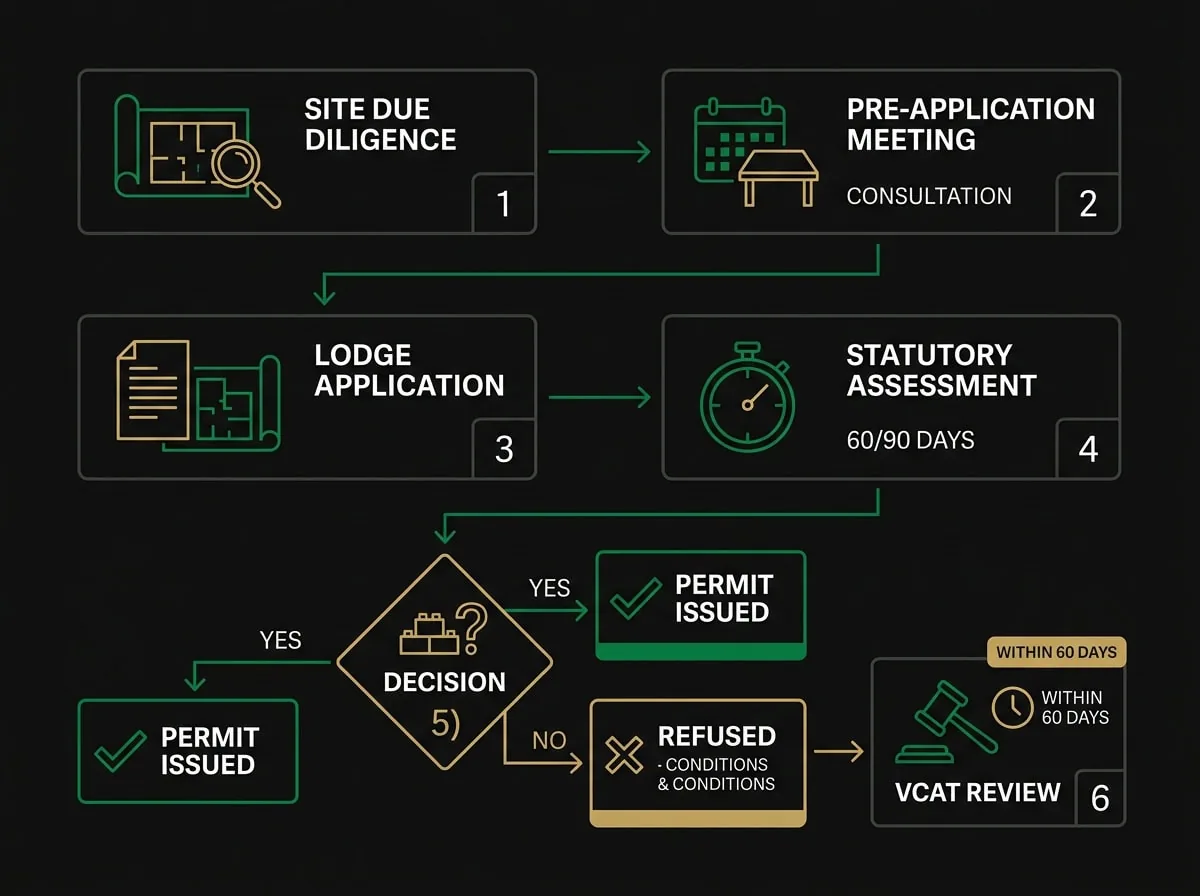
- Conduct a thorough due diligence review before purchase. A site assessment covering zoning, overlays, title restrictions, and infrastructure constraints can identify issues that affect development potential before you commit capital. This may include a review of the planning scheme, a title search, and a preliminary arborist assessment where trees are present.
- Request a pre-application meeting with the Responsible Authority. Most Melbourne councils offer pre-application meetings, and these can provide valuable early guidance on council’s expectations. Pre-application feedback is not binding, but it can help you refine your design before lodgement and reduce the likelihood of requests for further information (RFIs) during assessment.
- Prepare a thorough planning permit application. Applications that include a well-prepared design response, a ResCode assessment, and supporting reports (shadow diagrams, landscape plans, arborist reports where required) tend to progress more efficiently than bare-minimum submissions. A complete application reduces the likelihood of RFIs, which can add several weeks to the assessment timeline. For guidance on what drawings are required, see architectural planning drawings for planning permits in Victoria.
- Engage with neighbours early where objections are likely. Neighbour objections are one of the most common causes of planning permit delays. In some cases, early engagement with adjoining owners — particularly where overlooking, overshadowing, or traffic impacts are potential concerns — can reduce the volume and intensity of objections received during the statutory notification period.
- Understand your VCAT rights. If your application is refused or subject to unreasonable conditions, or if a decision is not made within the statutory timeframe (deemed refusal), you may have grounds to apply to VCAT for a review. VCAT proceedings can be time-consuming and costly, but they are sometimes the most efficient path to a permit where council’s position is unreasonable.
Frequently Asked Questions
What is the difference between a planning permit and a building permit in Victoria?
A planning permit is issued by the Responsible Authority (typically the council) and relates to the use and development of land under the planning scheme. A building permit is issued by a registered building surveyor and relates to compliance with the National Construction Code and the Building Regulations. Most residential developments require both — the planning permit is generally obtained first, as it establishes the approved design that the building permit will then certify for construction.
How long does it typically take to obtain a planning permit for a townhouse development in Melbourne?
Timeframes vary depending on the council, the complexity of the application, and whether objections are received. For a straightforward three to four-unit townhouse development in a GRZ area without overlays, an assessment period of three to five months from lodgement to decision is a reasonable indicative range. Applications in heritage overlay areas, or those that attract significant objections, may take considerably longer. For a council-by-council breakdown, see our planning permit timeline guide.
Can ResCode standards be varied in a planning permit application?
Most Clause 55 (ResCode) standards are discretionary, meaning they can be varied where the application demonstrates that the objectives of the standard are met through an alternative design response. Mandatory standards cannot be varied. A well-prepared planning permit application will identify any proposed variations to ResCode standards and provide a clear justification for why the design still meets the underlying objectives.
What is a Neighbourhood Character Overlay and how does it affect my development?
A Neighbourhood Character Overlay (NCO) applies additional design requirements to areas where council has identified a distinctive character worth protecting. If your site is within an NCO, your planning permit application will need to demonstrate how the proposed development responds to the neighbourhood character statement in the relevant schedule. This may influence building form, materials, setbacks, and landscaping — but does not necessarily prevent multi-dwelling development.
Do I need a planning permit to subdivide land in Victoria?
In most cases, yes — a planning permit is required to subdivide land in Victoria. The subdivision process also involves a separate application to the relevant authority under the Subdivision Act 1988, and a Statement of Compliance must be issued before titles can be created. The planning permit for subdivision is typically sought concurrently with, or following, the planning permit for the development itself.
What happens if my planning permit application is refused?
If your planning permit application is refused by the Responsible Authority, you may apply to VCAT for a review of the decision. The application to VCAT must be lodged within 60 days of the refusal notice. VCAT will conduct a merits-based review of the application, considering the planning scheme provisions and any submissions from objectors. In some cases, VCAT may approve an application that council has refused, or approve it subject to amended conditions.
How does the Residential Growth Zone differ from the General Residential Zone for developers?
The Residential Growth Zone (RGZ) is designed to accommodate higher-density development and typically permits buildings up to 13.5 metres or four storeys by default, compared to the General Residential Zone’s (GRZ) default of 11 metres and 3 storeys. Note the difference in force: the GRZ and NRZ heights are mandatory (“must not exceed”), whereas the RGZ 13.5 metres is expressed as a “should” and can be varied on merit. RGZ sites near activity centres may support apartment developments or larger townhouse projects that would not be feasible in a GRZ. However, RGZ sites are typically priced to reflect their higher development potential, so an indicative feasibility assessment would typically consider land cost as well as yield.
Conclusion: Turning Planning Knowledge Into Development Outcomes
The Victorian planning system offers genuine development opportunities for informed developers — but it rewards those who invest time in understanding the provisions that apply to their sites. Knowing the difference between an NRZ and a GRZ, understanding how ResCode standards can be applied strategically, and recognising the overlay constraints that affect a site before purchase are all steps that may meaningfully improve your development outcome. Across Melbourne, the councils that administer these provisions each have their own priorities and patterns of decision-making, and experience with those patterns is a genuine advantage in the planning process.
SQM Architects – ABN 32 600 928 390, ARBV Reg. No. 51498
SQM Architects works with property developers across City of Whitehorse, City of Boroondara, City of Manningham, City of Monash, City of Knox, and Maroondah City Council, with a consistent focus on planning permit outcomes across Melbourne. If you’re assessing a site or preparing a planning permit application in Melbourne, we’d welcome the opportunity to discuss your project.
Book a Strategy Call — contact SQM Architects on (03) 9005 6588 to arrange a complimentary review of your development site.
This article provides general information only. For project-specific guidance, consult with a qualified architect or planning professional.