
Victoria’s planning system is undergoing its most significant transformation in decades. For property developers active in Melbourne, the reforms introduced between 2025 and 2026 are not background noise — they directly affect how planning permits are assessed, how long approvals take, who can object to your application, and what leverage you hold as a developer when a Responsible Authority fails to act. Understanding the current planning permit timeline framework, and how it is evolving, may be the difference between a project that settles on time and one that haemorrhages holding costs in a protracted VCAT dispute.
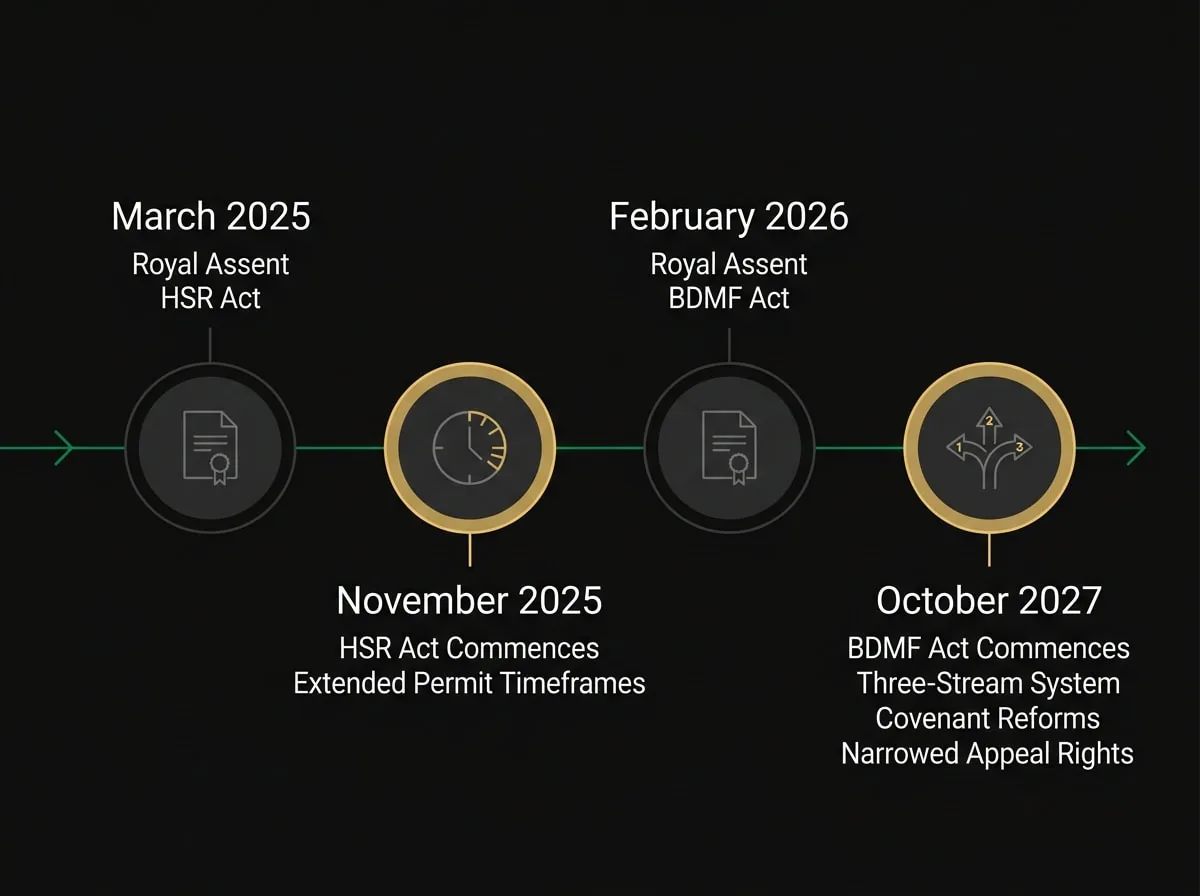
Two landmark pieces of legislation now govern Victoria’s planning framework: the Consumer and Planning Legislation Amendment (Housing Statement Reform) Act 2025 and the Planning Amendment (Better Decisions Made Faster) Act 2026. Together, they represent the most comprehensive overhaul of the Planning and Environment Act 1987 since its inception. Some changes are already in effect. Others commence in October 2027. Developers who understand both timelines — and position their projects accordingly — may be better positioned for development outcomes than those who do not.
This guide covers the key changes to the planning permit process, your rights as a developer under Victorian law, how the new three-stream assessment system will operate, what the reforms mean for objections and VCAT proceedings, and how council-level variations across Melbourne may affect your next acquisition. Practical next steps are included throughout.
The Legislative Foundation: Two Acts, Two Timelines
Before examining the specific changes, it is worth understanding the legislative architecture. Victoria’s planning permit process is governed by the Planning and Environment Act 1987 (PE Act), which sets out the statutory framework within which all planning schemes, Responsible Authorities, and applicants must operate. The two recent reform Acts amend this legislation in stages, and the commencement dates matter significantly for project planning.
Housing Statement Reform Act 2025
The Consumer and Planning Legislation Amendment (Housing Statement Reform) Act 2025 received Royal Assent on 18 March 2025, with most provisions commencing by 25 November 2025. This Act introduced the first tranche of substantive changes to the PE Act, targeting planning permit procedures, planning scheme amendment processes, Ministerial call-in powers, and VCAT proceedings.
For developers, the most immediately actionable change is the extension of default planning permit expiry timeframes. Where a permit does not specify its own timeframe, the new defaults are:
- 3 years to commence a use or development (previously 2 years)
- 5 years to complete a development (previously 4 years)
- 3 years from commencement of a use
Critically, these extended timeframes apply to permits issued both before and after the Act commenced, provided the permit had not already expired at commencement. For developers managing staged or complex projects across Melbourne — where construction timelines can shift due to financing, contractor availability, or market conditions — this extension may provide meaningful breathing room without the cost and uncertainty of a permit extension application.
Better Decisions Made Faster Act 2026
The Planning Amendment (Better Decisions Made Faster) Act 2026 received Royal Assent on 17 February 2026 and has been described as the biggest shake-up of Victoria’s planning system in decades. Its default commencement date is 29 October 2027, allowing time for supporting regulatory changes — including updates to the Planning and Environment Regulations 2015, new Ministerial guidelines, and revisions to the Victoria Planning Provisions (VPP).
The Act establishes three planning permit assessment streams, introduces affordable housing contribution mechanisms, strengthens enforcement powers, and provides greater flexibility around restrictive covenants in planning permit decisions. Developers planning projects with lodgement dates before October 2027 will continue to operate under the current assessment framework — but understanding the incoming system now may inform acquisition strategy, project design, and preliminary feasibility considerations. For a broader overview of how these changes fit within Victoria’s regulatory landscape, see our Victoria Planning Regulation overview.
The Three-Stream Planning Permit Assessment System
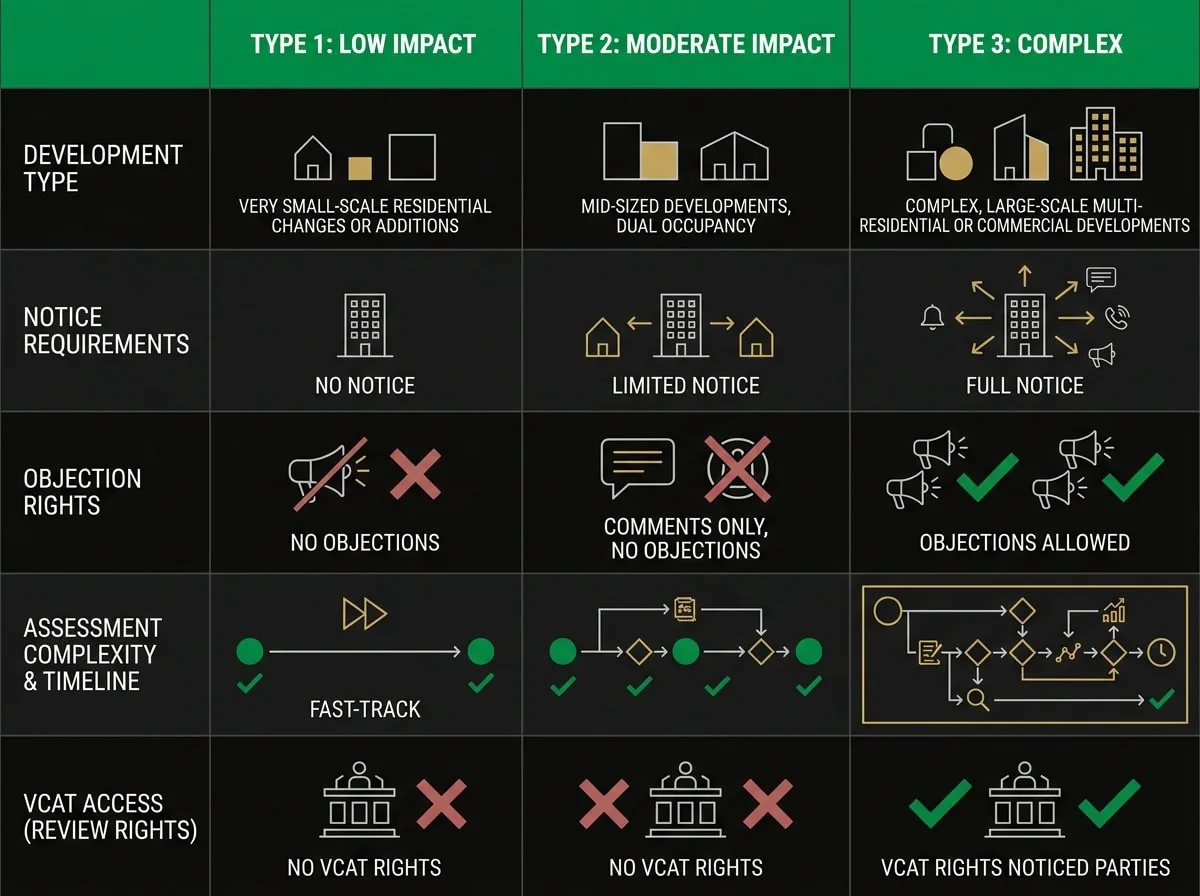
The centrepiece of the Better Decisions Made Faster Act 2026 is a tiered assessment system that replaces the current one-size-fits-all approach to planning permit applications. Each stream is calibrated to the complexity, risk, and likely community impact of the proposed development. The precise scope of each category will be set by regulations yet to be finalised, but the framework is clear. For context on how the fast-track pathways interact with this new system, see our Fast-Track Planning Bill developer’s guide.
Type 1 — Low Impact, Fast-Track
Type 1 applies to low-impact, small-scale developments — expected to include single dwellings and minor subdivisions. Applications in this stream are not subject to public notice requirements or third-party objections. The Act introduces new timeframe mechanisms for Type 1 applications, with prescribed determination periods to be confirmed in supporting regulations. If the Responsible Authority does not determine a Type 1 application within the prescribed timeframe, the applicant may treat the non-determination as a deemed refusal and apply to VCAT for review — consistent with the established Victorian planning law framework. For developers, this timeframe mechanism is a meaningful shift: it removes the ability of a Responsible Authority to delay a straightforward application indefinitely.
Type 2 — Moderate Impact, Limited Notice
Type 2 applies to moderate-impact developments that are compliant with planning policies. While objections cannot be made against Type 2 applications, some specified Type 2 applications may be subject to notice requirements. People who receive notice may comment on the proposed development, but a comment does not constitute an objection and does not carry third-party appeal rights. Indicative approval timeframes for Type 2 applications will be confirmed in supporting regulations ahead of the October 2027 commencement.
Type 3 — Complex Developments, Full Process
Type 3 is the default category — applied unless a proposal meets the criteria for Type 1 or Type 2. It applies to larger, more complex, and higher-risk developments, including high-density residential, commercial, and industrial proposals close to sensitive receptors. Type 3 applications are subject to the full assessment process, including public notice and objections. However, the right to apply for review at VCAT will be limited to objectors who have received direct notice of the application — a significant narrowing of third-party appeal rights compared to the current framework. Indicative approval timeframes for Type 3 applications will be confirmed in supporting regulations. Developers should monitor planning.vic.gov.au for updates as regulations are finalised.
For developers targeting medium-density projects across Whitehorse, Boroondara, or Manningham, the practical implication is that projects designed to meet Type 1 or Type 2 criteria may achieve faster approvals with reduced objection risk. This may warrant a design-led approach to preliminary feasibility considerations — where the project is structured around the assessment stream it is likely to attract, rather than the maximum yield it could theoretically achieve.
Developer Rights: Objections, VCAT, and Deemed Refusal
Understanding your rights within the planning permit process is as important as understanding the process itself. Victorian law provides developers with several procedural protections that are often underutilised.
Deemed Refusal and VCAT Review Rights
Under the current framework, if a Responsible Authority fails to determine a planning permit application within the statutory timeframe — generally 60 days for most standard applications, though timeframes may vary depending on application type and referral requirements — the applicant may treat the application as a deemed refusal and apply to VCAT for a review. This right is preserved under the reformed framework and remains one of the most important tools available to developers facing a council that is slow to act or unwilling to make a decision. Proactively managing the statutory clock — and being prepared to exercise deemed refusal rights where warranted — may assist in reducing approval timelines on contested applications.
Narrowed Third-Party Appeal Rights
One of the most developer-favourable changes in the Better Decisions Made Faster Act 2026 is the narrowing of third-party appeal rights. Under the incoming framework, only objectors who have received direct notice of a Type 3 application will have the right to apply for VCAT review. Community members in the same suburb who have not received direct notice will generally not be entitled to participate in an appeal. This may reduce the volume and cost of contested VCAT proceedings for larger developments.
The Act also introduces a new power for Responsible Authorities to reject objections that are considered frivolous, vexatious, irrelevant, or made to secure a commercial advantage. This provision may assist developers in managing objection campaigns that are not genuinely concerned with planning merit.
VCAT Case Management Improvements
The Housing Statement Reform Act 2025 strengthened VCAT’s case management powers, including the ability to treat multiple objectors as a group where their submissions raise similar grounds. VCAT may also conduct all or part of a proceeding on the basis of documents, impose time limits on submissions and witness examination, and identify issues at an early stage to encourage settlement. These changes may reduce the cost and duration of contested hearings — a meaningful improvement for developers whose projects attract organised community opposition.
Get the 7-point site check to run before committing to a permit application — zoning, overlays, setbacks and council red flags, in plain English. Free PDF, instant download.
- Zone, overlay & setback checks
- What council assesses first
- Permit-readiness red flags
Something went wrong. Please try again.
No spam. Unsubscribe anytime.
Check your inbox — your checklist is on its way.
Restrictive Covenants: A Significant Shift for Melbourne Developers
The Better Decisions Made Faster Act 2026 introduces significant reforms to the treatment of restrictive covenants in the planning permit process. This may be particularly relevant for developers targeting established Melbourne sites — across Boroondara, Whitehorse, and Manningham — where single-dwelling covenants have historically constrained medium-density development.
Under the previous regime, a Responsible Authority could not grant a planning permit where doing so would result in a breach of a registered restrictive covenant. The reformed framework removes this absolute prohibition. Responsible Authorities will now have greater discretion to approve the removal or variation of restrictive covenants, and may issue permits even where the permission sought would result in a breach of a registered covenant. VCAT has equivalent powers under the new framework.
Critically, when considering whether to allow removal or variation of a covenant, the Responsible Authority must consider the interests of the owner of the dominant tenement, Victorian state and regional planning strategy, and the merits of the proposed development. However, financial loss to the beneficiary of the covenant is explicitly excluded from the matters to be considered. The Responsible Authority and VCAT will not be liable for any loss suffered by any person as a result of a permit that breaches a registered restrictive covenant.
This is a meaningful change for preliminary feasibility considerations on covenant-affected sites. That said, legal advice on the specific covenant and its enforceability may be warranted before relying on this flexibility in a feasibility model. For a broader look at how planning considerations affect development feasibility, see our Property Development Planning Considerations guide.
Council-Level Variations Across Melbourne
While the state-level reforms apply uniformly across Victoria, the practical experience of obtaining a planning permit varies considerably between councils in Melbourne. Understanding these variations may inform both site selection and application strategy. For a detailed breakdown of permit timelines by council, see our Planning Permit Timeline Melbourne guide.
City of Boroondara and City of Whitehorse
Both councils operate in areas with significant heritage overlay coverage and established neighbourhood character policies. The City of Boroondara in particular applies Heritage Overlays across a substantial proportion of its residential areas, which may trigger additional permit requirements and referral processes. Applications in these areas are more likely to attract objections and may be assessed as Type 3 under the incoming framework. Early pre-application engagement with the Responsible Authority may assist in identifying heritage and character constraints before lodgement.
Manningham City Council and City of Monash
Manningham City Council and the City of Monash both contain significant areas subject to Significant Landscape Overlays and Vegetation Protection Overlays, particularly in hillside and creek corridor locations. These overlays may require planning permits for works that would otherwise be exempt, and may affect setbacks, site coverage, and tree removal. Developers targeting sites in these areas may need to allow additional time for referral processes and arborist reporting.
Knox City Council and Maroondah City Council
Knox City Council and Maroondah City Council contain a mix of General Residential Zone and Neighbourhood Residential Zone land, with varying ResCode schedule requirements. Both councils have been active in applying the state government’s activity centre reforms, with new Built Form Overlays and Housing Choice and Transport Zones applying in and around key centres. Developers targeting sites within walkable catchments of activity centres in these municipalities may find that the new zone controls allow greater height and density than the underlying residential zone would otherwise permit.
Practical Tips for Developers: Positioning for the New Framework
With the Better Decisions Made Faster Act 2026 commencing in October 2027, developers have a window to position projects and acquisition strategies for the new framework. The following practical guidance may assist. For guidance on the architectural drawings required to support a planning permit application, see our Architectural Planning Drawings guide.
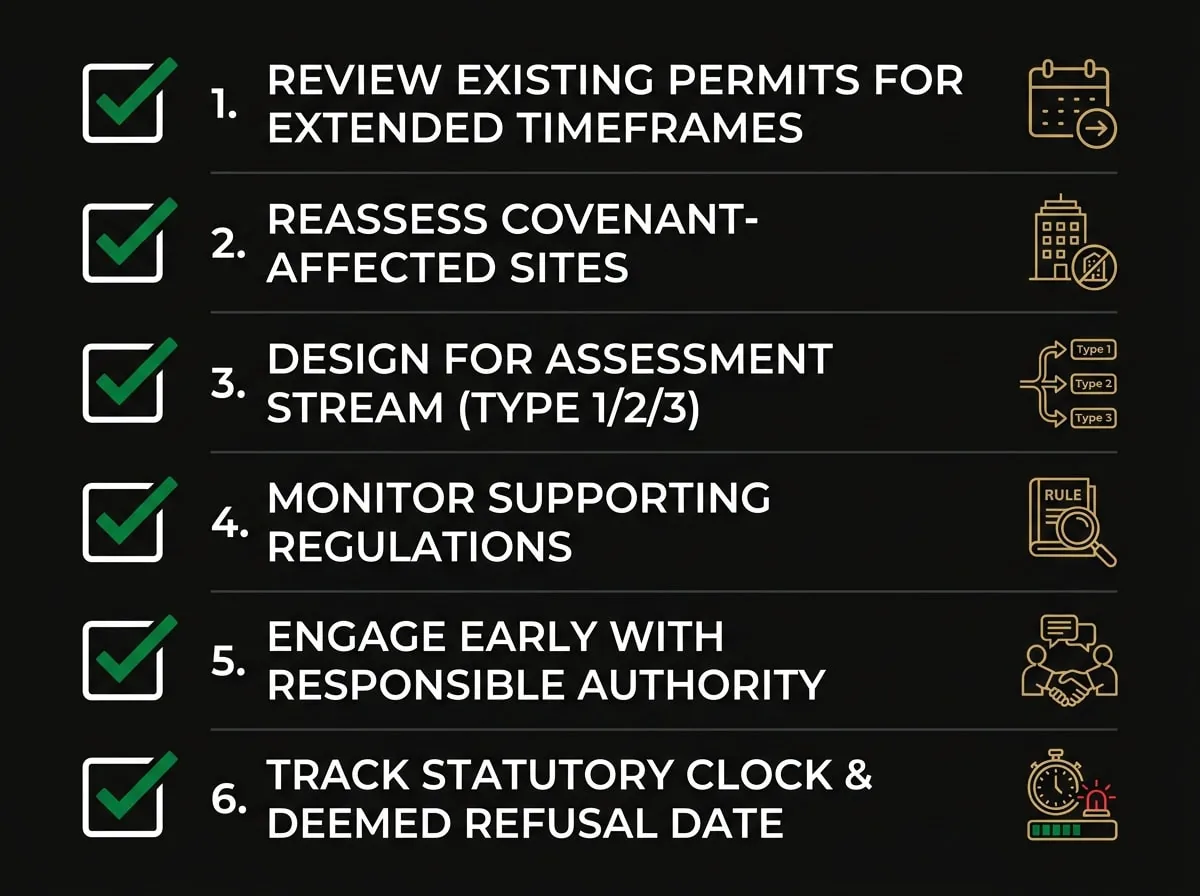
- Review existing permits now. If you hold a planning permit that was approaching expiry, confirm whether the extended default timeframes under the Housing Statement Reform Act 2025 apply. Permits that had not expired at commencement on 25 November 2025 may benefit from the extended 3-year commencement and 5-year completion defaults.
- Reassess covenant-affected sites under the new framework. Sites that were previously unviable due to single-dwelling covenants may now warrant reassessment in light of the reformed restrictive covenant provisions commencing in October 2027. Legal advice on the specific covenant remains important.
- Design for the assessment stream. Under the incoming framework, projects designed to meet Type 1 or Type 2 criteria may achieve faster approvals with reduced objection risk. Consider whether project design can be structured to target a lower-complexity assessment stream without compromising yield.
- Monitor the regulations. The precise scope of the Type 1, Type 2, and Type 3 categories will be set by regulations yet to be finalised. Staying across these regulations as they are released may allow early positioning for projects planned for lodgement after October 2027.
- Engage early with the Responsible Authority. Pre-application meetings remain one of the most cost-effective tools available to developers. Early engagement may identify issues that can be resolved before lodgement, reducing the risk of requests for further information that extend the statutory clock.
- Track the statutory clock. Know your lodgement date, the applicable statutory timeframe, and your deemed refusal date. Being prepared to exercise deemed refusal rights — and having VCAT materials ready to file — may encourage a Responsible Authority to act within timeframes.
Frequently Asked Questions
When does the three-stream planning permit assessment system commence?
The three-stream system established by the Planning Amendment (Better Decisions Made Faster) Act 2026 has a default commencement date of 29 October 2027. Developers planning projects with lodgement dates before October 2027 will continue to operate under the current assessment framework. The Victorian Government is currently preparing supporting regulatory changes, updated Victoria Planning Provisions, and new Ministerial guidelines ahead of commencement.
Do the extended planning permit expiry timeframes apply to permits already issued?
Yes — the extended default timeframes introduced by the Housing Statement Reform Act 2025 apply to permits issued both before and after the Act commenced on 25 November 2025, provided the permit had not already expired at that date. The new defaults are 3 years to commence and 5 years to complete a development, where the permit does not specify its own timeframe.
What is a deemed refusal and how can developers use it?
A deemed refusal occurs when a Responsible Authority fails to determine a planning permit application within the statutory timeframe — generally 60 days for most standard applications under the current framework, though timeframes may vary depending on application type and referral requirements. The applicant may then apply to VCAT for a review of the application as if it had been refused. This right is preserved under the reformed framework and may be used to apply pressure on a Responsible Authority that is slow to act or unwilling to make a decision.
How do the restrictive covenant reforms affect feasibility assessments?
The Better Decisions Made Faster Act 2026 removes the previous absolute prohibition on granting planning permits that breach registered restrictive covenants. Responsible Authorities will have greater discretion to approve removal or variation of covenants, and financial loss to the covenant beneficiary is excluded from the matters to be considered. This may make previously unviable covenant-affected sites worth reassessing, though legal advice on the specific covenant is recommended before relying on this flexibility in a preliminary feasibility assessment.
Will third-party objection rights be removed entirely under the new framework?
No — third-party objection rights are narrowed but not removed. Under the incoming framework, Type 1 and Type 2 applications will not be subject to objections, though some Type 2 applications may attract notice and comment rights. Type 3 applications — the default for larger, more complex developments — will retain objection and VCAT review rights, but only for objectors who have received direct notice of the application. Community members in the same suburb who have not received direct notice will generally not be entitled to participate in an appeal.
How does the new framework affect planning permit applications in heritage overlay areas?
Heritage overlay areas — common across the City of Boroondara and parts of the City of Whitehorse — are likely to attract Type 3 assessment under the incoming framework given their complexity and community impact. This means the full notice, objection, and VCAT review process will continue to apply. Early pre-application engagement with the Responsible Authority and a thorough heritage impact assessment prepared by a qualified heritage consultant may assist in managing these applications effectively.
What is the difference between a planning permit and a building permit in Victoria?
A planning permit is a legal document issued by the Responsible Authority — typically the local council — that allows a particular use or development to proceed on a specified parcel of land. A building permit is a separate approval issued by a registered building surveyor confirming that the proposed works comply with the National Construction Code and relevant building regulations. Both may be required for a development project — the planning permit generally comes first, as it establishes what can be built, while the building permit confirms how it must be built.
Conclusion: Act Now to Position for the New Framework
Victoria’s planning permit process is in transition. The changes already in effect — extended permit expiry timeframes, strengthened VCAT case management, and the first tranche of PE Act amendments — offer immediate practical benefits for developers managing active projects. The changes commencing in October 2027 — the three-stream assessment system, narrowed third-party appeal rights, and reformed restrictive covenant provisions — may fundamentally alter the risk and cost profile of medium-density development across Melbourne. Developers who understand both timelines, and who structure their projects and acquisitions accordingly, may be better placed to achieve faster approvals, lower objection risk, and stronger development outcomes.
SQM Architects has delivered a substantial portfolio of projects across Melbourne. Our team works with property developers across the City of Whitehorse, City of Boroondara, Manningham City Council, City of Monash, Knox City Council, and Maroondah City Council to navigate the planning permit process from site assessment through to permit issue. If you are assessing a site or planning your next project, we invite you to take the first step.
Book a Strategy Call — or call us directly on (03) 9005 6588.
This article provides general information only and does not constitute professional advice. For project-specific guidance, consult with a qualified architect or planning professional.