Understanding Deemed Refusal in Victoria’s Planning System
Victoria’s planning system operates under strict statutory timeframes that create automatic consequences when responsible authorities fail to make decisions within prescribed periods. For property developers working across Melbourne, understanding deemed refusal provisions represents a critical component of project risk management and timeline planning.
The deemed refusal mechanism under Section 79 of the Planning and Environment Act 1987 provides applicants with a pathway to VCAT when councils exceed statutory decision periods—typically 60 days for standard applications. This provision fundamentally differs from deemed approval systems in other jurisdictions, creating both opportunities and challenges for developers managing multi-unit residential projects with tight financing arrangements.
The Planning Amendment (Better Decisions Made Faster) Act 2026 will modify how deemed refusal interacts with new approval pathways once it commences, which is not before 29 October 2027, particularly for developments accessing the Townhouse and Low-Rise Code or the Great Design Fast Track. These changes affect project feasibility calculations, holding cost projections, and strategic decisions about when to escalate applications to tribunal review.
How Deemed Refusal Works Under Victorian Planning Law
The deemed refusal provision activates when a responsible authority fails to make a decision on a planning permit application within the statutory period. For most residential development applications in Melbourne, this period is 60 days from the date the application is lodged, provided all required information has been submitted.
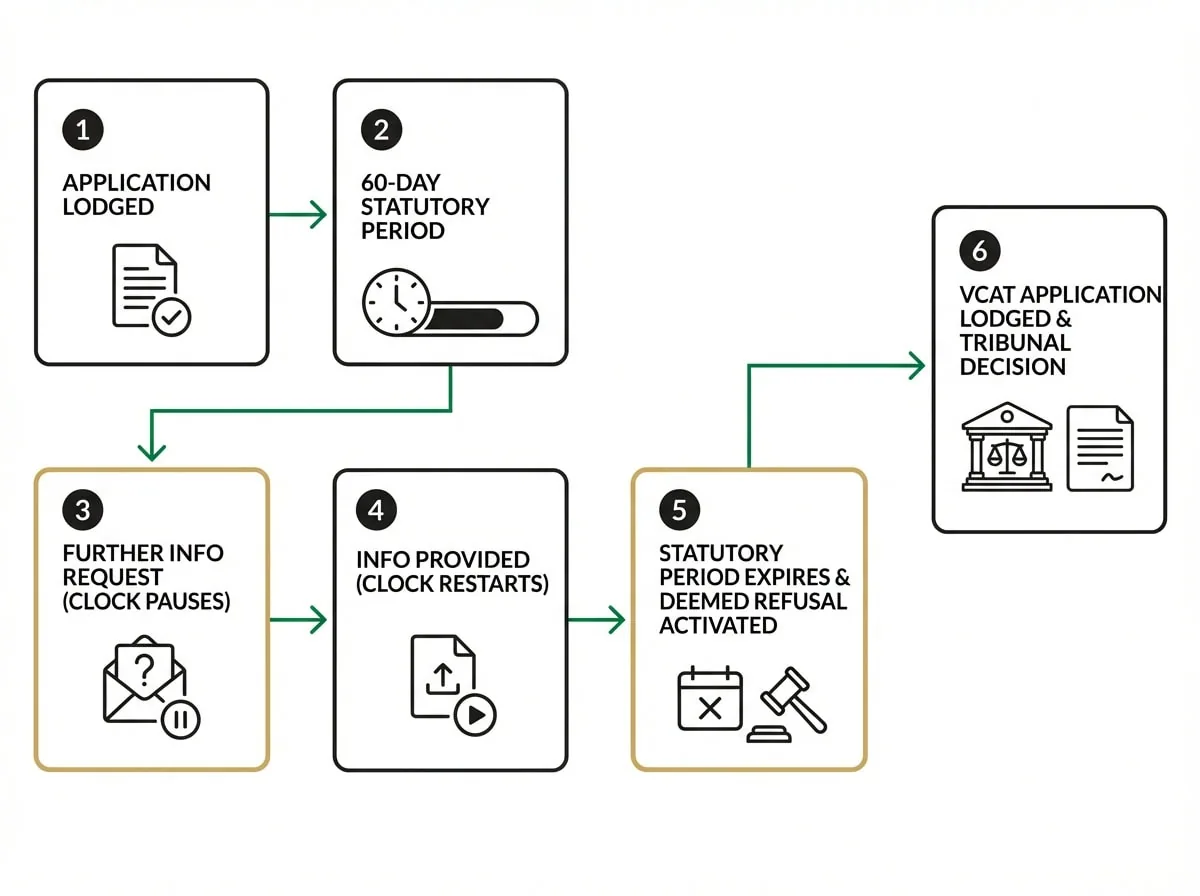
Once the statutory period expires without a decision, applicants may treat the application as refused and lodge an appeal to VCAT. This mechanism prevents indefinite delays and provides developers with certainty about maximum decision timeframes. However, the provision does not compel councils to approve applications—it merely transfers decision-making authority to the tribunal.
Current data from the Department of Transport and Planning indicates that actual processing times average approximately 140 days across Victoria, more than double the statutory period. This discrepancy creates significant implications for developers managing construction financing, land tax obligations, and revenue generation timelines. The 2025 planning reforms aim to reduce these delays, though implementation varies across different councils.
The deemed refusal pathway differs fundamentally from the new deemed-to-comply provisions introduced for townhouse developments and single dwellings under 300 square metres. Deemed-to-comply applications meeting all code standards may receive approval within approximately 10 business days, whilst deemed refusal represents a fallback mechanism when councils fail to decide within statutory timeframes.
Statutory Timeframes and When Deemed Refusal Applies
Understanding the precise statutory periods is essential for developers planning project timelines and financing arrangements. The standard 60-day period applies to most residential development applications, including townhouses, dual occupancies, and apartment buildings in the General Residential Zone, Residential Growth Zone, and Neighbourhood Residential Zone.
The 60-day period commences when the responsible authority receives a complete application with all required documentation. If the council requests further information under Section 54 of the Planning and Environment Act 1987, the statutory clock stops until the applicant provides the requested material. This pause mechanism can extend decision timeframes significantly, particularly for complex multi-unit developments requiring detailed shadow diagrams, traffic assessments, or arborist reports.
VicSmart applications—which include single dwellings and small second dwellings on lots under 300 square metres meeting deemed-to-comply standards—operate under a 10-business-day statutory period. These applications cannot be extended through further information requests, creating greater certainty for eligible projects. The VicSmart pathway was updated in August 2025 through Amendment VC282 to align with new Clause 54 standards.
For applications accessing the new fast-track pathways introduced in 2025, including developments under the Townhouse and Low-Rise Code, the deemed refusal provisions still apply if councils exceed statutory periods. However, these pathways aim to reduce processing times through objective assessment criteria and limited discretionary considerations, potentially reducing the frequency of deemed refusal scenarios.
Calculating Statutory Periods Accurately
Developers must calculate statutory periods carefully to determine when deemed refusal rights activate. The 60-day period runs in calendar days — weekends and public holidays are counted, not excluded. Only the VicSmart pathway is measured in business days. If day 60 falls on a weekend or public holiday, the period expires on the next business day. For projects with December lodgement dates, the Christmas-New Year shutdown does not extend the statutory period, though it may affect how quickly a council actually reaches a decision.
A further information request only resets the statutory clock if it is made within the prescribed time — 28 days of the application being lodged. Where it is, the 60-day period runs from the date the applicant provides the requested material, and total processing time can stretch well past 120 days. A request made after the prescribed time does not have that effect: under section 54(2) a late request does not affect the applicant’s right to seek review for failure to decide. So a council asking for more documentation on day 45 does not stop the clock, and the deemed refusal right still accrues at day 60.
Responsible authorities across Melbourne—including the City of Whitehorse, City of Boroondara, Manningham City Council, City of Monash, Knox City Council, and Maroondah City Council—apply these timeframes consistently, though processing efficiency varies. Developers working across multiple municipalities should track each council’s average decision timeframes to inform project planning and escalation strategies.
Get the 7-point site check to run before committing to a permit application — zoning, overlays, setbacks and council red flags, in plain English. Free PDF, instant download.
- Zone, overlay & setback checks
- What council assesses first
- Permit-readiness red flags
Something went wrong. Please try again.
No spam. Unsubscribe anytime.
Check your inbox — your checklist is on its way.
Strategic Considerations: When to Invoke Deemed Refusal
The decision to invoke deemed refusal and proceed to VCAT represents a significant strategic choice with financial and timeline implications. Whilst the provision provides a pathway to decision when councils exceed statutory periods, tribunal proceedings introduce costs, uncertainty, and extended timeframes that may exceed the original delay.
VCAT proceedings typically cost between $50,000 and $500,000 depending on project complexity, expert witness requirements, and the number of objectors. Legal representation, town planning experts, traffic engineers, and arborists all contribute to these costs. For developments with tight profit margins, these expenses can materially affect project viability, particularly when combined with extended holding costs during tribunal proceedings.
Tribunal hearings typically occur 6-12 months after lodging an application for review, though this varies based on VCAT’s caseload and the complexity of the matter. This timeline often exceeds the period required for councils to make decisions if applicants wait beyond the statutory period. Developers must weigh the certainty of a tribunal decision against the possibility of council approval through continued negotiation.
The Planning Amendment (Better Decisions Made Faster) Act 2026 aims to reduce third-party appeal rights for certain development types, potentially making VCAT proceedings more straightforward for compliant applications once it commences — not before 29 October 2027. However, these changes do not eliminate the costs and timeframes associated with tribunal review, making deemed refusal invocation a decision requiring careful financial analysis.
Alternative Approaches to Council Delays
Before invoking deemed refusal, developers may consider alternative strategies to expedite council decisions. Direct engagement with planning officers can clarify outstanding issues and identify pathways to approval without tribunal intervention. Pre-application meetings, though not eliminating statutory timeframes, can reduce the likelihood of extensive further information requests that pause the decision clock.
Some developers use the deemed refusal provision strategically, lodging VCAT applications whilst continuing negotiations with councils. This approach maintains pressure for decision-making whilst preserving the option for council approval before the tribunal hearing. If the council approves the application after VCAT lodgement, the tribunal matter can be withdrawn, though application fees are not refundable.
For developments accessing the new deemed-to-comply pathways under the Townhouse and Low-Rise Code or updated Clause 54 standards, compliance with all objective standards may reduce the strategic value of deemed refusal. These applications should receive approval within shortened timeframes if properly documented, making tribunal escalation less necessary for projects meeting all code requirements.
Impact of 2025-26 Planning Reforms on Deemed Refusal
The Planning Amendment (Better Decisions Made Faster) Act 2026 will make significant changes to Victoria’s planning system that affect how deemed refusal provisions operate in practice, though none of them applies before it commences on a date no earlier than 29 October 2027. These reforms aim to reduce the frequency of deemed refusal scenarios by streamlining approval processes and limiting discretionary assessment for compliant developments.
The Bill’s modifications to third-party appeal rights represent a fundamental shift for developers accessing fast-track pathways. For townhouse developments meeting all deemed-to-comply standards under the Townhouse and Low-Rise Code, objectors typically cannot appeal to VCAT, reducing the complexity of tribunal proceedings if deemed refusal is invoked. This change may make VCAT review more predictable for compliant applications, though it does not eliminate the costs or timeframes associated with tribunal proceedings.
The introduction of the Great Design Fast Track pathway provides an alternative approval route for developments demonstrating compliance with industry-tested design principles. Projects accessing this pathway may receive faster council decisions, potentially reducing the need to invoke deemed refusal provisions. However, the pathway’s eligibility criteria and assessment processes remain subject to responsible authority interpretation, creating variability across Melbourne councils.
Amendment VC282, which came into effect on 8 September 2025, updated Clause 54 standards for single dwellings and small second dwellings on lots under 300 square metres. These changes introduce new deemed-to-comply standards for tree canopy, site coverage, and sustainability requirements, potentially reducing discretionary assessment and associated delays. For eligible projects, the updated VicSmart pathway operating under a 10-business-day statutory period may eliminate deemed refusal scenarios entirely.
Interaction with New Development Standards
The deemed-to-comply provisions introduced through the Townhouse and Low-Rise Code create a parallel assessment framework that operates alongside traditional deemed refusal mechanisms. Developments meeting all code standards should receive approval without discretionary assessment, theoretically eliminating the delays that trigger deemed refusal rights.
However, implementation varies across responsible authorities. Some councils request further information even for apparently compliant applications, pausing statutory clocks and extending decision timeframes. Developers should verify their proposal’s compliance with code standards before lodging applications and maintain detailed documentation demonstrating compliance with each objective standard.
The reforms also modify how neighbourhood character is assessed for residential developments. The removal of neighbourhood character as a discretionary standard for deemed-to-comply applications under ResCode may reduce subjective assessment requirements that previously contributed to extended processing times. This change particularly affects developments in areas with Neighbourhood Character Overlays, where previous assessment processes often exceeded statutory periods.
Deemed Refusal vs Deemed-to-Comply: Critical Distinctions
The introduction of deemed-to-comply pathways in 2025 creates potential confusion with deemed refusal provisions, as both mechanisms use similar terminology but operate fundamentally differently. Understanding these distinctions is essential for developers planning project timelines and assessing approval risks.
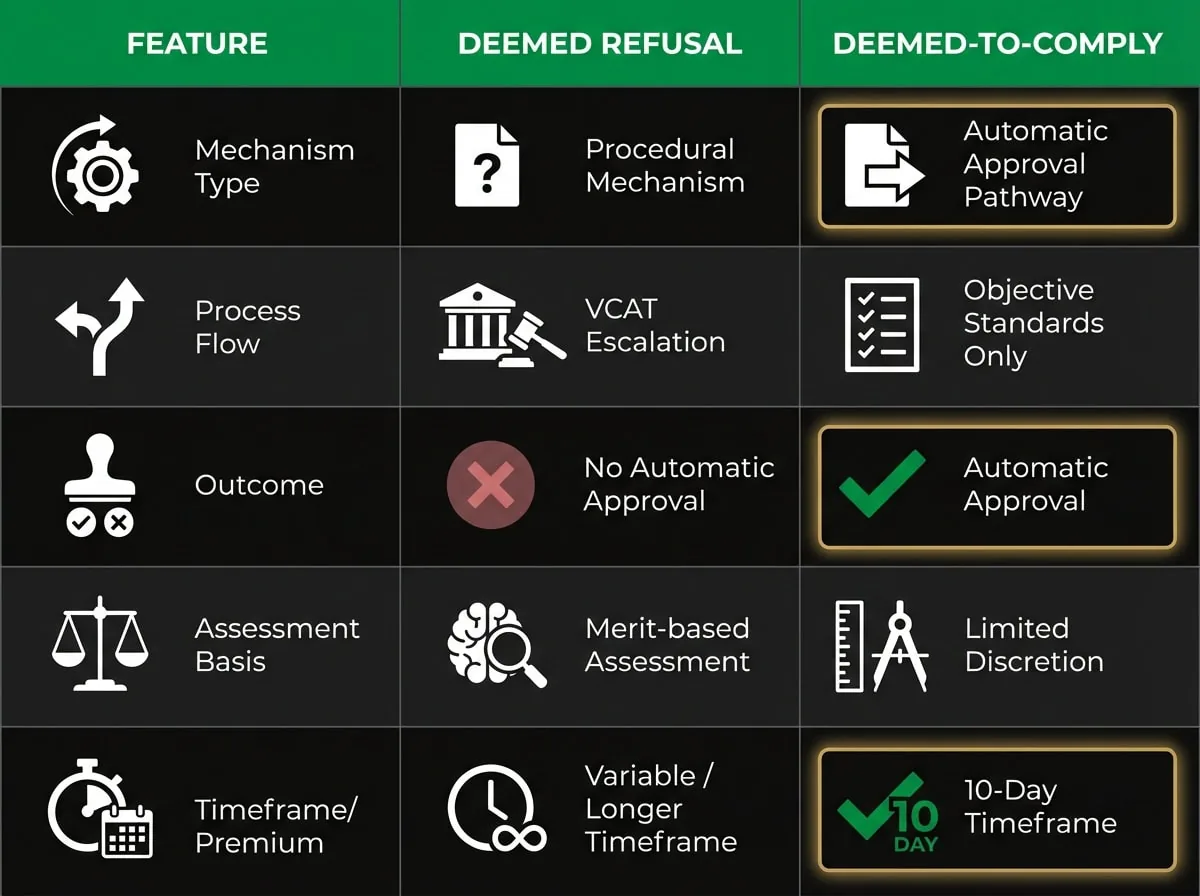
Deemed refusal represents a procedural mechanism that activates when councils fail to decide applications within statutory periods. It does not result in automatic approval—rather, it transfers decision-making authority to VCAT. Developers invoking deemed refusal must still demonstrate that their proposal meets planning scheme requirements and represents appropriate development for the site.
Deemed-to-comply provisions, introduced through the Townhouse and Low-Rise Code and updated Clause 54 standards, create automatic approval pathways for developments meeting all objective standards. These applications should receive approval within shortened timeframes without discretionary assessment, provided all code requirements are satisfied. The mechanism aims to eliminate subjective considerations that previously extended processing times.
The key distinction lies in outcomes: deemed refusal provides a pathway to tribunal review when councils delay decisions, whilst deemed-to-comply provides automatic approval when objective standards are met. Developers can potentially invoke deemed refusal for deemed-to-comply applications if councils exceed statutory periods, though this scenario should be rare for properly documented compliant projects.
Practical Application for Multi-Unit Developments
For townhouse developments of up to three storeys accessing the deemed-to-comply pathway, the interaction between these provisions creates specific strategic considerations. If a development meets all Townhouse and Low-Rise Code standards, the responsible authority should approve the application within approximately 10 business days, eliminating the need for deemed refusal invocation.
However, if the council requests further information or disputes compliance with code standards, the statutory clock pauses, potentially extending decision timeframes beyond the deemed-to-comply pathway’s intended efficiency. In these scenarios, developers must determine whether to provide requested information and continue council assessment, or invoke deemed refusal and proceed to VCAT for determination of code compliance.
The reduced third-party appeal rights for deemed-to-comply applications may make VCAT proceedings more straightforward if deemed refusal is invoked. Objectors typically cannot appeal council approvals for developments meeting all code standards, meaning tribunal proceedings focus primarily on whether the development satisfies objective requirements rather than subjective neighbourhood character considerations.
Financial Implications of Deemed Refusal for Developers
The decision to invoke deemed refusal carries significant financial implications that extend beyond direct VCAT costs. Developers must evaluate these impacts against the costs of continued delay whilst awaiting council decisions, creating complex financial trade-offs that affect project viability.
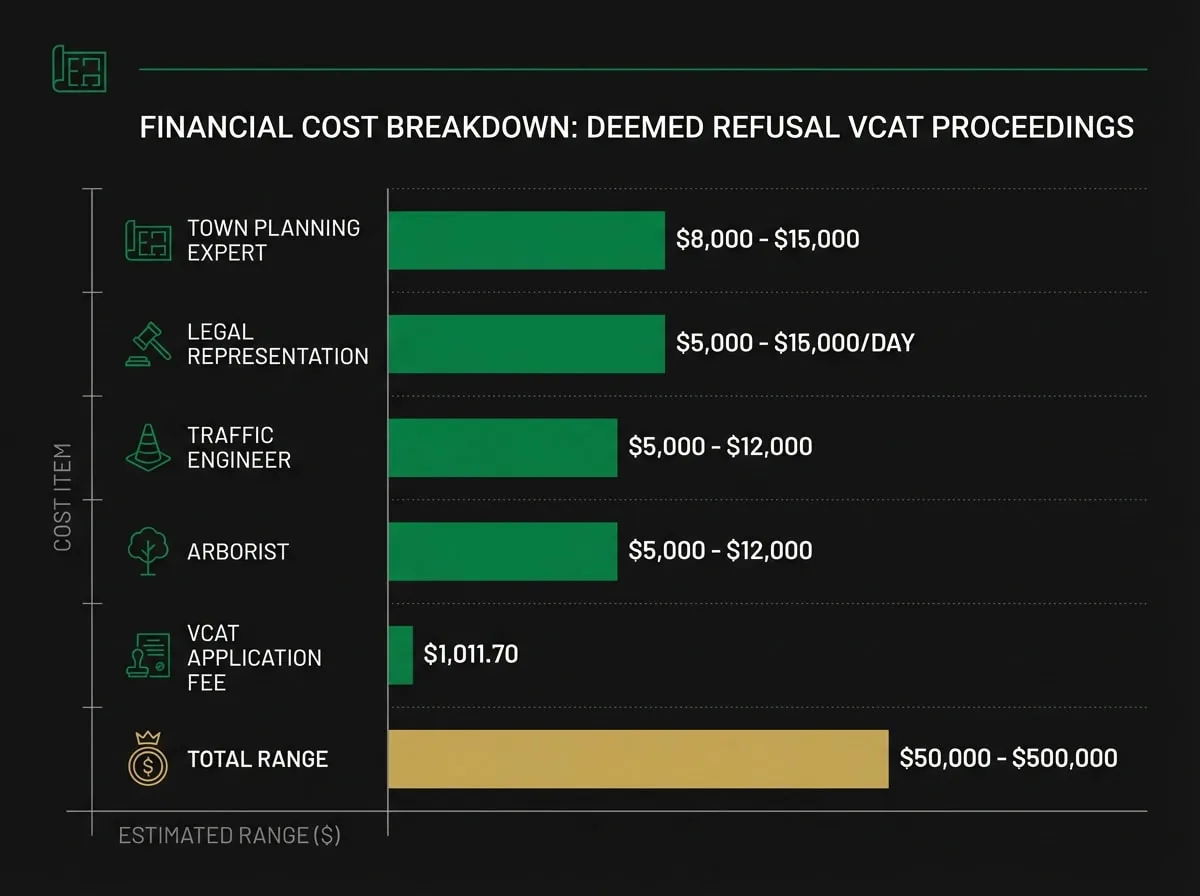
Direct tribunal costs typically range from $50,000 to $500,000 depending on project complexity and the number of expert witnesses required. Town planning experts generally charge $8,000-$15,000 for reports and hearing attendance, whilst traffic engineers, arborists, and other specialists add $5,000-$12,000 each. Legal representation costs vary based on hearing duration, with daily rates of $5,000-$15,000 for experienced planning barristers.
Holding costs during tribunal proceedings can exceed direct VCAT expenses for projects with significant debt financing. Interest payments on acquisition loans, land tax obligations, and opportunity costs from delayed revenue generation compound monthly. For a $2M development site with 70% LVR financing at 8% interest, holding costs approximate $9,300 monthly, meaning a 6-month tribunal delay costs $55,800 in interest alone.
The uncertainty of tribunal outcomes creates additional financial risk. Whilst VCAT may approve applications that councils were reluctant to decide, the tribunal can also refuse permits or impose conditions that reduce project viability. Developers must model multiple scenarios—approval, refusal, and conditional approval—to assess whether deemed refusal invocation represents prudent risk management.
ROI Considerations for Deemed Refusal Decisions
Developers should calculate the break-even timeline for deemed refusal invocation by comparing VCAT costs and extended holding costs against the financial impact of continued council delay. If council approval appears likely within 90-120 days beyond the statutory period, the total cost of waiting may be less than tribunal proceedings, particularly for smaller developments with modest holding costs.
For larger multi-unit developments with significant debt servicing requirements, earlier VCAT escalation may be financially prudent even if council approval is possible. The certainty of a tribunal hearing date—typically 6-12 months from application lodgement—allows developers to plan construction commencement and financing drawdowns with greater precision than indefinite council delays.
The 2025 planning reforms’ aim to reduce average processing times from 140 days to periods closer to statutory timeframes may affect these calculations. If councils achieve faster decision-making through streamlined assessment processes, the frequency of deemed refusal scenarios should decrease, reducing the need for developers to model tribunal escalation costs into project feasibility assessments.
Council-Specific Deemed Refusal Patterns Across Melbourne
Processing timeframes and deemed refusal frequencies vary significantly across Melbourne councils, creating location-specific considerations for developers planning multi-site portfolios. Understanding these patterns informs site selection decisions and approval timeline projections.
The City of Whitehorse processes residential development applications with average timeframes that typically exceed statutory periods for complex multi-unit proposals, though single dwelling applications often receive decisions within 60 days. The council’s interpretation of neighbourhood character provisions in areas with overlays can extend assessment periods, particularly for developments in Blackburn, Box Hill, and Mont Albert precincts.
City of Boroondara maintains relatively consistent processing timeframes across its municipality, though applications in heritage overlay areas or precincts with significant tree protection requirements may experience extended assessment periods. The council’s focus on design quality and neighbourhood character integration can result in multiple rounds of further information requests that pause statutory clocks.
Manningham City Council, City of Monash, Knox City Council, and Maroondah City Council each demonstrate distinct processing patterns influenced by local planning policies and resource allocation. Developers working across multiple municipalities should track historical decision timeframes for similar development types to inform project planning and deemed refusal risk assessment.
Pre-Application Strategies to Avoid Deemed Refusal Scenarios
Proactive engagement with council planning departments before lodging formal applications can reduce the likelihood of delays that trigger deemed refusal provisions. Pre-application meetings allow developers to identify potential issues, clarify information requirements, and demonstrate professional competence before the statutory clock commences.
Comprehensive application documentation that anticipates council concerns and addresses them proactively may reduce further information requests that pause statutory periods. Shadow diagrams demonstrating compliance with overshadowing standards, detailed landscape plans showing tree retention strategies, and traffic assessments addressing parking and access concerns all contribute to complete applications that councils can assess within statutory timeframes.
For developments accessing deemed-to-comply pathways, detailed compliance statements demonstrating how the proposal meets each objective standard can expedite council assessment and reduce discretionary considerations that extend processing times. These statements should reference specific code provisions and include supporting calculations, measurements, and diagrams that verify compliance.
VCAT Proceedings Following Deemed Refusal
Once deemed refusal is invoked and an application for review is lodged with VCAT, the tribunal assumes decision-making authority and conducts a merit-based assessment of the development proposal. Understanding the tribunal process is essential for developers evaluating whether to invoke deemed refusal or continue negotiating with councils.
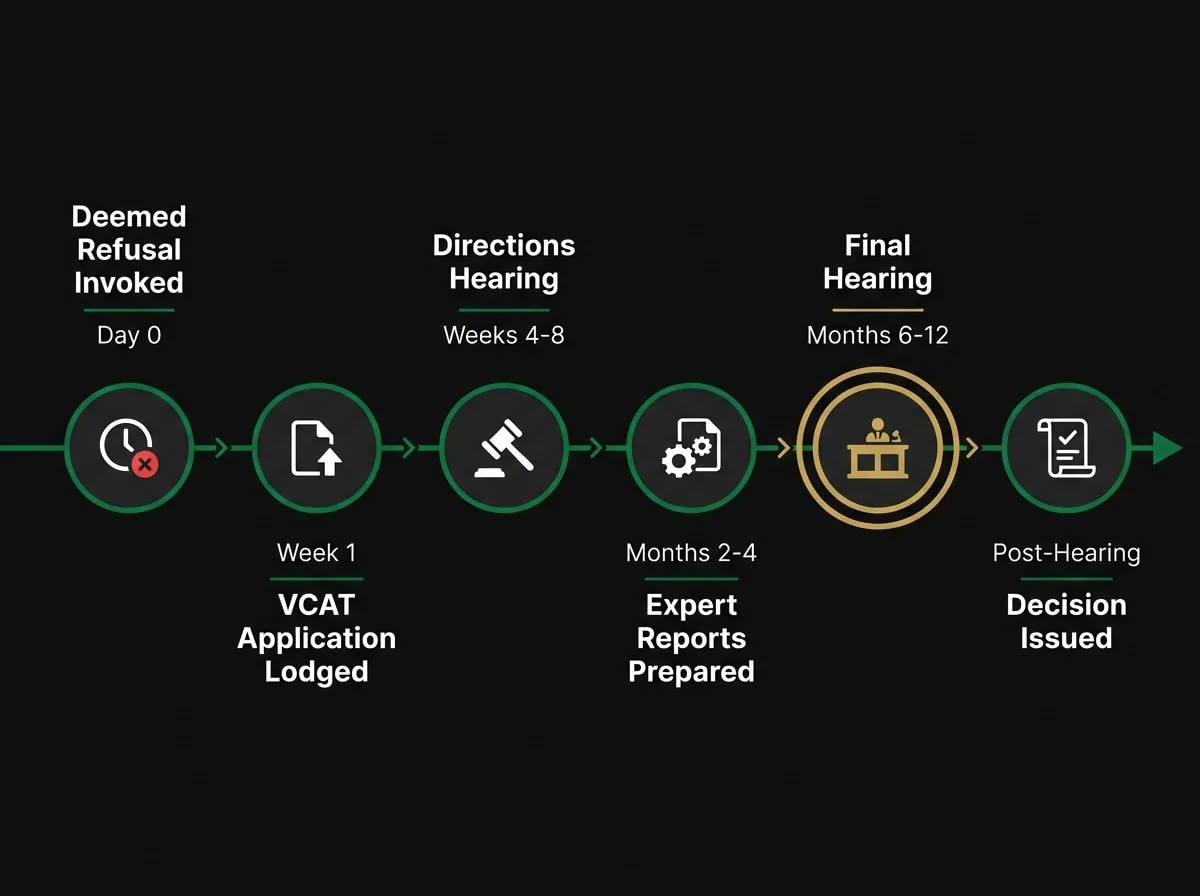
VCAT proceedings commence with the lodgement of an application for review, which must occur within specified timeframes after the deemed refusal date. The application fee is $1,011.70 as of 2026, though this represents a minor component of total tribunal costs. The tribunal schedules a directions hearing within 4-8 weeks to establish timelines for expert reports, witness statements, and the final hearing.
The merit-based assessment conducted by VCAT considers the same planning scheme provisions that would apply to council assessment, including zone purposes, overlay requirements, and state and local planning policies. The tribunal is not bound by council officer recommendations or previous council decisions, conducting an independent evaluation of whether the proposal represents appropriate development for the site.
Hearing durations vary from half-day sessions for straightforward applications to multi-day proceedings for complex developments with numerous objectors. The 2025 planning reforms’ restrictions on third-party appeal rights for deemed-to-comply applications may reduce hearing complexity for compliant townhouse developments, though this depends on whether objectors dispute code compliance.
Evidence Requirements and Expert Witnesses
VCAT proceedings require expert evidence addressing planning merit, with town planning experts providing the primary evidence supporting development proposals. These experts prepare detailed reports analysing the proposal against planning scheme provisions, demonstrating compliance with relevant standards, and addressing objector concerns.
Additional expert witnesses may be required depending on the development’s characteristics and objection grounds. Traffic engineers address vehicle access, parking provision, and traffic generation impacts. Arborists provide evidence regarding tree protection, removal justification, and replacement planting strategies. Acoustic consultants may be necessary for developments near commercial zones or main roads where noise impacts require assessment.
The quality and comprehensiveness of expert evidence significantly affects tribunal outcomes. Developers should engage experienced planning experts familiar with VCAT procedures and the specific planning scheme provisions applicable to their site. Expert reports should anticipate objector arguments and address them proactively, reducing the likelihood of adverse findings during cross-examination.
Managing Third-Party Objections in Deemed Refusal Scenarios
Third-party objections complicate deemed refusal scenarios by introducing additional parties to VCAT proceedings and potentially extending hearing durations. The 2025 planning reforms modify objector rights for certain development types, creating new strategic considerations for developers managing community opposition.
For developments accessing deemed-to-comply pathways under the Townhouse and Low-Rise Code, objectors typically cannot appeal council approvals to VCAT if all code standards are met. This restriction significantly reduces the complexity of tribunal proceedings following deemed refusal, as the primary issue becomes whether the development satisfies objective standards rather than addressing subjective neighbourhood character concerns.
However, objectors may still participate in VCAT proceedings following deemed refusal by disputing whether the development meets code requirements. These disputes often focus on technical compliance with setback standards, overlooking provisions, or site coverage calculations. Developers should maintain detailed documentation demonstrating compliance with each standard to address these challenges efficiently.
For developments not accessing deemed-to-comply pathways, traditional objector rights remain, allowing affected neighbours to participate fully in tribunal proceedings. Proactive community consultation before lodging applications can reduce objection numbers and identify concerns that can be addressed through design modifications, potentially simplifying subsequent VCAT proceedings if deemed refusal is invoked.
Negotiated Outcomes During Tribunal Proceedings
VCAT proceedings following deemed refusal do not necessarily result in contested hearings. Many applications resolve through negotiated outcomes between developers, councils, and objectors during the tribunal process. These settlements can reduce costs, shorten timeframes, and produce outcomes acceptable to all parties.
Mediation sessions facilitated by VCAT members provide structured opportunities for negotiation. Developers may agree to design modifications addressing objector concerns in exchange for withdrawal of opposition, whilst councils may support amended proposals that address their initial assessment concerns. These outcomes avoid contested hearings whilst achieving permit approval.
The strategic value of negotiated outcomes depends on the modifications required and their impact on project viability. Minor setback adjustments or additional landscaping may represent acceptable compromises, whilst significant reductions in dwelling numbers or building height may fundamentally alter project economics. Developers should establish clear parameters for acceptable modifications before entering mediation to avoid agreeing to changes that compromise project viability.
Documentation and Evidence for Deemed Refusal Applications
Successful VCAT proceedings following deemed refusal require comprehensive documentation demonstrating planning merit and code compliance. The quality of this evidence directly affects tribunal outcomes and the efficiency of hearing processes.
Planning permit applications should include detailed architectural plans showing compliance with all relevant standards, including setbacks, building height, site coverage, and private open space provision. Shadow diagrams demonstrating compliance with overshadowing standards at specified times on 22 September are mandatory for most residential developments. Landscape plans showing tree retention, canopy coverage calculations, and replacement planting strategies address vegetation protection requirements.
For developments accessing deemed-to-comply pathways, compliance statements should reference each applicable standard and provide supporting calculations. These statements should address setback measurements, overlooking distances, solar access to private open space, and any other objective requirements. Detailed documentation reduces the scope for disputes about code compliance during tribunal proceedings.
Traffic and parking assessments may be required for larger developments or sites with access constraints. These reports should demonstrate compliance with car parking rates specified in the planning scheme and address vehicle access safety, swept path analysis for service vehicles, and traffic generation impacts on surrounding streets.
Expert Report Standards for VCAT Proceedings
Town planning expert reports form the cornerstone of evidence in VCAT proceedings following deemed refusal. These reports should provide comprehensive analysis of the proposal against all relevant planning scheme provisions, including zone purposes, overlay requirements, state planning policies, and local planning policies.
Effective expert reports address potential objection grounds proactively, demonstrating how the development responds to neighbourhood character, manages amenity impacts on adjoining properties, and contributes to housing supply objectives. Reports should reference relevant VCAT decisions establishing precedents for similar development types in comparable locations.
The 2025 planning reforms’ emphasis on objective standards and reduced discretionary assessment may simplify expert report requirements for deemed-to-comply applications. However, comprehensive analysis remains necessary to demonstrate code compliance and address any disputes raised by objectors or councils regarding technical standard interpretation.
Frequently Asked Questions
What happens if a council exceeds the 60-day statutory period for deciding my planning permit application?
When a responsible authority exceeds the statutory decision period—typically 60 days for standard residential development applications—you may treat the application as refused and lodge an application for review with VCAT under Section 79 of the Planning and Environment Act 1987. This deemed refusal provision does not result in automatic approval but transfers decision-making authority to the tribunal. You must still demonstrate that your proposal meets planning scheme requirements and represents appropriate development. VCAT proceedings typically cost $50,000-$500,000 and take 6-12 months to reach hearing, so developers should evaluate whether tribunal escalation is financially prudent compared to continued council negotiation.
How do deemed refusal provisions interact with the new deemed-to-comply pathways for townhouse developments?
Deemed refusal and deemed-to-comply represent fundamentally different mechanisms despite similar terminology. Deemed-to-comply pathways under the Townhouse and Low-Rise Code provide automatic approval for developments meeting all objective standards, typically within approximately 10 business days. Deemed refusal activates when councils exceed statutory decision periods, allowing VCAT escalation regardless of the assessment pathway. For townhouse developments meeting all code standards, deemed refusal scenarios should be rare if applications are properly documented. However, if councils dispute code compliance or request further information that pauses statutory clocks, developers may still invoke deemed refusal to obtain tribunal determination of whether the development satisfies objective requirements.
Can third-party objectors appeal to VCAT if I invoke deemed refusal for a development meeting all deemed-to-comply standards?
The Planning Amendment (Better Decisions Made Faster) Act 2026 will restrict third-party appeal rights for developments meeting all deemed-to-comply standards under the Townhouse and Low-Rise Code, once it commences on a date no earlier than 29 October 2027. Objectors typically cannot appeal council approvals for compliant applications, reducing the complexity of subsequent VCAT proceedings. However, objectors may participate in tribunal proceedings following deemed refusal by disputing whether the development actually meets all code requirements. These disputes often focus on technical compliance with setback standards, overlooking provisions, or site coverage calculations. Developers should maintain detailed documentation demonstrating compliance with each objective standard to address these challenges efficiently during tribunal proceedings.
What are the typical costs and timeframes for VCAT proceedings following deemed refusal?
VCAT proceedings following deemed refusal typically cost between $50,000 and $500,000 depending on project complexity, the number of expert witnesses required, and objector participation. Town planning experts generally charge $8,000-$15,000 for reports and hearing attendance, whilst traffic engineers, arborists, and other specialists add $5,000-$12,000 each. Legal representation costs vary based on hearing duration, with daily rates of $5,000-$15,000 for experienced planning barristers. Tribunal hearings typically occur 6-12 months after lodging an application for review, though this varies based on VCAT’s caseload and matter complexity. Developers must also account for ongoing holding costs during tribunal proceedings, including interest payments on acquisition loans, land tax obligations, and opportunity costs from delayed revenue generation.
Should I invoke deemed refusal immediately when the statutory period expires, or continue negotiating with the council?
The decision to invoke deemed refusal requires careful financial analysis comparing VCAT costs and extended holding costs against the potential for council approval through continued negotiation. If council approval appears likely within 90-120 days beyond the statutory period, the total cost of waiting may be less than tribunal proceedings, particularly for smaller developments with modest holding costs. However, for larger multi-unit developments with significant debt servicing requirements, earlier VCAT escalation may be financially prudent even if council approval is possible. The certainty of a tribunal hearing date allows developers to plan construction commencement and financing drawdowns with greater precision than indefinite council delays. Consider engaging directly with planning officers to clarify outstanding issues before invoking deemed refusal, as this may identify pathways to approval without tribunal intervention.
How do the 2025-26 planning reforms affect deemed refusal provisions for residential developments?
The Planning Amendment (Better Decisions Made Faster) Act 2026 aims to reduce the frequency of deemed refusal scenarios by streamlining approval processes and limiting discretionary assessment for compliant developments, from its commencement on a date no earlier than 29 October 2027. The reforms target reducing average processing times from approximately 140 days to periods closer to the 60-day statutory timeframe, though implementation varies across responsible authorities. The introduction of deemed-to-comply pathways for townhouse developments and updated Clause 54 standards for single dwellings creates automatic approval routes that should eliminate delays triggering deemed refusal rights. However, the fundamental deemed refusal mechanism under Section 79 of the Planning and Environment Act 1987 remains unchanged, providing developers with VCAT escalation rights when councils exceed statutory periods regardless of the assessment pathway applicable to their development.
Do deemed refusal provisions apply differently across Melbourne councils?
Whilst the statutory framework for deemed refusal applies consistently across all Victorian councils, processing timeframes and the frequency of deemed refusal scenarios vary significantly between municipalities. The City of Whitehorse, City of Boroondara, Manningham City Council, City of Monash, Knox City Council, and Maroondah City Council each demonstrate distinct processing patterns influenced by local planning policies, resource allocation, and interpretation of neighbourhood character provisions. Developers working across multiple municipalities should track historical decision timeframes for similar development types to inform project planning and deemed refusal risk assessment. Pre-application meetings with council planning departments can clarify local assessment approaches and identify potential issues that may extend processing times beyond statutory periods, allowing developers to address these concerns proactively before lodging formal applications.
Conclusion: Strategic Management of Deemed Refusal Provisions
Deemed refusal provisions represent a critical safeguard for developers navigating Victoria’s planning system, providing certainty about maximum decision timeframes and access to independent tribunal review when councils exceed statutory periods. The 2025-26 planning reforms introduce new approval pathways and streamlined assessment processes that aim to reduce the frequency of deemed refusal scenarios, though the fundamental mechanism remains an essential component of development risk management.
Successful developers approach deemed refusal strategically, evaluating the financial implications of tribunal escalation against the costs of continued council delay. This analysis requires modelling VCAT costs, holding costs during tribunal proceedings, and the probability of favourable outcomes through different pathways. For developments accessing deemed-to-comply routes under the Townhouse and Low-Rise Code or updated Clause 54 standards, comprehensive documentation demonstrating code compliance may eliminate deemed refusal scenarios entirely by enabling rapid council approval.
Understanding how deemed refusal provisions interact with new planning reforms, council-specific processing patterns, and third-party appeal rights allows developers to make informed decisions about project timelines, financing arrangements, and escalation strategies. For a complimentary assessment of how deemed refusal provisions may affect your specific development project, contact SQM Architects on (03) 9005 6588.
This article provides general information about Victorian planning for property developers. It does not constitute professional advice. For specific guidance on your project, contact SQM Architects (ARBV Reg. No. 51498) for a complimentary site assessment.