
For property developers in Melbourne’s Eastern Suburbs, getting side and rear setbacks wrong can derail an otherwise viable project. ResCode Standards B17 to B20 govern these critical dimensions, yet they’re among the most misunderstood provisions in Clause 54 (and formerly Clause 55). The difference between a compliant design and a VCAT appeal often comes down to understanding not just the numbers, but how Responsible Authorities interpret “reasonable regard” to neighbourhood character and existing development patterns.
This guide breaks down Standards B17 to B20 with practical examples from Whitehorse, Boroondara, Manningham, Monash, Knox, and Maroondah councils. Whether you’re planning a dual occupancy in Box Hill, townhouses in Glen Waverley, or units in Doncaster, you’ll learn how to navigate setback requirements whilst maximising developable area. Based on experience across 210+ Eastern Suburbs projects, patterns emerge showing what typically works—and what may trigger objections.
Recent amendments including VC267 (31 March 2025) have introduced deemed-to-comply pathways for certain developments, whilst VC282 (8 September 2025) updated various Clause 54 design requirements. Understanding how these changes affect setback assessments is crucial for developers seeking efficient approval pathways.
The Four Setback Standards: What Each One Controls
ResCode divides side and rear setbacks into four distinct standards, each addressing different building elements and site conditions. Understanding this structure prevents the common mistake of applying a single setback rule across your entire development.
Standard B17: Street Setback controls how far buildings must sit back from street frontages. Whilst this primarily affects front setbacks, it becomes relevant for corner sites where side boundaries also face streets. The objective requires buildings to respect the existing or preferred neighbourhood character, which varies significantly across Eastern Suburbs councils.
Standard B18: Site Coverage limits the proportion of site area covered by buildings and works. This indirectly affects setbacks by constraining total building footprint. Experience across extensive Eastern Suburbs projects shows site coverage often becomes the binding constraint before setback dimensions, particularly on smaller lots under 500m².
Standard B19: Permeability mandates minimum permeable surface area, typically 20% of site area in garden areas. This standard works in tandem with setbacks—your side and rear setback areas often provide the permeable surfaces needed for compliance. Councils increasingly scrutinise permeability calculations, especially where hard landscaping or decking is proposed in setback zones.
Standard B20: Energy Efficiency requires buildings to achieve reasonable energy efficiency standards, which can influence setback design. North-facing setbacks affect solar access, whilst side setbacks impact natural ventilation. The City of Boroondara and Manningham City Council particularly emphasise this connection in their assessment of performance-based applications.
Standard B17 Deep Dive: Side and Rear Setback Dimensions
Standard B17 specifies the actual setback distances your development must achieve. The standard setback table provides deemed-to-comply dimensions based on wall height, but performance-based assessment allows variation where you can demonstrate appropriate outcomes.
The Standard Setback Table
For walls up to 3.6m in height (single storey), the standard requires:
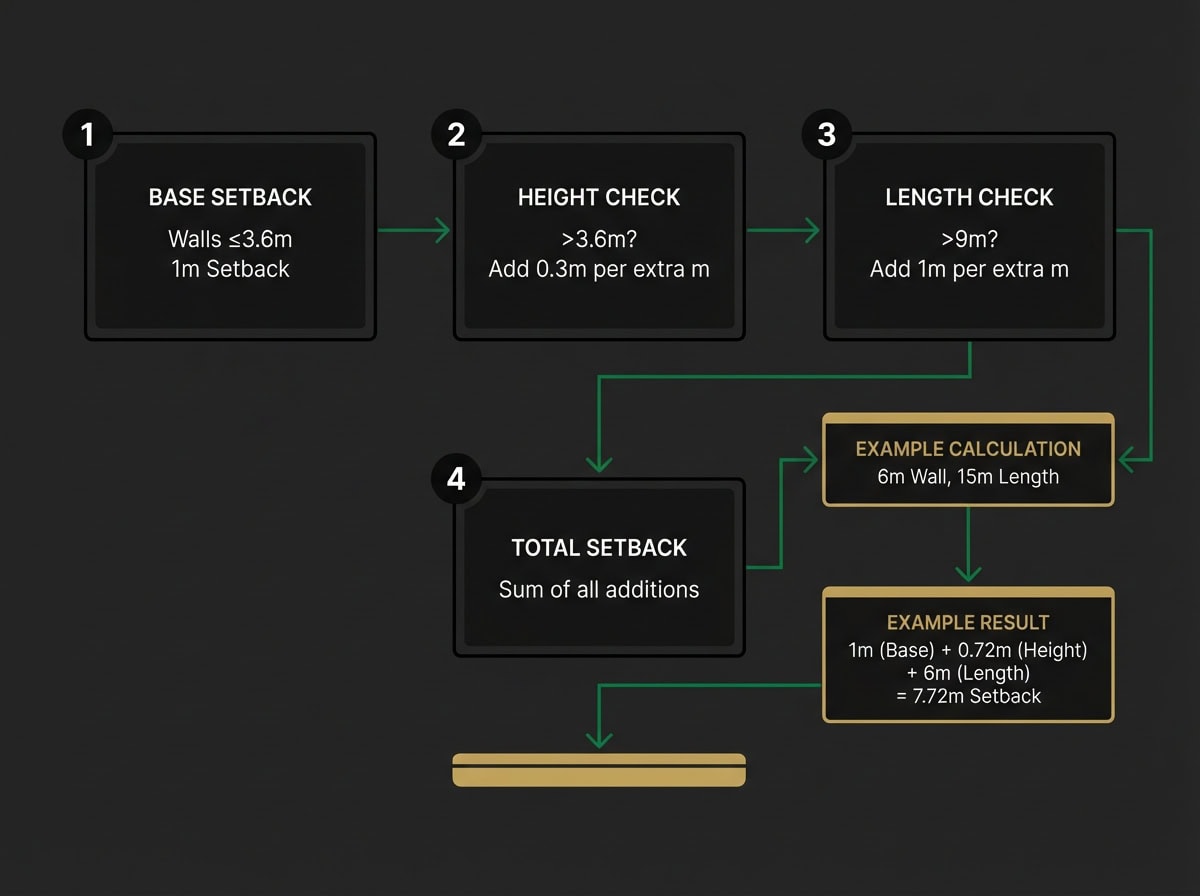
- 1m setback for walls up to 3.6m high
- Plus 0.3m for every metre (or part thereof) of height over 3.6m
- Plus 1m for every metre (or part thereof) that the wall exceeds 9m in length
For a typical two-storey development with 6m wall height and 15m wall length, this calculates to: 1m (base) + 0.9m (height increment for 3m over 3.6m, rounded up) + 6m (length increment for 6m over 9m) = 7.9m setback. However, this theoretical maximum rarely applies in practice—councils assess the performance criteria instead.
In the City of Whitehorse and City of Monash, projects have achieved 3m side setbacks for two-storey developments by demonstrating adequate spacing between buildings, appropriate landscaping opportunities, and consistency with neighbourhood patterns. The key is showing how your proposal meets the performance criteria even when varying the standard.
Performance-Based Assessment Reality
Most successful Eastern Suburbs developments rely on performance-based assessment rather than strict compliance with the setback table. The performance criteria focus on:
- Providing adequate separation between buildings on adjoining lots
- Limiting views into habitable room windows and private open space of adjoining dwellings
- Providing adequate daylight and solar access to existing dwellings
- Limiting unreasonable impacts from building bulk and massing
- Providing opportunities for landscaping
Knox City Council and Maroondah City Council tend to apply these performance criteria more strictly than other Eastern Suburbs councils, particularly regarding visual bulk impacts. Developments in Wantirna, Bayswater, and Croydon may benefit from shadow diagrams and 3D visualisations showing minimal amenity impacts to neighbours.
Council-Specific Variations and Local Policies
Whilst ResCode provides the state-wide framework, each Responsible Authority applies local variations through planning scheme schedules and policy guidelines. Understanding these nuances prevents costly redesigns during the assessment process.
City of Boroondara Approach
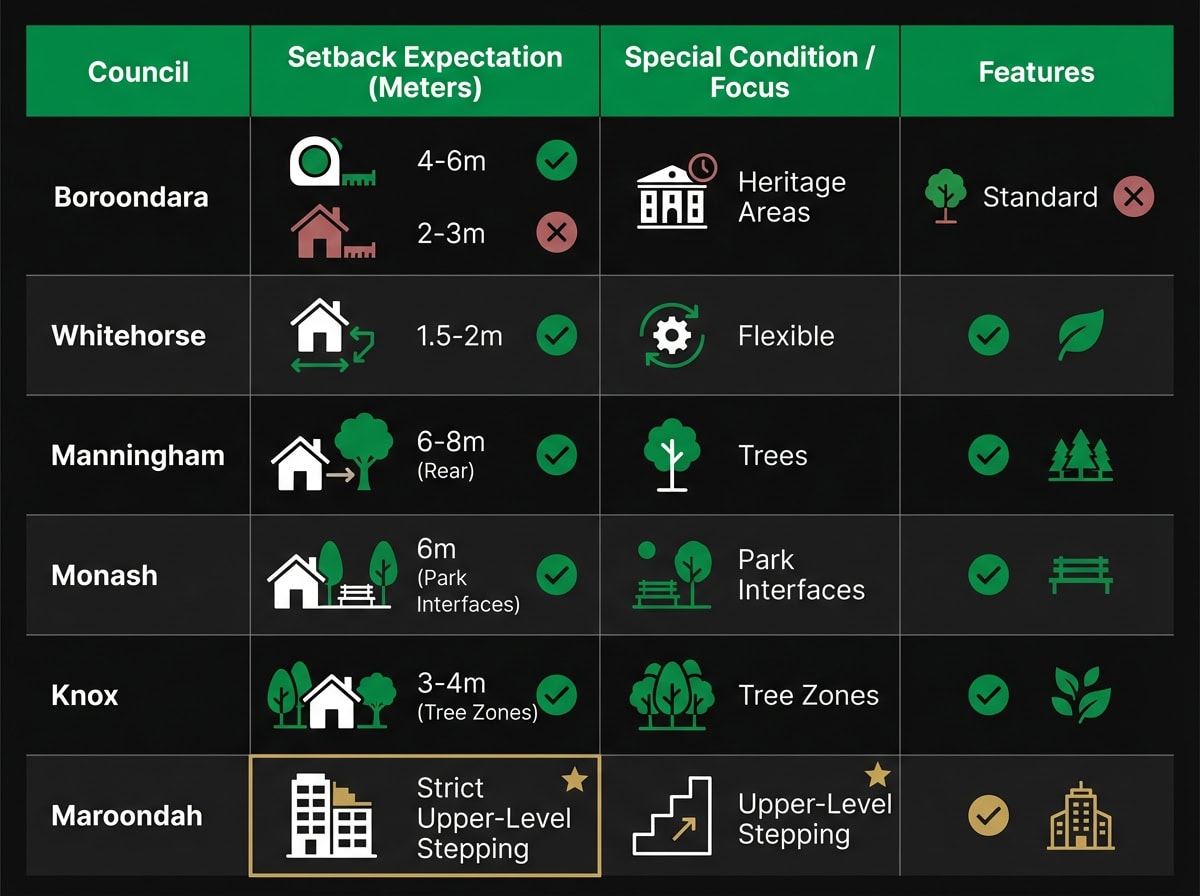
Boroondara’s Neighbourhood Character Precincts significantly influence setback expectations. In Heritage Overlay areas like Kew and Camberwell, side setbacks of 4m to 6m are commonly expected to match existing Victorian and Edwardian housing patterns. The council’s Urban Character Framework specifically references “generous side setbacks” as a key character element.
For non-heritage areas, Boroondara generally accepts 2m to 3m side setbacks for two-storey development, provided upper-level setbacks increase to 3m to 4m. This stepped approach reduces visual bulk whilst maintaining ground-floor efficiency. Understanding these unwritten expectations can streamline the application process.
City of Whitehorse Expectations
Whitehorse applies ResCode more flexibly in established residential areas, particularly in Box Hill, Burwood, and Nunawading. The council accepts reduced setbacks where developments demonstrate high-quality architectural design and appropriate landscaping. Side setbacks of 1.5m to 2m for single-storey elements are routinely approved when coupled with 3m upper-level setbacks.
However, Whitehorse’s Residential Growth Zone areas around activity centres have different expectations. Here, the council encourages more intensive development with reduced setbacks, sometimes accepting 1m side setbacks for multi-unit developments that contribute to urban consolidation objectives.
Manningham City Council Requirements
Manningham emphasises landscape character, particularly in areas like Doncaster and Templestowe. The council’s Neighbourhood Character Study identifies “treed garden settings” as a key characteristic, which translates to expectations for larger rear setbacks (typically 6m to 8m) to accommodate canopy trees.
Side setbacks in Manningham generally follow standard ResCode dimensions, but the council scrutinises cumulative visual bulk. For developments with multiple dwellings, varying setbacks across the site (rather than uniform minimums) demonstrates better design response and typically achieves smoother approval.
City of Monash, Knox, and Maroondah Patterns
These three councils apply ResCode relatively consistently with state standards, but each has specific triggers:
- Monash: Focuses on interface with public open space. Developments backing onto parks or reserves face stricter rear setback scrutiny (typically 6m minimum) to protect public amenity.
- Knox: Emphasises retention of existing vegetation. Side and rear setbacks must demonstrate how significant trees will be protected, often requiring 3m to 4m setbacks from tree protection zones.
- Maroondah: Applies stricter interpretation of visual bulk standards. Upper-level setbacks typically need to be 1m to 1.5m greater than ground-floor setbacks to achieve approval without objections.
Common Setback Challenges and Practical Solutions
Across numerous Eastern Suburbs projects, certain setback challenges recur. Here’s how to address them proactively in your design and planning permit application.
Challenge 1: Narrow Lots and Side Setback Compliance
Lots under 15m width struggle to achieve standard side setbacks whilst maintaining viable dwelling widths. A typical 12m-wide lot with 2m setbacks on each side leaves only 8m for the dwelling—insufficient for functional room layouts.
Solution: Utilise the “single dwelling on a lot” exemption where applicable, or demonstrate performance compliance through:
- Increased upper-level setbacks (3m to 4m) to reduce visual bulk
- High-quality boundary wall treatments with articulation and varied materials
- Offset windows to avoid direct overlooking of neighbours
- Landscaping plans showing screening vegetation in reduced setback areas
Approval has been achieved for 1.5m side setbacks on 12m-wide lots in Glen Waverley and Blackburn by combining these strategies with shadow analysis proving minimal amenity impact. For property owners considering backyard subdivision, these setback constraints become particularly relevant when assessing site viability.
Challenge 2: Rear Setback Conflicts with Private Open Space
ResCode requires both adequate rear setbacks (typically 6m to 9m for two-storey development) and minimum private open space dimensions (typically 40m² with 5m minimum dimension). On lots under 500m², these requirements can conflict.
Solution: Integrate rear setback area with private open space design. The setback zone can form part of your required private open space, provided it’s accessible, usable, and appropriately dimensioned. Include detailed landscape plans showing how the space functions for residents whilst maintaining setback compliance.
In Doncaster and Templestowe projects, rear setbacks have been successfully designed as landscaped terraces that satisfy both setback and private open space requirements, often incorporating raised decking to manage slope whilst maintaining the required setback distance from the boundary.
Challenge 3: Corner Sites and Dual Street Frontages
Corner sites face setback requirements on two street frontages plus side and rear boundaries. This can consume 40% to 50% of site area in setbacks, severely constraining development potential.
Solution: Negotiate secondary street setbacks based on neighbourhood patterns rather than strict ResCode application. Many Eastern Suburbs streets have varied setbacks—your application should include a streetscape analysis showing existing setback ranges. Councils often accept reduced secondary street setbacks (3m to 4m instead of 6m to 9m) where this matches prevailing character.
For the non-street boundaries, apply standard side/rear setback provisions. The City of Whitehorse and City of Boroondara have both approved corner site developments with asymmetric setbacks that respond to actual street character rather than theoretical standards.
Challenge 4: Existing Non-Compliant Setbacks on Adjoining Properties
When neighbouring properties have buildings closer to boundaries than current ResCode standards allow, developers often question whether they must comply with standards that existing development doesn’t meet.
Solution: Yes, you must still comply—but you can use existing non-compliant setbacks as justification for performance-based assessment. Argue that your proposal maintains or improves upon existing conditions. Include survey plans showing neighbouring building positions and demonstrate that your setbacks equal or exceed what exists.
This approach works particularly well in older established areas of Camberwell, Kew, and Balwyn where pre-ResCode development sits hard on boundaries. Councils accept that requiring full compliance would be inconsistent with established character.
Maximising Development Potential Within Setback Constraints
Strategic design can optimise developable area whilst maintaining setback compliance. These techniques have proven successful across numerous projects.
Stepped Building Forms
Rather than uniform setbacks across all levels, step buildings back progressively. Ground floors can utilise minimum setbacks (1m to 2m), first floors set back further (3m to 4m), and any second-storey elements set back even more (4m to 6m). This approach:
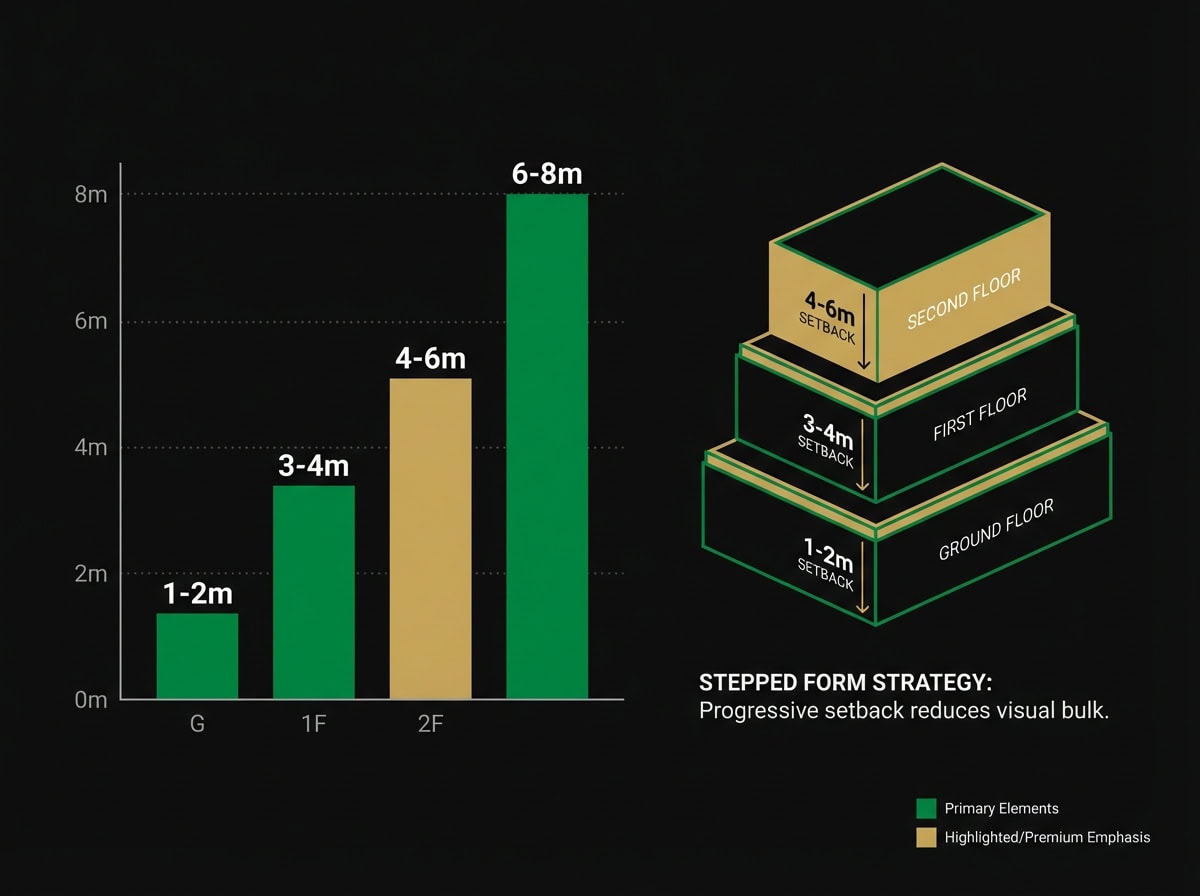
- Reduces visual bulk and overshadowing impacts
- Demonstrates design excellence in performance-based assessment
- Maximises ground-floor footprint where land value is highest
- Creates opportunities for balconies and terraces in upper-level setback zones
Manningham City Council and City of Boroondara particularly favour this approach, often approving developments with reduced ground-floor setbacks when upper levels demonstrate appropriate stepping.
Strategic Boundary Wall Placement
ResCode allows walls on boundaries up to 3.2m height and 9m length (or 50% of boundary length, whichever is lesser) without requiring setbacks. Strategic use of this provision can preserve developable area:
- Place garages and services on boundaries rather than habitable rooms
- Use boundary walls on southern boundaries where overshadowing isn’t an issue
- Limit boundary wall length to 9m, then set back remaining building elements
- Articulate boundary walls with varied materials and depths to reduce bulk appearance
In Knox and Maroondah projects, boundary walls have been used for single-storey garage and laundry elements, preserving setback areas for landscaping and private open space whilst maximising internal dwelling area.
Integrated Landscape Design
Setback areas aren’t wasted space—they’re opportunities for landscape design that enhances development value and approval prospects. Include detailed landscape plans showing:
- Canopy trees in rear setbacks (particularly important in Manningham and Knox)
- Screening vegetation in side setbacks to address overlooking concerns
- Permeable paving treatments that contribute to permeability requirements
- Integration with private open space and outdoor living areas
Developments with comprehensive landscape plans may achieve faster approval and fewer objections. The City of Whitehorse and City of Monash both reference landscape quality in their assessment of performance-based setback variations.
The Planning Permit Application Process for Setback Variations
When your design varies from standard setbacks, your planning permit application must clearly justify the variation. Here’s what Responsible Authorities expect to see.
Required Documentation
Performance-based setback applications should include:
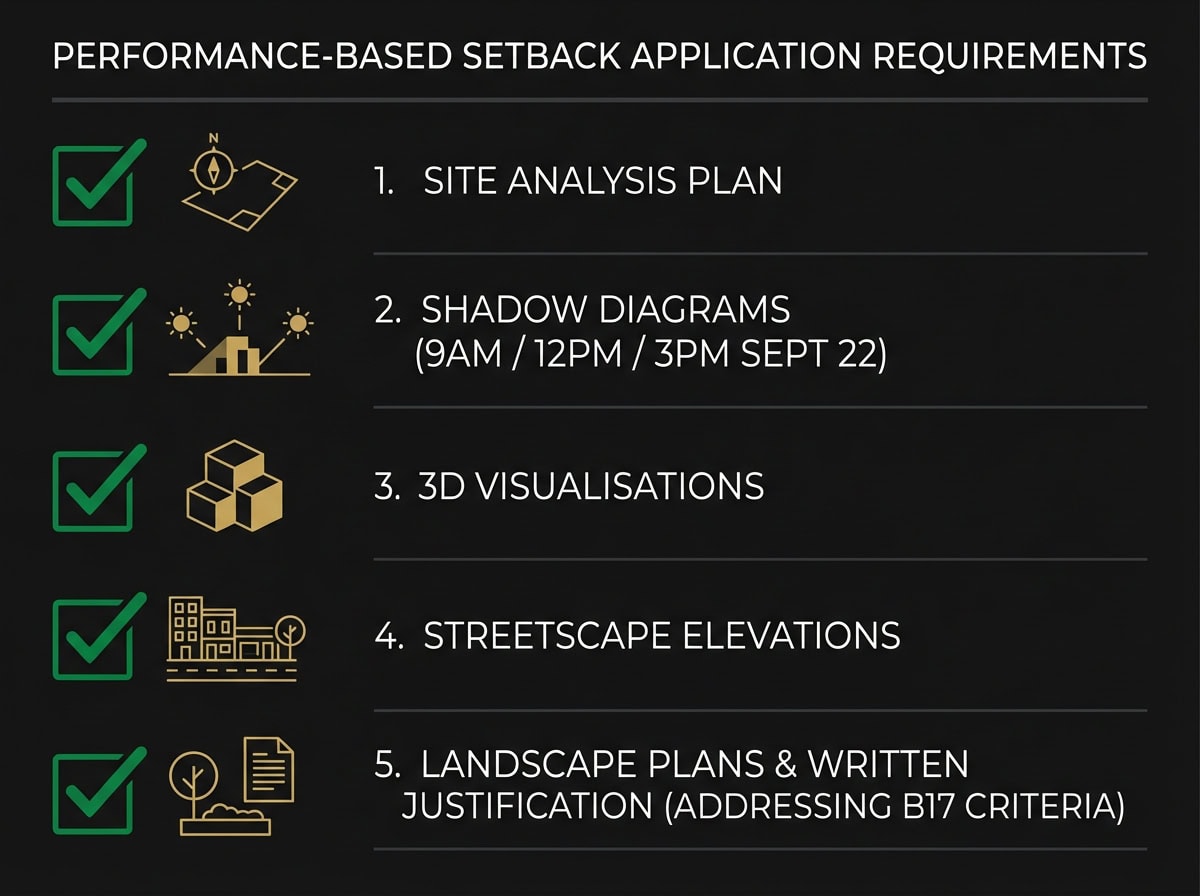
- Site analysis plan: Showing existing buildings on adjoining properties, their setbacks, and relationship to your proposal
- Shadow diagrams: Demonstrating overshadowing impacts at 9am, 12pm, and 3pm on 22 September (spring equinox)
- 3D visualisations: Showing building bulk and massing from neighbouring properties’ perspectives
- Streetscape elevations: Illustrating how your setbacks relate to existing neighbourhood patterns
- Landscape plans: Detailing planting in setback areas and how it addresses amenity concerns
- Written justification: Explicitly addressing each performance criterion in Standard B17
Applications lacking this documentation face requests for further information, extending timeframes by 4 to 8 weeks. Thorough documentation may help address council concerns and support efficient assessment. Understanding the broader building permit process helps developers coordinate planning and building approvals effectively.
Neighbour Consultation Strategy
Setback variations trigger neighbour objections more than any other ResCode element. Proactive consultation before lodgement can prevent formal objections:
- Present preliminary plans to immediate neighbours
- Address specific concerns through design modifications where reasonable
- Document consultation efforts in your planning application
- Consider written agreements with neighbours acknowledging reduced setbacks
In Boroondara and Whitehorse projects, early neighbour engagement may help reduce objection rates in some cases. Councils view consultation efforts favourably, even when objections still arise.
Timeframes and Assessment Process
Standard planning permit applications face statutory timeframes of 60 days, but setback variations often extend this:
- Weeks 1-2: Initial council assessment and allocation to planner
- Weeks 3-4: Detailed review and potential request for further information
- Weeks 5-6: Neighbour notification period (14 days minimum)
- Weeks 7-10: Objection review and assessment against ResCode performance criteria
- Weeks 11-12: Decision or referral to council planning committee
Applications with objections may extend to 90 to 120 days. If council doesn’t decide within statutory timeframes, you can appeal to VCAT for deemed refusal, though this rarely benefits developers seeking ongoing council relationships.
Recent Amendments Affecting Setback Assessment
Planning scheme amendments have modified how councils assess setback compliance, particularly for certain development types.
VC267 Deemed-to-Comply Pathways
Amendment VC267 (31 March 2025) introduced streamlined assessment pathways for townhouse and low-rise apartment developments. Where developments meet specific criteria including setback standards, they may qualify for faster approval through deemed-to-comply assessment.
For Eastern Suburbs developers, this means projects meeting standard B17 setback dimensions (without variation) may qualify for expedited processing. However, most sites require some setback variation to optimise yield, making performance-based assessment still necessary for commercially viable developments.
VC282 Design Requirement Updates
Amendment VC282 (8 September 2025) updated various Clause 54 design requirements, including provisions affecting how setbacks interact with other standards. The amendment emphasises integrated assessment of setbacks with street character, tree canopy coverage, and daylight access.
This reinforces the importance of comprehensive applications that address setback variations holistically rather than in isolation. Councils now explicitly consider how setback design contributes to broader neighbourhood character and environmental outcomes.
VC243 Transitional Provisions Removal
Amendment VC243 (1 September 2023) removed transitional provisions that previously allowed some developments to use older standards. All current applications must comply with current ResCode provisions, eliminating any ambiguity about which standards apply.
For developers with older planning permits, this means permit amendments or extensions must comply with current standards, potentially requiring increased setbacks compared to original approvals.
Frequently Asked Questions About ResCode Setbacks
Can I build right to the boundary if my neighbour’s house is already there?
Not automatically. Whilst ResCode allows boundary walls up to 3.2m height and 9m length, you must still demonstrate compliance with performance criteria regarding visual bulk, overshadowing, and amenity impacts. Existing non-compliant neighbouring development doesn’t exempt you from current standards, but it can support performance-based justification for reduced setbacks that match existing conditions.
Do setback requirements differ between single dwellings and multi-unit developments?
Yes, significantly. Single dwellings on lots may qualify for more flexible assessment under Clause 54, whilst multi-unit developments face stricter scrutiny under the same clause. Additionally, developments of three or more dwellings trigger different assessment pathways in some council planning schemes. The City of Boroondara and Manningham City Council particularly apply higher setback expectations for multi-unit developments to address cumulative amenity impacts.
How do I calculate setbacks for sloping sites?
Setbacks are measured horizontally from the boundary, regardless of slope. However, wall height calculations for determining required setback distances use natural ground level, not finished floor levels. On sloping sites, this often means different effective wall heights at different points along the boundary. Include detailed sections showing ground levels and wall heights at multiple points in your planning application to demonstrate accurate setback calculations.
What happens if my development is 100mm short of the required setback?
Minor variations (under 200mm) are generally assessed on performance criteria rather than strict numerical compliance. However, councils vary in their tolerance—Knox City Council and Maroondah City Council tend to require strict compliance, whilst City of Whitehorse and City of Monash may accept minor variations with appropriate justification. Always design to meet standards exactly; relying on council flexibility for minor shortfalls is risky.
Can I include balconies and eaves in the setback area?
Balconies and eaves projecting into setback areas are assessed based on their impact on amenity. Eaves up to 600mm projection are generally accepted, whilst balconies face stricter scrutiny due to overlooking potential. Upper-level balconies within reduced setback areas typically require screening (1.7m high minimum) and should be shown on plans with privacy treatments detailed. In Boroondara and Whitehorse projects, recessed balconies within the building envelope perform better than projecting balconies in setback zones.
Do heritage overlays change setback requirements?
Heritage overlays don’t directly modify ResCode setback standards, but they add additional assessment criteria. In heritage areas, councils expect setbacks that match or respect existing heritage building patterns. The City of Boroondara’s heritage precincts in Kew, Camberwell, and Hawthorn typically require 4m to 6m side setbacks to match Victorian and Edwardian housing patterns, regardless of what ResCode minimum standards might allow.
How far back should I set upper levels compared to ground floors?
Whilst ResCode doesn’t mandate specific upper-level setback increases, councils expect progressive stepping. A typical successful approach: ground floor at 2m, first floor at 3m to 4m, second floor (if applicable) at 4m to 6m. This demonstrates design response to visual bulk concerns and may achieve approval even where ground-floor setbacks vary from standards. Manningham City Council and City of Monash particularly favour this stepped approach in their assessment of multi-storey developments.
What is the difference between setbacks and fence height regulations?
Setbacks control building position relative to boundaries, whilst fence height regulations govern boundary fencing. Both are separate planning considerations. A compliant setback doesn’t automatically permit any fence height, and vice versa. Fencing within setback areas must comply with both setback landscaping expectations and fence height limits (typically 2m for side/rear boundaries in residential zones).
Conclusion: Strategic Setback Design for Development Success
ResCode Standards B17 to B20 create the framework for side and rear setbacks, but successful Eastern Suburbs developments require understanding how each Responsible Authority interprets and applies these standards. The difference between a profitable project and a VCAT appeal often comes down to strategic setback design that balances development yield with demonstrable amenity outcomes.
With recent amendments including VC267 and VC282 reshaping assessment pathways, developers need current expertise to navigate setback requirements efficiently. Experience across numerous projects in Whitehorse, Boroondara, Manningham, Monash, Knox, and Maroondah has shown that proactive setback design—integrated with landscape planning, building form, and neighbourhood character analysis—may achieve faster approvals and fewer objections than minimum-compliance approaches.
Get Your Site Assessment: SQM Architects (ARBV Reg. No. 51498) offers site assessments for Eastern Suburbs developers. Analysis of your site’s setback constraints and strategies to optimise development potential whilst maintaining planning approval certainty is available. Call (03) 9005 6588 to discuss your project.
This article provides general information about Victorian planning for property developers. It does not constitute professional advice. For specific guidance on your project, contact SQM Architects (ARBV Reg. No. 51498) for a site assessment.