
Receiving a Show Cause Notice on an active development site is one of the more stressful moments in a property developer’s career. Whether it arrives from the Municipal Building Surveyor, the Responsible Authority, or the Building and Plumbing Commission (BPC), the instinct is often to panic — or worse, to ignore it. Neither response serves your project or your development outcome.
The good news is that a Show Cause Notice is not a conviction, a fine, or a demolition order. It is, in legal terms, an invitation — a formal opportunity to explain your position before enforcement action is taken. Developers who understand the process, respond strategically, and engage the right professionals early are far better positioned to resolve the matter without escalation. Responding promptly — generally within the first 14 days — with a credible rectification plan could reduce the likelihood of escalation to the Magistrates’ Court or VCAT, though outcomes will depend on the specific circumstances of each matter.
This guide provides Melbourne property developers — particularly those active across Melbourne including the City of Whitehorse, City of Boroondara, Manningham City Council, City of Monash, Knox City Council, and Maroondah City Council — with a practical overview of what Show Cause Notices are, how they arise, what the escalation pathway looks like, and how to respond effectively to protect your project and your development outcome.
The Two Types of Show Cause Notice Developers Encounter
In Victoria, “Show Cause Notice” is not a single, uniform document. The term applies across two distinct regulatory frameworks, and understanding which type you have received determines your response strategy, your timeframes, and the authority you are dealing with.
1. Building Notices Under the Building Act 1993
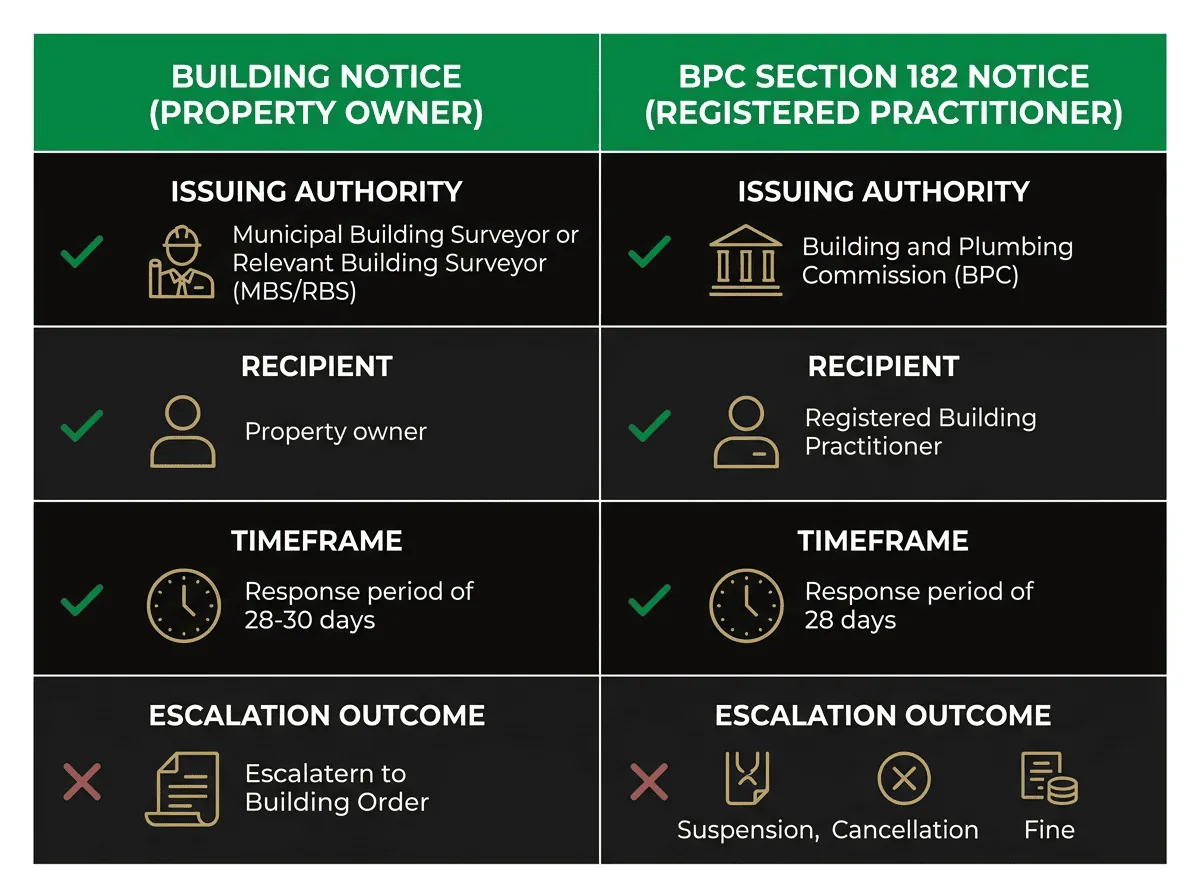
The most common Show Cause Notice a developer will encounter is a Building Notice issued under the Building Act 1993. This document is issued by either a Municipal Building Surveyor (MBS) or a Relevant Building Surveyor (RBS) when an inspection reveals that building work may not comply with the Act or the Building Regulations 2018. Common triggers include work carried out without a building permit, work that deviates from an issued building permit, or a structure deemed unsafe or unfit for occupation.
Critically, a Building Notice is issued to the owner of the property — not the builder, architect, or project manager. As a developer, this means the legal obligation to respond sits with you, regardless of which contractor or consultant may have caused the non-compliance. The notice triggers a formal “show cause” process: you are given the opportunity to explain, in writing, why the building work should not be demolished, altered, or otherwise remedied as directed.
Response timeframes for Building Notices are typically 28 to 30 days from the date of service. If you do not respond within the specified period, or if your response does not satisfy the building surveyor, a Building Order may be issued — a more serious directive that mandates specific action and carries significant penalties for non-compliance.
2. Show Cause Notices Against Registered Building Practitioners
The second type of Show Cause Notice is issued by the Building and Plumbing Commission (BPC) — formerly the Victorian Building Authority (VBA) — under Section 182 of the Building Act 1993. This notice targets Registered Building Practitioners (RBPs), not property owners directly. It initiates a disciplinary process that may result in suspension, cancellation of registration, a reprimand, or a fine.
While this type of notice is directed at your builder, building surveyor, or other registered practitioners rather than at you as the developer, it can have significant flow-on consequences for your project. A suspended or deregistered builder mid-construction creates serious programme and contractual risks. Developers should be aware of this process and factor it into their contractor due diligence. The BPC provides an initial 28-day show cause period, which may be extended on request.
How Show Cause Notices Arise on Development Sites
Understanding the common triggers for Show Cause Notices helps developers implement proactive risk management across their projects. Notices rarely arise without warning — there is almost always a preceding event or pattern that, in hindsight, signalled the risk.
Common Triggers in Melbourne
- Unauthorised building work: Construction commenced without a building permit, or work that materially deviates from the approved plans and specifications.
- Planning permit condition breaches: Works that contravene conditions attached to a planning permit — for example, exceeding approved building heights, altering approved materials, or failing to implement required landscaping.
- Section 173 Agreement non-compliance: Failure to register or comply with a Section 173 Agreement is a significant and increasingly common trigger, particularly on subdivisions and medium-density developments across the City of Monash and City of Whitehorse.
- Neighbour complaints: Adjoining owners or occupiers lodging complaints with the Responsible Authority about perceived breaches — a particularly common pathway in heritage-sensitive areas within the City of Boroondara.
- Routine inspections: Municipal Building Surveyors conducting site inspections, or building surveyors identifying non-compliance during mandatory inspection stages.
- ResCode non-compliance: Residential developments that deviate from Clause 54 (one dwelling on a lot) or Clause 55 (two or more dwellings) standards without adequate justification, including setbacks, overlooking, and overshadowing provisions.
- Developer Bond Scheme breaches: From July 2026, residential buildings over three storeys will be required to lodge a 2% bond of total build cost. Failure to comply may trigger a Show Cause Notice and could block the issuance of an Occupancy Permit.
It is worth noting that councils across Melbourne vary considerably in their enforcement posture. Manningham City Council and Knox City Council tend to favour a graduated approach — beginning with education letters or informal notices before escalating to formal Show Cause Notices. The City of Boroondara, particularly in heritage overlay areas, has demonstrated a willingness to escalate more quickly to VCAT Enforcement Orders where heritage values are at risk. City of Monash, following internal reviews in 2025, has tightened its procedural accuracy to ensure all notices allow for postage time — adding seven days to the statutory minimum — to avoid notices being declared procedurally invalid.
The Escalation Pathway: From Notice to Enforcement Order
A Show Cause Notice sits at the beginning of a formal enforcement escalation pathway. Developers need to understand each stage and the consequences of inaction at any point.
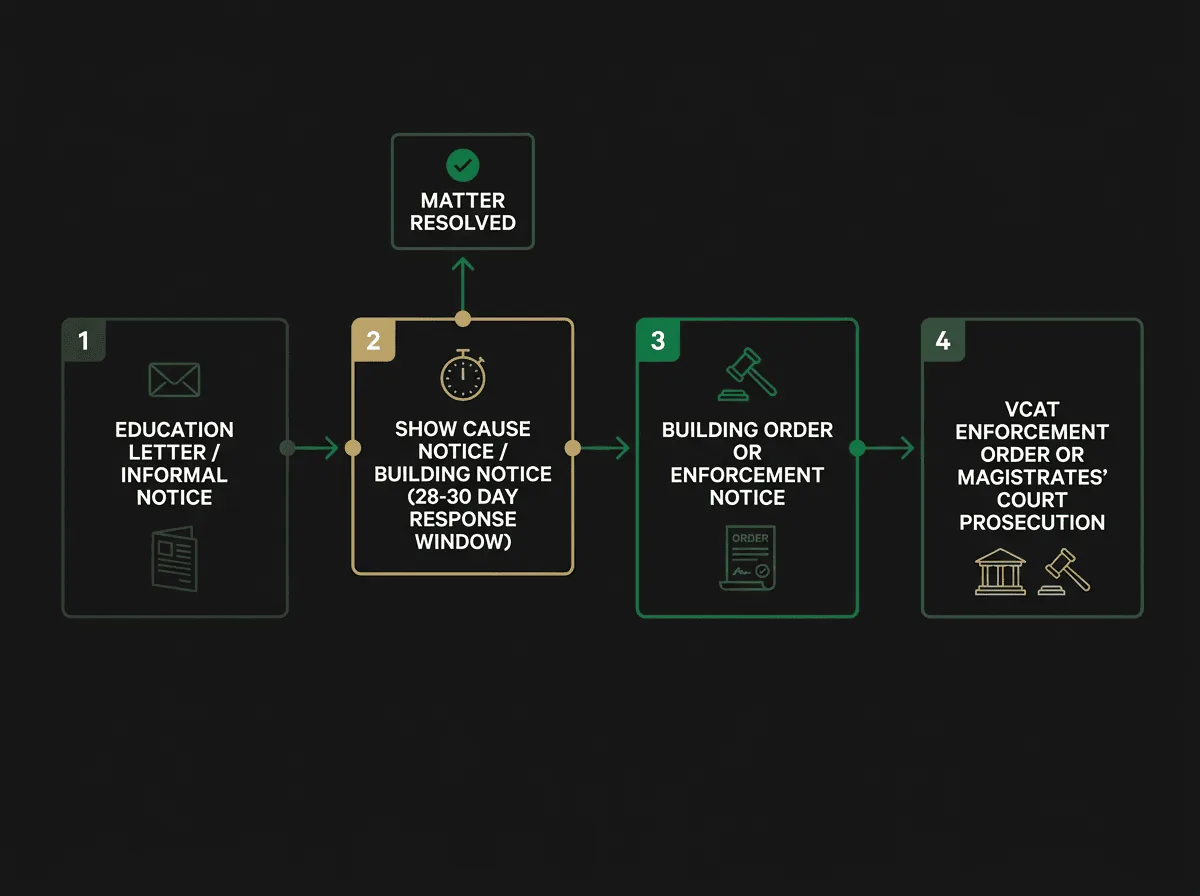
Stage 1: Education Letter or Informal Notice
Many councils — particularly Manningham City Council and Maroondah City Council — will issue an informal education letter before commencing formal enforcement action. This is not a statutory document, but it should be treated with the same seriousness as a formal notice. It is an early opportunity to open a dialogue with the Responsible Authority and potentially resolve the matter before it escalates. Ignoring an education letter is a common and costly mistake.
Stage 2: Show Cause Notice / Building Notice
The formal Show Cause Notice or Building Notice is issued when the Responsible Authority or building surveyor has formed a view that a breach may have occurred and that enforcement action may be warranted. This is your primary opportunity to respond. A well-prepared, evidence-based response submitted within the show cause period may result in the notice being withdrawn or no further action being taken.
Stage 3: Building Order or Enforcement Notice
If your response is unsatisfactory, or if you fail to respond within the specified timeframe, the authority may issue a Building Order (under the Building Act 1993) or an Enforcement Notice (under the Planning and Environment Act 1987). These are statutory documents that mandate specific action within a defined timeframe. Non-compliance at this stage constitutes a serious offence.
Stage 4: VCAT Enforcement Order or Magistrates’ Court Prosecution
The most serious escalation pathway involves the Responsible Authority applying to VCAT for an Enforcement Order under Section 114 of the Planning and Environment Act 1987, or referring the matter to the Magistrates’ Court for criminal prosecution. Penalty units in Victoria are indexed annually — refer to the Department of Treasury and Finance for the current value. Serious contraventions can also attract custodial sentences.
Importantly, the Planning Amendment (Better Decisions Made Faster) Act 2026 will introduce a commercial benefit recovery mechanism once it commences — a date that is not before 29 October 2027 — enabling courts to order developers to repay financial gains derived from a planning breach — for example, additional revenue generated from an unapproved additional storey. This reform significantly raises the stakes for non-compliance.
Get the 7-point site check to run before committing to a permit application — zoning, overlays, setbacks and council red flags, in plain English. Free PDF, instant download.
- Zone, overlay & setback checks
- What council assesses first
- Permit-readiness red flags
Something went wrong. Please try again.
No spam. Unsubscribe anytime.
Check your inbox — your checklist is on its way.
How to Respond to a Show Cause Notice: Practical Steps
A structured, professional response to a Show Cause Notice may be the difference between a resolved matter and a protracted enforcement dispute. The following steps outline a practical approach for developers.
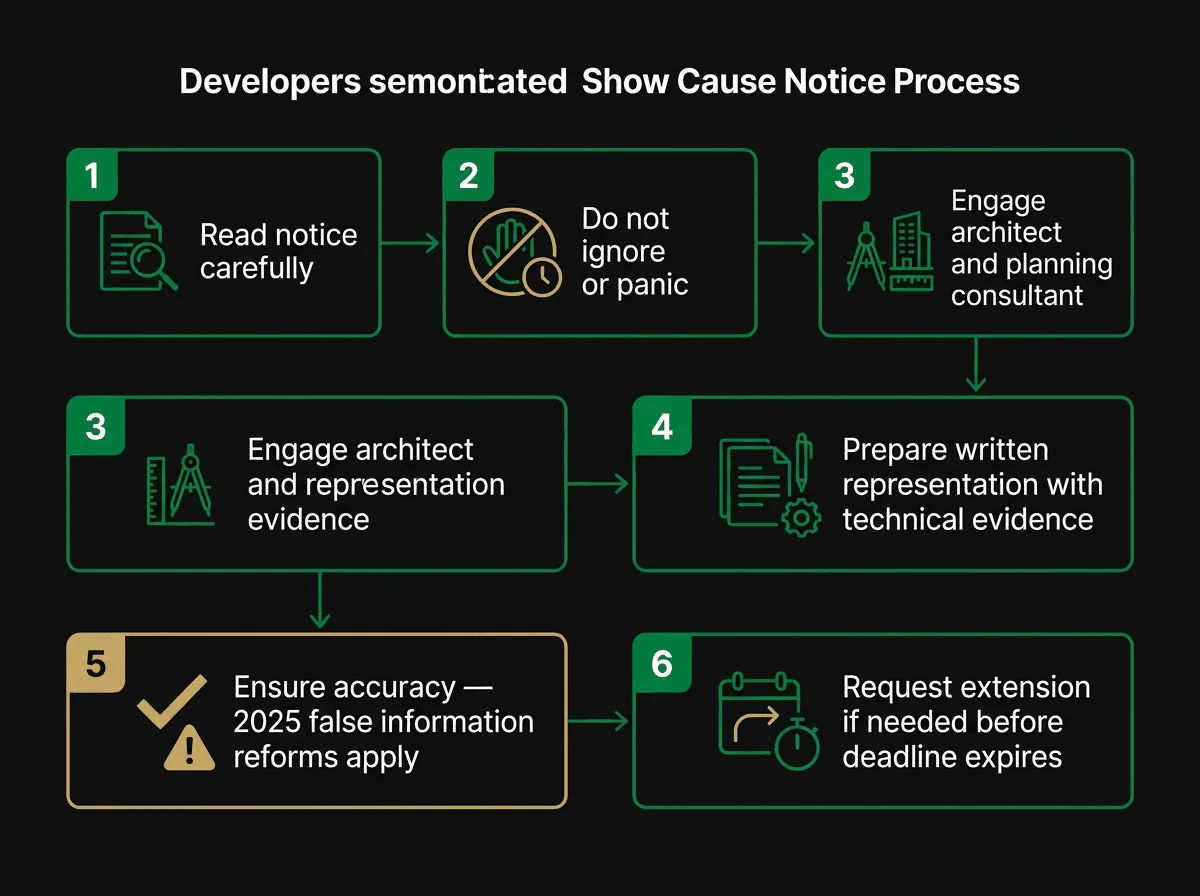
Step 1: Read the Notice Carefully and Immediately
Identify the specific alleged breach, the legislative basis for the notice, the response deadline, and the proposed enforcement action. Note whether the notice has been served by registered post — if so, allow for postage time when calculating your response deadline. City of Monash, for example, now formally adds seven days to the statutory 21-day minimum to account for postage.
Step 2: Do Not Ignore It — and Do Not Panic
A Show Cause Notice is not a final determination. It is an invitation to respond. Ignoring it, however, effectively waives your right to be heard and will almost certainly result in escalation to a Building Order or Enforcement Notice. Equally, responding in haste without proper preparation may weaken your position.
Step 3: Engage Your Architect and Planning Consultant Immediately
Your response should be technically grounded. Engage your architect to assess whether the alleged non-compliance is accurate, and to prepare documentation demonstrating either compliance or a credible rectification pathway. Where the notice relates to ResCode matters — for example, Clause 55 setback or overlooking standards — your response should specifically reference the relevant clauses and provide technical evidence of compliance or proposed rectification.
Step 4: Prepare a Written Representation
Your written representation should address each alleged breach directly and include:
- A clear statement of your position — whether you dispute the alleged breach, accept it, or propose rectification
- Technical evidence supporting your position, such as architectural drawings, engineering reports, or survey certificates
- A realistic and committed rectification timeline, if works are required
- Names and details of any registered practitioners engaged to assess or rectify the works
- Any mitigating circumstances relevant to the breach
Step 5: Be Accurate — The 2025 “False Information” Reforms Apply
Under reforms introduced in 2025, providing false or misleading information in response to an enforcement investigation is now a standalone criminal offence. Any representation you make in response to a Show Cause Notice must be entirely accurate. If you are uncertain about any aspect of the alleged breach, seek professional guidance before responding rather than providing information that may later be found to be inaccurate or misleading.
Step 6: Request an Extension If Needed
If the show cause period is insufficient to prepare a thorough response, contact the issuing authority before the deadline expires and request an extension. Both the BPC and most councils will consider extension requests on their merits. Failing to request an extension and missing the deadline is far more damaging than asking for more time.
Council Variations Across Melbourne
While the legislative framework under the Building Act 1993 and the Planning and Environment Act 1987 applies uniformly across Victoria, enforcement practice varies meaningfully between councils. Developers active across multiple Melbourne municipalities should be aware of these differences.
- City of Whitehorse: Generally takes a graduated approach to enforcement, with informal contact often preceding formal notices. Responsive to rectification plans submitted promptly and professionally.
- City of Boroondara: Maintains a more assertive enforcement posture, particularly in heritage overlay areas. Has demonstrated willingness to escalate to VCAT Enforcement Orders where heritage values are at risk. Early engagement is strongly advisable on any heritage-affected site.
- Manningham City Council: Favours a conciliatory first approach, often issuing education letters before formal notices. Responsive to proactive developer engagement and rectification commitments.
- City of Monash: Has tightened procedural accuracy following 2025 internal reviews, ensuring all notices account for postage time. Responds well to technically detailed representations supported by registered practitioner assessments.
- Knox City Council: Tends toward negotiated compliance outcomes where possible. Developers with a demonstrated history of good faith engagement generally achieve more favourable outcomes.
- Maroondah City Council: Applies a graduated enforcement approach. Education letters are common as a first step, with formal notices reserved for matters where informal resolution has not been achieved.
SQM Architects has delivered projects across Melbourne over many years, building experience in compliance and enforcement matters across the region. That experience is built in part on understanding how each council approaches compliance and enforcement — and engaging proactively before matters escalate.
Practical Tips for Developers: Avoiding Show Cause Notices
The most effective strategy for managing Show Cause Notices is to avoid receiving them in the first place. The following practices may significantly reduce your exposure across active development projects.
- Audit Section 173 Agreements before construction commences. Ensure all agreements are registered on title and that your construction programme accounts for all conditions. Non-compliance with Section 173 Agreements is a significant and avoidable trigger for enforcement action.
- Conduct pre-construction permit condition reviews. Before breaking ground, have your architect and planning consultant review every condition attached to your planning permit. Identify any conditions that require pre-commencement action — such as endorsed plans, material samples, or landscape plans — and ensure these are satisfied before works begin.
- Maintain a compliant inspection regime. Ensure mandatory building inspection stages are booked and completed on time. Missed inspections are a common pathway to compliance issues being identified retrospectively.
- Respond to neighbour complaints proactively. If you become aware of a neighbour complaint to the Responsible Authority, engage with the council proactively rather than waiting for a formal notice. Early engagement often allows matters to be resolved informally.
- Prepare for the Developer Bond Scheme. From July 2026, residential buildings over three storeys will require a 2% bond of total build cost. Factor this into your project financing and ensure compliance from the outset to avoid triggering enforcement action or delays to your Occupancy Permit.
- Document everything. Maintain comprehensive records of all permit approvals, endorsed plans, inspection certificates and compliance documentation, and correspondence with the Responsible Authority and building surveyor. In the event of a dispute, contemporaneous documentation is your most valuable asset.
Frequently Asked Questions
What is the difference between a Show Cause Notice and a Building Order?
A Show Cause Notice (or Building Notice) is a preliminary document that invites you to explain why enforcement action should not be taken. It is not a final determination. A Building Order, by contrast, is a statutory directive that mandates specific action — such as demolition or rectification — within a defined timeframe. Non-compliance with a Building Order constitutes a serious offence and may result in prosecution in the Magistrates’ Court.
How long do I have to respond to a Show Cause Notice in Victoria?
Response timeframes vary depending on the type of notice and the issuing authority. Building Notices under the Building Act 1993 typically allow 28 to 30 days for a written response. BPC Show Cause Notices directed at registered practitioners allow 28 days, with extensions available on request. Planning-related notices from councils typically allow 20 to 30 days. Always check the specific deadline stated in your notice and allow for postage time if the notice was served by registered post.
Can I appeal a Building Notice or Building Order?
Yes. Under Section 142 of the Building Act 1993, the owner of a building or land may apply to the Building Appeals Board (BAB) to have a Building Notice or Building Order set aside. The prescribed appeal period is 30 days from the date the notice is served. Grounds for appeal may include that the building work falls within permit exemptions under Schedule 3 of the Building Regulations 2018, or that the notice was not validly issued.
Does a Show Cause Notice affect my ability to sell or refinance the property?
An unresolved Building Notice or Enforcement Notice may appear on a property’s title search or Section 32 vendor statement, which could affect your ability to sell or refinance. Lenders and purchasers will typically require evidence that any outstanding notices have been resolved before proceeding. Addressing compliance matters promptly is therefore important not only for your current project but for your broader development outcome.
What happens if I ignore a Show Cause Notice?
Ignoring a Show Cause Notice effectively waives your right to be heard and will almost certainly result in escalation. The building surveyor or Responsible Authority may proceed to issue a Building Order or Enforcement Notice without further consultation. In serious cases, the matter may be referred to VCAT for an Enforcement Order or to the Magistrates’ Court for prosecution, with penalties potentially reaching significant amounts per day of ongoing non-compliance.
Can my builder or architect respond to the notice on my behalf?
Yes. The Responsible Authority or building surveyor will generally accept representations from a registered building practitioner, architect, planning consultant, or legal representative acting on your behalf. Given the technical nature of most Show Cause Notices, engaging a qualified professional to prepare and submit your response is strongly advisable. Ensure any representative is clearly authorised to act on your behalf and that their response accurately reflects your position.
What is the “false information” risk under the 2025 reforms?
Under reforms introduced in 2025, it is now a standalone criminal offence to knowingly or recklessly provide false or misleading information during an enforcement investigation — including in your Show Cause Notice response. This reform significantly raises the stakes for developers who might be tempted to minimise or misrepresent the nature of a breach. Any information provided in your response must be entirely accurate, and if you are uncertain, seek professional guidance before submitting.
Conclusion: Act Early, Respond Professionally, Protect Your Project
A Show Cause Notice is a serious document that demands a prompt, professional, and technically grounded response. But it is not the end of the road. Developers who understand the process, engage the right professionals early, and respond within the show cause period with credible evidence and a realistic rectification plan are well positioned to resolve the matter without escalation. The key variables are time and preparation — both of which are within your control from the moment the notice arrives.
SQM Architects has supported developers through compliance challenges at every stage of the development lifecycle across Melbourne. If you have received a Show Cause Notice or Building Notice, or if you want to implement proactive compliance measures across your current or upcoming projects, our team may be able to help you assess your position and identify appropriate next steps.
Book a Strategy Call — speak with SQM Architects about your project’s compliance position today. Call us on (03) 9005 6588.
This article provides general information about Victorian planning and building compliance for property developers. It does not constitute professional advice. For specific guidance on your project, contact SQM Architects for a complimentary site assessment.