Understanding the Key Differences for Melbourne Property Developers
When planning a development project in Melbourne, one of the first decisions you’ll face is whether to engage a draftsperson or an architect. This choice significantly impacts your project timeline, planning approval success rate, and ultimately, your development returns.
The distinction matters more than many developers realise. Whilst both professionals can prepare drawings for planning permits, their qualifications, scope of work, and ability to navigate complex planning schemes vary considerably. For property developers working across Whitehorse, Boroondara, Manningham, Monash, Knox, and Maroondah, understanding these differences is essential to making informed decisions that safeguard your development.
This guide examines the practical differences between draftspeople and architects from a developer’s perspective, covering qualifications, costs, and when each professional adds the most value to your project.
Qualifications and Registration Requirements in Victoria
The educational and registration requirements for architects and draftspeople differ substantially under Victorian legislation. These differences directly affect the complexity of projects each professional can legally undertake and the level of professional accountability they carry.
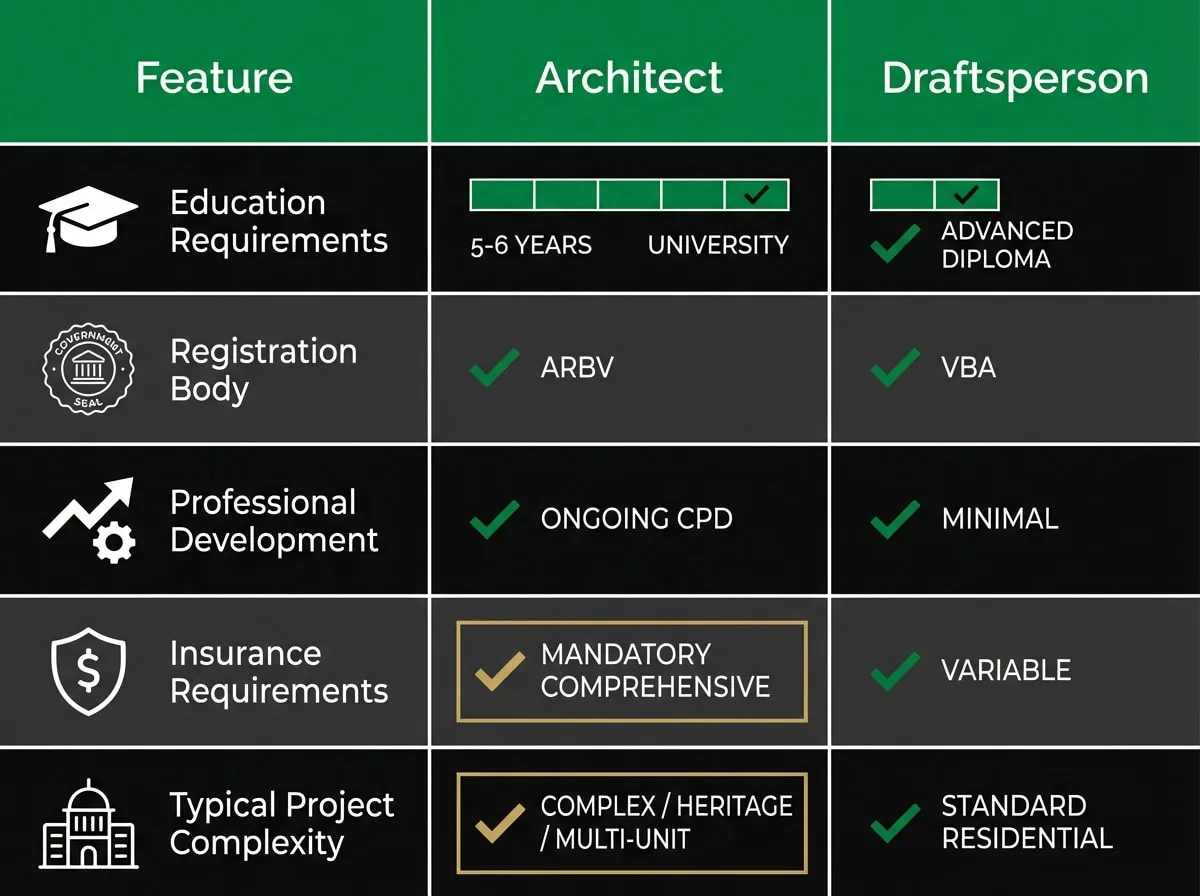
Architects must complete extensive education and registration requirements before they can legally use the title “architect” in Victoria. The pathway includes a recognised university degree (typically five to six years of study), a minimum of two years supervised professional experience, successful completion of the Architectural Practice Examination, and annual registration renewal with the Architects Registration Board of Victoria (ARBV). Registered architects must also maintain professional indemnity insurance and complete ongoing Continuous Professional Development obligations.
Draftspeople in Victoria have more varied pathways to practice. Draftspeople who wish to be registered with the Building and Plumbing Commission (BPC) do so under the class “Building Design (Architectural)”. Registration requires completion of an Advanced Diploma in Building Design (Architectural) and at least one year of professional experience. However, the educational requirements are considerably less extensive than those for architects.
Some draftspeople operate without formal tertiary qualifications, having learned their skills on the job or through TAFE courses. Whilst they may produce technical drawings, Victorian law does not reserve the preparation of planning or building permit documentation to any registered class — the Building Regulations 2018 prescribe restricted work only for building surveyors, building inspectors and domestic builders. What registration governs is title: an unregistered person must not represent themselves as a registered building designer. For developers, verifying BPC registration is essential before engaging any draftsperson.
Scope of Services and Design Capability
The scope of work typically provided by architects versus draftspeople differs significantly, particularly for development projects requiring creative problem-solving and comprehensive project coordination.
Architects generally offer full-service project delivery, from initial site analysis through to construction administration. Their services typically include conceptual design development, detailed design documentation, coordination with consulting engineers (structural, civil, hydraulic), preparation of planning permit applications, energy efficiency assessments, interior design integration, and construction phase services including contract administration and site inspections. Architects are trained to maximise site potential, navigate complex planning overlays, and create designs that balance aesthetic quality with commercial viability.
For developers working on sites with challenging characteristics—steep topography, heritage overlays, neighbourhood character requirements, or complex planning scheme provisions—architects bring valuable expertise in design solutions that satisfy planning requirements whilst optimising development yield.
Draftspeople typically focus on technical documentation rather than comprehensive design services. Their core work involves translating existing design concepts into detailed construction drawings, preparing documentation for planning permit and building permit applications, and producing plans that comply with the National Construction Code and ResCode requirements. Many draftspeople work from standard designs or builder-supplied concepts, adapting these to specific sites and client requirements.
Whilst experienced draftspeople can suggest modifications and provide advice on planning regulations, their primary expertise lies in accurate technical drawing rather than holistic design problem-solving. For straightforward development projects—such as standard townhouse developments on flat sites with minimal planning constraints—a competent draftsperson may provide adequate documentation at lower cost.
Get the 7-point site check to run before committing to a permit application — zoning, overlays, setbacks and council red flags, in plain English. Free PDF, instant download.
- Zone, overlay & setback checks
- What council assesses first
- Permit-readiness red flags
Something went wrong. Please try again.
No spam. Unsubscribe anytime.
Check your inbox — your checklist is on its way.
Cost Comparison for Development Projects
Professional fees represent a significant consideration for developers, but evaluating cost requires looking beyond initial design fees to consider the total project value delivered.
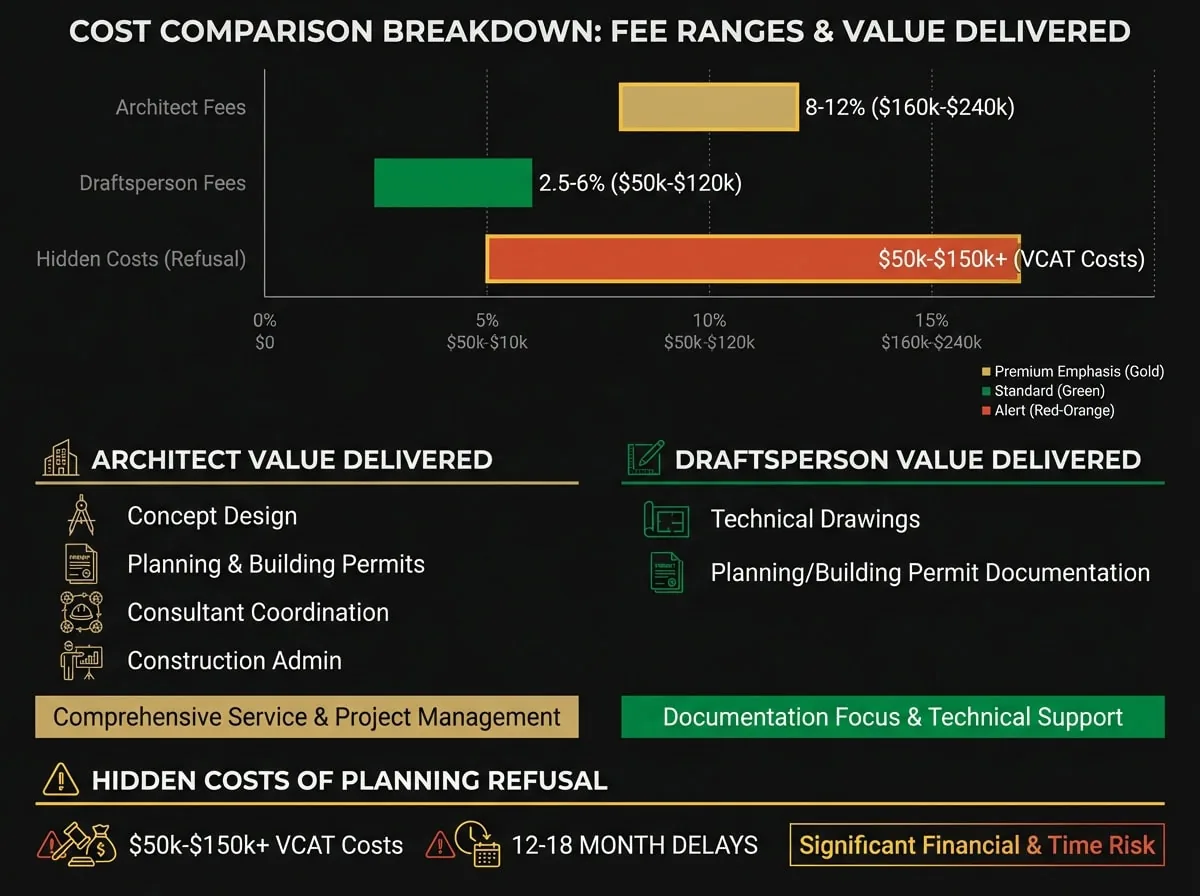
Architect fees in Melbourne could potentially range from 4% to 12% of total construction cost for some residential development projects, though this varies considerably based on project complexity, scope of services, and individual firm pricing structures. For a $2M townhouse development, architectural fees might be in the vicinity of $80,000 to $240,000 in some cases, though individual projects may vary significantly. Architects may charge on a percentage basis, fixed fee, or hourly rate depending on the project and agreement structure.
These fees generally cover comprehensive services including concept design, planning permit documentation, detailed design development, building permit documentation, consultant coordination, and construction phase services. The value proposition lies in optimised design outcomes, potentially higher planning approval success rates, and construction documentation that may help minimise variations and delays.
Draftsperson fees may be lower in many cases, potentially ranging from 1.5% to 6% of construction cost for some practitioners, or charged on a per-square-metre basis for residential projects. For the same $2M development, draftsperson fees could range from $30,000 to $120,000 in some instances, though pricing varies widely between individual practitioners. However, these fees often cover a narrower scope of work, primarily focused on drawing production rather than comprehensive design services and project coordination.
Developers should consider that lower initial design fees may not necessarily translate to better overall project economics. A well-designed project by an experienced architect may potentially achieve better planning outcomes, higher sale prices, more efficient construction, and fewer costly variations during the build phase. Some experienced architectural firms have reported high planning approval rates in their portfolios, though outcomes vary significantly by project complexity and local planning context.
Planning Permit Success and Council Navigation
For property developers, planning permit approval is often the critical path item that determines project viability. The professional you engage can significantly impact your likelihood of first-time approval and the speed of the planning process.
Architects typically bring extensive experience in preparing planning permit applications that address all requirements of the relevant Victorian planning scheme. They understand how to respond to planning policies, demonstrate compliance with ResCode standards, address neighbourhood character considerations, and prepare compelling design responses to planning objections. Experienced architects often maintain relationships with council planning departments and understand the specific expectations and priorities of different municipalities across Melbourne.
For example, the City of Boroondara has particularly stringent neighbourhood character requirements, whilst Manningham City Council focuses heavily on vegetation protection and landscape character. An architect familiar with these councils can tailor the design approach and documentation to address specific local concerns, potentially improving approval prospects.
Draftspeople can prepare planning permit documentation that meets technical compliance requirements, but may have less experience in addressing subjective planning considerations or responding to complex planning objections. For straightforward developments in areas with minimal planning constraints, a draftsperson may successfully navigate the planning process. However, for sites with heritage overlays, significant vegetation, or in areas with strong neighbourhood character policies, the additional expertise of an architect often proves valuable.
The cost of planning refusals or lengthy VCAT appeals can far exceed the difference in professional fees between architects and draftspeople. A refused planning application could delay a project by 12 to 18 months and potentially add costs that could range from $50,000 to $150,000 or more in some cases for VCAT proceedings, revised designs, and extended holding costs, though actual costs vary widely based on case complexity.
When to Engage an Architect
Certain project types and site conditions strongly favour engaging an architect rather than a draftsperson. Understanding these scenarios helps developers make strategic decisions about professional engagement.
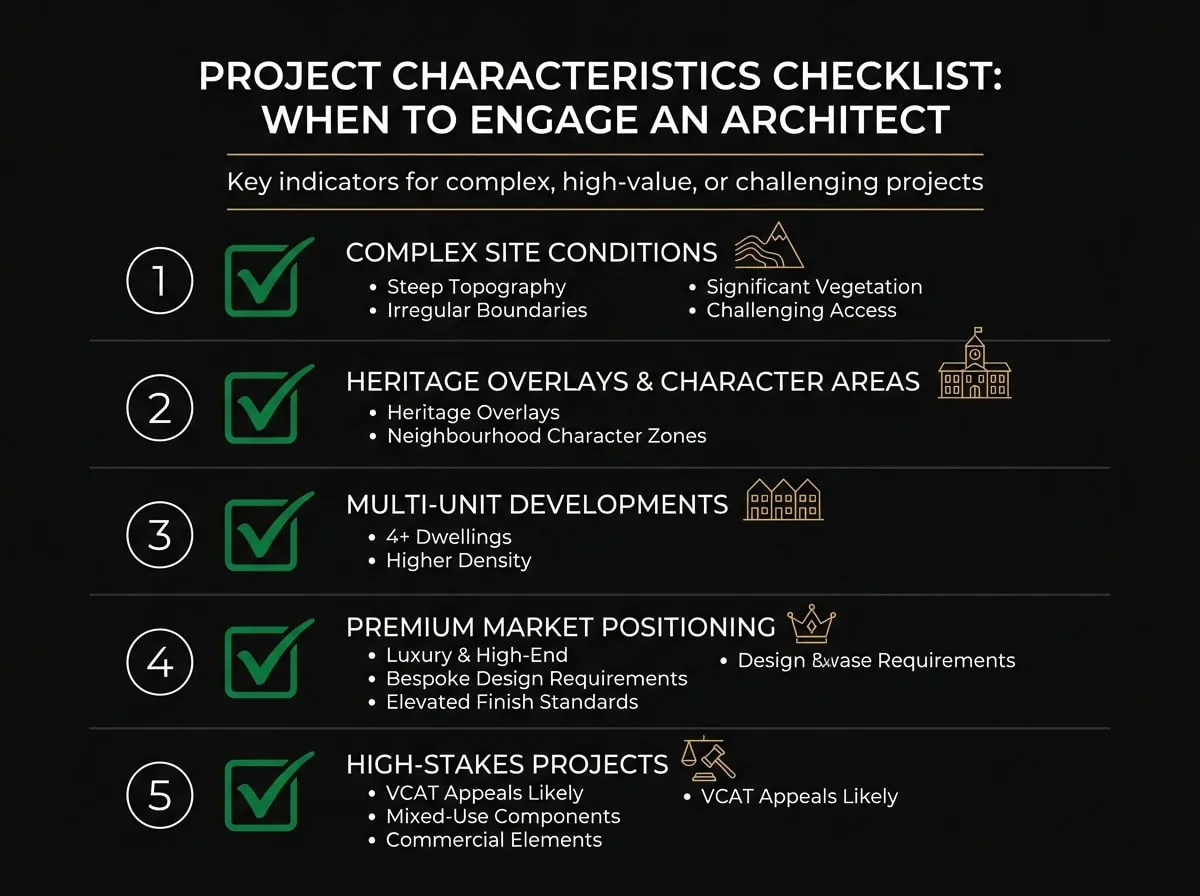
Complex site conditions warrant architectural expertise. Sites with steep topography, irregular boundaries, significant vegetation, or challenging access require creative design solutions that maximise development potential whilst satisfying planning requirements. Architects are trained to analyse site constraints and develop innovative responses that draftspeople may not conceive.
Heritage overlays and neighbourhood character areas demand sophisticated design responses. Councils in Boroondara, Whitehorse, and Manningham have extensive heritage overlay areas where planning applications receive intense scrutiny. Architects experienced in heritage contexts understand how to design contemporary developments that respect heritage character whilst achieving viable development outcomes.
Multi-unit developments benefit from architectural input to optimise unit layouts, maximise natural light, create efficient circulation, and design amenity spaces that may enhance marketability. The difference between a mediocre unit layout and an excellent one can potentially impact sale prices and absorption rates. For developments of four or more dwellings, architectural fees typically represent good value relative to the potentially improved sales outcomes that may be achieved.
Premium market positioning requires architectural design quality. If your development strategy targets the upper end of the market, architect-designed projects may command price premiums and sell faster than standard developments. The “architecturally designed” marketing message can resonate with buyers seeking quality and distinction.
Projects requiring VCAT appeals benefit from architectural expertise in expert witness testimony and design advocacy. If your project faces planning objections or council refusal, an architect can provide expert evidence at VCAT and defend the design merits of the proposal.
When a Draftsperson May Be Sufficient
Not every development project requires the comprehensive services of an architect. Understanding when a draftsperson can adequately serve your needs helps optimise professional fee expenditure.
Standard townhouse developments on flat, regular sites in areas with minimal planning constraints may not require architectural input. If you’re developing a straightforward two or three-townhouse project using a proven layout on a site without heritage overlays, significant vegetation, or neighbourhood character considerations, a competent draftsperson can prepare adequate documentation.
Subdivision projects that don’t involve building design may only require surveying and subdivision documentation rather than architectural services. A draftsperson can prepare the necessary plans for a Statement of Compliance and coordinate with surveyors to complete the subdivision process.
Minor alterations or additions to existing developments may not warrant architectural fees. If you’re making small modifications to an existing approved design or adding minor elements like carports or pergolas, a draftsperson can document these changes efficiently.
Budget-constrained projects in highly competitive market segments may need to minimise design fees to maintain viability. If you’re developing in the entry-level market where price sensitivity is extreme and design differentiation provides limited value, a draftsperson may represent the appropriate professional engagement.
However, even in these scenarios, developers should verify that the draftsperson has specific experience with similar projects and demonstrated success in obtaining planning approvals from the relevant council. Requesting examples of previous work and references from past clients provides important due diligence.
Professional Indemnity Insurance and Risk Management
Professional indemnity insurance requirements differ between architects and draftspeople, creating different risk profiles for developers who engage these professionals.
Architects must maintain professional indemnity insurance as a condition of their registration with the ARBV. This insurance protects clients against financial loss resulting from professional negligence, errors, or omissions in the architect’s work. The insurance requirement provides developers with recourse if design errors lead to planning refusals, construction problems, or other financial losses.
The ARBV sets minimum insurance requirements based on the value of projects undertaken. For larger development projects, architects must carry substantial insurance coverage. This regulatory framework provides developers with confidence that the architect has appropriate financial backing to address any professional errors.
Draftspeople registered with the BPC must also maintain professional indemnity insurance, though requirements may differ from those for architects. However, insurance coverage levels can vary significantly between individual practitioners. Developers should verify that any draftsperson they engage carries adequate professional indemnity insurance relative to the project value and potential risks.
For development projects with significant financial exposure, the professional indemnity insurance carried by your design professional represents an important risk management consideration. A $3M development project warrants engaging a professional with insurance coverage commensurate with potential losses from design errors or planning failures.
Coordination with Other Consultants
Development projects require coordination between multiple consultants—structural engineers, civil engineers, surveyors, town planners, energy assessors, and landscape architects. The ability to effectively manage this consultant team impacts project efficiency and outcomes.
Architects typically take the lead consultant role, coordinating input from all required specialists and ensuring their work integrates into a cohesive design and documentation package. This coordination includes briefing engineers on design intent, reviewing engineering drawings for conflicts with architectural design, coordinating surveyor input for site levels and boundaries, and ensuring energy assessor requirements are incorporated into the design.
For developers, having a single point of coordination simplifies project management and reduces the risk of conflicts between different consultants’ work. The architect’s role in managing consultant coordination is particularly valuable for complex projects involving multiple disciplines.
Draftspeople may have less experience in consultant coordination and may expect the developer or builder to manage relationships with other professionals. This can work adequately for simple projects with minimal consultant input, but becomes problematic for complex developments requiring extensive engineering or specialist input.
Developers should clarify consultant coordination responsibilities before engaging either an architect or draftsperson. Understanding who will manage the consultant team and how coordination will occur prevents confusion and ensures efficient project delivery.
Construction Phase Services and Contract Administration
The level of involvement during construction varies significantly between architects and draftspeople, with implications for construction quality and developer risk management.
Architects typically offer construction phase services including contract administration, site inspections, response to builder requests for information, assessment of variations, and certification of progress payments. These services help ensure the project is built in accordance with the approved design and documentation, identify construction issues early, and provide the developer with professional oversight of builder performance.
For developers, architectural construction phase services provide valuable quality control and help manage builder relationships. Site inspections identify defects or departures from approved plans before they become major problems. Contract administration services ensure variations are properly documented and priced fairly.
Draftspeople typically have minimal involvement once construction commences. Their engagement usually concludes with approval of the building permit. Whilst some draftspeople may offer to respond to builder questions during construction, comprehensive construction phase services are generally outside their typical scope of work.
Developers should consider whether construction phase oversight is valuable for their project. For complex designs or when working with builders who lack extensive experience, having the design professional involved during construction reduces risk and helps ensure quality outcomes.
Market Perception and Sales Outcomes
The marketing value of “architect-designed” developments represents a tangible but often underestimated benefit of engaging an architect rather than a draftsperson.
Some market observations suggest that architect-designed homes could potentially command price premiums in certain segments of the Melbourne market, particularly in established suburbs across Melbourne where buyers value design quality and distinction, though this varies significantly by location, design quality, and market conditions. For townhouse and apartment developments, architectural design quality can influence buyer perception, sales velocity, and achievable prices in some cases.
Developments that demonstrate thoughtful design—well-proportioned rooms, abundant natural light, quality materials, and attention to detail—may sell faster and achieve higher prices than generic developments in some market segments. The ability to market a project as “architect-designed” could provide a competitive advantage in crowded markets.
For developers targeting the premium market segments in suburbs like Kew, Camberwell, Balwyn, or Canterbury, architectural design quality is essential to achieving target price points. Buyers in these markets expect and pay for design excellence. The additional architectural fees may be recovered through higher sale prices and faster sales absorption in some cases.
Conversely, for developments targeting the entry-level market where price sensitivity dominates purchasing decisions, design quality may provide limited marketing advantage. In these segments, minimising all costs including design fees may be the appropriate strategy.
Regulatory Compliance and Building Code Expertise
Both architects and draftspeople must ensure their designs comply with the National Construction Code, ResCode, and relevant Australian Standards. However, the depth of expertise in navigating complex compliance issues varies.
Architects receive extensive training in building regulations, accessibility requirements, fire safety, structural principles, and environmental performance. This broad regulatory knowledge enables them to design compliant solutions for complex building types and unusual site conditions. When projects involve mixed-use developments, accessibility challenges, or innovative construction methods, architectural expertise in regulatory compliance becomes particularly valuable.
Draftspeople develop strong practical knowledge of building regulations through experience, particularly for standard residential building types. For conventional townhouse developments or single-dwelling projects, experienced draftspeople understand the applicable regulations and can produce compliant documentation.
However, when projects involve unusual circumstances—such as buildings on steep sites requiring complex structural solutions, mixed-use developments with commercial and residential components, or innovative construction methods—the broader regulatory knowledge of architects provides greater confidence in achieving compliant outcomes.
Understanding the difference between planning permits and building permits is essential, as building permit refusals due to non-compliance with building regulations create costly delays and require redesign work. Ensuring your design professional has appropriate expertise for your project’s complexity level minimises this risk.
Making the Right Choice for Your Development
The decision between engaging an architect or draftsperson should be based on careful analysis of your specific project characteristics, development strategy, and risk tolerance rather than design fees alone.
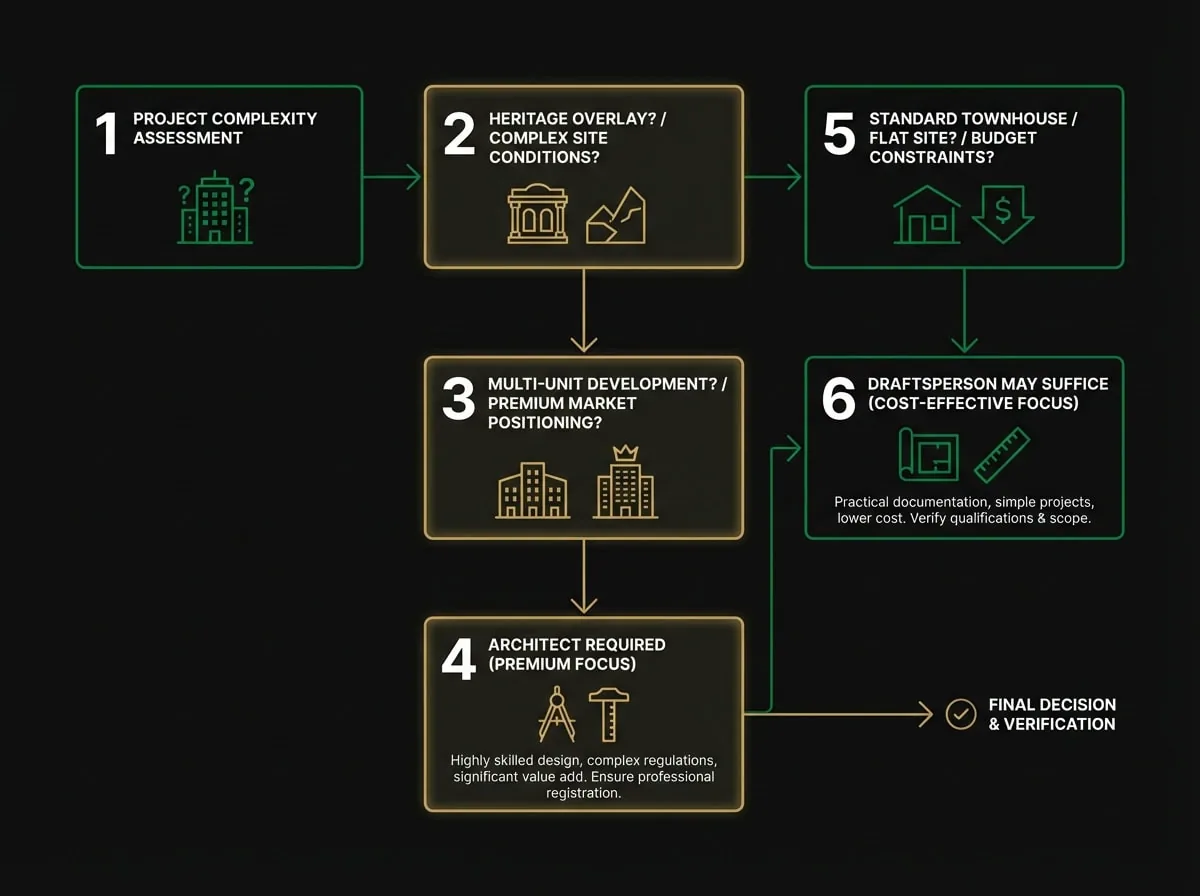
For complex sites, premium market positioning, challenging planning contexts, or projects where design quality significantly impacts sales outcomes, architectural services typically deliver strong return on investment. High planning approval rates and potentially higher sale prices achieved by well-designed developments may justify the additional professional fees in many cases.
For straightforward developments on uncomplicated sites in areas with minimal planning constraints, where you’re targeting price-sensitive market segments, a competent registered draftsperson may provide adequate services at lower cost.
Regardless of which professional you engage, verify their registration status, review examples of previous work similar to your project, speak with past clients about their experience, and ensure they carry appropriate professional indemnity insurance. The quality and experience of the individual practitioner matters more than their professional designation.
Consider requesting initial consultations with both architects and draftspeople to compare their proposed approaches, understand the scope of services each would provide, and evaluate which professional best understands your development objectives. This comparative assessment helps ensure you make an informed decision that optimises both project outcomes and professional fee expenditure.
This article provides general information about engaging design professionals in Victoria. It does not constitute professional advice. Contact SQM Architects for project-specific guidance.
Frequently Asked Questions
Do I need an architect or can a draftsperson handle my Melbourne townhouse development?
For most townhouse developments in Melbourne, a qualified draftsperson can typically prepare planning permit drawings that comply with ResCode requirements. However, if your project involves complex design elements, heritage overlays, or you’re seeking to challenge standard planning controls, an architect may provide additional value. The choice generally depends on your project’s complexity, budget, and whether you’re pursuing a straightforward or more innovative design approach. This is general information only and doesn’t constitute professional advice for your specific circumstances.
What’s the cost difference between hiring a draftsperson versus an architect in Melbourne?
Generally, draftspeople charge lower fees than architects for similar scope projects. Draftsperson fees for a standard dual occupancy or townhouse development in areas like Whitehorse or Boroondara could potentially range from $3,000-$8,000 in some cases, while architect fees for comparable projects might range from $8,000-$20,000 or more, depending on project complexity and service scope. However, costs vary significantly based on project specifics and individual practitioner pricing, so it’s advisable to obtain quotes from multiple professionals for your particular development.
Can a draftsperson represent me at VCAT if my planning permit is refused?
No, draftspeople cannot typically represent clients at VCAT proceedings. If your planning permit application is refused by council and you wish to appeal to VCAT, you would generally need to engage either an architect, town planner, or legal representative with appropriate qualifications. This is an important consideration when choosing your design professional, particularly if your project may face planning challenges or if you’re developing in councils with stricter approval rates across Melbourne.
Are architects required for commercial developments in Victoria?
Victorian law does not require a registered architect for building design, at any height or floor area. The Architects Act 1991 reserves the title “architect” and terms such as “architectural design” — an unregistered person must not use them in relation to building design — but the design work itself may also be carried out by a registered building designer, who is a registered building practitioner under the Building Act 1993. Choosing between the two is a question of capability, complexity and risk, not a legal threshold. What does depend on your building classification and scope is which consultants and certifications your project needs, so it’s worth confirming that early in your planning phase.
How do architects and draftspeople differ in handling ResCode variations?
Both architects and draftspeople can prepare applications seeking variations to ResCode standards, but architects typically bring more extensive training in design justification and presenting alternative solutions. If your development in areas like Manningham or Monash requires variations to standard requirements—such as reduced setbacks, increased site coverage, or modified private open space—an architect may provide stronger design responses and better support documentation. However, experienced draftspeople familiar with local planning schemes can also successfully navigate standard variations in many cases.
Which professional should I choose for a heritage overlay property in Boroondara or Whitehorse?
For properties within heritage overlays in councils like Boroondara or Whitehorse, engaging an architect is generally advisable. Architects typically have more comprehensive training in heritage considerations, design sensitivity, and preparing the detailed heritage impact assessments that council planning officers and heritage advisors expect. Heritage overlay applications often involve more complex design challenges and stricter assessment criteria, where an architect’s qualifications may strengthen your planning permit application. That said, some experienced draftspeople may also have strong heritage project backgrounds worth considering.
Can I start with a draftsperson and switch to an architect later if needed?
While it’s technically possible to engage a draftsperson initially and later bring in an architect, this approach may create inefficiencies and additional costs. If preliminary drawings need significant redesign or the architect identifies planning issues requiring substantial changes, you could face delays and duplicated fees. For straightforward developments in Knox, Maroondah, or Monash that clearly suit a draftsperson’s scope, this may not be a concern. However, for borderline-complex projects, it’s generally more cost-effective to engage the appropriate professional from the outset based on your project’s anticipated challenges.