
Meeting solar and energy compliance for a Melbourne apartment development carries a budget impact that varies by project and council. This guide gives an indicative view of what solar compliance may cost developers. For more detail, see our guide on solar and energy requirements for apartments.
For property developers active across Melbourne, the stakes are particularly high. Councils within the City of Whitehorse, City of Boroondara, Manningham City Council, City of Monash, Knox City Council, and Maroondah City Council each apply the Victoria Planning Provisions (VPP) baseline, but layer on varying Environmentally Sustainable Design (ESD) requirements that can materially affect your compliance budget. Understanding what has changed, who is affected, and what action to take before April 2026 could determine whether your next apartment project captures available rebates or absorbs avoidable costs.
SQM Architects has delivered projects across Melbourne, and across that portfolio, solar compliance costs are increasingly influencing feasibility outcomes. This article outlines the key regulatory changes, indicative cost ranges, and the action items developers may need to prioritise before the current rebate window closes.
What Changed: The Regulatory Shifts Driving Solar Compliance Costs
Amendment VC267 — Effective 31 March 2025
Amendment VC267 introduced two new standards under Clause 55.05 of the VPP that directly affect residential apartment developments up to three storeys. Standard B5-3 (Rooftop Solar Energy Generation Area) now mandates that all new residential developments designate a structurally reinforced solar zone on the roof. This is not optional — failure to demonstrate compliance on submitted plans may trigger a Request for Further Information (RFI) from the Responsible Authority, adding weeks to your planning permit timeline.
Standard B5-2 (Overshadowing of Existing Solar Panels) introduces a new constraint that many developers have not yet factored into feasibility. New developments must not overshadow existing rooftop solar panels on neighbouring properties between 9 am and 4 pm on 22 September. If your proposed building envelope creates shadow over a neighbour’s solar array during this window, you may be required to redesign setbacks or reduce building height — both of which can significantly affect yield calculations.
Clause 58 Requirements for Larger Apartment Buildings
For apartment buildings of seven or more storeys (or any height in Activity Centre or Capital City Zones), Clause 58 continues to apply. Standard D6 (Energy Efficiency) requires buildings to be oriented to make appropriate use of solar energy and achieve adequate thermal efficiency. Standard D25 (Solar Access) requires that at least 70% of dwellings receive a minimum of three hours of direct sunlight between 9 am and 3 pm on 21 June. These requirements have not changed, but the all-electric mandate has increased their practical significance — solar PV is now a necessary offset for the higher peak electrical loads of all-electric buildings.
The All-Electric Mandate
As of 2024–2025, all new planning permit applications for residential developments must be all-electric — no gas connection is permitted. This has a direct bearing on solar compliance budgets. All-electric buildings require high-capacity electrical switchboards, heat-pump hot water systems, and induction cooking infrastructure. Solar PV is no longer an optional sustainability measure; it functions as a necessary load offset. Developers who have not yet updated their standard specification to reflect all-electric design may find their ESD consultants flagging significant gaps during the Sustainable Design Assessment (SDA) or Sustainability Management Plan (SMP) stage.
Who Is Affected: Development Types and Thresholds
The regulatory changes affect different development scales in different ways. Understanding which requirements apply to your project type is the first step in accurate budget planning.
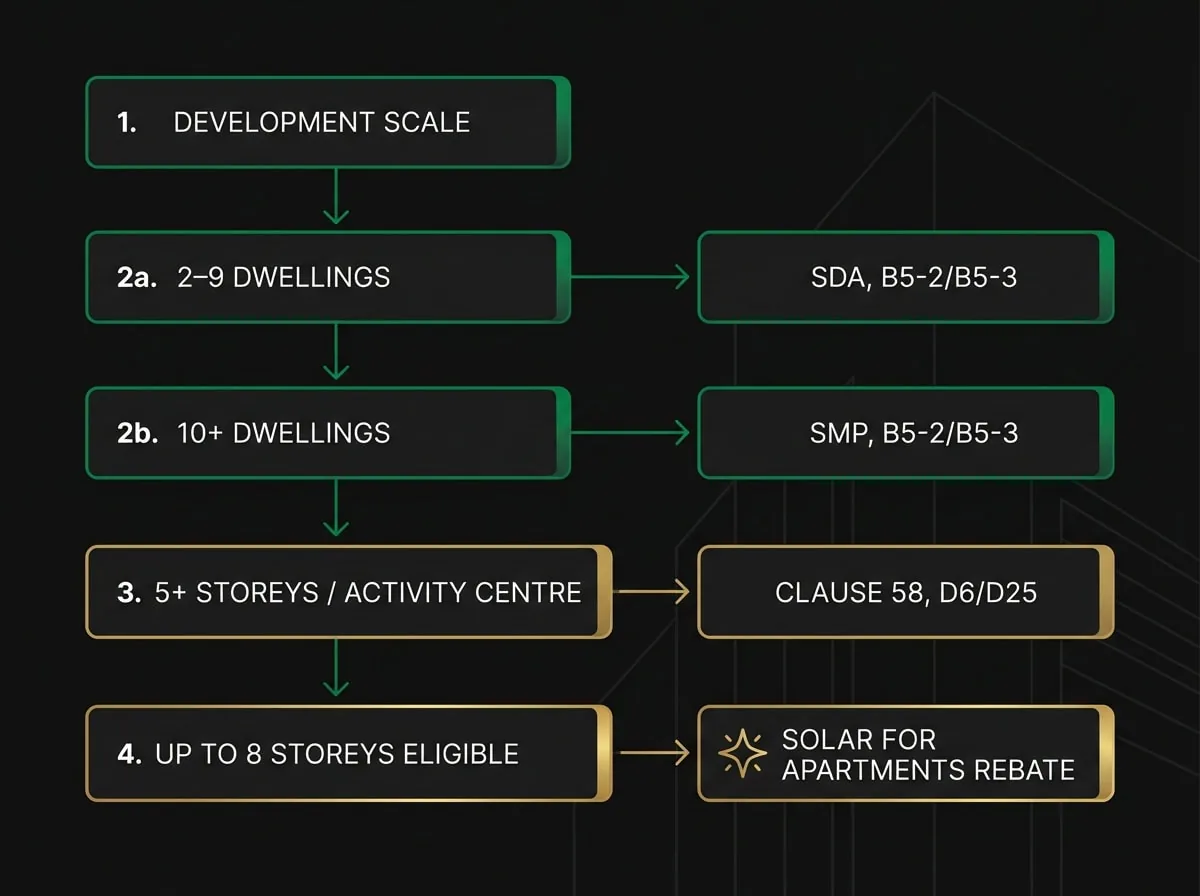
- 2–9 dwellings: A Sustainable Design Assessment (SDA) is required by most Melbourne councils. Amendment VC267 Standards B5-2 and B5-3 apply. Indicative SDA cost: $1,500–$3,500.
- 10+ dwellings: A Sustainability Management Plan (SMP) is required. This is a more detailed document addressing NatHERS ratings, solar PV sizing, battery energy storage system (BESS) feasibility, and ongoing monitoring. Indicative SMP cost: $5,000–$15,000+ depending on complexity.
- 7+ storeys or Activity Centre Zone: Clause 58 applies in full, including Standards D6 and D25. Solar access modelling is required at the design stage, not as an afterthought.
- Buildings up to 8 storeys with median capital improved value at or below $950,000: Potentially eligible for the Solar for Apartments Rebate (Round 3) — up to $2,800 per apartment, capped at $140,000 per building. This rebate window closes 30 April 2026, or when funds are exhausted.
Developers pursuing projects under the Planning Amendment (Better Decisions Made Faster) Bill 2025 framework should note that Type 2 and Type 3 classifications both require ESD compliance documentation — see also our guide to deemed refusal provisions for how assessment pathways interact with compliance obligations. Categorising your project correctly from the outset — and ensuring solar compliance is addressed in the initial application — may help avoid RFIs that reset the statutory clock. Developers working on townhouse and low-rise projects should also review the Townhouse and Low-Rise Code for applicable ESD thresholds.
Indicative Solar Compliance Costs: Budget Planning Benchmarks
The following cost ranges are indicative only and will vary based on building size, roof configuration, structural capacity, and council-specific ESD requirements. Developers should obtain project-specific quotes from qualified consultants and solar retailers during feasibility.
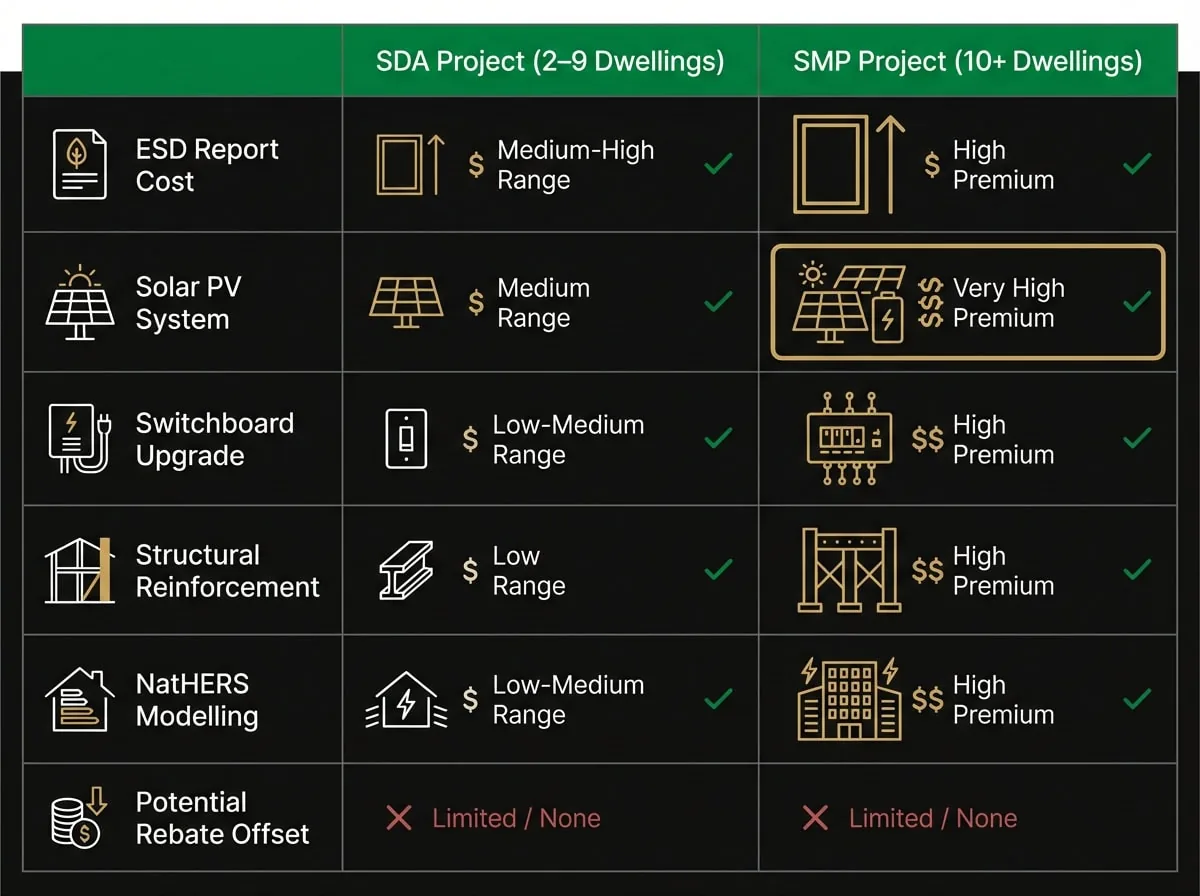
Solar PV Installation
- System cost: Approximately $1,000–$1,400 per kW (pre-rebate)
- Typical 10kW common area system: $9,000–$13,000 before rebates and Small-scale Technology Certificates (STCs)
- Solar for Apartments Rebate (Round 3): Up to $2,800 per apartment, maximum $140,000 per building — available until 30 April 2026
- Switchboard upgrade (if required): Variable — obtain an electrician’s assessment early in the design phase to avoid late-stage cost surprises
ESD Reporting and Compliance Documentation
- SDA (2–9 dwellings): $1,500–$3,500
- SMP (10+ dwellings): $5,000–$15,000+
- Solar Context Report (overshadowing assessment): Recommended at feasibility stage; cost varies by consultant
- NatHERS thermal modelling: Often bundled with SMP; confirm scope with your ESD consultant
Design-Stage Costs to Anticipate
- Structural reinforcement for solar zones (Standard B5-3): Budget for this in your structural engineer’s scope from the outset
- Roof form redesign (if overshadowing triggers Standard B5-2 non-compliance): Potentially significant — conduct a Solar Context Report before lodging your planning permit application
- Heat-pump hot water systems (all-electric mandate): Higher capital cost than gas alternatives; factor into your standard specification
Get the 7-point site check to run before committing to a permit application — zoning, overlays, setbacks and council red flags, in plain English. Free PDF, instant download.
- Zone, overlay & setback checks
- What council assesses first
- Permit-readiness red flags
Something went wrong. Please try again.
No spam. Unsubscribe anytime.
Check your inbox — your checklist is on its way.
Council Variations Across Melbourne
While the VPP provides the baseline, councils across Melbourne apply varying ESD overlay requirements and local policies. Developers should confirm current requirements directly with the relevant Responsible Authority or engage an architect familiar with the applicable planning scheme before finalising feasibility assumptions.
The City of Whitehorse and City of Boroondara both require ESD assessments aligned with the VPP baseline, with Boroondara applying particular scrutiny to solar access and overshadowing in established residential neighbourhoods where heritage overlays are common. Manningham City Council and Maroondah City Council apply standard VPP ESD requirements, though both councils have been active in requesting detailed SMP documentation for medium-density projects. The City of Monash and Knox City Council similarly follow the VPP baseline, with Monash increasingly active in the Activity Centres Programme — developments in nominated activity centres may face elevated ESD expectations as the programme expands to additional locations in 2025–2026.
It is worth noting that some inner-Melbourne councils have introduced requirements that exceed the VPP baseline — for example, mandatory Green Factor Scores and minimum solar PV per dwelling thresholds. While these do not directly apply to Melbourne councils at present, they signal the direction of travel for ESD policy across metropolitan Melbourne. Developers with projects in the pipeline beyond 2026 may wish to design to a higher ESD standard now to future-proof their assets.
Timeline: Key Dates and Action Windows
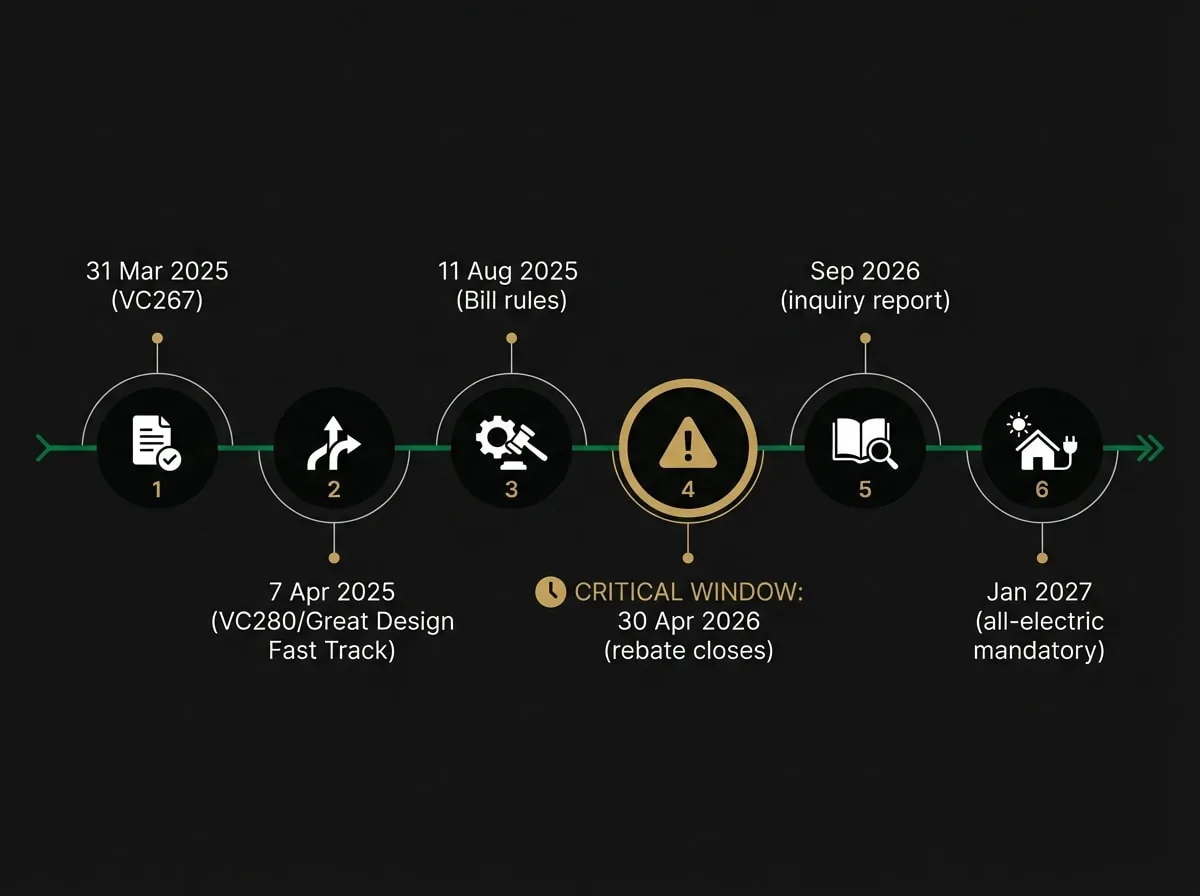
- 31 March 2025: Amendment VC267 took effect — Standards B5-2 and B5-3 now apply to all new residential planning permit applications
- 7 April 2025: Amendment VC280 gazetted — Clause 53.25 Great Design Fast Track introduced for well-designed apartment and townhouse developments of 8+ homes between two and eight storeys
- 11 August 2025: Updated residential planning rules for single homes and small second homes took effect under the Planning Amendment (Better Decisions Made Faster) Bill 2025 framework
- 30 April 2026: Solar for Apartments Rebate (Round 3) closes — up to $2,800 per apartment, $140,000 per building. Funds may be exhausted before this date
- January 2027: Victoria’s all-electric mandate for new homes and most new commercial buildings becomes mandatory under state policy
- End of September 2026: Victorian Legislative Assembly Environment and Planning Committee expected to report on renewable energy access for apartment dwellers — further regulatory changes may follow
What Developers Should Do Now
The convergence of these regulatory changes creates both compliance obligations and financial opportunities. Developers who act before 30 April 2026 may be able to capture Solar for Apartments rebates that could materially reduce installation costs. Those who delay risk absorbing full installation costs and facing planning permit delays caused by incomplete ESD documentation.
- Conduct a Solar Context Report at feasibility: Before lodging a planning permit application, assess whether your proposed building envelope will overshadow neighbouring solar panels under Standard B5-2. A redesign at feasibility is typically far less costly than one triggered by an RFI or VCAT appeal.
- Engage an ESD consultant early: Confirm whether your project requires an SDA or SMP, and ensure solar PV sizing, NatHERS ratings, and Standard B5-3 compliance are addressed in the initial design — not retrofitted after permit lodgement.
- Assess Solar for Apartments rebate eligibility: If your building is up to 8 storeys with a median capital improved value at or below $950,000, engage a Solar Victoria authorised retailer to assess eligibility before the April 2026 window closes.
- Update your standard specification for all-electric design: Ensure heat-pump hot water systems, induction cooking, high-capacity switchboards, and solar-ready roof structures are included in your standard builder’s specification.
- Categorise your project under the 2025 Bill framework: If your design meets Type 2 criteria, you may be able to reduce the risk of third-party VCAT appeals that previously added significant time to project timelines.
- Obtain switchboard upgrade quotes early: Switchboard upgrades for all-electric, solar-ready buildings can be a significant and often underestimated cost. Commission an electrician’s assessment during the design phase.
Frequently Asked Questions
Does Standard B5-3 apply to my apartment development if it is more than three storeys?
Standard B5-3 under Clause 55.05 applies to residential developments up to three storeys. For buildings of four to six storeys, Clause 57 applies. For buildings of seven or more storeys (or any height in Activity Centre or Capital City Zones), Clause 58 applies instead, with solar access addressed under Standards D6 and D25. Your architect or ESD consultant can confirm which clause applies to your specific project based on its height and zone.
Can a property developer access the Solar for Apartments Rebate (Round 3)?
The Solar for Apartments Rebate (Round 3) is not available to property developers or community housing organisations — the building must be a completed development at the time of application and must be under the control of an Owners Corporation. Developers may wish to factor this into their marketing strategy, as eligible purchasers or the Owners Corporation established post-settlement could potentially access the rebate before 30 April 2026.
What happens if my proposed building overshadows a neighbour’s existing solar panels?
Under Standard B5-2 (effective 31 March 2025), new developments must not overshadow existing rooftop solar panels on neighbouring properties between 9 am and 4 pm on 22 September. If your building envelope creates non-compliant overshadowing, the Responsible Authority may require you to redesign setbacks or reduce building height, which could affect your development yield. Conducting a Solar Context Report at feasibility stage may help identify and address this risk before lodging a planning permit application.
How does the all-electric mandate affect my solar compliance budget?
The all-electric mandate means new residential planning permit applications cannot include gas connections. All-electric buildings have higher peak electrical loads, which increases the practical and financial case for on-site solar PV. Developers may need to budget for high-capacity switchboards, heat-pump hot water systems, and solar PV systems sized to offset all-electric loads — costs that were previously optional or shared with gas-based systems.
Will the Planning Amendment (Better Decisions Made Faster) Bill 2025 reduce my ESD compliance obligations?
The Bill streamlines planning permit assessment timelines and restricts third-party VCAT appeal rights, but it does not reduce ESD compliance obligations. Solar compliance requirements under the VPP — including Standards B5-2, B5-3, D6, and D25 — continue to apply regardless of which assessment pathway your project follows. Ensuring ESD documentation is complete at lodgement may help your application avoid RFIs that reset the statutory clock.
Do Melbourne councils have ESD requirements beyond the VPP baseline?
Most Melbourne councils — including the City of Whitehorse, City of Boroondara, Manningham City Council, City of Monash, Knox City Council, and Maroondah City Council — apply ESD requirements broadly consistent with the VPP baseline, though individual councils may request more detailed documentation for medium and large-scale projects. Developers should confirm current local policy requirements with the relevant Responsible Authority or engage an architect with direct experience in the applicable planning scheme before finalising feasibility assumptions.
What is the indicative cost of a Sustainability Management Plan for a 20-dwelling apartment project?
For a development of 10 or more dwellings, an SMP is typically required by most Melbourne councils. Indicative costs range from $5,000 to $15,000 or more, depending on the complexity of the project, the scope of NatHERS modelling required, and whether BESS feasibility is included. Developers should obtain project-specific quotes from qualified ESD consultants during the feasibility stage rather than relying on indicative ranges alone.
Conclusion
Solar compliance costs for Melbourne apartment developments have moved well beyond a line item that can be estimated at the back of a feasibility spreadsheet. The combination of Amendment VC267, the all-electric mandate, Clause 58 solar access requirements, and council-specific ESD policies means that solar design decisions made — or deferred — at the feasibility stage could influence planning permit timelines, construction costs, and development outcomes. With the Solar for Apartments Rebate (Round 3) closing on 30 April 2026 and further regulatory changes anticipated following the Legislative Assembly inquiry reporting in September 2026, the window for proactive action is narrowing.
SQM Architects has supported developers across Melbourne for over 12 years. If you are planning an apartment development and want to understand how current solar compliance requirements may affect your project’s feasibility and design, contact SQM Architects for a complimentary site assessment.
Book a Strategy Call — or call us directly on (03) 9005 6588.
This article provides general information about Victorian planning for property developers. It does not constitute professional advice. For project-specific guidance, contact SQM Architects.